

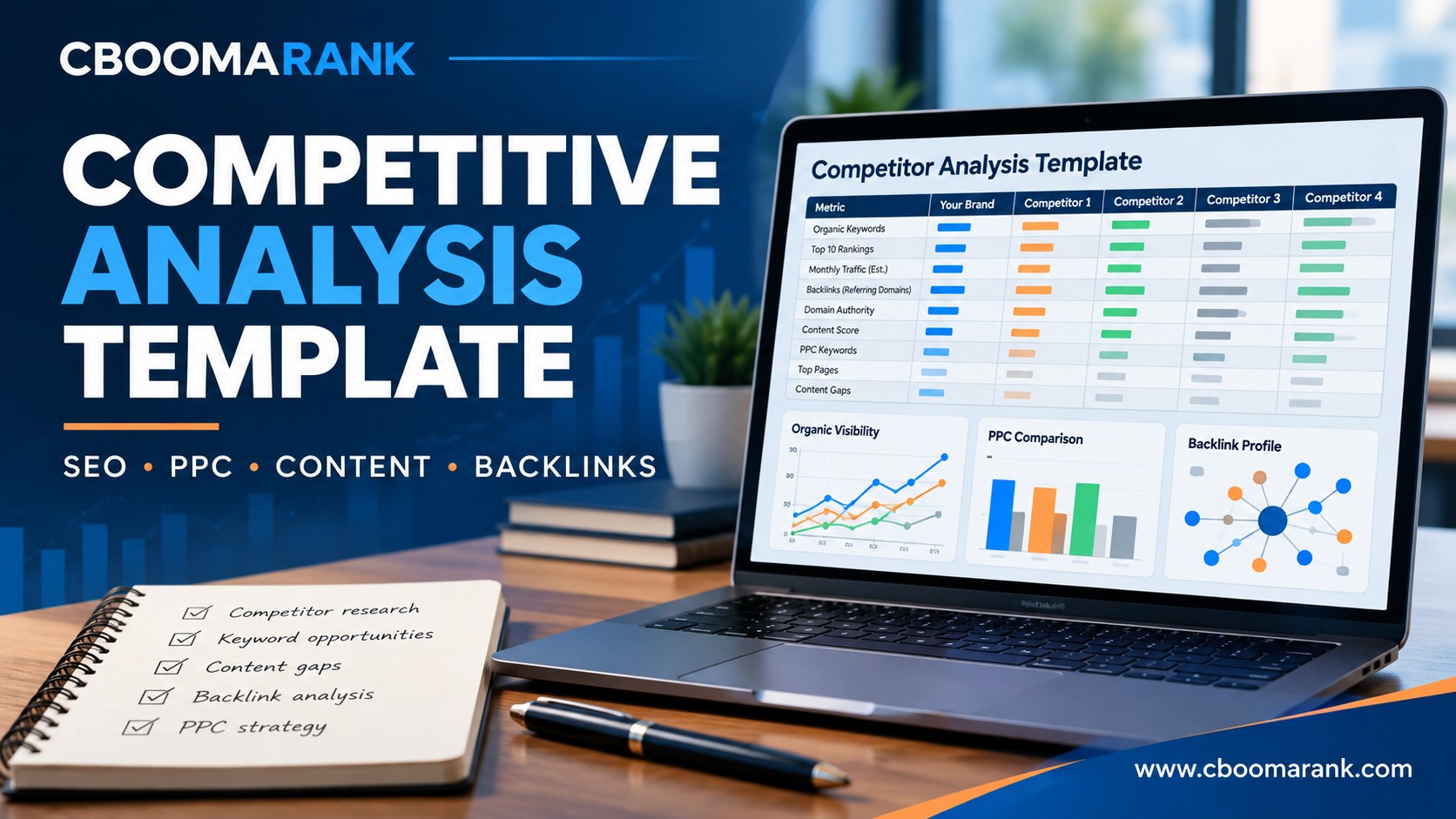
A competitor analysis template turns scattered research into decisions. Instead of collecting rival URLs in one document, search terms in another and campaign ideas in a third, a structured worksheet puts the evidence, priorities, people and next steps in one place. This free CBOOMARANK Excel workbook helps website owners, SEO teams, publishers and digital marketers compare competitors without pretending that estimates are verified facts.
The competitor analysis template includes a competitive scorecard, a keyword comparison sheet, a content gap matrix, backlink prospects, PPC and landing-page observations, and a 90-day action plan. You can adapt it for one website or several client projects. The article below explains what to collect, how to interpret it and when to update an existing page rather than publishing another one.
Quick answer: Select three to five relevant competitors. Compare six consistent dimensions, capture source URLs and observation dates, prioritize opportunities by impact, confidence and effort, and assign an owner to each action. Revisit the worksheet monthly as search results, ads and customer expectations change.
Download the Free Competitor Analysis Template (Excel)
In practice, the spreadsheet is designed for practical research, not for presenting invented traffic figures as evidence. Every performance field starts blank. Add your data from platforms you trust, record the date of the observation, and separate measured results from third-party estimates.
Download the free competitor analysis workbook (.xlsx)
Inside the workbook you will find seven coordinated sheets:
- Start Here: a seven-step operating procedure and evidence rules.
- Competitor Scorecard: comparison of your website with up to three rivals across six dimensions, including computed totals.
- Keyword Comparison: search queries, intent, positions, source-backed demand and prioritized opportunities.
- Content Gaps: audience needs, competing pages, source links and a simple impact-confidence-effort score.
- Backlink Prospects: relevant publications, observed competitor links, outreach rationale and contact status.
- PPC & Offers: ad messages, landing pages, geographic market, visible offers and observation dates.
- 90-Day Action Plan: accountable tasks, due dates, priority calculations and measurable outcomes.
However, the calculated priority cells are planning aids, not predictions. A high number should trigger closer review of relevance and feasibility; it does not guarantee traffic, rankings or sales. CBOOMARANK’s competitor analysis guide offers a broader strategy explanation if your team is new to competitor research.
What Is a Competitor Analysis Template?
A competitor analysis template is a repeatable worksheet for comparing businesses or websites that compete for customers, search visibility, links, attention or paid advertising placements. It creates a consistent place to capture claims and the evidence behind them. It should also identify what will change as a result of the analysis.
Competitive analysis versus competitor analysis
In practice, the phrases are often used interchangeably. In this guide, competitive analysis describes the strategic assessment, while competitor analysis refers to researching specific rival businesses, search competitors and pages. The template works for both. What matters is matching the analysis to the user’s task rather than arguing over terminology.
Why a template beats a list of rival websites
However, a list of domains does not explain why a competitor ranks, attracts relevant visitors or converts more effectively. It also makes repeat audits difficult. A structured template records the market, source, time, interpretation and proposed action, which helps another team member reproduce the research next month.
Who should use this competitor analysis template?
For example, small businesses can compare local search rivals and services. Ecommerce managers can evaluate category pages and transactional queries. Agencies can make research reproducible across client accounts. B2B teams can document competitor offers and buyer questions. Publishers can compare content structure, freshness and relevant linking sources without copying competitors’ material.
Step 1: How to Use the Competitor Analysis Template: Choose Competitors
Before entering anything into Excel, decide what kind of competitor matters to the current campaign. A competitor for organic search might not compete directly for paying customers. For example, a trade publication may rank for a high-value query even though it does not sell the same software as your company.
Record direct, indirect and search competitors separately
For example, direct competitors offer similar products to the same audience. Indirect competitors solve a related problem or compete for the same budget. Search competitors appear for relevant target queries, and can include forums, publishers, marketplaces, tools, directories and educational websites. Record the type of competitor in a note alongside the domain.
Keep the comparison set manageable
Start with three to five competitors for a specific business objective. More domains can be useful later, but adding 30 rivals often increases administrative work without improving decisions. Select representative competitors, then add a specialist rival only when the research reveals a distinct gap.
Match country, language and device
However, search rankings, paid ads and offers vary by geography and device. A result observed on mobile in Canada may differ from a desktop result in Germany. Record the country, language, device and evaluation date. Do not assume one market’s findings apply automatically to the United States, United Kingdom, France, India or other target regions.
To discover organic competitors, start with the keyword and search-intent workflows explained in Website Competitor Analysis and the best competitor analysis tools guide.
Step 2: Competitor Analysis Template for SEO and PPC: Build Your Scorecard
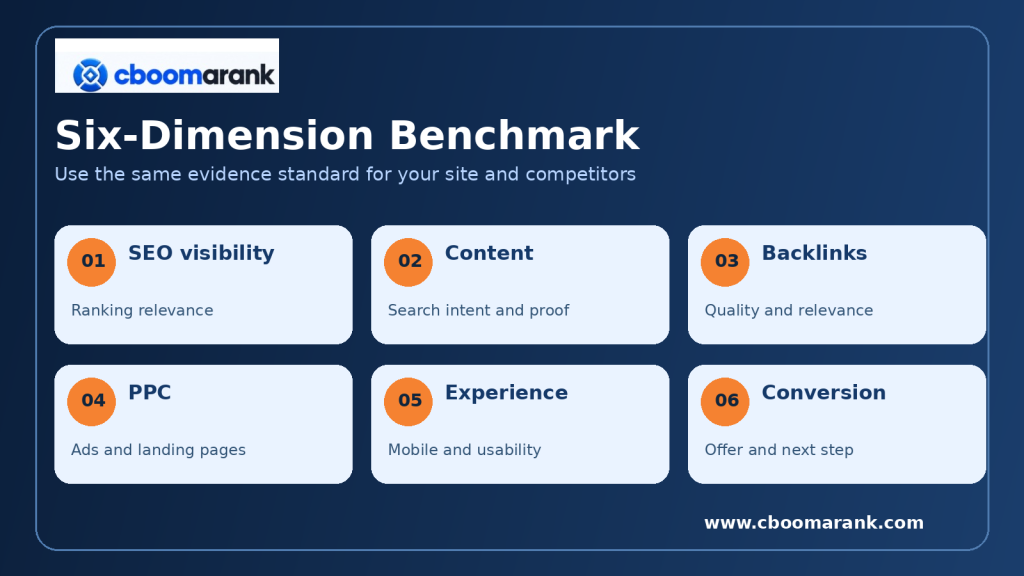
Next, the scorecard offers a quick common framework without pretending that unlike metrics are directly interchangeable. Use six dimensions: organic relevance, content usefulness, backlink evidence, paid-search messaging, site experience, and conversion clarity. Give each dimension a score from zero to five, then retain a short explanation and a source.
Dimension 1: Organic search relevance
First, review whether the competitor has pages that align with the queries and search intent your ideal customer uses. Consider the type and quality of ranking pages, not simply a headline count of keywords. A page with modest estimated traffic may still be highly valuable if it targets a buyer-ready topic.
Dimension 2: Content usefulness
Next, open the actual page. Does it answer the user’s question early? Does it include specific examples, clear comparisons, recent evidence and a practical next step? Use the competitor content gap analysis guide for a deeper five-dimension page evaluation rather than relying on word count.
Dimension 3: Backlinks and digital PR
Then, look for contextually relevant linking sites, linkable resources and the editorial reasons that a source might reference the competitor. Avoid assuming every competitor backlink is worth copying. A link from a low-quality or unrelated website may add little practical value and could create risk.
Dimension 4: Paid-search messaging
Where ads are visible, record the search query, geographic market, headline theme, landing-page promise and call to action. Competitor ads are snapshots, not proof of advertising budgets or returns. Keep observed claims separate from guesses about conversion performance.
Dimension 5: Website experience
Next, evaluate mobile usability, page navigation, accessibility, clarity and friction in forms or checkout. Performance diagnostics can support the evaluation, but an automated speed score alone does not describe the entire user experience. Technical SEO tools and a structured SEO audit report can help explain technical constraints.
Dimension 6: Conversion path and offer
Finally, check whether the page offers an appropriate next action: comparison, quote, consultation, trial, signup, purchase or another clear step. A competitor can have attractive content yet a confusing path to purchase. Capture the visible offer and the evidence supporting your interpretation.
Sample scorecard — illustrative, not measured competitor data
| Dimension | Your website | Rival A | Evidence to collect |
|---|---|---|---|
| Organic relevance | Score 0–5 | Score 0–5 | Target queries, ranking pages, intent |
| Content usefulness | Score 0–5 | Score 0–5 | Examples, sources, task completion |
| Backlink strength | Score 0–5 | Score 0–5 | Relevant referring sites, link context |
| PPC messaging | Score 0–5 | Score 0–5 | Observed ad and landing page |
| User experience | Score 0–5 | Score 0–5 | Mobile path, clarity, diagnostics |
| Conversion clarity | Score 0–5 | Score 0–5 | CTA, form, pricing/offer visibility |
These are blank inputs, not competitor measurements. The workbook calculates totals after you supply the scores. Compare trends and evidence within a consistent process; do not publish totals as third-party performance benchmarks.
Step 3: Fill in the SEO Keyword Comparison Sheet
The competitor analysis template keyword worksheet helps you choose relevant searches that deserve an action, not to celebrate the largest export. Start with your own important topics and add the competitors who consistently appear for those searches. Organize each keyword by intent, current ranking, competing page and commercial relevance.
Separate missing keywords from weak existing pages
For example, a missing keyword can signal a new topic, but it might also belong on a page you already own. A weak ranking may be better addressed by refreshing an existing URL, improving internal links or aligning the page with search intent. The keyword gap analysis guide explains how to distinguish those cases, while keyword cannibalization is a reminder not to create competing pages unnecessarily.
Keep your ranking data traceable
Next, record the observed positions, the source, the date and the market. Keyword positions fluctuate, and third-party search-volume estimates differ. Note which dataset you used. When available, your own Google Search Console performance report provides first-party clicks, impressions and average position for your verified property.
Score value before volume
However, high search volume is not automatically high business value. An informational query with little connection to your service may deserve less effort than a smaller commercial query that answers an urgent buyer question. Use the workbook’s relevance, impact and effort inputs to rank follow-up tasks, then inspect the top results manually before deciding what to publish.
Keyword worksheet example
| Search theme | Likely intent | Content decision | Next step |
|---|---|---|---|
| Competitor comparison template | Practical/commercial | Distinct asset-led article | Offer a usable worksheet |
| Best tool for keyword research | Commercial | Comparison page | Assess existing tool coverage |
| How to analyze rival backlinks | Educational/commercial | Supporting guide | Link to actionable backlink research |
| Generic marketing definition | Informational | Only if audience fit is strong | Deprioritize until relevance is established |
Importantly, these example decisions illustrate classification. They do not describe measured rankings for CBOOMARANK or any named rival.
Step 4: Use Your Competitor Analysis Template for Content Gaps Without Copying
For each important competitor page, note the target audience, search intent, useful sections, source quality, format and unanswered questions. The goal is to identify a better solution for your readers, not to reproduce someone else’s copy, headings, copyrighted image or proprietary research.
Content gap types to record
Next, use consistent labels: missing topic, weak supporting evidence, outdated information, wrong page format, intent mismatch, confusing conversion path or irrelevant gap. An apparent opportunity should become a content task only when it matches real audience needs.
Map every gap to an existing URL first
Then, enter your closest matching page in the worksheet. If the page already serves the same search intent, improving it in place is usually preferable to creating a near-duplicate. If the gap represents a genuinely different task, a new article or tool page may be justified. CBOOMARANK’s content decay guide offers a framework for refresh decisions.
Include proof in the notes column
For example, a clear note might say that a competitor shows dated product screenshots while your page has no current screenshot, or that your content omits an important buying question found in several reliable sources. That is more useful than merely writing “competitor content better.” Retain specific URL evidence and revisit the observation after publication.
Step 5: Evaluate Backlink Prospects and Referral Opportunities
In addition, the workbook’s backlink sheet is a prospect list, not an automated promise of links. Investigate where competitors receive relevant editorial mentions, which assets attracted those links and whether your team has genuinely useful material to contribute.
Qualify before outreach
For example, a suitable prospect should serve a real audience related to your topic. Review its editorial quality, publication policy, link placement, relevance, traffic context and potential conflicts of interest. Avoid treating irrelevant directory links or mass guest-post placements as a strategy. For deeper guidance, see Competitor Backlink Analysis.
Offer something worth referencing
For instance, original benchmarks, a practical template, tested methodology, case studies, helpful visual explanations or expert contributions can be legitimate reference assets. A generic request to “add my link” without audience value is unlikely to create a sustainable partnership.
Measure referral quality
A linking page that sends a small number of engaged and qualified visitors may be more valuable than a large but unrelated referral source. Track relevant visits, assisted conversions and the quality of relationships developed through outreach.
Step 6: Use Your Competitor Analysis Template to Compare PPC Ads and Offers
Similarly, paid-search competitor research should begin with visible and sourceable observations. Look at the message a competitor uses for a query, the landing page it leads to and the customer problem it claims to solve. Record the date, market and device. A visible ad does not establish the rival’s budget, return on ad spend or sales results.
Capture the promise and the proof
Does the landing page offer a free check, a comparison, a consultation, a trial or a price? Does the offer match the search query? Are claims supported with clear evidence? Record the exact page link and summarize the observation in your own words.
Compare the complete path
Then, trace the ad theme through headline, product explanation, supporting proof, signup path and thank-you experience where you can do so legitimately. A campaign with a compelling ad and a confusing form may still create avoidable friction. You can connect the review to CBOOMARANK’s high-converting Google Search Ads guide.
Keep privacy and access boundaries clear
Importantly, use information that is public or that you are authorized to access. Do not scrape private dashboards, bypass paywalls or login restrictions, or infer confidential advertising economics from a simple screenshot. The goal is to understand market positioning and improve your own campaigns responsibly.
How to Prioritize Opportunities in the Competitor Analysis Template
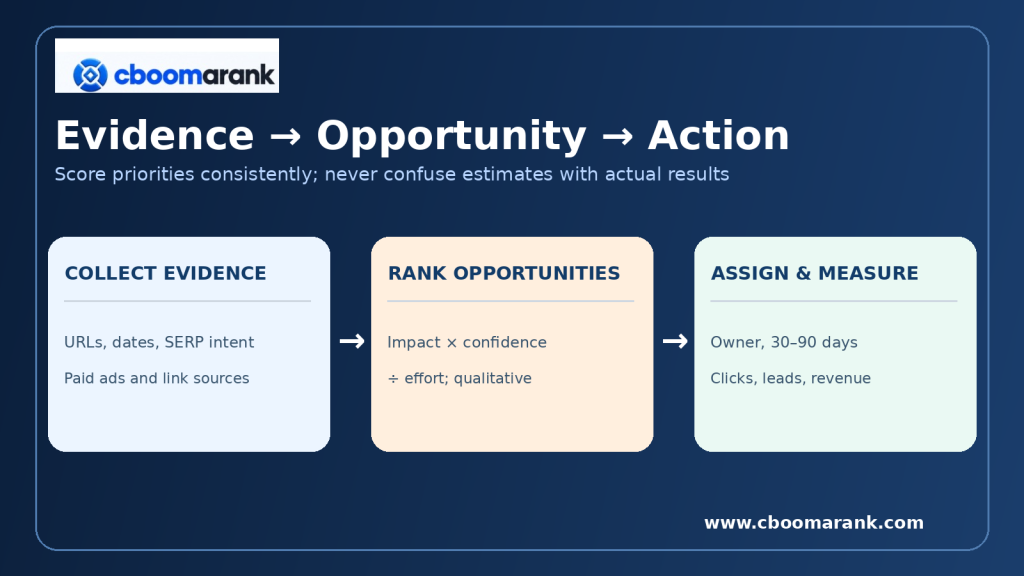
However, a large research workbook is useful only if it results in a manageable plan. The included sheets score opportunities with a simple heuristic: priority = impact × confidence ÷ effort. Each input uses a one-to-five scale, and the workbook calculates a result once all three fields are present.
Impact: what can improve for the audience or business?
First, impact is the estimated value of solving a real problem. It may involve improving a high-intent landing page, fixing an important content gap, making mobile forms usable or strengthening an authoritative resource. Avoid assigning the highest impact simply because a competitor is popular.
Confidence: how strong is your evidence?
Next, confidence should rise when the opportunity is supported by first-party performance data, clear SERP intent, current relevant examples or repeated user questions. It should fall when the idea relies on vague assumptions or incompatible third-party estimates.
Effort: what will it take to execute well?
Finally, consider research time, expert review, design, technical implementation, approvals and measurement. A large project may still be worth doing, but dividing it into milestones makes results easier to assess and prevents an unmanageable backlog.
Prioritization example
For example, a content refresh with high impact, good evidence and modest effort may outrank a complete site redesign with uncertain benefit. This is a decision aid, not a mathematical prediction. Review the highest-ranked actions with someone who understands the audience and technical dependencies.
Turn Your Competitor Analysis Template into a 90-Day Growth Plan
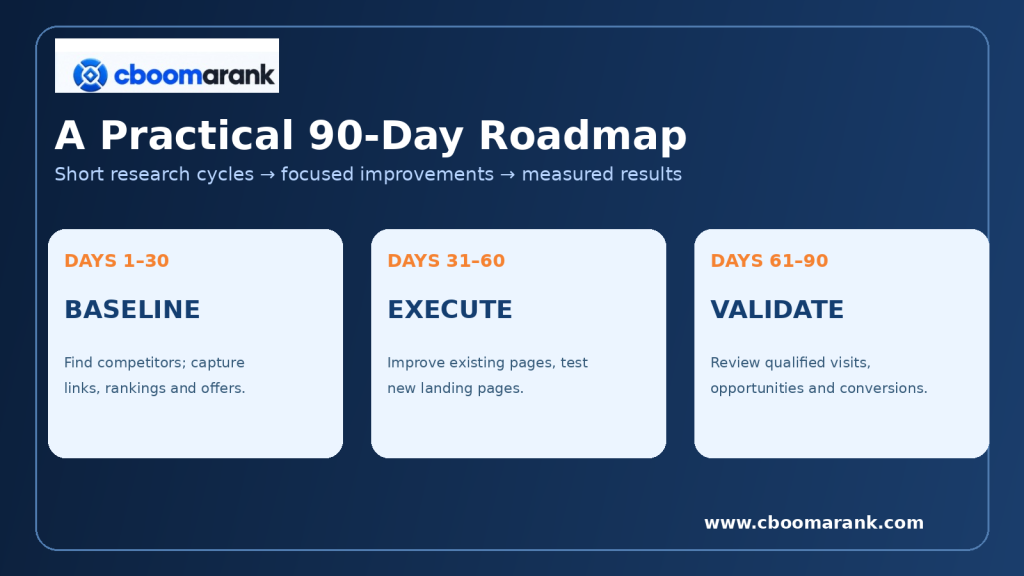
Days 1–30: Baseline and research
Start your competitor analysis template by defining the audience, business objective and geographic markets. List direct and search competitors. Fill the scorecard, record your important keywords and evaluate the pages already serving those topics. Document relevant competitor ads, offers and referring sources. Set baseline measurements for qualified traffic, enquiries and conversions where available.
Days 31–60: Implement focused improvements
Next, choose three to five research-backed tasks. Refresh the most relevant existing page, improve one conversion path, strengthen internal links, update outdated evidence, or create a truly distinct asset such as this editable template. Give each action an owner, an expected outcome and a reasonable review date.
Days 61–90: Measure, learn and refine
Finally, revisit Search Console, website analytics and conversion records. Compare results against the baseline while considering seasonality and other changes. Keep improvements that help actual visitors, revise assumptions that failed, and archive low-value ideas. Update the worksheet to make the next cycle faster and more reliable.
Competitive Analysis Template for Agencies, Publishers and Small Businesses
Agencies: show evidence and ownership
Client stakeholders need to understand why each recommendation matters. Share the scorecard with its evidence notes, label estimated data, and put deadlines and owners in the action sheet. A concise transparent worksheet can create more confidence than an oversized presentation with unsupported claims.
Publishers: focus on page usefulness and topical fit
However, publishing more posts is not always the best answer. Evaluate search intent, source quality, freshness, media and internal linking. A publisher may gain more by updating a useful established guide than by producing several near-identical posts on competitor research.
Small businesses: start with three high-value decisions
For example, if time is limited, choose the most important service query, your most commercially important page and one conversion bottleneck. Compare three relevant rivals, record the evidence and act on the single clearest opportunity. Expand the analysis only when the process produces measurable value.
Multilingual and international teams: localize observations
The United States, United Kingdom, Canada, India, France and Germany can have different SERP features, user phrasing, pricing expectations and legal considerations. Preserve source-country labels and write locally useful findings rather than translating one country’s competitor worksheet word for word.
Common Mistakes When Using Competitor Analysis Templates
Treating estimated traffic as confirmed revenue
However, an external traffic estimate is not a competitor’s analytics record. Label it as an estimate and avoid turning uncertain numbers into definitive sales claims. Where possible, use verified first-party figures for your own site.
Comparing rivals that serve different intents
For example, a software documentation page, a marketplace listing and a thought-leadership article may target different search tasks. Put each page into its correct intent category instead of comparing everything on one traffic metric.
Publishing a page for every keyword gap
Likewise, search terms can overlap heavily. Map them to intents and existing URLs first. Updating one authoritative page can help avoid unnecessary keyword cannibalization.
Copying competitor wording or design
Therefore, competitive intelligence should inform your differentiated solution, not duplicate protected creative work. Produce original examples, diagrams, commentary and templates that stand on their own.
Ignoring a measurable outcome
Ultimately, a template full of scores with no actions, owners or review dates is administrative overhead. Always connect an observation to a hypothesis, next step and outcome measure.
Trusted Data Sources for Your Competitive Analysis Workbook
Google Search Console
Use Google Search Console to examine queries, pages, clicks, impressions and search performance for properties you control. It does not reveal a competitor’s private Search Console account.
Google Search Central
In addition, consult Google Search Central’s SEO Starter Guide for people-first site practices and foundational technical guidance. These documents explain principles, not a direct ranking formula.
Google Ads Transparency Center
Similarly, use Google’s Ads Transparency Center to examine eligible publicly visible ad examples and their available metadata. Coverage and details vary, so record what you actually see.
CBOOMARANK competitor research
Use CBOOMARANK to explore website analysis, competitor research and SEO workflows, and consider the plans and available tools that fit your project. Feature availability depends on the selected plan and current product capabilities.
Frequently Asked Questions About Competitor Analysis Templates
Is the CBOOMARANK competitor analysis template free?
Yes. The attached Excel workbook is a free editorial planning resource. It does not include paid data subscriptions or automatically retrieve third-party metrics. Enter the evidence and measurements you have permission to use.
Can I use this template for SEO and PPC at the same time?
Yes. The workbook has separate keyword, content, backlink and PPC sheets, along with a common scorecard and action plan. Keep channel-specific measurements distinct and prioritize the shared customer problems they reveal.
How many competitors should I analyze?
Three to five is a useful starting point for many teams. Add more only when they represent a materially different search audience, business model, region or marketing strategy.
How often should I refresh competitor analysis?
Monthly reviews work for many ongoing campaigns, with faster reviews around major launches, migrations or market changes. Record each observation date so that old ad, pricing and ranking snapshots are not treated as permanent facts.
Does a high competitor score guarantee higher Google rankings?
No. The scorecard is a qualitative planning tool. Rankings depend on many factors, and the weights in this worksheet are not a search engine algorithm. Use it to structure evidence, not to claim rankings can be predicted from a spreadsheet.
Can I use this for a client or agency report?
Yes. Customize the workbook, document data sources and make clear which numbers are measured, estimated or illustrative. Use the action plan to assign responsibility and report meaningful outcomes to the client.
Should I create a new page for every competitor gap?
No. Compare search intent with the pages you already own. Improve an established URL when appropriate and create a new page only for a genuinely distinct task that existing content cannot satisfy.
Turn Competitive Research Into Measurable Growth
Ultimately, competitor analysis is most valuable when it identifies practical improvements for real users: a clearer product explanation, a more useful comparison, stronger evidence, better internal links, more relevant referral partnerships or a simpler conversion path. A consistent template keeps the work evidence-based and makes it easier to review progress after 30, 60 and 90 days.
Download the CBOOMARANK competitor analysis workbook, enter verified observations, and choose your next three actions. For a connected website and competitor-research workflow, explore CBOOMARANK’s platform and pricing, or start at www.cboomarank.com.
Continue reading: Competitor Analysis · Content Gap Analysis · Competitor Backlink Analysis.
