

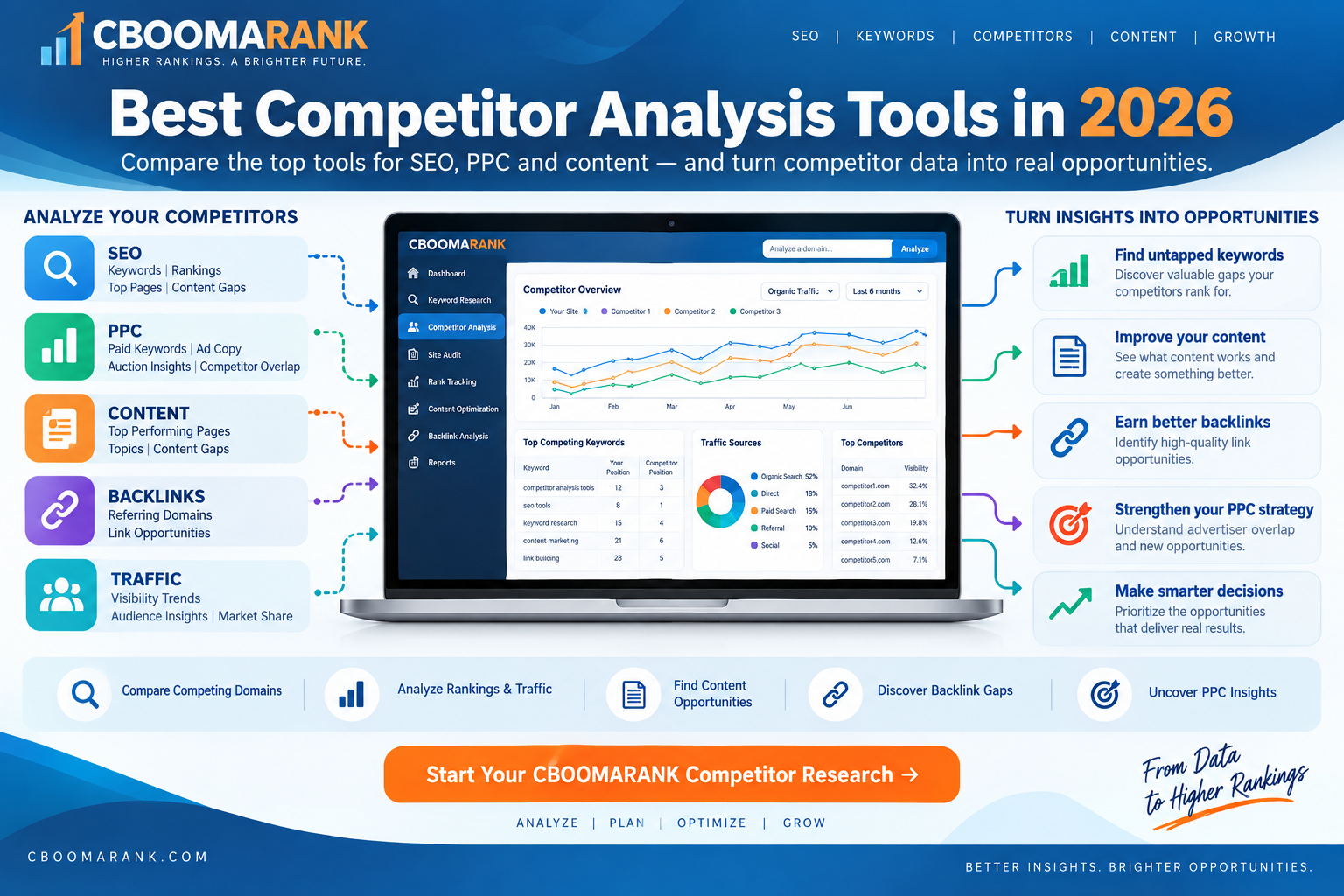
Competitor analysis tools help marketers understand where rival websites are gaining visibility, which keywords and pages attract demand, where backlinks are being earned, how paid-search competitors appear in the auction, and which content opportunities may be worth pursuing. The useful part is not simply collecting more competitor data. It is turning that data into decisions that improve search visibility, paid acquisition and content performance.
In 2026, competitor research is increasingly cross-channel. An SEO team may need organic keyword and backlink intelligence, while a PPC team needs paid-keyword and auction data. Content teams care about topics, ranking pages and audience demand. Agencies may need all of those signals together. That is why selecting the right platform requires looking beyond a single headline metric.
A strong workflow also connects competitor findings with your own site. For example, competitor keyword discoveries are more useful when they are compared with your existing keyword research, mapped to clear search intent, and validated against technical or content issues found in an SEO audit.
What Are Competitor Analysis Tools?
Competitor analysis tools are software platforms or data services that help you investigate how other businesses perform across search, advertising, content, backlinks, traffic and related digital channels. The exact scope varies by product. Some platforms concentrate heavily on SEO, while others specialize in PPC intelligence, web traffic benchmarking or content research.
For SEO, competitor research commonly starts with questions such as:
- Which domains compete with us for the same organic keywords?
- Which competitor pages attract the most search visibility?
- Which relevant keywords do competitors rank for that our site does not?
- Where are competitors earning backlinks?
- Which pages have gained or lost visibility over time?
- Which topics deserve stronger coverage on our own site?
Those questions complement broader activities such as SEO software evaluation, backlink analysis and rank tracking. Rather than treating each dataset in isolation, the goal is to identify a business opportunity and decide what action should follow.
PPC competitor analysis is different. Google Ads’ official Auction Insights documentation explains how advertisers can compare performance with other advertisers participating in the same auctions. The available metrics can include impression share, overlap rate, outranking share and top-of-page visibility, depending on campaign type.
Content analysis adds another layer. A competitor may rank because it satisfies search intent more effectively, has stronger topical depth, attracts better links, or presents information in a more useful format. That makes competitor research especially valuable when combined with content optimization rather than used simply to copy another site’s keywords.
Best Competitor Analysis Tools in 2026: Quick Comparison
There is no single competitor research platform that is the strongest choice for every company and every workflow. The better question is which combination of capabilities matches the decisions your team needs to make. The following comparison provides a practical starting point.
| Tool | Best for | SEO research | PPC research | Content research | Backlink analysis | Traffic intelligence | Ideal user |
|---|---|---|---|---|---|---|---|
| CBOOMARANK | Connected SEO competitor workflows | Yes | Developing / workflow dependent | Yes | SEO opportunity context | SEO-focused signals | Site owners, publishers and SEO teams |
| Semrush | Broad SEO and digital marketing research | Strong | Strong | Strong | Yes | Competitive research | Agencies and multi-channel teams |
| Ahrefs | Organic search and backlink research | Strong | Limited compared with PPC-first tools | Strong | Strong | Organic-search oriented | SEO and content teams |
| Similarweb | Traffic and market intelligence | Competitive visibility | Market-level research | Audience and traffic insights | Not its primary strength | Strong | Research and strategy teams |
| SpyFu | SEO and PPC competitor keyword research | Strong | Strong | Keyword-driven | Competitor backlink research | Search-focused estimates | PPC and SEO teams |
| SE Ranking | SEO competitor research and rank tracking | Strong | Competitive keyword research | SEO content workflows | Yes | SEO-focused | SMBs and agencies |
| Moz Pro | SEO research and authority analysis | Strong | Not PPC-first | SEO-focused | Yes | SEO-focused | SEO teams and consultants |
| Ubersuggest | Accessible SEO and keyword research | Yes | Limited | Yes | Yes | SEO-focused | Beginners and smaller teams |
| BuzzSumo | Content and engagement research | Content-focused | No | Strong | Content-link discovery | Content engagement focus | Content and PR teams |
| Google Ads Auction Insights | Direct Google Ads auction comparison | No | Strong for participating auctions | No | No | Advertising auction data | Google Ads advertisers |
The table should be read as a workflow guide rather than an absolute ranking. Capabilities change, packages differ and each platform measures the market in its own way. Before purchasing a tool, verify the features and limits that matter to your account directly with the provider.
If you are already comparing platforms, our existing SEO tool comparison and SEO software guide can help you evaluate how different tool categories fit together.
How We Evaluated These Competitor Analysis Tools
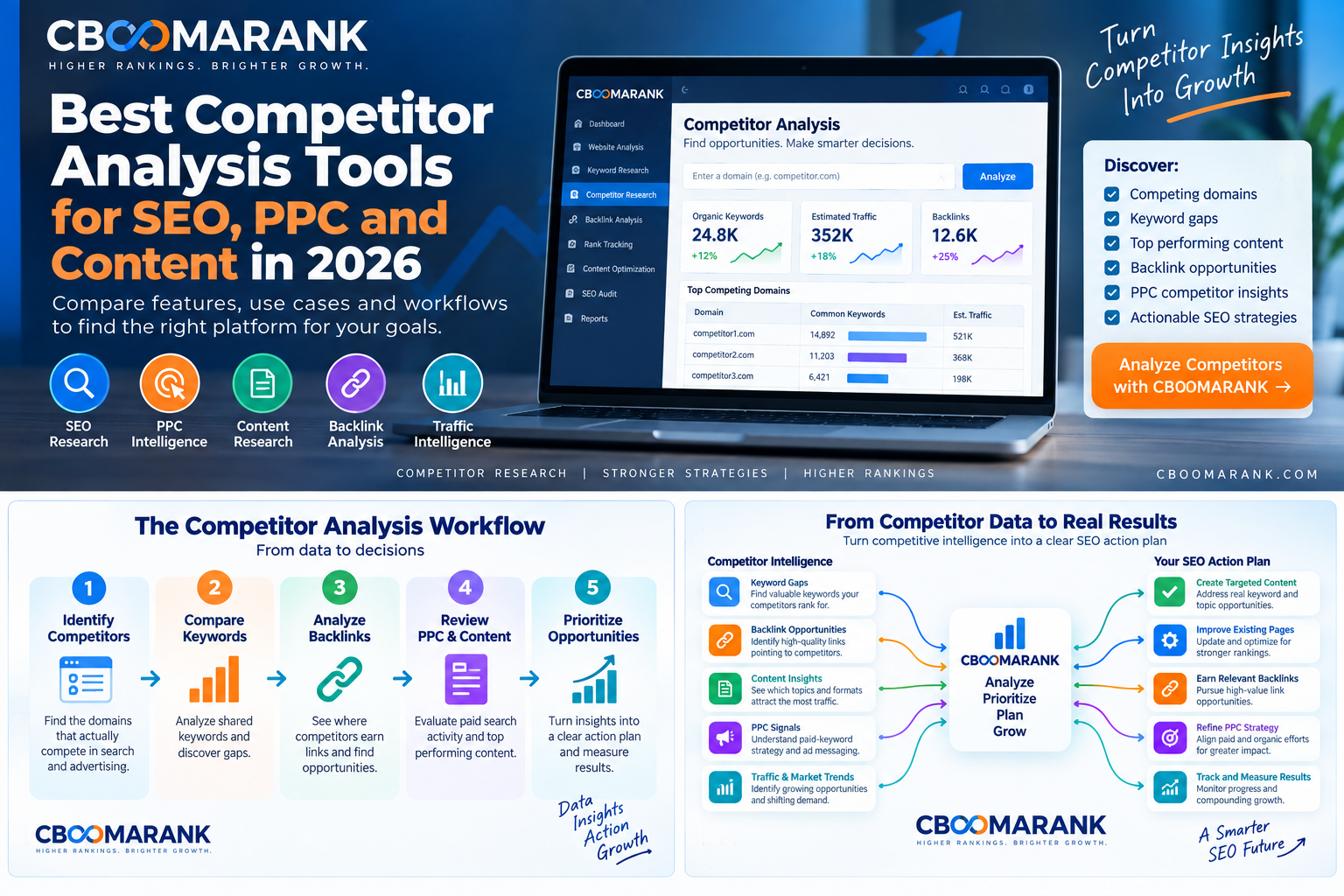
A useful competitor-analysis platform should help you move from observation to action. Large databases and attractive dashboards can be helpful, but they are not enough on their own. We evaluated the tools in this guide using the following practical criteria.
1. Breadth of competitor data
The first question is what kind of competitive data the platform actually provides. SEO teams may need organic keywords, ranking pages, backlink data and visibility trends. PPC teams need paid-keyword and auction intelligence. Content teams may care more about topic performance, competing pages and engagement signals.
2. Organic keyword intelligence
Competitor keyword research should make it possible to identify terms that competing domains rank for, compare overlapping keywords and uncover gaps. Ahrefs, for example, documents an Organic Competitors report that identifies competing websites based on shared organic rankings. This type of analysis helps distinguish your real search competitors from businesses that only compete with you offline.
3. Backlink intelligence
Backlink research is valuable when it reveals why a competing page has authority and where realistic link opportunities may exist. The purpose is not to reproduce every competitor link. A better approach is to combine competitor backlink findings with your own backlink analysis workflow and judge relevance, authority and editorial fit.
4. PPC visibility
PPC-focused research should help marketers understand who is competing in paid search, which terms may be commercially important, and how advertiser overlap changes. Google’s Auction Insights provides direct auction-level comparisons for eligible campaigns, while specialist tools can add historical or keyword-oriented competitor research.
5. Content research
Useful content research goes beyond counting keywords. It should help answer whether competitors cover an intent more completely, whether a format is performing well, which pages attract links and whether new or refreshed content could create a stronger result.
6. Traffic and market context
Traffic intelligence can help reveal whether a competing site appears to be growing, which channels contribute to visibility, and how market attention may be shifting. Because third-party traffic numbers are estimates, they should be treated as directional evidence rather than as exact analytics data.
7. Ability to prioritize action
This criterion matters most. Competitor data is valuable when it helps a team decide what to do next: create a new page, strengthen an existing page, improve internal links, pursue a backlink opportunity, adjust a paid-search campaign or monitor a newly emerging competitor.
This is also why competitor analysis should connect to your existing PPC research and SEO workflows instead of becoming another isolated dashboard.
Best Competitor Analysis Tools for SEO
SEO-focused competitor analysis usually combines keyword visibility, ranking URLs, backlinks, content gaps and performance trends. The tools below approach that problem from different angles.
CBOOMARANK
CBOOMARANK is being developed around connected SEO workflows rather than a single competitor metric. Competitor research can be used alongside keyword research, website analysis, SEO auditing and content-oriented workflows so that discoveries can be evaluated in the context of the user’s own website.
The practical objective is to help users answer questions such as which competing domains matter, which keyword gaps deserve attention and which SEO opportunities should be prioritized. It is better to use those insights as part of a decision process than to copy a competitor’s strategy directly.
Semrush for Competitor Analysis Tools Research
Semrush is commonly used by teams that want broad competitive research across organic search, paid search and content-related workflows. Its value for competitor analysis comes from bringing multiple research tasks into the same ecosystem, which can reduce the need to move between several unrelated tools.
Ahrefs for Competitor Analysis Tools and Backlink Research
Ahrefs is especially relevant when competitor research centers on organic rankings, competing pages, backlinks and content opportunities. Its documented Organic Competitors workflow identifies competing websites from shared search rankings, which is useful for discovering competitors that may not be obvious from the business category alone.
SE Ranking for Competitor Analysis Tools and Rank Tracking
SE Ranking is useful for teams that want competitor research integrated with ongoing SEO monitoring and rank tracking. That makes it practical for agencies and smaller teams that need a repeatable research-to-monitoring workflow.
Moz Pro for Competitor Analysis Tools Research
Moz Pro is best considered in SEO-centric workflows involving keyword research, link analysis, rankings and authority-oriented analysis. It can be useful when competitor research is part of a broader SEO process rather than a dedicated PPC intelligence workflow.
Ubersuggest for Competitor Analysis Tools and Keyword Research
Ubersuggest can provide a more approachable entry point for keyword, content and competitor research. It may suit smaller sites or marketers who want to investigate competing keywords and content opportunities without beginning with a more complex enterprise-oriented platform.
Turn Competitor SEO Data Into Action
Find the competitor opportunities that deserve attention first
Analyze your website, compare competing domains and connect keyword, content and technical signals with higher-impact SEO opportunities.
Best Competitor Analysis Tools for PPC
Paid-search competitor research requires a different dataset from organic SEO. An organic competitor may rank for hundreds of the same informational queries as your site without bidding on the same commercial terms. Conversely, an advertiser competing aggressively in Google Ads may have limited organic visibility. That is why PPC teams should evaluate paid-search overlap separately.
Semrush for PPC Competitor Analysis Tools
Semrush can support paid-search competitor research alongside its broader SEO workflow. This is useful for teams that want to compare organic and paid activity without separating those analyses into completely different environments. The practical value is in identifying commercially important terms, competitor positioning and areas where SEO and PPC strategies overlap.
SpyFu for PPC Competitor Analysis Tools
SpyFu is centered heavily on competitive search research. It can be useful when the main questions involve competitors’ search keywords, advertising history and the relationship between organic and paid visibility. Teams evaluating it should confirm the current plan limits and available datasets directly with the provider before making purchasing decisions.
Similarweb for Traffic and Competitor Analysis Tools
Similarweb approaches competitive research from a broader digital-market perspective. Rather than treating paid search as an isolated channel, its traffic and market intelligence can provide context around where competing websites appear to acquire attention. This can be useful for strategy teams examining the relative importance of search alongside other channels.
Google Ads Auction Insights for PPC Competitor Analysis
For advertisers already running eligible Google Ads campaigns, Auction Insights is especially useful because the data comes directly from the auctions in which the advertiser participates. Google documents metrics such as impression share, overlap rate and outranking-related comparisons depending on campaign type. It does not replace broader competitor research, but it answers a particularly important question: who is actually appearing in the same advertising auctions?
If paid search is part of your acquisition strategy, combine competitor findings with your existing PPC and Google Ads research rather than treating advertising intelligence as a separate exercise.
Best Competitor Analysis Tools for Content Research
Content competitor analysis should answer more than “which keywords does this page contain?” Strong content research looks at search intent, ranking pages, topical coverage, link attraction, freshness and whether competing resources satisfy the audience more effectively.
BuzzSumo for Content Competitor Analysis Tools
BuzzSumo is oriented toward content discovery, engagement and media research. It can be useful for identifying content themes, formats and publishers that receive attention, particularly when the objective extends beyond traditional rank tracking.
Semrush for Content Competitor Analysis Tools
Semrush can connect content research with keyword and competitor datasets. This is useful when a team wants to move from discovering a keyword gap to examining the pages competing for that topic and then deciding whether a new resource or an update to existing content is justified.
Ahrefs for Content and Competitor Analysis Tools
Ahrefs is useful for content research when organic search and backlinks matter heavily. Competitor pages can be evaluated for ranking keywords and links, helping marketers distinguish between content that merely exists and content that has accumulated meaningful search visibility or authority.
CBOOMARANK
CBOOMARANK’s content opportunity is to connect competitor findings with the site’s own keyword, technical and content context. Instead of assuming that every competitor topic deserves a new article, the workflow should first determine whether an existing page can be improved, whether the intent is already covered and whether the opportunity supports the site’s broader SEO goals.
This is particularly important for avoiding cannibalization. Before creating another page, compare the intended query with your existing search intent strategy and content optimization workflow.
How to Use Competitor Analysis Tools Step by Step
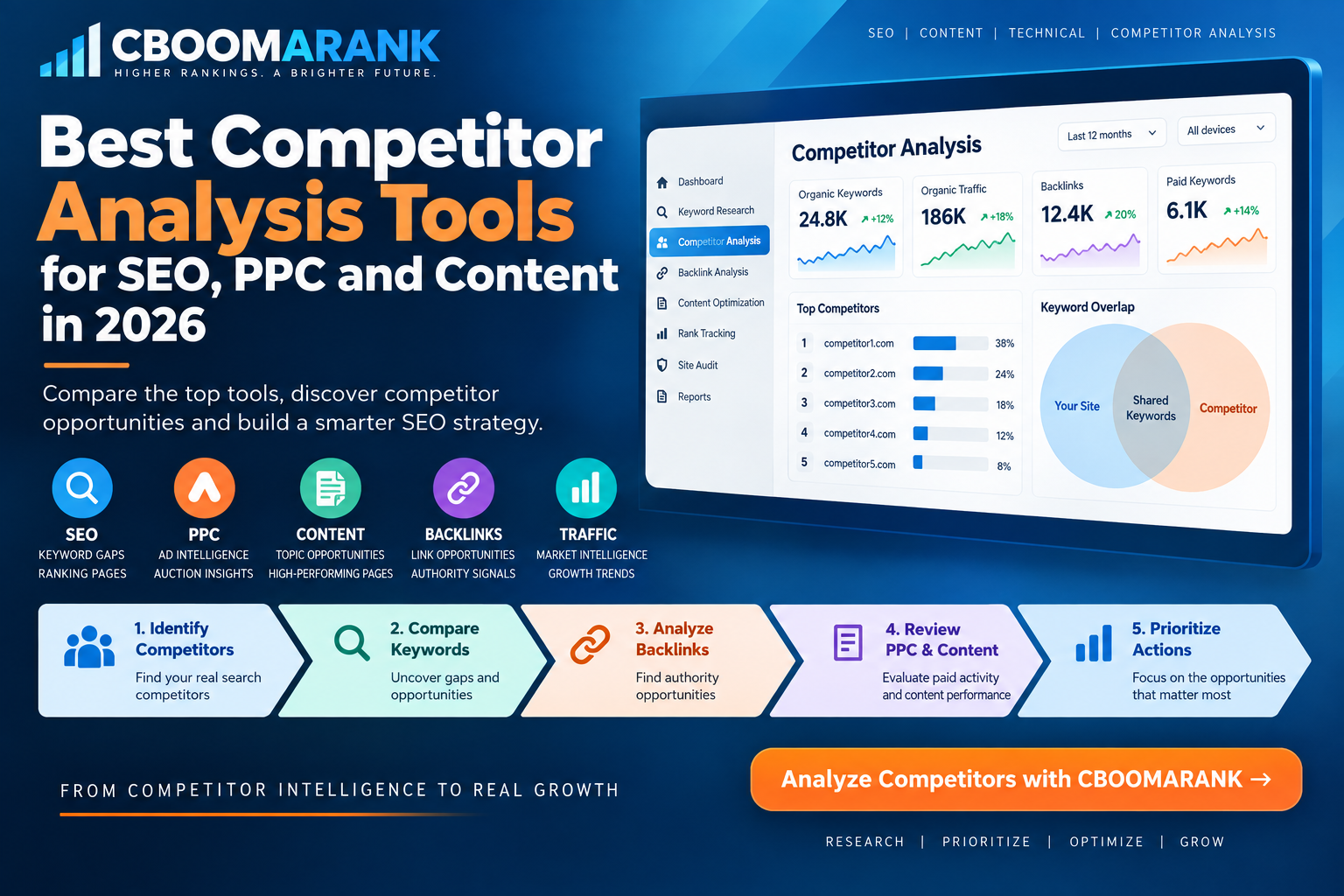
The best results usually come from a repeatable process rather than occasional competitor searches. The following workflow turns competitor data into a prioritized SEO, PPC and content plan.
1. Identify your true search competitors
Start with the domains that repeatedly appear for the queries that matter to your business. These may be different from your traditional commercial competitors. Search competitors are defined by visibility and intent, not simply by industry category.
2. Compare organic keyword visibility
Export or review keywords that both sites rank for, then separate them by intent, position and business relevance. Your established keyword research process provides the context needed to decide whether a competitor keyword actually deserves attention.
3. Find keyword and content gaps
Look for relevant themes where competitors have strong visibility and your site has weak or nonexistent coverage. A gap does not automatically mean “publish a new page.” First check whether an existing URL already addresses the intent and could be strengthened.
4. Compare ranking pages
Page-level analysis often reveals more than domain-level totals. Review what type of page ranks, how comprehensively it answers the query, how recently it has been maintained and whether multiple competitor pages consistently attract visibility.
5. Audit competing backlinks
Use competitor link data to understand which resources attract citations and what kinds of websites link to them. Then compare those findings with your own backlink analysis instead of pursuing links simply because a competitor has them.
6. Review paid-search activity
When PPC matters, investigate advertiser overlap, paid keyword themes, messaging and landing-page approaches. Use direct platform data where possible and third-party estimates as supporting evidence rather than treating estimates as exact campaign analytics.
7. Analyze content performance
Compare content topics, formats, freshness and search visibility. You can also use Google Trends to compare changes in search interest over time. Demand trends can help distinguish a weak page from a topic whose overall popularity is changing.
8. Prioritize opportunities by business value
Not every gap deserves equal effort. Consider search intent, conversion potential, difficulty, existing authority, content quality and the resources needed to compete. Competitor analysis should reduce wasted work, not create a longer list of low-priority tasks.
9. Create an action plan
Convert every meaningful finding into a specific action: create, refresh, consolidate, internally link, pursue an earned backlink, improve a landing page, test paid coverage or simply monitor. Your SEO audit workflow can help reveal technical issues that may need to be addressed before content changes can perform properly.
10. Measure results over time
After changes are implemented, monitor impressions, clicks, rankings and conversions rather than assuming the competitor-inspired action worked. Google’s Search Console performance documentation explains the core search-performance dimensions available in Search Console, including clicks, impressions, CTR and position data.
How CBOOMARANK Can Support Competitor Analysis
Competitor analysis becomes more useful when it is connected to the website being improved. CBOOMARANK is being built around that principle: research should feed into prioritization, remediation and measurement rather than ending with a competitor spreadsheet.
A connected workflow can bring together:
- competitor and keyword research;
- ranking URLs and search intent;
- website and SEO audit findings;
- content opportunities;
- authority and backlink signals;
- rank-monitoring context;
- recommended next actions; and
- reporting that helps users understand what changed.
For example, a competing domain may rank for a term your site does not. That observation alone is not enough. The useful questions are whether the term matches your audience, whether you already have a relevant page, whether that page has technical or content weaknesses, and whether the potential traffic has enough business value to justify the work.
That is where CBOOMARANK can connect competitor intelligence with other SEO workflows instead of forcing users to analyze each dataset independently. The aim is not to imitate a competitor but to identify opportunities that make sense for your own website.
Teams comparing broader platforms can also review our SEO software guide and SEO tool comparison for additional context.
Free vs Paid Competitor Analysis Tools
Free tools can answer several important competitive questions, but paid platforms become more valuable as the number of competitors, keywords, markets and recurring reports increases. The right threshold depends on how frequently competitor data influences decisions.
| Need | Free or limited tools | Paid tools | When upgrading makes sense |
|---|---|---|---|
| Basic search visibility | Manual search, Search Console and limited research tools | Broader domain and keyword datasets | When manual research becomes too slow or incomplete |
| Keyword comparison | Limited keyword samples and manual SERP checks | Large-scale competitor keyword and gap analysis | When you need recurring comparisons across many pages or competitors |
| Backlink research | Limited backlink samples | Deeper link indexes, filtering and competitor comparison | When link acquisition is an active SEO strategy |
| PPC analysis | Google Ads Auction Insights for your eligible campaigns | Historical and wider competitor paid-search research | When planning beyond the auctions in your own account |
| Traffic intelligence | Public indicators and limited estimates | Broader channel and market benchmarking | When traffic-channel strategy influences major investment decisions |
| Content research | Manual SERP analysis and Google Trends | Content discovery, historical visibility and deeper competitor datasets | When publishing volume or competitive complexity increases |
| Reporting and workflow | Spreadsheets and manual exports | Saved projects, recurring monitoring and integrated reporting | When multiple stakeholders need consistent competitor intelligence |
A common mistake is paying for several tools with heavily overlapping capabilities. Before adding another subscription, identify the exact decision the new tool must improve. In many cases, one broad SEO platform plus a specialist tool is more useful than maintaining multiple overlapping dashboards.
How to Choose the Right Competitor Analysis Tool
The best competitor analysis tools are not necessarily the platforms with the longest feature lists. The better choice is the tool—or combination of tools—that gives your team the evidence needed to make decisions without creating unnecessary complexity.
Choose based on the decisions you need to make
Start by defining the questions your team asks most frequently. An SEO-first team may care about ranking competitors, keyword gaps, backlinks and competing pages. A PPC team may care more about auction overlap, paid keywords and advertiser behavior. A content team may prioritize topic demand, competing resources, search intent and link attraction.
If your main objective is organic search growth, begin with a platform that supports reliable keyword, ranking-page and backlink research. Then connect those findings with your existing rank tracking and SEO audit processes so competitor observations can be validated against your own site’s performance.
SEO-first teams
SEO teams generally benefit most from competitor analysis platforms that connect several datasets: competing domains, shared keywords, ranking URLs, backlinks, authority indicators and historical visibility. The objective is not to reproduce a competitor’s site. It is to understand why competing pages earn visibility and where your own site has realistic room to improve.
Teams comparing broader platforms should review their current SEO software options carefully because adding a second or third tool with heavily overlapping keyword and backlink features may increase cost without improving decisions.
PPC teams
PPC teams should prioritize tools that help distinguish real paid-search competitors from organic competitors. Direct auction data from advertising platforms is especially useful because it reflects actual auction participation. Third-party tools can then add broader historical or keyword research around that direct account data.
When analyzing competitor advertising, avoid assuming that an estimated keyword, budget or traffic figure is exact. Use those estimates to generate hypotheses, then validate strategy against first-party campaign data and your own PPC research.
Content and editorial teams
Content teams should choose competitor analysis tools that make it easier to understand search intent, competing page formats, topic depth, freshness and link attraction. A competitor keyword is only useful when it represents a relevant audience need that your site can satisfy better.
Before creating a new article, compare the proposed topic with your existing content optimization and search intent workflows. This prevents unnecessary duplication and reduces the risk of keyword cannibalization.
Agencies
Agencies often need more than raw data. Client reporting, saved projects, recurring monitoring and the ability to move quickly between multiple domains can matter as much as the size of a keyword database. Agencies should also consider how easily findings can be explained to clients and converted into clearly prioritized actions.
Small businesses
Smaller teams usually benefit from starting with the minimum set of capabilities necessary to answer their highest-value questions. A simpler platform that is used consistently can produce more value than an advanced platform that becomes another unused dashboard.
That is why beginning with a clear keyword research process and a manageable competitor set is usually more effective than trying to monitor every rival at once.
Consider data depth and geographic coverage
Teams working across several countries or languages should verify that the tool supports the markets that matter to them. Search results, keyword demand and competitors vary by country, language and device. A platform that performs well for one market may not provide the same depth everywhere.
Check workflow fit before buying another tool
A final consideration is workflow duplication. If your current platform already handles the keyword, backlink and competitor tasks your team uses every week, adding another similar subscription may create more data without creating more insight.
Use competitor analysis to support a clear workflow: identify the opportunity, validate it, prioritize it, take action and measure the result.
Build a Smarter Competitor Research Workflow
Connect competitor insights with the SEO work that matters most
Bring competitor, keyword, content and technical signals into one workflow so you can prioritize opportunities instead of collecting disconnected data.
Related CBOOMARANK competitor research resources
If you are building a broader research stack, the following CBOOMARANK resources can help connect competitor intelligence with adjacent SEO decisions:
- competitor research and competitive analysis
- SEO tool comparisons
- backlink analysis and competitor link research
- rank tracking and search visibility monitoring
- keyword research and opportunity discovery
Frequently Asked Questions About Competitor Analysis Tools
1. What are competitor analysis tools?
Competitor analysis tools are platforms that help marketers examine how competing websites perform across areas such as organic keywords, ranking pages, backlinks, traffic, paid search and content. Different products specialize in different datasets, so the best choice depends on the questions your team needs to answer.
2. Which competitor analysis tool is best for SEO?
There is no universal best option for every SEO team. Ahrefs is widely used for organic-search and backlink research, while Semrush provides broad SEO and digital-marketing workflows. SE Ranking, Moz Pro, Ubersuggest and other platforms serve different budgets and use cases. CBOOMARANK is being developed around connecting competitor research with keyword, audit and optimization workflows. The right choice depends on your required data depth, markets, reporting needs and workflow.
3. Which tools can analyze competitors’ keywords?
Many SEO platforms can identify keywords for which competing domains rank. Examples include Semrush, Ahrefs, SE Ranking, Moz, Ubersuggest, SpyFu and other competitive-search platforms. Before acting on a keyword gap, evaluate its search intent, relevance and business value rather than assuming every competitor keyword should become a target.
4. What is the best competitor analysis tool for PPC?
Google Ads Auction Insights is particularly valuable for advertisers because it provides direct comparison data from eligible auctions in which the advertiser participates. Third-party platforms such as Semrush, SpyFu and Similarweb can provide broader competitive context. PPC teams often benefit from combining first-party auction data with third-party market research.
5. Can competitor analysis tools find backlink opportunities?
Yes. SEO platforms with backlink databases can show websites and pages linking to competitors. That information can reveal potential outreach targets, resource ideas and linkable content patterns. However, competitor links should be evaluated for relevance and quality rather than copied indiscriminately. A structured backlink audit and analysis workflow is a better foundation.
6. Are free competitor analysis tools enough?
Free tools can be enough for basic research, especially for small sites or occasional analysis. Google Search, Google Trends, Search Console and Google Ads data can answer several useful questions. Paid tools become more valuable when teams need larger datasets, historical comparisons, recurring monitoring, deeper backlink research or reports across many competitors.
7. How often should competitor analysis be performed?
The appropriate frequency depends on how quickly the market changes. Competitive industries may require monthly or even weekly monitoring of important queries, while broader strategic reviews can be performed quarterly. The most useful approach is continuous monitoring of critical metrics combined with deeper scheduled reviews, rather than rebuilding the entire analysis from scratch every day.
Final Verdict: Build a Competitor Analysis Workflow, Not Just a Tool Stack
The most effective competitor analysis strategy is not about finding one platform that claims to do everything. It is about connecting reliable competitive evidence with a repeatable decision process.
SEO teams need to understand shared keywords, competing pages, backlinks and ranking trends. PPC teams need auction and paid-search context. Content teams need to understand intent, topic coverage and the formats that earn visibility. Strategy teams may also need market-level traffic and audience context.
The strongest approach is therefore to choose tools based on the decisions they improve, not on the number of dashboards they contain.
A practical workflow looks like this:
- Identify the competitors that actually matter in search and advertising.
- Compare keyword, content, backlink and paid-search signals.
- Validate findings against your own website data.
- Separate high-value opportunities from interesting but low-priority observations.
- Turn each priority into a specific action.
- Measure whether the action improves visibility, traffic, leads or revenue.
CBOOMARANK’s opportunity is to connect those stages so competitor analysis does not end with a spreadsheet. A keyword gap should connect to content and search intent. A competitor backlink pattern should connect to authority and link opportunities. A ranking gap should connect to technical, content and internal-linking evidence. The result should be a clearer path from discovery to action.
If your objective is to build a more connected competitor research process, start your CBOOMARANK website analysis and competitor research workflow.
