

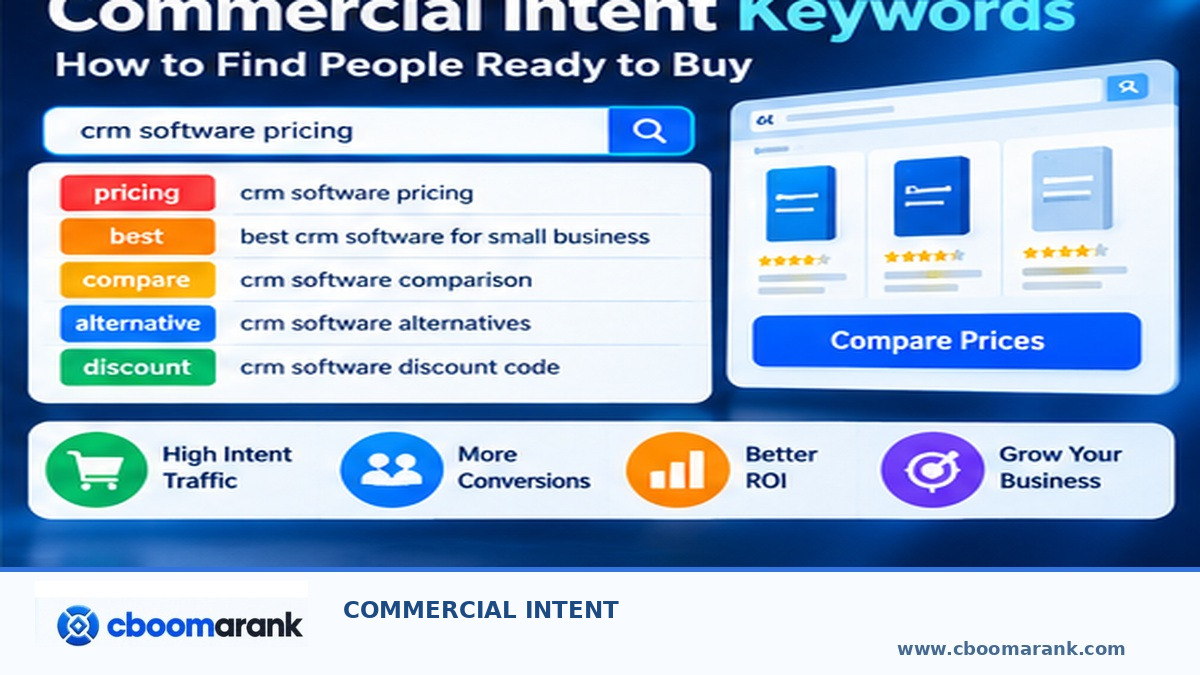
Commercial intent keywords often signal that a searcher is comparing options before deciding what to buy. Phrases such as “best,” “vs,” “alternatives,” “reviews” or “pricing comparison” can reveal evaluation needs, but context matters. A helpful commercial page clarifies trade-offs, evidence, fit and limitations so people can make decisions rather than merely clicking an affiliate or sales link.
Practical scope: Commercial investigation SERPs, page design and differentiation from transactional terms. The instructions below distinguish actual first-party metrics, observed search results, and third-party estimates. Their meaning changes with location, date, device, and source, so a useful decision begins by documenting those inputs.
What Is Commercial Keywords? Quick Explanation
Commercial intent keywords often signal that a searcher is comparing options before deciding what to buy. Phrases such as “best,” “vs,” “alternatives,” “reviews” or “pricing comparison” can reveal evaluation needs, but context matters. A helpful commercial page clarifies trade-offs, evidence, fit and limitations so people can make decisions rather than merely clicking an affiliate or sales link.
At a Glance: Evidence You Need Before Making a Decision
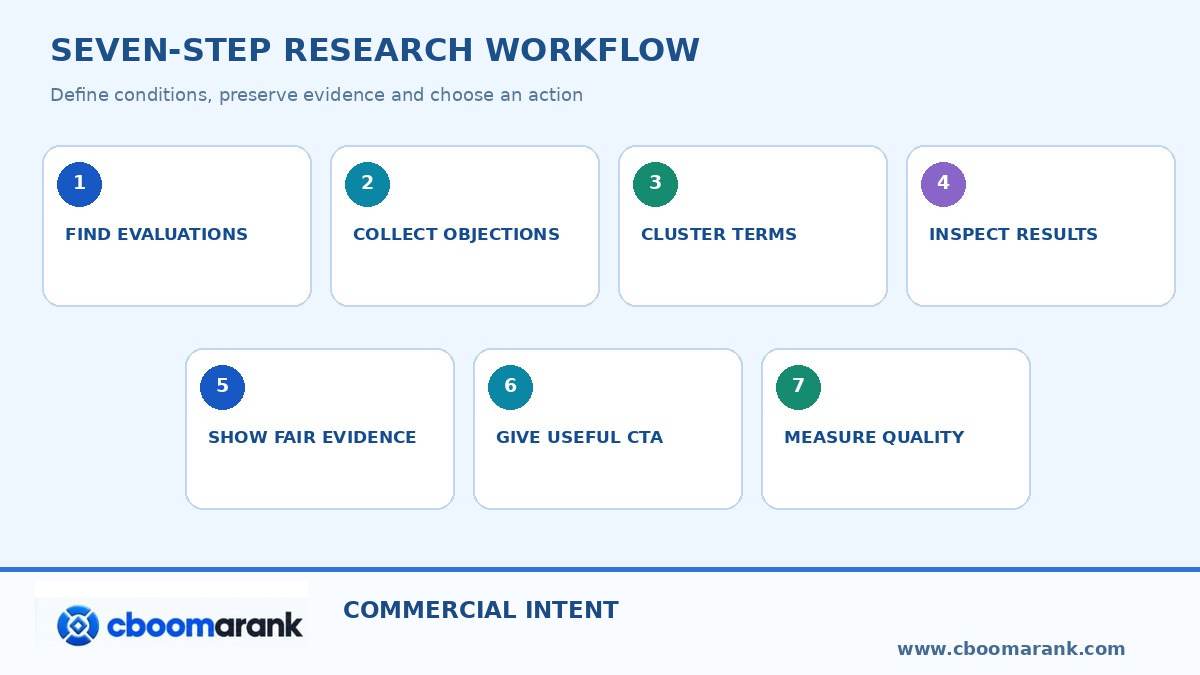
| Stage | What to do | Why it matters |
|---|---|---|
| 1 | Recognize commercial investigation | Read the query and review what currently ranks. |
| 2 | Collect competitor and customer evaluation questions | Review genuine sales objections, comparison requests, feature questions and support feedback. |
| 3 | Build keyword clusters by buying decision | Group best-of, alternatives, product-versus-product, software-for-industry, review and price-comparison phrases separately where needed. |
| 4 | Check what the SERP actually rewards | Record whether ranking results are unbiased roundups, vendor comparison pages, marketplaces or first-party product pages. |
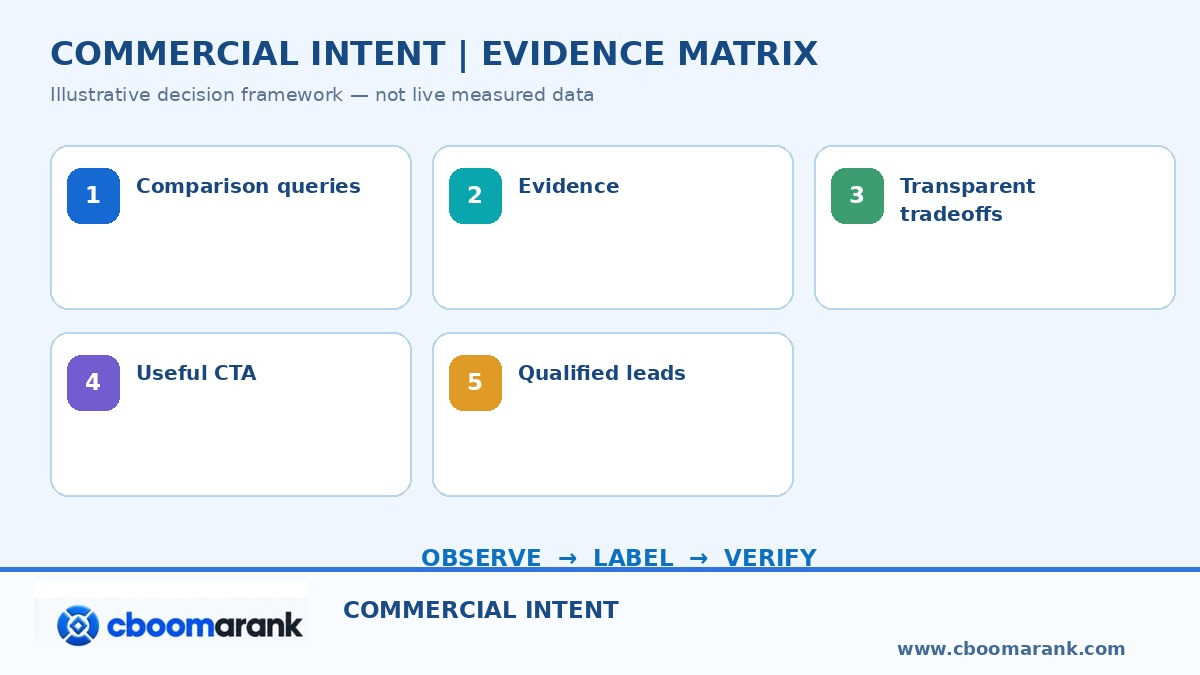
| 5 | Create evidence-based comparison pages | Explain who each option is suitable for, what was tested, limitations, total cost considerations and how features were verified. |
| 6 | Make the next action proportionate | Commercial readers may want a demo, calculator, pricing page, compatibility guide or short consultation. |
| 7 | Test quality through business outcomes | Measure whether visitors reach useful comparison sections, click relevant next steps and become qualified leads. |
How to Use Commercial Keywords: A Seven-Step Method
Step 1: Recognize Commercial Keywords and Buying Signals
Read the query and review what currently ranks. “Best website audit software” generally invites comparisons, while “buy website audit subscription” can be closer to a transaction. A search for a company name may be navigational instead. Do not build several pages for synonyms unless each term genuinely asks a different question.
For this stage, make your evidence traceable: record the scope of “recognize commercial investigation,” the source you consulted, what remains uncertain, and the next action you would take. If the available data is incomplete, mark it as an assumption rather than filling the gap with an unsupported ranking, conversion rate or advertising cost. This extra discipline makes commercial keywords work easier to audit when another analyst repeats the exercise next month.
Step 2: Collect competitor and customer evaluation questions — Commercial Keywords
Review genuine sales objections, comparison requests, feature questions and support feedback. Search relevant forums and public SERPs responsibly to discover missing information. Document concerns such as price, workflow compatibility, data accuracy, onboarding and customer support. These questions can turn a generic best-tools list into a useful evaluation framework.
For this stage, make your evidence traceable: record the scope of “collect competitor and customer evaluation questions,” the source you consulted, what remains uncertain, and the next action you would take. If the available data is incomplete, mark it as an assumption rather than filling the gap with an unsupported ranking, conversion rate or advertising cost. This extra discipline makes commercial keywords work easier to audit when another analyst repeats the exercise next month.
Step 3: Group Commercial Keywords by Buying Decision
Group best-of, alternatives, product-versus-product, software-for-industry, review and price-comparison phrases separately where needed. Map each group to a canonical page. Two phrases such as “rank tracking tools” and “best rank trackers” may share one SERP intent and should not trigger near-duplicate articles.
For this stage, make your evidence traceable: record the scope of “build keyword clusters by buying decision,” the source you consulted, what remains uncertain, and the next action you would take. If the available data is incomplete, mark it as an assumption rather than filling the gap with an unsupported ranking, conversion rate or advertising cost. This extra discipline makes commercial keywords work easier to audit when another analyst repeats the exercise next month.
Quality check for step 3
Confirm that the observation is relevant to the user’s real task and that a different location, date, device, page, or audience would not change its meaning. Document any exception in the research workbook so it does not become an unexplained outlier in a later presentation.
Step 4: Check what the SERP actually rewards
Record whether ranking results are unbiased roundups, vendor comparison pages, marketplaces or first-party product pages. Look for features including pricing tables, screenshots, original evaluations and clear disclosures. Match the format only where it genuinely helps the reader; original expertise and evidence are more valuable than copying competitors’ headings.
For this stage, make your evidence traceable: record the scope of “check what the serp actually rewards,” the source you consulted, what remains uncertain, and the next action you would take. If the available data is incomplete, mark it as an assumption rather than filling the gap with an unsupported ranking, conversion rate or advertising cost. This extra discipline makes commercial keywords work easier to audit when another analyst repeats the exercise next month.
Step 5: Create evidence-based comparison pages — Commercial Keywords
Explain who each option is suitable for, what was tested, limitations, total cost considerations and how features were verified. Include alternatives fairly. If the publisher sells one of the products, state that relationship. Avoid inaccurate current prices or fabricated trial results, and link to vendor documentation for changing details.
For this stage, make your evidence traceable: record the scope of “create evidence-based comparison pages,” the source you consulted, what remains uncertain, and the next action you would take. If the available data is incomplete, mark it as an assumption rather than filling the gap with an unsupported ranking, conversion rate or advertising cost. This extra discipline makes commercial keywords work easier to audit when another analyst repeats the exercise next month.
Step 6: Make the next action proportionate
Commercial readers may want a demo, calculator, pricing page, compatibility guide or short consultation. Give a clear relevant CTA without interrupting the explanation every paragraph. For an early evaluation query, a transparent checklist can be more valuable than an aggressive “buy now” prompt.
For this stage, make your evidence traceable: record the scope of “make the next action proportionate,” the source you consulted, what remains uncertain, and the next action you would take. If the available data is incomplete, mark it as an assumption rather than filling the gap with an unsupported ranking, conversion rate or advertising cost. This extra discipline makes commercial keywords work easier to audit when another analyst repeats the exercise next month.
Quality check for step 6
Confirm that the observation is relevant to the user’s real task and that a different location, date, device, page, or audience would not change its meaning. Document any exception in the research workbook so it does not become an unexplained outlier in a later presentation.
Step 7: Test quality through business outcomes
Measure whether visitors reach useful comparison sections, click relevant next steps and become qualified leads. Use Search Console to monitor organic visibility while analytics shows downstream behaviour. Compare results over enough time to avoid mistaking random daily changes for proven conversion growth.
For this stage, make your evidence traceable: record the scope of “test quality through business outcomes,” the source you consulted, what remains uncertain, and the next action you would take. If the available data is incomplete, mark it as an assumption rather than filling the gap with an unsupported ranking, conversion rate or advertising cost. This extra discipline makes commercial keywords work easier to audit when another analyst repeats the exercise next month.
Commercial Keywords in Practice: Worked Example
A hypothetical agency publishes “best SEO reporting tools for agencies” with a transparent evaluation table. Readers can see integrations, exports, current pricing references and test limitations. It links naturally to a separate pricing or demo page for readers ready to proceed. The editorial page focuses on helping a comparison decision rather than reusing identical sales text across ten keyword variants.
Evidence rule: Any example figures in this article are hypothetical teaching inputs, not CBOOMARANK customer results, a current Google Ads auction, or a measurement of a named competitor. Use your own collected records before drawing a commercial conclusion.
Common Commercial Keywords Mistakes and How to Avoid Them
1. Distinguish evaluation from checkout intent.
Distinguish evaluation from checkout intent. A more reliable approach is to label the exact source, period, market and limitations beside the observation, then state what the user should do next. This matters because stakeholder decisions can become expensive when a narrow sampled signal is promoted into an unsupported universal claim. Keep the correction tied to the reader’s goal and check whether the evidence changes after the next consistent measurement.
2. Avoid affiliate or vendor bias without disclosure.
Avoid affiliate or vendor bias without disclosure. A more reliable approach is to label the exact source, period, market and limitations beside the observation, then state what the user should do next. This matters because stakeholder decisions can become expensive when a narrow sampled signal is promoted into an unsupported universal claim. Keep the correction tied to the reader’s goal and check whether the evidence changes after the next consistent measurement.
3. Do not fabricate product testing or current pricing.
Do not fabricate product testing or current pricing. A more reliable approach is to label the exact source, period, market and limitations beside the observation, then state what the user should do next. This matters because stakeholder decisions can become expensive when a narrow sampled signal is promoted into an unsupported universal claim. Keep the correction tied to the reader’s goal and check whether the evidence changes after the next consistent measurement.
4. Consolidate near-synonymous keyword clusters.
Consolidate near-synonymous keyword clusters. A more reliable approach is to label the exact source, period, market and limitations beside the observation, then state what the user should do next. This matters because stakeholder decisions can become expensive when a narrow sampled signal is promoted into an unsupported universal claim. Keep the correction tied to the reader’s goal and check whether the evidence changes after the next consistent measurement.
5. Give comparison readers meaningful evidence.
Give comparison readers meaningful evidence. A more reliable approach is to label the exact source, period, market and limitations beside the observation, then state what the user should do next. This matters because stakeholder decisions can become expensive when a narrow sampled signal is promoted into an unsupported universal claim. Keep the correction tied to the reader’s goal and check whether the evidence changes after the next consistent measurement.
6. Measure buyer quality, not just clicks.
Measure buyer quality, not just clicks. A more reliable approach is to label the exact source, period, market and limitations beside the observation, then state what the user should do next. This matters because stakeholder decisions can become expensive when a narrow sampled signal is promoted into an unsupported universal claim. Keep the correction tied to the reader’s goal and check whether the evidence changes after the next consistent measurement.
Turn Commercial Keywords Findings into a 30-Day Action Plan
Week 1 — Collect a reproducible baseline
Agree which keywords, audience, countries, languages, URLs, and conversion goals belong to the project. Verify analytics and search reporting access. Save a dated baseline and label unknown values rather than pretending the available dataset is complete. If source settings differ, create separate rows rather than averaging incompatible results.
Week 2 — Prioritize the evidence
Group queries by shared intent and mark where an existing page already answers the need. Rate opportunities by relevance, feasibility, customer value, confidence and effort. Discuss apparent contradictions before moving budget or restructuring content. Choose one hypothesis that the team can test within its technical and editorial constraints.
Week 3 — Implement one controlled improvement
Improve the most relevant landing page, clarify its answer, fix a tracking problem or test an appropriate paid campaign if authorized. Record what was changed, when, and how success will be measured. Preserve backups and avoid simultaneous changes that make the outcome hard to interpret.
Week 4 — Measure qualified outcomes
Compare equivalent observation windows, review search impressions and clicks, and measure meaningful leads or registrations where tracking is configured. Distinguish correlation from causation. Keep changes that benefit customers, discard weak assumptions and set the next review cadence based on the business value of the finding.
Frequently Asked Questions About Commercial Keywords
What counts as a commercial keyword?
Usually a query expressing evaluation of products, vendors, prices, alternatives or features, subject to SERP context.
Is commercial intent the same as transactional intent?
No. Commercial investigation often comes before a specific purchase or signup action.
Should every keyword with “best” get a separate article?
No. Cluster variants that share one reader task and search intent.
How do I avoid thin comparison pages?
Include clear methodology, relevant expertise, real evidence, limitations and useful distinctions.
Can product pages rank for commercial queries?
Sometimes. The right page type depends on the actual query and results.
Official References and Further Reading
- Google Search Central: creating helpful content. Check the provider’s current definitions and limitations.
- Google Search Console: performance reports. Check the provider’s current definitions and limitations.
- Google Ads Keyword Planner: historical metrics and forecasts. Check the provider’s current definitions and limitations.
Continue researching with this related CBOOMARANK SEO guide and another practical CBOOMARANK resource. Related articles support this narrower task rather than replacing it.
Final Verdict: Make Commercial Keywords Measurable
The point of commercial keywords is not to collect impressive-looking metrics without context. Use a clear measurement specification, original evidence where available, defensible assumptions, and an action tied to a real customer need. A smaller, well-understood result can be more valuable than a broad ranking, search-volume or CPC estimate that cannot be reproduced.
Editorial review: October 2026. Tools, search layouts, plan limits and advertising costs can change. Examples are explicitly illustrative. This CBOOMARANK article is commercial editorial content; verify current third-party facts and product access before making a purchase.
