

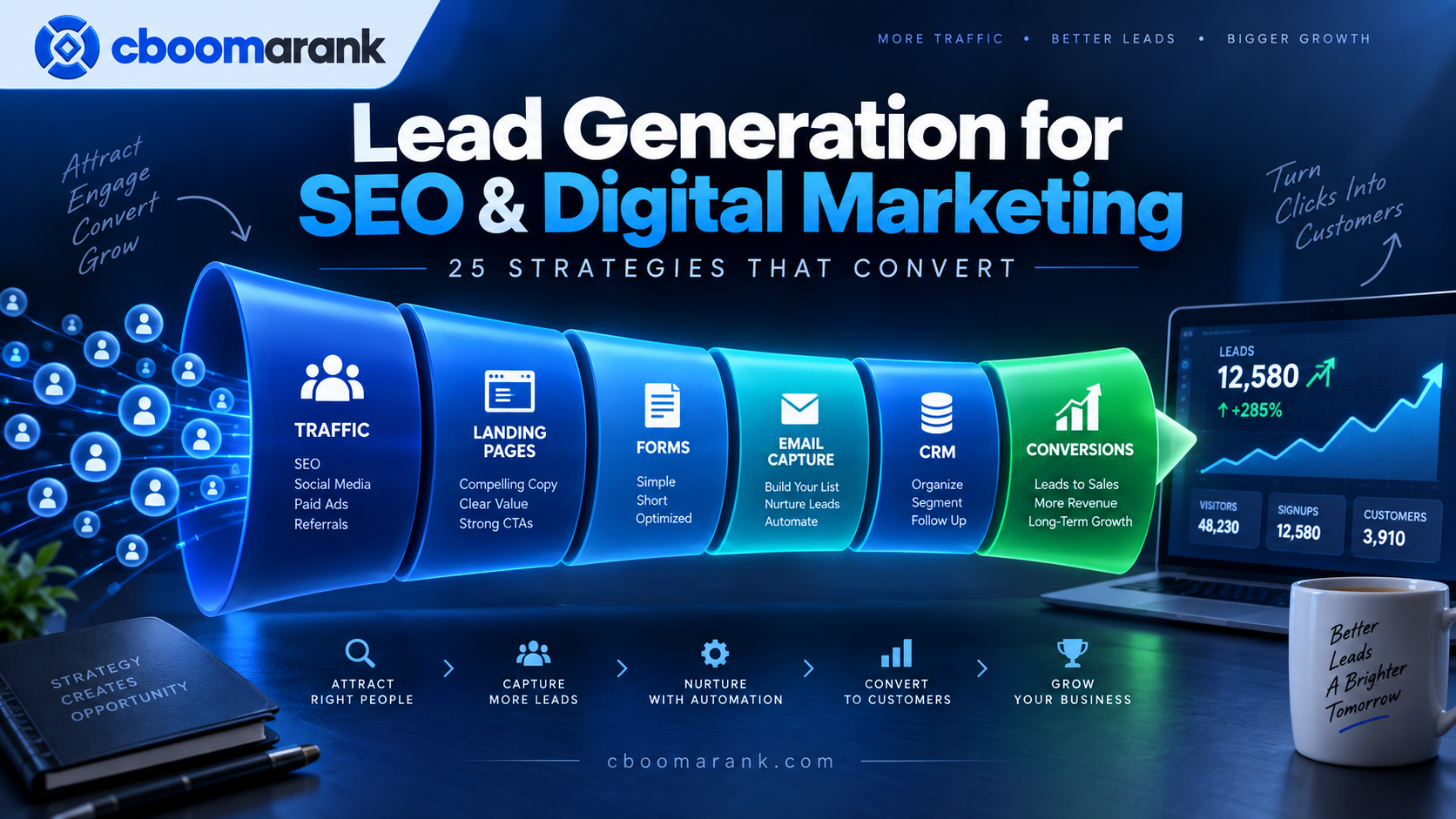
Lead generation is the process of turning anonymous attention into identifiable prospects who have a genuine reason to engage with your business. In SEO and digital marketing, that means more than simply increasing traffic. A successful strategy connects search visibility, useful content, paid acquisition, conversion optimization, email nurturing and measurement into one system that consistently produces qualified opportunities.
In 2026, businesses have access to more acquisition channels than ever, but that also makes inefficient marketing easier. Traffic without intent, poorly designed landing pages, weak offers and unreliable tracking can consume large budgets without producing meaningful pipeline. The strongest lead generation programs therefore focus on search intent, conversion quality, customer economics and measurable business outcomes.
Turn Search Demand Into Qualified Leads
Use CBOOMARANK to research keywords, analyze competitors, identify SEO opportunities and understand where prospective customers are searching before you invest more time or budget.
What Is Lead Generation?
Lead generation is the structured process of attracting potential customers, earning their interest and creating a measurable path for continued communication. A lead might submit a form, request a demo, start a trial, download a resource, subscribe to a newsletter, request pricing or contact a sales team.
The important distinction is that a lead is not merely a visitor. A visitor becomes a lead when enough information or intent exists to continue the commercial relationship. Good lead generation therefore combines acquisition with qualification.
Lead generation vs traffic generation
Traffic generation focuses on attracting visitors. Lead generation focuses on attracting the right visitors and providing a next step that matches their intent. Ten thousand poorly matched visitors may create less revenue than several hundred highly qualified visitors searching for a specific solution.
Lead generation vs demand generation
Demand generation creates awareness and interest across a market. Lead generation captures identifiable prospects from that demand. In practice, the two should work together. Educational content, research and brand visibility can create demand, while landing pages, tools, forms and offers convert part of that audience into leads.
The Lead Generation Funnel
1. Attract
SEO, PPC, content, social media, referrals, partnerships and other channels bring relevant audiences into the funnel.
2. Engage
Helpful pages, tools, comparisons, educational resources and proof build relevance and trust.
3. Convert
Forms, demos, trials, downloads, quotations and other offers capture intent and contact information.
4. Qualify
Behavior, company fit, budget, urgency and lifecycle signals help separate strong prospects from low-intent enquiries.
5. Nurture
Email, remarketing, useful content and sales follow-up move qualified prospects toward a buying decision.
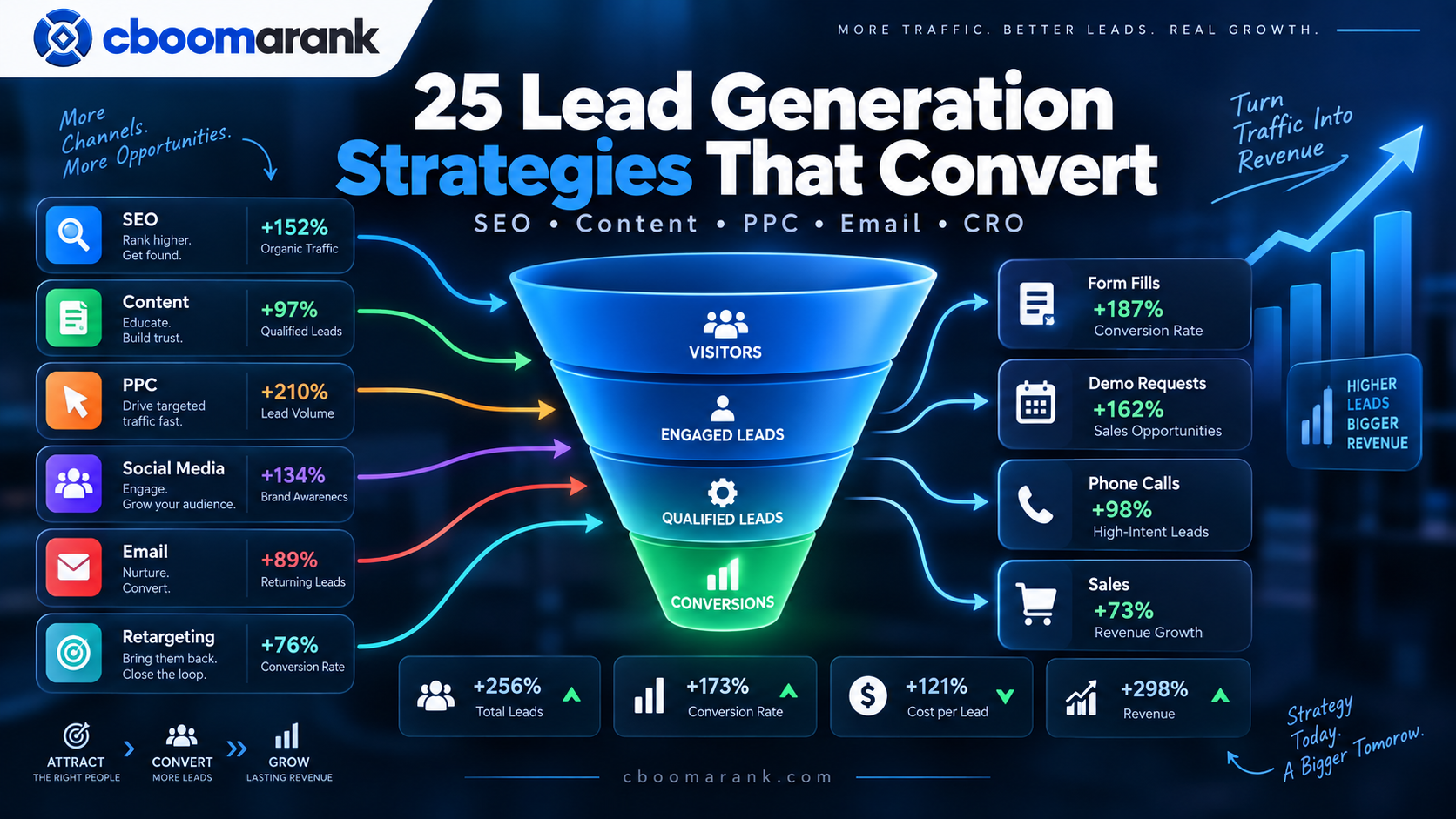
25 Lead Generation Strategies for SEO & Digital Marketing
The following strategies can work independently, but the strongest results usually come from combining several into a connected acquisition system.
1. Target high-intent keywords first
Keyword research should begin with commercial intent rather than search volume alone. Terms containing modifiers such as best, pricing, software, service, agency, consultant, comparison, alternative and review frequently indicate that the searcher is closer to evaluating a solution.
Map each keyword to the right type of page. Informational searches may need guides, while commercial searches often perform better with comparison pages, service pages, solution pages and targeted landing pages.
2. Build SEO landing pages around specific problems
A broad homepage cannot effectively answer every search intent. Create dedicated landing pages for important customer problems, industries, use cases and solution categories. Each page should explain the problem, demonstrate relevant expertise and provide a clear next action.
Technical performance matters as well. Use the principles covered in CBOOMARANK’s technical SEO tools guide to identify crawlability, indexation, speed and on-page issues that can prevent high-value landing pages from performing.
3. Create topic clusters instead of isolated posts
A strong content cluster connects a broad pillar topic with detailed supporting articles. For example, a lead generation pillar can link to pages about landing pages, conversion rate optimization, email nurturing, Google Ads, SEO, competitor research and lead scoring.
Internal links help visitors continue their journey and give search engines clearer information about topical relationships. Avoid publishing dozens of disconnected posts that compete for the same intent.
4. Publish comparison and alternative content
Searchers comparing products, platforms, agencies or approaches are often closer to conversion. Create fair, useful comparisons based on features, pricing models, ideal users, limitations and decision criteria.
Comparison content should help the reader decide rather than simply claim that your own product is superior. Clear decision frameworks can build significantly more trust.
5. Use competitor research to find acquisition gaps
Competitor research can reveal keywords, pages, backlink sources, advertising themes and content formats already attracting demand in your market. The goal is not to copy competitors; it is to understand which problems customers are actively researching and where existing solutions leave gaps.
CBOOMARANK’s competitor workflows can help identify search opportunities before you commit resources to a new campaign.
Find Competitor Lead Opportunities
Research competing domains, discover keyword gaps and identify content opportunities you can turn into targeted lead-generation campaigns.
6. Create genuinely useful lead magnets
Lead magnets work when the resource solves a meaningful problem. Templates, calculators, checklists, benchmarks, worksheets, original research and implementation frameworks usually provide stronger value than generic PDFs created only to collect email addresses.
The offer should closely match the page that introduces it. A technical SEO reader may want an audit checklist, while a PPC reader may prefer a budget calculator or campaign planning template.
7. Reduce friction in lead forms
Every additional field creates friction. Ask only for the information required at that stage of the customer journey. A newsletter signup may need only an email address, while a high-value service enquiry might reasonably request company information, budget and project requirements.
Make privacy expectations clear and ensure the form works properly on mobile devices.
8. Offer free diagnostic tools
Interactive tools can generate qualified demand because they provide immediate value. Website analyzers, calculators, estimators, checkers, graders and assessment tools allow prospects to understand a problem before speaking with sales.
This is especially relevant for CBOOMARANK: users can move from informational content into practical website, SEO, keyword and competitor analysis inside the platform.
9. Add contextual CTAs instead of generic banners
A CTA should logically follow the information around it. After a section discussing keyword research, invite the reader to research keywords. After competitor analysis, offer competitor research. Contextual CTAs usually feel more natural than repeating the same “buy now” message throughout every page.
10. Improve conversion rate optimization
Conversion rate optimization examines what happens after traffic arrives. Review headline clarity, offer relevance, form friction, page speed, social proof, navigation distractions and the strength of the next step.
Measure changes carefully. A higher form-submission rate is useful only if lead quality remains strong.
11. Use case studies and measurable proof
Case studies reduce uncertainty by showing how a solution was applied to a real problem. Strong case studies explain the initial situation, actions taken, measurement period and results without exaggerating causation.
Where possible, show the process as well as the outcome. Prospective customers want to understand how results were achieved.
12. Strengthen trust signals on commercial pages
Trust can include transparent pricing information, clear contact details, company information, expert authorship, credible testimonials, documented methodologies, privacy information and realistic claims.
Users evaluating an expensive service usually need more evidence than users reading a basic informational article.
13. Use Google Ads for high-intent demand
Paid search can place a relevant offer directly in front of people actively looking for a solution. Build campaigns around tightly aligned keywords, ad messages and landing pages rather than sending every click to a generic homepage.
For campaign fundamentals, see the CBOOMARANK Google Ads beginner’s guide and PPC advertising guide.
14. Use remarketing strategically
Many visitors are not ready to convert during their first session. Remarketing can reconnect with visitors who viewed pricing, product or service pages but did not complete the desired action.
Segment audiences by behavior rather than showing identical advertising to everyone. Someone who read one educational post should not necessarily receive the same campaign as someone who abandoned a demo form.
15. Build email nurture sequences around intent
Email nurturing should answer the questions prospects typically ask between initial interest and purchase. A useful sequence might include educational content, implementation guidance, case studies, comparisons, objections, pricing context and a final invitation to talk with sales.
Avoid overwhelming subscribers with daily promotional messages unless they explicitly requested that frequency.
16. Create webinar and workshop funnels
Live or recorded educational sessions can work well for complex services and B2B products. Choose a specific operational problem, teach something useful and make the commercial next step optional but obvious.
Repurpose webinars into articles, clips, email sequences, FAQs and sales enablement material.
17. Build referral programs
Existing customers, partners and professional networks can produce high-trust leads. A referral program works best when the benefit, eligibility and tracking process are simple.
Referral incentives should never encourage misleading reviews or deceptive endorsements.
18. Develop strategic partnerships
Complementary businesses often serve the same audience without directly competing. Joint research, webinars, integrations, newsletters and resource exchanges can introduce your brand to relevant prospects.
Choose partners based on audience fit and credibility rather than audience size alone.
19. Use guest contributions and digital PR
Thoughtful guest contributions can increase referral traffic, authority and brand discovery. Focus on publications that are genuinely relevant to your audience.
For a broader view of sustainable acquisition through links and outreach, see CBOOMARANK’s link building pricing guide.
20. Refresh declining high-value content
Older pages that once attracted qualified traffic may lose rankings as search intent changes, competitors improve their content or information becomes outdated. Updating valuable existing URLs can often be more efficient than publishing duplicate replacements.
Use the CBOOMARANK content decay SEO guide to understand when refreshes are appropriate.
21. Use local SEO for location-based leads
Businesses serving specific geographic areas should maintain accurate location information, relevant service pages, structured local information and consistent business profiles. Local landing pages should contain genuinely useful local content rather than repeating the same paragraph with different city names.
22. Use video to demonstrate expertise
Video can explain complex processes, demonstrate tools, answer objections and show product workflows. Convert longer videos into short clips and embed relevant videos into supporting articles and landing pages.
Always keep the conversion path clear: viewers should know what to do if they want deeper analysis, pricing or assistance.
23. Add conversational lead capture carefully
Live chat and automated assistants can help visitors find information and qualify their needs, especially on pricing and product pages. However, automated experiences should not pretend to be human, and users should have a clear path to human support where appropriate.
24. Score leads using meaningful signals
Lead scoring helps teams prioritize prospects. Useful signals may include company fit, page depth, product interest, repeat visits, pricing-page activity, demo requests, email engagement and explicit purchase intent.
Avoid treating every form submission as equally valuable. The purpose of scoring is to improve prioritization, not merely increase the number displayed in a CRM.
25. Connect marketing activity to revenue
The final strategy is measurement. Track which sources, campaigns and pages produce qualified opportunities, pipeline and customers. Cost per lead is useful, but cost per qualified lead, opportunity rate, customer acquisition cost and revenue contribution usually provide a better view of commercial performance.
Measurement should also include lead quality. A campaign producing inexpensive but irrelevant enquiries can appear successful until sales outcomes are examined.
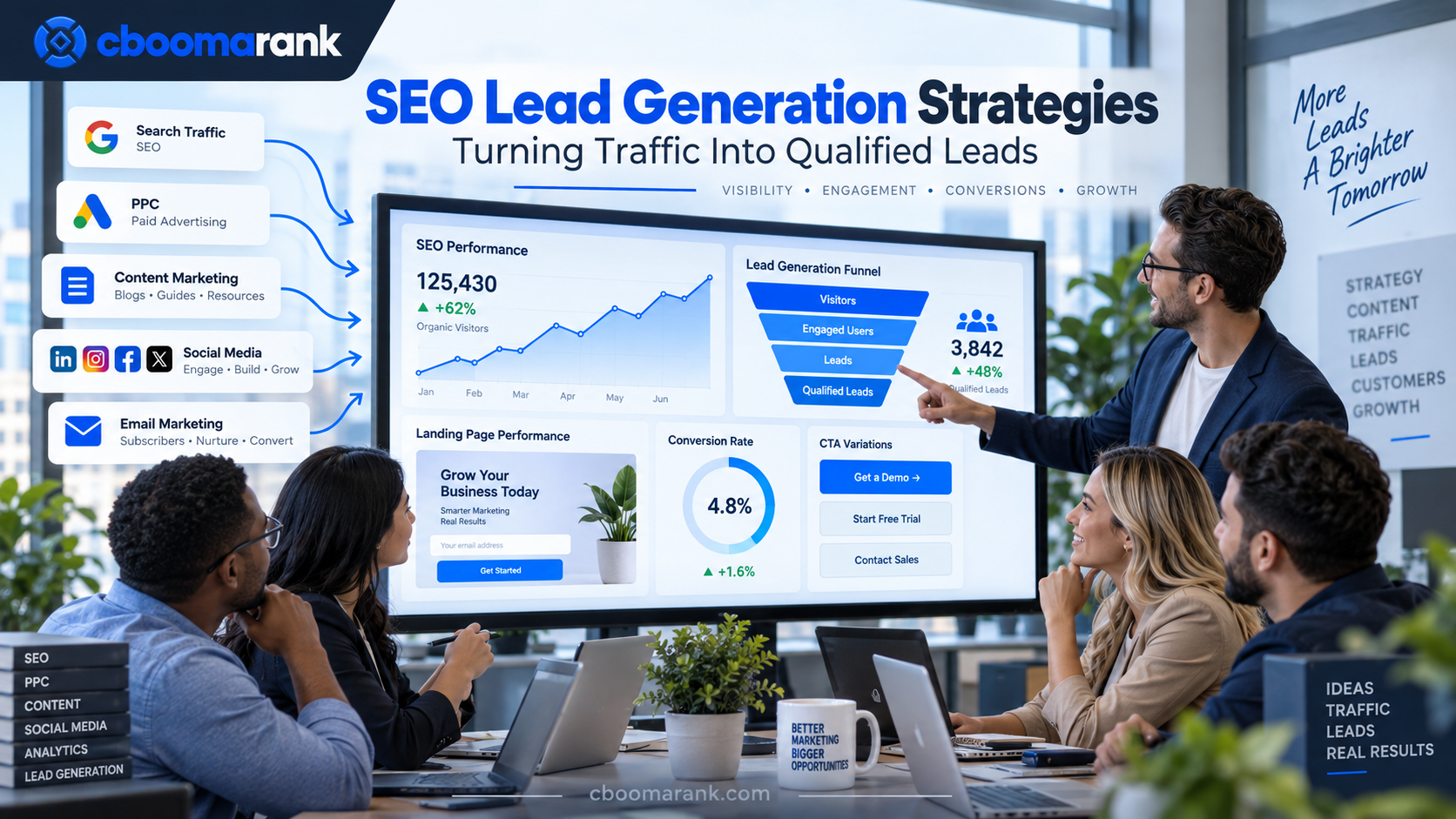
SEO Lead Generation: A Practical Workflow
A repeatable SEO lead generation workflow can be organized into six stages:
Research relevant keywords, questions and commercial search patterns.
Assign searches to informational, commercial or transactional page types.
Create resources that genuinely satisfy the underlying search need.
Improve internal linking, useful citations and relevant external signals.
Match offers and CTAs to the visitor’s stage and intent.
Connect acquisition data with qualified leads, opportunities and customers.
How to Measure Lead Generation Performance
A complete lead-generation dashboard should not rely on a single metric. Monitor acquisition, conversion, qualification and revenue together.
| Metric | What It Shows |
|---|---|
| Organic sessions | How much search-driven traffic reaches the site. |
| Conversion rate | The percentage of visitors completing the desired action. |
| Cost per lead | Acquisition cost for each captured lead. |
| Qualified-lead rate | How many leads meet agreed qualification standards. |
| Opportunity rate | How effectively qualified leads progress toward a sale. |
| Customer acquisition cost | Total acquisition cost required to gain a customer. |
| Pipeline or revenue | Commercial value produced by the acquisition system. |
Common Lead Generation Mistakes
High traffic does not guarantee qualified demand.
Offers should match the page and stage of the customer journey.
Forms, tables and buttons must work comfortably on smaller screens.
Competing URLs can weaken topical clarity and create keyword cannibalization.
Lead counts without qualification and revenue data can mislead decision-makers.
Strategic updates may recover performance without sacrificing established URL history.
Authoritative Lead Generation Resources
Google Search Central
Official guidance covering SEO fundamentals and search-friendly website practices.
Google Ads Help
Official documentation covering paid-search campaigns, bidding and conversion measurement.
Google Analytics Help
Official resources for understanding analytics, events, conversions and reporting.
Frequently Asked Questions About Lead Generation
What is the best lead generation strategy?
There is no universal best channel. The strongest strategy depends on customer intent, sales cycle, economics and market. Many businesses benefit from combining SEO for durable demand capture with paid media, email nurturing and conversion optimization.
Is SEO good for lead generation?
Yes, when SEO targets relevant search intent and the site provides a clear conversion path. SEO becomes much less valuable when traffic is treated as the final goal rather than the beginning of a customer journey.
How long does SEO lead generation take?
Timelines vary according to site authority, competition, technical health, content quality and market demand. SEO usually requires a longer investment horizon than paid advertising, although strong pages can continue attracting leads after the original publishing effort.
What is a qualified lead?
A qualified lead meets criteria that indicate a meaningful possibility of becoming a customer. Those criteria may include company fit, need, budget, authority, geography, product interest and buying timeframe.
How can I generate leads without paid advertising?
Organic search, useful content, email, partnerships, referrals, digital PR, communities, webinars and free tools can all generate leads without paying directly for each click. They still require time, expertise and operational investment.
How many lead generation channels should a business use?
Use enough channels to avoid excessive dependence on one source, but not so many that execution quality suffers. Start with the channels most closely aligned with customer behavior, measure them well and expand deliberately.
Build a Lead Generation System, Not Just More Traffic
The most effective lead generation programs connect discovery, intent, conversion and measurement. SEO can attract durable demand, paid campaigns can capture urgent demand, content can educate prospects, and email or remarketing can support longer buying journeys. The value comes from connecting these activities into one measurable system.
CBOOMARANK helps businesses investigate search demand, keyword opportunities, competitor visibility and website performance so marketing decisions can begin with better data.
Build Your Next Lead Generation Campaign with Better Search Data
Research keywords, analyze competitors and identify SEO opportunities before deciding where to invest your content and acquisition budget.
