

Introduction
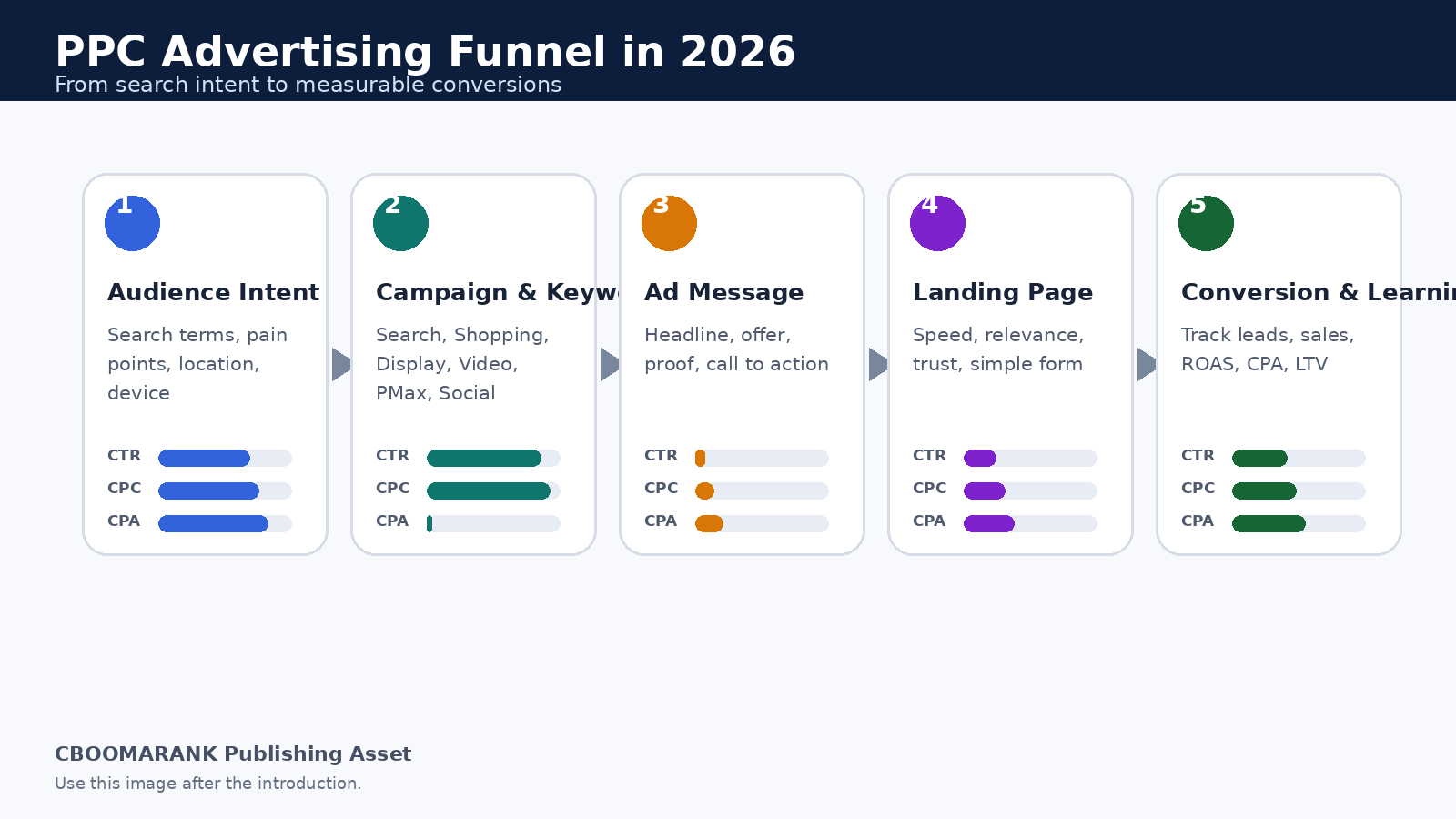
PPC advertising is one of the fastest ways to put your business in front of people who are already searching, browsing, comparing products, or ready to buy. Unlike organic SEO, which can take months to mature, pay-per-click campaigns can start sending visitors as soon as your ads are approved and your budget is active.
But PPC is not simply a matter of turning on ads and waiting for sales. Successful campaigns require clear goals, accurate conversion tracking, relevant keywords, persuasive ad copy, strong landing pages, disciplined budgeting, and continuous optimization. Without that structure, a business can spend a lot of money on clicks that never become leads or customers.
This updated guide explains how PPC advertising works in 2026, the major campaign types, typical pricing models, campaign setup steps, Google Ads automation features, click-fraud precautions, and best practices for improving return on ad spend. It is written for beginners, small businesses, and growing brands that want a practical roadmap before investing heavily in paid traffic.
Table of Contents
- What Is PPC Advertising?
- Why PPC Matters for Businesses
- Main Types of PPC Campaigns
- PPC Pricing Models and Rates
- Pros and Cons of PPC Advertising
- How to Create a PPC Campaign
- Google Ads and AI Automation in 2026
- Keyword Research, Match Types and Negative Keywords
- Ad Copy, Landing Pages and Conversion Tracking
- Budgeting, Bidding and Optimization
- PPC Alternatives and Multi-Channel Strategy
- Click Fraud and Invalid Traffic Prevention
- PPC Best Practices Checklist
- FAQ
- Internal and External Links
What Is PPC Advertising?
PPC stands for pay-per-click. It is a digital advertising model where an advertiser pays when someone clicks an ad. The ad may appear on a search engine results page, a website, a mobile app, a social feed, a video platform, a shopping result, or another digital placement depending on the ad network and campaign type.
In search advertising, PPC usually starts with user intent. A person searches for something like ‘best accounting software for small business’ or ’emergency plumber near me.’ Advertisers bid to appear for relevant searches, and the platform decides which ads to show based on factors such as bid, ad relevance, landing page quality, expected performance, and policy eligibility.
The original CBOOMARANK article introduced PPC as a way to target specific audiences, drive traffic, generate leads, and increase conversions. This rewrite expands that foundation with updated 2026 guidance for Google Ads, AI-driven campaign types, tracking, budgeting, and safe optimization.
Why PPC Matters for Businesses
PPC matters because it can connect your offer with buyers at the moment they are actively researching a solution. A local service company can appear for urgent searches, an ecommerce store can show product ads, a SaaS company can target comparison keywords, and a B2B brand can reach decision-makers through search, display, video, and social advertising.
The biggest advantage of PPC is speed. SEO builds long-term visibility, while PPC can produce measurable traffic immediately. The strongest businesses often use both: SEO for compounding organic growth and PPC for controlled demand capture, retargeting, launch campaigns, seasonal offers, and testing new markets.
PPC also gives marketers measurable feedback. You can track impressions, clicks, cost per click, conversion rate, cost per acquisition, return on ad spend, and revenue. That data helps businesses understand which messages, offers, keywords, audiences, and landing pages are worth scaling.
Main Types of PPC Campaigns
Different PPC campaign types serve different goals. Beginners should not run every campaign type at once. Start with the format that best matches your customer journey, then expand after tracking is reliable.
| Campaign Type | Best For | How It Works | Beginner Recommendation |
| Search Ads | High-intent leads and sales | Text ads appear when users search relevant terms. | Start here if people already search for your product or service. |
| Shopping Ads | Ecommerce product sales | Product listings show images, prices and product information. | Use when product feed quality and pricing are competitive. |
| Display Ads | Awareness and remarketing | Visual ads appear across websites, apps and placements. | Use carefully; segment remarketing separately from cold awareness. |
| Video Ads | Brand awareness and education | Video creative appears on YouTube and video placements. | Best when you have strong creative and a clear audience. |
| Social Ads | Audience targeting and demand creation | Ads appear in social feeds based on audience signals. | Useful for visual products, offers, and retargeting. |
| Performance Max | Cross-channel automated reach | A goal-based campaign can access Google Ads inventory from one campaign. | Use after conversion tracking and creative assets are ready. |
| Remarketing | Re-engaging previous visitors | Shows ads to users who previously visited or engaged. | Strong for ecommerce, lead generation and long sales cycles. |
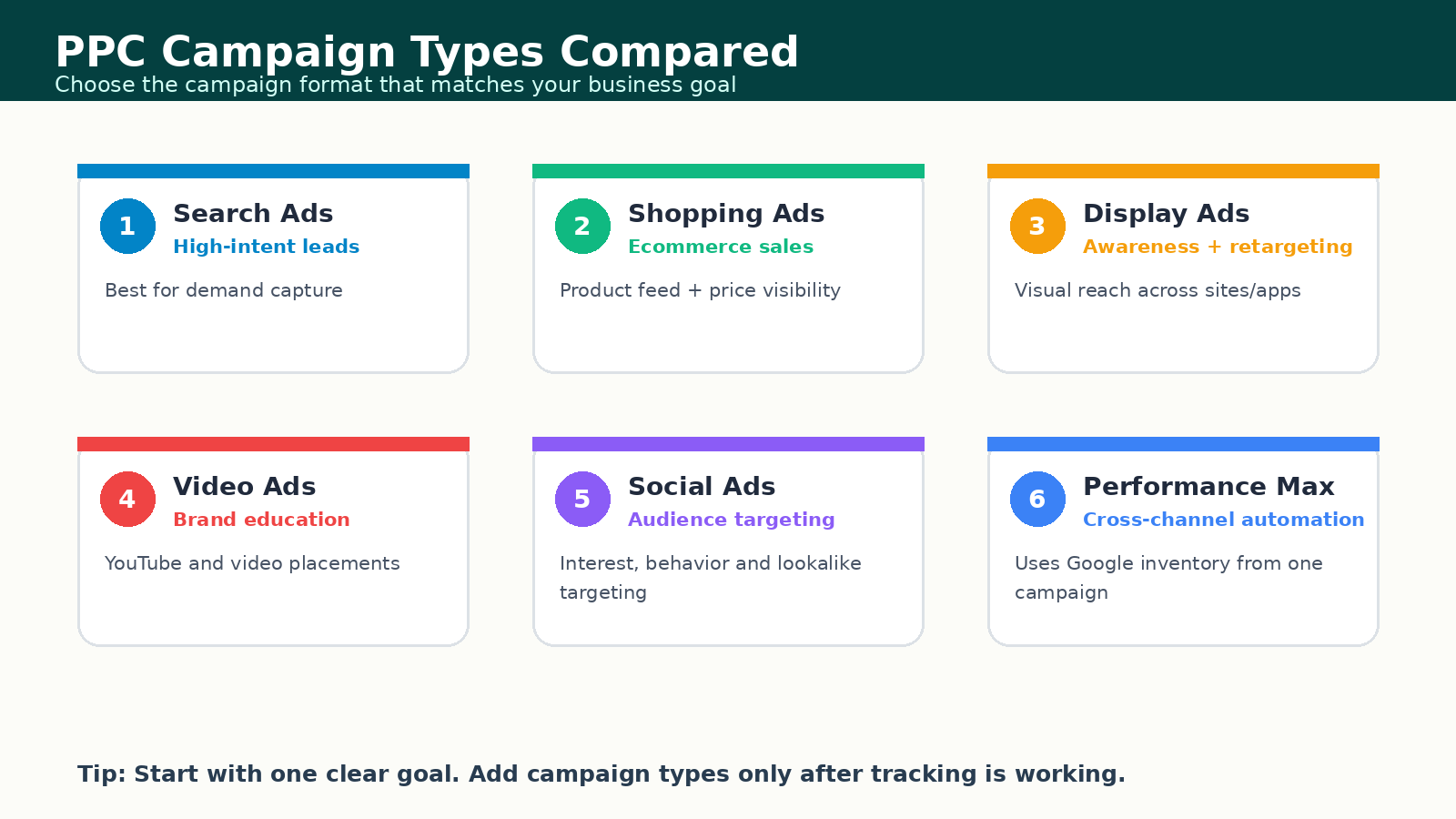
Supporting image: PPC campaign types compared
ALT text: Comparison of PPC campaign types including search ads, shopping ads, display ads, video ads, social ads, and Performance Max.
PPC Pricing Models and Rates
PPC cost depends on platform, industry, competition, targeting, keyword intent, bidding strategy, landing page quality, conversion rate, and daily budget. A competitive legal, finance, insurance, SaaS, or hosting keyword can cost far more than a low-competition local or informational keyword.
The most common pricing model is cost per click, where you pay when someone clicks your ad. However, not all paid media uses the same model. Display and awareness campaigns may use cost per thousand impressions, video campaigns may use video-view or reach-based bidding, and some networks support cost-per-action or conversion-focused bidding.
| Pricing Model | Meaning | Best Use Case | Watch Out For |
| CPC | Cost per click | Search ads, lead generation, shopping campaigns | High CPC keywords can drain budget without strong conversion tracking. |
| CPM | Cost per thousand impressions | Brand awareness, display, video, programmatic | Cheap impressions do not always mean quality traffic. |
| CPA | Cost per acquisition/action | Lead generation and sales campaigns | Requires enough conversion data to optimize well. |
| ROAS | Return on ad spend bidding | Ecommerce and revenue-tracked campaigns | Needs accurate purchase value tracking. |
| Agency Management Fee | Fee paid to manage campaigns | Businesses outsourcing PPC strategy | Ask what is included: setup, optimization, reporting, creative, tracking. |
Pros and Cons of PPC Advertising
| Pros | Cons |
| Fast visibility and traffic after launch. | Costs can rise quickly in competitive industries. |
| Strong targeting by keywords, location, device, audience and intent. | Poor tracking can make ROI look better or worse than reality. |
| Budget control through daily budgets and bid strategies. | Requires ongoing optimization, testing and maintenance. |
| Measurable performance across clicks, leads, sales and revenue. | Click fraud or invalid traffic can waste spend if not monitored. |
| Useful for testing offers, landing pages and market demand. | Ads stop when budget stops, unlike SEO content that can compound over time. |
How to Create a PPC Campaign
A campaign should be built around a measurable business goal, not around random keywords. Use the steps below as a beginner-friendly setup workflow.
- Define the business goal: leads, sales, calls, bookings, trials, store visits, app installs or brand awareness.
- Choose the platform and campaign type that matches the goal.
- Set up conversion tracking before scaling spend.
- Research keywords, audiences and competitors.
- Build tightly themed ad groups or asset groups.
- Write ads that match search intent and include a clear offer.
- Create landing pages that continue the promise made in the ad.
- Start with a controlled budget and collect clean data.
- Review search terms, negative keywords, locations, devices, assets and landing-page performance.
- Scale winners gradually while pausing or improving weak segments.
Google Ads and AI Automation in 2026
Google Ads has become more automated, especially through campaign types and settings such as Performance Max and AI Max for Search campaigns. Google describes Performance Max as a goal-based campaign type that lets advertisers access Google Ads inventory from a single campaign. That can be useful when conversion tracking, creative assets, audience signals and feed data are strong.
AI Max for Search campaigns is not a separate campaign type. Google describes it as an optimization layer for existing Search campaigns that can help expand matching, personalize assets and improve reporting. Beginners should treat AI automation as a multiplier, not a replacement for strategy. Bad conversion tracking, weak landing pages and unclear offers can still lead to poor results even when automation is enabled.
The safest approach is to give the platform clean data. That means tracking real business outcomes, excluding irrelevant traffic, providing strong creative assets, using accurate product feeds, and reviewing search terms and campaign insights regularly.
Keyword Research, Match Types and Negative Keywords
Keyword research is the foundation of search PPC. Use keywords to understand how customers describe their problems, compare solutions and express buying intent. Google Keyword Planner can help advertisers discover keyword ideas and view estimates related to searches and costs.
Beginner campaigns should separate high-intent keywords from research-stage keywords. Someone searching ‘buy CRM software for small business’ is closer to conversion than someone searching ‘what is CRM.’ Both may be valuable, but they deserve different bids, ads and landing pages.
Negative keywords are just as important as target keywords. They prevent ads from showing for irrelevant searches. For example, a premium agency may add negative keywords such as free, jobs, course or template if those terms attract traffic that is unlikely to convert.
Ad Copy and Creative Assets
Good PPC ads are clear, specific and aligned with the searcher’s intent. The headline should reflect the user’s problem or goal. The description should explain the value proposition, proof point and next step. Generic claims like ‘best service’ are weaker than specific benefits such as ‘Get a free PPC audit in 24 hours’ or ‘Reduce wasted ad spend with certified campaign management.’
For automated campaigns, creative quality matters even more because the platform may combine assets in different ways. Provide multiple headlines, descriptions, images, logos and videos where applicable. Review asset performance and replace weak assets regularly.
Always make sure the landing page matches the ad. If an ad promises a pricing guide, the page should show pricing information quickly. If the ad promotes an ecommerce discount, the product page should display the offer clearly.
Landing Page Optimization
A PPC campaign is only as strong as its landing page. A high click-through rate does not matter if visitors bounce or fail to convert. Landing pages should be fast, mobile-friendly, relevant to the ad, easy to scan, and focused on one primary action.
Useful landing page elements include a clear headline, persuasive subheadline, benefit bullets, proof such as reviews or case studies, a visible call to action, trust badges, FAQs, and short forms. Remove distractions that pull visitors away from the conversion goal.
Test one major change at a time: headline, offer, form length, call-to-action copy, page speed, social proof, or layout. The goal is to reduce cost per conversion, not just increase traffic.
Conversion Tracking and Measurement
Conversion tracking is essential because it shows which ads, keywords, listings and campaigns produce meaningful actions. Google Ads documentation explains that conversion tracking can help identify which ads, listings and keywords are most successful for a business.
Common PPC conversions include form submissions, phone calls, purchases, booked appointments, demo requests, newsletter signups, app installs and offline sales imports. Ecommerce campaigns should track purchase value so return on ad spend can be measured accurately.
Do not rely only on clicks. A campaign with cheap clicks can still be unprofitable if the traffic does not convert. Track conversion rate, cost per conversion, lead quality, revenue, ROAS and lifetime value wherever possible.
Budgeting, Bidding and Optimization
A beginner PPC budget should be large enough to collect useful data but controlled enough to avoid waste. Start with a test budget, focus on a small set of high-intent keywords or audiences, and expand only after you know which segments convert.
Bidding strategy should match your data maturity. New campaigns may need manual or simpler automated bidding until enough conversion data exists. More advanced bidding strategies work best when conversion tracking is accurate and the account has enough volume.
Optimization is an ongoing cycle: review search terms, add negative keywords, improve ad relevance, test landing pages, adjust locations and devices, improve creative assets, review conversion quality and shift budget toward profitable segments.
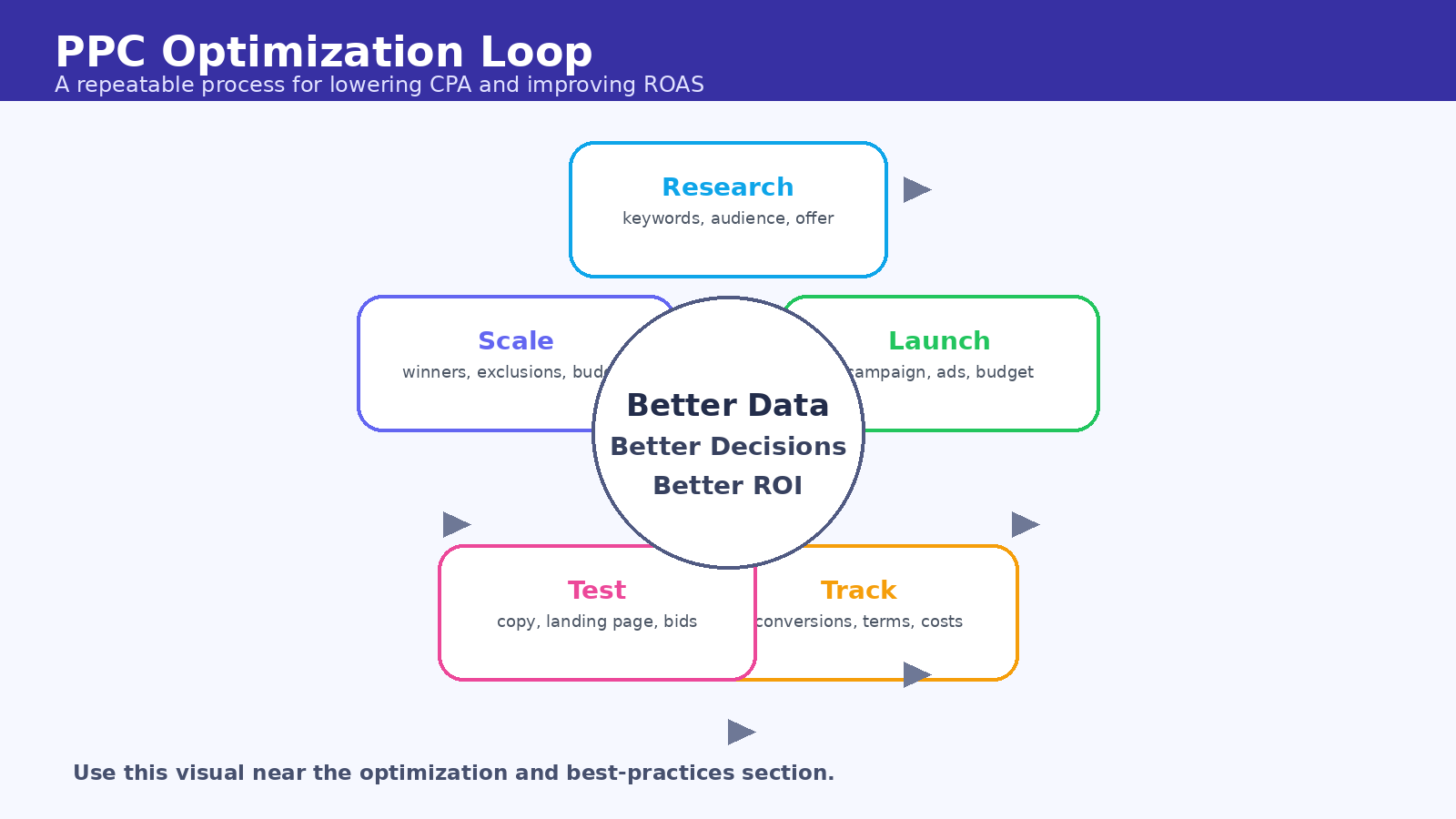
Supporting image: PPC optimization loop
ALT text: PPC optimization loop showing research, launch, tracking, testing, and scaling for better campaign ROI.
| Metric | What It Means | How to Use It |
| CTR | Click-through rate | Measures ad relevance and appeal. Improve headlines and match intent. |
| CPC | Cost per click | Shows how much traffic costs. Manage bids and keyword quality. |
| CVR | Conversion rate | Shows landing page and offer effectiveness. Improve page relevance and trust. |
| CPA | Cost per acquisition | Shows lead or sale cost. Compare against profit margin and customer value. |
| ROAS | Revenue divided by ad spend | Important for ecommerce and revenue-tracked campaigns. |
| Impression Share | Share of eligible impressions received | Useful for budget and competitive diagnostics. |
PPC Alternatives and Multi-Channel Strategy
PPC is powerful, but it should not be the only marketing channel. Businesses can combine PPC with SEO, content marketing, email marketing, social media, influencer campaigns, affiliate marketing, native advertising and conversion rate optimization.
SEO helps build long-term organic visibility. Email marketing nurtures leads after the first click. Content marketing educates buyers before they are ready to purchase. Social ads can create demand and retarget engaged users. PPC works best when these channels support one another.
For example, a CBOOMARANK reader might discover a brand through an SEO blog post, return through a remarketing ad, compare services through a PPC landing page, and convert after receiving an email follow-up. The best strategy measures the full journey instead of treating each channel as isolated.
Click Fraud and Invalid Traffic Prevention
Invalid traffic includes clicks and impressions that do not come from genuine user interest. Google Ads documentation says invalid traffic is detected by monitoring systems, and advertisers should use targeted keywords and ad text to help ads show to genuinely interested customers.
Advertisers should still monitor unusual patterns. Warning signs include sudden click spikes from unexpected locations, very high click volume with no engagement, abnormal device or placement performance, suspicious referral sources, and conversion rates that collapse without explanation.
Prevention tactics include precise targeting, negative keywords, placement exclusions, IP exclusions where appropriate, conversion-quality monitoring, campaign segmentation, fraud detection tools, and regular account audits.
PPC Best Practices Checklist
Use this checklist before publishing or refreshing a PPC campaign:
- Define one primary business goal per campaign.
- Set up conversion tracking before increasing budget.
- Separate branded, non-branded, competitor and remarketing campaigns where needed.
- Use landing pages that match the ad promise.
- Add negative keywords during setup and after launch.
- Review search terms and placements regularly.
- Use clear calls to action and specific offers.
- Check mobile experience and page speed.
- Compare CPA and ROAS against real business margins.
- Pause waste, test improvements and scale winners gradually.
Sample Beginner PPC Campaign Plan
| Step | Action | Example |
| Goal | Choose one measurable outcome | Generate consultation requests for a PPC management service. |
| Audience | Define buyer intent | Small businesses searching for Google Ads help. |
| Keywords | Start narrow | ppc agency, google ads management, ppc audit. |
| Landing Page | Match ad to offer | Free Google Ads account review landing page. |
| Tracking | Record lead submissions and calls | Google Ads conversion tag + GA4 event. |
| Budget | Begin with a test budget | Spend enough to evaluate, then increase after results. |
| Optimization | Review weekly | Search terms, CPC, CPA, conversion quality and landing page behavior. |
FAQ
What is PPC advertising?
PPC advertising is a digital advertising model where businesses pay when someone clicks their ad. Ads can appear on search engines, websites, apps, social platforms, video platforms and shopping results.
Is PPC good for beginners?
Yes, but beginners should start with a clear goal, small budget, tight targeting, reliable conversion tracking and a relevant landing page.
What is the difference between PPC and SEO?
PPC buys traffic through ads and can generate results quickly. SEO builds organic visibility over time and can continue attracting visitors without paying for each click.
How much does PPC cost?
PPC cost depends on industry, keywords, competition, platform, location, bidding strategy and conversion rate. Costs can range from low-cost awareness impressions to expensive high-intent search clicks.
What is CPC?
CPC means cost per click. It is the amount an advertiser pays when someone clicks an ad.
What is CPM or Pay-Per-Mille?
CPM means cost per thousand impressions. It is commonly used for awareness campaigns where advertisers pay for views rather than clicks.
What is Performance Max?
Performance Max is a Google Ads goal-based campaign type that can access Google Ads inventory from a single campaign.
What is AI Max for Search campaigns?
AI Max is an optimization layer within existing Google Ads Search campaigns. It uses Google AI to expand matching, personalize assets and support performance reporting.
How do I reduce wasted PPC spend?
Use focused targeting, negative keywords, conversion tracking, placement exclusions, landing-page improvements and regular search-term reviews.
Should businesses use PPC and SEO together?
Yes. PPC can generate immediate traffic and test offers, while SEO builds long-term organic visibility and reduces dependence on paid clicks over time.
Suggested Internal Links for CBOOMARANK
- CBOOMARANK Blog
- Pay Per Click Management
- Search Engine Optimization
- Local SEO
- Digital Marketing
- Best Free SEO Tools for Beginners
- SEO Pricing Guide
- Semrush vs Ahrefs
- Submit URL to Search Engines
