

A Practical 2026 Guide to Better Search Relevance, Stronger Landing Pages and Smarter Optimization
CBOOMARANK Publishing Guide • Updated September 2026
Introduction
Google Ads Quality Score is one of the most discussed metrics in paid search, but it is also one of the most misunderstood. Many advertisers treat it like a target in itself, chase perfect 10/10 scores, or assume that increasing bids is the fastest way to improve it. In reality, Quality Score is best used as a diagnostic signal that helps you understand whether your keyword, ad and landing page are working together well for the user.
According to Google Ads Help, Quality Score is a diagnostic tool available at the keyword level on a 1–10 scale. It is based on the combined performance of three components: expected clickthrough rate, ad relevance and landing page experience. Google also notes that Quality Score is not an input in the ad auction and is not a KPI that should be aggregated with the rest of your performance data. That means it is useful, but it should be read alongside business metrics such as clicks, conversion rate, CPA, ROAS and lead quality.
If you want to improve Quality Score, the goal is not to ‘hack’ the score. The goal is to make your campaigns more relevant, more useful and more aligned with what the searcher wants. When those things improve, Quality Score often improves as a by-product.
What Quality Score Actually Measures
Quality Score exists to give you a sense of how your ads compare with other advertisers showing for the same searches. A higher score generally indicates that your ad and landing page are more relevant and useful for the keyword than competing experiences.
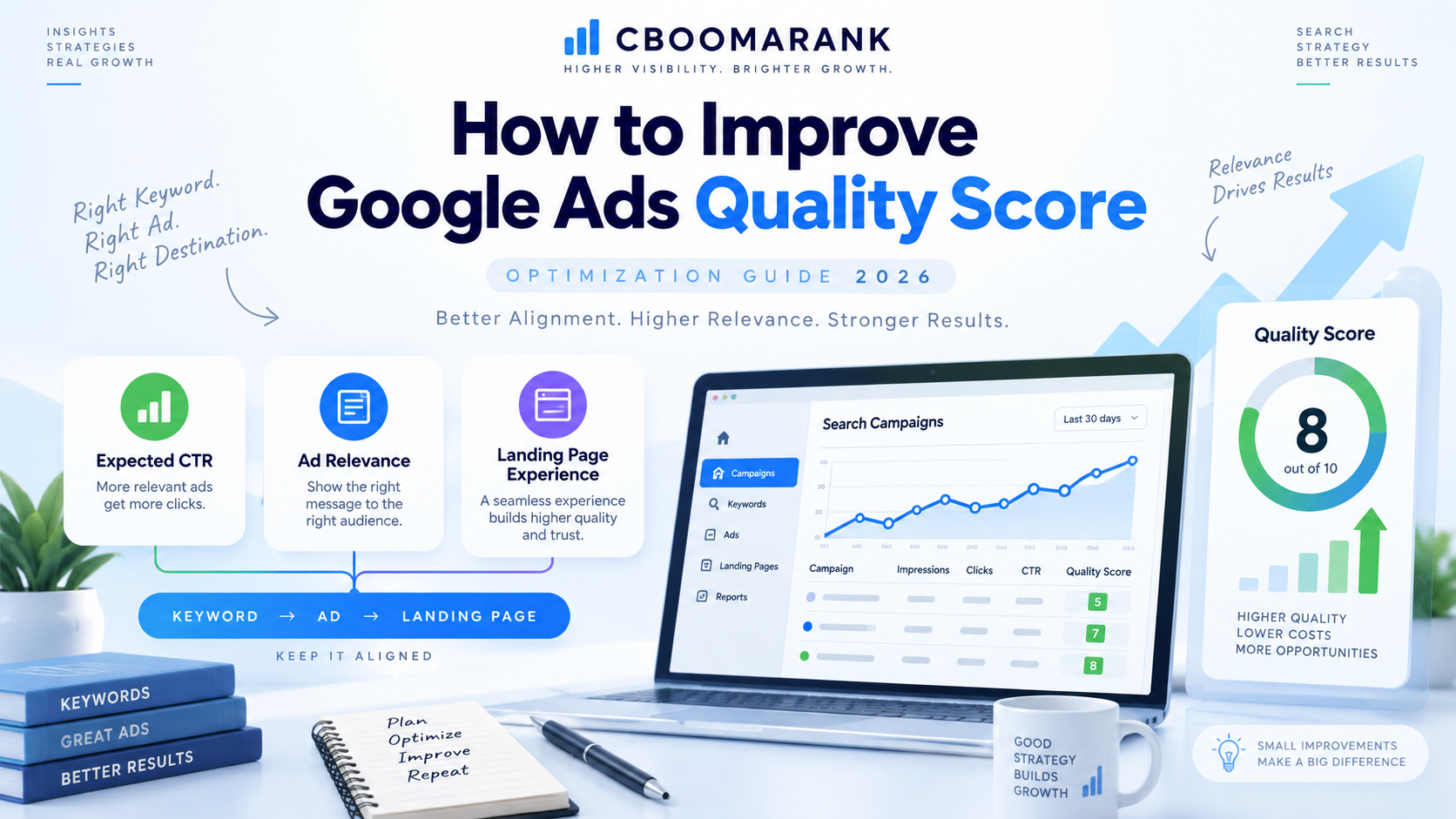
Google calculates Quality Score using three core components. Each component is labeled Above average, Average or Below average, based on how your ads performed against other advertisers on the exact same search over the last 90 days. That comparison is useful because it helps you see where the problem really is instead of making random campaign changes.
The Three Quality Score Components
| Component | Meaning |
| Expected CTR | Google’s estimate of how likely your ad is to be clicked when it is shown for a keyword. |
| Ad Relevance | How closely your ad copy and offer match the intent behind the keyword. |
| Landing Page Experience | How useful, relevant and easy-to-use the destination page is for the person who clicked the ad. |
How to Check Quality Score in Google Ads
You can review Quality Score directly in the Search keywords table. Google says you can click the Columns icon, open the Quality Score section, then add Quality Score together with Landing Page Exp., Exp. CTR and Ad Relevance. You can also add historical versions of these columns to compare how the scores have changed over time.
This is important because a total Quality Score number alone does not tell you what to fix. A 5/10 score caused by low ad relevance needs a different solution than a 5/10 score caused by a weak landing page. The component columns help you identify the exact bottleneck.
Important Quality Score Truths to Remember
- Quality Score is a diagnostic tool, not a performance KPI.
- Quality Score is not an input in the ad auction.
- Changing keyword match type alone does not directly change Quality Score.
- A good score is useful, but it matters less than profitable clicks and conversions.
- Improvements come from better relevance, better user experience and cleaner targeting — not from cosmetic account changes alone.
Step-by-Step: How to Improve Google Ads Quality Score
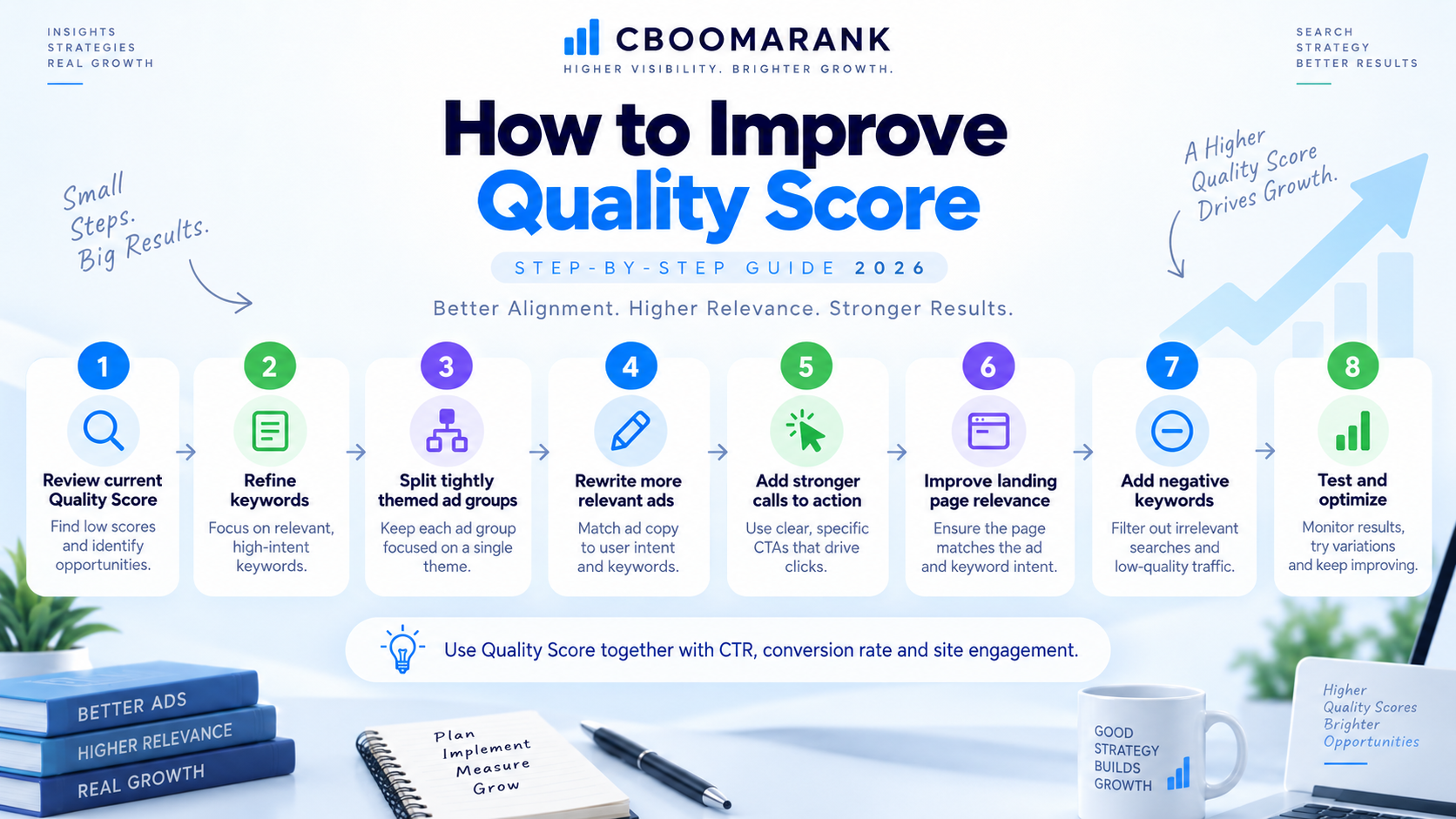
1. Review current Quality Score and component status
Start by sorting keywords by Quality Score and then looking at the component columns. Find which themes have low scores and note whether the weakness comes from expected CTR, Google Ads Quality Score, ad relevance or landing page experience. This first diagnosis saves time and prevents you from making changes in the wrong place.
2. Tighten keyword targeting
Many poor scores begin with loose or low-intent keywords. Remove terms that do not match your offer well. Split broad mixed lists into smaller keyword themes. If you sell agency SEO software, a keyword like ‘SEO jobs’ is irrelevant, while ‘SEO software for agencies’ is highly aligned. Cleaner keyword targeting improves both ad relevance and click quality.
3. Split keywords into tightly themed ad groups
Google’s own best practices emphasize tightly themed ad groups because they make it easier to write ads that directly match the search. Avoid putting many different intentions inside one ad group. For example, ‘free SEO checker,’ ‘enterprise SEO platform’ and ‘keyword tracking tool’ should not all live together. Separate themes make your ads more specific and usually help expected CTR as well.
4. Rewrite ads to mirror search intent
If ad relevance is Average or Below average, one of the fastest fixes is to make your ad copy more directly reflect the keyword and the user’s intent. Use the language that searchers use. Highlight the offer that best answers the query. If the keyword is ‘Google Ads audit service’, the ad should clearly mention a Google Ads audit, not just generic digital marketing support.
5. Improve headlines, offers and calls to action
Expected CTR often improves when the ad becomes more compelling. Test stronger value propositions such as free consultation, transparent pricing, faster setup, expert support or a demo. Strong calls to action such as ‘Book a Demo’, ‘Get a Free Audit’ or ‘Start Your Trial’ can improve click appeal when they match the intent of the search.
6. Strengthen landing page relevance and consistency
The page should continue the promise made in the ad. Google advises advertisers to ensure the landing page matches the user search and to keep messaging consistent from the ad to the page. If the ad promotes affordable CRM software for small businesses, the landing page should immediately show that product, audience and offer — not a vague homepage that forces the user to search for the right information.
7. Improve page usability, clarity and speed
Landing page experience is not only about message match. The page should also be useful and easy to navigate. Reduce clutter, make the next step obvious, improve mobile usability, ensure forms are easy to use and avoid slow-loading pages or distracting popups. A clean user experience helps both Quality Score and conversion rate.
8. Add negative keywords and refine search traffic
Irrelevant impressions hurt the quality of the traffic entering your campaigns. Use the Search terms report to identify unwanted queries and add negative keywords where needed. This makes your keywords more focused, your ads more relevant and your performance data cleaner.
9. Test continuously instead of changing everything once
Strong advertisers do not guess; they test. Create new ad variants, compare landing-page versions and track how changes affect expected CTR, engagement and conversion rate. Quality Score often moves gradually as historical performance improves, so give meaningful tests enough time before deciding what worked.
A Troubleshooting Framework
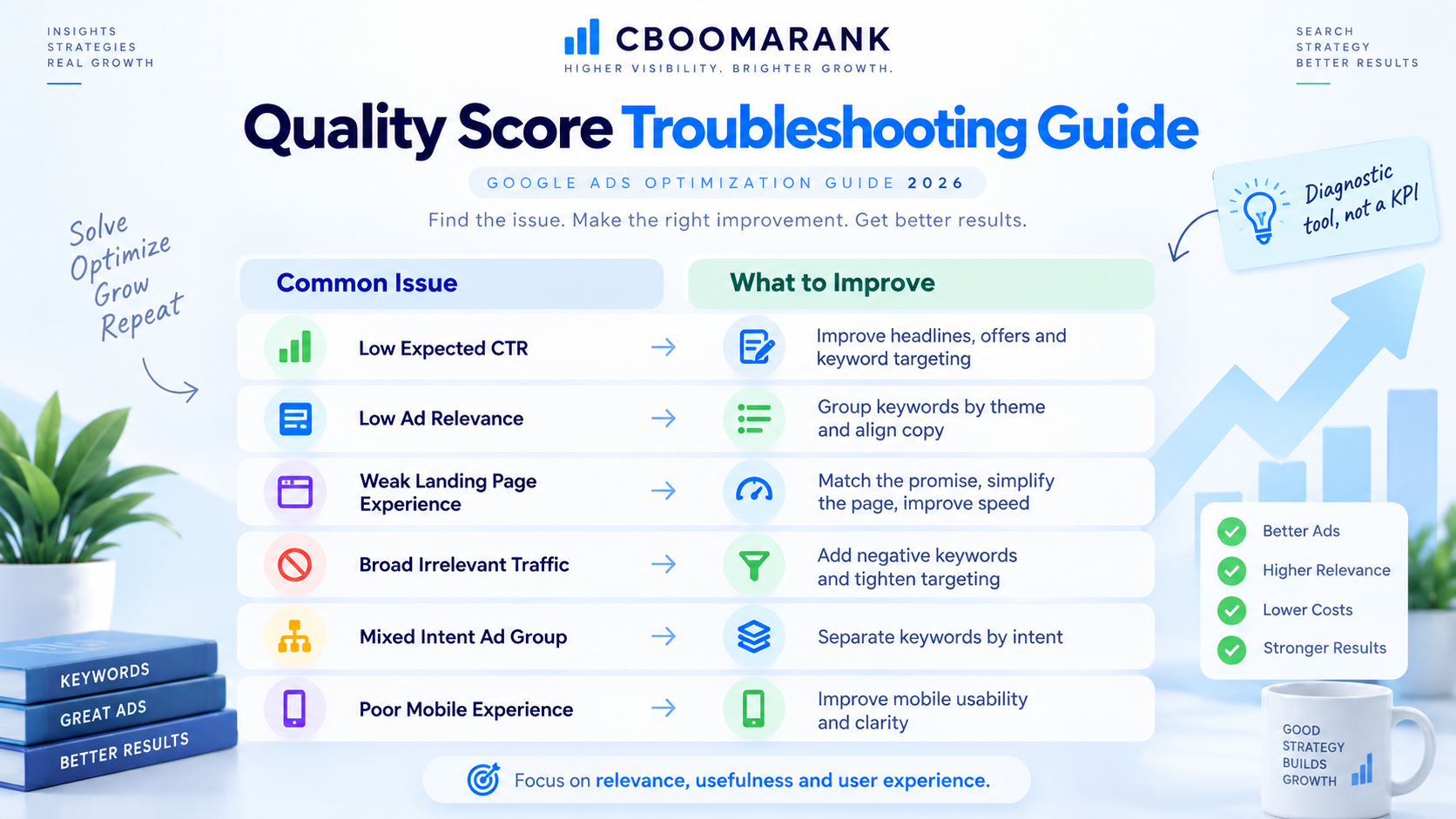
| If You See This Problem | Focus Here |
| Low Expected CTR | Improve headlines, offers, calls to action and the relevance of keyword targeting. |
| Low Ad Relevance | Split ad groups by theme and rewrite ads to match the keyword and user intent. |
| Weak Landing Page Experience | Make the landing page more relevant, clearer, faster and easier to use. |
| Irrelevant Search Traffic | Add negative keywords and tighten targeting. |
| Mixed-Intent Ad Group | Separate keywords by intent so one ad can better answer each search. |
| Poor Mobile Experience | Simplify the page, improve readability and remove friction on smaller screens. |
How to Improve Expected CTR
Expected CTR measures the likelihood that your ad will be clicked when it appears. If this component is weak, focus on making the ad more compelling and more aligned with what the searcher wants to see.
Practical ways to improve expected CTR include using stronger headlines, mentioning the exact problem or solution in the ad, testing clearer calls to action, highlighting benefits that matter to the audience and ensuring the keyword theme is tight enough for the ad to feel highly relevant.
Google also notes that advertisers can improve clickthrough rate by editing ad text to make the offer more compelling and ensuring the ad details match the intent of the keywords.
How to Improve Ad Relevance
Ad relevance is usually a structure-and-copy issue. If different keyword themes are stuffed into the same ad group, the ad cannot speak clearly to each search. The fix is to separate themes and write ads that directly match the language and intent of those terms.
Use keyword-specific headlines where natural, align descriptions with the offer, and avoid vague copy that could apply to any search. Relevance improves when the ad feels like a precise answer rather than a generic promotion.
How to Improve Landing Page Experience
Landing page experience improves when the destination page is both relevant and useful. That means the page should match the promise of the ad, answer the user’s intent quickly and make the next action easy.
Common landing-page improvements include tighter message match, better page hierarchy, clearer proof points, stronger above-the-fold clarity, faster load times, simpler forms, cleaner mobile layouts and fewer distractions.
Remember that a beautifully designed page can still underperform if it does not connect directly to the search intent. Relevance and usability matter together.
Common Myths About Quality Score
Myth 1: Higher bids improve Quality Score
Bids can influence visibility and auction behavior, but Quality Score itself is a diagnostic based on expected CTR, ad relevance and landing page experience.
Myth 2: A 10/10 Quality Score guarantees strong profitability
A high score is helpful, but it does not guarantee a strong CPA, ROAS or lead quality. Business metrics still come first.
Myth 3: Account structure tricks alone improve Quality Score
Google has explained that purely administrative account structure changes do not matter unless they lead to a better user experience through more relevant ads or landing pages.
Myth 4: Match type changes directly increase Quality Score
Google states that Quality Score is based on historical impressions for exact searches, so changing match types does not directly change the score.
What to Measure Alongside Quality Score
Quality Score is more useful when read next to real business metrics. Google specifically advises using it with other metrics such as clickthrough rate, conversion rate and site engagement.
At minimum, review Quality Score together with impressions, CTR, conversion rate, cost per conversion, lead quality, bounce/engagement signals and landing-page performance. A rising Quality Score that does not improve business outcomes is not enough.
30-Day Quality Score Improvement Plan
Days 1–3: Audit
Export Search keywords, add Quality Score columns, identify low-scoring themes and isolate the problem component.
Days 4–7: Restructure
Split mixed ad groups, remove weak keywords and add obvious negative keywords.
Week 2: Rewrite ads
Create new responsive search ad variations with stronger keyword alignment, clearer offers and better CTAs.
Week 3: Improve landing pages
Update message match, tighten headlines, improve page clarity, test mobile usability and reduce friction.
Week 4: Optimize from data
Review search terms, CTR, conversion rate and component changes. Expand what works and pause what does not.
Frequently Asked Questions
What is a good Google Ads Quality Score?
Many advertisers treat 7–10 as strong, but the best score is one that comes with profitable performance. A 6/10 keyword that converts well may be more valuable than a 10/10 keyword that does not generate real business results.
Can Quality Score lower my costs?
Higher ad quality can support better efficiency because more relevant ads and landing pages often create stronger performance signals. However, you should view this through actual CPC, CPA and ROAS outcomes rather than assuming the score alone will reduce costs.
How long does it take to improve Quality Score?
Because Quality Score reflects historical performance, improvements are often gradual. Some changes may help quickly, but meaningful movement usually comes after the account collects better data over time.
Should I pause all low Quality Score keywords?
Not automatically. First determine whether the keyword is strategically important and whether the problem is fixable. Some low-score keywords can become productive after better ad and landing-page alignment.
Final Verdict
The fastest way to improve Google Ads Quality Score is to stop treating it as a mystery. Every low score points back to one of three causes: people are not clicking as often as expected, the ad does not feel relevant enough, or the landing page is not useful enough for the search.
Fix those causes systematically. Tighten keyword targeting. Build tighter ad groups. Write better ads. Make the landing page clearly continue the promise of the ad. Remove irrelevant traffic with negative keywords. Then judge progress with both Quality Score and real business outcomes.
That is the CBOOMARANK approach: better alignment, higher relevance and stronger performance.
Suggested Categories and Tags for Publishing
Suggested Categories:
- Google Ads
- PPC Advertising
- Search Engine Marketing
- Digital Advertising
Suggested Tags:
- Google Ads
- Quality Score
- PPC
- SEM
- expected CTR
- ad relevance
- landing page experience
- Search campaigns
- keyword targeting
- landing page optimization
Recommended CBOOMARANK Internal Links
- How to Create High-Converting Google Search Ads
- Keyword Research for Google Ads
- Google Display Ads: Best Practices
- Google Shopping Ads Setup Guide
- Google Ads Beginner’s Guide for 2026
- PPC Advertising Ultimate Guide
- CBOOMARANK Blog
