

AI search is changing how people discover products, software, services and brands. A buyer may now ask ChatGPT for the best SEO software, use Google AI Mode to compare providers, ask Perplexity for recommendations, or rely on an AI Overview before visiting a traditional search result.
That creates a new measurement problem for marketers: How visible is your brand inside AI-generated answers?
AI visibility tools are designed to answer that question. They monitor prompts across AI search engines, record brand mentions and citations, compare your share of voice with competitors, identify the pages AI systems cite, and increasingly help teams understand what they need to improve.
In this guide, CBOOMARANK compares eight of the strongest AI visibility platforms available in 2026: Semrush AI Visibility, Ahrefs Brand Radar, SE Ranking/SE Visible, Profound, Peec AI, Otterly.AI, Scrunch AI and Writesonic.
Quick verdict: Semrush is the strongest all-round choice for teams that want traditional SEO and AI visibility together. Ahrefs is particularly powerful for large-scale discovery and citation research. SE Ranking offers a strong balance for agencies and operational SEO teams. Profound is built for serious enterprise AEO programs. Peec AI provides a clean dedicated AI analytics experience. Otterly.AI is one of the most accessible starting points. Scrunch combines AI monitoring with site and agent-readiness analysis, while Writesonic connects AI visibility with content creation and optimization.
What Is an AI Visibility Tool?
An AI visibility tool monitors how a brand, product, website or competitor appears in responses generated by AI search and answer engines.
Depending on the platform, this can include ChatGPT, Google AI Overviews, Google AI Mode, Gemini, Perplexity, Microsoft Copilot, Claude and other emerging AI systems.
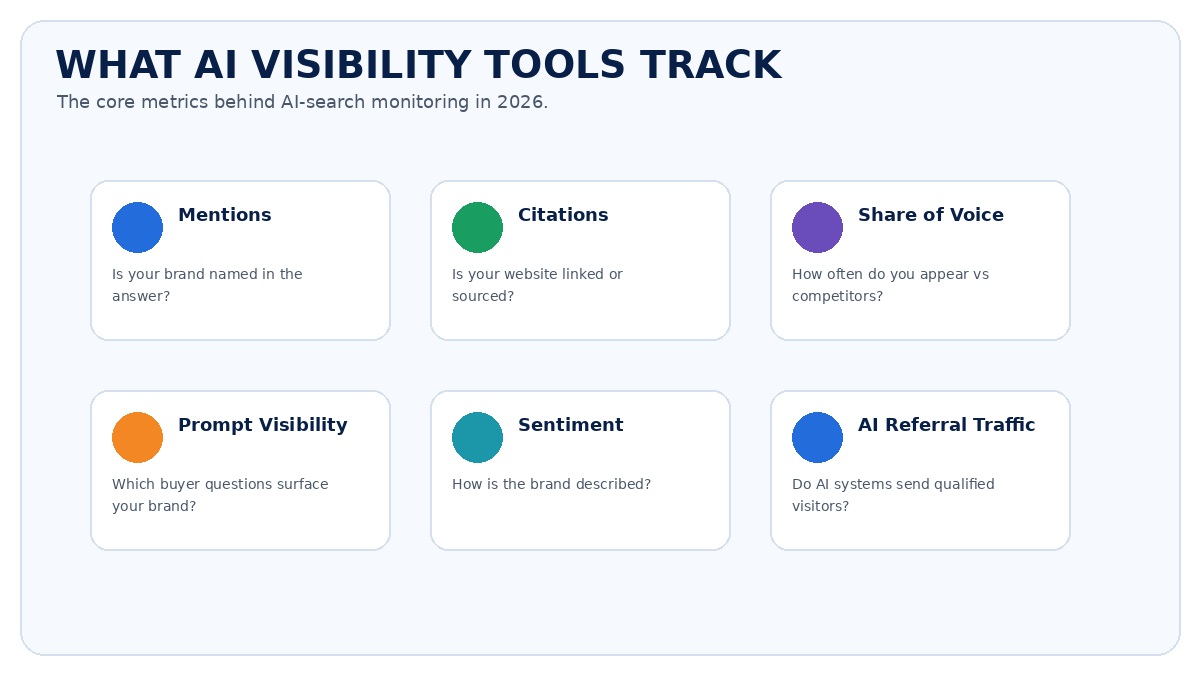
The most useful platforms go beyond simply telling you whether the brand appeared. They help measure:
- brand mentions;
- linked citations;
- AI share of voice;
- competitor visibility;
- prompt-level rankings;
- sentiment and positioning;
- cited pages and domains;
- AI search traffic;
- AI crawler activity;
- visibility changes over time.
This category is sometimes described as AI search monitoring, GEO software, AEO software, LLM visibility tracking or generative engine optimization software. The terminology is still evolving, but the commercial goal is the same: understand whether AI systems are surfacing your brand when buyers ask relevant questions.
Best AI Visibility Tools in 2026: Quick Comparison
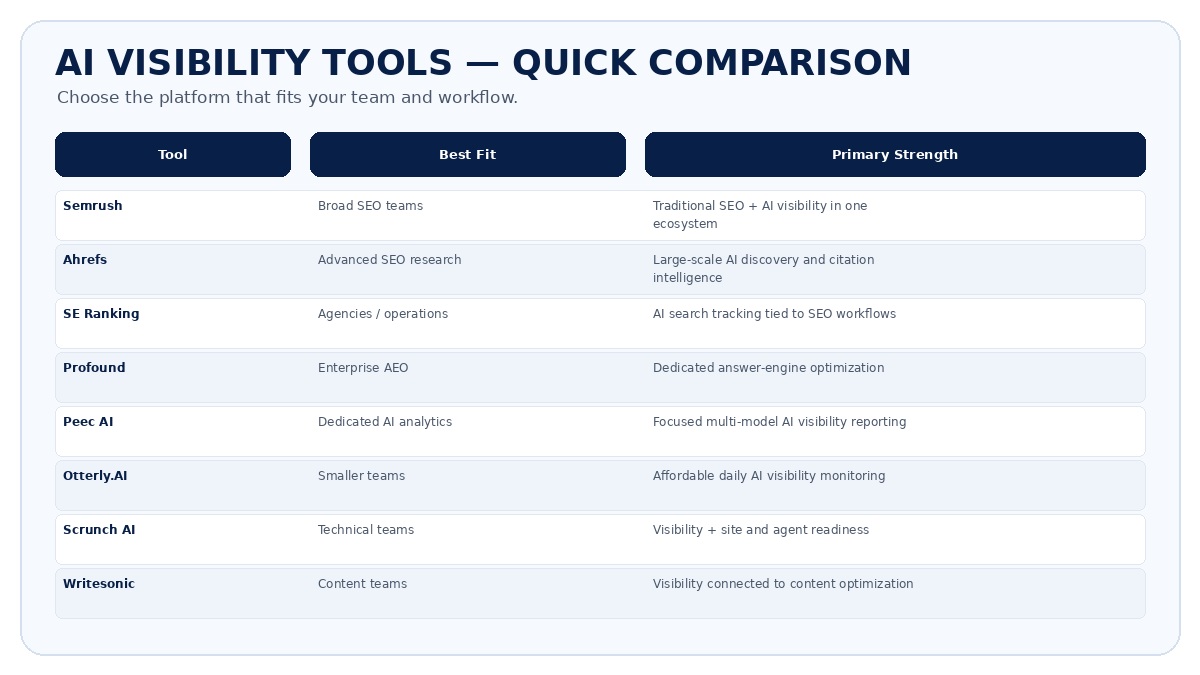
| Tool | Best For | AI Coverage | Starting Price* |
|---|---|---|---|
| Semrush AI Visibility | Best overall SEO + AI visibility ecosystem | ChatGPT, Google AI, Gemini, Perplexity and more | $99/mo billed annually |
| Ahrefs Brand Radar | Large-scale AI discovery and citation analysis | AI Overviews, AI Mode, ChatGPT, Perplexity, Gemini, Copilot | Custom prompts from $50/mo; AI index from $199/mo |
| SE Ranking / SE Visible | Agencies and SEO teams | AI Overviews, AI Mode, ChatGPT, Perplexity, Gemini | AI Search add-on from $89/mo |
| Profound | Enterprise AEO and AI search operations | Multiple answer engines by plan | $99/mo billed yearly |
| Peec AI | Dedicated AI search analytics | ChatGPT, AI Mode, AI Overviews, Copilot, Perplexity, Gemini and more | Plans vary by prompt/model volume |
| Otterly.AI | Affordable monitoring for smaller teams | ChatGPT, Google AI Overviews, Perplexity, Copilot; add-ons available | $29/mo |
| Scrunch AI | AI visibility + site/agent readiness | 4 engines on Core; up to 9 on Enterprise | $250/mo |
| Writesonic | AI visibility + content optimization | ChatGPT, Gemini, Google AI Overviews and broader agency coverage | $199/mo billed annually |
1. Semrush AI Visibility — Best Overall SEO + AI Visibility Platform
Semrush is one of the strongest choices for teams that do not want AI visibility to live in a separate analytics silo. Its current AI Visibility offering combines AI-search monitoring with the broader Semrush SEO ecosystem.
The dedicated AI Visibility Base plan currently starts at $99 per month per domain when billed annually. It includes AI visibility reporting, 25 custom prompts tracked daily, competitor analysis, prompt research and an AI-readiness site audit.
Semrush monitors mentions across platforms including ChatGPT, Google AI experiences, Gemini and Perplexity. Higher SEO + AI Search plans increase the number of prompts, domains and automation features available.
- AI visibility reports for any domain;
- custom prompt tracking;
- AI competitor research;
- prompt research;
- brand-performance analysis;
- AI-readiness auditing;
- integration with traditional SEO research, Site Audit and Position Tracking.
Best for: marketing teams that want one established platform for both traditional SEO and AI-search measurement.
See Semrush AI Visibility pricing.
2. Ahrefs Brand Radar — Best for AI Discovery and Citation Intelligence
Ahrefs Brand Radar takes a distinctive approach to AI visibility. Instead of relying only on a small user-defined prompt set, its AI Visibility Index maps brand presence across hundreds of millions of search-backed prompts.
Ahrefs says Brand Radar can analyze AI visibility across Google AI Overviews, Google AI Mode, ChatGPT, Perplexity, Gemini and Copilot. It measures mentions, citations and AI share of voice and helps identify which pages and domains appear as sources.
Ahrefs also supports custom prompt tracking for high-value buyer questions. Paid Ahrefs plans include a small daily prompt allowance, while larger custom-prompt packages and Brand Radar platform access can be purchased separately.
- AI share-of-voice benchmarking;
- brand mention monitoring;
- citation analysis;
- custom prompt tracking;
- AI source discovery;
- AI traffic and bot analytics;
- connections with SEO, YouTube, Reddit and other off-site visibility signals.
Best for: SEO teams that want AI visibility combined with deep backlink, competitor and organic-search intelligence.
3. SE Ranking / SE Visible — Best for Agencies and Operational SEO Teams
SE Ranking has expanded aggressively into AI-search monitoring through its AI Search capabilities and SE Visible product.
The AI Search add-on extends tracking across Google AI Overviews, Google AI Mode, ChatGPT, Perplexity and Gemini. The platform can track brand mentions, citations, competitive share of voice and prompt-level performance while keeping the data connected to the wider SE Ranking SEO workflow.
Current add-on pricing starts at $89 per month for 200 checks, with larger 450- and 1,000-check packages available. One check represents one prompt on one AI platform.
- AI Results Tracker;
- five major AI engines;
- AI Research for competitive analysis;
- SE Visible access;
- brand, citation and share-of-voice tracking;
- API-based AI search data for larger workflows.
Best for: agencies and existing SE Ranking users who want AI search added to an established SEO operating workflow.
Read SE Ranking’s AI Search documentation.
4. Profound — Best Dedicated Enterprise AEO Platform
Profound is designed specifically around answer-engine optimization rather than adding AI visibility onto a traditional SEO suite.
Its Starter plan currently begins at $99 per month when billed yearly and tracks 50 prompts in ChatGPT. Growth expands coverage to three answer engines and 100 tracked prompts, while Enterprise supports broader answer-engine coverage, multiple companies and customized AEO programs.
That enterprise orientation makes Profound particularly relevant for brands treating AI discovery as a distinct marketing channel with dedicated budgets, teams and reporting.
- brand visibility monitoring;
- prompt tracking;
- competitive AI-search analysis;
- AEO-oriented optimization workflows;
- enterprise coverage and services;
- multi-company tracking on higher plans.
Best for: brands and enterprise teams building a dedicated AEO program.
5. Peec AI — Best Dedicated AI Search Analytics Experience
Peec AI focuses tightly on AI-search analytics rather than attempting to become a complete traditional SEO platform.
Teams can monitor prompts across major AI systems, compare their visibility with competitors and track how often their brand appears in AI-generated answers. Available models include ChatGPT, Google AI Mode, AI Overviews, Microsoft Copilot, Perplexity and Gemini, with broader model coverage available for enterprise customers.
Peec’s current plans scale primarily around prompt volume, model selection and projects. Its public pricing structure includes Starter, Pro, Advanced and Enterprise tiers, with unlimited users on the self-service tiers.
- AI visibility scoring;
- prompt tracking;
- competitor benchmarking;
- multi-model analysis;
- daily tracking;
- multi-country capabilities;
- API and SSO at enterprise level.
Best for: marketing teams that want focused AI visibility analytics without the complexity of a large traditional SEO suite.
6. Otterly.AI — Best Affordable AI Visibility Tool
Otterly.AI is one of the most accessible entry points for businesses that want daily AI-search monitoring without immediately committing to an enterprise platform.
The Lite plan currently starts at $29 per month and includes 15 tracked prompts across Google AI Overviews, ChatGPT, Perplexity and Microsoft Copilot. Google AI Mode, Gemini and Claude can be added separately.
Higher plans increase prompt limits and add capabilities such as API access, citation analysis, GEO audits, reports, Looker Studio connections and agent analytics.
- daily prompt tracking;
- brand visibility monitoring;
- multiple AI search engines;
- unlimited team members;
- multi-country support;
- citation analysis on higher plans;
- API and reporting capabilities.
Best for: solo marketers, smaller companies and teams entering AI visibility monitoring for the first time.
7. Scrunch AI — Best for AI Visibility Plus Site and Agent Readiness
Scrunch takes a broader approach by combining AI visibility monitoring with audits designed to help brands understand whether their digital properties are accessible and useful to AI systems.
The Core plan currently costs $250 per month and includes 125 prompts, five site audits per month, one brand workspace, five users and coverage across ChatGPT, Perplexity, Google AI Overviews and Microsoft Copilot.
Enterprise expands coverage to as many as nine AI platforms, including Gemini, Claude, Google AI Mode, Grok and Meta AI, while also adding SSO, integrations and more advanced site/agent capabilities.
- prompt monitoring;
- AI visibility benchmarking;
- site audits;
- agent-experience capabilities;
- expanded AI platform coverage on Enterprise;
- SSO, API and integrations on enterprise plans.
Best for: organizations that care about both brand visibility and the technical experience AI agents have when accessing their websites.
8. Writesonic — Best for AI Visibility Plus Content Optimization
Writesonic combines AI-search visibility with content creation, SEO auditing and optimization workflows.
The current Basic plan starts at $199 per month when billed annually and tracks AI visibility across ChatGPT, Gemini and Google AI Overviews. Higher tiers expand prompt limits, sentiment analysis, action-oriented workflows and broader AI-search capabilities.
Writesonic is particularly interesting for teams that want to move directly from “we are missing from these AI answers” to content production and optimization within the same platform.
- AI-search visibility tracking;
- prompt monitoring;
- AI bot analytics;
- content generation;
- SEO audits;
- sentiment analysis on higher plans;
- action-oriented GEO workflows.
Best for: content teams that want AI visibility data directly connected to writing and optimization workflows.
How We Evaluated the Best AI Visibility Tools
AI visibility software is still a young category, so feature lists alone can be misleading. We focused on the practical capabilities that matter when a brand wants to measure and improve AI discovery.
- AI engine coverage: Which answer engines can the platform monitor?
- Prompt tracking: Can teams monitor high-value buyer questions consistently?
- Mentions and citations: Does the platform distinguish between a brand mention and a linked source?
- Competitive benchmarking: Can you compare share of voice and prompt performance against competitors?
- Historical tracking: Can you measure whether visibility is improving?
- Geography and language: Can prompts be localized for real markets?
- Actionability: Does the platform help explain what content or technical work should happen next?
- SEO integration: Can AI visibility be connected to traditional organic-search performance?
- Pricing and scalability: Is the model suitable for the intended team size and prompt volume?
Which AI Visibility Tool Is Best for Different Users?
| User | Recommended Tool | Why |
|---|---|---|
| SEO team wanting one broad platform | Semrush | Strong connection between traditional SEO and AI visibility. |
| Advanced SEO / data research team | Ahrefs | Large-scale AI index plus citation and organic-search data. |
| Agency managing client SEO | SE Ranking | Operational SEO, AI search and API workflows together. |
| Enterprise AEO program | Profound | Purpose-built answer-engine optimization platform. |
| Dedicated AI analytics team | Peec AI | Focused interface and multi-model visibility analytics. |
| Small business or solo marketer | Otterly.AI | Low entry cost and daily tracking. |
| Technical / agent-readiness team | Scrunch AI | Combines AI visibility with site and agent audits. |
| Content production team | Writesonic | Visibility data connects directly to content and optimization. |
AI Visibility Metrics That Actually Matter
A single “AI visibility score” can be useful for orientation, but it should not be the only metric you track.
Brand Mentions
How often does an AI response name your company or product when answering relevant prompts?
Citations
How often does the answer link to your website as a source? A mention without a citation and a citation without a brand mention can represent different opportunities.
AI Share of Voice
How often do you appear compared with competitors across the prompt set that matters to your market?
Prompt-Level Visibility
Which exact buyer questions surface your brand, and which ones consistently recommend competitors instead?
Sentiment
Being mentioned is not automatically positive. Teams should understand whether AI systems describe the brand favorably, neutrally or negatively.
AI Referral Traffic
Visibility becomes more commercially meaningful when AI systems send qualified visitors, leads or customers to the site.
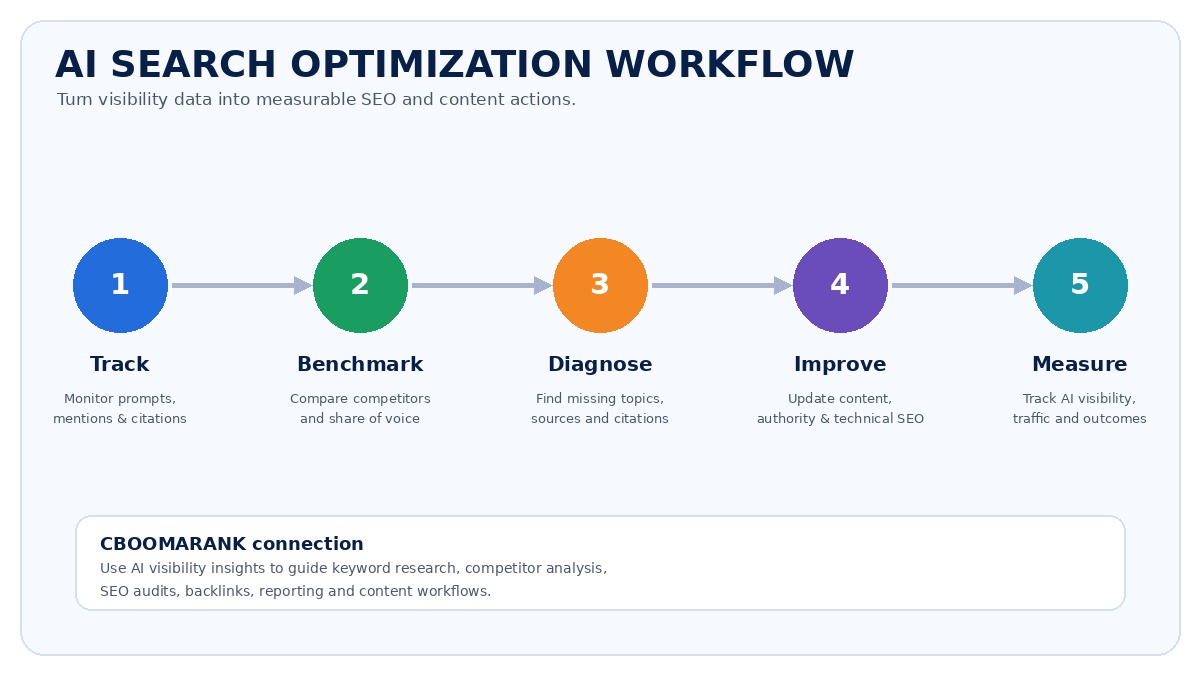
Where CBOOMARANK Fits Into the AI Search Workflow
Editorial disclosure: CBOOMARANK publishes this comparison and is also developing its own SEO and analytics platform.
CBOOMARANK is not being ranked here as a dedicated AI visibility tracker because we do not want to claim functionality that has not been implemented and validated.
Its current direction is relevant to the wider AI-search workflow because CBOOMARANK connects website analysis, keyword research, competitor research, backlink analysis, SEO audits, reporting and publisher/content workflows.
A practical workflow can therefore use a dedicated AI visibility platform to identify missing mentions or citations, then use CBOOMARANK’s broader SEO research and optimization workflows to investigate the website, competitors, keywords and authority signals behind those opportunities.
As the CBOOMARANK product evolves, dedicated AI-search visibility, prompt tracking and AI citation analysis would be logical additions to that connected workflow.
Explore the CBOOMARANK app or review our Ultimate SEO Software Comparison Guide.
How to Choose an AI Visibility Tool
Before paying for any platform, define what you actually need to monitor.
- List your important AI engines. A platform that tracks ChatGPT but not Google AI Mode may be insufficient for your market.
- Build a buyer-prompt set. Track questions connected to comparison, pricing, alternatives, recommendations and purchase decisions.
- Identify competitors. Visibility has more meaning when benchmarked against companies fighting for the same buyer attention.
- Decide whether citations matter. If content acquisition is the goal, source-level citation analysis is essential.
- Check localization. AI answers can differ by country, language and market context.
- Calculate the real tracking cost. Prompt pricing can multiply quickly across models, countries and daily checks.
- Connect visibility to business outcomes. AI mentions are useful, but traffic, leads, brand demand and revenue are more important.
How to Improve AI Search Visibility
Tracking is only the first step. The objective is to understand why competitors appear and improve the signals that make your brand useful to search and answer systems.
- Create genuinely useful, original content around questions buyers ask.
- Build clear topical authority instead of publishing disconnected articles.
- Use strong internal linking to connect related topics.
- Keep important pages crawlable and technically sound.
- Make claims specific and support them with evidence.
- Earn mentions and citations from authoritative third-party sources.
- Maintain accurate brand, product and company information across the web.
- Update outdated pages when facts, pricing or products change.
- Compare competitor citations to find source and content gaps.
- Measure both traditional search and AI-search performance together.
For broader optimization guidance, see the CBOOMARANK SEO Optimization Guide, Top Keyword Research Tools Compared and Best SEO Automation Tools.
Frequently Asked Questions
What is the best AI visibility tool?
Semrush is our strongest all-round choice for teams that want SEO and AI visibility together. Ahrefs is excellent for large-scale AI discovery and citations, while dedicated platforms such as Profound, Peec AI, Otterly.AI and Scrunch serve different team sizes and workflows.
What does an AI visibility tool track?
Most platforms track brand mentions, citations, prompt-level appearances, competitor visibility and share of voice across AI-generated answers. More advanced products may also track sentiment, AI crawler activity, referral traffic or technical readiness.
Can I track my brand in ChatGPT?
Yes. Several tools in this guide execute defined prompts in ChatGPT on a recurring schedule and record whether your brand is mentioned, cited or recommended.
Can I track Google AI Overviews and AI Mode?
Yes. Tools such as Ahrefs, SE Ranking, Semrush, Otterly.AI and others provide varying levels of Google AI monitoring. Always check the exact model and country coverage before subscribing.
Is AI visibility the same as SEO ranking?
No. Traditional rankings measure a page’s position in search results for a query. AI visibility measures whether and how a brand or source appears inside generated answers. The two channels influence one another but should be measured separately.
Do I need GEO software if I already use an SEO platform?
Not necessarily. Semrush, Ahrefs and SE Ranking increasingly combine SEO and AI-search measurement. A specialist platform becomes more attractive when AI visibility is important enough to require deeper prompt coverage, dedicated reporting or enterprise workflows.
Final Verdict
AI visibility has become a measurable part of digital search strategy. Brands can no longer assume that strong Google rankings automatically mean strong visibility in ChatGPT, AI Mode, Gemini or Perplexity.
Choose Semrush if you want the strongest broad SEO + AI workflow. Choose Ahrefs when AI citations and large-scale search intelligence matter most. SE Ranking is particularly attractive for agencies and operational SEO teams. Profound is well suited to enterprise AEO. Peec AI provides a focused analytics experience. Otterly.AI offers an accessible entry point. Scrunch adds deeper technical and agent-readiness capabilities, while Writesonic connects AI visibility directly with content production.
The important step is to begin measuring now. AI search is evolving quickly, and building a visibility baseline today gives you something concrete to improve as the channel grows.
Next in the CBOOMARANK AI Search series: How to Rank in Google AI Overviews.
