

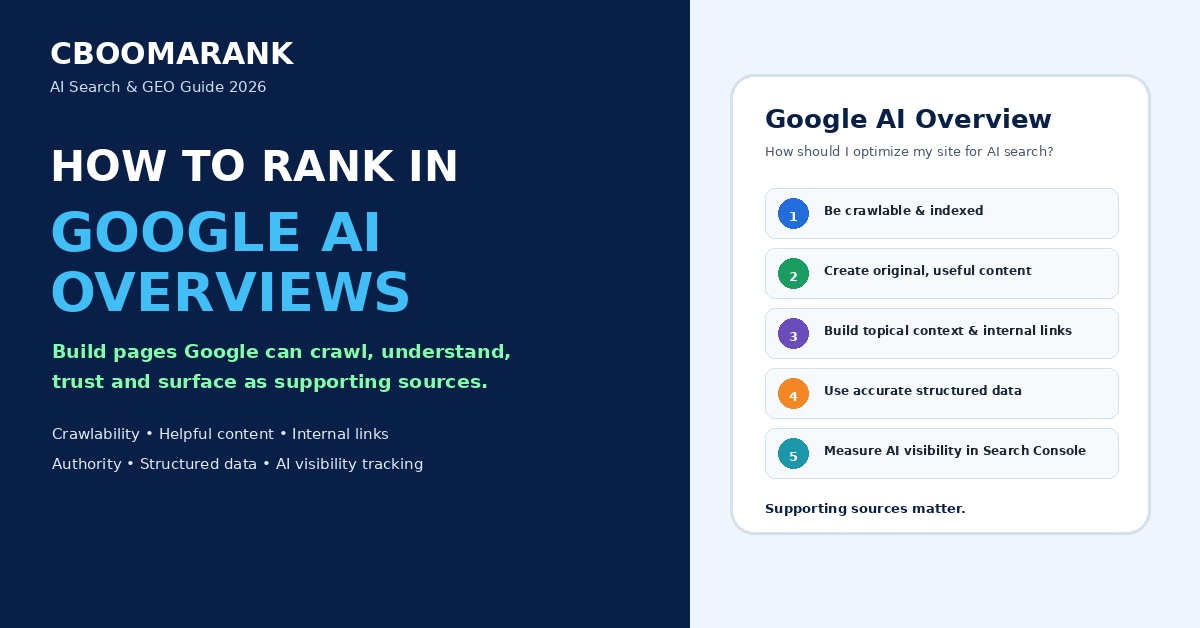
Google AI Overviews have changed the way many search results are presented. Instead of showing only a list of traditional blue links, Google can generate an AI-powered overview that summarizes information and includes links to supporting web sources.
For publishers, businesses and SEO teams, that creates an important question: how do you improve your chances of appearing in Google AI Overviews?
The answer is less mysterious than many marketers assume. Google’s official guidance is clear that its generative AI features are built on the same core Search ranking and quality systems used across Google Search. There is no separate secret “AI SEO” formula, no special AI schema and no requirement to create an llms.txt file.
The strongest strategy is to build pages that Google can crawl and index, provide genuinely useful and original information, satisfy the searcher’s intent, demonstrate real expertise, maintain a strong technical foundation and measure AI-search visibility over time.
This CBOOMARANK guide explains what Google AI Overviews are, how Google retrieves supporting sources, the SEO practices that matter most in 2026, the common GEO/AEO myths you can ignore, and how to measure your visibility using Search Console.
What Are Google AI Overviews?
Google AI Overviews are generative AI responses that can appear within Google Search results. They synthesize information relevant to a search and provide links to web resources that support or expand on the response.
They are related to, but different from, Google AI Mode. AI Overviews are integrated into the standard Search experience, while AI Mode provides a more conversational interface where users can ask follow-up questions and explore a topic in greater depth.
For site owners, both experiences matter because Google can surface pages as supporting resources within generated responses.
| Feature | AI Overviews | AI Mode |
|---|---|---|
| Where it appears | Within regular Google Search results | Dedicated conversational Search experience |
| User behavior | Reads overview and may click supporting links | Can ask follow-up questions and explore subtopics |
| Web links | Includes supporting web resources | Includes links to supporting web resources |
| Search Console | Included in generative AI reporting | Included in generative AI reporting |
How Google Finds Sources for AI Overviews
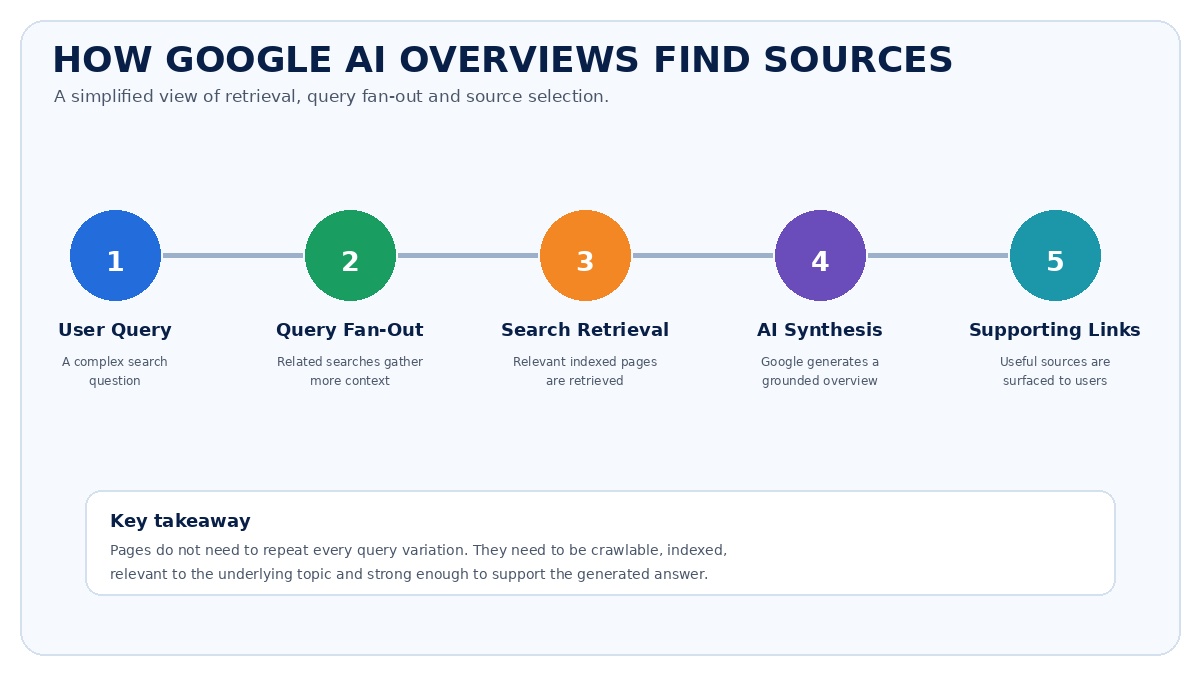
Google says its generative AI Search features rely on core Search ranking and quality systems. Two important concepts help explain how this works: retrieval-augmented generation and query fan-out.
Retrieval-Augmented Generation
Retrieval-augmented generation, often shortened to RAG, allows an AI system to retrieve relevant and current web pages from Google’s Search index and use those sources to help ground a generated response.
This is one reason ordinary SEO fundamentals remain important. If Google cannot properly crawl, understand or index a page, that page is less likely to become a useful retrieval source.
Query Fan-Out
Google can also use query fan-out, where the system generates multiple related searches to gather information needed to answer a broader user question.
For example, a user may ask a complex question that touches pricing, comparisons, technical features and user experience. Google may retrieve relevant information from different pages instead of relying on one page that matches the original wording exactly.
This means pages do not need to repeat every possible long-tail keyword variation. They need to be genuinely relevant and useful to the underlying topic.
Can You Actually “Rank” in Google AI Overviews?
There is no guaranteed formula that gives a page a fixed AI Overview ranking. Google decides when an AI Overview is useful, which information to retrieve and which web resources to show.
It is better to think in terms of eligibility, relevance and visibility rather than trying to force a specific numbered ranking.
Your objective is to make your website a strong candidate whenever Google needs reliable information for a relevant search.
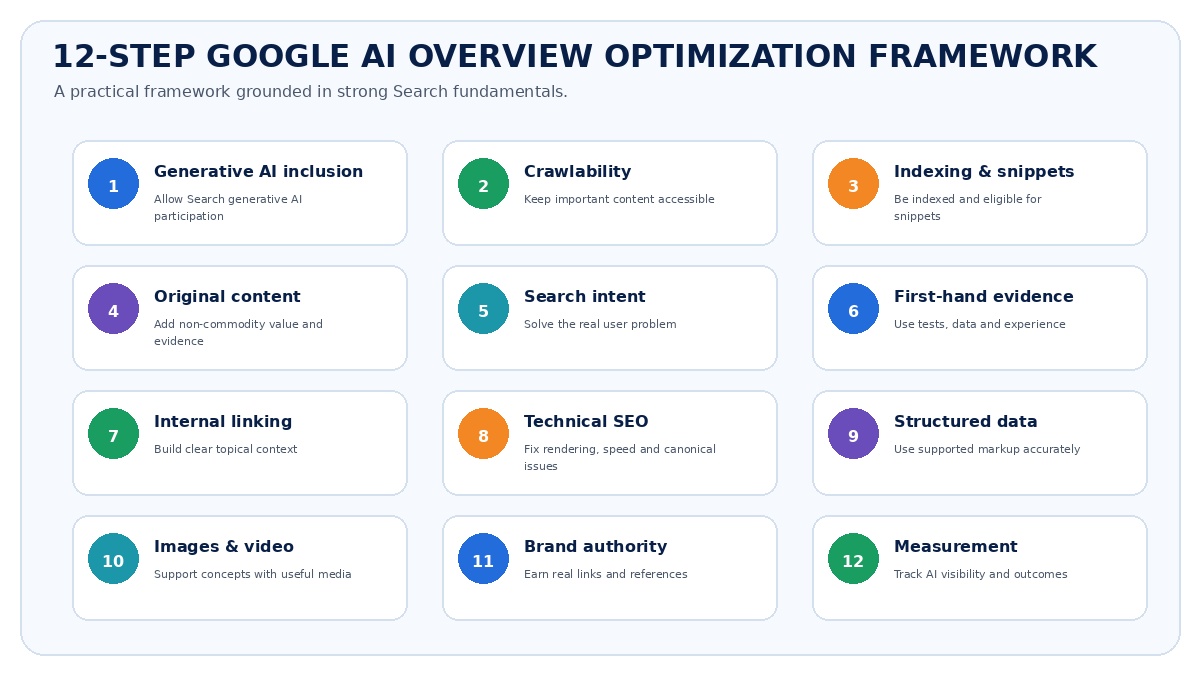
How to Rank in Google AI Overviews: 12 Practical Steps
1. Make Sure Your Site Is Included in Search Generative AI Features
Google Search Console now includes a Search generative AI control. If your property is excluded from generative AI features, your pages will not be eligible to appear as links or help ground responses in supported Google generative AI experiences.
In Search Console, review Settings → Search generative AI and make sure the site is included if AI-search visibility is part of your strategy.
2. Ensure the Page Is Crawlable, Indexed and Eligible for a Snippet
Google states that a page must be indexed and eligible to appear in Google Search with a snippet before it can be eligible for generative AI features.
- Do not accidentally block Googlebot.
- Check robots.txt rules.
- Review accidental
noindexdirectives. - Use canonical URLs consistently.
- Make sure important content is available to Google during rendering.
- Submit and maintain useful XML sitemaps.
- Use Search Console URL Inspection to diagnose important pages.
Passing these requirements does not guarantee inclusion, but failing them can prevent the page from becoming eligible.
3. Create Valuable, Non-Commodity Content
Google’s 2026 AI optimization guidance places unusually strong emphasis on non-commodity content.
Commodity content simply restates information that is already widely available. Non-commodity content adds something original: direct experience, proprietary data, first-hand observations, examples, experiments, expert reasoning, unique comparisons or a distinctive point of view.
If ten pages say essentially the same thing, Google has little reason to prefer yours as a supporting source. Give the system information that is difficult to replace with another generic summary.
- Original research or survey data
- First-hand product testing
- Real screenshots or demonstrations
- Unique case studies
- Detailed examples
- Expert commentary
- Original frameworks and workflows
- Current data that adds context to a topic
4. Answer the Real Search Intent, Not Just the Keyword
Because Google can use semantic understanding and query fan-out, optimizing for AI Overviews is not about repeating the exact phrase “how to rank in Google AI Overviews” dozens of times.
Think about what the user actually needs to know. For this topic, that includes eligibility, crawlability, indexing, content quality, authority, internal linking, structured data, images, Search Console reporting and common misconceptions. If you are building the keyword plan behind those topics, see our Top Keyword Research Tools Compared guide and Google Keyword Planner for SEO tutorial.
Cover the subject comprehensively enough that the page genuinely resolves the user’s problem.
5. Add First-Hand Expertise and Evidence
AI systems can summarize generic knowledge extremely well. That makes genuine experience more valuable, not less. Content teams can also reduce repetitive optimization work with carefully chosen SEO automation tools while keeping editorial review and original expertise in the process.
When possible, show how you arrived at your conclusion. Use real screenshots, original charts, product tests, Search Console observations, experiments and direct experience.
A page that contributes new information is more useful than one that simply rewrites the existing search results.
6. Structure the Page for Human Readers
Google does not require content to be broken into artificial micro-sections for AI. However, clear organization still helps humans and search systems understand a page.
- Use descriptive H2 and H3 headings.
- Keep paragraphs focused.
- Use lists where they genuinely improve readability.
- Use comparison tables for structured comparisons.
- Give definitions before advanced explanations.
- Place important information close to the section where it is needed.
The goal is readability, not artificial “AI chunking.”
7. Build Strong Internal Linking and Topical Context
Internal links help search engines discover pages and understand how topics relate to one another. They also guide readers deeper into useful material. Strong internal linking should connect keyword research, technical SEO, authority building and AI visibility into one coherent topic cluster.
For example, this article is part of CBOOMARANK’s AI Search cluster and should connect naturally to our Best AI Visibility Tools in 2026 guide, traditional SEO Optimization Guide and related keyword and technical SEO content.
Instead of publishing disconnected posts, create meaningful topic clusters where each article answers a distinct part of the larger subject.
8. Maintain a Strong Technical SEO Foundation
Technical SEO continues to matter because Google still has to fetch, render and process your content. For a broader site-optimization framework, see the CBOOMARANK SEO Optimization Guide.
- Maintain clean crawl paths.
- Avoid unnecessary duplicate URLs.
- Keep canonicalization consistent.
- Follow JavaScript SEO best practices.
- Improve page speed and responsiveness.
- Make the site work well on mobile devices.
- Separate primary content clearly from intrusive page elements.
- Keep important information available in the rendered page.
A technically confusing website makes it harder for both people and search systems to access useful information.
9. Use Structured Data Correctly — But Don’t Invent “AI Schema”
Structured data remains useful for normal Google Search eligibility and rich-result features when the markup accurately represents visible page content.
However, Google explicitly says there is no special schema.org markup required for AI Overviews or AI Mode.
Use relevant supported structured data because it benefits your overall Search presence, not because someone promises that adding an “AI schema” will force Google to cite your site.
10. Add High-Quality Images and Video When They Improve the Page
Google’s generative AI optimization guidance specifically encourages useful image and video content.
Strong visuals create additional ways for your site to appear in Search and can make difficult concepts much easier to understand.
- Use original graphics where possible.
- Add meaningful ALT text.
- Use clear filenames.
- Place images near the relevant section.
- Use diagrams to explain processes.
- Use screenshots when showing real software or data.
11. Build Legitimate Brand and Source Authority
Google’s AI features can draw on information from many parts of the web, including websites, videos, forums and other sources.
That does not mean you should manufacture fake mentions or spam third-party sites. Google specifically warns against chasing inauthentic mentions.
Instead, build real authority:
- Publish research worth referencing.
- Earn legitimate backlinks.
- Contribute expert commentary.
- Maintain consistent business information.
- Create useful tools and resources.
- Develop genuine brand demand.
- Participate constructively in relevant industry conversations.
12. Keep Important Business and Product Information Accurate
For ecommerce and local businesses, Google can use product and business information in generative responses.
Maintain accurate data through appropriate Google systems such as Merchant Center and Google Business Profile where relevant. Keep pricing, availability, contact information and other important details current.
Google AI Overview Optimization Checklist
| Check | What to Verify |
|---|---|
| Generative AI inclusion | Site is included in Search generative AI features in Search Console |
| Indexing | Important page is indexed and eligible for a Search snippet |
| Crawlability | Googlebot can access the important content |
| Content originality | Page adds experience, evidence, data or a unique perspective |
| Search intent | Page answers the underlying user problem |
| Internal links | Relevant supporting pages are connected logically |
| Technical SEO | Mobile usability, rendering, canonicalization and page experience are healthy |
| Structured data | Supported markup accurately matches visible content |
| Media | Useful images/video support the topic |
| Authority | Brand earns legitimate links, citations and references |
| Measurement | Generative AI visibility is monitored in Search Console |
How to Measure Google AI Overview Visibility in Search Console
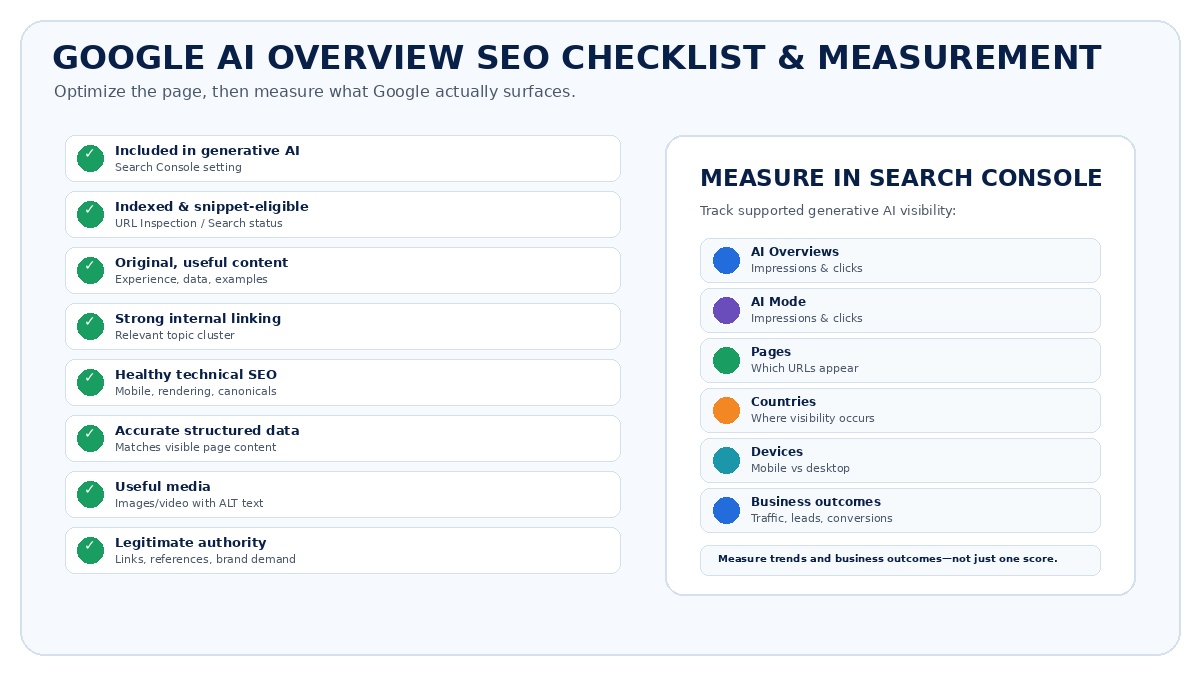
Google introduced a dedicated Generative AI performance report in Search Console in 2026, and says the insights were rolled out worldwide by August 31, 2026.
The report covers supported generative AI features on Google Search, including:
- Google AI Overviews
- Google AI Mode
The dedicated report can help you understand:
- how generative AI impressions change over time;
- which pages are appearing;
- which countries generate visibility;
- which devices are involved;
- performance by date.
Google’s standard Search Console methodology also explains how AI Overview and AI Mode links are counted. Clicking a link to your website from these experiences counts as a click. An AI Overview occupies a single Search result position, and links inside that overview are assigned the position of the containing AI Overview element.
Do not rely only on one visibility number. Track the pages that appear, the topics associated with those pages, referral traffic, leads, conversions and overall organic-search performance.
Common Google AI Overview SEO Myths
Myth 1: You Need an llms.txt File to Rank in Google AI Overviews
Google says it does not use llms.txt as a ranking or visibility mechanism for Google Search. Creating one for another service is fine, but it neither improves nor harms your Google Search visibility.
Myth 2: You Need Special AI Schema
There is no special AI schema required for Google’s generative AI Search features. Continue using supported structured data correctly where it benefits traditional Search features.
Myth 3: Every Paragraph Must Be Broken Into Tiny “AI Chunks”
Google says there is no requirement to split content into tiny fragments for its AI systems. Structure the page in the way that best serves readers.
Myth 4: You Must Rewrite Content Specifically for AI
Google’s systems can understand meaning, context and synonyms. Do not create awkward content merely to target every possible conversational query variation.
Myth 5: More Manufactured Brand Mentions Mean More AI Visibility
Inauthentic mentions are not a sustainable strategy. Build genuine authority and references instead.
SEO vs GEO vs AEO for Google AI Overviews
GEO, or generative engine optimization, and AEO, or answer engine optimization, are useful industry terms for discussing AI-search visibility.
However, Google’s own position is straightforward: optimizing for generative AI Search is still fundamentally SEO because AI Overviews and AI Mode rely on Google Search’s ranking, indexing and quality systems.
That does not mean AI visibility should be ignored as a measurement category. It means the work should remain grounded in strong Search fundamentals rather than unsupported hacks.
Where CBOOMARANK Fits Into the AI Overview Workflow
Editorial disclosure: CBOOMARANK publishes this guide and is also developing an SEO and analytics platform.
CBOOMARANK’s current workflows can support many of the foundational tasks behind AI-search optimization, including website analysis, keyword research, competitor research, backlink analysis, SEO auditing, reporting and content workflows.
A practical workflow is:
- Use Search Console and AI visibility tools to identify where your site appears.
- Use keyword and competitor research to understand the underlying topics.
- Run SEO audits to find technical barriers.
- Analyze authority and backlink gaps.
- Improve or create genuinely useful content.
- Measure Search and AI visibility again.
For the monitoring side of this workflow, see our Best AI Visibility Tools in 2026 comparison. That guide explains how platforms track AI mentions, citations, competitors and share of voice across AI-search experiences.
You can also open the CBOOMARANK app to connect website analysis, keyword research, competitor research, SEO audits, backlinks and reporting in one workflow. Review the CBOOMARANK pricing plans or continue with our SEO Optimization Guide.
Put This AI Search Workflow Into Practice With CBOOMARANK
CBOOMARANK brings website analysis, keyword research, competitor research, SEO auditing, backlink analysis and reporting into a connected workflow. Use those tools to investigate the SEO foundations behind your Google AI Overview opportunities.
Frequently Asked Questions
How do I rank in Google AI Overviews?
There is no guaranteed ranking formula. Focus on being eligible for Google Search, creating useful and original content, satisfying search intent, maintaining a strong technical foundation, building legitimate authority and monitoring visibility in Search Console.
Does normal SEO help with AI Overviews?
Yes. Google says its generative AI Search features are rooted in its core Search ranking and quality systems, so traditional SEO best practices remain foundational.
Do I need special schema for Google AI Overviews?
No. Google says there is no special schema markup required for its generative AI Search features.
Does Google use llms.txt for AI Overviews?
No. Google says its Search systems ignore llms.txt. The file may be useful for other services that explicitly support it, but it does not improve Google Search rankings or AI Overview visibility.
Can I see AI Overview traffic in Search Console?
Search Console includes generative AI performance reporting for supported Search experiences, including AI Overviews and AI Mode. Google also documents how clicks, impressions and positions are counted for these result types.
Is GEO different from SEO?
GEO can be a useful label for measuring and improving visibility in generative engines, but for Google Search the underlying optimization work remains strongly connected to traditional SEO fundamentals.
Final Verdict
The best way to improve your chances of appearing in Google AI Overviews is not to search for an AI-specific shortcut.
Make your pages technically accessible. Create information that is genuinely useful and difficult to replace. Demonstrate real experience. Structure content clearly. Build internal context and legitimate authority. Use supported structured data correctly. Add useful images and video. Then measure what Google actually surfaces using Search Console.
AI Search changes the interface, but strong websites still win by providing information that people and search systems can trust and use.
Next in the CBOOMARANK AI Search series: Best LLM SEO Tools in 2026.
