

Search visibility is no longer limited to traditional Google rankings. Buyers increasingly ask ChatGPT, Gemini, Perplexity, Google AI Mode and other answer engines to recommend products, compare software, explain problems and identify trusted sources.
That shift has created a new category of software commonly described as LLM SEO tools, AI visibility platforms, GEO tools, AEO software or generative search optimization platforms.
The best LLM SEO tools help marketing teams understand whether their brand is mentioned or cited in AI-generated answers, which prompts trigger visibility, which competitors appear more frequently, what sources influence the answers and what actions may improve performance.
This CBOOMARANK guide compares 10 leading platforms based on their published 2026 capabilities, AI-engine coverage, workflow, positioning and pricing. Pricing and product limits change frequently, so always verify the vendor’s current plan before purchasing.
If you are new to this category, first read our Best AI Visibility Tools in 2026 guide and our guide on how to rank in Google AI Overviews. Together, these articles explain both the measurement side and the optimization side of AI search.
What Is an LLM SEO Tool?
An LLM SEO tool measures or improves how a brand, website or piece of content appears in answers generated by large language models and AI-powered search systems.
Traditional SEO tools primarily measure rankings, keywords, backlinks, crawlability and organic-search traffic. LLM SEO platforms add a different layer: they can track whether a brand is mentioned inside generated answers, whether its website is cited, how frequently competitors appear and which prompts or topics drive visibility.
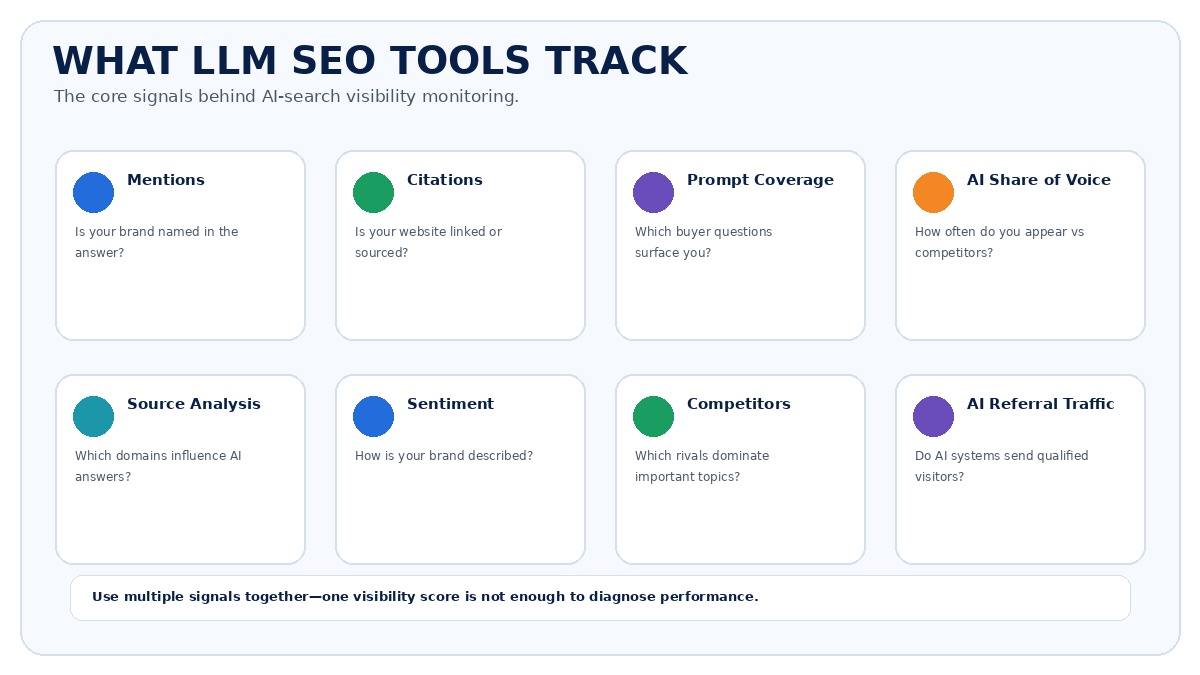
- Brand mentions: Is your company named in the AI response?
- Citations: Does the answer link to or source your website?
- AI share of voice: How often do you appear compared with competitors?
- Prompt tracking: Which buyer questions surface your brand?
- Source analysis: Which third-party websites influence AI answers?
- Sentiment: How is your brand described?
- Competitive analysis: Which rivals dominate important topics?
- Optimization recommendations: What should your SEO or content team do next?
LLM SEO does not replace traditional SEO. A strong workflow connects AI visibility data with keyword research, technical SEO, competitor analysis, backlinks and content optimization. Our SEO Optimization Guide covers those underlying fundamentals in more detail.
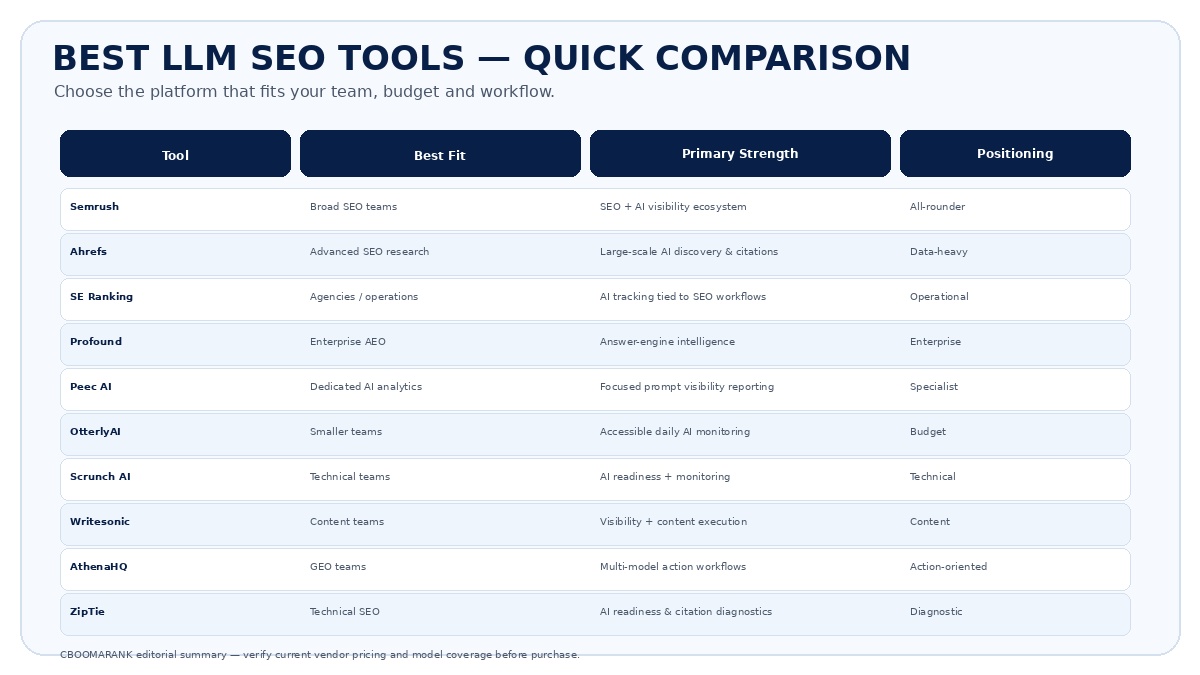
Best LLM SEO Tools in 2026: Quick Comparison
| Tool | Best For | Published AI Coverage | Starting Price / Note* |
|---|---|---|---|
| Semrush AI Visibility | Overall SEO + AI visibility workflow | ChatGPT, Google AI, Gemini, Perplexity | $99/mo per domain billed annually |
| Ahrefs Brand Radar | Large-scale AI discovery and citation intelligence | AI Overviews, AI Mode, ChatGPT, Perplexity, Gemini, Copilot and more | Custom prompts from $50/mo; AI Visibility Index from $199/mo |
| SE Ranking / SE Visible | Agencies and operational SEO teams | AI Overviews, AI Mode, ChatGPT, Perplexity, Gemini | AI Search add-on from $89/mo |
| Profound | Enterprise AI-search intelligence | Major answer engines across enterprise datasets | Plans vary; verify current pricing |
| Peec AI | Dedicated AI-search analytics | Multiple leading AI models | Usage-based plans; verify current pricing |
| OtterlyAI | Small teams and accessible monitoring | ChatGPT, AI Overviews, Perplexity, Copilot; optional Gemini, AI Mode and Claude | From $29/mo |
| Scrunch AI | AI readiness, technical analysis and brand monitoring | ChatGPT, Perplexity, AI Overviews, Copilot; more on Enterprise | Core from $250/mo |
| Writesonic | Content teams that want GEO + production workflows | ChatGPT, Gemini, Google AI Overviews on published entry GEO plans | Basic $249/mo monthly; $199/mo annual |
| AthenaHQ | Action-oriented GEO teams and multi-model monitoring | 10+ AI models on paid plans | Free tier; Starter $295/mo |
| ZipTie | Technical AI-search readiness and citation analysis | ChatGPT, Perplexity, Google AI and other answer engines | Check current plans |
*Pricing shown reflects publicly available information checked in September 2026 and can change. Taxes, usage limits, additional models, users and annual billing may affect final cost.
How We Compared the Best LLM SEO Tools
There is no single perfect AI visibility platform for every company. We evaluated the category using practical criteria that matter when a marketing team has to turn AI-search data into action.
- Model coverage: Does the platform monitor the AI systems your buyers actually use?
- Prompt flexibility: Can you track real buyer questions rather than only a fixed vendor database?
- Citation analysis: Can you identify the websites and pages influencing AI responses?
- Competitive intelligence: Can you compare visibility against meaningful rivals?
- Historical tracking: Can you measure improvement instead of viewing a one-time snapshot?
- Actionability: Does the platform help explain what to improve?
- Traditional SEO integration: Can AI-search findings connect to keyword, content, technical and backlink workflows?
- Scalability: Can agencies and larger teams track multiple brands, countries and prompt sets?
1. Semrush AI Visibility — Best Overall for SEO + AI Search
Semrush is a strong choice for teams that want AI visibility inside a broader search-marketing ecosystem rather than another completely separate analytics product.
Its AI Visibility offering monitors brand mentions across ChatGPT, Google AI, Gemini and Perplexity. Published features include AI Visibility Overview, competitor research, prompt research, custom prompt tracking and AI-readiness auditing.
The Base AI Visibility plan is currently listed at $99 per month per domain when billed annually. That makes it particularly relevant for companies that already use Semrush for traditional SEO and want to extend the workflow into generative search.
- Best for: SEO teams wanting traditional and AI search in one ecosystem
- Strength: Connected keyword, competitor, audit and AI visibility workflow
- Consider: Costs can rise when managing several domains, users or add-ons
See Semrush AI Visibility pricing.
2. Ahrefs Brand Radar — Best for Large-Scale AI Discovery
Ahrefs Brand Radar takes a particularly data-heavy approach to AI-search intelligence. It combines custom prompt monitoring with a large AI Visibility Index designed to reveal how brands appear across large sets of AI queries.
Ahrefs publishes support for Google AI Overviews, AI Mode, ChatGPT, Perplexity, Gemini and Copilot, with additional platform coverage depending on the product and plan.
Custom prompt tracking starts from $50 per month. The AI Visibility Index starts from $199 per month for an individual index, while broader all-platform access is priced higher.
- Best for: Advanced SEO research and large-scale AI discovery
- Strength: Huge visibility datasets combined with Ahrefs backlink and SEO intelligence
- Consider: The product structure can be more complex than a simple prompt tracker
3. SE Ranking / SE Visible — Best for Agencies and Operational SEO Teams
SE Ranking has built AI-search functionality into its wider SEO workflow while also offering SE Visible for strategic AI visibility monitoring.
The AI Search add-on supports Google AI Overviews, AI Mode, ChatGPT, Perplexity and Gemini. It extends prompt monitoring, sources analysis, visibility tracking and competitive research while also providing access to SE Visible.
The AI Search add-on currently starts at $89 per month for 200 checks, with larger packages available. SE Visible can also be purchased separately for teams that primarily need AI visibility monitoring.
- Best for: Agencies, multi-client teams and operational SEO workflows
- Strength: AI monitoring connected to rank tracking, audits and competitor research
- Consider: Understand the difference between SE Ranking AI Search and SE Visible before choosing
4. Profound — Best for Enterprise AI-Search Intelligence
Profound is positioned toward larger brands and sophisticated AI-search programs. Its research and products focus heavily on answer-engine intelligence, brand visibility, citations, AI-agent behavior and enterprise-scale datasets.
Profound is particularly interesting for companies that view AI search as a strategic intelligence function rather than simply another rank tracker.
- Best for: Enterprise brands and advanced AI-search teams
- Strength: Deep answer-engine research and enterprise intelligence
- Consider: More platform than many small businesses need
5. Peec AI — Best Dedicated AI Search Analytics Experience
Peec AI is purpose-built around measuring brand visibility in AI search. Its positioning is straightforward: monitor prompts, understand where your brand appears, compare competitors and examine the sources influencing visibility.
Peec’s current pricing model is based on prompt volume and the number of AI models analyzed. This can work well for teams that want direct control over how much monitoring they purchase.
- Best for: Marketing teams wanting dedicated AI analytics
- Strength: Focused interface and prompt-based visibility monitoring
- Consider: Broader traditional SEO work may require a separate platform
6. OtterlyAI — Best Accessible Option for Smaller Teams
OtterlyAI is one of the more approachable dedicated AI-search monitoring tools for smaller teams. Its Lite plan currently starts at $29 per month and includes 15 search prompts with daily tracking.
The core plan tracks ChatGPT, Google AI Overviews, Perplexity and Microsoft Copilot. Gemini, Google AI Mode and Claude can be added separately.
- Best for: Solo marketers, SMBs and teams testing AI visibility monitoring
- Strength: Low entry price and straightforward daily prompt tracking
- Consider: Additional AI engines may require paid add-ons
7. Scrunch AI — Best for AI Readiness and Technical Visibility
Scrunch combines AI visibility monitoring with technical analysis of how a site is interpreted and accessed by AI systems.
Its Core plan currently costs $250 per month and includes 125 unique prompts, site audits, one brand workspace and monitoring across ChatGPT, Perplexity, Google AI Overviews and Microsoft Copilot.
Enterprise plans expand model coverage to additional systems including Gemini, Claude, Google AI Mode, Grok and Meta AI.
- Best for: Technical teams and brands concerned with AI crawler/readiness issues
- Strength: Combines monitoring with site auditing
- Consider: Entry price is higher than budget-focused trackers
8. Writesonic — Best for Content + GEO Execution
Writesonic approaches AI search from both the measurement and execution sides. Its platform combines content production, traditional SEO and AI-search visibility features.
Published GEO functionality includes brand monitoring, prompt tracking, AI bot analytics and optimization workflows. Current documentation lists the Basic plan at $249 per month monthly or $199 per month with annual billing.
- Best for: Content teams wanting AI visibility connected to production
- Strength: Strong execution layer rather than monitoring alone
- Consider: Teams that only need basic visibility tracking may not need the entire content stack
9. AthenaHQ — Best for Action-Oriented Multi-Model GEO
AthenaHQ is built as a GEO command center rather than a simple reporting dashboard. It combines cross-platform AI visibility monitoring, source and competitor intelligence, content recommendations and action-focused optimization workflows.
Athena currently offers an Essential free tier and a Starter plan priced at $295 per month. The Starter tier provides visibility across roughly 10 AI models, along with integrations, exports and content optimization capabilities.
- Best for: GEO specialists and teams that want monitoring plus recommended actions
- Strength: Broad model coverage and action-oriented workflow
- Consider: Paid plans are positioned above entry-level SMB monitoring tools
10. ZipTie — Best for Technical AI Search Readiness
ZipTie focuses heavily on the technical and diagnostic side of AI search. Its research and tooling examine crawler access, AI-search readiness, brand mentions, source visibility and citation behavior across answer engines.
This makes ZipTie particularly relevant when your primary question is not simply “Are we mentioned?” but “What technical or content issue may be preventing AI systems from discovering, extracting or citing us?”
- Best for: Technical SEO and AI-search readiness auditing
- Strength: Diagnostic and citation-focused perspective
- Consider: Verify current pricing and exact platform coverage for your required markets
Which LLM SEO Tool Is Best for Different Users?
| User | Recommended Tool | Why |
|---|---|---|
| SEO team wanting one broad ecosystem | Semrush | Connects AI visibility with familiar SEO research and auditing |
| Advanced SEO researchers | Ahrefs Brand Radar | Large AI datasets combined with strong backlink and search intelligence |
| Agencies managing multiple clients | SE Ranking / SE Visible | Operational SEO plus dedicated AI visibility workflows |
| Large enterprise brands | Profound | Enterprise answer-engine intelligence and research depth |
| Dedicated AI analytics teams | Peec AI | Focused prompt, visibility and competitor monitoring |
| Small teams and beginners | OtterlyAI | Accessible entry price and straightforward tracking |
| Technical AI readiness teams | Scrunch / ZipTie | Site auditing and AI-readiness focus |
| Content teams | Writesonic | Visibility insights tied directly to content execution |
| GEO teams wanting action recommendations | AthenaHQ | Broad model monitoring plus optimization workflow |
What Metrics Should an LLM SEO Tool Track?
Do not choose a platform based on one proprietary visibility score alone. AI-search performance is multidimensional.
- Mention rate: How frequently is the brand named?
- Citation rate: How frequently is the website linked or sourced?
- Share of voice: How visible are you compared with competitors?
- Prompt coverage: Which questions trigger your brand?
- Source overlap: Which third-party sites repeatedly influence answers?
- Sentiment: Is the brand described positively, negatively or inaccurately?
- Page visibility: Which URLs receive citations?
- Model variance: Does performance differ between ChatGPT, Gemini, Perplexity and Google AI?
- Business impact: Are AI referrals generating engaged visitors, leads or revenue?
The same principle applies to keyword research: do not optimize from one metric in isolation. Use multiple signals to understand the opportunity. See our Top Keyword Research Tools Compared guide for the traditional search side of that workflow.
LLM SEO Tools vs Traditional SEO Software
| Traditional SEO | LLM / AI Search SEO |
|---|---|
| Keyword rankings | Prompt visibility |
| SERP position | Mentions and citations |
| Backlink profile | Sources influencing AI responses |
| Organic click-through rate | AI referral and recommendation visibility |
| Search competitors | Answer-engine competitors |
| Keyword share of voice | AI share of voice |
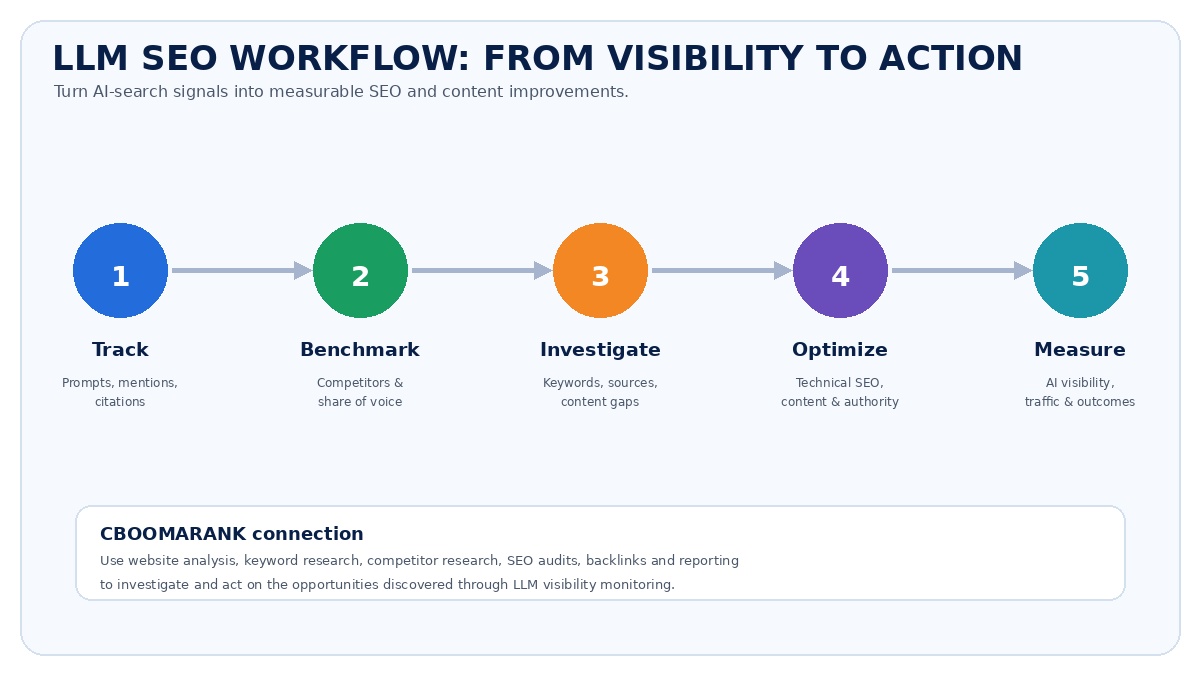
The strongest strategy is to connect the two rather than treating them as competing disciplines. AI visibility can reveal an opportunity; traditional SEO tools help diagnose the website, content, keywords, authority and technical issues behind it.
For repetitive SEO work, also see our guide to the Best SEO Automation Tools.
Where CBOOMARANK Fits Into the LLM SEO Workflow
Editorial disclosure: CBOOMARANK publishes this comparison and is also developing its own SEO and analytics platform.
CBOOMARANK is not being presented here as a replacement for every dedicated LLM visibility tracker. Instead, its current strength is the broader SEO workflow around the AI-search data.
Once an AI visibility platform identifies a citation gap, missing topic or competitor advantage, CBOOMARANK can help investigate the foundations behind that opportunity through website analysis, keyword research, competitor research, SEO audits, backlink analysis, reporting and content workflows.
- Identify an AI-search visibility or citation gap.
- Research the topic and keyword opportunity.
- Analyze competitors appearing in the answer.
- Audit the target website or page.
- Investigate backlinks and authority.
- Improve or create useful content.
- Measure both traditional search and AI visibility again.
Connect Your AI Search Insights With CBOOMARANK
Use CBOOMARANK to connect website analysis, keyword research, competitor research, SEO auditing, backlink analysis and reporting around the opportunities you discover through LLM visibility monitoring.
Frequently Asked Questions
What are the best LLM SEO tools in 2026?
Leading options include Semrush AI Visibility, Ahrefs Brand Radar, SE Ranking and SE Visible, Profound, Peec AI, OtterlyAI, Scrunch AI, Writesonic, AthenaHQ and ZipTie. The best choice depends on your model coverage, prompt volume, budget, workflow and whether you also need traditional SEO features.
What does an LLM SEO tool track?
Typical metrics include brand mentions, citations, prompt visibility, share of voice, competitor visibility, source domains, sentiment and sometimes AI referral traffic or crawler activity.
Can traditional SEO tools track ChatGPT visibility?
Several established SEO platforms now include AI-search monitoring. Semrush, Ahrefs and SE Ranking are examples of traditional SEO ecosystems that have expanded into AI visibility and prompt tracking.
Do I need a separate tool for ChatGPT, Gemini and Perplexity?
Not necessarily. Many platforms monitor several answer engines from one dashboard. Check the exact engines included in your plan because some vendors treat particular models as add-ons or reserve them for higher tiers.
Is LLM SEO the same as GEO?
The terms overlap significantly. LLM SEO focuses on visibility in large language model responses, while GEO generally refers to optimizing visibility across generative engines. AEO is another related term focused on answer engines.
Can CBOOMARANK help with AI search optimization?
CBOOMARANK can support the traditional SEO and research work surrounding AI-search opportunities, including website analysis, keyword research, competitor research, SEO audits, backlinks, reporting and content workflows. Dedicated AI visibility tracking should be evaluated based on the specific functionality available in the platform.
Final Verdict
The best LLM SEO tool depends on what you are trying to accomplish.
Choose Semrush when you want a broad SEO and AI-search ecosystem. Choose Ahrefs Brand Radar when large-scale visibility and citation intelligence matter most. SE Ranking is particularly attractive for agencies and operational SEO teams. Profound is positioned strongly for enterprise AI-search programs, while Peec AI provides focused dedicated analytics.
OtterlyAI offers an accessible entry point for smaller teams. Scrunch and ZipTie emphasize technical AI readiness. Writesonic connects visibility with content production, while AthenaHQ emphasizes multi-model monitoring and action-oriented GEO workflows.
Whichever platform you choose, avoid treating AI visibility as an isolated dashboard. Connect the data to real SEO execution: research the topic, understand the competitor, fix technical issues, improve content, build authority and measure again.
Continue the CBOOMARANK AI Search series: Best AI Visibility Tools in 2026 and How to Rank in Google AI Overviews.
