

Google AI Mode is changing how people search. Instead of entering a short keyword and reviewing a traditional results page, users can ask complex questions, compare options, explore subtopics, upload visual information and continue with conversational follow-up questions.
For website owners, this creates a major SEO question: how do you optimize for Google AI Mode?
The answer is more straightforward than many marketers expect. Google says there is no separate technical system, special AI schema or secret markup required to appear in AI Mode. The same fundamental SEO practices that help pages perform in Google Search remain the foundation for visibility in generative AI features.
However, the way AI Mode retrieves and combines information means SEOs should think beyond one keyword and one ranking position. Content needs to be crawlable, useful, well connected, trustworthy and relevant across the broader questions and subtopics surrounding a user’s intent.
This guide explains how Google AI Mode works from an SEO perspective, what Google officially recommends, how query fan-out changes content strategy, what to measure in Search Console, and how CBOOMARANK can support the wider SEO workflow.
For background, read our How to Rank in Google AI Overviews guide, our comparison of the Best AI Visibility Tools, and our guide to the Best LLM SEO Tools.
What Is Google AI Mode?
Google AI Mode is a conversational Search experience designed for questions that require deeper exploration, reasoning, comparisons or multiple steps.
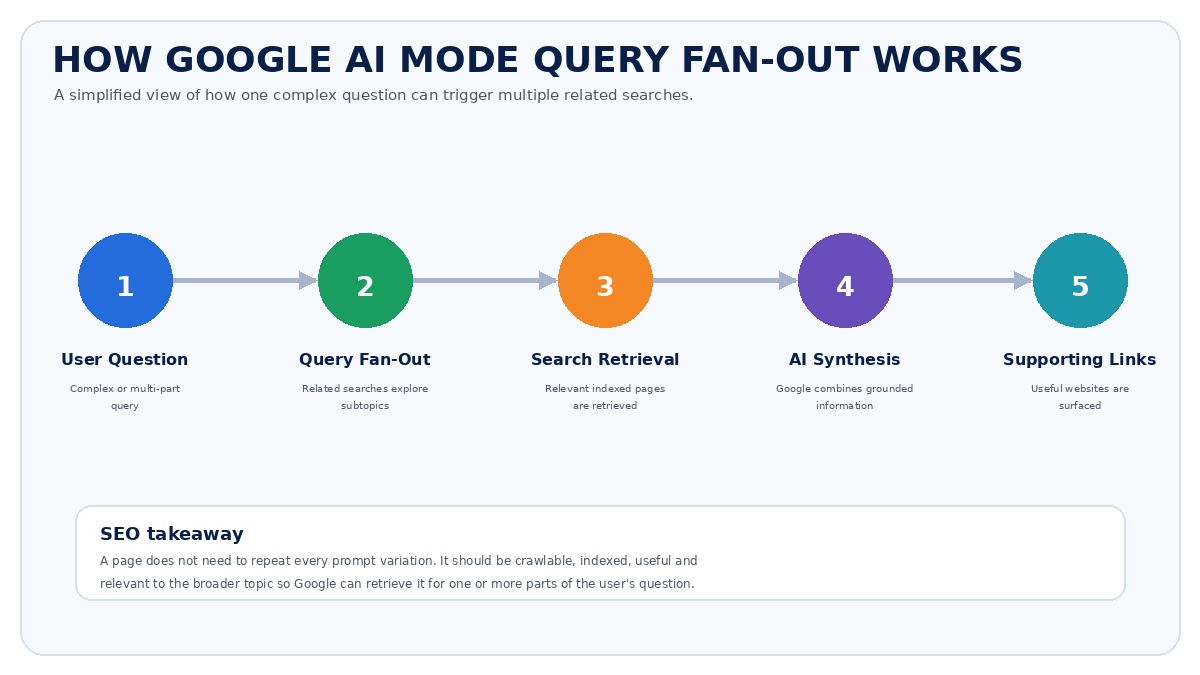
Instead of relying only on one search query, AI Mode can break a complex request into related subtopics, run multiple searches and combine information into a generated response with links to supporting websites.
Google calls this process query fan-out. The system can issue multiple related searches across subtopics and data sources, retrieve relevant pages and then use those results to build a more complete response.
This means a page can become useful to AI Mode even when it does not exactly match the wording of the user’s original prompt. A page may instead support one important part of the broader question.
Google AI Mode vs AI Overviews
| Feature | AI Overviews | AI Mode |
|---|---|---|
| Main experience | Generated overview within Google Search | Dedicated conversational AI Search experience |
| User behavior | Reads summary and explores supporting links | Can ask follow-up questions and continue exploring |
| Query complexity | Useful for many informational and complex searches | Designed especially for deeper exploration, comparisons and reasoning |
| Query fan-out | May use related searches to build responses | Can extensively fan out across subtopics and data sources |
| Web links | Surfaces supporting websites | Surfaces links throughout AI-powered responses |
| Search Console | Included in Search performance reporting | Included in Search performance reporting |
Does Google AI Mode Require Special SEO?
No. Google’s official documentation is explicit that there are no additional technical requirements for appearing in AI Overviews or AI Mode.
To be eligible as a supporting link, a page needs to meet normal Google Search technical requirements, be indexed and be eligible to appear with a snippet.
Google also says website owners do not need a special schema type, an AI-specific text file or new machine-readable markup to appear in its generative AI Search features.
This is an important distinction because the growth of GEO, AEO and LLM SEO has created a large number of supposed AI-specific optimization tricks. For Google AI Mode, the strongest strategy remains excellent SEO combined with genuinely useful content.
See Google’s official AI features and your website documentation and its generative AI optimization guide.
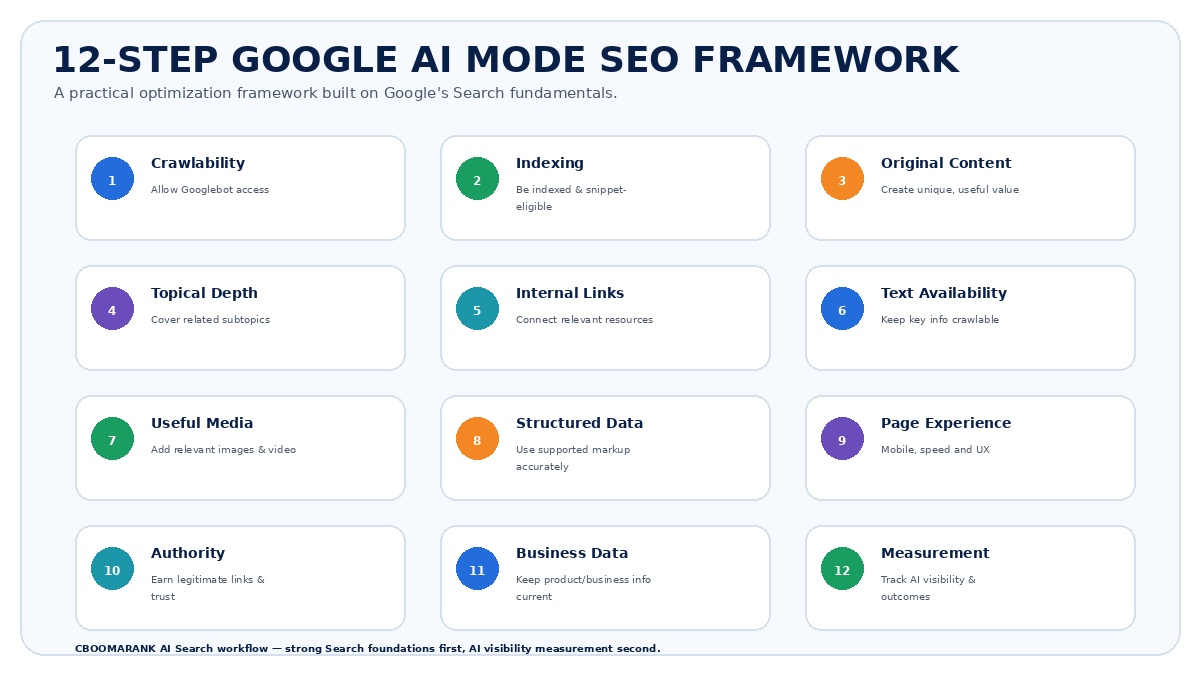
12-Step Google AI Mode SEO Framework
1. Make Sure Google Can Crawl Your Website
AI Mode depends on Google’s Search systems. If Googlebot cannot access important pages because of robots.txt, firewall rules, CDN restrictions or authentication barriers, those pages cannot become useful supporting resources.
- Check robots.txt.
- Review CDN and firewall rules.
- Confirm Googlebot can access important resources.
- Use Search Console URL Inspection for important pages.
2. Ensure Important Pages Are Indexed
A page needs to be indexed and eligible for a normal Google Search snippet before it can be considered as a supporting link in AI Mode.
Check canonical tags, noindex directives, crawl status, duplicate pages and sitemap coverage before looking for advanced AI-search explanations.
3. Create Useful, Original and Non-Commodity Content
Google’s 2026 generative AI guidance places strong emphasis on valuable, unique and non-commodity content.
If dozens of pages repeat the same generic definition, there is little reason for an AI-powered Search experience to prefer one over another. Add information that genuinely improves the web:
- original tests;
- first-hand experience;
- unique datasets;
- expert analysis;
- examples and case studies;
- comparison frameworks;
- original images and video;
- clear explanations that solve the user’s actual problem.
4. Optimize for Topics, Not Only Exact Keywords
Query fan-out changes how content should be planned. A complex AI Mode request may generate multiple related searches behind the scenes.
Instead of creating a page that repeats one keyword, build strong topical coverage around the problem.
For example, a user asking how to improve ecommerce SEO may trigger searches related to crawlability, product schema, category pages, internal linking, images, merchant data, page experience and backlinks.
Use keyword research to understand that topic structure. Our Top Keyword Research Tools Compared guide can help with that process.
5. Strengthen Internal Linking
Google specifically recommends making content easy to discover through internal links.
Internal linking helps search engines understand how pages relate to one another and allows readers to move naturally through a topic cluster.
- Link pillar pages to detailed supporting articles.
- Use descriptive anchor text.
- Avoid leaving important pages orphaned.
- Connect related questions and subtopics.
- Update older articles when a new relevant page is published.
6. Keep Important Information Available as Text
Google recommends ensuring that important content is available in textual form.
Do not hide critical explanations only inside images, videos, canvas elements or interfaces that are difficult for crawlers to process.
Images and videos can strengthen a page, but the essential meaning should also be clearly expressed in crawlable HTML text.
7. Use Helpful Images and Video
Generative Search is increasingly multimodal. Google recommends supporting textual content with high-quality images and video when they help users understand the subject.
- Use descriptive filenames.
- Add accurate ALT text.
- Place media near relevant text.
- Create original diagrams where they clarify a process.
- Make image landing pages useful.
8. Use Structured Data Correctly
Structured data can help Google understand specific entities and page information, but there is no special Google AI Mode schema.
Use supported structured data only when it accurately describes the visible page content. Do not add markup solely because someone claims it will force a page into AI Mode.
9. Improve Page Experience
A page may satisfy every technical requirement and still provide a poor experience. Google recommends considering the overall page experience rather than optimizing one isolated metric.
- Provide good Core Web Vitals.
- Use HTTPS.
- Make pages work well on mobile.
- Avoid intrusive interstitials.
- Keep ads from overwhelming the main content.
- Make the main information easy to identify.
For a broader optimization framework, see the CBOOMARANK SEO Optimization Guide.
10. Build Legitimate Authority
AI Search has not eliminated the importance of trust and authority. Pages should demonstrate why they deserve to be used as supporting resources.
- Earn legitimate editorial backlinks.
- Build recognizable expertise in a topic.
- Reference primary sources.
- Keep factual information accurate and current.
- Show real authorship or business identity where relevant.
- Create resources other websites naturally want to cite.
11. Keep Business and Product Information Accurate
For local businesses and ecommerce sites, Google recommends keeping Business Profile and Merchant Center information current.
That includes prices, availability, business details, product information and other structured commercial data that Google may use across its Search ecosystem.
12. Measure AI Search Visibility and Business Outcomes
Optimization without measurement quickly becomes guesswork.
Google includes AI Mode and AI Overviews traffic within Search Console performance data. In 2026, Google also introduced dedicated Search Generative AI performance reporting to provide more specific visibility into impressions from generative AI Search features.
Do not stop at impressions. Track whether AI-search visibility produces meaningful outcomes:
- clicks;
- engaged sessions;
- time on site;
- newsletter signups;
- leads;
- sales;
- qualified conversions.
See Google’s official Search Generative AI performance report announcement.
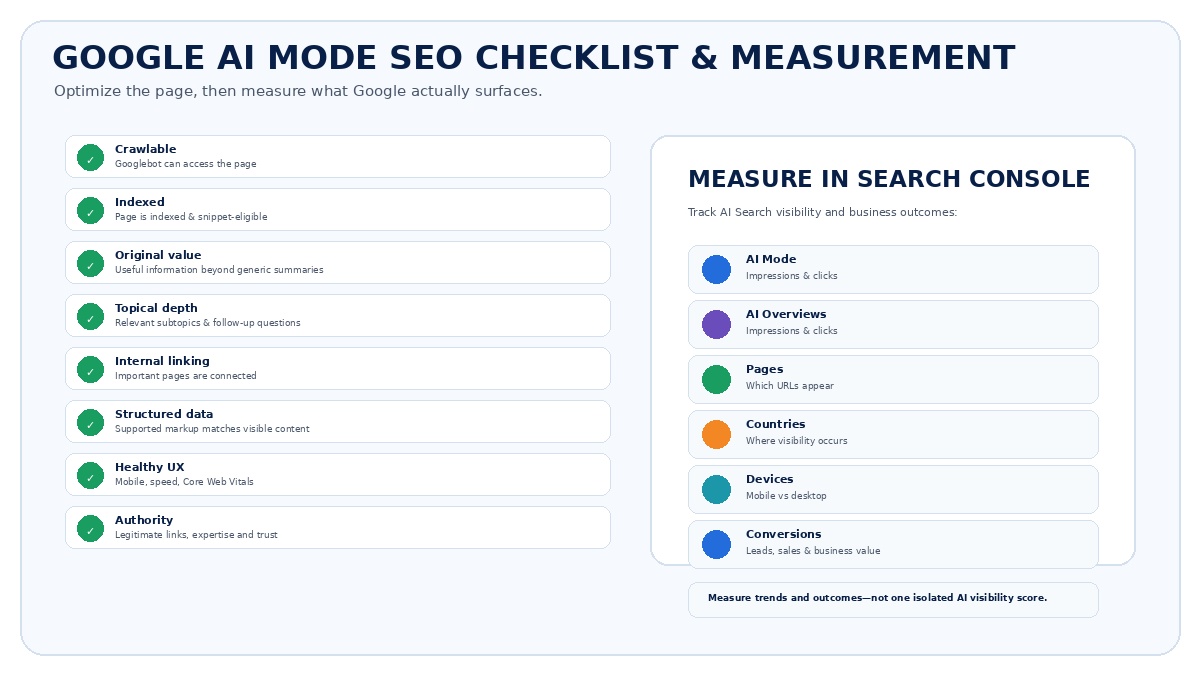
Google AI Mode SEO Checklist
| Check | What to Verify |
|---|---|
| Crawlability | Googlebot can access the page and important resources |
| Indexing | Page is indexed and eligible for a Search snippet |
| Original value | Content adds useful information beyond generic summaries |
| Topical depth | Page and site address relevant subtopics and follow-up questions |
| Internal links | Important pages are discoverable and logically connected |
| Text availability | Essential information exists in crawlable HTML text |
| Media | Images and videos are useful, descriptive and relevant |
| Structured data | Supported markup matches visible page content |
| Page experience | Mobile usability, Core Web Vitals and overall UX are healthy |
| Authority | Content demonstrates expertise and earns legitimate references |
| Measurement | Search Console and analytics are used to measure AI-search outcomes |
What Does Query Fan-Out Mean for SEO?
Query fan-out is one of the most important concepts for understanding Google AI Mode.
A traditional SEO workflow often begins with one query and one results page. AI Mode can instead interpret the user’s intent, identify related subproblems, run multiple searches and retrieve information from several pages before producing a response.
This creates several implications for SEO:
- A page does not need to repeat every possible prompt variation.
- Strong topical relevance becomes more important.
- Supporting articles can contribute to visibility across a broader topic.
- Internal links help establish relationships between related pages.
- Original specialist resources can become supporting sources even when they are not the obvious primary result for the initial query.
The practical strategy is to create the best set of resources for the topic rather than producing dozens of near-duplicate pages for every prompt variation.
Google AI Mode SEO vs Traditional SEO
| Traditional SEO Focus | AI Mode SEO Perspective |
|---|---|
| One keyword | Broader intent and related subtopics |
| Single SERP | Query fan-out across multiple searches |
| Ranking position | Supporting-link and AI visibility opportunities |
| Keyword competitors | Topic and answer-source competitors |
| Page optimization | Page + topic-cluster optimization |
| Organic traffic | Search traffic plus generative AI visibility and outcomes |
The two disciplines should not be separated. AI Mode is built on Google’s wider Search systems, so technical SEO, content quality, internal linking and authority remain fundamental.
Common Google AI Mode SEO Myths
Myth 1: You Need a Special AI Schema
You do not. Google says there is no special schema.org markup required specifically for AI Overviews or AI Mode.
Myth 2: You Need an LLMs.txt File to Rank in AI Mode
Google says you do not need to create new AI text files or machine-readable files to appear in its Search AI features.
Myth 3: Traditional SEO No Longer Matters
Google states the opposite. Its generative AI Search features rely on core Search ranking and quality systems.
Myth 4: One AI Visibility Score Tells the Whole Story
No single score can explain performance across all prompts, models, countries, topics and user journeys. Measure visibility together with citations, traffic, engagement and business results.
Where CBOOMARANK Fits Into the Google AI Mode SEO Workflow
Editorial disclosure: CBOOMARANK publishes this guide and is also developing its own SEO and analytics platform.
CBOOMARANK’s role in this workflow is to connect the underlying SEO work needed to investigate and improve AI-search opportunities.
- Analyze the website and identify technical issues.
- Research the topic and keyword opportunity.
- Study competitors and their content.
- Audit crawlability, indexing and on-page SEO.
- Investigate backlink and authority gaps.
- Improve or create useful content.
- Connect relevant pages through internal links.
- Measure Search and AI visibility over time.
The goal is not to chase an isolated AI ranking trick. It is to build a website that Google can crawl, understand, trust and confidently surface as a useful supporting resource.
Put Your Google AI Mode SEO Strategy Into Practice With CBOOMARANK
Use CBOOMARANK to connect website analysis, keyword research, competitor research, SEO audits, backlink analysis, reporting and content workflows around your AI-search opportunities.
Frequently Asked Questions
How do I optimize for Google AI Mode?
Focus on strong Search fundamentals: allow crawling, ensure important pages are indexed, create original people-first content, build clear internal links, provide important information in text, use helpful media, apply supported structured data accurately and maintain a strong page experience.
Does Google AI Mode use normal SEO rankings?
Google says AI Mode is rooted in its core Search ranking and quality systems. AI Mode may use techniques such as query fan-out to retrieve supporting pages across multiple related searches.
Do I need special schema for Google AI Mode?
No. Google says there is no special structured data required specifically for AI Mode or AI Overviews. Any structured data you use should be a supported type and match the visible page content.
Do I need an LLMs.txt file for Google AI Mode?
No. Google’s documentation says new AI text files or special machine-readable files are not required for inclusion in its generative AI Search features.
Can I measure Google AI Mode traffic in Search Console?
Yes. Google includes AI Mode within overall Search performance data and has also introduced dedicated Search Generative AI reporting for visibility from generative AI Search features.
Is Google AI Mode SEO the same as GEO?
They overlap. GEO is a broader term for improving visibility across generative engines. Google AI Mode SEO focuses specifically on Google’s generative Search experience while still relying heavily on traditional SEO fundamentals.
Final Verdict
Google AI Mode does not require a completely new SEO discipline.
The most sustainable strategy is to build pages that Google can crawl and index, publish genuinely useful and original information, cover topics thoroughly, create strong internal connections, use structured data accurately, provide good media and user experience, and build legitimate authority.
Query fan-out makes topical depth especially important because one AI Mode request may trigger several related searches. That creates opportunities for strong specialist pages and well-organized content clusters to become supporting sources.
Measure the results in Search Console and analytics, connect AI-search visibility back to real business outcomes, and continue improving the SEO foundations behind your content.
Continue the CBOOMARANK AI Search series: Best AI Visibility Tools in 2026, How to Rank in Google AI Overviews, and Best LLM SEO Tools in 2026.
