

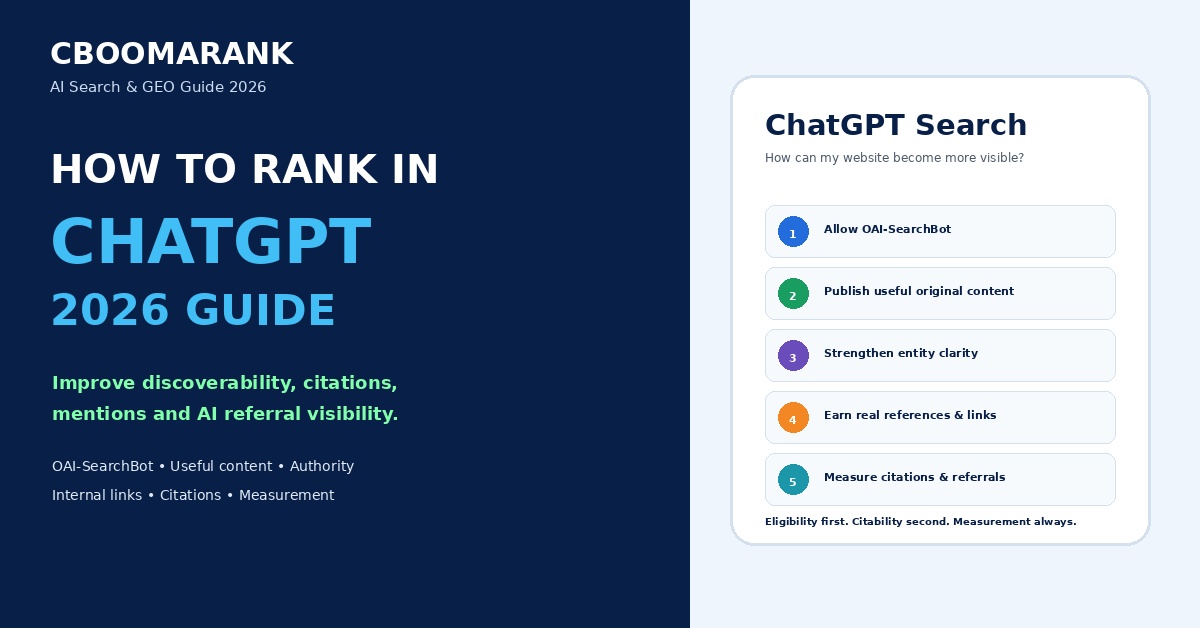
Search is no longer limited to ten blue links. Millions of people now use conversational AI systems to research products, compare software, understand complex subjects, find businesses and make buying decisions.
That shift has created an increasingly important question for website owners and marketers: how do you rank in ChatGPT?
The phrase “rank in ChatGPT” is useful shorthand, but it needs an important clarification. OpenAI does not publish a guaranteed top-ranking formula for ChatGPT Search. Public websites can be eligible to appear, and ChatGPT Search uses multiple factors intended to surface relevant and reliable information, but placement is not guaranteed.
What website owners can do is improve the conditions that make their content discoverable, crawlable, understandable, useful and cite-worthy.
This guide explains the official OpenAI requirements we know, the difference between OAI-SearchBot and GPTBot, the SEO and content practices that support AI visibility, how to measure ChatGPT referral traffic, and how to connect those insights to a broader SEO workflow.
This article is part of the CBOOMARANK AI Search series. You may also want to read Best AI Visibility Tools in 2026, How to Rank in Google AI Overviews, Best LLM SEO Tools in 2026 and Google AI Mode SEO.
What Does “Ranking in ChatGPT” Actually Mean?
Traditional SEO usually measures visibility through search-engine ranking positions. ChatGPT Search works differently.
A useful way to think about ChatGPT visibility is through several possible outcomes:
- Your website is cited as a source in an answer.
- Your page is linked from a ChatGPT search result.
- Your brand is mentioned when a user asks about your category.
- Your product or service is recommended in a relevant comparison or buying journey.
- Your content influences an answer because it contains relevant, reliable information.
- ChatGPT sends referral traffic to your website.
These outcomes are not identical to holding position number one on Google. AI-search visibility is more distributed. The same brand can appear for one prompt, disappear for another, and be cited differently as the user’s question, location, intent or available web information changes.
How ChatGPT Search Finds Website Content
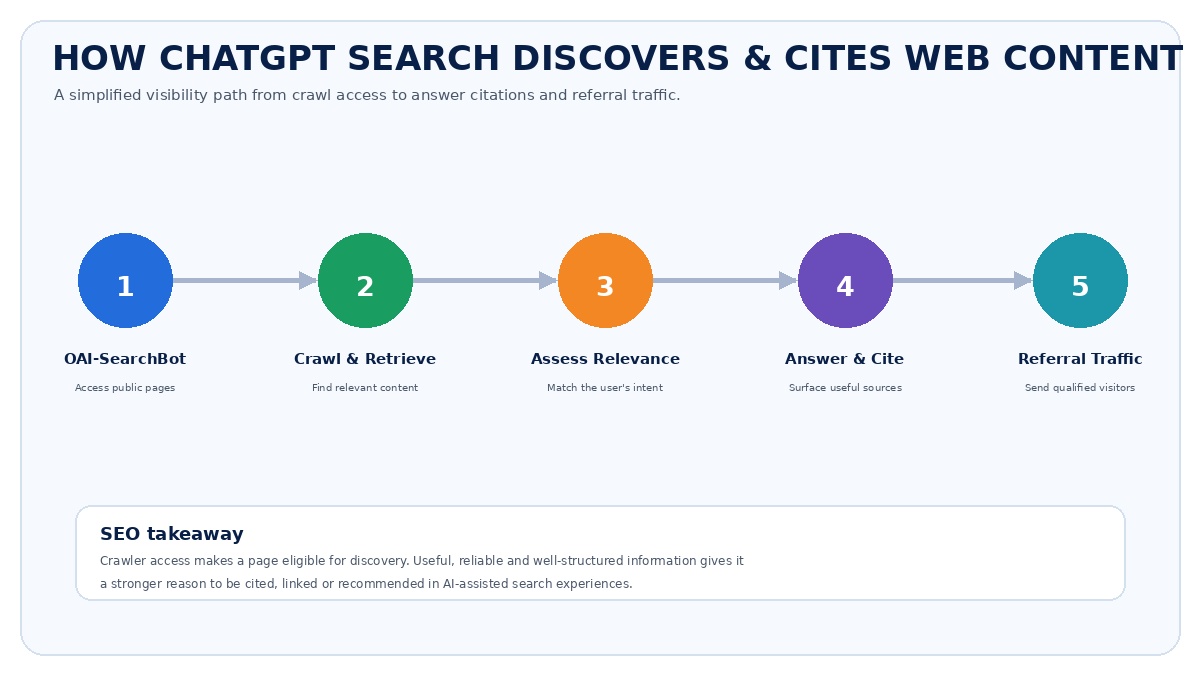
OpenAI says any public website can appear in ChatGPT Search. For your content to be included in summaries and snippets, OpenAI recommends making sure your website does not block OAI-SearchBot.
Your hosting provider, firewall, CDN or bot-protection system also needs to permit legitimate OpenAI SearchBot traffic. A robots.txt rule that allows the crawler will not help if a firewall or security layer returns a 403 response before the crawler can reach the page.
OpenAI publishes SearchBot IP ranges that infrastructure teams can use when validating legitimate crawler traffic.
Official references: OpenAI Publishers and Developers FAQ, Searching the web with ChatGPT, and OpenAI SearchBot IP ranges.
OAI-SearchBot vs GPTBot: Know the Difference
| Crawler | Primary Purpose | Why It Matters |
|---|---|---|
| OAI-SearchBot | Supports discovery of public web content for ChatGPT Search | Allowing access helps content become eligible to be discovered, surfaced, cited and linked in search experiences |
| GPTBot | Associated with collecting web content that may be used to improve generative AI models | Publishers can manage GPTBot separately from SearchBot access |
This distinction matters. A publisher may want its pages discoverable in ChatGPT Search while separately controlling whether GPTBot can access content for potential model improvement.
Do not assume that blocking one OpenAI crawler automatically represents your preference for every OpenAI use case. Review crawler controls deliberately.
There Is No Guaranteed ChatGPT Ranking Formula
OpenAI says ChatGPT Search ranks results using multiple factors intended to help users find relevant and reliable information. Placement is not guaranteed.
That means anyone promising a guaranteed number-one position in ChatGPT should be treated cautiously.
Beyond OpenAI’s published crawler and eligibility guidance, many practical recommendations in this article come from established SEO, information architecture, content-quality and authority principles. They should be treated as optimization practices rather than secret OpenAI ranking factors.
12-Step Framework to Improve ChatGPT Visibility
1. Allow OAI-SearchBot to Crawl Important Pages
Start with the official eligibility requirement.
Review your robots.txt file and make sure important public content is not unintentionally blocked from OAI-SearchBot.
A basic configuration may look like:
User-agent: OAI-SearchBot
Allow: /
Do not paste this blindly into a complex robots.txt configuration. Check existing rules and make sure they match your publishing policy.
2. Check Your CDN, Firewall and Bot Protection
Robots.txt is only one layer. Cloud security systems, WAF rules, rate limits and bot challenges can prevent legitimate crawlers from reaching a website.
- Check for unexpected 403 responses.
- Review rate-limiting events.
- Inspect CDN and WAF bot rules.
- Validate crawler requests against OpenAI’s published IP ranges.
- Avoid allowing spoofed user agents solely because they claim to be OAI-SearchBot.
3. Keep Important Pages Public, Accessible and Indexable
If a page requires a login, depends on unsupported client-side interactions or is blocked by security challenges, it becomes harder for automated systems to access its useful information.
Make important informational and commercial landing pages directly reachable through normal web URLs.
4. Create Content That Directly Answers Real Questions
AI assistants are heavily question-driven. Instead of writing only around a short keyword, understand the real task the user is trying to complete.
For example, a page about SEO software should not simply repeat “best SEO tools.” It should explain what different tools do, who each tool is best for, their trade-offs, pricing considerations, workflow differences and how a buyer should choose.
This is one reason detailed comparison pages and practical guides can be strong resources for AI-assisted research.
5. Publish Original Information That Is Worth Citing
Generic summaries are easy to reproduce. Citation-worthy resources are harder to replace.
- Original research and surveys
- First-hand product testing
- Unique datasets
- Benchmarks
- Expert interviews
- Step-by-step experiments
- Original charts and diagrams
- Case studies with real outcomes
- Clear definitions backed by primary sources
If your page contains information that exists nowhere else, it has a stronger reason to be referenced by humans, search engines and AI systems.
6. Make Your Brand and Entities Unambiguous
Make it easy to understand who your company is, what it does, what products it offers and how those products relate to the subject being discussed.
- Use a clear About page.
- Keep company and product naming consistent.
- Show author information where appropriate.
- Clearly describe services and products.
- Keep contact and business information accurate.
- Use supported structured data where relevant.
This is a practical clarity strategy rather than a disclosed ChatGPT ranking factor.
7. Strengthen Your Internal Linking and Topic Clusters
Strong internal linking helps visitors and crawlers discover related resources and understand the structure of a topic.
For example, CBOOMARANK’s AI Search cluster connects our guides on AI visibility tools, Google AI Overviews, LLM SEO tools and Google AI Mode SEO.
Each article covers a distinct search intent while strengthening the broader topic.
8. Earn Real Mentions, References and Backlinks
Traditional authority-building remains valuable because reputable references help establish that a resource or brand is recognized beyond its own website.
- Earn editorial backlinks.
- Contribute expert commentary.
- Publish research people naturally reference.
- Build legitimate partnerships.
- Get listed in relevant industry resources.
- Avoid manufactured link schemes and fake mentions.
Backlinks should not be viewed as a disclosed ChatGPT ranking formula. Their broader value is that they contribute to web authority, discovery, referral traffic and corroboration.
9. Use Clear Page Structure
Well-organized content is easier for both people and automated systems to interpret.
- Use one clear H1.
- Break major concepts into descriptive H2 headings.
- Use H3 headings for detailed subtopics.
- Use tables for comparisons.
- Use lists for processes and checklists.
- Place direct answers close to the questions they answer.
- Avoid burying the main information beneath unnecessary filler.
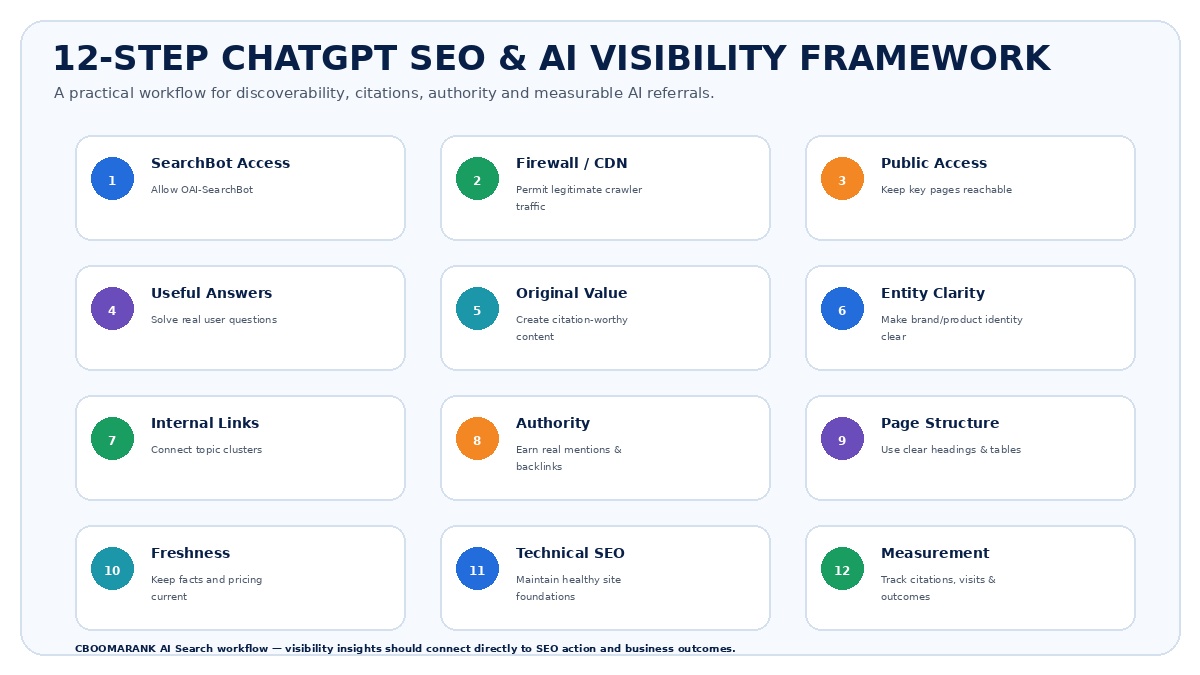
10. Keep Facts, Pricing and Product Information Current
AI-assisted comparisons lose value quickly when the underlying information is stale.
Review pages that contain:
- software pricing;
- feature lists;
- product availability;
- statistics;
- regulatory information;
- technical specifications;
- company names and ownership;
- fast-changing AI product capabilities.
Link to primary sources when factual accuracy matters.
11. Build Strong Technical SEO Foundations
ChatGPT visibility should not become an excuse to neglect your wider website.
- Use HTTPS.
- Maintain clean canonicalization.
- Remove accidental noindex directives.
- Fix broken internal links.
- Improve mobile usability.
- Keep page performance healthy.
- Make important content available in HTML.
- Maintain accurate XML sitemaps.
A healthy technical foundation supports Google visibility, crawler access and general discoverability across the open web.
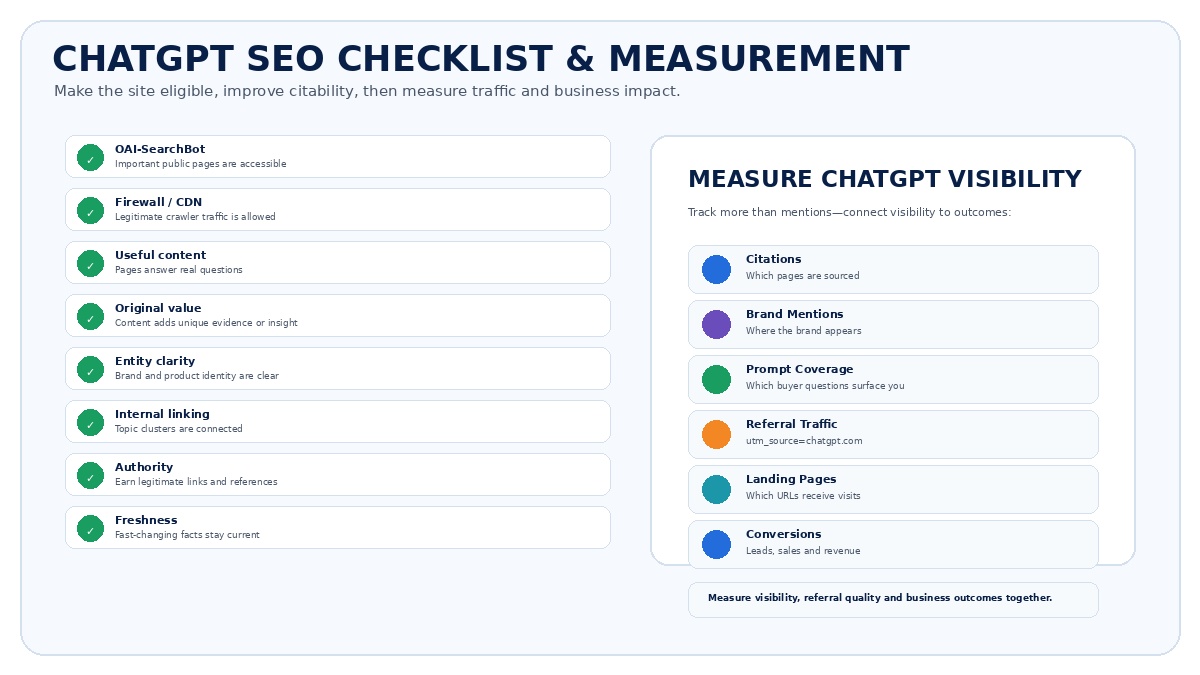
12. Measure ChatGPT Visibility and Referral Traffic
OpenAI says ChatGPT referral links automatically include the parameter utm_source=chatgpt.com, allowing publishers to identify inbound ChatGPT Search traffic in analytics tools.
Track more than visits:
- ChatGPT referral sessions
- Landing pages receiving AI traffic
- Engaged sessions
- Conversions and leads
- Revenue from AI-assisted discovery
- Brand mentions across important prompts
- Citations and source links
- Competitor share of voice
This is where dedicated AI visibility tools and LLM SEO tools can supplement normal web analytics.
ChatGPT SEO Checklist
| Check | What to Verify |
|---|---|
| OAI-SearchBot | Important public pages are not blocked in robots.txt |
| Firewall / CDN | Legitimate SearchBot requests can reach the website |
| Public access | Important content does not require login or unsupported interaction |
| Content quality | Page answers real questions with useful and original information |
| Entity clarity | Brand, product, author and business information are understandable |
| Internal linking | Related articles are logically connected and discoverable |
| Authority | Website earns legitimate mentions, links and references |
| Freshness | Fast-changing facts, prices and product information are current |
| Technical SEO | HTTPS, canonicals, mobile UX and crawlability are healthy |
| Measurement | ChatGPT referrals, citations, mentions and conversions are monitored |
ChatGPT SEO vs Traditional Google SEO
| Traditional Search SEO | ChatGPT / AI Search Visibility |
|---|---|
| Keyword rankings | Prompt-level visibility and citations |
| SERP position | Mentions, citations, recommendations and links |
| Googlebot crawlability | OAI-SearchBot accessibility plus wider web discoverability |
| Organic traffic | AI referral traffic and assisted discovery |
| Search competitors | Brands and sources appearing in AI answers |
| Keyword share of voice | Prompt or answer-engine share of voice |
These disciplines overlap rather than replace each other. Strong traditional SEO can increase the quality and discoverability of your website, while AI-search monitoring adds another visibility layer.
Common ChatGPT SEO Mistakes
Blocking OAI-SearchBot Accidentally
This is the most direct technical mistake. If you want summaries and snippets from your pages to be eligible in ChatGPT Search, review SearchBot access.
Allowing robots.txt but Blocking the Crawler at the Firewall
A permissive robots.txt file does not override your CDN, WAF or hosting firewall.
Confusing GPTBot With OAI-SearchBot
They serve different purposes. Manage them separately according to your publishing and data-use preferences.
Publishing Generic AI-Written Summaries at Scale
Producing hundreds of interchangeable pages adds little durable value. Build resources with expertise, evidence, analysis and genuine usefulness.
Treating Brand Mentions as Guaranteed Rankings
A mention in one answer does not mean your brand permanently “ranks” for that topic. Prompts, context and available sources can change.
Ignoring Conversion Quality
AI visibility is valuable only when it supports real objectives. Measure qualified visitors, leads, sales and brand discovery—not mentions alone.
Where CBOOMARANK Fits Into the ChatGPT SEO Workflow
Editorial disclosure: CBOOMARANK publishes this guide and is also developing its own SEO and analytics platform.
CBOOMARANK’s role is to connect AI-search opportunities with the underlying SEO work needed to investigate and improve them.
- Identify an important ChatGPT visibility, mention or citation gap.
- Research the topic and underlying keywords.
- Analyze competitors and sources already appearing around the topic.
- Audit the target website and page.
- Investigate internal-linking and content gaps.
- Analyze backlink and authority opportunities.
- Improve or create genuinely useful content.
- Measure search visibility, AI referrals and business outcomes.
This creates a connected workflow rather than treating ChatGPT visibility as an isolated dashboard metric.
Turn ChatGPT Visibility Insights Into SEO Action With CBOOMARANK
Use CBOOMARANK to connect website analysis, keyword research, competitor research, SEO audits, backlink analysis, reporting and content workflows around the opportunities you discover through AI Search.
Frequently Asked Questions
How do I rank my website in ChatGPT?
There is no guaranteed ChatGPT ranking formula. To improve eligibility and discoverability, make your website publicly accessible, allow OAI-SearchBot where appropriate, ensure your CDN or firewall permits legitimate crawler traffic, publish useful and reliable information, build strong SEO foundations and earn legitimate references across the web.
Does ChatGPT crawl websites?
Yes. OpenAI operates OAI-SearchBot for search-related web discovery. OpenAI provides publisher guidance for controlling crawler access through robots.txt and infrastructure rules.
Should I allow OAI-SearchBot?
If you want your public website content to be eligible for discovery, summaries, citations and links in ChatGPT Search, OpenAI recommends not blocking OAI-SearchBot.
Is OAI-SearchBot the same as GPTBot?
No. OAI-SearchBot supports search-related discovery, while GPTBot is associated with content that may be used to improve generative AI models. Publishers can manage these crawlers separately.
Can I track traffic from ChatGPT?
Yes. OpenAI says ChatGPT referral URLs automatically include utm_source=chatgpt.com, which can help publishers identify ChatGPT traffic in analytics platforms.
Do backlinks help with ChatGPT visibility?
OpenAI has not published a formula saying that a specific number of backlinks guarantees ChatGPT placement. However, legitimate links and references remain valuable for general web authority, discovery, corroboration and referral traffic.
Is ChatGPT SEO the same as GEO?
ChatGPT SEO is a platform-specific part of the broader GEO and AI-search optimization landscape. GEO usually refers to improving visibility across multiple generative and answer engines rather than ChatGPT alone.
Final Verdict
You cannot guarantee a number-one ranking in ChatGPT.
You can, however, make your website easier for ChatGPT Search to discover and use. Start by allowing OAI-SearchBot where appropriate and confirming your infrastructure does not block legitimate OpenAI crawler traffic.
Then strengthen the fundamentals: publish original and useful information, answer real questions, make your brand and entities clear, build strong internal links, maintain technical SEO, earn legitimate references and keep fast-changing facts current.
Finally, measure whether ChatGPT citations and referrals lead to engaged visitors and business outcomes. AI visibility should connect back to SEO execution, content quality and real value—not become another vanity metric.
Continue the CBOOMARANK AI Search series: Best AI Visibility Tools in 2026, How to Rank in Google AI Overviews, Best LLM SEO Tools in 2026 and Google AI Mode SEO.
