

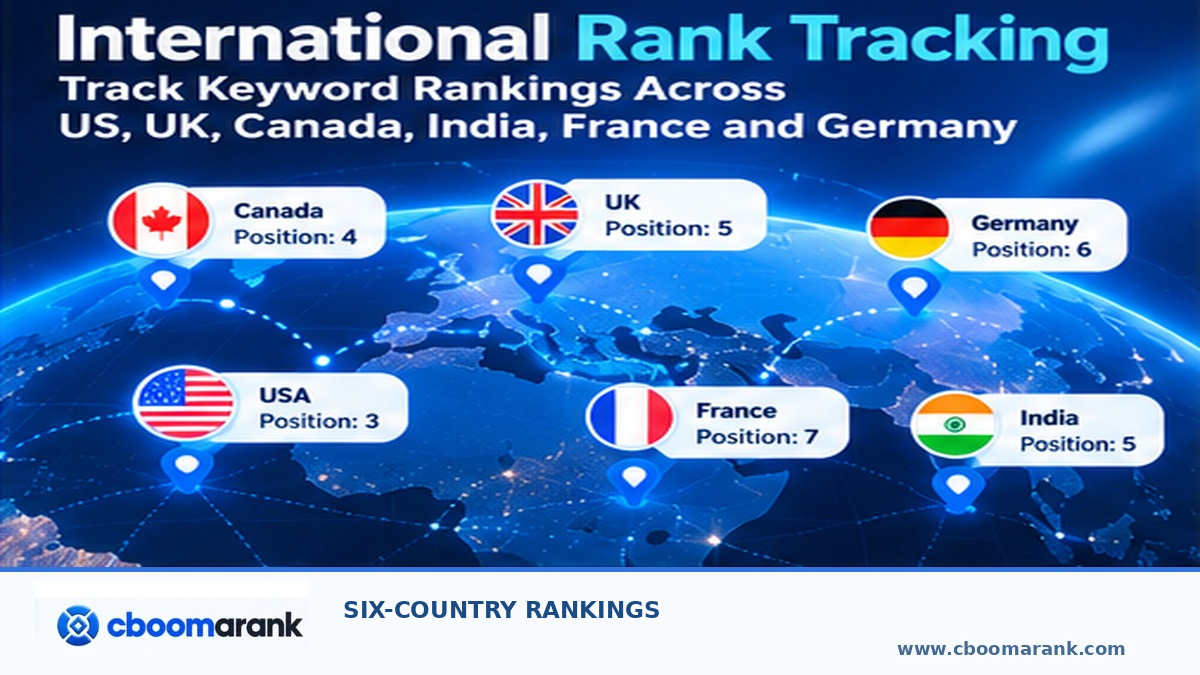
International rank tracking is not a single global rank column. Searches in the United States, United Kingdom, Canada, India, France and Germany may produce different results because intent, competition, language, location and device differ. This guide shows how to design comparable but separate observations for six markets without pretending translation creates equivalent keywords.
Practical scope: A six-market measurement protocol with language and country separation. The instructions below distinguish actual first-party metrics, observed search results, and third-party estimates. Their meaning changes with location, date, device, and source, so a useful decision begins by documenting those inputs.
What Is International Rank Tracking? Quick Explanation
International rank tracking is not a single global rank column. Searches in the United States, United Kingdom, Canada, India, France and Germany may produce different results because intent, competition, language, location and device differ. This guide shows how to design comparable but separate observations for six markets without pretending translation creates equivalent keywords.
International Rank Tracking: Evidence to Compare Across Countries
| Stage | What to do | Why it matters |
|---|---|---|
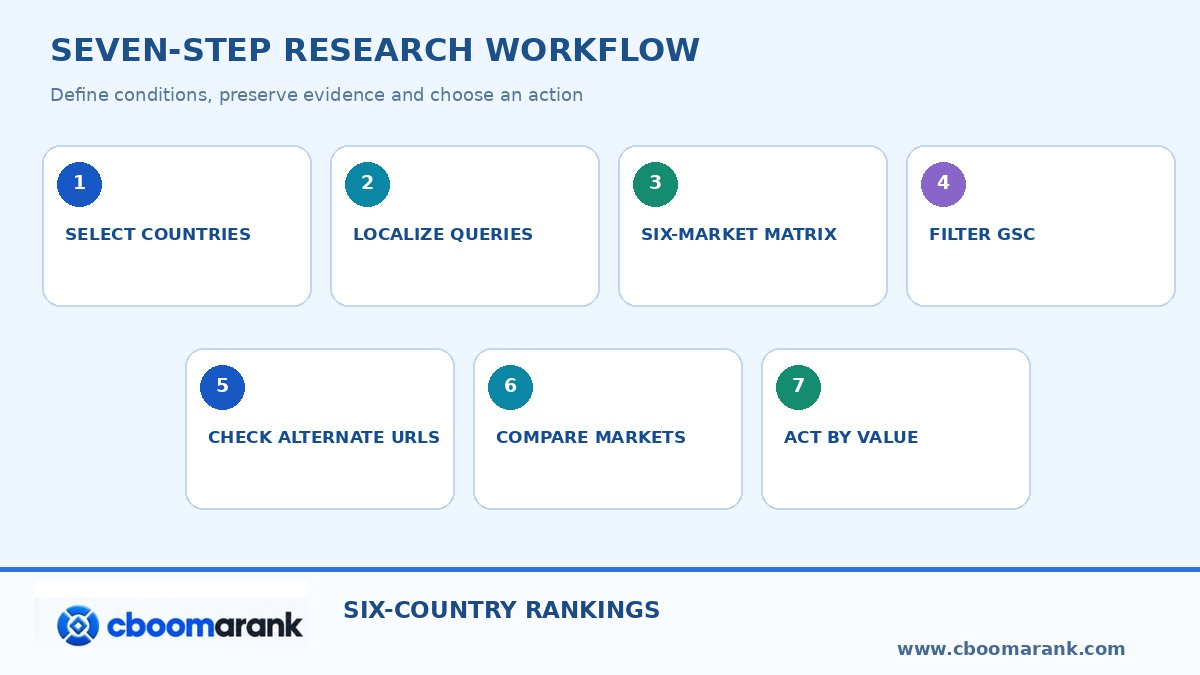
| 1 | Select genuine markets and landing pages | Confirm which countries the business serves, which pages are relevant to each market and whether an international SEO configuration exists. |
| 2 | Localize keywords, not merely translations | Separate English variants from French and German search vocabulary. |
| 3 | Build the six-country tracking matrix | Make separate rows for United States, United Kingdom, Canada, India, France and Germany. |
| 4 | Validate Search Console country slices | Google Search Console can segment performance by country and device. |
| 5 | Watch hreflang and canonical behavior | Check whether intended alternate-language URLs are discoverable, crawlable and properly linked. |
| 6 | Keep country and language performance separate | A successful UK landing page can rank poorly in Canada while a different Canadian page performs well. |
| 7 | Prioritize actions by commercial value | Compare qualified leads and reachable customers, not only total search volume. |
How to Use International Rank Tracking: A Seven-Step Method
Step 1: Select genuine markets and landing pages
Confirm which countries the business serves, which pages are relevant to each market and whether an international SEO configuration exists. A business that only sells in the United States should not celebrate a German position that cannot convert. Record the correct country-facing URL and language before allocating tracking credits.
For this stage, make your evidence traceable: record the scope of “select genuine markets and landing pages,” the source you consulted, what remains uncertain, and the next action you would take. If the available data is incomplete, mark it as an assumption rather than filling the gap with an unsupported ranking, conversion rate or advertising cost. This extra discipline makes international rank tracking work easier to audit when another analyst repeats the exercise next month.
Step 2: Localize keywords, not merely translations — International Rank Tracking
Separate English variants from French and German search vocabulary. A literal translation may be grammatical but rarely used by buyers. Research native-language modifiers, local terminology, plurals and commercial phrase structure. Have a fluent reviewer check important French and German queries before building a ranking dashboard.
For this stage, make your evidence traceable: record the scope of “localize keywords, not merely translations,” the source you consulted, what remains uncertain, and the next action you would take. If the available data is incomplete, mark it as an assumption rather than filling the gap with an unsupported ranking, conversion rate or advertising cost. This extra discipline makes international rank tracking work easier to audit when another analyst repeats the exercise next month.
Step 3: Build an International Rank Tracking Matrix for Six Countries
Make separate rows for United States, United Kingdom, Canada, India, France and Germany. Add language, target city where applicable, device, keyword variant, canonical URL and collection date. Use a consistent definition of organic position. A keyword set can share an intent cluster without being forced to share an identical spelling.
For this stage, make your evidence traceable: record the scope of “build the six-country tracking matrix,” the source you consulted, what remains uncertain, and the next action you would take. If the available data is incomplete, mark it as an assumption rather than filling the gap with an unsupported ranking, conversion rate or advertising cost. This extra discipline makes international rank tracking work easier to audit when another analyst repeats the exercise next month.
Quality check for step 3
Confirm that the observation is relevant to the user’s real task and that a different location, date, device, page, or audience would not change its meaning. Document any exception in the research workbook so it does not become an unexplained outlier in a later presentation.
Step 4: Validate Search Console country slices
Google Search Console can segment performance by country and device. Filter a query and landing page as needed, then compare impressions, clicks and average position for the same date period. Data gaps may result from insufficient impressions, a wrong property or an overly narrow query filter. Do not interpret missing rows as proof that a site is blocked.
For this stage, make your evidence traceable: record the scope of “validate search console country slices,” the source you consulted, what remains uncertain, and the next action you would take. If the available data is incomplete, mark it as an assumption rather than filling the gap with an unsupported ranking, conversion rate or advertising cost. This extra discipline makes international rank tracking work easier to audit when another analyst repeats the exercise next month.
Step 5: Watch hreflang and canonical behavior — International Rank Tracking
Check whether intended alternate-language URLs are discoverable, crawlable and properly linked. Review canonical choices and hreflang annotations when appropriate. A page targeting Germany but canonicalized unexpectedly to another market can create a confusing report. Tracking cannot repair technical international SEO problems on its own.
For this stage, make your evidence traceable: record the scope of “watch hreflang and canonical behavior,” the source you consulted, what remains uncertain, and the next action you would take. If the available data is incomplete, mark it as an assumption rather than filling the gap with an unsupported ranking, conversion rate or advertising cost. This extra discipline makes international rank tracking work easier to audit when another analyst repeats the exercise next month.
Step 6: Keep country and language performance separate
A successful UK landing page can rank poorly in Canada while a different Canadian page performs well. Avoid averaging these into a “global position.” Use market-level dashboards that show leading pages, missed intents, SERP features and business relevance. Distinguish a worldwide brand query from nonbranded customer acquisition.
For this stage, make your evidence traceable: record the scope of “keep country and language performance separate,” the source you consulted, what remains uncertain, and the next action you would take. If the available data is incomplete, mark it as an assumption rather than filling the gap with an unsupported ranking, conversion rate or advertising cost. This extra discipline makes international rank tracking work easier to audit when another analyst repeats the exercise next month.
Quality check for step 6
Confirm that the observation is relevant to the user’s real task and that a different location, date, device, page, or audience would not change its meaning. Document any exception in the research workbook so it does not become an unexplained outlier in a later presentation.
Step 7: Prioritize actions by commercial value
Compare qualified leads and reachable customers, not only total search volume. For each market, identify one technical fix, one content improvement and one conversion-friction reduction supported by evidence. Smaller markets with stronger buyer intent may deserve earlier investment than a large but irrelevant volume figure.
For this stage, make your evidence traceable: record the scope of “prioritize actions by commercial value,” the source you consulted, what remains uncertain, and the next action you would take. If the available data is incomplete, mark it as an assumption rather than filling the gap with an unsupported ranking, conversion rate or advertising cost. This extra discipline makes international rank tracking work easier to audit when another analyst repeats the exercise next month.
International Rank Tracking in Practice: Worked Example
A SaaS team serving six markets sees “rank tracking software” with different visibility patterns in the US and UK. France and Germany use language-localized phrases rather than English exact matches. The team records separate observations in the workbook, maps every query to a suitable page, checks Search Console by country and then allocates translation review to the weakest qualified market. This is an illustrative planning example, not measured CBOOMARANK ranking data.
Evidence rule: Any example figures in this article are hypothetical teaching inputs, not CBOOMARANK customer results, a current Google Ads auction, or a measurement of a named competitor. Use your own collected records before drawing a commercial conclusion.
Common International Rank Tracking Mistakes and How to Avoid Them
1. Language variants are not identical keyword markets.
Language variants are not identical keyword markets. A more reliable approach is to label the exact source, period, market and limitations beside the observation, then state what the user should do next. This matters because stakeholder decisions can become expensive when a narrow sampled signal is promoted into an unsupported universal claim. Keep the correction tied to the reader’s goal and check whether the evidence changes after the next consistent measurement.
2. Do not average six countries into a universal position.
Do not average six countries into a universal position. A more reliable approach is to label the exact source, period, market and limitations beside the observation, then state what the user should do next. This matters because stakeholder decisions can become expensive when a narrow sampled signal is promoted into an unsupported universal claim. Keep the correction tied to the reader’s goal and check whether the evidence changes after the next consistent measurement.
3. Track actual eligible landing pages for each region.
Track actual eligible landing pages for each region. A more reliable approach is to label the exact source, period, market and limitations beside the observation, then state what the user should do next. This matters because stakeholder decisions can become expensive when a narrow sampled signal is promoted into an unsupported universal claim. Keep the correction tied to the reader’s goal and check whether the evidence changes after the next consistent measurement.
4. Check hreflang and canonical clues before editing content.
Check hreflang and canonical clues before editing content. A more reliable approach is to label the exact source, period, market and limitations beside the observation, then state what the user should do next. This matters because stakeholder decisions can become expensive when a narrow sampled signal is promoted into an unsupported universal claim. Keep the correction tied to the reader’s goal and check whether the evidence changes after the next consistent measurement.
5. Segment commercial outcomes by served geography.
Segment commercial outcomes by served geography. A more reliable approach is to label the exact source, period, market and limitations beside the observation, then state what the user should do next. This matters because stakeholder decisions can become expensive when a narrow sampled signal is promoted into an unsupported universal claim. Keep the correction tied to the reader’s goal and check whether the evidence changes after the next consistent measurement.
6. Avoid claims of local visibility based on one global tool snapshot.
Avoid claims of local visibility based on one global tool snapshot. A more reliable approach is to label the exact source, period, market and limitations beside the observation, then state what the user should do next. This matters because stakeholder decisions can become expensive when a narrow sampled signal is promoted into an unsupported universal claim. Keep the correction tied to the reader’s goal and check whether the evidence changes after the next consistent measurement.
Turn International Rank Tracking Findings into a 30-Day Action Plan
Week 1 — Collect a reproducible baseline
Agree which keywords, audience, countries, languages, URLs, and conversion goals belong to the project. Verify analytics and search reporting access. Save a dated baseline and label unknown values rather than pretending the available dataset is complete. If source settings differ, create separate rows rather than averaging incompatible results.
Week 2 — Prioritize the evidence
Group queries by shared intent and mark where an existing page already answers the need. Rate opportunities by relevance, feasibility, customer value, confidence and effort. Discuss apparent contradictions before moving budget or restructuring content. Choose one hypothesis that the team can test within its technical and editorial constraints.
Week 3 — Implement one controlled improvement
Improve the most relevant landing page, clarify its answer, fix a tracking problem or test an appropriate paid campaign if authorized. Record what was changed, when, and how success will be measured. Preserve backups and avoid simultaneous changes that make the outcome hard to interpret.
Week 4 — Measure qualified outcomes
Compare equivalent observation windows, review search impressions and clicks, and measure meaningful leads or registrations where tracking is configured. Distinguish correlation from causation. Keep changes that benefit customers, discard weak assumptions and set the next review cadence based on the business value of the finding.
Frequently Asked Questions About International Rank Tracking
Can I use the same English keyword in all six countries?
Only if it reflects real search behavior. Research local spelling and intent, especially in France and Germany.
Does hreflang guarantee local rankings?
No. It helps search engines understand alternates, but relevance and eligibility remain separate issues.
Should I compare positions across countries directly?
Only as appropriately qualified observations, not as equivalent market share measures.
What is the best reporting unit?
Country, language, device, exact query and target URL, with a clear measurement date.
Can Search Console replace a multi-country tracker?
It supplies first-party performance but does not replace every specific geo/device SERP observation.
Official References and Further Reading
- Google Search Console: analyze reports by country and device. Check the provider’s current definitions and limitations.
- Google Search Console: performance reports. Check the provider’s current definitions and limitations.
- Google Search Central: creating helpful content. Check the provider’s current definitions and limitations.
Continue researching with this related CBOOMARANK SEO guide and another practical CBOOMARANK resource. Related articles support this narrower task rather than replacing it.
Final Verdict: Make International Rank Tracking Measurable
The point of international rank tracking is not to collect impressive-looking metrics without context. Use a clear measurement specification, original evidence where available, defensible assumptions, and an action tied to a real customer need. A smaller, well-understood result can be more valuable than a broad ranking, search-volume or CPC estimate that cannot be reproduced.
Editorial review: October 2026. Tools, search layouts, plan limits and advertising costs can change. Examples are explicitly illustrative. This CBOOMARANK article is commercial editorial content; verify current third-party facts and product access before making a purchase.
