

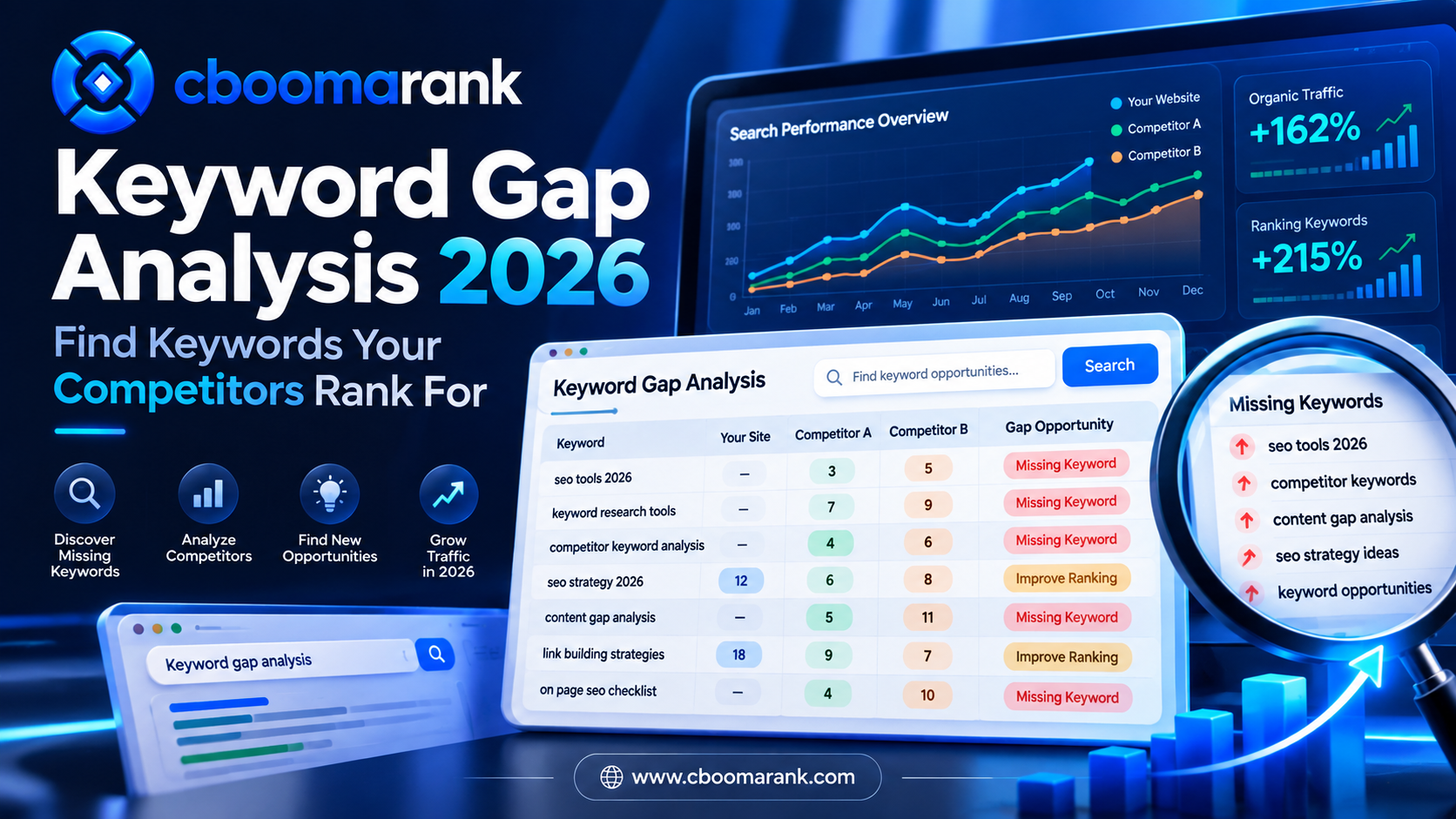
A keyword gap analysis shows the search queries your competitors rank for while your website does not, or where your visibility is materially weaker. Instead of guessing what to publish next, the process helps you identify missing topics, underserved search intent and commercial opportunities that already produce visibility for competing websites.
In 2026, keyword research should go beyond collecting large lists of search terms. The more useful question is whether a keyword represents a realistic opportunity for your site, matches your audience, supports an important stage of the buying journey and can be served by content that is genuinely stronger than what currently ranks.
This guide explains how to run a practical keyword gap analysis, compare several competitors, prioritize missing keywords, identify content gaps and turn the findings into an actionable SEO roadmap. It also explains how CBOOMARANK can connect competitor research, keyword intelligence and website analysis in one workflow.
What Is a Keyword Gap?
A keyword gap is a search query or topic for which one or more competitors have visibility but your website has little or no presence. The gap may be complete, meaning you do not rank meaningfully for the query, or partial, meaning you rank but your competitors hold stronger positions.
For example, three competing SEO platforms may rank for “technical SEO audit checklist,” while your website has no page targeting that intent. That is a potential content gap. If your page ranks on page two while competitors occupy the top results, the opportunity may instead involve improving an existing page.
Therefore, keyword gap analysis is not simply a list-building exercise. It helps you decide whether to create, update, consolidate or deprioritize content.
Why Keyword Gap Analysis Matters
SEO teams often generate ideas from brainstorming, keyword tools and customer questions. Those methods are useful, but competitor data adds another layer of evidence.
If several relevant competitors receive visibility from the same topic, the query may represent an established demand pattern in your market. More importantly, a keyword gap can reveal subjects your own content strategy has overlooked.
The analysis can also uncover gaps across different stages of the funnel. One competitor may dominate informational searches while another performs strongly for comparison and buying-intent queries. Understanding those differences helps you build a more balanced strategy.
For broader competitive context, see the CBOOMARANK guide to website competitor analysis.
Keyword Gap vs Traditional Keyword Research
Traditional keyword research usually begins with seed topics related to your products, services or audience. From those seeds, you expand into related terms, questions and variations.
A keyword gap starts from the opposite direction. Instead of asking what people might search, you examine what already drives visibility for websites competing with you.
The two methods work best together. Traditional research helps you explore the market broadly, while competitor gap analysis shows where other sites have already captured demand that you may be missing.
Choose the Right Competitors for Keyword Gap Analysis
The quality of your analysis depends heavily on the competitors you select. Your closest business competitor is not necessarily your closest search competitor.
A company can compete with you commercially but rank for very different keywords. Conversely, an informational publisher, software directory or niche blog may compete for many of the same queries without selling the same product.
Use Organic Search Competitors
Start with domains that repeatedly appear for keywords important to your business. If the same website ranks across dozens of your target topics, it is useful for keyword gap analysis even if its business model differs from yours.
You can identify these domains through your existing competitor research process and compare them with the sites highlighted in our competitor analysis tools guide.
Use Several Competitors, Not Just One
One competitor can create a distorted picture. A topic might be important only to that specific business. However, if three or four relevant competitors all rank for the same group of keywords and your site does not, the signal becomes stronger.
A practical starting point is three to five competitors. This is large enough to expose recurring patterns while remaining manageable for manual review.
Build a Keyword Gap Comparison Set
Create a working table that includes the keyword, search intent, competitor positions, your position, estimated search demand, topic cluster, commercial value, current URL and recommended action.
The recommended action is particularly important. Every keyword should eventually lead to one of several decisions: create a new page, update an existing page, consolidate overlapping content, strengthen internal linking, or ignore the keyword because it does not fit the business.
This prevents your research from becoming a spreadsheet that never translates into execution.
Find Missing Keyword Gaps
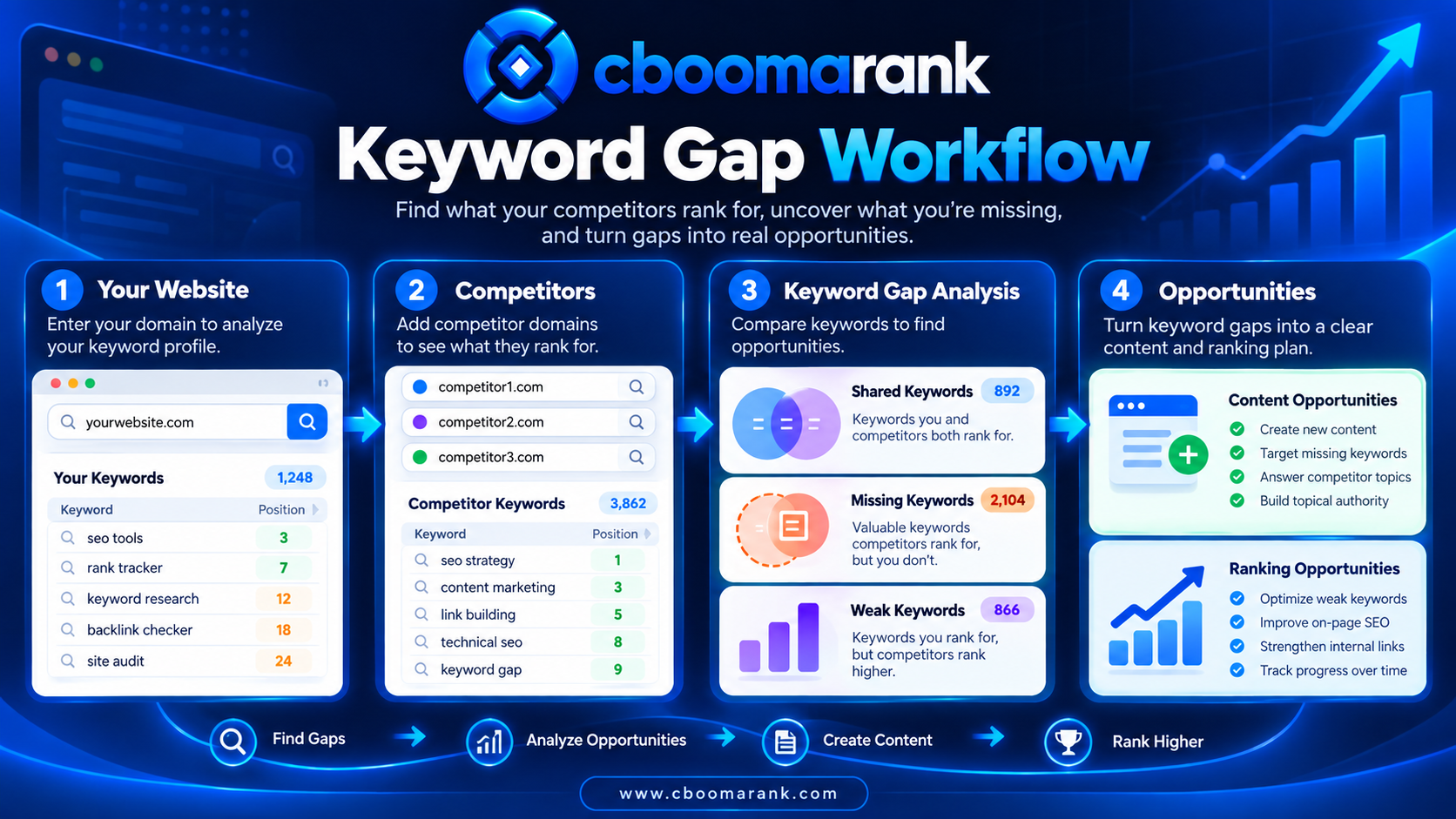
A missing keyword is a query where competitors rank but your site has no meaningful visibility. These are usually the easiest gaps to understand, but they still require judgment.
Do not automatically create a page for every missing keyword. First determine whether the intent fits your site. A competitor may rank because it serves a product category, geography or audience segment you do not target.
Next, check whether several missing terms belong to the same topic. Ten related keywords may need one strong page rather than ten thin pages.
Shared Competitor Keyword Gaps
Keywords shared by several competitors can be high-priority candidates. If multiple sites in your market rank for a query and your site does not, the pattern suggests that the topic may be important to your audience.
However, confirm search intent before assigning priority. A high-volume informational query may still be less valuable than a smaller commercial query directly connected to your product.
Unique Competitor Keyword Gaps
Unique keywords can also matter. One competitor may have discovered a useful niche topic that the rest of the market has ignored.
Review these opportunities carefully. Some will be irrelevant, but others can reveal emerging categories, long-tail questions and underserved customer problems.
Find Weak Keyword Gaps
A weak gap occurs when your site ranks for a keyword but significantly below competitors. These opportunities are often faster to act on because you already have a relevant page.
Instead of creating a new article, analyze the existing page. Compare its depth, freshness, search intent alignment, internal links, evidence, examples and user experience with higher-ranking competitor pages.
You may discover that the page needs a clearer title, stronger sections, updated statistics, more complete answers or better internal linking.
Find Untapped Keyword Opportunities
An untapped keyword is typically a query for which multiple competitors have visibility while your domain has none. These can be useful because they represent proven competitor coverage rather than speculative ideas.
Group them by intent and topic before prioritizing. If dozens of keywords revolve around one underlying concept, build a topic cluster instead of publishing isolated pages.
This is where keyword gap analysis becomes a content-planning tool rather than simply a ranking comparison.
Use Search Intent to Filter Keyword Gaps
Search intent describes what the user is trying to accomplish. A keyword can look attractive numerically but still be a poor fit if the intent does not match your content or business model.
Common intent categories include informational, commercial investigation, transactional and navigational searches.
For example, “what is backlink analysis” is primarily informational, while “best backlink analysis tools” has stronger commercial investigation intent. A pricing-related query may be closer to a buying decision.
Map each keyword gap to the appropriate funnel stage before deciding where it belongs in your roadmap.
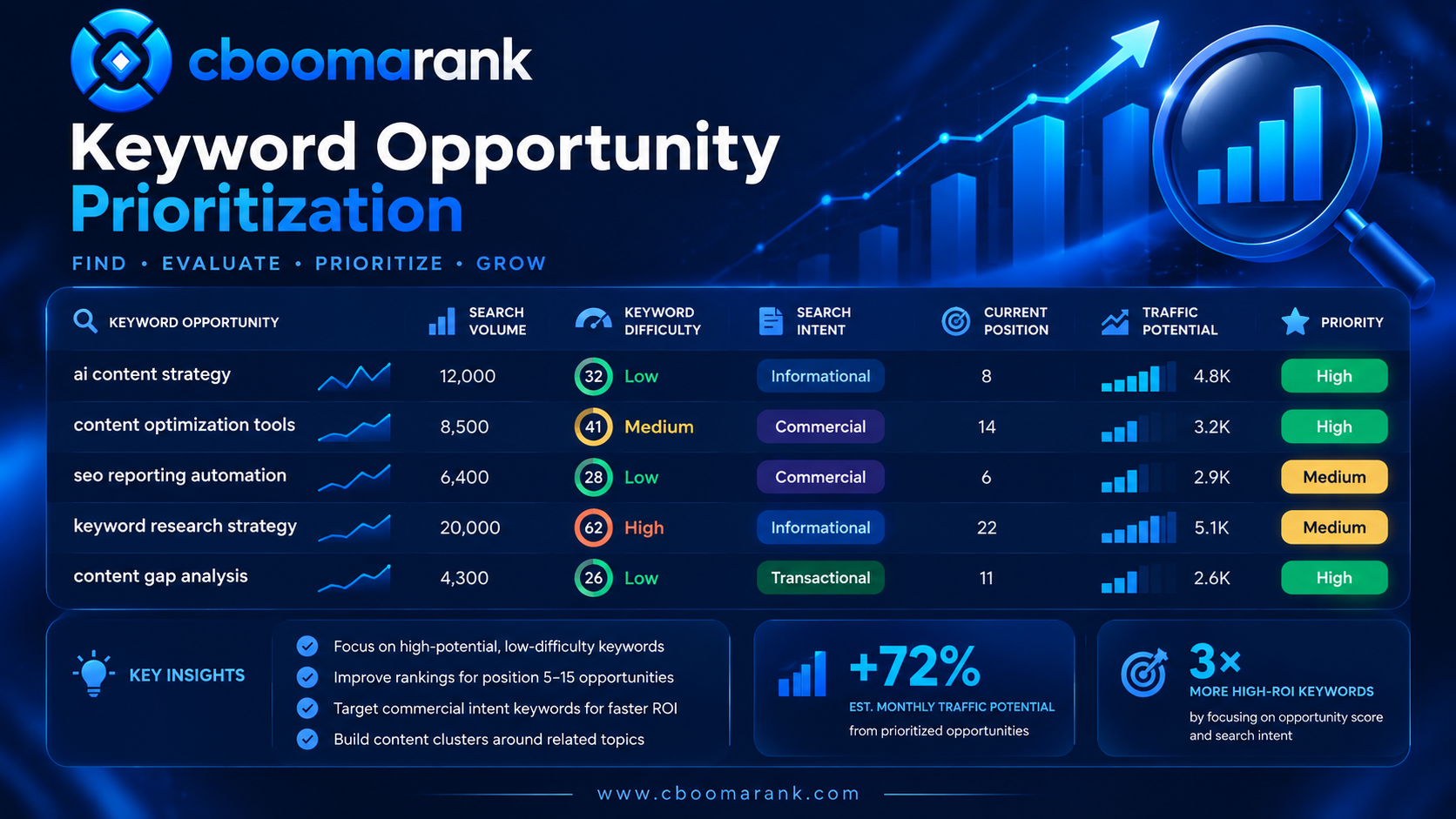
Prioritize Keyword Gaps by Business Value
Search volume alone is a weak prioritization method. A lower-volume keyword closely connected to your product may be more valuable than a broad high-volume query with little commercial relevance.
Consider business value, intent, ranking difficulty, current authority, content requirements and conversion potential together.
You can create a simple priority score. For example, rate business relevance, intent fit, achievable difficulty and content opportunity from one to five. Then use the total as a directional prioritization aid rather than an absolute truth.
Use Search Console to Validate Keyword Opportunities
Google Search Console is especially useful for finding partial keyword gaps. Its Performance report shows the queries generating impressions and clicks for your own site, along with metrics such as click-through rate and average position.
Look for queries where your pages receive impressions but rank below their potential. These may be faster opportunities than topics where your site has no visibility at all.
You can also compare queries by page to determine whether an existing URL already serves the intent. This helps avoid unnecessary new pages and potential cannibalization.
See Google’s official Search Console Performance report documentation.
Use Google Trends to Validate Direction
Google Trends can help evaluate whether interest in a topic is stable, declining, seasonal or growing. It should not replace keyword volume data, but it can add useful context.
Google distinguishes between exact search terms and broader topics, so be deliberate about which type you compare. Related and rising searches can also reveal adjacent queries worth investigating.
Review Google’s official documentation for comparing search terms and topics and finding related searches.
Use Keyword Planner for Additional Validation
Google Keyword Planner can generate keyword ideas from seed terms or websites and provide planning metrics useful for evaluating demand.
When validating keyword gaps, use the competitor term as a starting point, then review closely related ideas. This may reveal variants your competitor does not currently rank for strongly.
Google’s official Keyword Planner documentation explains how to discover ideas using keywords or websites.
Compare Keyword Gap Difficulty With Your Current Authority
Not every gap is realistically achievable immediately. A young website competing against highly authoritative publishers may struggle with extremely competitive head terms.
Therefore, compare the strength of the current results with your own domain and page authority, topical depth and backlink profile.
This is also where link analysis becomes relevant. If top-ranking competitor pages have strong editorial backlinks, your plan may require both better content and stronger link acquisition. See our competitor backlinks analysis guide for the complementary workflow.
Keyword Gap Analysis for Existing Content
Keyword gap research is not only for new articles. It can identify missing subtopics inside pages you already have.
Suppose your competitor guide ranks for questions about pricing, implementation, integrations and reporting, while your equivalent page covers only basic definitions. The gap may indicate that your article does not fully satisfy the broader search intent.
In that case, expanding the existing page can be better than creating several new URLs.
Avoid Keyword Cannibalization When Closing Gaps
Keyword cannibalization occurs when several pages on the same site compete for substantially the same search intent.
Before creating a new page, search your own site for existing URLs covering the topic. If a strong page already exists, update it instead of publishing a duplicate.
This is the same safeguard we use in the CBOOMARANK publishing workflow before every new high-priority article.
Internal linking also helps clarify relationships between related pages. For broader technical checks, see our technical SEO tools guide.
Keyword Gap Analysis for Paid Search
Keyword gap thinking can also support paid search. Competitor research may reveal commercial terms your organic strategy has overlooked, while Google Ads data can help validate advertiser interest.
However, organic and paid competition are not identical. A keyword with high advertiser competition does not automatically mean it is the hardest organic keyword to rank for.
Similarly, negative keyword strategy is important in paid campaigns because irrelevant queries can waste budget. For more context, read our negative keywords guide.
Group Keyword Gaps Into Topic Clusters
Large keyword-gap exports can contain hundreds or thousands of variations. Publishing one page per keyword is neither practical nor desirable.
Instead, cluster related terms by shared intent. A cluster might contain a primary keyword, closely related secondary terms, common questions and commercial modifiers.
Choose one central page for the main intent and support it with narrower articles where users genuinely need separate answers.
Topic clustering helps create a logical content architecture rather than a collection of disconnected posts.
Turn Keyword Gaps Into a Content Roadmap
Once the gaps are grouped, convert them into a publishing roadmap. Start with opportunities that combine strong business relevance, achievable competition and clear intent.
Then assign each topic an action: create, update, consolidate or monitor. Add the intended page type, primary keyword, supporting keywords, internal-link targets, CTA and desired publication date.
This creates accountability and allows the research to feed directly into production.
Where CBOOMARANK Fits in Keyword Gap Analysis
CBOOMARANK is designed to connect keyword research with competitor analysis, website metrics, SEO auditing and content opportunities.
The goal is to make the gap actionable. Instead of simply showing that a competitor ranks for a keyword, the workflow should help you determine whether you already have a relevant page, how strong the competing pages are, what related keywords matter and what action should happen next.
For businesses managing multiple competitors, this can reduce the amount of manual switching between separate research tools.
Start by analyzing your website with CBOOMARANK, or review the available plans on the CBOOMARANK pricing page.
A Practical Keyword Gap Workflow
Begin by selecting three to five relevant organic competitors. Export or collect the keywords they rank for, then compare those terms with your own visibility.
Next, remove irrelevant queries and group the remaining terms by search intent and topic. Separate missing keywords from weak rankings so you can distinguish new-content opportunities from optimization opportunities.
After that, evaluate business value, competition and the strength of the pages currently ranking. Check whether your site already has a page that could satisfy the query before creating anything new.
Finally, assign each opportunity a clear action and track whether the resulting content improves impressions, clicks, rankings and conversions.
Keyword Gap Prioritization Checklist
- Confirm the competitor is genuinely relevant to your organic search market.
- Compare several competitors instead of relying on one domain.
- Separate completely missing keywords from weak existing rankings.
- Group closely related keywords by search intent.
- Check whether an existing page already targets the same intent.
- Evaluate business relevance before search volume.
- Review ranking difficulty and current SERP strength.
- Check Google Search Console for existing impressions and positions.
- Use Trends to understand seasonality and direction where appropriate.
- Map keywords to funnel stages and suitable page types.
- Choose whether to create, update, consolidate or ignore.
- Plan internal links and CTAs before publishing.
Common Keyword Gap Analysis Mistakes
One common mistake is treating every competitor keyword as an opportunity. Competitors often rank for topics that are irrelevant to your customers or business model.
Another mistake is prioritizing solely by search volume. This can push high-value commercial opportunities below broad informational topics with little conversion potential.
A third mistake is creating a new page without checking existing content. That can produce cannibalization and weaken rather than strengthen your site.
Finally, teams often complete a keyword-gap export but never build an execution workflow. Research has value only when it leads to better content, stronger optimization and measurable outcomes.
Frequently Asked Questions About Keyword Gap Analysis
What Is a Keyword Gap?
A keyword gap is a search query or topic where competitors have visibility and your website has little or none. It can reveal opportunities for new content or improvements to existing pages.
How Many Competitors Should I Use for Keyword Gap Analysis?
Three to five relevant organic competitors is usually a practical starting point. This makes recurring patterns easier to identify without creating an unnecessarily large dataset.
Should I Target Every Missing Keyword?
No. Filter missing keywords by search intent, business relevance, ranking feasibility and whether your site can create genuinely useful content for the query.
What Is the Difference Between a Keyword Gap and a Content Gap?
A keyword gap refers to missing or weaker search-query visibility. A content gap is broader and may include missing subjects, formats, questions or funnel stages even when no single keyword defines the opportunity.
Can Keyword Gap Analysis Improve Existing Content?
Yes. Weak-gap analysis can reveal terms where an existing page already ranks but competitors perform better. Updating that page may be faster and safer than creating another URL.
How Often Should I Run Keyword Gap Analysis?
Quarterly analysis works well for many websites, while highly competitive industries may benefit from monthly monitoring. Major product launches, market changes and competitor activity can also justify an additional review.
Final Takeaway on Keyword Gap Analysis
Keyword gap analysis is valuable because it turns competitor visibility into a structured SEO opportunity map. It helps you discover missing topics, weak rankings, overlooked commercial queries and areas where your current content does not fully satisfy search intent.
The strongest strategy is not to copy competitors keyword by keyword. Instead, use their visibility as evidence, validate the opportunity with your own data and build content that better serves the audience.
When keyword gaps are combined with Search Console data, trend context, competitor analysis and content-quality review, the result is a more defensible SEO roadmap.
Find Keyword Gaps and Competitor Opportunities With CBOOMARANK
Use CBOOMARANK to connect competitor research with keyword intelligence, website analysis and SEO opportunities. Identify where competing sites have visibility, evaluate your own pages and turn gaps into prioritized actions.
After publishing new or significantly updated pages, make sure they are discoverable and internally connected. Our guide to submitting URLs to search engines explains the next steps.
