

Competitor backlinks can reveal where other websites in your market are earning authority, referral traffic and visibility. Instead of guessing which websites may link to you, competitor backlink analysis starts with evidence: which domains already link to similar businesses, which pages attract the most links and which link opportunities your own site is missing.
In 2026, effective link building is not about collecting the largest possible number of backlinks. Instead, the better goal is to understand relevance, editorial context, authority, traffic potential and whether a link makes sense for real users. A competitor may have thousands of links, yet only a small percentage may be useful opportunities. Therefore, a structured backlink-gap workflow helps separate valuable prospects from noise.
This guide explains how to analyze competitor backlinks, identify backlink gaps, prioritize opportunities, avoid risky tactics and turn the findings into a repeatable outreach strategy. It also shows how CBOOMARANK can fit into a broader SEO and competitor-research workflow.
What Are Competitor Backlinks?
Competitor backlinks are links pointing to websites that compete with you for customers, rankings, visibility or topical authority. Those links may come from industry publishers, blogs, news sites, directories, associations, universities, partners, review sites and resource pages.
The purpose of studying competitor backlinks is not to copy every link. Instead, you want to answer practical questions. Start by identifying websites that repeatedly link to businesses in your niche. Next, examine the competitor pages that attract links naturally. Then, look for publications willing to cite expert resources and resource pages that mention several businesses similar to yours.
Once you answer those questions, a generic backlink list becomes a source of qualified opportunities.
Why Competitor Backlinks Matter for SEO
Competitor backlink analysis gives structure to link building. Without it, outreach can become random. Teams may contact websites that have little relevance, weak editorial standards or no history of linking to similar content.
By contrast, a backlink-gap analysis begins with websites that have already shown interest in your market. This can make prospecting more efficient because you are starting with demonstrated linking behaviour rather than a completely cold list.
Competitor backlinks can also explain why particular rival pages perform strongly. One competitor may earn links because it publishes original statistics. Another may have a free calculator, checklist, template or research report that attracts citations.
As a result, backlink research can influence both your outreach strategy and your content roadmap.
Competitor Backlinks vs a General Backlink Audit
A normal backlink audit concentrates on your own domain. It examines who links to your website, which pages receive those links, the anchor text being used and whether there are suspicious patterns worth reviewing.
Competitor backlink analysis has a different purpose. It looks outward. The objective is to discover link sources that competitors have earned and evaluate whether those sources could also be relevant to your business.
Both processes are useful. However, when your goal is growth, competitor research often creates a clearer opportunity list because it highlights websites already linking within your niche.
Choose the Right Competitors for Backlink Analysis
Choosing the wrong competitors can distort the entire analysis. Your biggest commercial competitor is not always your strongest search competitor.
For example, a local service company may compete commercially with another local firm but compete in Google Search with directories, review websites, publishers and national brands. Therefore, use both business competitors and search competitors when building your comparison set.
Use Search Competitors, Not Only Business Competitors
Start with domains that repeatedly rank for the keywords you care about. If a website appears across many of the same searches as your business, it can be useful for competitor backlink research even when its business model is different.
You can combine this exercise with your broader website competitor analysis so you understand both ranking overlap and link overlap.
Separate Direct, Content and Marketplace Competitors
Direct competitors sell similar products or services. Content competitors rank for informational topics important to your buyers. Marketplace and directory competitors aggregate many providers in one location.
Each group can reveal different backlink opportunities. Consequently, separating them makes your findings easier to interpret.
Avoid Unrelated Authority Sites
A major media website may rank for one of your keywords because of its enormous overall authority. Nevertheless, its backlink profile may have little relevance to a smaller specialist business.
Prioritize domains whose audience, content type, geography and commercial intent resemble your own situation.
Build a Competitor Backlink Comparison Set
A useful starting point is three to five competitors. With only one competitor, unusual links can look more important than they really are. With several competitors, recurring patterns become easier to identify.
Create a comparison table containing the competitor domain, referring domain, source URL, target URL, anchor text, link type, topical relevance, quality indicators and opportunity status.
In addition, record whether the referring domain links to one competitor or several competitors. A site that independently links to three businesses in your niche deserves more attention than an unrelated site that links to only one competitor once.
How to Find Competitor Backlink Gaps
A backlink gap is a website or page that links to one or more competitors but does not currently link to your website. These gaps are often useful prospects because the publisher has already demonstrated interest in your industry.
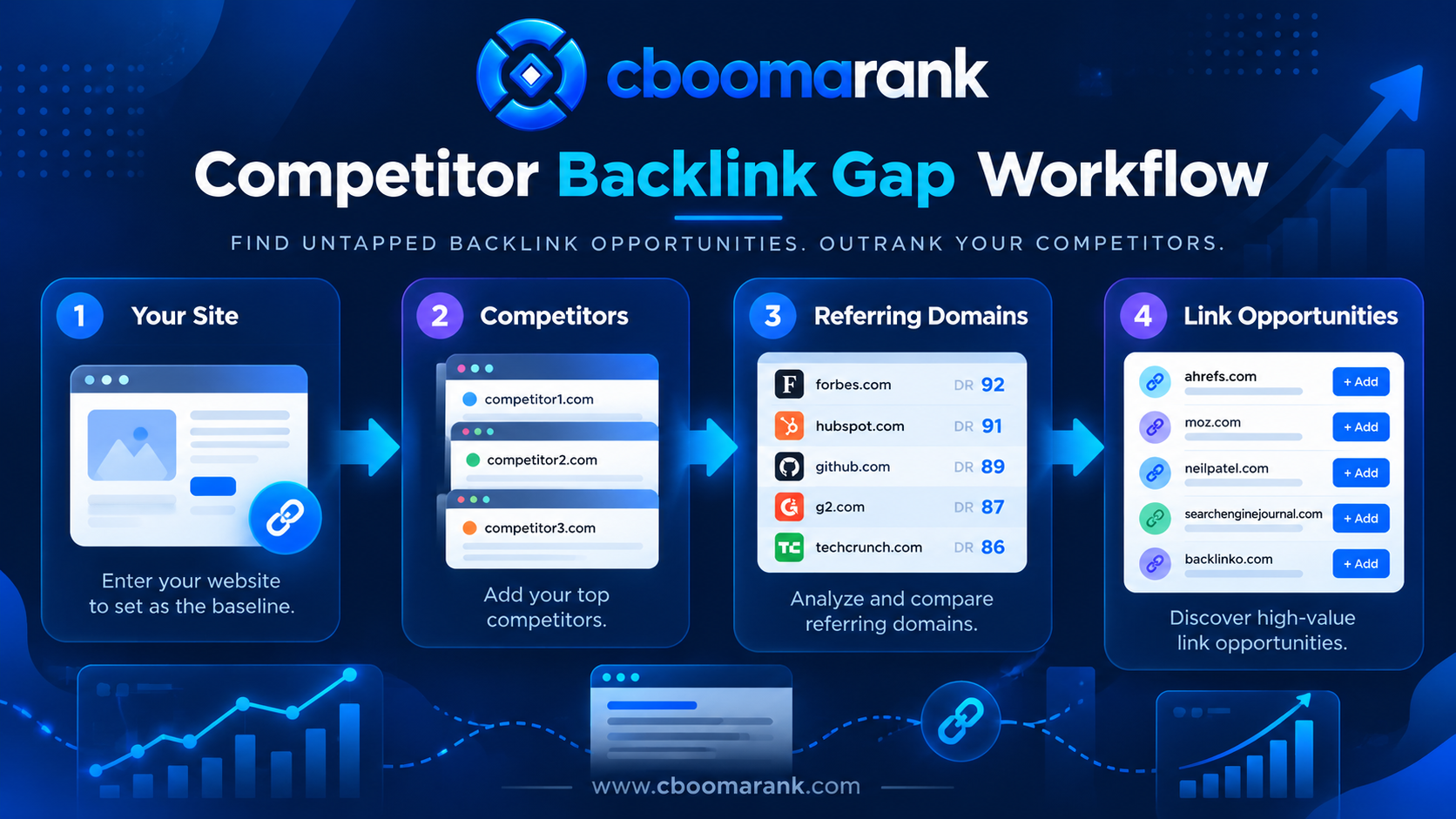
Start by grouping referring domains into three categories. First, identify domains linking to multiple competitors. Second, identify highly relevant websites linking to only one competitor. Third, separate irrelevant, promotional or low-quality domains that do not deserve outreach.
Next, open the actual source page. A relevant domain can still contain an irrelevant link, so page-level context matters.
Competitor Backlinks Shared by Multiple Rivals
Shared referring domains can be especially important. If a publisher links naturally to three competitors but not to your site, there may be a clear visibility gap.
However, do not automatically request inclusion. First determine why those competitors were referenced. Perhaps they supplied data, created a useful tool or were included in an editorial comparison.
Unique Competitor Backlinks
Unique links can also be valuable when the source is highly relevant. A specialist industry publication may cite only one competitor because that company produced unique research or contributed an expert opinion.
In this situation, the opportunity may be to create a comparable or better resource rather than simply asking the publication to add another link.
Evaluate Competitor Backlinks by Relevance
Relevance should come before raw authority metrics. A link from a respected publication in your exact industry may be more useful than a link from a powerful but unrelated website.
Review the topic of the linking page, its intended audience, the surrounding paragraph and the reason the competitor is mentioned. If the backlink appears naturally inside a guide, research article, comparison or resource page, it may represent a genuine editorial opportunity.
Additionally, ask whether your website currently has a page worthy of inclusion. Outreach becomes much easier when you can offer a genuinely useful resource.
Evaluate Authority Without Chasing One Metric
SEO platforms often provide domain-level and page-level authority scores. These metrics can help sort a large prospect list, but they should not become the entire decision.
Different providers use different indexes, calculations and update schedules. Therefore, authority scores are best used comparatively rather than treated as universal measurements.
Consider several signals together: topical relevance, editorial quality, organic visibility, likely referral traffic, link placement, the site’s publishing history and the quality of other websites it references.
This principle also applies when using CBOOMARANK authority and competitor metrics. A score should support the decision rather than replace editorial judgment.
Inspect Pages Earning the Most Competitor Backlinks
Do not stop at the referring-domain level. The competitor page receiving the backlink often explains why the link exists.
Common link-earning assets include original research, statistics pages, calculators, templates, free tools, surveys, glossaries, benchmark reports, comparison guides and detailed tutorials.
If several competitors earn links to the same type of asset, that pattern can influence your own content strategy.
For example, if competing websites consistently earn editorial links to benchmark reports, another generic blog post may not close the gap. Instead, an original dataset, survey or useful interactive resource may provide a stronger reason for publishers to cite your website.
Analyze Competitor Backlinks by Anchor Text
Anchor text is the clickable wording used in a link. Reviewing competitor anchor text can help reveal why a page is being referenced.
Branded anchors may indicate reputation or company citations. Descriptive anchors can reveal the topic of the referenced resource. URL anchors may simply reflect a neutral source citation.
However, do not try to force exact-match anchor text through outreach. Natural editorial linking is safer and usually more credible.
Google’s current spam policies classify several manipulative practices as link spam when they are primarily intended to manipulate rankings, including certain paid links, excessive link exchanges and automated link creation. Therefore, the better objective is to earn links because the destination genuinely deserves to be referenced. Review Google’s spam policies.
Classify Competitor Backlinks by Opportunity Type
After collecting backlink prospects, classify them. Different link types require different strategies, so segmentation helps improve outreach efficiency.
Editorial Competitor Backlinks
Editorial links appear inside articles, tutorials, research and news coverage. Earning them generally requires a strong reason for inclusion such as unique data, expert commentary or a particularly useful resource.
Resource Pages and Industry Lists
Resource pages intentionally collect useful websites, tools or references. If your site fits the purpose of the page and provides real value, outreach can be relatively straightforward.
Guest Contributions and Expert Commentary
Some publishers accept contributed articles or expert insight. Focus on websites with real editorial standards and relevant audiences rather than networks created mainly to distribute links.
Directories, Associations and Membership Links
Relevant professional associations, local directories and legitimate industry organisations may offer useful citations. On the other hand, low-quality directories created mainly for SEO should receive much lower priority.
Digital PR and News Backlinks
Competitors may earn links through research, announcements, data stories and journalist commentary. Those links may be difficult to replicate directly, yet they can reveal which subjects publishers in your market consider newsworthy.
Prioritize Competitor Backlinks Before Outreach
Once you have a prospect list, prioritize it instead of contacting everyone. A simple scoring model can combine relevance, editorial quality, authority, traffic potential, likelihood of earning the link and long-term relationship value.
For example, score topical relevance from one to five, editorial credibility from one to five and outreach feasibility from one to five. Then add a strategic note explaining why the prospect matters.
A smaller specialist publication with a perfect niche fit may deserve more attention than a major general website where your chance of earning a contextual link is extremely low.

Create a Better Linkable Asset Than Your Competitor
Competitor backlink analysis becomes much more powerful when it changes what you create. If a competing article has earned dozens of strong links, merely rewriting that topic is rarely enough.
Look for ways to improve the underlying asset. Add newer statistics, better diagrams, original examples, expert input, a downloadable template, a calculator, a practical checklist or proprietary data.
Then compare your resource with the competitor page from a publisher’s perspective. Ask which resource is easier to cite. Then compare which one provides stronger evidence and solves the reader’s problem more completely.
Those questions are generally more useful than asking whether your article is longer.
Competitor Backlinks Outreach Without Spam
Good outreach is specific. Mention the exact page you are contacting the publisher about, explain why your resource fits and keep the request concise.
Avoid mass emails that could be sent unchanged to hundreds of websites. Instead, where appropriate, identify an outdated statistic, broken resource, incomplete comparison or missing perspective.
Most importantly, frame the message around improving the publisher’s page rather than simply demanding a backlink.
Track every prospect through stages such as not contacted, contacted, replied, reviewing, linked, declined and follow-up required. This turns link building into a measurable workflow rather than a collection of disconnected emails.
Competitor Backlinks You Should Avoid
Not every competitor backlink is worth replicating. Ignore obvious spam sites, automated directories, hacked pages, unrelated websites, low-quality article farms and domains that appear to exist primarily to sell ranking links.
Also be careful with paid placements. Paid advertising and legitimate sponsorship are part of normal marketing, but links intended to influence search rankings require appropriate handling. Google’s guidance explains the use of attributes such as rel="sponsored" or rel="nofollow" where applicable.
Consequently, competitor research should help you discover legitimate opportunities rather than reproduce risky patterns.
Use Google Search Console With Competitor Backlink Research
Google Search Console’s Links report can show your top linking sites, top linked pages and common linking text. It is useful for checking whether a backlink prospect already links to your website and understanding which pages currently attract external links.
However, Google explains that the report is not a comprehensive list of every backlink and may contain only a sample. Therefore, use it as one source of evidence rather than your sole backlink database.
See the official Google Search Console Links report documentation.
Use Bing to Compare Competitor Backlinks
Bing Webmaster Tools provides a Backlinks feature that can compare your site’s backlink profile with other websites. It includes information about referring domains, source pages and anchor text.
Bing also provides a filter for domains linking to competitors but not to your own site, which makes it useful for backlink-gap discovery.
Once you identify potential gaps, export the candidates and manually inspect the source pages before beginning outreach. See the official Bing Webmaster Tools Backlinks documentation.
Where CBOOMARANK Fits in Competitor Backlink Analysis
CBOOMARANK is being developed to connect competitor research, website analysis, authority metrics, keyword intelligence and backlink opportunities into one workflow.
The goal is to reduce the gap between discovering that a competitor has an advantage and deciding what action should follow.
For example, a backlink opportunity becomes more useful when you can also evaluate the competitor page, review the keywords it targets, compare your own competing content and determine whether the next step should be content improvement, outreach or creation of a new linkable asset.
For broader competitor research, read our best competitor analysis tools guide and our detailed website competitor analysis guide.
You can also analyze your website with CBOOMARANK or review available options on the CBOOMARANK pricing page.
A Practical Competitor Backlinks Workflow
Use a repeatable process rather than conducting backlink research only when rankings decline.
First, select three to five search competitors. Next, collect their referring domains and important source pages. Then identify domains that link to competitors but not to you.
After that, review each source page for relevance and editorial quality. Classify the opportunity, assign a priority score and determine what resource you would need to earn the link.
Finally, conduct focused outreach and record the result. Over time, compare response rates, links earned, referral traffic and ranking improvements to refine your process.
Connect Competitor Backlinks With Keyword Research
Backlink analysis becomes more useful when combined with keyword research. A competitor page may have many links but target keywords that are not commercially important to your business.
Therefore, map link-winning pages to the keywords and search intent they serve. Prioritize assets that combine strong backlink potential with meaningful business relevance.
This can also help determine where link building fits within your wider SEO plan. For more technical context, see our technical SEO tools guide.
Connect Competitor Backlinks With Internal Linking
External links can strengthen a page, but internal links determine how users and search engines navigate the rest of your site. When a new linkable asset begins earning backlinks, connect it strategically to relevant commercial and informational pages.
Likewise, link supporting articles back to the asset where appropriate. This creates a more coherent information architecture instead of leaving backlink authority isolated on one page.
For additional background, review our external links guide and the CBOOMARANK link-building resources.
Competitor Backlinks Checklist
- Choose competitors that overlap with your real search visibility.
- Compare at least three competitors instead of relying on one domain.
- Find referring domains that link to several competitors.
- Review the actual source page, not only a domain-level metric.
- Check topical relevance and editorial quality.
- Inspect competitor pages earning the most backlinks.
- Review anchor text and surrounding link context.
- Classify each opportunity by link type.
- Prioritize prospects before conducting outreach.
- Create a stronger reason for publishers to link to your content.
- Avoid manipulative link schemes and low-quality directories.
- Track outreach, responses, earned links and referral value.
Common Competitor Backlink Analysis Mistakes
One common mistake is sorting prospects only by an authority score. Another is contacting every referring domain without checking whether the source page is relevant.
A third mistake is trying to replicate a competitor’s link without understanding why it was earned. For example, a competitor may have received a link because it supplied exclusive data. Sending the publisher an ordinary product page is unlikely to produce the same result.
Finally, many teams fail to track outreach outcomes. Without that data, it becomes difficult to learn which publishers, content assets and approaches actually work.
Frequently Asked Questions About Competitor Backlinks
What Are Competitor Backlinks?
Competitor backlinks are inbound links pointing to websites that compete with you in search results or in your market. Studying them can reveal publishers, resources and domains that may also be relevant to your website.
What Is a Competitor Backlink Gap?
A backlink gap is a website that links to one or more competitors but not to your own site. These domains can make useful outreach prospects because they have already demonstrated interest in the topic or market.
Should I Copy Every Competitor Backlink?
No. Many competitor backlinks may be irrelevant, weak, outdated or impossible to reproduce. Prioritize links that are editorially relevant, credible and useful to real users.
How Many Competitors Should I Analyze?
Three to five competitors is a practical starting point. That is usually enough to reveal recurring referring domains without creating an unmanageable research project.
How Often Should I Analyze Competitor Backlinks?
For an active SEO campaign, monthly or quarterly analysis is usually practical. Highly competitive markets may benefit from more frequent monitoring, while stable niches may require less frequent review.
Are More Competitor Backlinks Always Better?
No. Backlink quantity alone does not determine quality. A smaller set of highly relevant editorial links can be more useful than thousands of low-value links from unrelated sources.
Final Takeaway on Competitor Backlinks
Competitor backlinks are valuable because they replace random prospecting with evidence. They reveal which websites already reference your market, which competitor assets attract attention and where clear backlink gaps exist.
The strongest approach is not to copy links one by one. Instead, determine why the competitor earned the link, create something genuinely worth citing and prioritize publishers that are relevant to your audience.
That approach produces a more sustainable backlink strategy and is better aligned with search-engine guidance that discourages manipulative link schemes.
Find Better SEO and Backlink Opportunities With CBOOMARANK
Use CBOOMARANK to connect competitor research with website analysis, keywords, authority metrics and backlink opportunities. Instead of viewing competitor backlinks in isolation, evaluate them alongside the pages and search opportunities that matter to your business.
