

| Quick answer: External links point from your website to another domain. Use them when they help readers, cite trustworthy sources, write descriptive anchor text, and qualify paid or user-generated links with the correct rel attributes. |
Table of Contents
- Introduction
- What Is an External Link?
- External Links vs Internal Links vs Backlinks
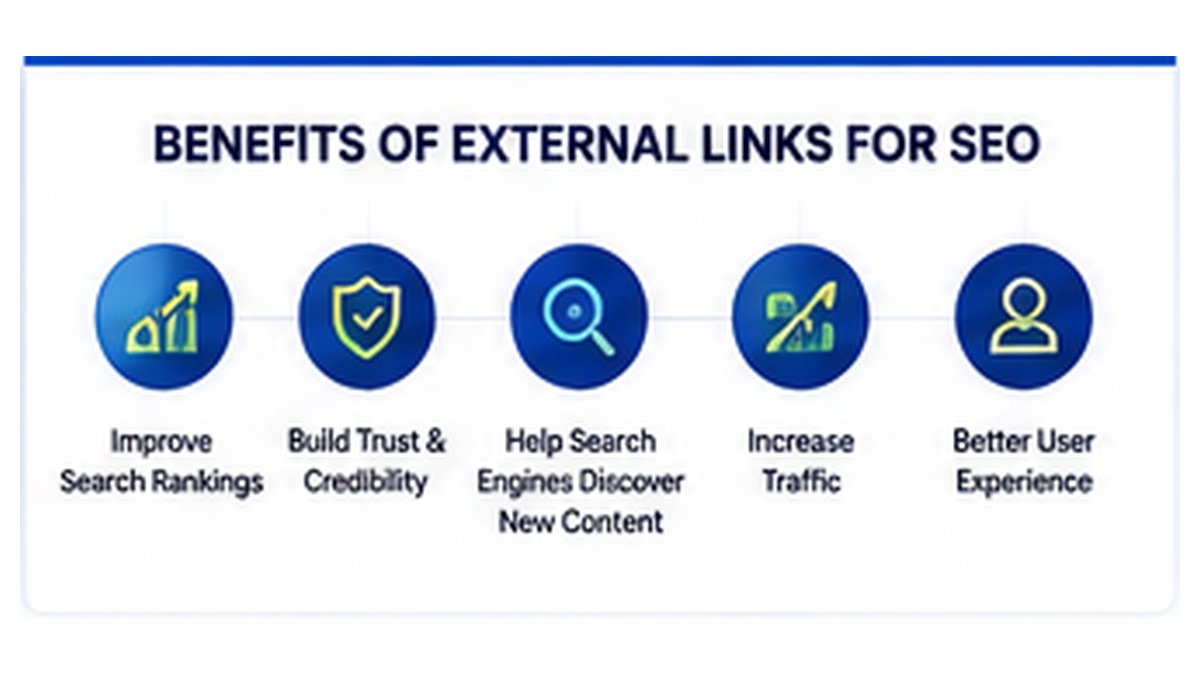
- Why External Links Matter for SEO and Users
- Are External Links a Direct Ranking Factor?
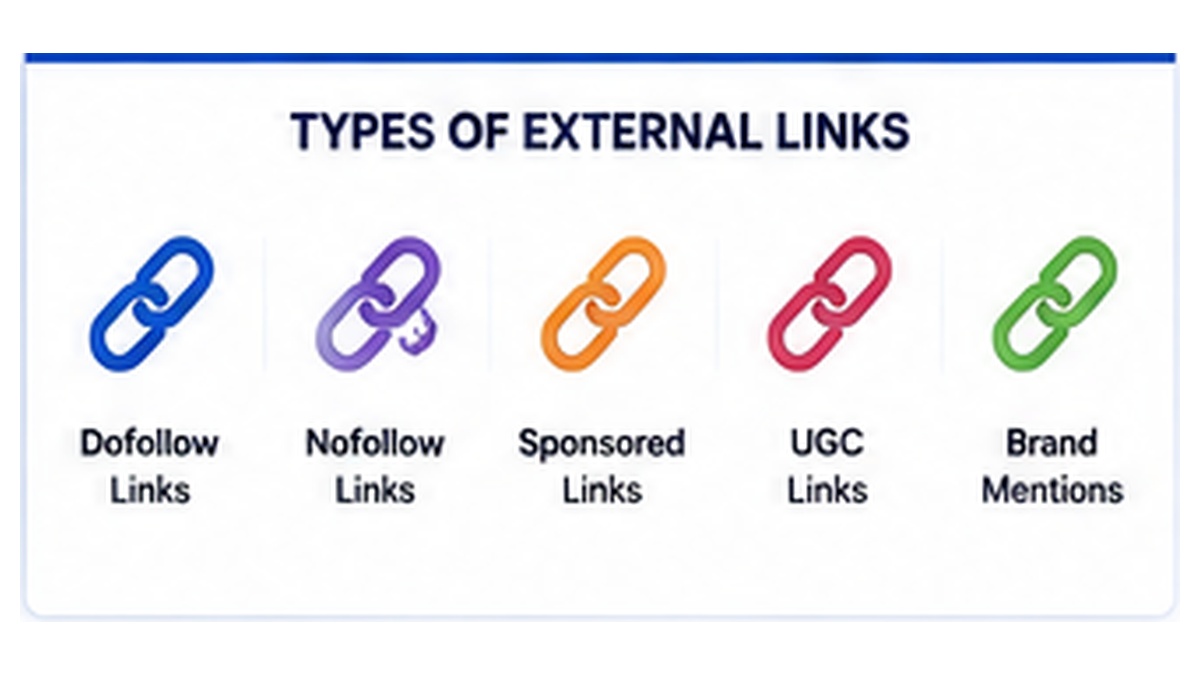
- Types of External Links
- Understanding nofollow, sponsored and ugc
- Choose Relevant and Trustworthy Sources
- Use Descriptive Anchor Text
- Make External Links Crawlable
- How Many External Links Should a Page Have?
- Should External Links Open in a New Tab?
- External Links and Affiliate Marketing
- External Links and Guest Posts
- How to Audit External Links
- Common External Linking Mistakes
- External Link SEO Checklist
- Frequently Asked Questions
- Conclusion
Introduction
External links are one of the simplest elements of a web page, yet they are often misunderstood. A single hyperlink can help a reader verify a claim, discover a primary source, compare a product, understand a technical term, or continue researching a topic beyond your website. Used well, external links make content more useful and more trustworthy.
For SEO, the key is not to add links merely because a checklist says every article needs them. The goal is to link when another page genuinely improves the reader’s understanding. Google says links help it understand page relevance and discover pages, and it specifically advises publishers not to be afraid of linking to other sites when doing so makes sense. The quality of the destination, the context around the link, the anchor text, and the relationship between publisher and destination all matter.
This 2026 guide replaces outdated advice that treats every external link as a ranking trick or confuses outbound links with backlinks. You will learn the difference, how to qualify paid and user-generated links correctly, how to choose credible sources, how many links to use, and how to audit external links on a WordPress site.
What Is an External Link?
An external link is a hyperlink on one website that points to a page or resource on a different domain. If a CBOOMARANK article links to Google Search Central, that is an external or outbound link from CBOOMARANK. The same link is an inbound link, or backlink, from the perspective of Google Search Central’s page.
External links can point to articles, documentation, research papers, government pages, company websites, tools, videos, PDFs, social profiles, datasets, product pages, or any other useful resource on another domain. They can appear as text links, linked images, buttons, citations, or references, provided the underlying link is implemented in a crawlable way.
External Links vs Internal Links vs Backlinks
These terms describe the direction and ownership of a link. An internal link connects one page on your own site to another page on the same site. An external link points from your site to another domain. A backlink is a link from another website pointing to yours.
The distinction matters because each type supports a different part of SEO. Internal links help users and search engines navigate your site and understand relationships between your pages. External links help readers reach supporting sources and related resources outside your site. Backlinks may send referral traffic and can contribute to how search engines evaluate a page’s prominence and relevance.
| Link Type | Direction | Primary Purpose | Example |
| Internal link | Your page → another page on your domain | Navigation, discovery, site structure | Blog post → related CBOOMARANK guide |
| External link | Your page → another domain | Citation, evidence, deeper resource | CBOOMARANK → Google Search Central |
| Backlink | Another domain → your site | Referral traffic and external authority signals | Industry blog → CBOOMARANK article |
Why External Links Matter for SEO and Users
External links can improve the usefulness of an article by connecting statements to primary or authoritative sources. When a guide discusses Google’s linking rules, linking directly to Google Search Central is more useful than forcing the reader to search for the documentation independently.
They also create context. A descriptive external link tells readers what they will find next and helps search engines understand the relationship between the current page and the destination. Google explicitly notes that linking to other sites can help establish trustworthiness when you cite your sources.
External linking is not a substitute for original expertise. A page that merely summarizes other websites and links away repeatedly may still be thin. The strongest content adds its own explanation, examples, experience, analysis, or decision support, then uses external links selectively where another source adds evidence or depth.
Are External Links a Direct Ranking Factor?
There is no useful reason to think in terms of a fixed ranking boost for adding a certain number of outbound links. Google does not publish a formula such as one external link equals a ranking increase. Instead, external linking should be treated as part of producing clear, well-supported, user-focused content.
A relevant citation can strengthen a page because it gives readers evidence and context. An irrelevant link added only for SEO can weaken the experience. Focus on usefulness first: link when the destination helps the reader verify, understand, compare, or act.
Types of External Links
Ordinary editorial links are links you choose because the destination is useful and relevant. These links normally do not need a special rel attribute. Examples include citing official documentation, linking to original research, or referencing a manufacturer specification.
Sponsored links are advertisements, paid placements, affiliate relationships, advertorials, or other links where compensation or a commercial arrangement influences the placement. Google recommends rel=”sponsored” for these links; rel=”nofollow” is still accepted for paid links, although sponsored is more specific.
UGC links appear in user-generated content such as comments, forums, community posts, or user profiles. Google recommends rel=”ugc” for this situation, and nofollow may also be used.
Nofollow links are appropriate when sponsored or ugc does not describe the relationship and you would rather Google not associate your site with, or crawl the linked page from, your link. It should not be automatically added to every external link.
Understanding nofollow, sponsored and ugc
One of the most important updates to older external-link advice is that nofollow is not the universal solution for every outbound link. For a normal editorial link to a trustworthy source, no special rel attribute is required. Use the attribute that describes the relationship accurately.
Use sponsored when the link exists because of payment, sponsorship, advertising, affiliate compensation, or another commercial arrangement. Use ugc for links inserted by users in comments, forums, and similar areas. Use nofollow when the other values do not apply and you do not want to associate your site with the destination. Multiple values can be combined when appropriate.
These attributes are not a reliable method for preventing a page from being indexed. A destination may be discovered through other links, sitemaps, or sources. If your objective is to control indexing of your own page, use the appropriate indexing controls rather than treating external-link attributes as a substitute.
| Relationship | Recommended rel value | Typical use |
| Normal editorial link | None required | Trusted source or useful resource |
| Paid / affiliate / advertising | sponsored (nofollow also accepted) | Commercial relationship |
| User-generated content | ugc (or nofollow) | Comments, forums, community posts |
| Other untrusted / non-endorsed link | nofollow | When sponsored/ugc do not fit |
Official guidance: Google’s outbound-link qualification documentation
Choose Relevant and Trustworthy Sources
A good external link supports the point you are making. If you are discussing search-engine guidelines, the search engine’s official documentation is usually stronger than a random blog that paraphrases it. For medical, legal, financial, scientific, or regulatory topics, primary and authoritative sources become even more important.
Evaluate the destination before linking. Ask whether the page is current, whether the publisher is identifiable, whether the claim is supported, whether the page has a clear purpose, and whether it is safe for your audience. Be careful with pages that are overloaded with ads, redirect unexpectedly, have been repurposed, or exist mainly to sell links.
Do not rely on third-party authority scores alone. Domain Authority and Domain Rating can be useful comparative metrics, but they do not tell you whether a specific page is accurate, relevant, editorially sound, or appropriate for your readers.
Use Descriptive Anchor Text
Anchor text is the clickable wording of a link. Good anchor text is descriptive, concise, and relevant to the destination. It should set an accurate expectation without forcing keywords.
Instead of writing “click here,” use wording such as “Google’s link best practices” or “our guide to building high-quality backlinks.” This is easier for readers scanning a page and gives search engines clearer context. Avoid stuffing exact-match keywords into every anchor or turning entire sentences into links unless the full sentence genuinely needs to be clickable.
The surrounding sentence matters too. A link placed in a clear explanation is more useful than a link dumped into a list without context. Space links naturally rather than chaining several links into adjacent words.
Read Google directly: Link best practices for Google
Make External Links Crawlable
For standard web links, use a normal HTML anchor element with an href attribute. Google says this is the most reliable format for crawling links. JavaScript-only click handlers, spans pretending to be links, or anchors without href attributes may not be parsed reliably.
In WordPress, the normal editor link tool already creates a standard anchor link in most cases. The main task for publishers is therefore to choose the right URL, write useful anchor text, and apply a rel attribute only when the relationship requires it.
How Many External Links Should a Page Have?
There is no universal ideal number. Google explicitly says there is no magical ideal number of links on a page. The right amount depends on the topic, the length of the content, and how much supporting material readers need.
A short tutorial may need only two or three citations. A research-heavy comparison may reasonably include many more. Avoid adding external links simply to hit a target. Every link should have a purpose: evidence, definition, original source, deeper explanation, useful tool, or relevant next step.
Should External Links Open in a New Tab?
Opening external links in a new tab is a user-experience decision rather than an SEO requirement. It can be useful when readers are likely to compare sources while keeping the article open, but forcing every external link into a new tab can also create clutter, especially on mobile devices and for users relying on assistive technology.
If you choose to open a link in a new tab, use your CMS’s normal option and test the experience. Do not treat target=”_blank” as an SEO optimization. The destination, context, and relationship attributes are more important for search guidance.
External Links and Affiliate Marketing
Affiliate links are external links with a commercial relationship. Because compensation may be earned if a reader purchases or signs up, these links should be qualified appropriately. Google’s current documentation recommends sponsored for advertisements and paid placements, and affiliate links generally fall within that commercial category.
For CBOOMARANK review content, use clear disclosure language for affiliate relationships and configure affiliate outbound links consistently. The editorial review itself should still be useful without the commission: explain who the product suits, limitations, alternatives, pricing considerations, and evidence supporting the recommendation.
External Links and Guest Posts
Guest posting can earn legitimate exposure and editorial links, but links placed mainly to manipulate rankings are risky. If a guest post is paid or sponsored, qualify commercial links appropriately. If the content exists only to insert keyword-rich links, it is not a sustainable strategy.
The safer approach is audience-first publishing: contribute useful content to a relevant site, use natural anchors, and link only where the destination genuinely expands the topic. For deeper guidance, see CBOOMARANK’s guest posting and high-quality backlink guides.
Related CBOOMARANK guides:
- Guest Posting Guide: Earn Links the Right Way in 2026
- How to Build High-Quality Backlinks in 2026
- How To Earn High-Authority Links That Drive Rankings
- Backlinks & Link Building Guides 2026
How to Audit External Links
External links age. Pages move, domains expire, resources are deleted, redirects change, and formerly trustworthy pages can be repurposed. A link that was useful two years ago may now create a poor experience.
A practical audit checks whether each important outbound URL still loads, whether it redirects to the expected destination, whether the content remains relevant, whether the source is still trustworthy, and whether commercial or user-generated links have the correct rel attributes. Prioritize pages with high traffic, product reviews, evergreen guides, and content that contains many citations.
Broken-link tools can speed up discovery, but manual review still matters because a URL can return a successful status code while the content itself has changed. Update or remove links that no longer help the reader.
| Audit Check | What to Look For | Action |
| HTTP status | Broken page or server error | Replace or remove |
| Redirects | Unexpected or multi-hop redirects | Link to final canonical destination |
| Relevance | Destination no longer matches claim | Update source |
| Trust | Domain repurposed, hacked or low quality | Remove or replace |
| rel attributes | Paid/UGC link missing qualification | Add sponsored/ugc/nofollow as needed |
Common External Linking Mistakes
A common mistake is confusing an outbound external link with a backlink. The same hyperlink can be described differently depending on perspective, but adding an outbound link does not mean your site has earned a backlink.
Another mistake is applying nofollow to every external link. That is unnecessary for ordinary trusted editorial links. Other problems include linking to weak sources when primary sources exist, using generic anchor text repeatedly, linking to irrelevant pages for perceived authority, adding too many commercial links, failing to disclose affiliate relationships, and leaving broken links untouched for years.
Finally, avoid manipulative link schemes. Buying or selling links for ranking credit, excessive link exchanges, automated link creation, and low-quality guest-post networks can violate search-engine spam policies. A long-term external-link strategy should support readers rather than attempt to manufacture signals.
For link-spam rules, see Google Search Essentials spam policies
External Link SEO Checklist
Before publishing, ask: Does this link help the reader? Is the destination relevant to the sentence? Is the source trustworthy and current? Is the anchor text descriptive? Does the URL work? Is the link a normal crawlable anchor? Is there a commercial or user-generated relationship that requires sponsored, ugc, or nofollow? Would the article still make sense if the link disappeared?
After publishing, review important links periodically. Update destinations when better primary sources become available, repair broken URLs, remove links that have become unsafe or irrelevant, and keep affiliate and sponsored-link qualification consistent across the site.
Frequently Asked Questions
What is an external link in SEO? An external link is a hyperlink from your website to a different domain. It is also called an outbound link from the perspective of the page containing it.
Are external links good for SEO? They can support useful, trustworthy content by connecting readers to relevant sources. There is no fixed ranking bonus for adding a certain number of outbound links, so use them when they genuinely improve the page.
Should every external link be nofollow? No. Google says ordinary links do not need a rel attribute. Use sponsored for paid placements, ugc for user-generated links, and nofollow when the other values do not apply and you do not want association with the destination.
How many external links should an article have? There is no universal number. Add as many as are genuinely useful for citations, evidence, definitions, tools, or deeper reading without overwhelming the reader.
Do external links and backlinks mean the same thing? No. An external link is a link from your page to another domain. A backlink is a link from another website to your site. A single hyperlink is outbound for the source site and inbound for the destination site.
Should external links open in a new tab? It is optional and mainly a usability choice. Test what works for your audience; it is not a required SEO tactic.
Conclusion
External linking is not about sending authority away or filling an SEO quota. It is about connecting readers to useful information in a clear, trustworthy way. Link to relevant and credible destinations, use descriptive anchor text, keep links crawlable, and qualify paid or user-generated links correctly.
For CBOOMARANK, the strongest approach is to combine thoughtful external citations with a strong internal-link structure and a sustainable backlink strategy. That gives readers both directions they need: deeper resources inside the site and trustworthy evidence beyond it.
Recommended Internal Links
- Backlinks & Link Building Guides 2026 — Use near discussion of backlinks and related resources.
- Guest Posting Guide: Earn Links the Right Way in 2026 — Use in guest-posting and link-building sections.
- How to Build High-Quality Backlinks in 2026 — Use when distinguishing outbound links from earned backlinks.
- How To Earn High-Authority Links That Drive Rankings — Use as a deeper authority-building resource.
