

Introduction
Guest posting is still one of the most useful ways to build authority, reach new audiences, and earn backlinks. But the way businesses use guest posting in 2026 needs to be more careful than the old approach of publishing thin articles anywhere that accepts links.
The right way to guest post is simple: help the host website serve its audience. The link should be a natural result of useful content, not the only reason the article exists. When guest posting is done properly, it can bring referral traffic, brand visibility, relationships, topical authority, and high-quality backlinks.
The wrong way is also clear: publishing low-quality guest posts on irrelevant websites, forcing exact-match anchor text, paying for links that pass ranking credit, or using content networks created mainly to manipulate search results. Those tactics are risky and can damage long-term SEO.
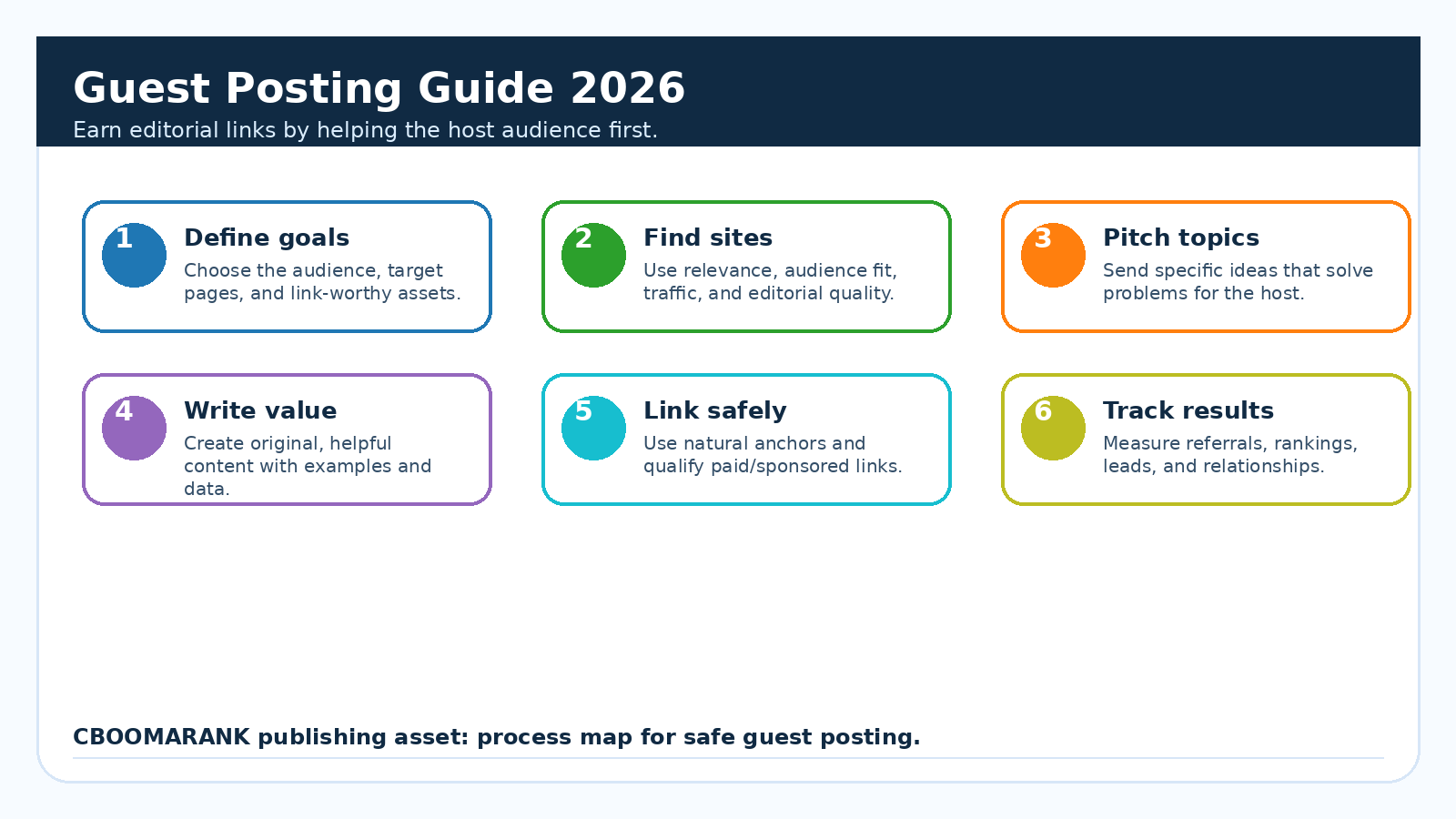
This guide explains how to earn links the right way through guest posting. You will learn how to choose target pages, find quality websites, qualify prospects, pitch editors, write posts people actually want to read, add links safely, and track results.
For related CBOOMARANK resources, read What Are Backlinks and Why They Matter for SEO, How to Build High-Quality Backlinks in 2026, and Best Free SEO Tools for Beginners.
What Is Guest Posting?
Guest posting, also called guest blogging, is the practice of writing and publishing an article on another website. In most cases, the guest author receives an author bio, brand exposure, referral traffic, and sometimes one or more relevant links back to their website.
A good guest post is not an advertisement disguised as an article. It should educate, explain, compare, demonstrate, or solve a real problem for the host website’s readers. The best guest posts feel like they belong on the host site because they match the audience, tone, and editorial standards.
Guest posting can be useful for SEO because it may earn editorial backlinks. It can also help your brand appear in front of an audience that already cares about your topic.
Why Guest Posting Still Works in 2026
| Benefit | Why It Matters |
| Relevant backlinks | A helpful guest article can earn a contextual backlink from a related website. |
| Referral traffic | Readers can click through from the article to your guide, service page, or tool. |
| Brand authority | Publishing on respected websites builds recognition and trust. |
| Industry relationships | Guest posting opens doors for partnerships, interviews, podcasts, and collaborations. |
| Content distribution | Your ideas reach people beyond your own blog and social channels. |
Guest posting works best when the website has a real audience and the article adds value. A post on a relevant industry blog can support SEO and bring qualified visitors. A post on a low-quality site with no readers usually offers little value, even if the domain metric looks impressive.
The main goal should be audience value. SEO value follows when the article is useful, original, relevant, and placed on a trustworthy website.
What Google Says About Guest Posting Links
Google does not say that every guest post is bad. The problem is link spam: links created primarily to manipulate rankings. Google’s spam policies describe link spam as creating links to or from a site primarily to manipulate search rankings. The policy specifically calls out optimized anchor text in articles, guest posts, or press releases when used in ways that pass ranking credit.
Google also explains how to qualify outbound links. For paid placements, sponsorships, advertorials, affiliate links, or similar relationships, publishers should use appropriate link attributes such as sponsored, nofollow, or ugc depending on the nature of the link.
A Google Search Central blog reminder also notes that low-quality sponsored and guest posts primarily intended to gain links can lead to algorithmic or manual actions if links are not qualified correctly. See Google’s link tagging and link spam update for additional context.
| Guest Posting Scenario | Safe Recommendation |
| You write a helpful unpaid article for a relevant site | Use natural links only where they help the reader. Avoid exact-match anchor manipulation. |
| You pay a site to publish a guest post | Use rel=”sponsored” or rel=”nofollow” on links that could pass ranking credit. |
| A user submits content in comments or a community area | Use rel=”ugc” where appropriate. |
| The link is an affiliate or commercial recommendation | Use sponsored or nofollow attributes according to the relationship. |
| The site exists mainly to sell guest post links | Avoid it. It is unlikely to provide sustainable SEO value. |
The Right Guest Posting Mindset
The safest guest posting mindset is audience-first, relationship-second, link-third. If the article would still be useful without a backlink, you are likely on the right path. If the article exists only to insert a keyword-rich link, rethink the strategy.
A strong guest post should do at least one of these things: teach the reader something specific, offer a proven process, share original examples, explain a complex topic, compare options, or provide a useful checklist.
The backlink should point to a page that genuinely expands the topic. For example, if your guest post explains how to audit backlinks, a natural link may point to a deeper backlink audit checklist or a practical guide on backlink quality.
Step 1: Define Your Linkable Assets Before Outreach
Before you contact any website, decide what you want to promote. A linkable asset is a page worth linking to because it helps readers solve a problem. This may be a long-form guide, original research, a checklist, a template, a calculator, a tool, or a useful comparison article.
Do not send editors to a generic homepage unless it is genuinely the most useful destination. Guest post links perform better when they point to specific pages that match the article topic and reader intent.
| Linkable Asset | Guest Post Angle |
| Backlink checklist | How to evaluate link quality before outreach |
| SEO pricing guide | How businesses should budget for SEO campaigns |
| Free SEO tools guide | How beginners can run SEO without paid software |
| Semrush vs Ahrefs comparison | How to choose an SEO tool for agency workflows |
| Submit URL to search engines guide | How new websites get indexed faster |
Step 2: Find Relevant Guest Posting Opportunities
Avoid random lists of guest posting sites. Many public lists are outdated or filled with low-quality websites. Instead, build your own prospect list from websites that publish content for the same audience you want to reach.
Start with your niche. If you run an SEO and digital marketing website, relevant guest posting targets may include marketing blogs, WordPress blogs, web hosting publications, SaaS blogs, analytics blogs, small business websites, and agency blogs.
| Discovery Method | How to Use It |
| Search operators | Search for your topic plus phrases like “write for us”, “guest post”, “contributor guidelines”, or “submit an article”. |
| Competitor backlinks | Use backlink tools to find websites that have linked to similar guides or competitors. |
| Author footprints | Search for authors in your niche and see where they have contributed guest articles. |
| Industry newsletters | Find blogs and publications that feature expert contributions. |
| Partner websites | Pitch educational content to software partners, agencies, and complementary businesses. |
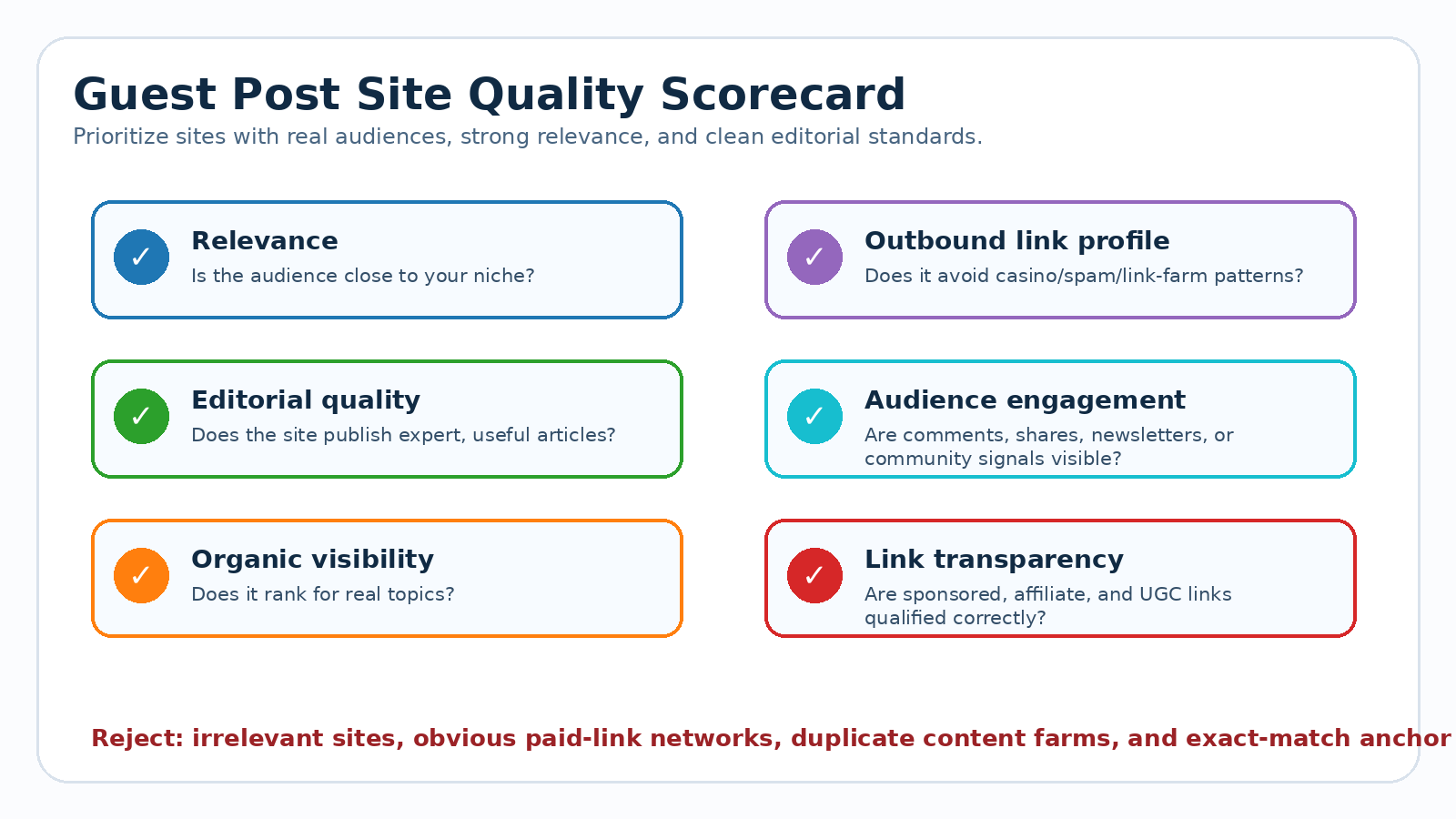
Image ALT Text: Guest post site quality scorecard showing relevance, editorial quality, organic visibility, audience engagement, and link transparency.
Step 3: Qualify Every Website Before You Pitch
A guest post is only as valuable as the website that publishes it. Before pitching, review the site manually. Do not rely only on third-party metrics like Domain Rating or Domain Authority. These metrics are useful for screening, but they do not replace editorial judgment.
The best guest post targets have topical relevance, real editorial standards, active content, organic visibility, real readers, and a clean outbound link profile.
| Quality Signal | Good Sign | Warning Sign |
| Topical relevance | The site publishes content related to your niche. | The site accepts every topic from finance to gambling to coupons. |
| Editorial standards | Articles have named authors, clear structure, and useful insights. | Content looks AI-spun, thin, duplicate, or generic. |
| Organic visibility | The site ranks for relevant industry terms. | No visible traffic or rankings despite high domain metrics. |
| Audience trust | The site has real comments, newsletter, social activity, or brand reputation. | No audience signals and no clear business purpose. |
| Outbound links | Links are relevant and natural. | Every post contains commercial exact-match links. |
| Transparency | Sponsored or paid content is labeled properly. | Paid posts pass dofollow links without disclosure or qualification. |
Step 4: Pitch Useful Topic Ideas
Editors receive many generic guest post pitches. Your job is to make the editor’s decision easy. Read the website first, understand the audience, then pitch specific ideas that fill gaps in their existing content.
A strong pitch is short, relevant, and helpful. It should show that you understand the website and can contribute something useful. Avoid sending a mass email that starts with “Dear Sir/Madam” and lists random article titles.
| Weak Pitch | Better Pitch |
| “I want to publish a guest post on SEO.” | “I noticed your blog covers ecommerce SEO but does not have a 2026 checklist for product-page internal linking. I can write a practical guide with examples.” |
| “Please give me a dofollow backlink.” | “I can contribute a detailed article that helps your readers solve a specific problem.” |
| “I can write any topic.” | “Here are three topic ideas based on your existing categories and content gaps.” |
Guest Post Outreach Email Template
Subject: Guest article idea for [Website Name]
Hi [Editor Name],
I enjoyed your recent article on [specific article/topic]. The section about [specific detail] was especially useful because [reason].
I would like to contribute a practical guest article for your readers. Here are a few topic ideas:
1. [Topic idea focused on their audience]
2. [Topic idea that fills a content gap]
3. [Topic idea with original examples/data]
I can make the article original, well-structured, and non-promotional, with examples your audience can use immediately.
Would any of these be a good fit?
Best,
[Your Name]
Step 5: Write a Guest Post Editors Want to Publish
After a pitch is accepted, focus on quality. The guest post should be as useful as something you would publish on your own website. Weak content may get rejected, and even if it gets published, it is unlikely to produce traffic, authority, or long-term SEO value.
A strong guest post starts with search intent and audience intent. Ask what the reader is trying to accomplish. Then organize the article around that outcome.
| Content Element | Optimization Tip |
| Headline | Make it specific and benefit-driven. |
| Introduction | Explain the problem and promise a clear result. |
| Structure | Use short sections, H2/H3 headings, tables, and examples. |
| Originality | Add personal experience, data, workflows, screenshots, or examples. |
| Links | Use links only where they support the reader. |
| Conclusion | Summarize the action steps and next best move. |
Avoid thin posts that repeat basic advice. Editors want content that adds something new. Include practical steps, mini case studies, comparison tables, checklists, or templates that make the article easier to use.
If you are writing about SEO, include examples, realistic workflows, and tool recommendations. If you are writing for ecommerce, include product-page examples. If you are writing for agencies, include client reporting or workflow advice.
Step 6: Add Links Safely and Naturally
Links inside a guest post should be useful. The safest approach is to link to relevant resources that expand the topic. This may include your own article, the host website’s existing content, original research, official documentation, or trusted industry sources.
Anchor text should be natural. Instead of forcing an exact-match anchor like “best guest posting services cheap”, use branded, partial-match, or descriptive anchor text that fits the sentence.
| Anchor Type | Example |
| Branded | CBOOMARANK |
| Descriptive | a beginner guide to backlink quality |
| Article title | How to Build High-Quality Backlinks in 2026 |
| Partial match | guest posting outreach checklist |
| Natural sentence | this detailed SEO pricing guide |
Do not demand dofollow links. Do not overuse exact-match anchors. Do not hide commercial relationships. If the placement is paid or sponsored, the link should be qualified appropriately.
A natural guest post usually includes a small number of helpful links, not a paragraph filled with promotional URLs.
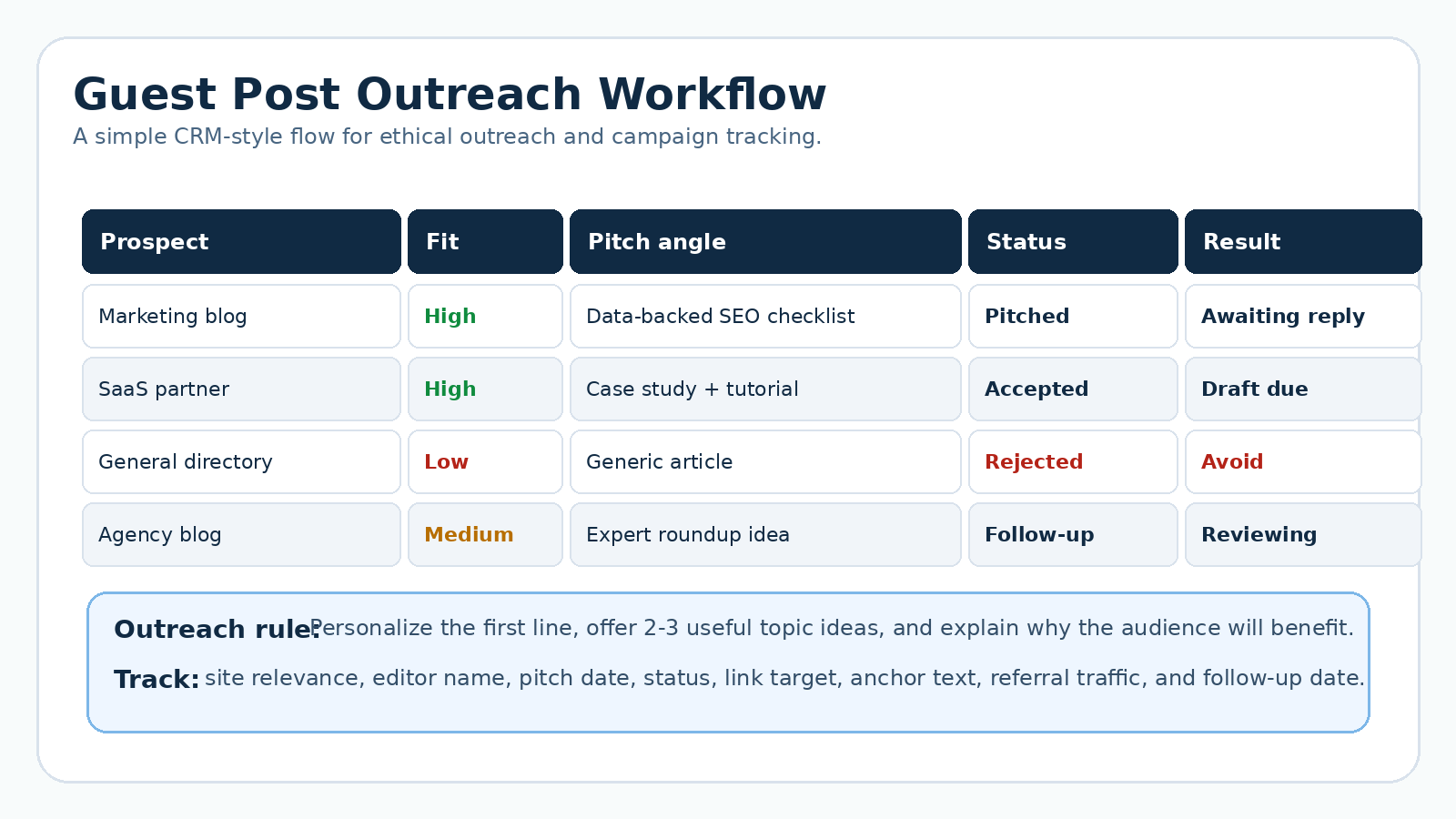
Image ALT Text: Guest post outreach workflow dashboard showing prospects, pitch angles, status, and campaign tracking fields.
Step 7: Track Results After Publication
Guest posting should be measured. A published guest post is not the finish line. Track what happened after the article went live so you can improve your outreach strategy.
Measure referral traffic, assisted conversions, backlinks, keyword movement, brand mentions, and relationships created. Some guest posts will drive immediate referral traffic. Others may create long-term authority and partnership value.
| Metric | Why It Matters |
| Referral visits | Shows whether readers clicked through to your website. |
| Engaged sessions | Shows whether referral visitors found the content useful. |
| Backlink status | Confirms whether the link is live and properly formatted. |
| Anchor text | Helps you avoid over-optimization across campaigns. |
| Keyword movement | Shows whether target pages improved over time. |
| Relationships | Tracks editors, partners, and future opportunities. |
Guest Posting Mistakes to Avoid
- Publishing on irrelevant websites just because they accept guest posts.
- Buying dofollow links from guest post marketplaces without proper qualification.
- Using the same exact-match anchor text across many posts.
- Submitting low-quality articles that exist only to place a link.
- Ignoring the host website’s audience and editorial guidelines.
- Linking only to money pages instead of helpful resources.
- Sending mass outreach emails with no personalization.
- Failing to track published links and campaign results.
Helpful Tools for Guest Posting Campaigns
| Tool Type | Example Tools | Use Case |
| Search and prospecting | Google, Bing, Ahrefs, Semrush | Find relevant websites and competitor guest post links. |
| Quality review | Ahrefs, Semrush, Moz, Similarweb | Check traffic, backlinks, authority estimates, and organic visibility. |
| Email discovery | Hunter, Snov.io, website contact pages | Find editor or marketing contact details. |
| Outreach tracking | Google Sheets, Airtable, HubSpot, Notion | Track pitch status, follow-ups, topics, and outcomes. |
| Analytics | Google Analytics 4, Google Search Console | Measure referral traffic, engagement, and ranking progress. |
Simple 30-Day Guest Posting Campaign Plan
| Week | Action Plan |
| Week 1 | Choose linkable assets, define target audience, and collect 30-50 relevant websites. |
| Week 2 | Qualify sites, remove poor prospects, and prepare personalized pitch ideas. |
| Week 3 | Send outreach, follow up politely, and outline accepted topics. |
| Week 4 | Write approved posts, submit drafts, track publication dates, and measure results. |
Recommended Internal Links for CBOOMARANK
- CBOOMARANK Blog
- Best Free SEO Tools for Beginners
- What Are Backlinks and Why They Matter for SEO
- How to Build High-Quality Backlinks in 2026
- Semrush vs Ahrefs
- Ubersuggest vs Semrush
- Submit URL to Search Engines
Recommended External Authoritative References
- Google Search Central: Qualify your outbound links
- Google Search Central: Spam policies for Google Web Search
- Google Search Central Blog: Link tagging and link spam update
- Ahrefs: What is guest blogging?
- Ahrefs: Guest blogging for SEO
- Ahrefs Help: What makes a high-quality backlink?
FAQ
Is guest posting still good for SEO in 2026?
Yes, guest posting can still support SEO when it is relevant, editorial, helpful, and not used mainly to manipulate rankings. It works best when the host site has a real audience and the article provides genuine value.
Are guest post backlinks safe?
Guest post backlinks are safer when they are natural, relevant, editorially placed, and useful to readers. Paid or sponsored placements should use the correct link attributes such as sponsored or nofollow.
Should I pay for guest posts?
Paying for publishing or sponsored content is a business decision, but links in paid placements should not pass ranking credit unless properly qualified. Avoid networks that sell dofollow guest post links at scale.
How many links should a guest post include?
Use only the links that help the reader. A natural guest post may include one relevant link to your resource, internal links to the host site, and references to trusted external sources.
What makes a website good for guest posting?
A good guest post target is relevant to your niche, has editorial standards, publishes helpful content, has real audience signals, and does not look like a link farm.
What anchor text should I use?
Use natural anchor text such as your brand name, article title, or a descriptive phrase. Avoid repeating exact-match commercial keywords across multiple guest posts.
How do I find guest posting sites?
Use search operators, competitor backlink research, author footprint searches, industry newsletters, partner blogs, and niche publications. Always manually review quality before pitching.
What should I track after publication?
Track the live URL, backlink status, link attribute, anchor text, referral traffic, engagement, keyword movement, conversions, and future relationship opportunities.
Final Verdict
Guest posting is not dead. Low-quality guest posting is dead. In 2026, the best guest posting campaigns are built around useful content, relevant audiences, strong editorial standards, and transparent link practices.
The right way to earn links through guest posting is to create content the host website would be proud to publish. Choose relevant sites, pitch specific ideas, write original articles, link only where helpful, qualify sponsored links properly, and track results after publication.
If you use guest posting as a relationship-building and audience-building strategy, it can support SEO, referral traffic, brand authority, and long-term digital growth.
