

Introduction
Backlinks are one of the most important concepts in search engine optimization. If you want your website to rank higher, build authority, attract referral traffic, and compete in organic search, you need to understand how backlinks work.
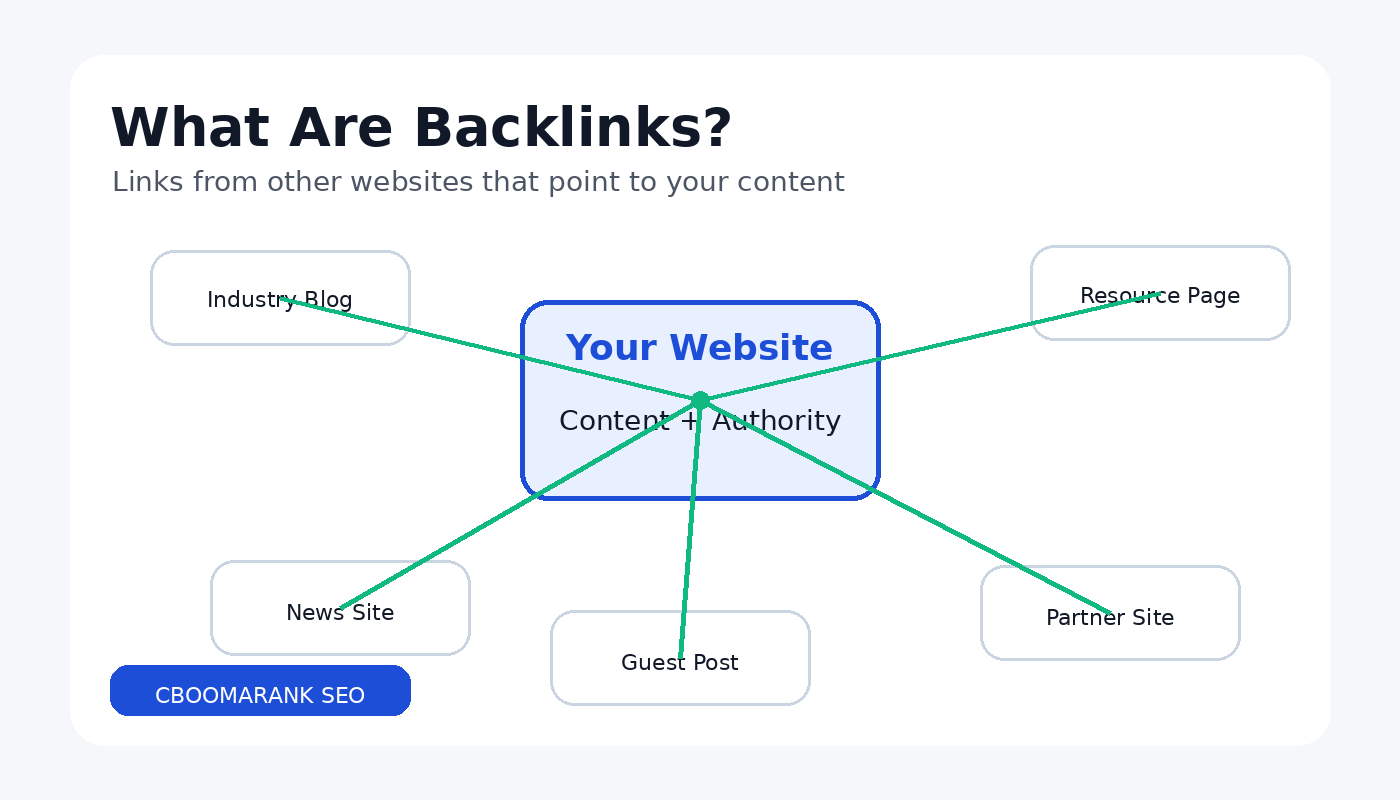
A backlink is a hyperlink from one website to another. When another website links to your page, your website has earned a backlink. Backlinks are also called inbound links, incoming links, or external links.
Backlinks matter because they can help search engines discover pages, understand relationships between websites, evaluate authority, and connect users with helpful resources. However, not all backlinks are equal. One relevant link from a trusted website can be more valuable than hundreds of weak links from unrelated or spammy domains.
For more beginner SEO guides, visit the CBOOMARANK Blog and read related resources such as Best Free SEO Tools for Beginners and Submit URL to Search Engines.
What Is a Backlink?
A backlink is a clickable link on another website that points to your website. For example, if a marketing blog publishes a guide about SEO tools and links to your article on keyword research, that link is a backlink for your website.
Backlinks are similar to recommendations. When a relevant website links to your content, it signals that your page may be useful, credible, or worth visiting. Search engines can use links to discover new pages and understand how different pages are connected across the web.
The value of a backlink depends on the quality of the linking website, the relevance of the page, where the link appears, the anchor text used, and whether the link is editorially placed. A link that helps real users is usually stronger than a link created only to manipulate rankings.
Backlinks vs Referring Domains
Beginners often confuse backlinks with referring domains. A backlink is the individual link pointing to your page. A referring domain is the website that sends the backlink.
| Scenario | Backlinks | Referring Domains |
| One article links to your page once | 1 | 1 |
| One website links to your page five times | 5 | 1 |
| Three different websites link to your page | 3 | 3 |
This distinction matters because a website can send many backlinks, but links from multiple relevant referring domains often show broader trust and visibility. In backlink analysis, you should look at both total backlinks and unique referring domains.
Why Backlinks Matter for SEO
1. Backlinks Help Search Engines Discover Pages
Search engines use links to crawl the web. When trusted pages link to your content, search engine crawlers may discover that content faster. This is especially important for new websites, newly published blog posts, and pages that do not yet have many internal links.
Backlinks are not the only discovery method. Sitemaps, internal links, and direct URL inspection tools also help. But links remain part of how the web is connected.
2. Backlinks Can Improve Authority
Backlinks can act as authority signals when they come from relevant, trusted websites. A backlink from a respected publication, industry blog, university, tool provider, or niche resource page can support your website authority more than a link from a random low-quality directory.
Authority does not mean chasing only large websites. A smaller but highly relevant niche blog with a real audience can be more valuable than an unrelated high-metric website with no topical connection.
3. Backlinks Help Search Engines Understand Relevance
The clickable text in a hyperlink is called anchor text. Anchor text and surrounding text can help users and search engines understand what the linked page is about. For example, a link using the text “backlink audit checklist” gives clearer context than a vague link saying “click here.”
However, anchor text should be natural. If every backlink uses the exact same keyword, the profile can look manipulated. A healthy backlink profile includes branded anchors, article titles, partial-match phrases, naked URLs, and natural wording.
4. Backlinks Can Drive Referral Traffic
Good backlinks can send real visitors to your website. If a relevant article links to your guide, readers may click through to learn more. That referral traffic may lead to subscribers, affiliate clicks, consultation requests, purchases, or brand recognition.
This is why the best link building strategy is not only about search engines. A good backlink should make sense for human readers and help them find useful information.
5. Backlinks Build Brand Trust
When your website is mentioned and linked by trusted sources, your brand becomes easier to recognize. Over time, backlinks can support authority, visibility, and reputation within your niche.
For a growing blog or business, backlinks can help position your brand as a useful source of information. This is important for SEO, but it also matters for credibility with real users.
Types of Backlinks
Dofollow Backlinks
A dofollow backlink is a normal link that can pass ranking signals from one page to another. The link does not need a special dofollow attribute. When people talk about valuable SEO backlinks, they are often referring to standard editorial links from trusted pages.
Nofollow Backlinks
A nofollow backlink includes a rel=”nofollow” attribute. This tells search engines that the linking page does not want to fully endorse the destination page. Nofollow links may still provide referral traffic, brand visibility, and a natural-looking link profile.
Sponsored Links
Sponsored links are used for paid placements, sponsorships, advertorials, and affiliate relationships. If a link is paid or part of a commercial arrangement, it should be qualified properly. Google recommends using rel=”sponsored” for ads or paid placements, with nofollow still accepted as a way to qualify paid links.
UGC Links
UGC means user-generated content. These links often appear in comments, forums, community posts, and user-submitted content. They can be useful for discussion, but they should be managed carefully because user-generated areas are often abused by spammers.
Editorial Backlinks
Editorial backlinks are links placed naturally because another website finds your content useful. These are among the strongest backlinks because they are earned through value, relevance, and trust.
What Makes a High-Quality Backlink?
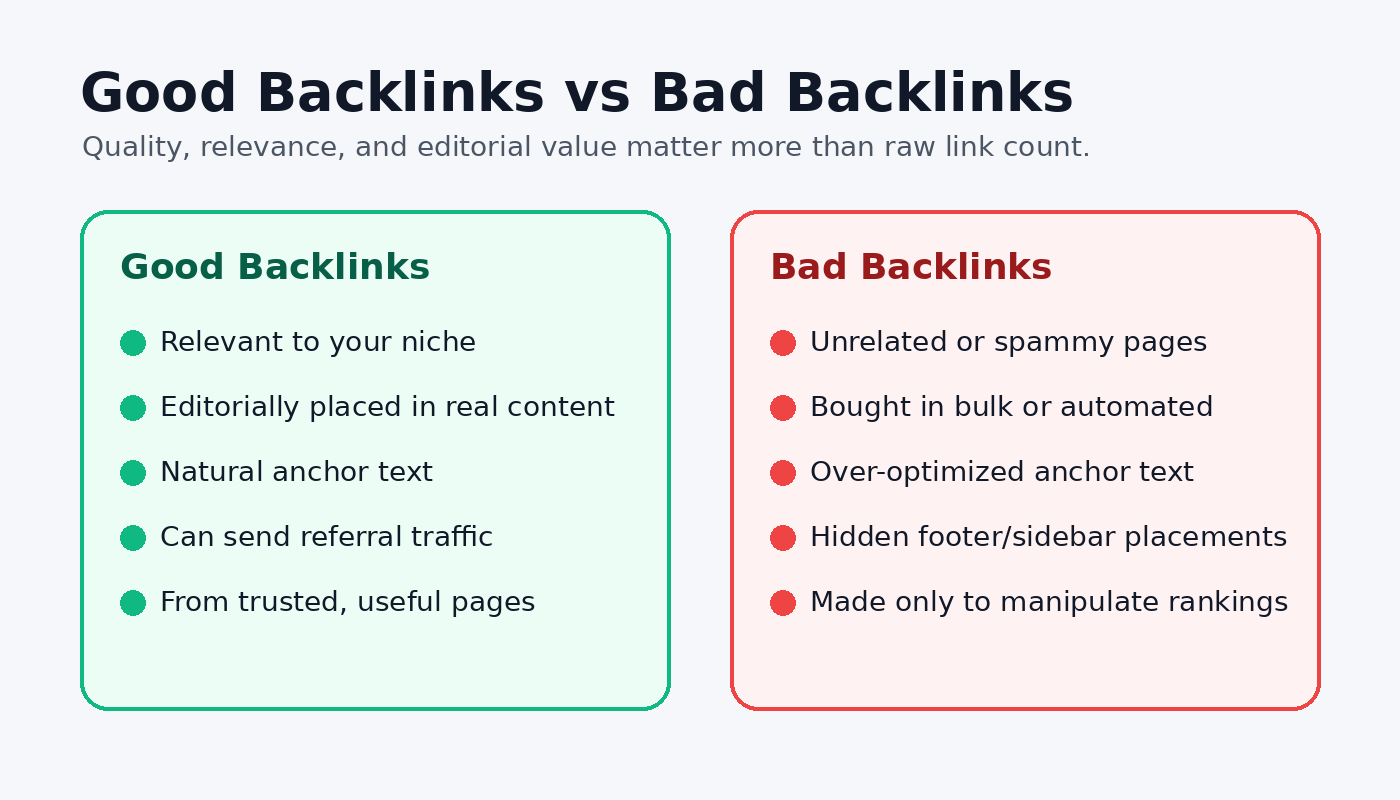
A high-quality backlink is usually relevant, trusted, editorially placed, natural, and useful to readers. Quality matters more than quantity. A small number of excellent links can outperform a large number of weak links.
1. Relevance
A backlink from a relevant website is usually more valuable than a link from an unrelated site. If your website is about SEO, links from marketing, web hosting, analytics, WordPress, SaaS, or business websites are more relevant than links from unrelated niches.
2. Authority
Authority refers to the trust and strength of the linking website or page. SEO tools estimate authority using their own metrics, but those metrics are not Google scores. Use them as indicators, not as absolute truth.
3. Editorial Placement
Links placed naturally inside the main content of a useful article are generally stronger than links hidden in footers, sidebars, low-quality directories, or automated pages. Editorial placement matters because it usually means the link exists to help readers.
4. Natural Anchor Text
Natural anchor text helps readers understand where the link goes. It should not look forced or repetitive. A balanced backlink profile includes branded anchors, partial keyword anchors, page titles, natural phrases, and URLs.
5. Traffic Potential
The best backlinks can send actual visitors. Before pursuing a backlink, ask whether real users read the page and whether the link would be useful to them. If a link has no audience and no editorial value, it may not be worth much.
Good Backlinks vs Bad Backlinks
| Good Backlinks | Bad Backlinks |
| Relevant to your niche | Completely unrelated to your topic |
| Editorially placed in useful content | Automatically generated or spammy |
| From trusted websites with real audiences | From link farms or low-quality directories |
| Uses natural anchor text | Uses over-optimized exact-match anchors |
| Can send referral traffic | Exists only to manipulate rankings |
| Earned through useful content or relationships | Bought in bulk with no quality control |
Safe Ways to Build Backlinks
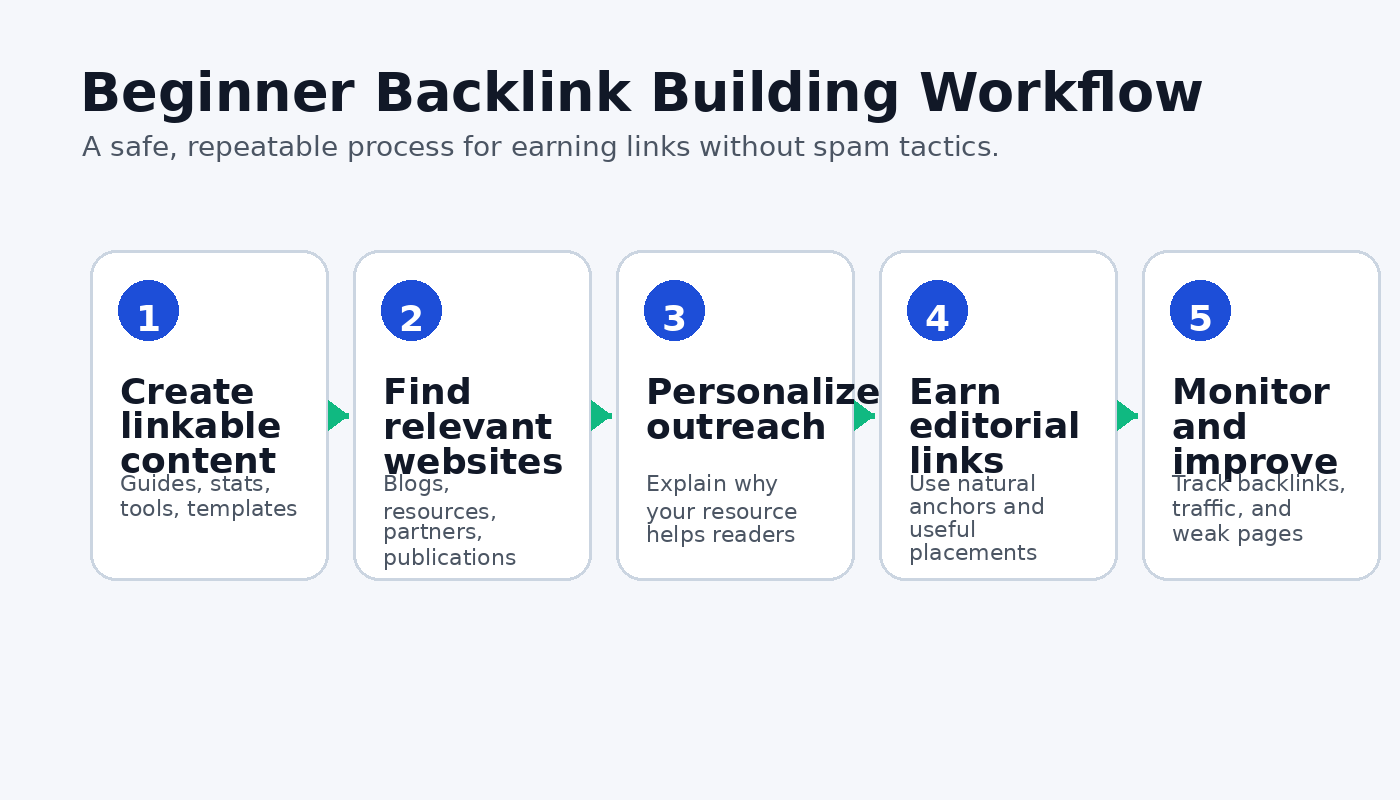
1. Create Linkable Content
People link to resources that help their audience. Linkable content includes original statistics, detailed guides, free tools, templates, checklists, comparison tables, case studies, infographics, and step-by-step tutorials.
2. Guest Posting
Guest posting means writing an article for another relevant website. A good guest post should help the host website’s audience, include original ideas, follow editorial guidelines, and use natural links. Avoid guest posting only for low-quality links.
3. Broken Link Building
Broken link building means finding dead links on relevant websites and suggesting your useful content as a replacement. This works best when your content genuinely replaces or improves the missing resource.
4. Expert Quotes and Digital PR
Journalists, bloggers, and content creators often need expert comments. When your response is useful and relevant, your brand may earn mentions and links from credible publications.
5. Original Research
Original data attracts links because writers need credible sources. You can publish surveys, industry benchmarks, statistics, pricing data, tool comparisons, or case studies. Research content can become a strong backlink asset over time.
6. Resource Pages
Resource pages list useful tools, guides, templates, or checklists. A well-organized resource page can earn links because it saves readers time and helps them discover helpful material.
7. Internal Linking
Internal links are links between pages on your own website. They are not backlinks, but they help distribute authority and guide visitors to related content. If one page earns backlinks, use internal links from that page to support other relevant posts.
Backlink Mistakes to Avoid
Buying Cheap Backlink Packages
Avoid offers that promise hundreds or thousands of backlinks for a very low price. These links are usually automated, irrelevant, or spammy. They rarely support long-term SEO and may create risk.
Using Private Blog Networks
Private Blog Networks, or PBNs, are networks of websites created mainly to manipulate rankings. They can be risky because they are not built around real editorial value.
Overusing Exact-Match Anchor Text
If too many backlinks use the exact same commercial keyword, the pattern can look unnatural. Use varied anchors and prioritize links that help readers.
Ignoring Relevance
A high metric score does not automatically make a backlink good. Relevance, editorial context, and trust are more important than chasing a single number.
Neglecting Content Quality
Link building cannot save weak content forever. If your article is thin, outdated, confusing, or unhelpful, earning natural backlinks will be difficult.
How to Check Your Backlinks
You can check backlinks using free and paid SEO tools. Start with Google Search Console, then expand to dedicated SEO platforms when you need competitor analysis and deeper link data.
| Tool | Best For |
| Google Search Console | Free backlink and search performance data from Google |
| Ahrefs | Deep backlink analysis and referring domain research |
| Semrush | Competitor backlink analysis and SEO reports |
| Moz Link Explorer | Domain Authority and link profile checks |
| SE Ranking | Affordable backlink monitoring and SEO tracking |
| Ubersuggest | Beginner-friendly backlink and keyword checks |
How Many Backlinks Do You Need?
There is no fixed number of backlinks required to rank. The answer depends on keyword difficulty, competition, content quality, website authority, search intent, technical SEO, internal linking, and competitor backlink profiles.
A local business may rank with a small number of strong local links. A competitive finance, legal, SaaS, ecommerce, or hosting website may need a much stronger backlink profile to compete.
Instead of asking only how many backlinks you need, study the top-ranking pages. Look at how many referring domains they have, what types of websites link to them, and whether your content can offer something more useful.
Backlink Quality Checklist
| Question | Why It Matters |
| Is the website relevant to my niche? | Relevance supports topical authority. |
| Is the page trusted and useful? | Trust matters more than raw quantity. |
| Is the link editorially placed? | Editorial links usually exist to help readers. |
| Is the anchor text natural? | Natural anchors reduce manipulation signals. |
| Can the page send referral traffic? | Traffic adds business value beyond rankings. |
| Is the link paid or sponsored? | Paid links should be properly qualified. |
Recommended Internal Links for CBOOMARANK
- Best Free SEO Tools for Beginners
- SEO Pricing Guide
- Semrush vs Ahrefs
- Ubersuggest vs Semrush
- Submit URL to Search Engines
- CBOOMARANK Blog
External Authoritative References
- Google Search Central SEO Starter Guide
- Google Search Central Spam Policies
- Google Search Central – Qualify Outbound Links
- Google Search Central – Link Best Practices
- Ahrefs – What Makes a High-Quality Backlink
- Ahrefs Academy – Referring Domains
Final Verdict
Backlinks are links from other websites to your website. They matter because they help search engines discover content, understand relevance, evaluate authority, and send real users to helpful pages.
The best backlinks are relevant, trusted, editorially placed, natural, and useful. The worst backlinks are spammy, unrelated, automated, or built only to manipulate rankings.
For beginners, the safest backlink strategy is simple: create helpful resources, publish content worth citing, build real relationships, contribute to relevant websites, and avoid cheap link schemes. Backlinks are not the only SEO factor, but they remain an important part of building long-term organic visibility.
FAQ
What are backlinks in SEO?
Backlinks are hyperlinks from one website to another. If another website links to your page, that link is a backlink for your website.
Why are backlinks important?
Backlinks can help search engines discover pages, understand relevance, evaluate authority, and send referral traffic.
What is a high-quality backlink?
A high-quality backlink usually comes from a trusted, relevant website, appears naturally in useful content, uses natural anchor text, and provides value to readers.
Are nofollow backlinks useless?
No. Nofollow backlinks may not pass signals the same way standard links do, but they can still bring referral traffic, brand visibility, and credibility.
How do I get backlinks?
You can earn backlinks by creating useful content, publishing original research, guest posting on relevant sites, building free tools, using broken link building, and contributing expert quotes.
Are paid backlinks safe?
Paid links can be risky if used to manipulate rankings. Sponsored or paid links should be qualified using appropriate link attributes.
How many backlinks do I need to rank?
There is no fixed number. It depends on competition, keyword difficulty, content quality, authority, search intent, and competitor backlink profiles.
What is the difference between backlinks and internal links?
Backlinks come from other websites. Internal links connect pages on your own website. Both are useful, but they serve different purposes.
Can bad backlinks hurt SEO?
Spammy, manipulative, or irrelevant backlinks can create risk. Focus on relevant editorial backlinks instead of buying cheap link packages.
