

Introduction
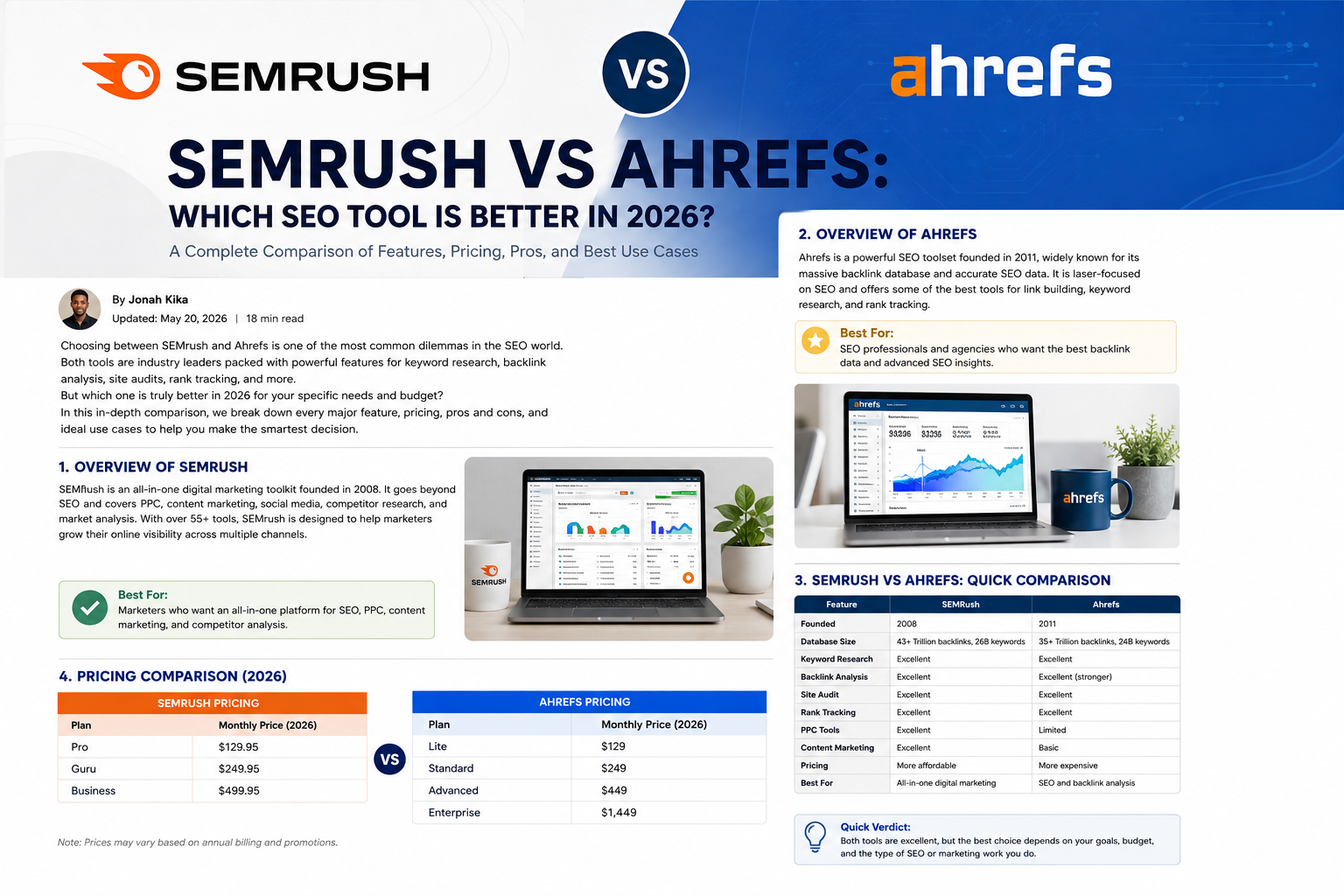
Choosing between Semrush and Ahrefs is difficult because both platforms have grown far beyond simple keyword tools. Each now combines competitive research, technical auditing, rank tracking, content intelligence, backlink data, and emerging AI-search capabilities. Yet they still feel different in daily use and are built for slightly different buyers.
Semrush is the broader digital-marketing suite. It covers SEO, paid advertising research, content planning, local visibility, reporting, and AI-search monitoring through a large collection of connected toolkits. Ahrefs remains more tightly centered on search intelligence: understanding competitors, backlinks, keyword demand, content opportunities, technical issues, and brand visibility across traditional and AI-powered search.
The right choice is therefore not simply the platform with the longest feature list. It is the platform that matches your workflow. This guide compares Semrush and Ahrefs across the areas that matter most in 2026, including price, data, usability, AI tools, and the practical return you can expect from your subscription.
Semrush vs Ahrefs at a Glance
| Category | Semrush | Ahrefs | Winner |
| Overall scope | Full digital-marketing and SEO suite | Search, content, backlinks, and competitor intelligence | Semrush |
| Keyword research | Huge database, intent, PPC and grouping tools | Strong traffic-potential and SERP analysis | Tie |
| Backlink analysis | Strong database plus outreach workflow | Excellent link discovery and competitor UX | Ahrefs |
| Site audit | Broad checks, clear reports, integrations | Deep technical issues and strong prioritization | Tie |
| Rank tracking | Daily tracking and granular local targeting | Clean reporting; pricing table lists weekly updates | Semrush |
| PPC research | Dedicated advertising research and ad examples | Useful paid-keyword intelligence inside Site Explorer | Semrush |
| Content marketing | Dedicated content toolkit and briefs | AI Content Helper and content opportunity research | Semrush |
| Local SEO | Listings, reviews, map rank tracking, local plans | GBP Monitor and local research capabilities | Semrush |
| AI-search visibility | Semrush One, prompt tracking, AI reports | Brand Radar, custom prompts, agents, AI Content Helper | Tie |
| Backlink-focused SEO | Very capable | Core strength and excellent workflow | Ahrefs |
| Best for agencies | Broader reporting and client services | Great for specialist SEO teams | Semrush |

What Is Semrush?
Semrush is an all-in-one digital-marketing platform built around SEO but expanded into advertising research, content marketing, local SEO, social media, reporting, and AI-search visibility. Its classic SEO Toolkit includes Keyword Overview, Keyword Magic Tool, Keyword Strategy Builder, Position Tracking, Site Audit, backlink tools, competitor research, and reporting. Semrush also sells separate or bundled toolkits for content, local marketing, social media, and AI visibility.
Its biggest advantage is breadth. A team can move from keyword research to a technical audit, inspect a competitor’s paid ads, monitor local rankings, produce a client report, and track AI-search prompts without leaving the wider Semrush ecosystem. The trade-off is complexity: new users may need time to understand which toolkit contains each feature and which capabilities require an add-on or higher plan.
What Is Ahrefs?
Ahrefs is an SEO and marketing-intelligence platform best known for Site Explorer, Keywords Explorer, Site Audit, Rank Tracker, and Content Explorer. It has also expanded into web analytics, AI visibility, content optimization, local profile monitoring, brand tracking, and embedded AI agents. Its interface is usually more focused than Semrush, and many SEO professionals value how quickly they can move from a competing domain to its best pages, keywords, links, and content gaps.
Ahrefs is especially strong when your workflow begins with competitor intelligence. Site Explorer brings organic traffic, backlink, paid-search, site-structure, and AI-visibility data into one research environment. The platform is not as broad as Semrush for PPC management, social publishing, or local marketing operations, but it is extremely capable for organic search strategy.
2026 Pricing Comparison
Pricing changes frequently, so always confirm the current checkout page before purchasing. The figures below reflect official pricing pages checked on August 6, 2026. Check Semrush pricing and check Ahrefs pricing before subscribing.
| Platform | Plan | Monthly price | Best suited to |
| Semrush SEO Toolkit | Pro | $139.95 | Freelancers, small businesses, and SEO beginners |
| Semrush SEO Toolkit | Guru | $249.95 | Growing teams and agencies |
| Semrush SEO Toolkit | Business | $499.95 | Established agencies and larger organizations |
| Semrush One | Starter | $199 | SEO plus AI-search visibility |
| Semrush One | Pro+ | $299 | Growing brands scaling SEO and AI visibility |
| Ahrefs | Starter | $29 | Entry-level competitor and SEO research |
| Ahrefs | Lite | $129 | Small businesses and individual SEO professionals |
| Ahrefs | Standard | $249 | Serious content and SEO teams |
| Ahrefs | Advanced | $449 | Larger agencies and data-heavy teams |
| Ahrefs | Enterprise | $1,490 | Enterprise organizations |
On headline price, Ahrefs Lite costs slightly less than Semrush Pro. However, these plans are not identical. Semrush Pro provides a broader marketing toolkit, while Ahrefs Lite is more tightly focused on SEO research and monitoring. Ahrefs Starter is useful for occasional research, but its smaller limits make it unsuitable as the main platform for an active agency or large content program.
Keyword Research: Which Tool Is Better?
Semrush keyword research
Semrush Keyword Magic Tool provides access to more than 27.3 billion keywords and organizes related phrases into topic-based groups. The platform combines volume, keyword difficulty, intent, CPC, trend information, competitive density, SERP features, and personalized keyword recommendations. Because Semrush also has strong advertising data, it is particularly useful when SEO and PPC teams share research.
Related reading and official documentation: CBOOMARANK keyword research tools guide | Semrush Keyword Magic Tool documentation | Ahrefs Keywords Explorer
- Excellent keyword grouping and filtering.
- Clear search-intent labels.
- Strong CPC and paid-competition context.
- Keyword Strategy Builder for clusters and planning.
- Useful SERP-feature and AI Overview filters.
Ahrefs keyword research
Ahrefs Keywords Explorer is excellent for judging the real traffic opportunity behind a query. Its traffic-potential concept helps users look beyond the search volume of one keyword and estimate how much traffic the top-ranking page receives from all its related rankings. Ahrefs also makes it easy to inspect ranking history, parent topics, SERP composition, competing pages, and keyword ideas across multiple search engines and locations.
- Strong traffic-potential and parent-topic analysis.
- Excellent SERP and ranking-history views.
- Fast movement from keyword data to competitor pages.
- Useful keyword clustering and search-intent features on higher plans.
- Very practical for content-led SEO.
| Keyword research verdict Choose Semrush when you need a large, structured keyword workflow that connects SEO, PPC, intent, and reporting. Choose Ahrefs when you care most about organic traffic potential, ranking-page analysis, and content opportunities. This category is effectively a tie; the winner depends on how you make decisions. |
Backlink Analysis: Ahrefs Still Has the Edge
Backlink analysis is the category most closely associated with Ahrefs. Site Explorer is fast, clear, and extremely useful for finding new links, lost links, referring domains, link intersections, anchor patterns, top linked pages, and competitor link growth. Ahrefs says its index contains tens of trillions of live backlinks, and its interface makes large backlink profiles easier to interpret than many competing platforms.
Semrush also has a strong backlink database, Backlink Analytics, Backlink Audit, Link Building Tool, and outreach-oriented workflows. It can identify toxic-link signals, compare competitors, find prospects, and manage a campaign. For teams that want prospect discovery and outreach management in the same system, Semrush is convenient.
Related reading and official documentation: CBOOMARANK link-building tools guide | Ahrefs Site Explorer | Semrush Backlink Analytics
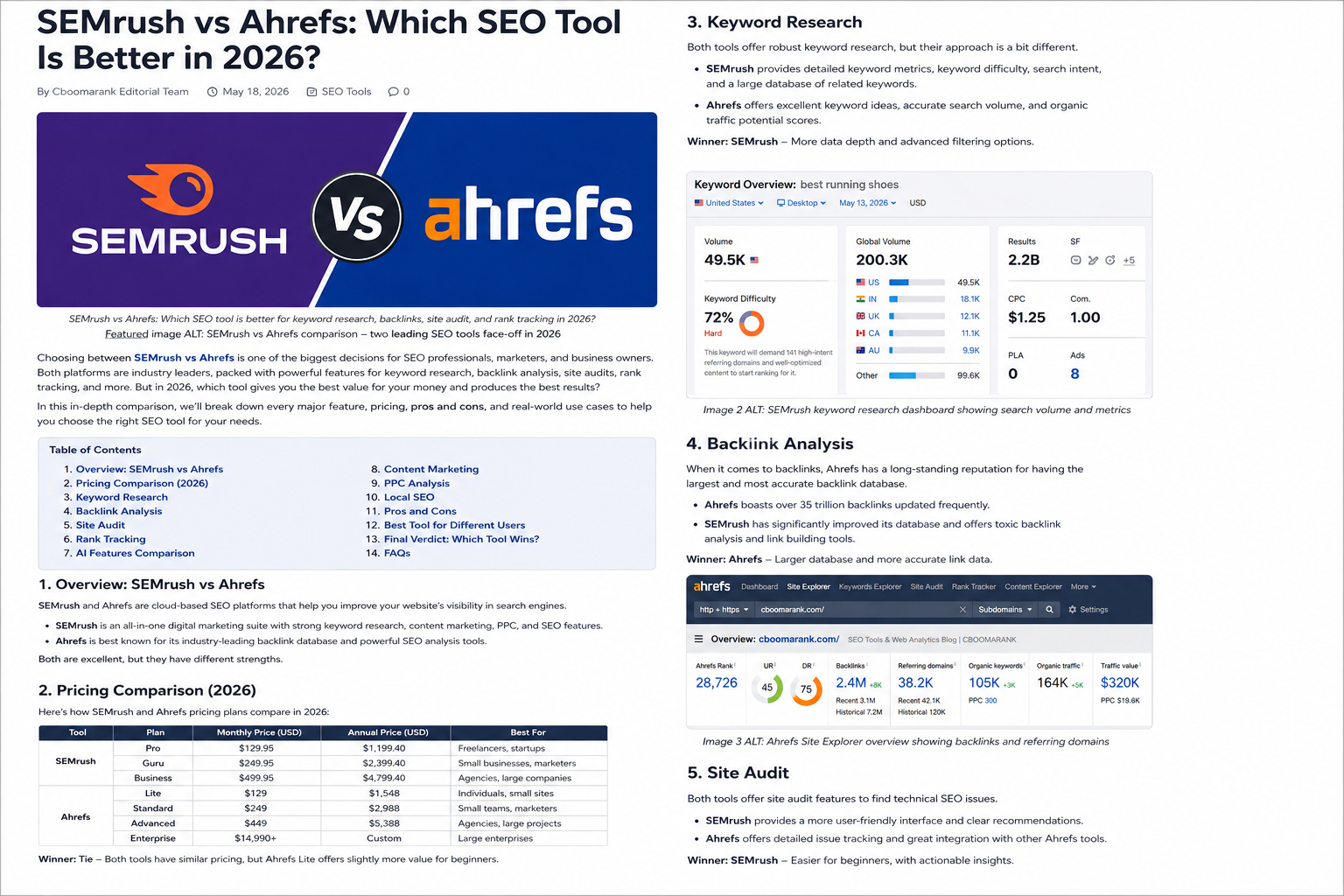
| Backlink verdict Ahrefs wins for pure backlink research, link discovery, competitive analysis, and day-to-day usability. Semrush remains a strong option and may be more convenient for agencies that want research, prospect management, outreach, and reporting in one broader platform. |
Site Audit and Technical SEO
Both tools can crawl a website, identify technical issues, group them by severity, and monitor progress over time. Ahrefs Site Audit checks more than 170 predefined technical and on-page issues. Semrush documents more than 140 checks covering crawlability, indexability, duplicate content, HTTPS, hreflang, performance, internal linking, and other technical areas.
Ahrefs has a clean issues-first workflow and strong visualizations. Its always-on auditing and near-real-time issue reporting can be useful for active sites. Semrush provides detailed issue explanations, thematic reports, crawl comparison, progress tracking, and integration with its wider reporting environment. It also connects audit findings with keyword, backlink, and on-page recommendations.
Related reading and official documentation: CBOOMARANK technical SEO guide | Ahrefs Site Audit | Semrush Site Audit
| Site audit verdict This is a tie. Ahrefs may feel cleaner for technical specialists, while Semrush is often better for teams that want audit findings connected to reporting, content, rankings, and client workflows. |
Rank Tracking
Semrush Position Tracking supports granular targeting by country, region, city, and postal code, along with device and search-engine settings. It can monitor traditional rankings, SERP features, AI Overviews, ChatGPT Search, and Google AI Mode. Semrush’s core positioning is built around daily tracking, which is useful for campaigns that require frequent reporting and local visibility checks.
Ahrefs Rank Tracker offers clean visibility, share-of-voice reporting, competitor comparisons, SERP history, location tracking, and the ability to import historical rankings from Site Explorer. However, Ahrefs’ public pricing comparison lists weekly updates for standard plan tiers, which may be less attractive to teams that expect daily rank movement without additional configuration or upgrades.
Related reading and official documentation: Semrush Position Tracking documentation | Ahrefs Rank Tracker
| Rank tracking verdict Semrush wins for frequent monitoring, local granularity, and agency reporting. Ahrefs remains excellent for strategic trend analysis and competitor share of voice. |
AI Features and AI-Search Visibility
AI-search visibility became a major buying criterion in 2026. Semrush One combines traditional SEO with prompt tracking, AI visibility reports, brand-performance monitoring across platforms such as ChatGPT, Gemini, Perplexity, and Google, and an AI-ready Site Audit. Semrush also offers AI-assisted keyword recommendations, content ideas, briefs, and optimization through its connected toolkits.
Ahrefs has moved aggressively into the same space. Brand Radar tracks visibility across AI and search environments; custom prompts are included in paid plans except Starter; AI Content Helper evaluates topic coverage; Agent A and Agent B assist with analysis and action; and Ahrefs has added AI indexes and citations reporting. Its AI Content Helper is designed to improve topic coverage rather than encourage keyword stuffing.
Related reading and official documentation: CBOOMARANK AI SEO tools guide | Semrush AI Visibility Toolkit | Ahrefs Brand Radar
| AI verdict Semrush currently offers the clearer packaged route for brands that want SEO and AI-search monitoring in one commercial plan. Ahrefs offers a powerful and rapidly expanding AI layer that is deeply connected to competitor, content, backlink, and technical data. For 2026, this category is a tie. |
Content Marketing
Semrush has the broader content-marketing workflow. Its separate Content Toolkit includes topic discovery, country-specific ideas, SEO brief generation, AI-assisted writing, brand-voice support, optimization, and performance tracking. This is useful for teams that need a repeatable process from idea to brief to optimized draft.
Ahrefs combines Content Explorer, competitor pages, content gaps, and AI Content Helper. Its approach is excellent for finding proven topics, pages that attract links, decaying content, and gaps in topical coverage. The writing environment is more focused on search relevance and topic completeness than on managing a full editorial operation.
Related reading and official documentation: CBOOMARANK content-creation tools guide | Semrush Content Toolkit pricing and features | Ahrefs AI Content Helper
| Content verdict Semrush wins for end-to-end content operations. Ahrefs is outstanding for research, content opportunity discovery, and topic coverage. |
PPC and Advertising Research
Semrush is the clear winner for PPC. Advertising Research can reveal competitor keywords, estimated paid traffic, landing pages, ad history, and live ad-copy examples. Semrush’s keyword tools also expose CPC, paid competition, and advertising intent, making the platform useful for combined SEO and paid-search planning.
Ahrefs Site Explorer includes paid keywords, paid pages, estimated paid traffic, and paid-traffic cost. These reports are valuable for competitor research, but Ahrefs is not as complete as Semrush for a dedicated PPC workflow.
Related reading and official documentation: CBOOMARANK PPC tools guide | Semrush Advertising Research
| PPC verdict Semrush wins comfortably. Choose Ahrefs for occasional paid-search intelligence; choose Semrush when PPC is a meaningful part of your service or acquisition strategy. |
Local SEO
Semrush offers a mature local-marketing stack with listing management, review monitoring, Google Business Profile optimization, Map Rank Tracker, and location-based pricing. It is designed for businesses and agencies managing one or many locations.
Ahrefs now offers GBP Monitor, which can track profile changes, send alerts, reject unwanted edits, bulk-edit profiles, preserve change history, and monitor calls, directions, website clicks, and search terms. This makes Ahrefs more capable for local SEO than it was in previous years, but Semrush still provides the broader operational toolkit.
Related reading and official documentation: CBOOMARANK Local SEO services | Ahrefs GBP Monitor
| Local SEO verdict Semrush wins for complete local SEO management. Ahrefs GBP Monitor is a useful addition, especially for profile protection and monitoring. |
Ease of Use
Ahrefs generally has the cleaner learning curve for SEO research. Its core tools are easy to understand, and the interface keeps related competitor, keyword, content, and link reports close together. This helps specialists move quickly from discovery to analysis.
Semrush contains more tools, which naturally makes the platform feel busier. Once configured, however, its Projects system is powerful because rankings, audits, backlinks, on-page recommendations, and reporting can be organized around each website. Agencies that use several marketing channels may accept the extra complexity in exchange for fewer separate subscriptions.
Pros and Cons
Semrush pros
- Broad SEO, PPC, content, local, social, reporting, and AI-search ecosystem.
- Strong keyword database and search-intent tools.
- Daily and highly localized position tracking.
- Better choice for PPC research and multi-channel agencies.
- Strong client reporting and project management.
Semrush cons
- Busy interface and steeper learning curve.
- Important content, local, social, and AI capabilities may require separate toolkits or higher-priced bundles.
- Costs can rise quickly for multiple users, locations, and add-ons.
Ahrefs pros
- Excellent backlink and competitor research workflow.
- Clean interface for SEO specialists.
- Strong keyword traffic-potential and SERP analysis.
- Powerful content and link-opportunity research.
- Rapidly expanding AI, local, analytics, and brand-monitoring features.
Ahrefs cons
- Less comprehensive than Semrush for PPC, social media, and full local-marketing operations.
- Public plan comparison lists weekly rank-tracking updates.
- Some advanced keyword and AI features require Standard or higher tiers.
- Starter plan is useful for light research but limited for serious ongoing campaigns.
Which Tool Is Best for Different Users?
| User type | Best choice | Why |
| SEO agency | Semrush | Broader client reporting, PPC, local SEO, projects, and multi-channel services |
| Link-building specialist | Ahrefs | Best-in-class backlink discovery and competitor link analysis workflow |
| Content-focused blogger | Ahrefs | Strong topic, keyword, competitor-page, and traffic-potential research |
| Small business doing SEO and ads | Semrush | SEO and PPC data in one platform |
| Local business or multi-location brand | Semrush | Listings, reviews, map tracking, and local operations |
| Technical SEO consultant | Tie | Both offer excellent audits; preference depends on workflow |
| Ecommerce SEO team | Ahrefs or Semrush | Ahrefs for organic category/product research; Semrush for PPC and omnichannel work |
| Enterprise brand tracking AI visibility | Tie | Both now offer strong AI-search and brand-monitoring capabilities |
Best Value Recommendation
The best value depends on what you would otherwise buy separately. If you need SEO, PPC research, rank tracking, client reports, local visibility, and content operations, Semrush can replace several tools and justify its higher total cost. If your work is concentrated on organic search, backlinks, competitor research, and content strategy, Ahrefs Lite or Standard can provide a more focused experience with less interface clutter.
Related reading and official documentation: CBOOMARANK pricing | Semrush SEO Toolkit pricing | Ahrefs pricing
For a solo blogger or specialist who mainly needs organic research, Ahrefs is often the better value. For a small business, ecommerce brand, or agency that actively uses paid search, local SEO, and client reporting, Semrush is usually the more economical all-in-one decision.
Final Verdict: Semrush or Ahrefs?
Semrush is the better overall marketing platform. It wins for breadth, PPC intelligence, local SEO, reporting, frequent rank tracking, and teams that manage several acquisition channels. Ahrefs is the better pure SEO research experience. It wins for backlink analysis and often feels faster for competitor research, organic content strategy, and link-focused work.
Our 2026 recommendation is straightforward: choose Semrush when you need one platform to support an agency or multi-channel marketing team. Choose Ahrefs when organic search, content, and backlinks are the center of your workflow. Neither is universally better, but one will be materially better for the way you work.
Related reading and official documentation: CBOOMARANK SEO best practices guide | CBOOMARANK free SEO analysis
Frequently Asked Questions
Is Semrush better than Ahrefs?
Semrush is better for all-in-one marketing, PPC, local SEO, reporting, and multi-channel agency work. Ahrefs is better for backlink analysis, competitor research, and a focused organic SEO workflow.
Which is cheaper, Semrush or Ahrefs?
Ahrefs Lite starts at $129 per month, while Semrush SEO Toolkit Pro is $139.95 per month. Ahrefs also offers a $29 Starter plan, but it is designed for lighter use and has much smaller limits.
Which tool has better backlink data?
Ahrefs remains the preferred choice for many professionals because of its backlink index, link reports, and easy competitor-analysis workflow. Semrush is still very capable and adds outreach management.
Which tool is better for keyword research?
Both are excellent. Semrush is stronger for structured keyword grouping, intent, and PPC context. Ahrefs is stronger for traffic potential, SERP analysis, and content-led research.
Which tool is better for agencies?
Semrush is usually better for agencies because it combines SEO, PPC, local marketing, reporting, and project tools. Specialist SEO or link-building agencies may prefer Ahrefs.
Can I use Semrush and Ahrefs together?
Yes. Some advanced teams use Semrush for rank tracking, PPC, local SEO, and reporting while using Ahrefs for backlink and competitor research. However, most small teams should begin with one platform and add the second only when the additional data produces measurable value.
Which is better for AI search optimization?
Both now provide AI-search monitoring and content features. Semrush offers dedicated bundled AI visibility plans, while Ahrefs provides Brand Radar, custom prompts, AI Content Helper, and embedded AI agents.
Suggested Internal Links for CBOOMARANK
- Best keyword research tools
- Best link-building tools
- Best AI SEO tools
- SEO best practices
- Technical SEO guide
- PPC tools for research and reporting
