

Artificial intelligence is now part of everyday SEO work, but the winning strategy in 2026 is not to publish more machine-written pages. It is to use AI to research faster, identify gaps, improve workflows and monitor visibility—while people remain responsible for accuracy, originality, experience and business judgment.
Google’s current guidance for generative AI features says that optimizing for AI experiences remains SEO. The fundamentals still matter: accessible pages, useful original content, clear structure, crawlability, strong images and video where relevant, accurate structured data and a good page experience. Google also warns that generating many low-value pages with AI can violate its scaled-content-abuse policies.
This guide compares 15 tools across five jobs: research, content intelligence, technical auditing, AI-search visibility and first-party measurement. No tool is “Google approved,” and no third-party score reveals Google’s private ranking systems. Use these products as decision support—not as substitutes for expertise or evidence.
| Quick recommendation: For most small businesses: combine ChatGPT or Gemini for cited research, Google Search Console and CBOOMARANK for first-party diagnostics, one content-optimization platform such as Surfer or Frase, and one AI-visibility monitor only when AI-search referrals or brand mentions justify the cost. |
Best AI SEO tools in 2026: quick comparison
| Tool | Best for | Key capabilities | Access model |
| ChatGPT Search & Deep Research | Cited research, synthesis and workflow assistance | Research, outlines, source comparison, structured analysis | General AI assistant; verify outputs |
| Google Gemini Deep Research | Research connected to Google’s AI ecosystem | Multi-source research, reports and exploration | General AI assistant; verify outputs |
| Semrush AI Visibility Toolkit | Broad AI-search and competitor monitoring | Mentions, citations, topic gaps, perception and share of voice | Paid platform |
| Ahrefs Brand Radar | AI visibility plus web, video and demand context | Mentions, citations, prompts and cross-channel discovery | Paid add-on/platform |
| Surfer | Updating and optimizing on-page content | Content Editor, Content Audit, SERP and AI-search guidance | Paid platform |
| Clearscope | Editorial content optimization for teams | Topic coverage, briefs, optimization and integrations | Paid platform |
| Frase | SEO and GEO briefs, scoring and workflows | Research, briefs, content optimization and GEO scoring | Paid platform |
| MarketMuse | Content inventory, planning and authority gaps | Topic modeling, prioritization, briefs and optimization | Paid platform |
| Writesonic GEO | Multi-platform AI visibility and citation monitoring | Visibility, citation share, trends and project dashboards | Paid platform |
| Jasper | Governed marketing content workflows at scale | Agents, brand controls, optimization and production workflows | Paid platform |
| Screaming Frog SEO Spider | Technical crawling with custom AI analysis | Crawls, custom prompts, API connections and MCP workflows | Free limited / paid licence |
| Otterly.AI | Accessible AI-search monitoring | Prompt monitoring, mentions and citations across AI engines | Paid platform |
| Peec AI | AI-search analytics for marketing teams | Visibility, position, sentiment, sources and competitor tracking | Paid platform |
| Google Search Console | First-party Google performance measurement | Queries, pages, indexing and generative AI performance views | Free |
| CBOOMARANK | Website and URL diagnostics alongside AI workflows | SEO analysis, reports, URL review and growth opportunities | Free analysis + paid plans |
What changed in AI SEO in 2026?
1. AI-search visibility became measurable—but still directional
Google introduced a dedicated generative AI performance view in Search Console, giving verified site owners a clearer view of impressions in AI features. Third-party platforms now monitor brand mentions, citations, sentiment and share of voice across AI assistants. Because answers vary by user, geography, time and prompt wording, these measurements should be treated as trends and benchmarks rather than exact market totals.
2. “GEO” and “AEO” did not replace SEO
Google explicitly describes generative-engine optimization and answer-engine optimization as work within the broader search experience. A separate collection of secret AI-ranking tricks is unlikely to outperform strong technical SEO, useful content, relevant authority and clear brand information. Review third-party recommendations against official Google guidance.
3. Research assistants became more capable—and more source-aware
ChatGPT Search and Deep Research and Gemini Deep Research can explore many sources, compare claims and create structured reports. That makes them useful for competitive research, audience-question discovery and evidence gathering. Their outputs still require source inspection, date checks and expert review.
4. Technical SEO tools added AI and agent workflows
Crawlers can now send page elements to multiple language-model APIs, classify issues, extract patterns and connect with agent workflows. This helps teams analyze large sites more quickly, but prompts must be carefully designed and outputs sampled before changes are applied at scale.
5. Human quality control became the differentiator
Google’s guidance on generative AI content permits useful AI assistance but warns against low-value scaled production. The strongest content adds firsthand experience, original data, expert review, clear sourcing, unique media, examples and a reason for the reader to choose that page over a generic summary.
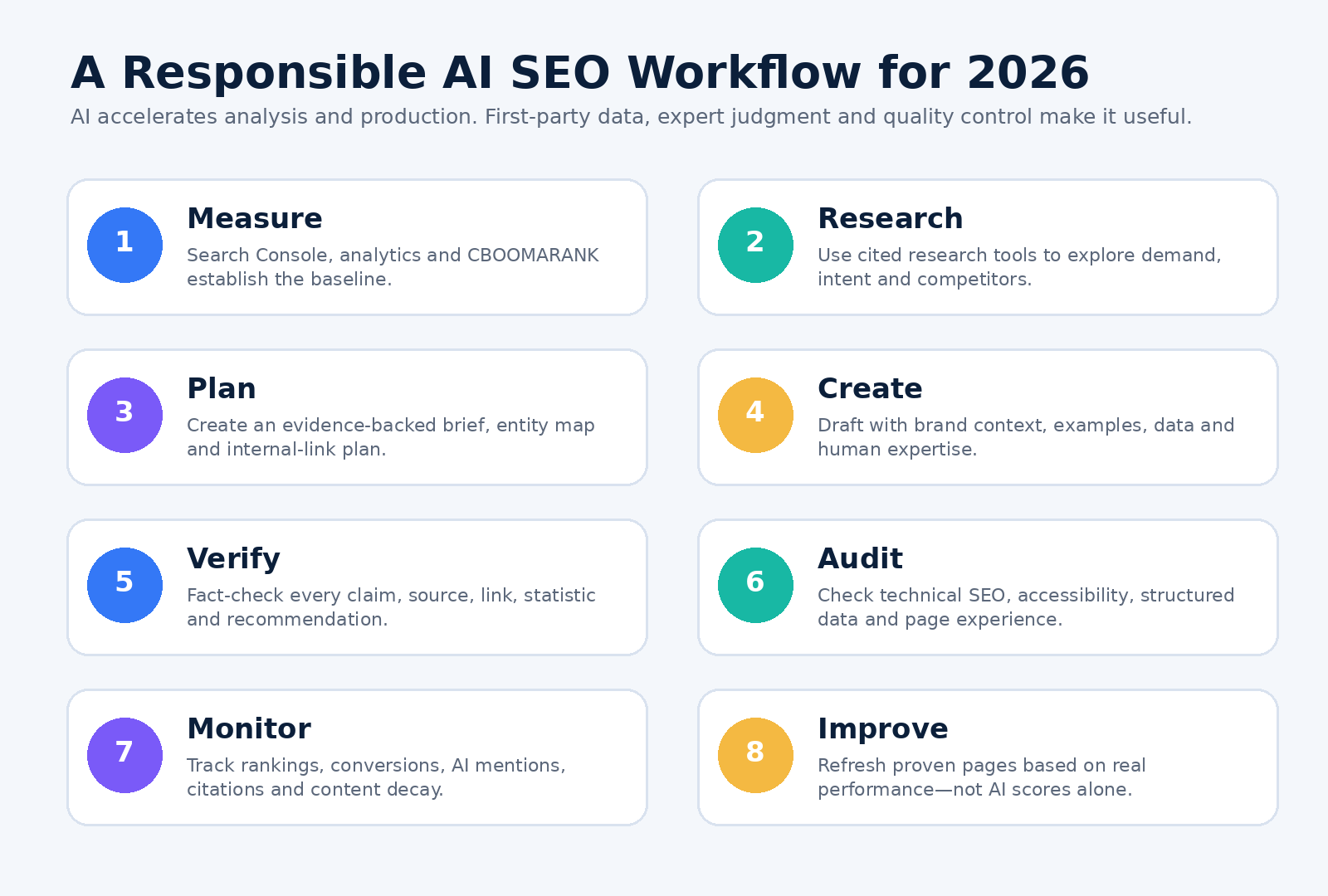
Use AI to accelerate research and analysis, then verify, audit, measure and improve with human oversight.
Alt text: Eight-step responsible AI SEO workflow for 2026
The 15 best AI SEO tools for 2026
1. ChatGPT Search and Deep Research: best for cited SEO research
ChatGPT Search is useful for fast, current orientation, while Deep Research is better for multi-source investigations and structured reports. SEO teams can use it to compare search-result patterns, summarize official documentation, identify customer questions and organize a content brief.
- Ask it to prioritize official or trusted domains.
- Require citations for time-sensitive claims.
- Upload first-party exports or briefs when permitted by your organization.
- Use it to critique an outline, not merely generate one.
Best practice: Do not treat generated keyword volumes, rankings, backlinks or traffic estimates as factual unless they come from a connected, verifiable data source. Never publish citations you have not opened.
2. Google Gemini Deep Research: best for Google-centered research workflows
Gemini Deep Research can investigate complex questions, analyze many sources and produce organized reports. It is useful for market research, competitor comparisons, topic discovery and synthesizing information from Google-connected workflows.
- Research a market before choosing target topics.
- Compare product features using official sources.
- Develop audience questions and content angles.
- Create a source map for a writer or reviewer.
Best practice: Use it as a research assistant. Validate every important statement and avoid sending confidential customer or business data without an approved data-governance process.
3. Semrush AI Visibility Toolkit: best all-in-one AI visibility suite
Semrush AI Visibility Toolkit is designed to monitor how brands appear in AI-generated answers, benchmark competitors and identify topic or perception gaps. It can connect AI visibility analysis with a broader SEO and competitive-research workflow.
- Monitor mentions, citations and visibility trends.
- Compare several competitors.
- Inspect cited pages and topic coverage.
- Review brand perception and narrative drivers.
Best practice: Choose it when your team already uses Semrush or needs a broad platform. Treat visibility numbers as directional because AI responses are dynamic and personalized.
4. Ahrefs Brand Radar: best for connecting AI visibility with wider search demand
Ahrefs Brand Radar tracks brand visibility across AI answers and connects it with channels that can influence discovery, including conventional search and other web surfaces. It is particularly useful for teams that already rely on Ahrefs for backlink and content research.
- Track mentions, citations, impressions and AI share of voice.
- Explore prompts and topics where competitors appear.
- Investigate the pages and sources associated with visibility.
- Connect AI-search analysis with backlink and keyword research.
Best practice: Use Brand Radar to find patterns and opportunities, then verify which pages actually drive qualified visits and conversions in your own analytics.
5. Surfer: best for refreshing and optimizing existing content
Surfer Content Audit combines Search Console data with SERP analysis to identify pages that may benefit from re-optimization. Its editor and audit workflows help teams review coverage, structure and competitive context for both traditional and AI-assisted discovery.
- Prioritize pages that already have impressions.
- Build or improve content briefs.
- Review topical coverage and structure.
- Refresh existing posts rather than publishing duplicates.
Best practice: Avoid chasing a perfect content score. A score is a model-specific diagnostic, not a Google ranking factor. Preserve clarity and originality when following term recommendations.
6. Clearscope: best for editorial teams and structured optimization
Clearscope Optimize supports research, topic coverage, content grading and integrations with common writing and publishing platforms. It is a strong fit for editorial teams that need consistent briefs and review workflows.
- Create writer-friendly briefs.
- Review relevant concepts and questions.
- Improve existing drafts without keyword stuffing.
- Collaborate through WordPress, Google Docs or Microsoft Word workflows.
Best practice: Choose Clearscope when editorial usability and governance matter more than fully automated article generation.
7. Frase: best for briefs, research and combined SEO/GEO guidance
Frase combines SERP research, content briefs, optimization and generative-search guidance. Its workflow can help teams move from opportunity discovery to a structured brief and revision process.
- Analyze competing pages and questions.
- Generate an initial brief and outline.
- Review SEO and GEO-oriented content signals.
- Optimize published pages as new evidence appears.
Best practice: Use the scoring system as a checklist, not an instruction to add every suggested phrase. Strong content answers the task completely and naturally.
8. MarketMuse: best for content inventories and authority planning
MarketMuse analyzes content inventories and topic relationships to help teams identify authority gaps, prioritize updates and create detailed briefs. It is most useful for sites with many existing pages and competing editorial priorities.
- Identify weak or missing coverage within a topic cluster.
- Prioritize updates by potential and existing authority.
- Create briefs based on topic modeling.
- Reduce cannibalization through better planning.
Best practice: Choose MarketMuse when deciding what to update is a larger problem than drafting content. Combine its recommendations with Search Console and conversion data.
9. Writesonic GEO: best for multi-brand AI visibility dashboards
Writesonic’s GEO dashboard tracks AI visibility and citation share across several AI platforms. It can be useful for agencies or teams monitoring multiple brands and countries from one workspace.
- Track visibility trends by AI platform.
- Monitor citation share and competitors.
- Review projects across multiple brands.
- Turn observed gaps into content or authority actions.
Best practice: Use it when AI visibility is a defined KPI. Do not assume a visibility increase automatically produces traffic or revenue; connect monitoring to analytics and CRM outcomes.
10. Jasper: best for governed marketing production at scale
Jasper focuses on marketing-specific agents, repeatable workflows, brand controls and optimization. It is suited to larger teams that need consistent campaign and content production rather than a standalone chat interface.
- Encode brand voice and content rules.
- Run repeatable production and localization workflows.
- Use optimization agents during revision.
- Maintain approval and governance steps.
Best practice: Jasper is most valuable when a team already has strong strategy, source material and review processes. Scaling a weak brief only produces weak content faster.
11. Screaming Frog SEO Spider: best for AI-assisted technical crawling
Screaming Frog SEO Spider can connect custom AI prompts to OpenAI, Gemini, Anthropic and local-model workflows while crawling. It also supports technical audits, structured extraction, crawl comparisons and agent-oriented integrations.
- Classify titles, headings or page types during a crawl.
- Detect repeated content patterns that need manual review.
- Extract facts or entities from large URL sets.
- Combine crawl data with custom scripts and APIs.
Best practice: Test prompts on a small sample before running them across an entire site. AI classifications can be inconsistent, and API use can expose page data or create unexpected costs.
12. Otterly.AI: best accessible AI-search monitoring platform
Otterly.AI monitors how brands and pages appear across services such as ChatGPT, Google AI features, Perplexity, Gemini and Microsoft Copilot. It offers a focused alternative to broader enterprise SEO suites.
- Track selected prompts and brand mentions.
- Identify cited sources and pages.
- Compare visibility over time.
- Spot missing coverage or competitor advantages.
Best practice: Choose it when you need focused monitoring without a full traditional SEO suite. Build a stable prompt set that reflects real customer questions.
13. Peec AI: best for AI-search analytics and competitor benchmarking
Peec AI helps marketing teams track prompts, visibility, position, sentiment, cited sources and competitors across major AI-search platforms.
- Organize the prompts that influence buying decisions.
- Benchmark visibility and sentiment against competitors.
- Inspect sources cited in answers.
- Prioritize actions from observed gaps.
Best practice: Use Peec for strategic monitoring rather than vanity reporting. The most valuable prompts are those connected to buyer problems, product categories and purchase decisions.
14. Google Search Console: best first-party measurement platform
Google Search Console is not an AI writing tool, but it is essential for responsible AI SEO. It shows the actual queries, pages, countries, devices, indexing issues and search performance associated with your verified site. Google’s generative AI reporting adds a dedicated view of visibility in AI features.
- Find high-impression pages with low click-through rates.
- Identify queries that deserve better answers.
- Monitor indexing and technical problems.
- Measure changes after content updates.
Best practice: Start with Search Console before paying for another optimization score. First-party performance data should guide which pages you improve.
15. CBOOMARANK: best companion for website and URL diagnostics
CBOOMARANK’s free SEO analysis and URL analysis can support an AI-assisted workflow by identifying practical website and page-level opportunities. Use these diagnostics alongside Search Console, analytics and expert review.
- Review site and URL-level SEO opportunities.
- Connect content work with technical and authority signals.
- Create a prioritized improvement list.
- Move from generic AI suggestions to page-specific action.
Best practice: Use the analysis as a starting point, then discuss larger implementation needs through CBOOMARANK’s SEO services.
How to choose the right AI SEO tool
Choose by the decision you need to make
Do not buy several products that answer the same question. Select one tool for each essential job: first-party measurement, research, content intelligence, technical auditing and—only when needed—AI visibility monitoring.
Test the tool on your own pages
Run a short pilot using pages with known traffic, conversion and ranking histories. Compare the tool’s recommendations with actual results. A useful platform should help your team make better decisions, not merely produce an impressive dashboard.
Check source transparency and data limitations
Ask where recommendations come from, how frequently data is refreshed, which AI platforms and locations are monitored, whether prompts are fixed or modeled, and how personalization is handled. Reject guarantees of rankings or “Google approval.”
Calculate total workflow cost
Subscription price is only part of the cost. Include setup, integrations, editorial review, API usage, training, governance and time spent interpreting reports. A simpler tool used consistently can outperform an expensive suite that the team ignores.
A practical AI SEO workflow for CBOOMARANK readers
- 1. Establish the baseline. Export Search Console queries and pages, review analytics and run a CBOOMARANK site or URL analysis.
- 2. Select a page or topic with business value. Prioritize existing impressions, qualified traffic, lead potential and relevance to your site—not volume alone.
- 3. Research with citations. Use ChatGPT or Gemini to explore official documentation, customer questions and competitor positioning. Validate ideas with the keyword research tools guide.
- 4. Create an evidence-backed brief. Define the reader, intent, required facts, examples, sources, unique angle, internal links and conversion goal.
- 5. Draft with human expertise. Add experience, screenshots, original examples, limitations and a clear point of view. AI may assist, but the author remains accountable.
- 6. Optimize without stuffing. Use Surfer, Clearscope, Frase or MarketMuse to identify missing concepts and structural opportunities. Reject irrelevant suggestions.
- 7. Run technical and editorial QA. Check facts, citations, grammar, accessibility, schema, links, mobile layout, crawlability and duplication.
- 8. Strengthen authority. Add useful internal links and build legitimate relationships using the updated link-building tools guide.
- 9. Publish and measure. Track impressions, clicks, qualified visits, conversions, citations and brand mentions. Record the change date.
- 10. Refresh based on evidence. Improve pages that show opportunity or decay. Do not change successful content solely because an AI score moved.
| Turn AI suggestions into an SEO action plan Run a CBOOMARANK analysis to identify page-level opportunities, then prioritize the fixes most likely to improve visibility and conversions. Start a free SEO audit |
AI SEO mistakes to avoid
- Publishing unverified facts or invented citations. Open every source and confirm the claim, date and context.
- Creating hundreds of near-identical pages. Scaled, low-value content can violate search spam policies.
- Replacing subject-matter expertise with fluent text. A polished paragraph is not proof of accuracy or experience.
- Sending confidential data to unapproved tools. Follow your organization’s privacy, security and contractual requirements.
- Optimizing only for third-party scores. Google does not use proprietary SEO-tool scores as direct ranking signals.
- Ignoring conversion quality. More impressions or AI mentions do not automatically mean more revenue.
- Using AI outreach as spam. Personalize genuinely, respect recipients and focus on relevant relationships.
- Publishing duplicate articles for the same intent. Update a strong existing URL where practical rather than cannibalizing it.
Frequently asked questions
What is the best AI SEO tool for beginners?
A practical beginner stack is ChatGPT or Gemini for cited research, Google Search Console for first-party performance data, CBOOMARANK for website diagnostics and one content-optimization tool only when the workflow requires it.
Can AI-generated content rank on Google?
AI-assisted content can appear in search when it is useful, original, reliable and compliant with Google policies. Mass-generating low-value pages to manipulate rankings can violate spam policies.
Does Google prefer human-written content?
Google focuses on content quality and usefulness rather than whether AI was involved. The publisher is responsible for accuracy, originality, transparency and value.
What is GEO or generative engine optimization?
GEO describes efforts to improve visibility in generative AI answers. Google’s current guidance treats this as part of SEO rather than a replacement for technical SEO, useful content and authority.
How can I measure visibility in AI search?
Use Google Search Console’s generative AI performance views for verified Google data, then consider platforms such as Semrush, Ahrefs, Otterly, Peec or Writesonic for directional cross-platform monitoring.
Can ChatGPT perform keyword research by itself?
ChatGPT can help brainstorm topics, questions and intent patterns, but it should not be trusted for exact search volume, ranking difficulty or traffic estimates unless those figures come from a verifiable connected source.
Should I replace my SEO team with AI tools?
No. AI tools can reduce repetitive work, but strategy, technical implementation, fact-checking, brand judgment, creative differentiation and accountability still require qualified people.
How often should AI-optimized content be updated?
Update content when facts, products, search behavior or performance change. Review important commercial pages regularly, but avoid cosmetic date changes that add no value.
Conclusion
The best AI SEO tools in 2026 do not eliminate SEO fundamentals. They help teams research faster, organize information, find technical patterns, improve editorial workflows and understand how brands appear in both traditional and AI-assisted search. The competitive advantage comes from combining those capabilities with first-party data, original expertise, trustworthy sourcing and disciplined human review.
Begin with the pages that already matter. Review the best keyword research tools, strengthen authority with the link-building tools guide, and connect paid and organic insights through the PPC tools guide. Then use CBOOMARANK to turn observations into a prioritized website-improvement plan.
| Need help implementing an AI-assisted SEO strategy? CBOOMARANK can help you audit your website, prioritize improvements and build a search strategy around measurable business goals. Contact CBOOMARANK |
