

Link building is no longer a numbers game. The strongest campaigns now combine relevant editorial coverage, useful content, digital PR, competitor research, careful prospect qualification, personalized outreach and ongoing monitoring. A tool can make those steps faster, but it cannot turn an irrelevant pitch or a low-value page into a link worth earning.
This guide compares 15 of the best link building tools available in 2026. The list covers backlink research, opportunity discovery, outreach management, contact verification, journalist sourcing, broken-link prospecting and link monitoring. It also explains how to build a practical tool stack without paying for overlapping features.
Quick recommendation: Start with Google Search Console and CBOOMARANK for first-party analysis and site context. Add one major backlink database such as Ahrefs, Semrush, Moz, Majestic or SE Ranking. Use BuzzStream, Pitchbox or another outreach platform only when spreadsheets and a normal inbox are no longer sufficient. Digital PR teams should also consider journalist-source platforms such as Qwoted or Featured.
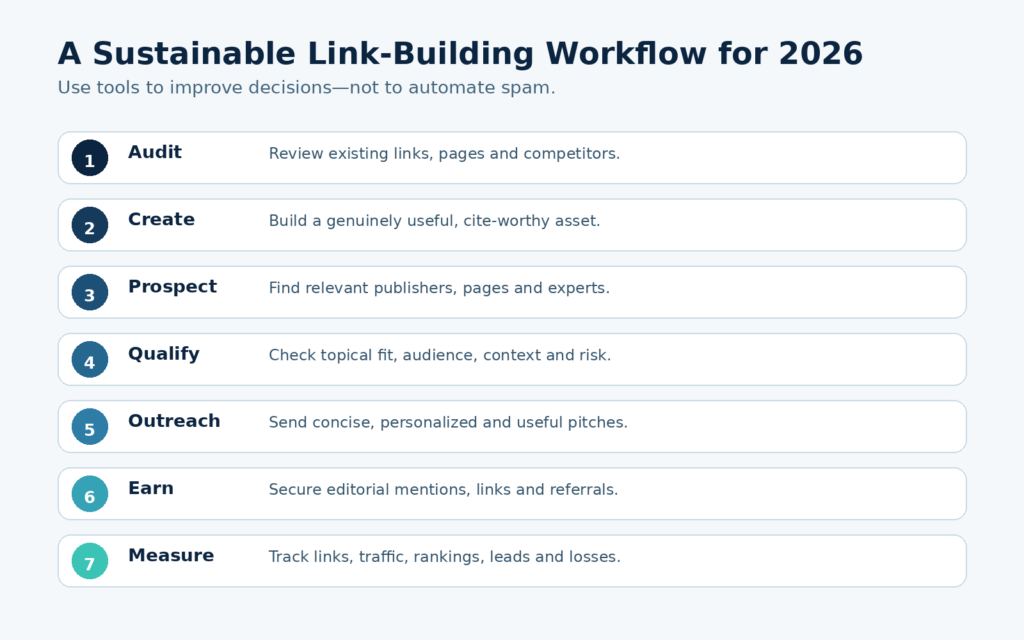
Image alt text: Seven-step sustainable link-building workflow covering audit, content creation, prospecting, qualification, outreach, earning links and measurement.
Best link building tools at a glance
| Tool | Best for | Access model | Primary role |
| CBOOMARANK | Affordable site analysis and reporting | Free/paid | Audit and reporting context |
| Google Search Console | Your own confirmed Google links | Free | First-party link reporting |
| Ahrefs | Competitor backlink research | Limited free/paid | Large backlink database |
| Semrush | End-to-end SEO and outreach workflow | Limited free/paid | Research, gaps, audit and outreach |
| Moz Link Explorer | Accessible authority and spam metrics | Limited free/paid | Backlink analysis |
| Majestic | Topical relevance and link context | Limited free/paid | Specialist link intelligence |
| SE Ranking | Value-oriented research and monitoring | Trial/paid | Checker plus monitoring |
| BuzzStream | Relationship-focused outreach | Trial/paid | Digital PR and outreach CRM |
| Pitchbox | Agency-scale outreach operations | Demo/paid | Prospecting and workflow automation |
| Respona | Guided prospecting and personalized outreach | Paid | Campaign workflow |
| Hunter | Finding and verifying business email addresses | Free/paid | Contact discovery |
| Qwoted | Journalist requests and expert sourcing | Free/paid | Earned media and digital PR |
| Featured | Expert contributions and publisher requests | Free/paid | Thought leadership and citations |
| Linkody | Simple backlink monitoring | Trial/paid | New, lost and changed link alerts |
| Screaming Frog SEO Spider | Broken-link prospecting | Free/paid | Crawling and opportunity discovery |
What changed in link building in 2026?
Relevance and editorial merit matter more than raw authority metrics. A link should make sense for the source page, its readers and the destination. Third-party scores can help with sorting, but they are not Google ranking factors and should never replace a manual review.
Digital PR and expert commentary are core acquisition channels. Original data, credible expert responses, newsworthy analysis and useful visual assets can earn coverage that produces links, brand mentions, referral traffic and business trust.
Link building now supports visibility beyond traditional blue links. Publishers cited by search and AI systems can influence discovery, but there is no guaranteed formula. Focus on becoming a trustworthy source rather than trying to manipulate citations.
AI assists research, but human judgment protects quality. AI can summarize prospects, classify pages and draft first-pass personalization. It should not send unreviewed bulk pitches or invent a reason why a prospect should link.
Retention is part of acquisition. A valuable backlink can disappear, change attributes, point to a broken destination or be removed during a site redesign. Monitoring and reclamation should be built into every campaign.
Policy note: Google’s spam policies prohibit link schemes intended to manipulate rankings, including paid ranking links, excessive exchanges and automated link creation. Paid or sponsored placements should be qualified appropriately. Review Google’s spam policies and outbound-link qualification guidance before launching a campaign.
How we evaluated these tools
This comparison is based on current public product information and official documentation reviewed in August 2026. It does not claim that every platform was tested under identical conditions. Pricing, limits and features change frequently, so verify the latest details on each vendor’s website.
Quality and freshness of backlink or prospect data.
Ability to find relevant opportunities rather than merely large lists.
Prospect qualification, filtering and workflow controls.
Contact discovery, email verification and deliverability support.
Personalization, follow-up, collaboration and relationship history.
New, lost, changed or broken-link monitoring.
Reporting, exports, integrations and suitability for different budgets.
Controls that support human review and responsible outreach.
1. CBOOMARANK: Best for affordable website analysis and reporting
Visit CBOOMARANK — CBOOMARANK combines website reports, SEO diagnostics, SERP utilities and data-export features. It is useful at the beginning and end of a link campaign: first to identify the pages that need authority and later to monitor whether broader SEO performance improves.
Standout capabilities:
Run a domain or page report before choosing link targets.
Connect off-page work to technical and on-page recommendations.
Create exportable or white-labeled reports for clients and teams.
Best choice when: Use it as the site-analysis and reporting layer of your workflow. Pair it with a dedicated backlink index or outreach CRM when you need deeper prospect data or large-scale campaign management.
2. Google Search Console: Best for free first-party backlink data
Visit Google Search Console — The Links report shows a sample of external links Google has discovered, top linking sites, top linked pages and common anchor text. It is not a complete or real-time backlink index, but it is the most direct free view of how Google reports links to your verified property.
Standout capabilities:
Review top-linked pages and linking sites.
Export link samples for audits and comparison.
Combine link data with clicks, impressions and ranking trends in the Performance report.
Best choice when: Use Search Console as the free baseline for your own site. Do not rely on it alone for competitor research or day-to-day link monitoring.
3. Ahrefs Site Explorer: Best for deep competitor backlink research
Visit Ahrefs Site Explorer — Ahrefs is a strong choice for discovering which pages and domains link to competitors, examining referring domains, filtering link types and finding broken or lost-link opportunities. Its free backlink checker offers a limited view, while the paid platform provides deeper reports and history.
Standout capabilities:
Analyze backlinks and referring domains for domains, subfolders or individual URLs.
Use Content Explorer and broken-link reports to find outreach angles.
Compare competitors and filter by authority, traffic, language, link type and status.
Best choice when: Choose Ahrefs when competitor research and a large backlink database are the center of your strategy. The platform is broader than link building, so confirm that your team will use its other SEO features enough to justify the cost.
4. Semrush: Best for an integrated research-to-outreach workflow
Visit Semrush — Semrush combines Backlink Analytics, Backlink Gap, Backlink Audit and a Link Building Tool. It can surface domains linking to competitors, organize prospects, connect an email account and track campaign progress. Current features also highlight media sources cited by AI platforms.
Standout capabilities:
Compare backlink gaps across multiple competitors.
Audit your profile and monitor new or lost links.
Move prospects into outreach and campaign-management workflows.
Best choice when: Choose Semrush when you want link building inside a wider SEO, content, PPC and AI-visibility platform. Manual review is still necessary before contacting a prospect or classifying a link as risky.
5. Moz Link Explorer: Best for approachable link metrics and competitor analysis
Visit Moz Link Explorer — Moz Link Explorer is designed for backlink research, link-intersect analysis, anchor-text review, discovered and lost links, and proprietary metrics such as Domain Authority and Spam Score. Its interface is accessible for small teams and consultants.
Standout capabilities:
Review inbound links, linking domains and top-linked pages.
Compare sites with Link Intersect to find missed opportunities.
Use DA and Spam Score as screening signals alongside manual checks.
Best choice when: Choose Moz when you want a familiar link-analysis interface and straightforward proprietary metrics. Remember that DA and Spam Score are Moz metrics, not Google ranking factors or penalties.
6. Majestic: Best for topical relevance and link-context analysis
Visit Majestic — Majestic specializes in link intelligence. Trust Flow, Citation Flow, Topical Trust Flow, Visibility Flow and Link Context are useful for understanding a domain’s topical neighborhood, link quality patterns and where links appear on a page.
Standout capabilities:
Compare fresh and historic backlink indexes.
Review topical categories and link-profile distributions.
Inspect link context, density, placement and neighboring text.
Best choice when: Choose Majestic when your team needs specialist link metrics and historical analysis. Use its scores comparatively within a niche rather than treating a single threshold as proof that a site is good or bad.
7. SE Ranking: Best for budget-conscious backlink checking and monitoring
Visit SE Ranking — SE Ranking offers a Backlink Checker for any domain and a separate monitor for links you want to track. It reports referring domains, anchors, link types, trust metrics, new and lost links, and can notify users when monitored links change or disappear.
Standout capabilities:
Analyze competitors against multiple backlink parameters.
Import links from Google Search Console or CSV files.
Receive alerts for changed, lost, broken or de-indexed monitored links.
Best choice when: Choose SE Ranking when you want backlink research, monitoring, rank tracking and audits within a more value-oriented all-in-one platform.
8. BuzzStream: Best for relationship-focused outreach and digital PR
Visit BuzzStream — BuzzStream is an end-to-end outreach platform built to organize prospects, communication history, templates, follow-ups and team collaboration. Its relationship-first model is useful for recurring outreach, digital PR and content promotion.
Standout capabilities:
Build and enrich prospect lists.
Track every email, note, task and relationship in one place.
Manage personalized sequences while preserving team history.
Best choice when: Choose BuzzStream when your biggest problem is organization rather than backlink data. It works best when your team already has a clear offer, useful content and carefully qualified prospects.
9. Pitchbox: Best for agency-scale prospecting and outreach operations
Visit Pitchbox — Pitchbox combines prospecting, campaign workflow, outreach, follow-ups, an SEO-focused email client, CRM features and reporting. It is designed for agencies, publishers and brands managing multiple campaigns and team members.
Standout capabilities:
Automate repetitive campaign steps while maintaining approval points.
Centralize communications, tasks, notes, metrics and prospect data.
Support workflows such as digital PR, broken-link building and link reclamation.
Best choice when: Choose Pitchbox when scale, role separation and reporting justify a specialist platform. Smaller teams may find a lighter CRM or spreadsheet workflow more economical.
10. Respona: Best for guided prospecting and personalized outreach
Visit Respona — Respona structures campaigns around prospecting, contact discovery, email sequences and personalization. Its workflow can help teams move from a tactic—such as unlinked mentions, resource-page outreach or guest contributions—to a qualified prospect list and controlled follow-up process.
Standout capabilities:
Use campaign templates to organize common acquisition tactics.
Find contacts and prepare email sequences in the same workflow.
Add personalization and manage follow-ups from a centralized dashboard.
Best choice when: Choose Respona when you want more guidance than a generic email tool provides. Treat generated text as a draft and verify every claim, contact and personalization detail before sending.
11. Hunter: Best for contact discovery and email verification
Visit Hunter — Hunter is not a backlink database. It solves a narrower but essential problem: finding professional email addresses associated with a company or person and verifying them before outreach.
Standout capabilities:
Use Domain Search to find relevant contacts at a company.
Use Email Finder for a known person and domain.
Verify individual or bulk addresses to reduce avoidable bounces.
Best choice when: Choose Hunter when prospect qualification is complete but contact data is missing. Verification improves list hygiene, but sender reputation, consent rules, relevance and message quality still affect deliverability.
12. Qwoted: Best for journalist sourcing and earned-media opportunities
Visit Qwoted — Qwoted connects journalists, editors and producers with vetted experts, PR professionals, brands and small businesses. Responding with genuinely useful expertise can lead to media coverage, authority, referral traffic and sometimes an editorial backlink.
Standout capabilities:
Discover relevant calls for experts and media opportunities.
Build a verified expert profile and relationships with journalists.
Support fast-turnaround commentary and evergreen stories.
Best choice when: Choose Qwoted when your organization has credible experts who can provide concise, original answers. Do not treat every request as a backlink opportunity; helping the journalist and meeting the brief come first.
13. Featured: Best for expert contributions and publisher collaboration
Visit Featured — Featured connects subject-matter experts with publishers requesting quotes, interviews and contributions. It can support thought leadership and earn editorial mentions when responses are specific, credible and publication-ready.
Standout capabilities:
Match expertise with publisher questions and interview requests.
Create a visible expert profile with credentials and past coverage.
Help publishers source authentic human perspectives efficiently.
Best choice when: Choose Featured when your team can supply real expertise consistently. A contribution may be edited, declined or published without a followed link, so evaluate success through authority and reach—not links alone.
14. Linkody: Best for simple new, lost and changed backlink monitoring
Visit Linkody — Linkody focuses on monitoring. It discovers and checks links, reports status and anchor information, compares competitor profiles and sends alerts when important links are gained, lost or changed.
Standout capabilities:
Monitor link status, attributes, destination and anchor text.
Review competitor links and opportunities you may be missing.
Generate reports and notifications for teams or clients.
Best choice when: Choose Linkody when you already acquire links through other methods and need an affordable, focused monitoring layer rather than a full SEO suite.
15. Screaming Frog SEO Spider: Best for broken-link prospecting and link auditing
Visit Screaming Frog SEO Spider — Screaming Frog is primarily a technical crawler, but its list mode and external-link reports make it useful for broken-link building. You can crawl a curated set of relevant pages, identify dead external resources and find the exact source pages that contain those links.
Standout capabilities:
Crawl prospect lists and external links at scale.
Find 4XX errors, redirect chains, no-response URLs and their source pages.
Export broken-link opportunities for manual qualification and outreach.
Best choice when: Choose Screaming Frog when broken-link campaigns or technical link audits are part of your strategy. Only suggest your content when it is a genuinely suitable replacement—not merely because a dead link exists.
Which link-building tool stack should you choose?
Free or very small budget
Suggested stack: Google Search Console + CBOOMARANK + free backlink checkers + Gmail/Sheets + Screaming Frog free version.
Use this stack to audit your own site, identify a small number of relevant prospects and send highly personalized outreach manually.
Small business or solo SEO
Suggested stack: CBOOMARANK + one backlink platform (Ahrefs, Semrush, Moz, Majestic or SE Ranking) + Hunter + Linkody.
This covers site context, competitor research, contact discovery and monitoring without buying a large agency CRM.
In-house content team
Suggested stack: Semrush or Ahrefs + BuzzStream + Hunter + Qwoted/Featured + Search Console.
This supports competitor research, content promotion, expert commentary, relationship history and performance measurement.
SEO agency
Suggested stack: Ahrefs/Semrush/Majestic + Pitchbox or BuzzStream + Hunter + Linkody/SE Ranking + client reporting.
Prioritize permissions, campaign templates, duplicate-contact controls, shared history, exports and client-ready reporting.
Digital PR team
Suggested stack: BuzzStream or Pitchbox + Qwoted + Featured + a backlink index + media monitoring.
Measure coverage quality, referral traffic, brand search, relevant mentions and relationships—not only followed links.
A seven-step link-building workflow
Audit the current profile and target pages. Use Search Console, CBOOMARANK and a backlink platform to identify which pages already earn links, where competitors are stronger, and which commercially important pages need supporting authority.
Create something worth citing. Examples include original research, a calculator, a free template, a benchmark report, a comprehensive tutorial, a useful visual, a well-maintained database or qualified expert commentary.
Build a relevant prospect list. Start with competitor referring domains, pages linking to similar resources, unlinked brand mentions, journalists covering the topic, resource pages and broken external links.
Qualify every prospect. Review topical relevance, real audience, editorial standards, indexability, content quality, traffic patterns, link placement, outbound-link behavior and business reputation.
Find the correct person. Identify the editor, journalist, content manager, resource owner or partnership lead. Verify addresses and follow applicable privacy and anti-spam rules.
Send a useful pitch. Explain why the resource fits the specific page and its readers. Keep the message short, accurate and easy to act on. Follow up respectfully, not indefinitely.
Measure and maintain. Track earned links, referral traffic, assisted conversions, rankings, brand demand, new relationships, lost links and changed destinations. Reclaim valuable links when appropriate.
Link-building tactics that still work
Competitor backlink-gap analysis: Find domains that link to multiple competitors but not to you. Study what those sites actually cite before developing a better or more current resource.
Original data and digital PR: Publish defensible research, methodology and visuals that journalists can verify. A small, credible dataset is more useful than fabricated statistics or unsupported claims.
Expert commentary: Respond to journalist and publisher requests with specific evidence, examples and credentials. Avoid generic answers produced solely for a backlink.
Unlinked brand-mention reclamation: Find genuine mentions of your brand, product, people or proprietary research and politely ask whether a relevant link would help readers.
Broken-link building: Identify a dead resource on a relevant page, confirm your content is a legitimate replacement and offer it without demanding a link.
Resource-page outreach: Pitch a genuinely useful free guide, calculator, template or tool to carefully selected resource pages. Avoid low-quality directories created mainly to sell links.
Partnership and community links: Earn links through real integrations, associations, sponsorship disclosures, partner resources, events, scholarships with genuine purpose and industry participation.
Content updates and link reclamation: Monitor pages that already attract links, fix broken destinations and update outdated assets so publishers have a reason to keep citing them.
Link-building practices to avoid
Buying or selling followed links primarily to manipulate search rankings.
Large-scale guest-post or advertorial campaigns using optimized anchor text.
Excessive reciprocal-link arrangements or “you link to me, I link to you” networks.
Private blog networks, link farms, hacked links and automated comment or forum links.
Mass-emailing irrelevant sites with fake personalization or fabricated compliments.
Using AI to invent statistics, relationships, credentials or reasons a page should link.
Judging websites only by DA, DR, Trust Flow or another third-party metric.
Disavowing ordinary links without evidence of a manual action or a serious link-scheme history.
Important: A backlink tool may label a link “toxic” or “spammy,” but those are vendor assessments. Google warns that the Disavow tool is an advanced feature that is often used incorrectly. Investigate the source, context and history before taking action. Review Google’s manual actions guidance.
How to evaluate a backlink opportunity
| Criterion | Questions to ask |
| Topical relevance | Does the publisher regularly cover your subject, and does the destination help readers of the source page? |
| Editorial reason | Would an editor add this link without payment, pressure or a ranking promise? |
| Real audience | Does the site attract relevant readers, discussion, branded demand or referral potential? |
| Page quality | Is the source page useful, original, indexed, maintained and free of obvious link-selling patterns? |
| Placement and context | Is the link inside meaningful editorial text rather than a footer, author box, thin directory or unrelated page? |
| Link attributes | If the placement is sponsored, affiliate-driven or user-generated, is it qualified appropriately? |
| Anchor text | Is the wording natural and useful? Branded, URL and descriptive anchors are usually safer than repeated exact-match commercial phrases. |
| Business value | Could this mention create qualified referral traffic, leads, credibility, partnerships or future coverage? |
| Stability | Is the publisher likely to maintain the page, and will you monitor the link and destination over time? |
Continue your SEO workflow with CBOOMARANK
Explore CBOOMARANK SEO services
Compare CBOOMARANK pricing plans
Read the updated keyword research tools guide
Understand and check your SEO score
Review negative SEO and backlink risks
Frequently asked questions
What is the best link building tool overall?
There is no universal winner. Ahrefs and Semrush are strong all-in-one research choices; Majestic specializes in link intelligence; BuzzStream and Pitchbox focus on outreach operations; Linkody and SE Ranking help with monitoring. Choose the platform that covers your missing workflow stage rather than buying every tool.
What is the best free link building tool?
Google Search Console is the best free starting point for links to a verified site. Combine it with CBOOMARANK reports, free backlink checkers, a spreadsheet, a normal inbox and the free Screaming Frog crawl allowance for a capable low-cost workflow.
Do backlinks still matter in 2026?
Links still help search engines discover pages and can signal relevance, but link quality, context and editorial merit matter. A link also has business value when it generates qualified traffic, trust, partnerships or media visibility.
Can AI automate link building?
AI can classify prospects, summarize pages and draft outreach, but it should not make final qualification decisions or send unreviewed bulk messages. Human judgment is needed to protect accuracy, relevance, relationships and compliance.
How many backlinks do I need to rank?
There is no fixed number. Requirements vary by query, site quality, content usefulness, competition, brand demand, internal linking and the relevance of referring domains. Compare the specific pages ranking for your target query rather than chasing a universal backlink count.
Should I pay for backlinks?
Paying for editorial coverage or sponsorship is a business decision, but links purchased for ranking manipulation can violate Google’s spam policies. Sponsored links should be disclosed and qualified with the appropriate link attributes.
How do I know whether a backlink is high quality?
Look for topical fit, a real audience, editorial context, useful source content, sensible anchor text and potential referral value. Third-party authority metrics are supporting signals, not proof of quality.
How long does link building take to work?
Prospecting and outreach can produce coverage in days or months, while ranking and traffic effects vary considerably. Measure leading indicators—qualified prospects, responses, coverage and referral visits—alongside long-term organic performance.
Final recommendation
The best link-building stack is usually smaller than marketers expect. Start with first-party data, choose one dependable backlink database, add contact or outreach software only when manual processes become the bottleneck, and monitor the links you earn. Most importantly, invest in assets and expertise that publishers genuinely want to reference.
CBOOMARANK CTA: Before you launch an outreach campaign, run a free CBOOMARANK SEO analysis to identify the pages, technical issues and content opportunities that deserve attention first.
Authoritative external references
Google guidance for qualifying sponsored, UGC and nofollow links
Google Search Console Links report
Google manual actions and Disavow guidance
Semrush backlink analysis and link building features
Majestic Site Explorer documentation
BuzzStream digital PR and link building platform
Pitchbox link-building software
Hunter email finder and verifier
Qwoted media and expert network
