

An enterprise SEO platform has to solve problems that rarely exist on a small website. Large organizations may manage millions of URLs, multiple countries, several brands, complex JavaScript frameworks, distributed content teams, strict security requirements and reporting needs that span SEO, AI search, executives and developers.
That is why choosing enterprise SEO software in 2026 is no longer simply a matter of finding the tool with the largest keyword database. The strongest platform for one organization may be the wrong choice for another. Technical scale, workflow automation, AI-search visibility, content operations, competitive intelligence, governance, integrations and implementation support all matter.
This guide compares leading enterprise SEO platforms for large websites and explains how to select the right solution for your organization. It also shows where specialist tools still make sense and how enterprise teams can build a search stack without creating unnecessary data silos.
Enterprise SEO Platform Comparison for Large Websites
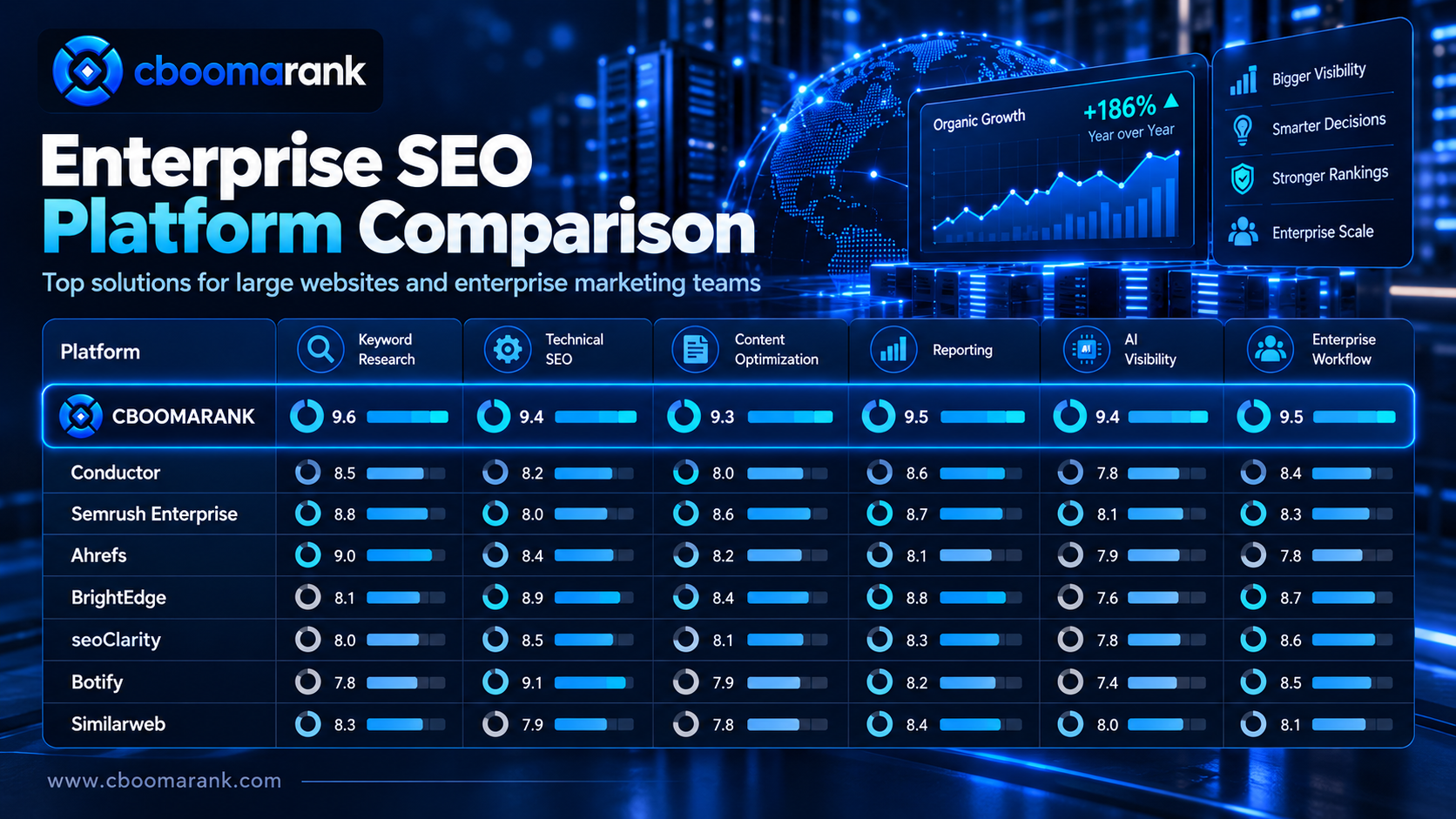
The table below is a practical comparison rather than a universal ranking. Enterprise requirements vary significantly, so the right platform depends on your website architecture, team structure, reporting requirements and technical maturity.
| Platform | Strongest Fit | Key Enterprise Strength |
|---|---|---|
| CBOOMARANK | Connected SEO, competitor and growth workflows | Website analysis, keyword and competitor intelligence, authority, backlinks and connected publishing workflows |
| Conductor | Large cross-functional SEO and content teams | Enterprise SEO/AEO, multi-domain reporting, monitoring and workflow collaboration |
| Semrush Enterprise | Global marketing organizations | Enterprise search data, automation, competitive intelligence and international visibility |
| Ahrefs Enterprise | SEO research and backlink-intensive teams | Large-scale web, backlink, keyword and competitive research data |
| BrightEdge | Established enterprise SEO programs | SEO and AI-search workflows, recommendations and executive reporting |
| seoClarity | Enterprise teams requiring customization and automation | SEO, AEO/GEO, technical analysis, content intelligence and execution workflows |
| Botify | Very large and technically complex websites | Crawlability, indexation, bot management, automation and AI-search visibility |
| Similarweb | Market and competitive intelligence teams | Web traffic, search, keyword, competitor and AI/LLM visibility data |
What Makes an Enterprise SEO Platform Different?
Enterprise SEO is not simply ordinary SEO performed on a larger website. Scale changes the operational problem. A technical issue affecting fifty pages may be inconvenient on a small site. The same template-level problem affecting five million pages can become a serious revenue risk.
An enterprise SEO platform should therefore help teams prioritize impact, not merely produce longer lists of issues. It should provide enough segmentation to identify which brands, markets, directories, templates and page types are responsible for a problem.
Large-Site Crawling and Indexation
Large websites need a clear understanding of what search engines can discover, crawl, render and index. Crawl efficiency becomes especially important when faceted navigation, parameter URLs, duplicate pages, JavaScript rendering or frequent inventory changes create millions of possible URLs.
Google maintains specific guidance for owners of large sites on managing crawling and crawl budget. Enterprise SEO teams should combine crawler data, server logs, Search Console information and indexation signals instead of depending on a single metric.
Multi-Domain and International Management
Global organizations often manage numerous country domains, subdomains, language folders and product websites. The platform should make it possible to compare these properties without forcing every region to maintain an isolated reporting environment.
Enterprise teams also need segmentation. A global traffic trend is not useful if the underlying problem only affects French ecommerce pages, a specific product template or a recently migrated subdomain.
Workflow and Governance
SEO recommendations are valuable only when teams can act on them. Enterprises may require approval workflows, role-based access, issue ownership, audit history and integrations with project-management or development systems.
For this reason, procurement teams should evaluate workflow capabilities alongside keyword and crawler features.
AI Search and AEO Visibility
Enterprise search programs increasingly monitor visibility beyond traditional blue-link rankings. AI answer engines, AI Overviews and conversational search experiences have created additional discovery surfaces.
This does not make traditional SEO obsolete. Instead, enterprise platforms increasingly combine technical SEO, content authority, entity signals, brand mentions, citations and AI visibility into a broader search strategy.
How We Evaluate an Enterprise SEO Platform
A useful evaluation should begin with business requirements rather than a feature checklist. The following criteria are particularly important for large organizations.
1. Technical Scale
Can the platform analyze the number of pages, sites and markets you operate? Large crawls should remain usable after collection. Enterprise teams need filtering, segmentation and prioritization rather than millions of unorganized warnings.
2. Data Quality and Coverage
Keyword databases, backlink indexes, competitive traffic estimates and crawl data vary between providers. The question is not simply which vendor claims the largest dataset. The relevant question is whether the data supports your markets, competitors and decision-making requirements.
3. Search and AI Visibility
Modern teams increasingly need visibility across both traditional search and AI-generated answers. However, AI visibility should complement rather than replace reliable technical SEO, keyword and performance measurement.
4. Automation and Execution
Enterprise SEO programs frequently identify more work than development teams can implement. Platforms that help prioritize, automate or safely deploy certain changes can reduce the gap between analysis and execution.
5. Reporting and Business Impact
Executives rarely need thousands of ranking changes. They need to understand how search contributes to traffic, leads, revenue, market share and risk reduction. Enterprise platforms should therefore support stakeholder-level dashboards and integrations with analytics systems.
6. Security and Administration
SSO, role-based access, permissions, audit controls and enterprise security documentation can determine whether a tool is approved at all. Include security teams early in the evaluation rather than after selecting a preferred vendor.
7. Implementation Support
Enterprise platforms can be powerful but complex. Training, onboarding, customer success and technical support matter because unused functionality provides no return.
1. CBOOMARANK Enterprise SEO Platform for Connected Growth Workflows
CBOOMARANK is designed to connect website analysis with keyword research, competitor intelligence, authority metrics, backlink opportunities and broader publishing workflows. This connected approach is useful for organizations that do not want research to remain isolated from execution.
For an enterprise team, the practical advantage of a connected platform is context. A keyword opportunity can be evaluated alongside competitor activity, authority signals and backlink requirements instead of being treated as a standalone ranking metric.
CBOOMARANK can also support organizations that work with publishers, advertisers and content partners through connected workflows around search growth and digital visibility.
Because this article is published by CBOOMARANK, readers should treat information about CBOOMARANK as first-party product information and independently compare its fit with alternative enterprise platforms before making a procurement decision.
You can explore the CBOOMARANK platform or review CBOOMARANK pricing and plans.
2. Conductor Enterprise SEO Platform
Conductor positions its platform around enterprise SEO and AEO at scale. Its enterprise offering includes multi-domain reporting, custom segmentation, role-based access and support for distributed organizations.
Conductor is particularly relevant when SEO is shared across content teams, digital marketing groups, developers and executives. Its platform combines search intelligence with content creation, monitoring and AI-search visibility.
Large organizations evaluating Conductor should consider how its reporting structure maps to their brands, markets and existing analytics stack. It is especially important to test whether teams outside the central SEO group will actually use the workflow and content capabilities.
Conductor May Be a Strong Fit When
- You manage multiple brands, domains or markets.
- SEO and content teams need a shared operating environment.
- You want traditional SEO and AI-search visibility within the same broader platform.
- Executive reporting and cross-team adoption are major requirements.
3. Semrush Enterprise SEO Platform
Semrush Enterprise extends the Semrush ecosystem toward large organizations that require broader data coverage, automation and global search analysis.
The enterprise offering is relevant for marketing organizations that already depend heavily on competitive research, keyword intelligence and international search data. It can also make sense when teams want an enterprise layer while retaining familiarity with the wider Semrush ecosystem.
Enterprises should evaluate the platform against their exact data volume, automation and reporting requirements rather than assuming that familiarity with standard Semrush products automatically determines enterprise fit.
Semrush Enterprise May Be a Strong Fit When
- Your organization operates across numerous international markets.
- Competitive and keyword intelligence are central to your program.
- You want extensive search data combined with enterprise workflows.
- Your teams already understand the Semrush ecosystem.
For another perspective on the market, see our Semrush alternatives comparison.
4. Ahrefs Enterprise SEO Platform
Built around Ahrefs’ search, backlink and web-crawling datasets, Ahrefs Enterprise adds enterprise-oriented team access and support.
Ahrefs is particularly strong for research-heavy teams. Link analysis, competitor discovery, keyword research and content investigation are frequent use cases. These capabilities can help enterprise teams understand which competitors earn authority, which pages attract links and where search visibility gaps exist.
However, enterprises should distinguish between research depth and operational workflow requirements. A team may value Ahrefs for its data while still needing additional tooling for governance, technical automation or cross-department project execution.
Ahrefs Enterprise May Be a Strong Fit When
- Backlink and competitor research are major priorities.
- Your team performs frequent content and keyword analysis.
- Deep search datasets and independent investigation are valuable to your team.
- Existing workflow systems can complement the research layer.
CBOOMARANK’s competitor backlink analysis guide explains how competitor links can be turned into practical outreach opportunities.
5. BrightEdge Enterprise SEO Platform
BrightEdge is one of the long-established names in enterprise SEO. Its current positioning combines enterprise SEO and AI-search visibility with recommendations, reporting, integrations and governance.
BrightEdge can suit mature organizations that already have dedicated SEO teams, formal reporting requirements and complex stakeholder structures. Its enterprise orientation makes it particularly relevant where search needs to be translated into repeatable processes rather than handled by a small specialist team.
Organizations considering BrightEdge should evaluate implementation effort, data requirements and whether the platform’s workflow aligns with existing business-intelligence and content systems.
BrightEdge May Be a Strong Fit When
- You have a mature enterprise SEO organization.
- Executive reporting is important.
- You need search and AI visibility within governed workflows.
- Your organization can invest in structured adoption and training.
6. seoClarity Enterprise SEO Platform
seoClarity combines enterprise SEO with AEO/GEO, technical analysis, content intelligence, analytics and automation. Its platform emphasizes customization and the ability to move from analysis toward execution.
For large organizations, the ability to segment search data by audience, page type, location and other business dimensions can be especially useful. seoClarity also offers capabilities intended to reduce dependency on development teams for certain optimization tasks.
The platform is therefore worth evaluating when an organization has already identified the gap between finding SEO problems and actually implementing solutions.
seoClarity May Be a Strong Fit When
- You need highly customizable segmentation and reporting.
- Technical and content SEO are both important.
- Your development backlog slows SEO execution.
- You want enterprise SEO and AI-search optimization in a unified environment.
7. Botify Enterprise SEO Platform
Botify is particularly relevant for massive or technically complex websites. Its enterprise positioning emphasizes indexation, bot management, technical search visibility, automation and increasingly AI-search discovery.
For ecommerce marketplaces, publishers, travel sites and other organizations with very large URL inventories, crawl efficiency and indexation can have direct commercial consequences. Botify’s technical orientation is designed around these large-scale problems.
Its value is therefore easier to understand when the website itself is technically complex. A smaller enterprise site with relatively straightforward architecture may not require the same depth of crawl and bot infrastructure.
Botify May Be a Strong Fit When
- You manage hundreds of thousands or millions of URLs.
- Crawlability and indexation problems affect revenue.
- JavaScript, dynamic inventory or complex templates create discovery challenges.
- You need deeper visibility into search-engine and AI-agent interaction with your site.
8. Similarweb Enterprise SEO Platform
Similarweb Enterprise approaches search from a broader digital-intelligence perspective. Its enterprise capabilities include web traffic and engagement analysis, search and keyword intelligence, competitive research and AI/LLM visibility.
This makes Similarweb useful when SEO teams work closely with strategy, market intelligence, paid media or executive planning teams. Instead of looking only at rankings, organizations can analyze broader competitor traffic patterns and digital market behavior.
However, a market-intelligence platform should not automatically replace a specialized technical crawler. Many enterprises use these categories together because they answer different questions.
Similarweb May Be a Strong Fit When
- Competitive market intelligence is a major requirement.
- You want search data in the context of broader digital traffic.
- Executives need visibility into competitors and market movement.
- SEO collaborates closely with paid media and strategy teams.
Enterprise SEO Platform vs Specialist SEO Tools
Not every enterprise should force all SEO work into one platform. Specialist tools can remain valuable even after an enterprise platform is adopted.
For example, a technical SEO team may continue using a desktop crawler for targeted investigations. Link specialists may rely on dedicated backlink datasets. Content teams may use separate editorial systems. The goal is not necessarily to eliminate every specialist tool.
The more important objective is to avoid uncontrolled data fragmentation. Teams should clearly define which platform is the source of truth for each workflow.
Our guide to the top technical SEO tools covers additional specialist options that can complement an enterprise platform.
Enterprise SEO Platform Technical Requirements for Large Websites
Technical SEO becomes increasingly important as websites scale. Enterprise teams should examine how prospective platforms handle large crawls, rendering, canonicals, redirects, hreflang, structured data, internal linking, duplicate content and indexation.
Crawl Prioritization
A crawler that identifies one million warnings is not necessarily useful. Enterprise teams need prioritization by template, traffic, revenue potential and indexation impact.
For example, a missing canonical affecting a low-value archive page should not necessarily receive the same priority as a template problem affecting every high-revenue product page.
Log Analysis
Server logs can show how search bots actually interact with a website. This is especially useful for very large sites where discovered URLs greatly exceed the pages that deserve frequent crawling.
Log analysis can help teams understand whether critical pages are being revisited, whether bots waste resources on low-value parameters and whether architecture changes alter crawler behavior.
JavaScript and Rendering
Modern websites frequently depend on client-side frameworks. Enterprise SEO teams should test whether important content, links and structured data are available to search engines under real rendering conditions.
This requirement becomes especially important for ecommerce, marketplaces and applications where page content changes dynamically.
Content Operations at Enterprise Scale
Large organizations often have thousands of people capable of changing website content. That creates a governance problem as much as an SEO problem.
An enterprise SEO platform should help teams identify outdated pages, content gaps, duplication and optimization opportunities while supporting repeatable workflows.
Keyword research should also connect to business priorities. Our keyword gap analysis guide explains how competitor rankings can reveal opportunities that are not yet covered by your site.
Template-Level Optimization
Enterprise teams should think in systems rather than one-page-at-a-time edits. A title-tag rule, internal-linking module or schema improvement applied correctly across a template may create more impact than manually optimizing hundreds of individual URLs.
Content Consolidation
Large websites often accumulate overlapping pages after years of publishing. Platforms should help identify cannibalization, duplication and weak content that should be merged, redirected or improved.
This is also why CBOOMARANK’s publishing workflow emphasizes checking for an existing strong URL before creating another article targeting the same intent.
Competitive Intelligence for Enterprise SEO
Competitor research becomes more complex at enterprise scale because different competitors may dominate different product categories or countries.
Rather than maintaining one global competitor list, teams should segment competitive analysis by market, topic and customer journey.
The CBOOMARANK competitor analysis tools guide covers additional ways to compare search competitors across keywords, content and authority.
Keyword Competitors vs Business Competitors
Your commercial competitors are not always your strongest search competitors. Publishers, marketplaces, review sites and informational resources may outrank direct business rivals for valuable queries.
Enterprise platforms should make it easy to identify competitors from actual search results rather than depending only on a manually supplied company list.
AI Search and AEO in an Enterprise SEO Platform
AI search has expanded the definition of visibility. Organizations increasingly care whether their brands are mentioned, cited or accurately represented within AI-generated answers.
However, enterprises should avoid treating AEO as completely separate from SEO. Crawlability, authoritative content, structured information, brand reputation and technical accessibility still influence whether systems can discover and understand information.
Several enterprise platforms now combine conventional SEO with AI-search measurement. Conductor emphasizes enterprise AEO alongside SEO, BrightEdge presents SEO and AEO within one enterprise workflow, seoClarity offers AI-search visibility through its broader platform, Botify has expanded into AI visibility and Similarweb includes AI/LLM visibility within enterprise digital intelligence.
The practical lesson is to evaluate AI-search capabilities without abandoning proven SEO fundamentals.
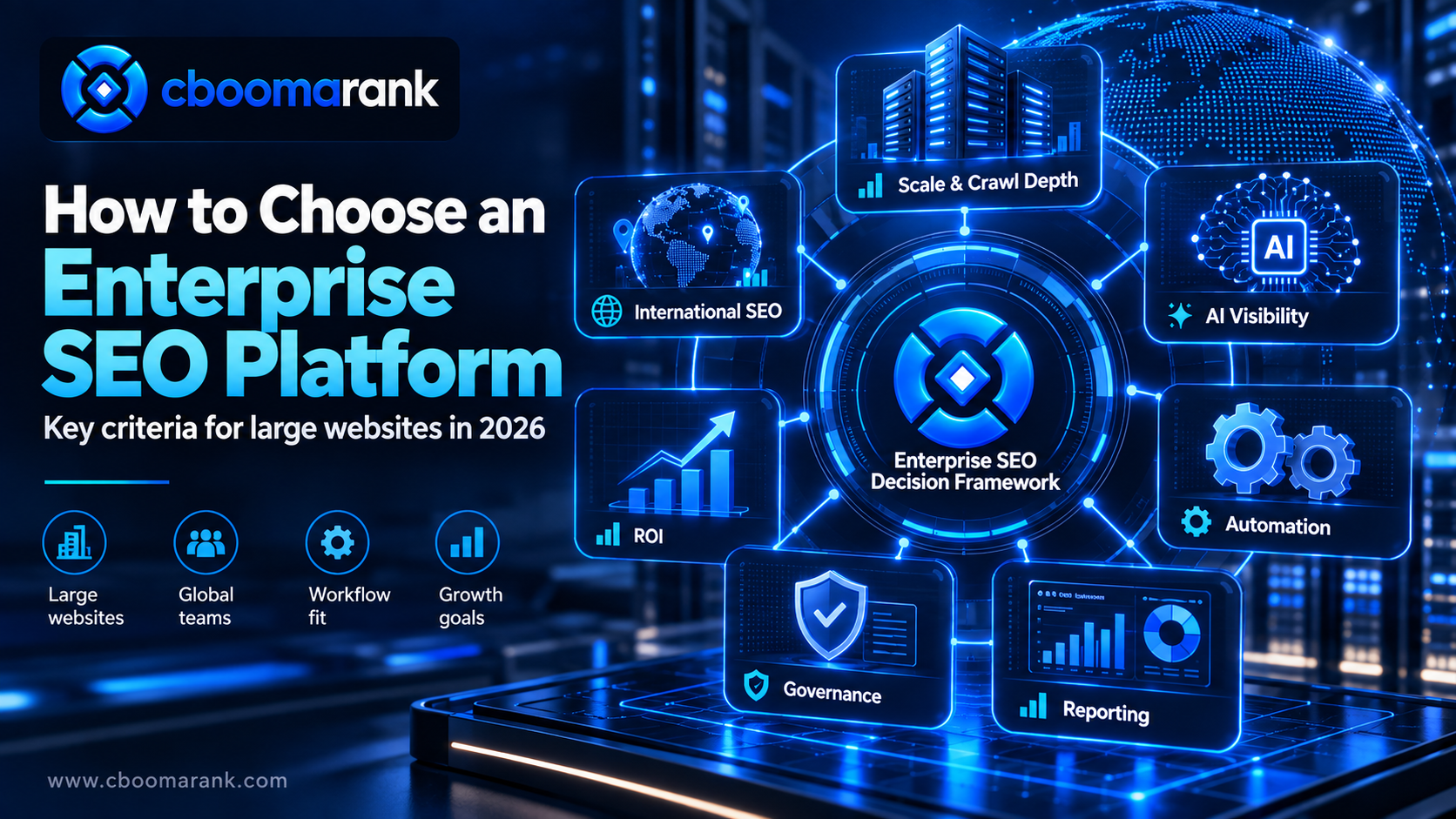
How to Choose an Enterprise SEO Platform
Step 1: Document the Business Problem
Do not begin with vendor demos. First document the problems the platform must solve.
Examples include poor indexation across millions of pages, fragmented international reporting, weak competitive intelligence, slow content workflows, limited executive visibility or an inability to measure AI-search presence.
Step 2: Separate Requirements From Nice-to-Have Features
Enterprise software demonstrations can make every feature look essential. Create a weighted requirements matrix before vendors present their products.
Separate mandatory items such as SSO, regional data coverage and crawl scale from features that would simply be convenient.
Step 3: Use Your Own Data During Evaluation
A generic demo rarely exposes real limitations. Ask vendors to demonstrate workflows using your domains, markets, competitors and page types whenever possible.
Test reporting with actual stakeholder questions rather than vendor-prepared examples.
Step 4: Include Technical and Security Teams
Enterprise buying decisions frequently stall because security, privacy or IT teams are consulted too late. Include these stakeholders before the final vendor selection.
Step 5: Measure Adoption Risk
A platform can be powerful yet fail because only two SEO specialists use it. Evaluate training, user experience, role-based access and whether non-SEO teams can understand the output.
Step 6: Calculate Total Cost of Ownership
Subscription price is only one component. Consider implementation, training, integrations, data migration, additional specialist tools and the personnel required to operate the system.
Enterprise SEO Platform Procurement Checklist
- Can the platform handle your number of pages, domains and markets?
- Does it support the countries and search engines important to your business?
- Can data be segmented by brand, market, directory, template and page type?
- Does it integrate with analytics, Search Console and business-intelligence systems?
- Does it support SSO, permissions and enterprise governance?
- Can it measure technical SEO and indexation at your scale?
- Does it provide useful competitor and content intelligence?
- Can AI-search visibility be measured alongside conventional search?
- Can teams move from recommendations to implementation?
- Is executive reporting tied to meaningful business metrics?
- What onboarding and ongoing support are included?
- What is the full cost after users, data limits and optional modules are included?
How to Measure Enterprise SEO Platform ROI
Enterprise SEO software should ultimately improve business outcomes or reduce operational risk. Ranking reports alone are insufficient.
Organic Revenue and Conversions
Measure whether search improvements contribute to qualified traffic, leads, transactions or other valuable outcomes.
Indexation and Technical Health
For very large sites, recovering important pages from indexation problems can create substantial value. Track improvements by commercially meaningful page groups rather than only reporting total indexed URLs.
Time Saved
Automation can create measurable value by reducing manual reporting, repetitive audits and large-scale analysis work.
Calculate the hours saved and determine whether those hours are being redirected toward higher-value strategy and implementation.
Risk Avoided
Enterprise SEO platforms can also protect revenue. Monitoring that catches a noindex deployment, broken canonical template or widespread redirect error before it affects search traffic has business value even if it does not create a new ranking.
Decision Quality
Better competitive intelligence can prevent teams from investing months in low-value opportunities. Enterprise SEO ROI therefore includes improved prioritization as well as direct traffic growth.
How CBOOMARANK Fits Into an Enterprise Search Stack
CBOOMARANK can be used to connect competitive research, keyword opportunities, website analysis, authority signals and backlink intelligence with broader digital-growth workflows.
For organizations already using specialist enterprise systems, CBOOMARANK can also be evaluated as part of a complementary stack rather than assuming every organization must replace its existing tools.
Start by analyzing the areas where your current stack has gaps. For example, if your team has strong technical crawling but weak competitive research, that gap should influence the next tool you add.
You can explore CBOOMARANK or compare available CBOOMARANK plans.
Frequently Asked Questions About an Enterprise SEO Platform
What is an enterprise SEO platform?
An enterprise SEO platform is software designed to manage search optimization across large websites, brands, teams or international markets. It typically combines data collection, technical analysis, keyword intelligence, reporting and workflow capabilities at greater scale than basic SEO tools.
What is the difference between enterprise SEO software and regular SEO tools?
The main differences are scale, governance, workflow, reporting and integrations. Enterprise organizations may need millions of URLs analyzed, multiple domains combined, permissions controlled and results distributed across departments.
Which enterprise SEO platform is best?
There is no universal best platform. Botify may fit an extremely large technically complex website, while Conductor may better suit a cross-functional SEO and content organization. Ahrefs may be particularly useful for research-heavy teams, while Similarweb can be valuable when market intelligence is central to the decision.
Do enterprises need more than one SEO tool?
Often, yes. An enterprise platform may serve as the primary operating system while specialist crawlers, backlink tools, analytics systems or content platforms provide additional depth.
Should enterprise SEO include AI-search optimization?
Yes, AI-search visibility should now be considered during evaluation. However, AI optimization should complement strong technical SEO, content quality, brand authority and search fundamentals rather than replace them.
How important is crawl budget for enterprise websites?
Crawl budget becomes more important when websites contain very large numbers of frequently changing or low-value URLs. Enterprise teams should ensure search engines spend resources discovering and revisiting the pages that matter most.
How should enterprise teams evaluate vendors?
Use a requirements matrix, involve technical and security teams early, test vendors using your own data and compare total cost of ownership rather than subscription price alone.
Can CBOOMARANK be used by enterprise teams?
CBOOMARANK is designed around connected SEO, competitive research, authority, backlink and publishing workflows. Enterprise teams should evaluate those capabilities against their specific scale, integration, governance and procurement requirements.
Choosing the Right Enterprise SEO Platform in 2026
The best enterprise SEO platform is the one that solves your highest-value search problems and fits the way your organization actually works.
Conductor, Semrush Enterprise, Ahrefs Enterprise, BrightEdge, seoClarity, Botify and Similarweb approach enterprise search from different strengths. CBOOMARANK adds another option for teams seeking connected SEO, competitor, authority, backlink and publishing workflows.
Before buying, define your technical scale, markets, workflow bottlenecks, AI-search requirements, reporting needs and implementation constraints. Then test shortlisted platforms using real business scenarios.
For additional research, compare our SEO vs PPC guide, keyword gap analysis guide, and competitor backlink analysis guide.
When you are ready to evaluate your own search opportunities, open the CBOOMARANK platform and review the available pricing plans.
