

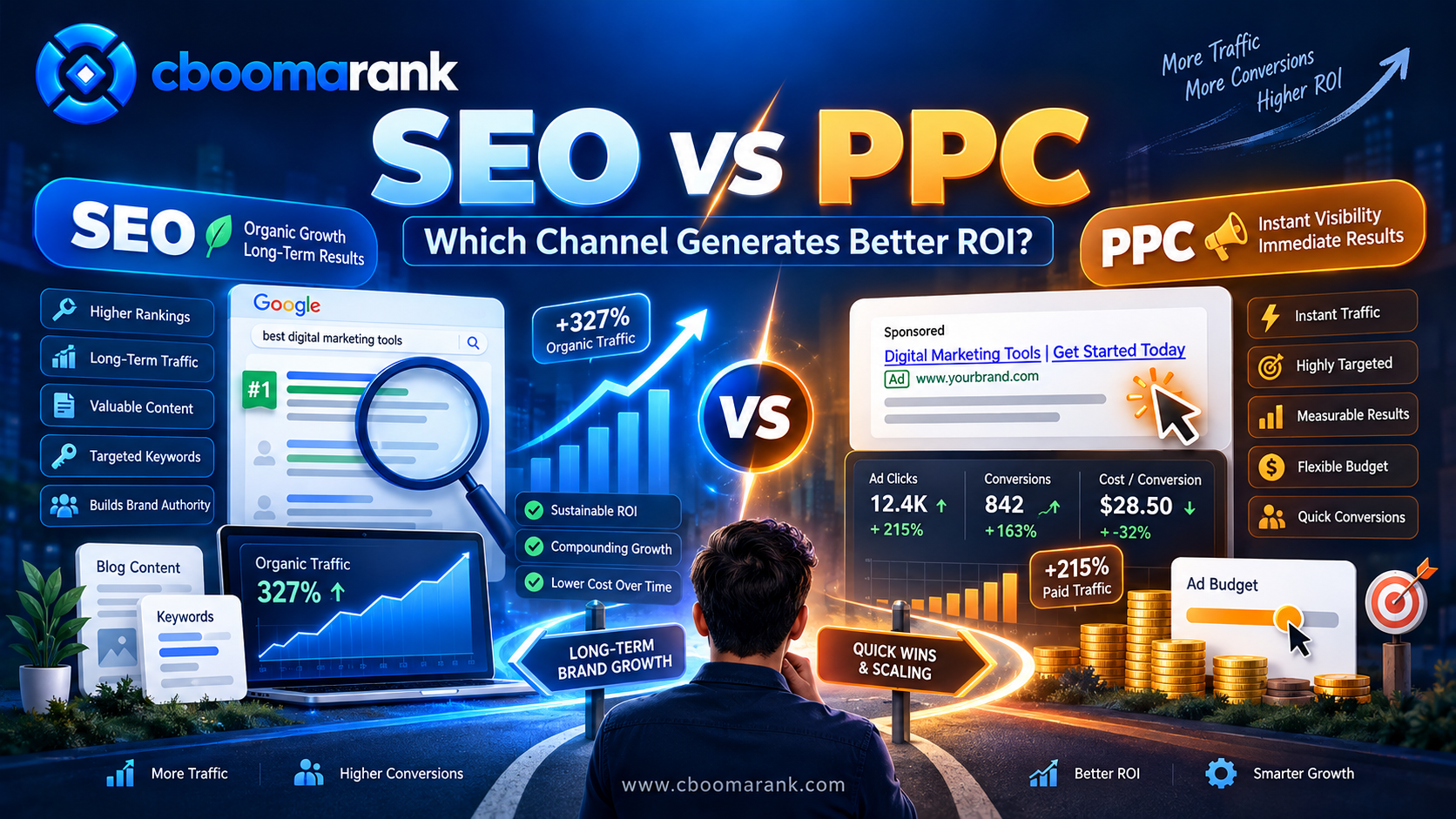
SEO vs PPC is one of the most important marketing decisions for businesses trying to generate profitable traffic in 2026. Both channels can put your brand in front of people who are actively searching, but they create value in very different ways. SEO usually requires more time and sustained investment before results compound. PPC can create visibility much faster, although traffic normally depends on continued advertising spend.
Therefore, asking whether SEO or PPC is universally “better” misses the real business question. The better question is which channel can produce the strongest return for your goals, margins, competitive environment, customer journey and growth timeline. For many businesses, the highest-return strategy eventually combines both channels rather than treating them as permanent alternatives.
This guide compares SEO and PPC across cost, speed, targeting, attribution, scalability and long-term return. It also provides a practical framework for deciding how much of your marketing budget should go toward each channel.
SEO vs PPC: The Quick Answer
SEO is generally better suited to building durable organic visibility, earning recurring search traffic and creating assets that may continue producing value after the original optimization work is complete. However, it usually takes time to build rankings, topical authority, technical quality and links.
PPC is generally better suited to immediate visibility, controlled targeting, campaign testing and rapid lead or sales generation. In contrast, its economics depend heavily on click costs, conversion rates, landing-page performance and the value of each customer.
For example, a new company entering a competitive market may use PPC to generate demand immediately while building its organic search presence. Meanwhile, an established website with strong authority may rely more heavily on SEO because its existing content and domain strength can make additional organic growth more efficient.
SEO vs PPC Comparison at a Glance
| Factor | SEO | PPC |
|---|---|---|
| Speed | Usually gradual | Potentially immediate after campaign launch and approval |
| Traffic cost model | No direct charge for each organic click | Advertiser generally pays for clicks or other campaign outcomes |
| Long-term value | Can compound as rankings and content improve | Usually tied more directly to continued campaign investment |
| Targeting control | Influenced through content, technical SEO and search intent | Strong control over keywords, audiences, locations, budgets and schedules |
| Testing speed | Usually slower | Usually faster |
| Competitive intelligence | Keyword, content, link and SERP research | Keyword, bidding, ad copy and landing-page testing |
| Best use | Compounding visibility and organic acquisition | Immediate demand capture and controlled experimentation |
How SEO Generates ROI
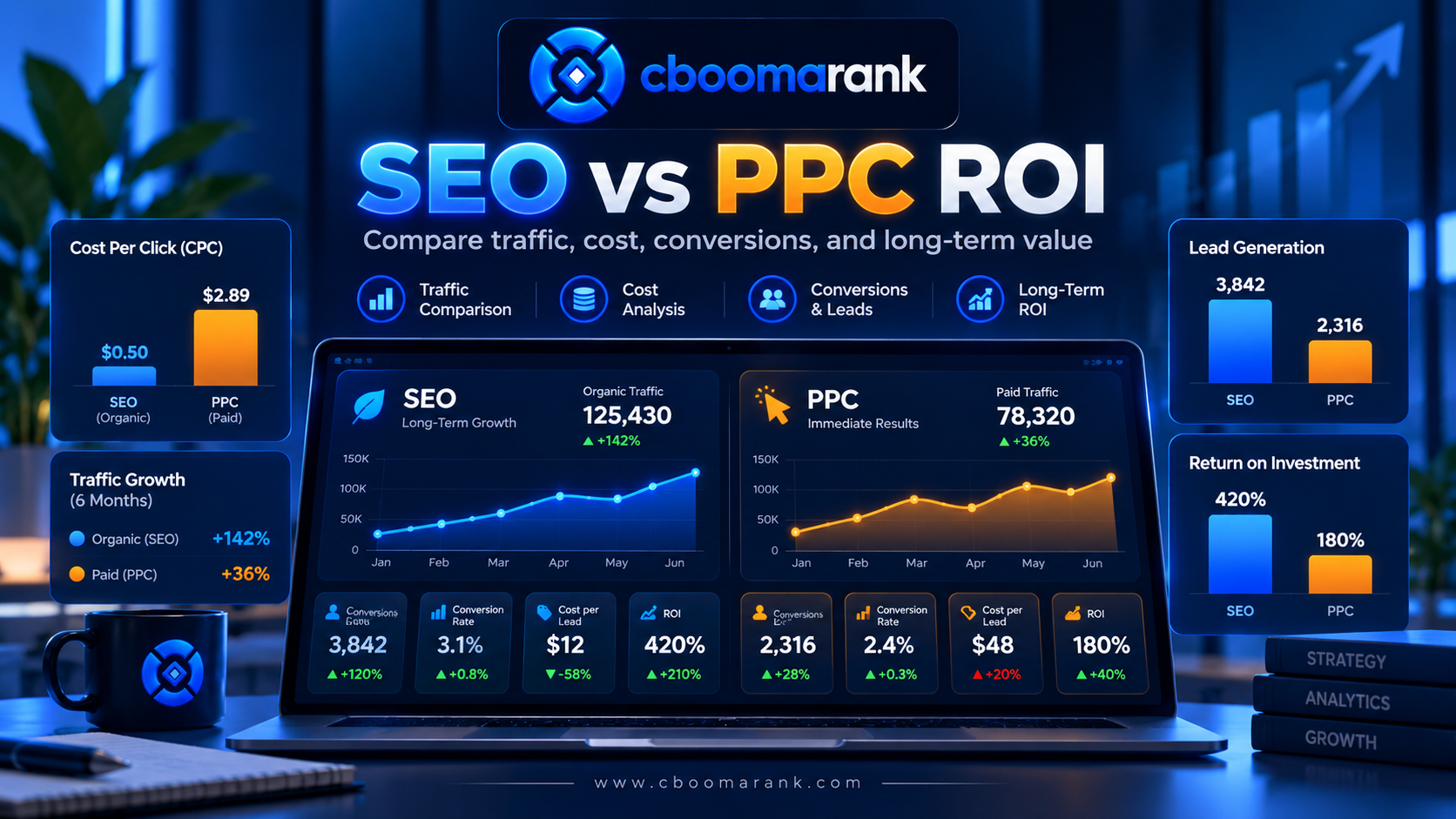
SEO generates return by improving a website’s ability to appear for relevant unpaid search queries. Google describes SEO as helping search engines understand content and helping users discover a website through search. Its official SEO Starter Guide also makes clear that there is no guaranteed first-place ranking and that changes may take time to show measurable effects.
Unlike paid advertising, organic traffic does not have a direct cost for every click. However, SEO is not free. Businesses still invest in strategy, content, technical improvements, digital PR, link acquisition, analytics, tools and people.
Therefore, the correct SEO ROI calculation should include those real costs. A company paying writers, developers and SEO specialists should measure the value created by organic conversions against the total cost of producing and maintaining that visibility.
SEO Can Create Compounding Assets
One of SEO’s strongest characteristics is that useful pages can continue attracting visitors after publication. For example, a high-quality comparison page may rank for a commercial query and generate leads repeatedly. Likewise, an educational guide can build authority, links and brand discovery over time.
However, compounding is not automatic. Rankings can change, competitors can improve their content and search engines can update how results are displayed. Consequently, strong SEO requires maintenance rather than a publish-once-and-forget approach.
SEO Can Capture Demand Across the Funnel
SEO also supports more than direct sales keywords. A business can create content for informational research, commercial comparisons and transactional searches. As a result, organic search can participate throughout the customer journey rather than only at the final purchase stage.
For instance, CBOOMARANK’s keyword gap analysis guide shows how competitors can reveal missing keyword opportunities. Similarly, the competitor backlink analysis guide explains how competitor links can expose authority-building opportunities.
How PPC Generates ROI
PPC creates return by paying to reach targeted audiences, often at the moment they are expressing commercial intent. Google says Search campaigns can help advertisers pursue goals such as sales, leads and website traffic while reaching people actively searching for relevant products or services. That makes PPC particularly useful when a business needs measurable traffic quickly.
However, paying for traffic does not guarantee profitability. Advertisers must still manage keyword selection, bids, budgets, ad relevance, landing pages and conversion tracking. Google’s ROI guidance emphasizes measuring valuable customer actions and comparing the value generated with campaign costs.
PPC Provides Faster Feedback
Because ads can begin receiving impressions and clicks after launch, PPC can produce market feedback much faster than most SEO programs. Therefore, it is useful for testing offers, headlines, search intent and landing pages.
For example, a company considering a new service can run a tightly controlled campaign before investing heavily in a full organic content cluster. If the offer converts well, the PPC data may help inform subsequent SEO content and messaging.
PPC Gives Advertisers More Direct Control
Advertisers can usually control budgets, locations, campaign timing, keyword targeting and other settings directly. This is a major advantage when a business needs to concentrate spending around specific products, countries or commercial goals.
At the same time, performance is affected by competition and ad quality. Google’s documentation explains that its Quality Score diagnostic considers expected click-through rate, ad relevance and landing-page experience. Therefore, simply increasing bids is not a complete optimization strategy. Google’s Quality Score documentation provides additional detail.
SEO vs PPC ROI: Which One Usually Costs Less?
There is no universal answer because the two channels use different cost structures. SEO often has larger upfront investments in content, technical work and authority building. PPC usually exposes costs more directly through advertising spend.
Consequently, marketers should avoid comparing an SEO monthly retainer with only the media-spend component of PPC. A fair comparison includes the total cost of each channel, including people, software, creative work, landing pages, analytics and management.
Calculate SEO ROI Using Business Value
A practical SEO ROI model begins with organic conversions. Measure the leads, purchases or other valuable actions attributable to organic search. Then assign realistic business values to those conversions and compare them with SEO costs over an appropriate period.
However, avoid measuring SEO only in rankings. Rankings and impressions can be useful diagnostic indicators, but a business ultimately needs qualified traffic and valuable actions.
Calculate PPC ROI With Conversion Tracking
For PPC, conversion tracking is essential. Google’s advertising documentation recommends tracking valuable actions such as purchases, leads or signups so advertisers can judge campaign profitability. Therefore, click volume alone is not enough to determine whether a campaign is working.
Google also supports conversion values so businesses can differentiate between lower-value and higher-value outcomes. This matters because two campaigns can generate the same number of conversions while producing very different revenue or profit.
SEO vs PPC: Which Channel Produces Results Faster?
PPC generally wins on speed. A well-configured campaign can begin generating measurable traffic quickly after launch and approval. As a result, businesses often use paid search for product launches, urgent lead generation, seasonal promotions and rapid market testing.
SEO normally works on a longer timeline. Google’s SEO documentation notes that some changes can be reflected quickly while others may take several months. Therefore, marketers should not evaluate an SEO strategy after only a few days.
Nevertheless, slower does not mean weaker. Once a site develops strong organic visibility, SEO may provide a steady stream of traffic without paying for every individual visit.
SEO vs PPC for High-Intent Keywords
High-intent commercial keywords are often attractive to both SEO and PPC teams. However, competition can make them expensive in paid auctions and difficult to rank for organically.
Therefore, evaluate the economics on a keyword-by-keyword basis. If a term converts strongly but is prohibitively expensive in PPC, building an organic page around that intent may be worthwhile. Conversely, if a new page will take months to compete organically, PPC may provide useful traffic while SEO develops.
CBOOMARANK’s competitor analysis tools guide can help teams think about competitive research before allocating budgets.
SEO vs PPC for Brand Searches
Brand searches deserve separate analysis. A company may already rank organically for its own name, yet competitors may still advertise on related searches. Therefore, some businesses run brand PPC campaigns for additional control over messaging, offers and landing pages.
However, the incremental value of brand advertising should be tested rather than assumed. Compare periods, devices, locations and conversion behavior to understand whether paid brand traffic adds meaningful business value beyond existing organic demand.
SEO vs PPC for New Businesses
New businesses often face a difficult organic starting point because they may have limited content, few links and little historical authority. PPC can therefore provide immediate visibility while the organic foundation is being built.
At the same time, relying entirely on paid acquisition can create risk if customer acquisition costs rise. Consequently, new businesses should consider building evergreen organic assets early rather than waiting until advertising becomes expensive.
SEO vs PPC for Established Websites
Established sites may already possess domain authority, backlinks and large content libraries. As a result, incremental SEO investments can sometimes produce value faster than they would for a brand-new website.
Nevertheless, PPC still provides useful control. Established brands can use it to test new offers, defend strategic search terms, support launches and reach segments that organic rankings do not capture effectively.
SEO vs PPC for Ecommerce
Ecommerce businesses often benefit from using both channels. SEO can build long-term visibility around product categories, buying guides, comparisons and informational content. Meanwhile, paid campaigns can promote high-margin products, seasonal offers and categories where immediate visibility matters.
However, margin discipline is critical. A campaign that generates revenue but consumes too much gross profit may not represent healthy growth. Therefore, ecommerce teams should measure contribution margin, repeat purchases and customer lifetime value rather than focusing only on revenue.
SEO vs PPC for B2B and SaaS
B2B and SaaS buyers often complete longer research journeys before becoming customers. Consequently, SEO can play a significant role in educating buyers through comparison pages, use cases, integration content and problem-focused guides.
PPC can complement this by capturing high-intent searches and testing commercial messaging. For example, paid search can quickly reveal whether prospects respond better to a free trial, product demo, consultation or pricing-focused landing page.
SEO vs PPC for Local Businesses
Local businesses should evaluate geographic demand carefully. SEO can strengthen local landing pages, service content and organic visibility, while PPC can target searches from specific locations and support time-sensitive campaigns.
Therefore, a local service company might use PPC to fill immediate appointment capacity while investing in local SEO for sustainable discovery over time.
When SEO Is Usually the Better Investment
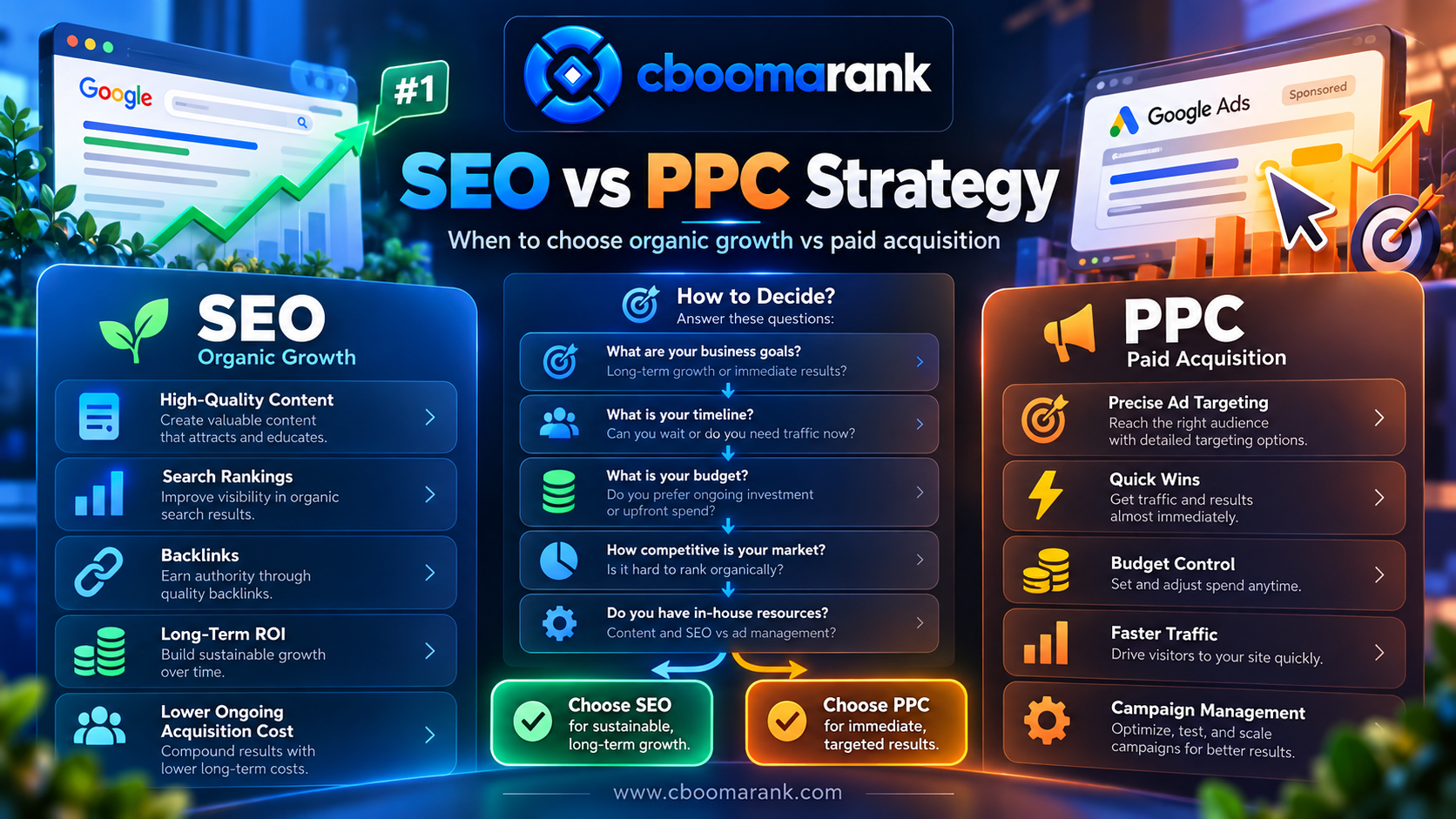
SEO becomes especially attractive when customers repeatedly search for topics connected to your products or services. It can also be valuable when the business has expertise that can be converted into useful content and when the economics support investing patiently in long-term acquisition.
Additionally, SEO can be a strong choice when paid click costs are high and the business can realistically build authority around valuable search topics. However, this requires a technically sound website and content that genuinely satisfies search intent.
When PPC Is Usually the Better Investment
PPC becomes especially attractive when speed and control matter. Businesses launching a new offer, entering a new market or testing commercial demand can often learn more quickly through paid campaigns.
Furthermore, PPC can be useful when conversion values are high enough to support competitive click costs. In these cases, advertisers can scale successful campaigns as long as additional spend continues to produce acceptable marginal returns.
Why SEO and PPC Often Work Better Together
The strongest strategy is frequently not SEO versus PPC but SEO plus PPC. Each channel can provide information that improves the other.
For example, PPC conversion data can reveal valuable search terms and messaging that deserve organic investment. Conversely, SEO data can reveal high-performing pages and search themes that may be useful in paid campaigns.
Similarly, paid traffic can help a business test a landing page before investing heavily in ranking it organically. Meanwhile, organic content can reduce dependence on paid acquisition for recurring informational demand.
For businesses already running paid search, the CBOOMARANK PPC advertising guide provides a deeper campaign framework. Our online advertising guide also covers the broader paid-media ecosystem.
A Practical SEO vs PPC Budget Framework
Start by separating immediate revenue needs from long-term acquisition goals. If the business requires leads this month, some paid investment may be necessary. However, if all spending is directed toward immediate traffic, the company may fail to build organic assets that reduce acquisition dependence later.
Next, identify the highest-value search themes. Use competitor research, keyword gaps, conversion data and customer conversations to determine where search demand overlaps with commercial value.
Then, assign each theme to the channel with the strongest current economics. Some keywords may deserve both organic and paid coverage. Others may be better suited to only one channel.
Example Allocation Logic
A new company might initially place more budget into PPC because it needs fast feedback. At the same time, it can fund technical SEO, core commercial pages and a small number of high-value content clusters.
As organic visibility grows, the company can reassess. Consequently, some paid budget may shift toward new market tests while mature organic pages continue capturing established demand.
Measure Incremental ROI, Not Just Channel Reports
One of the biggest measurement mistakes is assuming that every conversion reported by a platform is incremental. Instead, marketers should ask what would have happened without the marketing activity.
For example, a brand campaign may report excellent return because customers were already searching for the company. Similarly, an organic conversion may involve earlier paid interactions. Therefore, channel reports should be interpreted within the full customer journey.
Use analytics, controlled tests and business-level revenue data where possible. More importantly, compare marketing performance with profit rather than vanity metrics.
Common SEO vs PPC Mistakes
Comparing Organic Clicks With Ad Spend Alone
SEO has real labor and production costs. Therefore, organic clicks should not automatically be treated as free traffic.
Stopping PPC Because SEO Starts Ranking
Organic visibility does not automatically mean paid coverage has no incremental value. Instead, test the effect of reducing spend before making a permanent decision.
Using PPC Without Reliable Conversion Tracking
Clicks are not the same as business outcomes. Consequently, campaigns should connect advertising activity with leads, sales or other meaningful conversions.
Expecting SEO to Produce Immediate Results
Search optimization often requires patience. Therefore, evaluate trends over an appropriate period rather than reacting to daily ranking fluctuations.
Sending Both Channels to Weak Landing Pages
Neither SEO nor PPC can fully compensate for an offer or landing page that fails to satisfy visitors. Google’s advertising guidance also emphasizes landing-page experience as part of ad-quality diagnostics. Therefore, conversion optimization should accompany traffic acquisition.
How CBOOMARANK Helps With SEO and PPC Decisions
CBOOMARANK is designed to connect website analysis, keyword intelligence, competitor research, authority metrics, backlinks and actionable SEO insights. As a result, businesses can use competitive data to decide where organic investment deserves priority and where paid testing may provide faster validation.
For example, teams can use competitor and keyword research to identify commercial search opportunities, then compare those opportunities with existing rankings and content coverage. Likewise, backlink and authority data can help estimate how difficult an organic opportunity may be before committing resources.
Start with the CBOOMARANK platform to evaluate your website and competitors. For available commercial plans, see CBOOMARANK pricing.
SEO vs PPC Decision Checklist
- Choose more SEO investment when you have valuable recurring search demand, time to build authority and a realistic content or technical advantage.
- Choose more PPC investment when speed, targeting control, experimentation or immediate demand capture matters most.
- Use both when search is commercially important and you want short-term learning alongside long-term organic growth.
- Measure profit, not only traffic, impressions, clicks or ranking positions.
- Reallocate regularly because click costs, rankings, competition, conversion rates and business priorities can change.
Frequently Asked Questions About SEO vs PPC
Is SEO better than PPC?
SEO can be better for building long-term organic visibility, while PPC can be better for immediate traffic and controlled testing. Therefore, the right choice depends on the business objective rather than a universal rule.
Does SEO have a better ROI than PPC?
It can, particularly when strong organic pages continue generating qualified traffic over time. However, SEO still has content, technical and personnel costs. PPC can also deliver excellent return when conversion economics support the advertising cost.
Is PPC faster than SEO?
Generally, yes. Paid campaigns can begin generating traffic much sooner, while SEO improvements often require more time to influence rankings and traffic.
Should a new business start with SEO or PPC?
Many new businesses benefit from combining them. PPC can provide immediate market feedback, while SEO builds the website, content and authority needed for sustainable organic acquisition.
Can SEO and PPC target the same keywords?
Yes. In fact, running both channels on important commercial themes can provide additional data about search intent, conversion performance and messaging.
Should I stop PPC once my page ranks organically?
Not automatically. Instead, test whether reducing paid coverage changes total clicks, conversions and profit. The incremental value varies by keyword and competitive environment.
How should SEO ROI be measured?
Measure the value of organic conversions and compare it with the full cost of SEO work, including content, technical resources, tools and personnel. Additionally, evaluate performance over a period long enough to reflect the slower nature of organic growth.
How should PPC ROI be measured?
Track valuable conversions and compare their economic value with advertising and management costs. Google provides official guidance on calculating advertising ROI using conversion tracking.
Final Verdict: SEO vs PPC Is a Portfolio Decision
The most useful conclusion is not that SEO always beats PPC or that paid advertising always produces faster profit. Instead, each channel solves a different part of the growth problem.
SEO can create durable search visibility, reusable content assets and compounding organic acquisition. PPC can create rapid visibility, precise campaign control and faster commercial feedback. Therefore, the strongest allocation depends on your margins, customer value, competitive environment, website authority and growth timeline.
For most serious businesses, the goal should be to determine where each additional marketing dollar produces the greatest incremental profit. Use SEO to build durable demand capture, use PPC where speed and control create an advantage, and let real conversion data guide how the mix changes over time.
Ready to evaluate your search opportunities? Explore CBOOMARANK, compare your website against competitors, and review the available CBOOMARANK plans when you are ready to expand your SEO workflow.
