

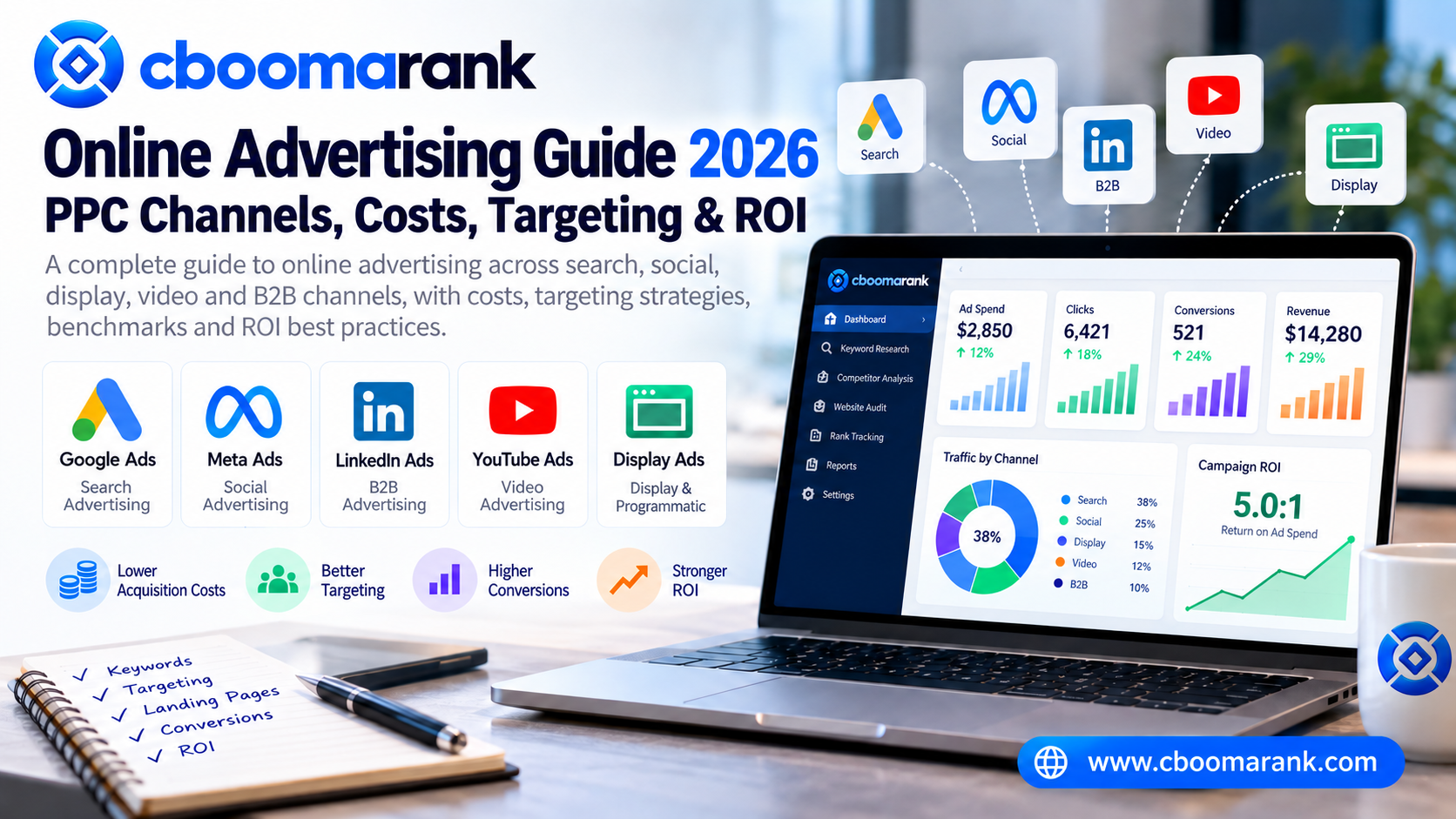
Online advertising has become one of the most measurable ways to reach potential customers, but profitable campaigns require much more than simply buying clicks. Businesses now have to choose the right advertising channels, understand auction-based pricing, control targeting, improve landing pages and connect advertising spend to qualified leads and revenue.
This 2026 guide explains how online advertising works across search, social, display, video and B2B channels. It also covers PPC costs, targeting methods, current benchmarks, conversion tracking and practical ways to improve return on ad spend.
Whether you manage campaigns for a small business, ecommerce store, SaaS company or professional service, the goal is the same: turn advertising data into decisions that produce profitable growth.
What Is Online Advertising?
Online advertising is paid digital promotion delivered through search engines, social platforms, websites, video networks, marketplaces and other internet-based channels. Advertisers normally pay according to clicks, impressions, views, conversions or other measurable actions.
The biggest advantage over many traditional advertising methods is measurement. A digital campaign can show how many people saw an ad, clicked it, reached a landing page, submitted a form, purchased a product or became a customer. That makes it possible to connect marketing activity with business outcomes.
However, greater measurement does not automatically mean better performance. Poor targeting, weak offers, slow landing pages and incomplete conversion tracking can make an apparently successful campaign unprofitable.
Online Advertising vs PPC Advertising
PPC advertising is an important part of online advertising, but the two terms are not identical. PPC means pay per click: the advertiser pays when a user clicks an advertisement. Search campaigns on Google Ads and Microsoft Ads are common examples.
Online advertising is broader. It includes PPC, cost-per-thousand-impression campaigns, video advertising, sponsored social posts, retargeting, programmatic display, shopping ads and other paid digital placements.
For most businesses, the strongest strategy uses several channels with different jobs. Search advertising can capture existing demand, social advertising can create or expand demand, remarketing can reconnect with previous visitors, and video can improve awareness and consideration.
Main Online Advertising Channels in 2026
Search Advertising
Search advertising places sponsored results in front of people who are actively searching for products, services or information. Because the user is already expressing intent, search can be particularly effective for lead generation and direct-response campaigns.
Google Ads remains the dominant search platform, while Microsoft Advertising can provide additional reach. Campaign quality depends heavily on keyword selection, match types, negative keywords, ad relevance, bidding strategy and landing-page alignment.
For a deeper starting point, see the CBOOMARANK Google Ads beginner guide and the guide to negative keywords.
Paid Social Advertising
Social platforms allow advertisers to reach people based on demographics, interests, behaviours, professional characteristics and first-party audience data. Meta, LinkedIn, TikTok, Pinterest and other networks can support awareness, lead generation and ecommerce campaigns.
Unlike search, social users may not be actively looking for the advertiser’s offer. Creative quality therefore plays a larger role. Strong visuals, concise messaging, compelling hooks and useful offers often matter as much as targeting.
Display and Programmatic Advertising
Display advertising uses visual placements across websites, apps and advertising networks. It can be useful for awareness, retargeting and reaching audiences outside search and social feeds.
Programmatic technology automates the buying and placement process. Advertisers should still pay close attention to placement quality, frequency, brand safety, viewability and conversion quality rather than judging campaigns only by inexpensive impressions.
Video Advertising
Video advertising can explain a product, demonstrate benefits and build familiarity faster than many static formats. YouTube is a major channel, while Meta, TikTok and LinkedIn also support video placements.
The opening seconds matter. Advertisers should communicate the problem, value proposition or key benefit quickly because users can easily skip or scroll past promotional content.
Shopping and Ecommerce Advertising
Shopping ads use structured product data such as title, image, price and availability to promote products directly in search and commerce environments. Strong product feeds, accurate categories, competitive pricing and conversion tracking are fundamental.
Retail media networks are also becoming more important because they allow brands to advertise close to the point of purchase. The best channel depends on where customers research and buy.
B2B Advertising
B2B campaigns often involve longer buying cycles, more expensive leads and multiple decision-makers. LinkedIn can be valuable because advertisers can target professional attributes such as job title, industry and company characteristics.
LinkedIn states that advertising cost is determined through an online auction and depends on optimization goals and bidding strategy, so there is no universal fixed CPC or CPM. LinkedIn’s advertising cost documentation explains this auction model.

How Online Advertising Costs Work
Advertising costs differ by platform, country, audience, industry, competition, objective and conversion value. A financial-services keyword may cost far more than a low-competition entertainment query, while a B2B decision-maker audience can cost more than a broad consumer audience.
Cost Per Click
Cost per click, or CPC, measures the amount paid for each click. It is useful for traffic and search campaigns, but a low CPC is not automatically good. Expensive clicks that consistently generate profitable customers may be more valuable than cheap clicks that never convert.
Cost Per Thousand Impressions
CPM measures the cost of one thousand impressions. It is common in awareness, display and social advertising. CPM should be considered alongside reach, frequency, click-through rate and downstream conversion quality.
Cost Per Lead and Cost Per Acquisition
CPL shows how much advertising spend is required to generate a lead, while CPA measures the cost of a completed customer acquisition or another defined conversion. These metrics move the analysis closer to actual business value.
Return on Ad Spend
ROAS compares revenue generated with advertising spend. A campaign that generates $10,000 in tracked revenue from $2,000 of advertising spend has a 5:1 ROAS. However, revenue alone does not equal profit, so businesses should also consider margins, refunds, sales costs and customer lifetime value.
2026 PPC and Search Advertising Benchmarks
Benchmarks are useful for context, but they should never become rigid performance targets. Industry, geography, brand strength, offer quality and conversion tracking can produce major differences.
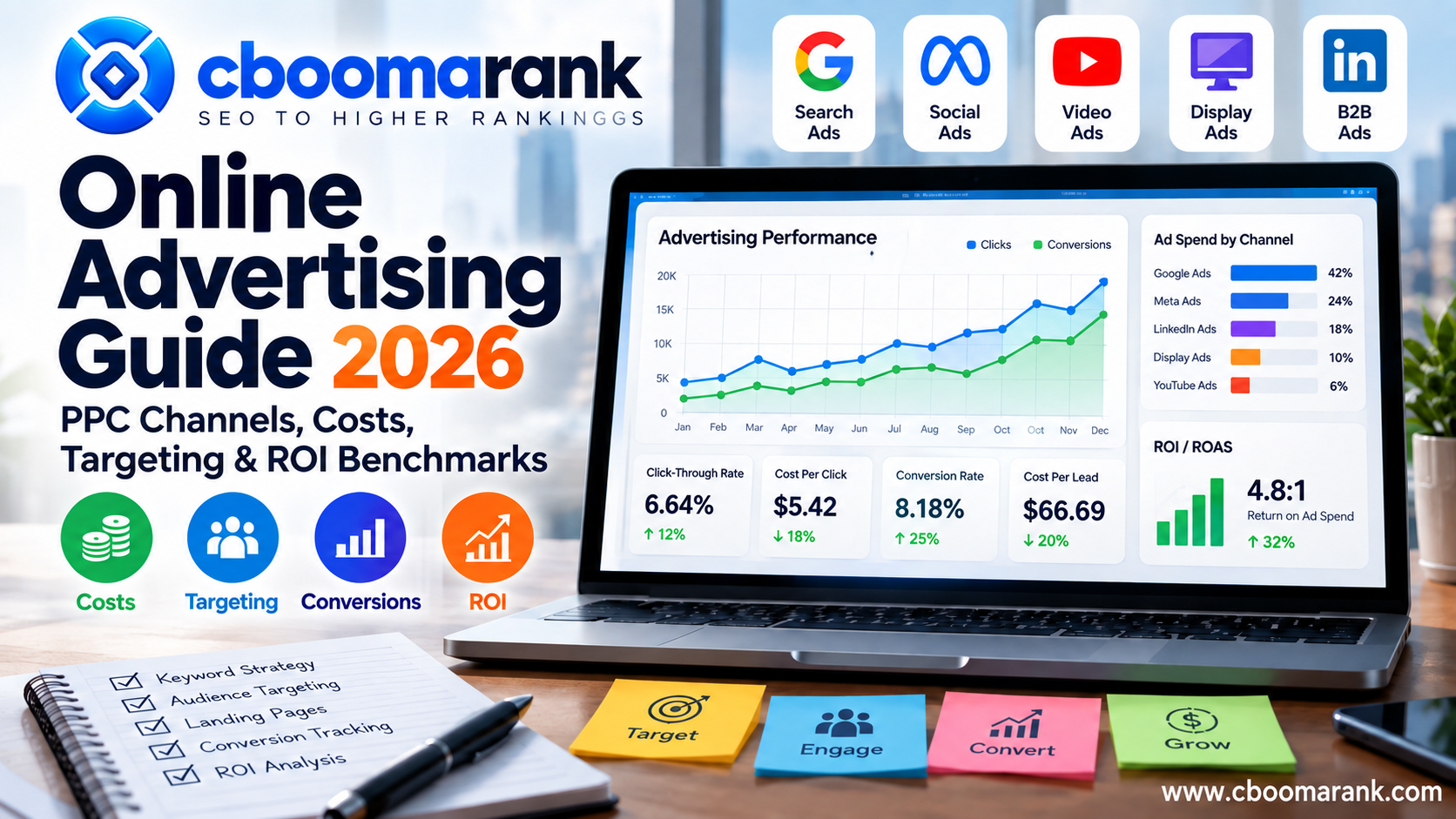
WordStream’s 2026 PPC benchmark analysis examined more than 13,000 U.S.-based search campaigns that ran from April 2025 through March 2026. The reported overall averages were:
| Metric | 2026 overall benchmark |
|---|---|
| Click-through rate | 6.64% |
| Cost per click | $5.42 |
| Conversion rate | 8.18% |
| Cost per lead | $66.69 |
These are U.S. search-ad averages and should not be treated as universal global standards. Industries can vary substantially. Use the figures as directional context and compare your campaigns primarily with your own historical performance and commercial targets. See the current WordStream PPC benchmark report and LocaliQ search advertising benchmarks.
How Online Advertising Auctions Work
Most major advertising platforms use auctions rather than fixed placement prices. When an eligible advertising opportunity becomes available, the platform considers factors such as bid, predicted performance, relevance, user context and campaign objective.
This means the highest bidder does not always receive the best outcome. Strong relevance and conversion data can improve campaign efficiency. Advertisers should therefore focus on the complete system: targeting, creative, landing page, measurement and bidding.
Online Advertising Targeting Strategies
Keyword and Search-Intent Targeting
Keyword targeting works best when campaign structure follows search intent. Informational searches, comparison searches and high-intent commercial searches should not automatically use the same message or landing page.
Advertisers should analyse the language real customers use, monitor search-term reports and exclude irrelevant queries. CBOOMARANK’s competitor analysis guide can also help identify gaps and competing messages.
Audience Targeting
Audience targeting can use interests, demographics, professional characteristics, customer lists, website visitors and platform-generated signals. Avoid narrowing an audience so aggressively that the platform cannot learn or deliver efficiently.
First-party data is becoming increasingly important because businesses can build audiences around existing customers, subscribers and qualified leads with appropriate consent and privacy controls.
Geographic and Device Targeting
Location targeting is valuable when a company serves specific cities, regions or countries. Device performance should also be reviewed because mobile and desktop visitors can behave very differently.
Do not assume the cheapest location is the best market. Compare lead quality, sales conversion and revenue after the click.
Remarketing
Remarketing reconnects with people who previously visited a website, viewed products or interacted with content. It can work well because the audience already knows the brand, but excessive frequency can create fatigue.
Segment remarketing audiences by intent whenever possible. A pricing-page visitor deserves a different message from a person who read one early-stage blog article.
How to Set an Online Advertising Budget
A practical budget starts with economics rather than a random daily amount. Estimate the acceptable customer acquisition cost, average conversion rate, close rate and customer value. Then work backwards to understand what a qualified click or lead can reasonably cost.
For example, if a business can profitably spend $300 to acquire a customer and one in five qualified leads becomes a customer, the theoretical ceiling is $60 per qualified lead before other costs and risk adjustments.
Start with enough budget to generate meaningful data, but avoid scaling before conversion tracking is reliable. Increase investment gradually when profitable patterns are repeatable.
Online Advertising ROI and ROAS Measurement
The most important advertising dashboard should connect media metrics with business metrics. Impressions and clicks explain delivery, but qualified leads, opportunities, revenue and profit explain commercial impact.
A useful measurement chain is:
Impression → Click → Landing-page visit → Conversion → Qualified lead → Opportunity → Customer → Revenue.
When that chain breaks, teams may optimize for the wrong outcome. High lead volume can look impressive while sales teams receive poor-quality prospects.
The recently published CBOOMARANK sales performance analytics guide explains how to connect SEO and marketing leads with pipeline and revenue.
Landing Pages and Conversion Performance
Advertising performance does not end when somebody clicks. Landing pages should continue the promise made in the advertisement, load quickly, explain the offer clearly and provide a simple next step.
Message mismatch is one of the most common causes of wasted spend. If an ad promotes a specific service but sends visitors to a generic homepage, users have to search for the information themselves.
Test headlines, proof, calls to action, forms and page structure. For lead-generation campaigns, ask only for information that is genuinely needed at that stage of the buying journey.
AI and Automation in Online Advertising
Advertising platforms increasingly use machine learning for bidding, targeting, creative combinations and campaign optimization. Automation can process more signals than a person can manage manually, but it still depends on the quality of the goals and data supplied by the advertiser.
If conversion tracking rewards low-quality actions, automated bidding can optimize toward more low-quality actions. Before using value-based or conversion-focused automation, define the business outcomes that matter and send accurate conversion signals back to the advertising platform.
Human review remains important for strategy, positioning, creative quality, compliance and commercial interpretation.
Privacy, Consent and Conversion Tracking
Privacy requirements and browser restrictions have made measurement more complex. Businesses should use appropriate consent management, secure first-party data practices and platform-supported conversion tools.
A measurement plan should document every important conversion, where the event is recorded and how it connects with CRM or ecommerce data. Regularly test tracking after website, checkout or form changes.
Never rely on one platform’s reported conversions without understanding its attribution model. Compare advertising-platform reporting with analytics, CRM and revenue data.
How CBOOMARANK Supports Online Advertising Decisions
Paid advertising performs better when it is connected with organic search, competitor intelligence and website performance. CBOOMARANK is being built to help marketers analyse websites, research keywords, understand competitors and identify opportunities across connected marketing workflows.
Use keyword and competitor insights to evaluate search demand, discover content gaps and compare how competitors position their offers. Website analysis can also identify technical or content issues that may weaken landing-page performance.
Analyze Your Website with CBOOMARANK
Businesses that want access to broader CBOOMARANK capabilities can review the available plans and choose the option that fits their workflow.
Common Online Advertising Mistakes
Optimizing for Clicks Instead of Business Outcomes
Traffic is useful only when it contributes to a meaningful objective. Track qualified leads, purchases, pipeline and revenue rather than celebrating click volume alone.
Using the Same Message for Every Audience
Different audiences have different problems and levels of awareness. Match the advertisement to the user’s intent, channel and buying stage.
Ignoring Negative Keywords and Exclusions
Search-term exclusions, audience exclusions and placement controls help prevent budget from being spent on irrelevant activity.
Scaling Before Tracking Is Reliable
Increasing spend on a campaign with broken measurement only creates more uncertainty. Validate analytics, forms, phone calls, ecommerce transactions and CRM handoffs first.
Judging Performance Too Quickly
Campaigns need enough data to support useful conclusions. Avoid making major decisions from a handful of clicks or conversions, particularly in high-value B2B markets.
Online Advertising Checklist for 2026
Before increasing advertising spend, confirm that the campaign has a clear commercial objective, defined audience, measurable conversion, appropriate landing page and reliable tracking.
Review search terms, placements and audience quality regularly. Monitor CPC, CPM, CTR and conversion rate, but connect those metrics with CPL, CPA, ROAS, revenue and customer value.
Compare performance by device, geography, campaign, landing page and audience. Refresh creative before fatigue damages response rates. Finally, document meaningful tests so future decisions are based on evidence instead of repeated guesswork.
Frequently Asked Questions About Online Advertising
What is the best online advertising channel?
There is no universal best channel. Search is strong for existing intent, social can generate demand, LinkedIn can support B2B targeting, video can build awareness and remarketing can re-engage previous visitors. The best channel is the one that reaches the right audience and produces acceptable business economics.
How much should a business spend on PPC?
Budget should be based on customer value, target acquisition cost, conversion rate and available demand. Start with enough spend to collect useful data, validate tracking and scale only after the economics are understood.
What is a good PPC conversion rate?
Conversion rates differ significantly by industry and campaign type. The 2026 WordStream search benchmark reported an 8.18% overall average across its U.S. dataset, but businesses should compare results with their own industry, geography and historical performance rather than treating one average as a universal target.
What is the difference between ROI and ROAS?
ROAS compares advertising revenue with advertising spend. ROI is broader because it considers the overall profit or return relative to total costs. A campaign can show strong ROAS while still producing weak profit if margins and operating costs are poor.
Should SEO and online advertising work together?
Yes. Paid and organic channels reveal different information about search demand, audience response and competitor activity. Strong teams share keyword insights, landing-page learnings and conversion data across both channels.
Final Takeaway
Online advertising in 2026 is less about buying the cheapest traffic and more about building a measurable growth system. The winning campaign connects the right channel with the right audience, message, landing page and business outcome.
Use benchmarks for context, not as absolute targets. Measure what happens after the click, improve conversion quality and connect campaign activity with qualified leads, pipeline and revenue.
When advertising, SEO, analytics and competitor intelligence work together, marketers gain a much clearer picture of which investments are actually creating growth.
