

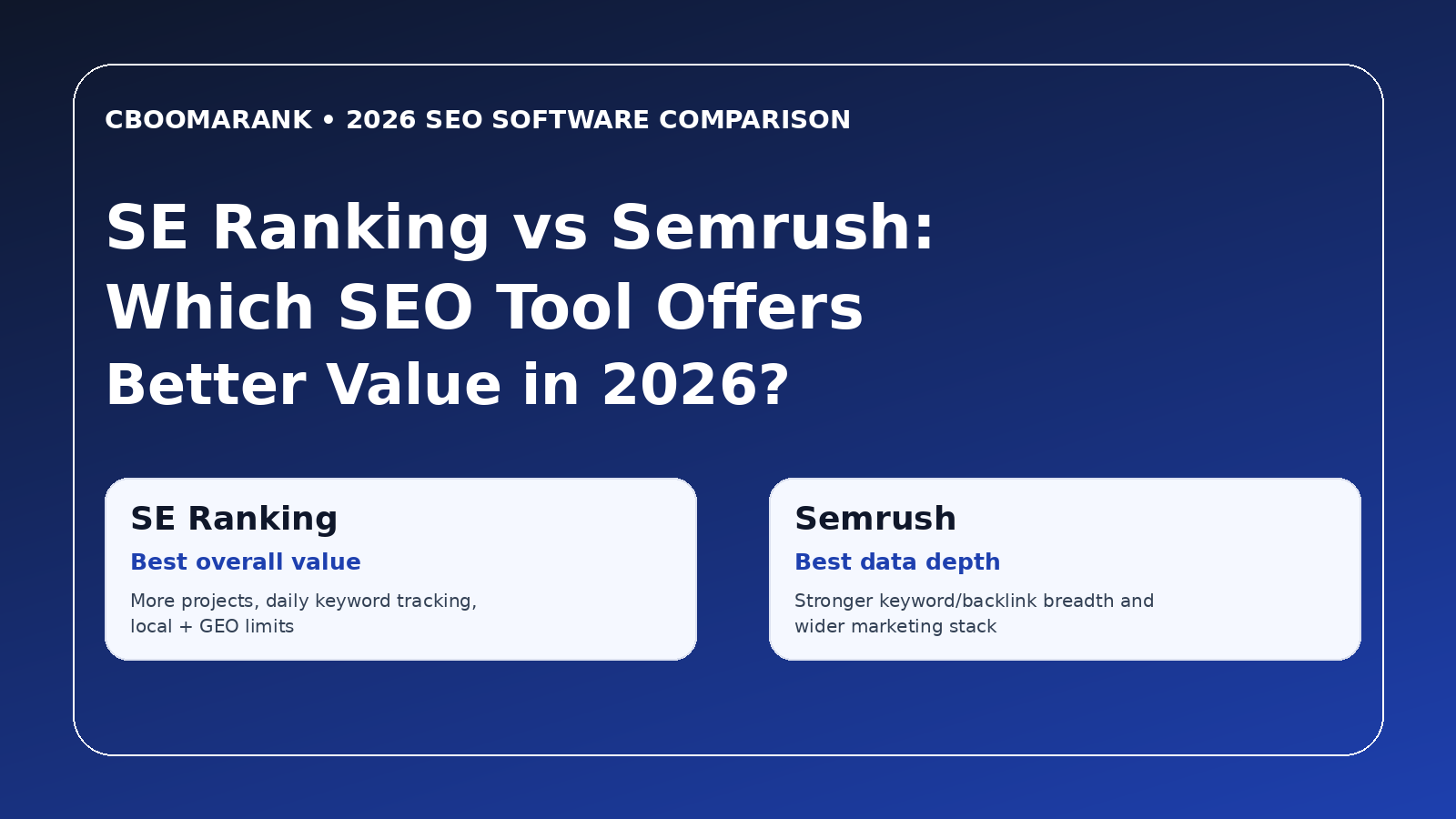
Quick Verdict: SE Ranking Wins on Value; Semrush Wins on Breadth
For most small businesses, SEO freelancers, content-led sites and cost-conscious agencies, SE Ranking offers the better value in 2026. Its Core plan is listed at $129 per month or $103.20 per month when billed annually, with 10 projects, 2,000 keywords tracked daily, 100 AI/GEO prompts tracked daily, 250,000 audit pages per month, 25,000 API credits and MCP access. Its pricing page also includes three Local Marketing locations and 25 Content Marketing articles in Core limits.
Semrush remains the stronger choice when your priority is maximum research depth and a broader marketing intelligence ecosystem. Its live pricing page lists the SEO plan at $139 per month or $117.33 per month billed annually, with five monitored websites and 500 daily tracked keywords. Semrush also offers Semrush One Starter at $199 monthly or $165.17 on annual billing for expanded AI visibility. Beyond SEO, separate Content, Local, Advertising and other toolkits can turn Semrush into a much wider marketing stack.
Bottom line: Choose SE Ranking when you want more SEO/GEO operating capacity for the money. Choose Semrush when you can justify a higher total software budget in exchange for deeper competitive data, richer PPC intelligence and a broader suite of specialist marketing tools.
Pricing note: Prices can change by billing cycle, region, tax and product packaging. Verify checkout before purchasing. This comparison uses vendor-listed USD pricing available on August 7, 2026.
Table of Contents
- SE Ranking vs Semrush at a glance
- 2026 pricing and value
- Keyword research
- Competitive research and PPC
- Backlink analysis
- Site audit and on-page SEO
- Rank tracking
- AI search and GEO
- Content marketing
- Local SEO
- Reporting and agency workflows
- Ease of use
- Pros and cons
- Who should choose each tool
- Final verdict
- FAQs
SE Ranking vs Semrush at a Glance
| Category | SE Ranking | Semrush | Winner |
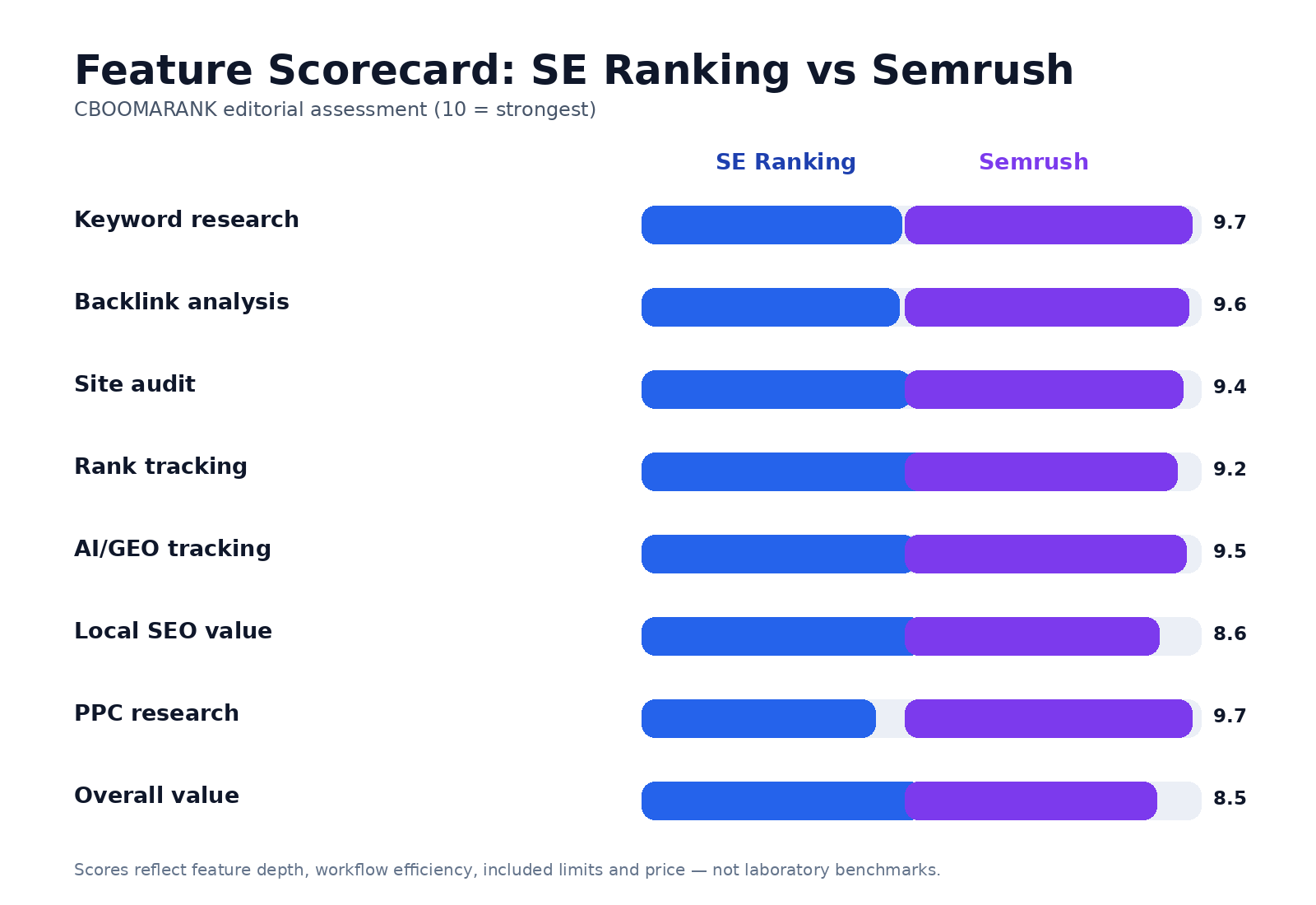
| Entry annual equivalent | $103.20/mo Core | $117.33/mo SEO | SE Ranking |
| Projects / websites | 10 Core / 30 Growth | 5 SEO / 15 Pro+ | SE Ranking |
| Daily rank keywords | 2,000 Core / 5,000 Growth | 500 SEO / 1,500 Pro+ | SE Ranking |
| Keyword research | Strong, unlimited research on paid plans | Exceptional database depth and workflows | Semrush |
| Backlinks | Strong checker, monitoring and competitor research | Deeper ecosystem and link-building workflows | Semrush |
| Site audit | 250K pages/mo Core; 2M Growth | Strong technical audit and prioritization | Tie |
| AI/GEO | 100 daily prompts Core; 250 Growth | AI visibility in current plans; expanded in Semrush One | Tie |
| Local SEO | 3 locations included in current Core/Growth limits | Dedicated Local Toolkit priced separately | SE Ranking |
| PPC intelligence | Useful competitor paid-search research | One of the strongest PPC research stacks | Semrush |
| Agency value | High limits; optional Agency Pack | Powerful reports, add-ons and ecosystem | SE Ranking |
| Overall value | More operating capacity per dollar | More breadth/data depth at higher total cost | SE Ranking |
2026 Pricing: Which Platform Gives You More for the Money?
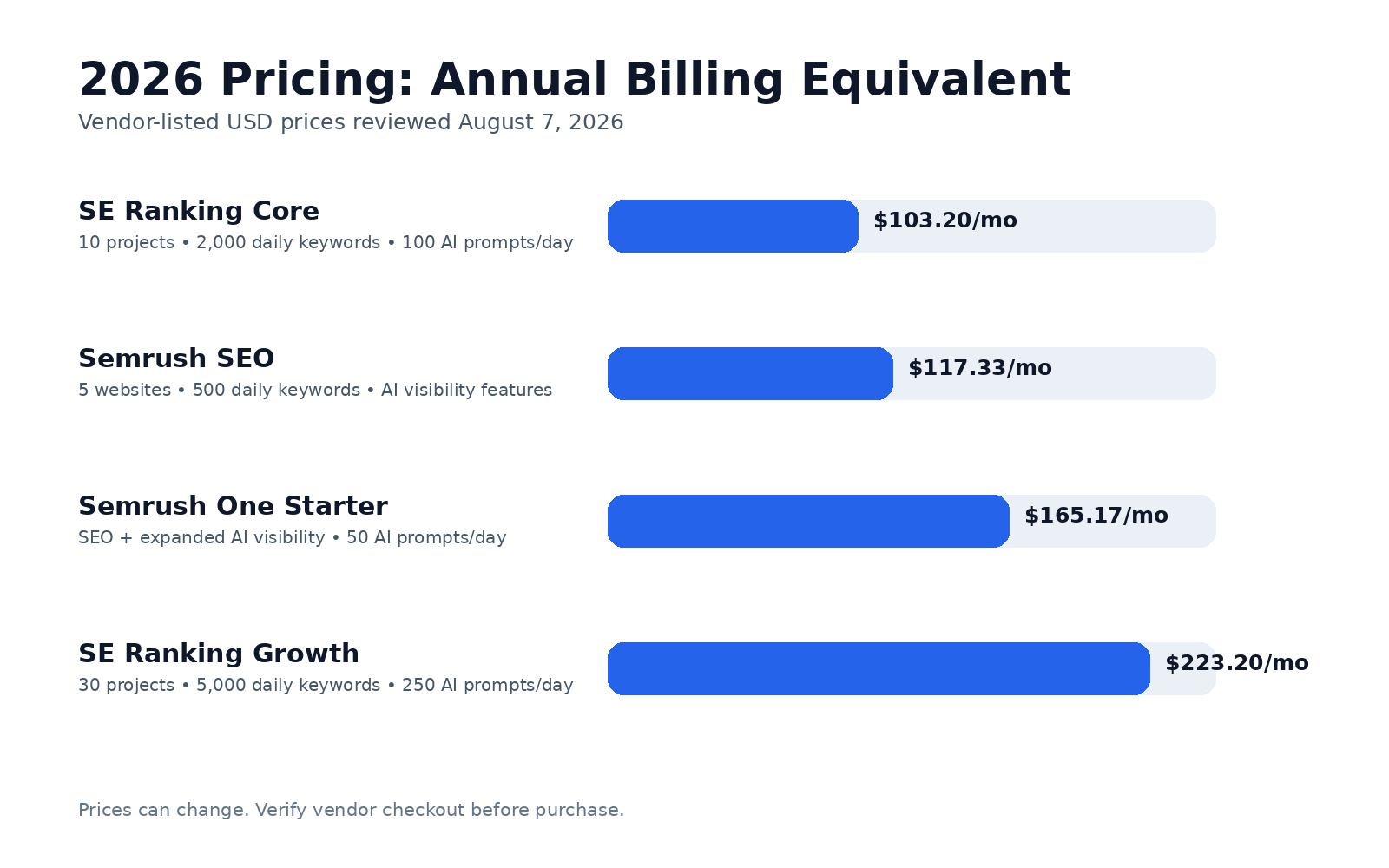
Pricing is the biggest reason the value verdict is not the same as the “most powerful tool” verdict. Semrush and SE Ranking now overlap more heavily in AI search, but their included limits remain very different.
SE Ranking pricing in 2026
SE Ranking’s current platform pricing starts with Core at $129 per month, discounted to an equivalent $103.20 per month on annual billing. Core includes 10 projects, one manager seat, 2,000 daily tracked keywords, 100 daily AI prompts, five domains in GEO research, 250,000 monthly audit pages, 25,000 research API credits and MCP access. Growth is $279 monthly or $223.20 on annual billing, expanding to 30 projects, three manager seats, 5,000 daily keywords, 250 daily AI prompts, 15 GEO research domains and two million audit pages per month.
SE Ranking also lists three Local Marketing locations in Core and Growth, plus 1,500 local/map rank-tracking keywords, listing management across 100+ directories and GBP posts. Its current plan table also shows 25 Content Marketing articles for Core and 50 for Growth. Those bundled limits are important because a business that needs rank tracking, local SEO, content optimization and GEO monitoring may avoid several separate subscriptions.
For agencies, the optional Agency Pack is listed at $69 per month on annual billing and adds white labeling, client-facing features, unlimited scheduled reporting with AI summaries, client seats and lead-generation tools. The expanded AI Search add-on begins at $89 monthly or $71.20 annual-equivalent for 200 prompts.
Semrush pricing in 2026
Semrush’s live SEO + AI Search pricing page lists its entry SEO plan at $139 per month, or $117.33 per month billed annually. That tier includes five websites to monitor, 500 keywords tracked daily, keyword research, competitor analysis, Position Tracking, Site Audit and AI visibility features. Semrush One Starter costs $199 monthly or $165.17 annual-equivalent and pairs the SEO foundation with expanded AI visibility limits, including 50 prompts tracked daily and additional AI brand-performance reporting.
Higher Semrush One tiers scale to Pro+ at $299 monthly ($248.17 annual-equivalent) and Advanced at $549 monthly ($455.67 annual-equivalent). Pro+ includes 15 websites and 1,500 daily tracked keywords; Advanced includes 40 websites and 5,000 daily tracked keywords plus API data integration and share-of-voice capabilities.
Semrush’s modular approach is a strength if you want specialized tools, but it can increase total cost. Its Content Toolkit is listed separately at $60 per month on annual billing, while Local Toolkit starts at $30 per location per month billed annually. The Advertising Toolkit is also a separate product. For a team that genuinely uses these capabilities, the breadth can justify the spend. For a smaller SEO operation, however, SE Ranking’s bundled limits can be easier to budget.
Value Math: What the Entry Plans Actually Buy
| Metric | SE Ranking Core | Semrush SEO |
| Annual-equivalent monthly price | $103.20 | $117.33 |
| Tracked sites/projects | 10 projects | 5 websites |
| Daily tracked keywords | 2,000 | 500 |
| AI/GEO prompt tracking | 100/day | Included AI visibility; expanded prompt tracking in Semrush One |
| Monthly audit pages | 250,000 | Plan-dependent Site Audit limits |
| Local locations | 3 listed in Core limits | Separate Local Toolkit |
| Content allocation | 25 articles listed | Separate Content Toolkit for full workflow |
That does not mean SE Ranking has four times the overall power simply because it tracks four times as many keywords at the entry level. Semrush’s research databases, competitive intelligence and workflow depth can create more value per query for advanced teams. Still, for a buyer whose main constraint is monthly software cost, SE Ranking’s capacity advantage is difficult to ignore.
Keyword Research: Semrush Is Deeper, SE Ranking Is More Cost-Efficient
Both platforms handle the core keyword-research jobs well: discovering related terms, evaluating search volume and difficulty, analyzing intent, reviewing SERPs and studying competitor keyword portfolios. The difference is depth and workflow maturity.
Semrush’s Keyword Magic Tool remains one of its flagship advantages. Semrush says the tool accesses a database of more than 27.3 billion keywords and supports topic grouping, questions filters, SERP-feature analysis, difficulty metrics and large-scale list organization. For editorial teams building thousands of pages, agencies doing market expansion, or PPC teams moving between organic and paid datasets, Semrush offers a very mature discovery environment.
SE Ranking’s Keyword Research and Competitive Research tools are easier to justify for users who need strong daily SEO research without paying primarily for database scale. Its current plans advertise unlimited keyword and competitor research, while the platform integrates ranking, competitor, backlink, content and GEO workflows in the same workspace. For most bloggers, small ecommerce sites and regional businesses, that is more than enough data to build a serious keyword strategy.
Winner: Semrush for depth; SE Ranking for value.
Competitive Research and PPC: Semrush Has the Clear Advantage
If your marketing strategy combines SEO and paid search, Semrush is usually the better fit. Its competitive ecosystem is designed to show how rivals acquire visibility across organic keywords, paid keywords, ads and broader traffic intelligence. In 2026, Semrush also sells an Advertising Toolkit with dedicated competitive ad research and AI-assisted campaign features, reinforcing its position as the more complete option for performance marketers.
SE Ranking can research competitors’ organic and paid keywords and surface useful PPC insights, but PPC is not the primary reason to choose the platform. It is better thought of as an SEO/GEO operating system with enough paid-search intelligence to support SEO strategy.
Winner: Semrush.
Backlink Analysis: Semrush Still Leads on Link Intelligence
SE Ranking includes backlink research and monitoring, making it practical for discovering referring domains, measuring Domain Trust/Page Trust, comparing competitors and watching new or lost links. For routine link prospecting and monitoring, it is fully capable.
Semrush goes further with a larger link-analysis ecosystem. Its Backlink Audit workflow evaluates suspicious links using dozens of parameters, adds a toxicity-oriented review process, supports integrations with Google Search Console and Analytics, and helps users organize removal or disavow workflows. Semrush also combines Backlink Analytics, Backlink Gap and link-building outreach workflows in a way that is especially useful to agencies and large sites.
The key distinction is not that SE Ranking lacks backlink tools; it is that Semrush makes backlink intelligence a deeper research specialty. If off-page SEO is central to your business model, Semrush is worth the premium.
Winner: Semrush.
Site Audit and On-Page SEO: Both Are Strong
Technical SEO is one of the closest parts of this comparison. Both platforms crawl websites, identify technical and on-page issues, prioritize fixes and track site health over time.
SE Ranking’s value comes from generous crawl limits. Core lists 250,000 audit pages per month and Growth lists two million. It also includes an On-Page SEO Checker and SERP Analyzer, with substantially higher limits on Growth. For agencies auditing many small and mid-sized client sites, that capacity is attractive.
Semrush Site Audit is exceptionally mature and tightly integrated with its other datasets. Its free SEO Checker and paid Site Audit focus on technical and on-page problems, prioritization and scheduled crawling. The platform also connects technical health with AI-search readiness, which matters as search visibility expands beyond classic blue links.
Winner: Tie. SE Ranking offers better crawl capacity for the money; Semrush has an exceptionally polished audit workflow and integration depth.
Rank Tracking: SE Ranking Offers Exceptional Capacity
Rank tracking is one of SE Ranking’s strongest value arguments. Core tracks 2,000 keywords daily and Growth tracks 5,000, with major search engines, location/device options and Top 100 tracking. The platform was historically known for rank tracking, and the 2026 packaging makes that strength even more obvious.
Semrush Position Tracking is also excellent. It tracks daily positions, competitors, devices and locations, supports visibility and share-of-voice analysis, and now connects ranking analysis with AI-search competitors. The issue is not quality—it is entry-level capacity. Semrush’s SEO plan lists 500 daily tracked keywords, while SE Ranking Core lists 2,000 at a lower annual-equivalent price.
Winner: SE Ranking for value and tracking volume.
AI Search and GEO: Both Platforms Are Now Serious Contenders
The biggest change in the SEO software market is that AI visibility is no longer a side feature. Both vendors now frame their platforms around traditional search plus generative or AI search visibility.
SE Ranking Core includes 100 prompts tracked daily across five LLM/search experiences, five domains in GEO research and unlimited AI source tracking according to its current plan table. Growth increases this to 250 prompts and 15 GEO research domains. Its optional AI Search add-on expands prompt limits and adds broader brand-level tracking through SE Visible.
Semrush has also moved aggressively into AI visibility. The live pricing page includes AI visibility in its SEO plans, while Semrush One provides deeper AI brand-performance capabilities across Google AI experiences, ChatGPT, Gemini, Perplexity and other discovery surfaces. Starter includes 50 tracked prompts daily; Pro+ raises this to 100; Advanced to 200.
Semrush has the edge in the sophistication of brand-performance reporting and its massive marketing data ecosystem. SE Ranking has the edge in how much prompt-tracking capacity it bundles into its lower-priced Core and Growth plans. For agencies monitoring many client prompts, that difference can translate directly into lower software cost.
Winner: Tie, with different strengths.
Content Marketing: Semrush Is More Sophisticated; SE Ranking Bundles More
Semrush’s Content Toolkit is now a distinct AI-driven workspace that covers topic discovery, SEO brief generation, long-form article creation, content optimization, repurposing and publishing. Semrush states that it can optimize content for both Google and AI-search visibility and can publish through connected channels including WordPress. That makes it a strong option for content teams that want an integrated production workflow.
The tradeoff is that the full Content Toolkit is sold separately. Semrush lists the Base content plan at $60 per month billed annually, with 10,000 articles per month and five SEO content boosts.
SE Ranking’s current Core and Growth pricing tables include Content Marketing article allowances of 25 and 50 respectively. Its broader content feature set includes Content Editor and AI-assisted writing/optimization. For a team that primarily needs SEO briefs and on-page optimization rather than a full content operating system, that included allocation improves value.
Winner: Semrush for workflow depth; SE Ranking for bundled value.
Local SEO: SE Ranking Is the Better Value for Multi-Location Basics
SE Ranking’s 2026 plan table includes three Local Marketing locations on both Core and Growth, 1,500 keywords for Local & Map Rank Tracker, listing management across 100+ directories and Google Business Profile posts. Extra locations start from $18.40 according to the current pricing table.
Semrush’s Local Toolkit is powerful and more automation-oriented, but it is priced separately. Its Base plan is listed at $30 per location per month billed annually, with automated Google Business Profile management, AI-powered posting, review auto-replies and map rank tracking. Pro costs $60 per location and adds listing management, expanded review functionality and higher map-tracking limits.
For a local business with one location that values automation, Semrush Local can be attractive. For an SEO buyer who wants local capabilities included alongside rank tracking and audits, SE Ranking provides the clearer value proposition.
Winner: SE Ranking on bundled value.
Reporting, Collaboration and Agencies
Agencies care about more than feature checklists. They need client limits, seats, exports, scheduled reports, white labeling and the ability to expand without rewriting their operating model.
SE Ranking Growth includes 30 projects and three manager seats, guest links, historical data across the project lifetime, page-change monitoring and 100,000 research API credits. Its optional $69-per-month Agency Pack adds white-label reporting, client-facing tools, scheduled reports with AI summaries and 30 client seats. That combination is highly competitive for agencies serving many small-to-mid-sized clients.
Semrush is exceptionally strong for agencies that sell broader digital marketing services. Its reporting ecosystem can combine data from more than 20 Semrush tools, and its optional reporting add-ons add scheduling, integrations, branding and AI summaries. Semrush also has lead-generation and partner ecosystem features. The catch is that multiple users and specialist toolkits can increase the monthly bill quickly.
Winner: SE Ranking for SEO-agency value; Semrush for full-service agency breadth.
Ease of Use and Learning Curve
SE Ranking generally feels easier to operationalize because the product is more focused. Projects, ranking, audits, competitors, backlinks, local and content workflows sit inside a coherent SEO-first structure. Teams moving from spreadsheets or smaller SEO tools can become productive quickly.
Semrush is more expansive. That is an advantage once you know where everything lives, but new users can face more menus, reports, toolkits and product boundaries. The platform rewards experienced marketers who can turn its depth into repeatable workflows. For a beginner, however, SE Ranking can feel less overwhelming.
Winner: SE Ranking for simplicity.
SE Ranking Pros and Cons
Pros
- Excellent project and daily rank-tracking limits for the price.
- AI/GEO prompt tracking is built into current Core and Growth plans.
- Three Local Marketing locations are listed in Core and Growth limits.
- Strong website auditing, competitor research, backlink monitoring and content tools.
- Growth is agency-friendly with 30 projects, three manager seats and large audit capacity.
- Optional Agency Pack gives white labeling and client-facing workflows without forcing every buyer to pay for them.
Cons
- Keyword and backlink research depth is not as dominant as Semrush at the high end.
- PPC and advertising intelligence is useful but not a central strength.
- Some agency, API and expanded AI features still require add-ons.
- The 2026 product packaging is changing quickly, so buyers should verify exact limits before committing.
Semrush Pros and Cons
Pros
- One of the deepest keyword and competitor-research ecosystems available.
- Excellent backlink intelligence, audit workflows and link-building research.
- Strong Site Audit and Position Tracking integrated with broader marketing data.
- Best choice in this comparison for PPC and cross-channel competitive intelligence.
- Semrush One provides sophisticated AI visibility and brand-performance tracking.
- Modular toolkits can cover SEO, content, local, advertising, social, market intelligence and more.
Cons
- Entry-level daily rank-tracking limits are lower than SE Ranking.
- Adding Content, Local, Advertising, extra users and reporting can substantially increase total cost.
- The product ecosystem is broader and can feel more complex to new users.
- For small SEO-only teams, you may pay for depth or ecosystem value you do not fully use.
Which Tool Should You Choose?
Choose SE Ranking if you are a blogger or content publisher
SE Ranking is the stronger value for publishers that need keyword research, rank tracking, audits, competitor insights, content optimization and AI-search monitoring without building a large software stack. The 2,000-keyword daily tracking limit on Core is especially useful for sites with growing content libraries.
Choose SE Ranking if you are a small or mid-sized SEO agency
The combination of 30 projects on Growth, 5,000 daily tracked keywords, three seats, guest links, two million monthly audit pages and optional white-label agency features makes SE Ranking highly efficient for recurring client work.
Choose Semrush if you are a full-service marketing agency
If your retainers include SEO, PPC, competitive research, content strategy, local marketing and wider market intelligence, Semrush can consolidate more specialist workflows under one vendor. The platform is more expensive when fully built out, but the breadth can replace several separate tools.
Choose Semrush if backlinks and competitive research drive your strategy
Organizations that depend heavily on large-scale keyword discovery, backlink intelligence, competitor gaps and paid-search research will usually extract more strategic value from Semrush’s datasets and mature research workflows.
Choose SE Ranking for local SEO value
Three included local locations and map/local tracking limits make SE Ranking attractive for local businesses and agencies that want local SEO inside the core SEO subscription rather than as a separate per-location toolkit.
Choose Semrush for ecommerce and paid growth teams
Ecommerce teams often need organic competitor research, paid keywords, product advertising intelligence, content opportunities, backlinks and market research at the same time. Semrush’s broader marketing ecosystem is better aligned with that cross-channel requirement.
Final Verdict: Which SEO Tool Offers Better Value in 2026?
CBOOMARANK’s 2026 value winner is SE Ranking. The reason is not that it beats Semrush in every feature. It does not. Semrush remains stronger in keyword database depth, backlink intelligence, PPC research and breadth of specialist marketing tools. But “better value” means the amount of useful operating capacity you receive for the money you actually spend.
At the entry level, SE Ranking Core costs less on annual billing while offering 10 projects, 2,000 daily tracked keywords, 100 daily AI prompts, 250,000 monthly audit pages, local SEO capacity, content allocations, API credits and MCP access. That package is unusually complete for an SEO-first buyer.
Semrush is the better investment when your organization can turn its deeper data and wider toolkit ecosystem into revenue. A mature agency, ecommerce brand or growth team may recover the higher software cost through stronger competitive intelligence, paid-search research and cross-channel workflows. In that case, “better value” can still mean Semrush because the tool fits a more complex job.
Recommended choice for most readers: SE Ranking. Recommended choice for advanced research, PPC-heavy teams and full-service agencies: Semrush.
Recommended CBOOMARANK Internal Links
- CBOOMARANK Website Analytics & SEO Tools
- Semrush vs Ahrefs comparison
- Technical SEO guide
- Content creation tools and software
Frequently Asked Questions
Is SE Ranking cheaper than Semrush in 2026?
At the entry level, yes on the vendor-listed pricing reviewed August 7, 2026. SE Ranking Core is $129 monthly or $103.20 annual-equivalent, while Semrush SEO is $139 monthly or $117.33 annual-equivalent. The larger difference is in included limits such as projects and daily tracked keywords.
Is SE Ranking as good as Semrush for keyword research?
SE Ranking is strong enough for most SEO teams, but Semrush has the edge in database depth, advanced discovery and mature keyword workflows. Semrush says Keyword Magic Tool accesses more than 27.3 billion keywords.
Which is better for rank tracking?
SE Ranking offers better tracking capacity for the price. Core includes 2,000 daily tracked keywords versus 500 on Semrush’s entry SEO plan.
Which is better for backlinks?
Semrush. SE Ranking provides capable backlink research and monitoring, but Semrush has deeper backlink analytics, audit and outreach-related workflows.
Which is better for AI search optimization?
Both are serious options in 2026. SE Ranking bundles generous daily prompt limits into Core and Growth, while Semrush One provides more advanced AI brand-performance reporting. Your best choice depends on whether you prioritize tracking volume or reporting depth.
Which is better for local SEO?
SE Ranking is the better bundled value because its current Core and Growth plans list three local locations. Semrush Local is more automation-rich but is sold as a separate per-location toolkit.
Which tool is best for agencies?
SE Ranking is excellent for SEO-focused agencies that need many projects and tracked keywords at predictable cost. Semrush is better for full-service agencies that also rely heavily on PPC, market intelligence, content, local and broader competitive research.
Can I use either tool for a small business?
Yes. If budget and simplicity matter most, SE Ranking is usually easier to justify. If you need deep competitive intelligence and expect to use a broader marketing suite, Semrush can be the stronger long-term platform.
