

Updated: August 4, 2026 • By CBOOMARANK Team
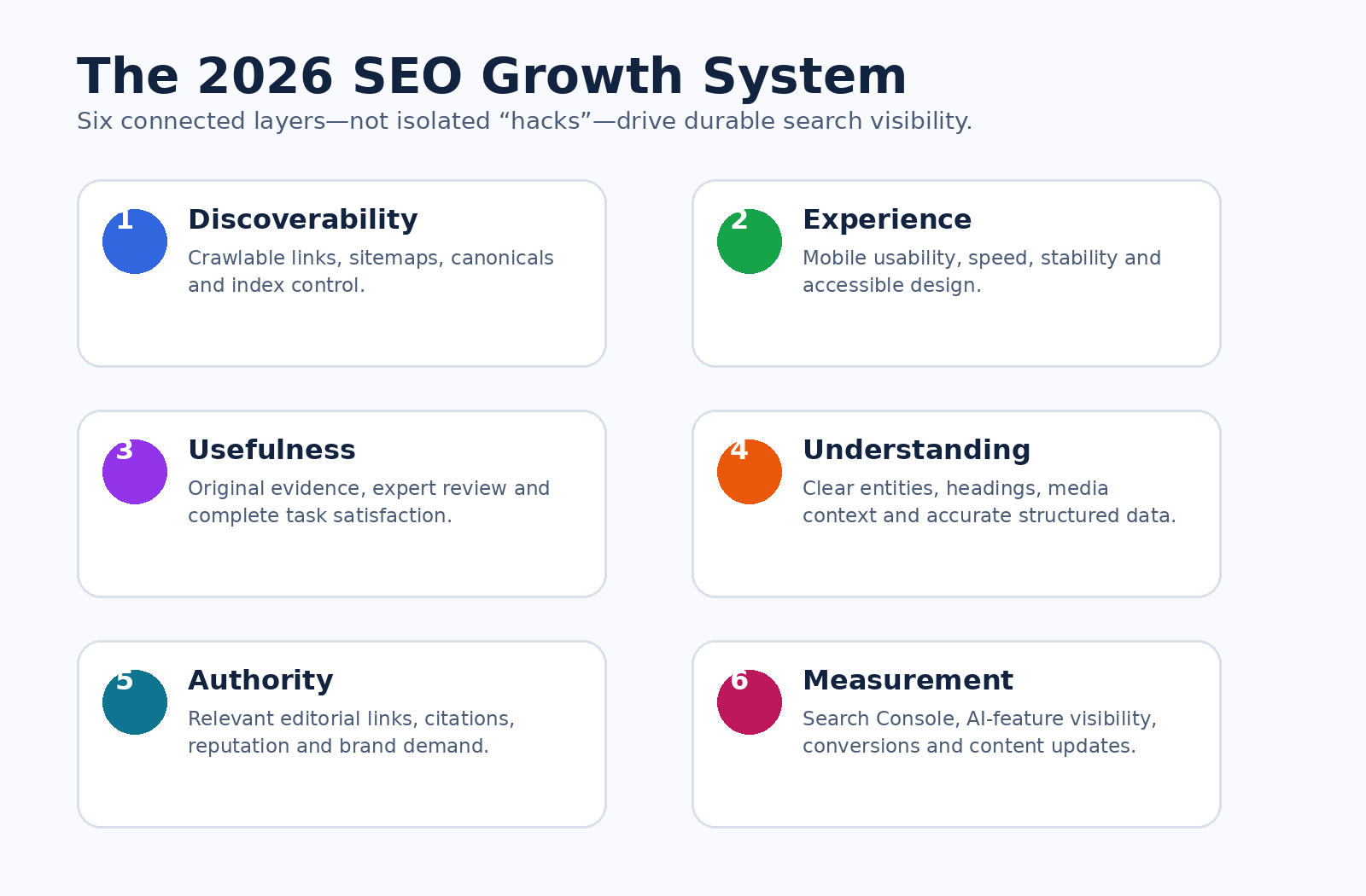
SEO in 2026 is no longer a contest to repeat exact-match keywords, publish the longest page or collect the largest possible number of links. Search now spans classic results, AI Overviews, AI Mode, images, video, local results, product experiences and Discover. The durable strategy is still SEO—but it must combine useful content, sound technical foundations, clear brand and entity signals, strong page experience and disciplined measurement.
Google’s current guidance is straightforward: foundational SEO practices continue to apply to generative AI search. There is no special shortcut, secret markup or guaranteed ‘GEO hack’ that replaces crawlability, quality and relevance. Pages are more likely to perform when they provide original value, make important information easy to understand, and give visitors a reason to trust and act on the content.
This guide replaces CBOOMARANK’s 2023 checklist with a practical 17-part system for earning qualified organic traffic and measuring whether that traffic contributes to leads, subscriptions or sales.
SEO best practices at a glance
| Priority | What good execution looks like |
| Content quality | Original evidence, expert input, accurate sourcing and clear task completion |
| Technical SEO | Crawlable pages, correct canonicals, clean sitemaps and mobile parity |
| Search appearance | Aligned title/H1, helpful snippet, strong images and accurate schema |
| Authority | Editorial links, reputation, brand consistency and transparent authorship |
| AI visibility | Foundational SEO plus complete, well-supported answers and GSC measurement |
| Revenue | Track conversions and improve pages that already attract qualified demand |
1. Establish a search baseline before changing the site
Start with evidence. Export at least three months of Google Search Console data by page, query, country and device. Record impressions, clicks, click-through rate and average position, then connect those pages to conversions in your analytics platform. In 2026, also review the dedicated generative-AI performance report where it is available so you can see visibility from AI Overviews, AI Mode and related experiences.
Create a short priority list: pages with high impressions and low CTR, pages ranking just outside the top results, pages losing clicks, and pages that generate revenue despite modest traffic. Improving proven pages is often faster and safer than publishing dozens of untested articles.
Action: Run a free SEO analysis and compare the findings with Search Console data.
2. Make every important page crawlable and indexable
A page cannot rank if Google cannot reliably discover, render and index it. Use standard HTML links, return successful HTTP status codes, keep important content available without interaction, and remove accidental noindex directives. Check the URL Inspection report after major template or plugin changes.
Do not use robots.txt as a substitute for noindex. Robots.txt controls crawling; a page that is blocked from crawling may still appear as a URL-only result if Google discovers it elsewhere. For pages that should not appear in search, use an appropriate noindex directive while allowing the crawler to access the page.
3. Consolidate duplicate URLs and submit only canonical pages
Choose one preferred URL for each piece of content. Redirect obsolete duplicates, use self-referencing canonical tags on indexable pages, and include only preferred canonical URLs in the XML sitemap. This is especially important when the same article is available through multiple domains, HTTP and HTTPS, trailing-slash variations, tracking parameters, category archives or print versions.
For CBOOMARANK, the primary blog version should remain consistent. A clean canonical and redirect strategy protects link equity and prevents analytics from being split across duplicate addresses.
4. Design for the mobile version first
Google uses the mobile version of a page for indexing and ranking. The mobile page should contain the same primary content, headings, images, structured data, internal links and metadata as the desktop version. Avoid hiding useful content behind components that fail to load or become difficult to use on smaller screens.
Test menus, tables, comparison cards, forms, ads and cookie notices on real mobile devices. A page that technically fits the screen can still perform poorly if the text is tiny, buttons overlap, ads obscure the content or the layout jumps during loading.
5. Publish non-commodity content with visible experience
Generic summaries are easy to reproduce and difficult to defend. Build pages around information that competitors cannot copy instantly: original screenshots, tool tests, pricing checks, benchmarks, templates, expert interviews, first-party data, before-and-after examples and transparent methodology.
Show who created the article and why readers should trust the advice. Use accurate bylines, author pages, reviewer information where appropriate, publication and update dates, source links and a corrections process. These signals are particularly important for financial, health, legal and other high-impact subjects.
6. Satisfy the search task—not just the keyword
Use keyword research to understand the audience’s language, but organize the page around the task the visitor wants to complete. A query such as ‘best SEO audit tool’ requires evaluation criteria, real comparisons, limitations, pricing context and a recommendation—not a definition followed by twenty nearly identical descriptions.
Review the current result page, related questions, first-party Search Console queries, customer conversations and support tickets. Cover the necessary subtopics naturally. Avoid forced keyword density targets, mechanical synonym insertion and headings written only to contain exact-match phrases.
Related guide: Keyword research tools for 2026.
7. Write clear title links and search snippets
Create a concise, descriptive title that matches the page’s main heading and avoids boilerplate repetition. Google may generate a title link from several on-page sources, so the title element, visible H1, prominent text and internal anchor text should communicate the same topic.
Write a unique meta description as a truthful pitch for the page. Google can select another passage when it better matches the query, but a strong description can improve clarity and click-through rate. Do not waste effort on the meta-keywords tag; Google does not use it for ranking or indexing.
8. Structure content for people and machine understanding
Use one clear page title, descriptive H2 and H3 sections, short paragraphs, meaningful lists, comparison tables and summary boxes where they help the reader. Answer important questions directly, then add explanation, evidence and nuance.
This structure can also help search systems identify useful passages, but do not split every sentence into artificial ‘chunks’ or write robotic question-and-answer blocks solely for AI systems. Google’s current AI guidance says useful, original content and foundational SEO remain the priority.
9. Strengthen authorship, brand and entity clarity
Make it easy to understand who operates the website, what the business offers, where it operates and how it can be contacted. Keep organization names, logos, addresses, telephone numbers and social profiles consistent across the site.
Use an About page, author profiles, editorial policies and accurate Organization structured data. Remove placeholder copy and conflicting contact details. Brand clarity helps users evaluate trust and reduces ambiguity for search systems.
10. Build topic clusters with useful internal links
Every important article should be linked from at least one crawlable hub, category page or relevant established article. Use descriptive anchor text that explains what the destination contains. Link to deeper supporting pages when they help the reader complete the task, not merely to manipulate anchor-text ratios.
A practical CBOOMARANK cluster could connect this guide with the keyword-research, link-building, AI SEO and PPC tools guides, then point commercial visitors to the free SEO analysis, SEO services and pricing pages. Audit orphan pages and broken links regularly.
Build the cluster with the AI SEO tools guide, the link-building tools guide and the PPC tools guide.
11. Use structured data accurately
Structured data helps Google understand page entities and may make eligible content available for richer search appearances. Blog posts should use accurate Article or BlogPosting markup with the real headline, author, dates and representative images. Organization and BreadcrumbList markup can clarify site and navigation information.
Markup must describe visible page content. Do not add ratings, FAQs, products or events that users cannot see, and do not expect structured data to improve rankings by itself. Validate with Google’s Rich Results Test and monitor enhancement reports in Search Console.
12. Optimize original images and visual assets
Use relevant original images near the text they support. Give files descriptive names, add concise alt text that explains the image’s purpose, specify dimensions to reduce layout shifts, and compress modern formats such as WebP or AVIF where supported.
Large featured images can support visibility in Search, Discover and social sharing, but oversized files can damage performance. Keep the best source image available while delivering responsive sizes to each device.
13. Meet Core Web Vitals without sacrificing usefulness
Core Web Vitals measure loading, responsiveness and visual stability. The recommended thresholds are an LCP of 2.5 seconds or less, INP of 200 milliseconds or less, and CLS of 0.1 or less at the 75th percentile of real-user visits.
Start with field data in Search Console and the Chrome User Experience Report, then use laboratory tools to diagnose causes. Common WordPress improvements include image optimization, efficient caching, fewer render-blocking scripts, restrained plugin use, stable ad dimensions and faster hosting. Performance is one part of page experience; a fast page still needs useful content.
14. Earn editorial links and genuine mentions
Links remain useful for discovery and relevance, but sustainable authority comes from being worth citing. Publish original research, free tools, statistics, templates, expert commentary and resources that solve recurring industry problems. Promote them to journalists, partners and relevant publishers with personalized outreach.
Avoid buying links for ranking, automated guest-post networks, large-scale exchanges, hidden links and keyword-rich sponsored anchors. Paid or sponsored placements should be qualified appropriately. Measure link quality by relevance, editorial judgment, referral value and reputation—not only a third-party authority score.
See the current link-building tools guide for research, outreach and monitoring options.
15. Refresh, merge and retire content deliberately
Updating an article should mean more than changing the year in its title. Retest tools, verify prices, replace obsolete screenshots, correct broken links, add new evidence and remove claims that no longer help the reader.
When several pages target the same intent, select the strongest URL, combine unique value and redirect redundant versions. Do not mass-delete content simply to appear ‘fresh.’ Use traffic, links, conversions, originality and strategic relevance to decide whether to improve, merge, noindex or remove a page.
16. Optimize for AI-powered search without chasing myths
Google states that the best practices for AI Overviews and AI Mode are the same foundations used by Search: crawlable pages, unique value, clear content, good experience and accurate business or product data. You do not need an llms.txt file, special AI markup or inauthentic web mentions for Google Search.
Create content that can support complex follow-up questions: define the decision, explain trade-offs, cite primary evidence, include concrete examples and keep facts current. Use Search Console’s generative-AI report to observe visibility, but judge success by qualified visits, engagement and conversions—not mentions alone.
17. Measure business outcomes and run controlled improvements
Rankings and impressions are diagnostic metrics, not the final goal. Track newsletter registrations, audit requests, account sign-ups, qualified leads, ecommerce sales and revenue by landing page. Segment results by country, device, query intent and content cluster.
Run one meaningful change at a time when possible: improve a title, expand a weak comparison, add first-party evidence, repair internal links or speed up the template. Record the date, request recrawling when appropriate and allow enough time for Google to recrawl and reprocess the page before drawing conclusions.
90-day implementation checklist
| Period | Priority work |
| Days 1–14 | Fix duplicate URLs, crawl blocks, canonical errors, sitemap issues, security challenges and inconsistent business information. |
| Days 15–30 | Upgrade the ten pages with the strongest impressions or commercial value; improve titles, snippets, evidence, internal links and calls to action. |
| Days 31–60 | Build two topic clusters, publish original assets, repair orphan pages and begin outreach for editorial citations. |
| Days 61–90 | Review Search Console and generative-AI visibility, compare conversions by landing page, and update the pages with the clearest opportunity. |
Turn the checklist into an action plan
Start with CBOOMARANK’s free SEO analysis to identify on-page and technical issues. Businesses that need implementation support can review CBOOMARANK’s SEO services and pricing plans.
Frequently asked questions
Are SEO best practices still relevant with AI Overviews and AI Mode?
Yes. Google says its generative AI features rely on core Search ranking and quality systems, so crawlability, useful original content, technical clarity and page experience remain the foundation.
Do I need GEO, AEO or an llms.txt file to appear in Google AI results?
No special file or markup is required for Google Search. AEO and GEO can describe a focus on answer or generative experiences, but Google advises site owners to prioritize established SEO practices rather than unsupported hacks.
How many keywords should a page target?
Use one clear primary topic and the related language needed to satisfy the search task. There is no ideal keyword count or density. Relevance, usefulness and natural coverage matter more than repetition.
How long does SEO take to work?
Some technical corrections can be processed after the next crawl, while competitive content and authority improvements may take weeks or months. Timing depends on crawl frequency, site history, competition and the scale of the change.
Are backlinks still important?
Links help search engines discover pages and understand relevance, but quality matters more than volume. Earn editorially chosen links and avoid schemes designed primarily to manipulate rankings.
Does structured data improve rankings?
Structured data helps Google understand content and can make eligible pages available for rich-result features, but it is not a direct ranking guarantee.
Should old articles be deleted?
Not automatically. Review their traffic, links, conversions, uniqueness and strategic fit. Improve or merge valuable pages; remove or noindex pages only when they provide little value and cannot be usefully repaired.
What should CBOOMARANK optimize first?
Start with pages that already receive impressions, rank near page one, generate leads or support important product and service journeys. Fix technical duplication and trust inconsistencies before scaling new content.
Conclusion
The most effective SEO strategy in 2026 is not a collection of tricks. It is a repeatable system: make the site easy to crawl, publish information worth citing, present it clearly, build trust, earn relevant authority and measure whether search visibility creates business value.
Use CBOOMARANK’s free SEO analysis to identify technical and on-page issues, then prioritize the changes that affect your most valuable pages. Consistent improvement across content, technology and conversion paths is more durable than chasing every new acronym or algorithm rumor.
Authoritative sources and further reading
- Google Search Essentials
- Google SEO Starter Guide
- people-first content guidance
- AI optimization guide
- AI features and your website
- generative AI performance reports
- title-link guidance
- snippet guidance
- crawlable-link guidance
- sitemap guidance
- Article structured data
- image SEO guidance
- Core Web Vitals
- mobile-first indexing
- spam policies
- third-party SEO guidance
