

High-authority backlinks can introduce your business to a relevant audience, help other publishers discover useful resources, and support search visibility when they are earned through genuine editorial choice. But authority is not a number you can buy, and no backlink guarantees a ranking improvement. In 2026, the better goal is to earn relevant, trustworthy links from pages that have a reason to mention your work.
This guide shows how to evaluate backlink opportunities, create link-worthy assets, run ethical digital PR, assess competitor links, pitch editors, manage sponsored placements correctly, and measure outcomes. You will also see how to connect those activities with CBOOMARANK keyword research, competitor research, backlink intelligence, outreach, monitoring and reports.
Quick answer: Publish something genuinely worth citing; identify the journalists, resource editors and communities for whom it is useful; pitch a specific reason to reference it; and monitor both editorial links and business outcomes. Prioritize contextual relevance over an impressive-looking domain metric.
What Are High-Authority Backlinks?
A backlink is a link from another website to a page on yours. People often call a backlink “high authority” when it comes from a well-known, trustworthy or influential publisher. However, authority is not one universally defined score. Domain Authority (DA), Domain Rating (DR) and similar figures are third-party metrics with different calculation methods. They can help with research, but Google does not use those vendor metrics as a direct ranking score.
Consider two examples. A small industry association publishes a detailed guide and cites your original research in the paragraph where the evidence belongs. A very large unrelated entertainment site lists hundreds of outbound links in a generic directory. The association’s link may have lower third-party domain metrics, yet it is more relevant to readers and more defensible as an editorial recommendation. A sensible high-authority backlink strategy looks at the source page, context, editorial independence, audience and risk, not merely the referring domain’s headline score.
Editorial links, referral links and paid links are different
An editorial link is added by a publisher because the destination helps the publisher’s audience. A referral link is any link that sends visitors, regardless of whether it affects search visibility. A sponsored link is part of advertising, sponsorship or another compensated arrangement and should be appropriately qualified. These categories can overlap in their business value, but they are not interchangeable from an SEO-policy perspective.
Google’s spam policies specifically cover buying or selling links for ranking purposes, excessive link exchanges, and scaled links created to manipulate rankings. Its outbound-link guidance explains appropriate link attributes. Build your process around those policies rather than assuming all acquired links should pass ranking credit.
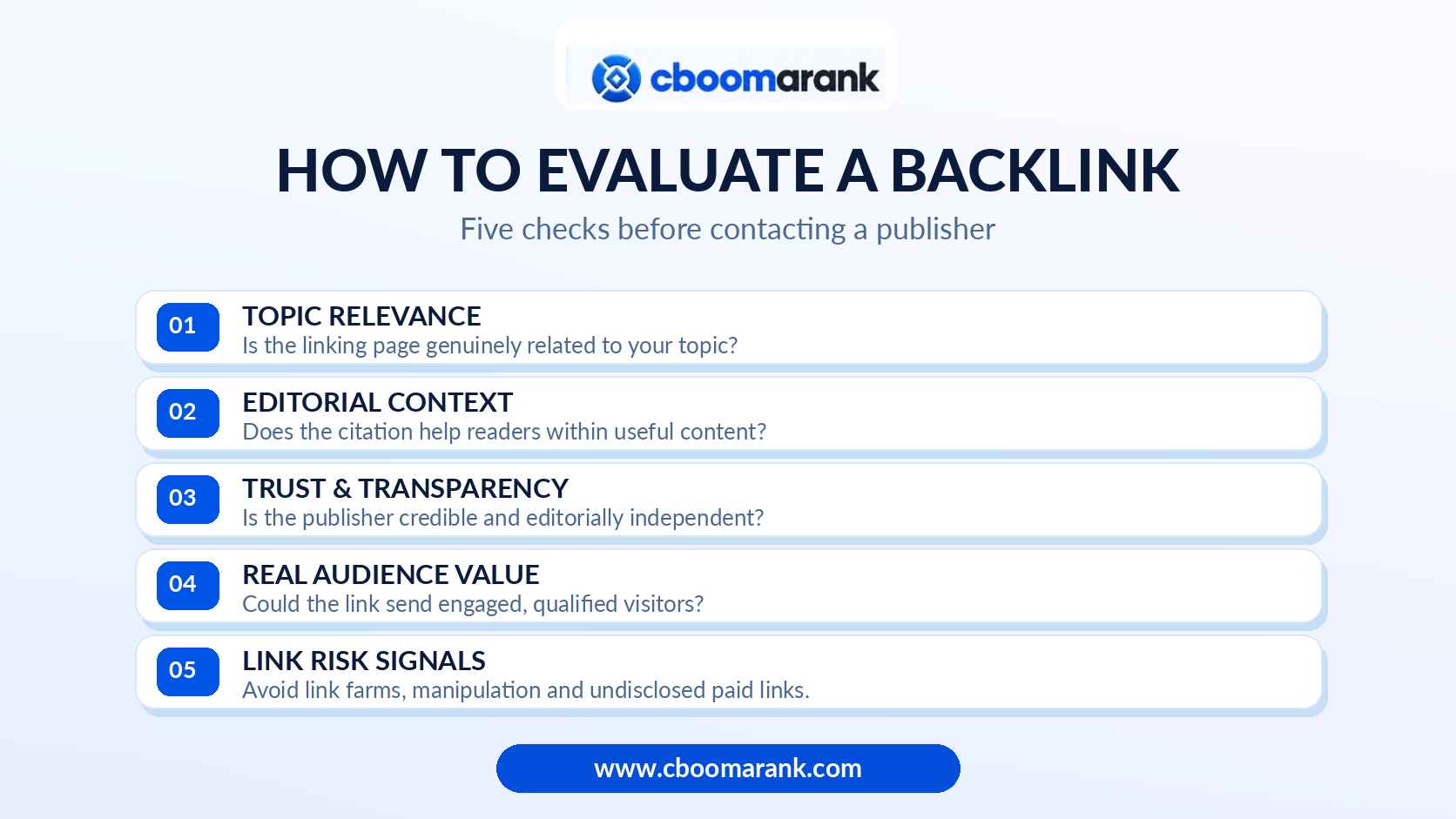
How to Evaluate a High-Authority Backlink Opportunity
Before contacting an editor, inspect the actual page where a link might appear. The best high-authority links tend to have a defensible reason to exist even if search engines did not count them.
1. Topic Relevance for High-Authority Backlinks
Ask whether the publisher serves people who could reasonably use your information. A cybersecurity resource pointing to an original network-security study is easier to justify than a celebrity-news site linking to a technical SEO tool. Look at recent coverage, editorial sections, geographic focus and the audience’s questions. Relevance also changes at page level: one highly focused article can be more valuable than a generic page on a famous domain.
2. Trustworthiness of High-Authority Backlink Sources
Look for real authorship, transparent ownership, reasonable sourcing, editorial corrections, useful content and clear distinctions between advertising and independent reporting. Be cautious when many posts seem templated, outbound links point to unrelated commercial destinations, or publishers promise ranking gains for a set fee. Established brands can still publish poor pages, and smaller publications can produce excellent reporting.
3. Placement, anchor text and link attributes
A contextual citation beside the data it supports usually makes more sense to readers than a disconnected footer or sitewide link. Descriptive anchor text should identify the destination naturally; forced exact-match commercial anchors are a warning sign. Check whether the link would be editorial, rel="nofollow", rel="sponsored", or another qualified type. Paid placements should not be disguised as independent endorsements.
4. Referral Value of High-Authority Backlinks
Check whether the source page is accessible, relevant to the intended audience and likely to be visited or shared. A technically reachable URL is not proof that it will rank or send traffic. Equally, the absence of a measurable SEO lift does not mean the link was useless: a citation can create reputation, partnership, qualified visits or conversions. Use referral analytics and campaign notes to understand the actual result.
5. Stability and Risk of High-Authority Backlinks
Consider whether the publisher has a history of deleting placements, changing destinations or converting editorial articles into large batches of paid links. Review unnatural outbound-link patterns and the source site’s general quality. Do not treat a third-party spam score as a definitive judgment; investigate the underlying evidence. Maintain a short reason for approving or rejecting each opportunity.
11 Sustainable Ways to Earn High-Authority Backlinks in 2026
Different industries have different linkable assets. A B2B software company can publish original benchmark data, while a local service provider may earn meaningful citations by supporting a community program or contributing subject-matter expertise. Use the strategies below as a menu, not a mass-mailing checklist.
1. Publish Original Research to Earn High-Authority Backlinks
Survey qualified respondents, analyze anonymized first-party data with permission, or conduct a repeatable study with documented methods. Publish sample size, dates, definitions, limitations and a usable summary. For instance, an SEO team could compare time-to-fix for categories of technical issues across a clearly defined sample of websites. A meaningful finding with transparent methodology is more defensible than a generic “100 statistics” compilation.
Offer a chart, methodology and clear citation URL. Give editors enough evidence to verify the claim without asking them to trust a branded infographic. Update the source page when new observations arrive, and label historical data clearly instead of silently replacing numbers.
2. Create Resources That Attract Quality Backlinks
Original templates, calculators, implementation checklists, testing tools and public datasets can earn citations when they solve a specific recurring problem. A linkable asset might be an SEO audit worksheet, a schema debugging reference, or a clear guide to interpreting Search Console metrics. Keep access straightforward and explain any data collection. A gated sales form can limit editorial usefulness if journalists need to view your evidence quickly.
3. Contribute expert commentary to journalists
Journalists need sources who can explain a development accurately and quickly. Build a short media-ready biography, factual evidence and direct contact details. Respond only when you have relevant expertise; include a concise, attributable quote and supporting data. You cannot demand a link or guarantee inclusion. The value is being a credible source, with a potential citation or mention as a secondary outcome.
4. Run digital PR around a specific story
A digital PR pitch needs a news angle, not a plea for a backlink. Consider timeliness, relevance to the publication’s readers, and independent evidence. Explain what changed, why it matters, how you measured it and where the supporting material lives. Make charts accessible and disclose any commercial interests. After publication, send corrections promptly if something is wrong and avoid pressuring editors over anchor text.
5. Offer thoughtful contributions to industry organizations
Trade associations, professional communities, educational programs and local organizations sometimes publish credible resource pages. Contribute expert training, data, checklists or event material that is independently useful. Any link should reflect real participation and the receiving site’s editorial policies. An unrelated membership directory sold primarily for SEO value is not the same as an earned editorial citation.
6. Share Case Studies That Can Earn High-Authority Backlinks
Explain the original problem, baseline, intervention, measurement period, confounding factors and outcome. Obtain permission before revealing client information. Avoid attributing all ranking movement to a single link or campaign when content quality, seasonality, competition and technical changes may also affect results. A detailed case study is often more citable than a boast about percentage growth with no context.
7. Pitch appropriate resource pages
Search for curated guides that genuinely help the audience you serve. Read the page first and verify your asset adds a missing capability, current evidence or useful perspective. One concise message should explain the gap and the relevant URL. If the page does not need your resource, move on. Mass submissions to low-quality directories rarely produce the same editorial value.
8. Help fix broken references when you have a true replacement
When an external page references a dead resource, check what that missing resource originally supplied. If your page addresses the same need with comparable or better information, politely alert the editor and offer it as an option. Do not pitch unrelated product pages as substitutes for expired research reports. This method works because it helps preserve a publisher’s useful references, not because the link is owed to you.
9. Recover Unlinked Mentions and Relevant Backlinks
Sometimes a publication quotes your study or names a tool without citing its source. Confirm that the mention is yours and that a source link would help readers verify the claim. Ask politely whether the editor would consider adding the original reference. Some publications intentionally avoid external links; respect that decision. Track attribution and referral traffic as well as links.
10. Publish distinctive visuals backed by primary data
Charts and diagrams can simplify a complex subject. Put the definition, dataset and update date alongside the visual, and supply a text equivalent for accessibility. Let editors use the graphic according to your licensing terms. Avoid placing invented statistics into polished illustrations; any numerical claim that readers might interpret as research needs a reliable source or explicit “illustrative example” labeling.
11. Contribute Guest Articles Without Link Schemes
Guest contributions can establish expertise and introduce your work to new readers when the article is written for the publication’s audience. Avoid scaled guest-post programs built mainly to inject keyword-rich links. If a placement is sponsored, use the appropriate link qualification. For a more detailed process, explore the CBOOMARANK link building tools comparison alongside Google’s published link policies.
Competitor Backlink Research: Find Gaps Without Copying Spam
Competitor analysis is useful when it reveals why a page was cited. It is unhelpful when it turns into cloning another site’s link list. Start with a handful of true organic competitors, including niche publishers that may differ from your commercial competitors. Identify a representative set of linked-to pages, the topics they cover and the pages that cite them.
Identify Competitor High-Authority Backlinks Worth Studying
Create categories such as original research citations, curated resources, journalist quotes, community contributions, professional profiles, sponsorships and low-value listings. For each, note the publisher, linking page, date, topic fit, surrounding context and whether a similar contribution from you would actually help readers. You may discover that the competitor’s most attractive links came from one unique study rather than a repeatable “link trick.”
Create Better Reasons to Earn High-Authority Backlinks
If a competitor has the only recent public comparison in your niche, produce an independent analysis with clearer methodology rather than paraphrasing theirs. If a resource list lacks a capability your tool offers, make that benefit easy to verify. In CBOOMARANK, connect competitor research with website projects, backlink opportunities and outreach campaigns, then qualify prospects manually before contacting anyone. Availability and accuracy depend on the metrics and provider coverage available for each domain.
How to Run High-Authority Link Outreach Without Spamming
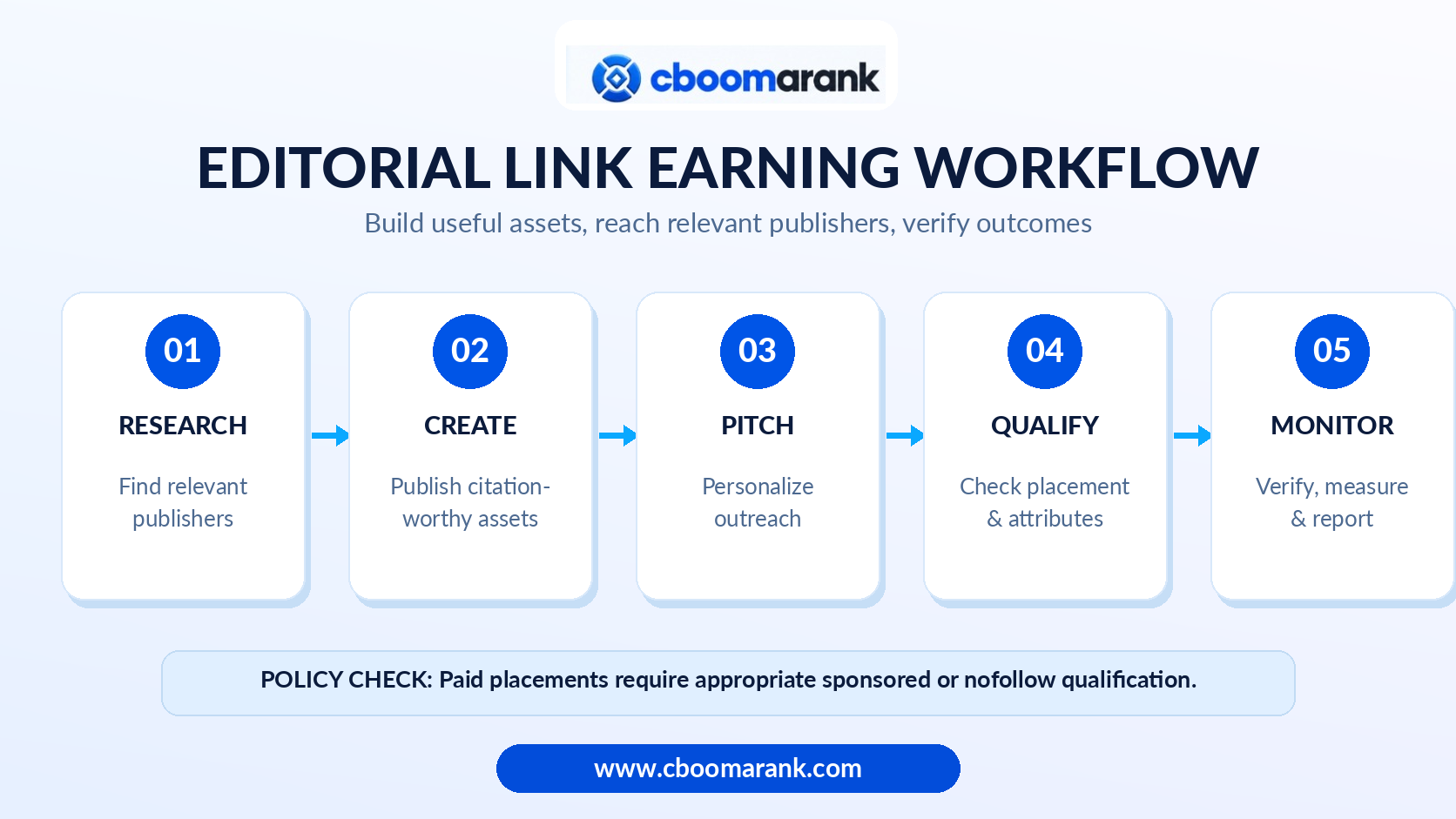
A good outreach process is short, respectful and built around editorial usefulness. Research the publication’s actual beat and preferred contact channel. Avoid harvesting irrelevant email lists or sending the same message to hundreds of editors. A link campaign should be auditable: who was contacted, why the resource was relevant, whether the editor replied and what ultimately happened.
Use a clear, specific email pitch
Example: “I saw your resource on measuring local search visibility. We published a new dataset covering how organizations track branded versus non-branded local queries, with methodology and an accessible chart. The section on reporting limitations may be useful to your readers. Here is the source URL. No response is needed if it is not relevant.” This format explains the fit without promising rewards or dictating the anchor text.
Keep follow-ups proportionate
One courteous follow-up may be reasonable if the outlet’s guidelines permit it. Do not treat silence as permission to keep sending reminders. Record opt-outs, corrections and negative replies. Publishers retain full editorial control over whether, how and where to mention your material.
Document relationships, not just placements
Track useful conversations and future topic interests, even when a pitch earns no link. A reporter who trusts your accurate explanations may contact you for a later story. Measure relationship quality through repeat invitations, evidence requests and relevant coverage rather than raw email volume alone.
Sponsored Posts, Guest Posts and Google’s Link Spam Policies
Buying advertising is a normal marketing activity. Attempting to purchase ranking credit is different. Google’s spam policies identify links bought or sold for ranking purposes as a problematic practice and explicitly discuss advertorials, guest posts with optimized anchor text and large-scale schemes. The link qualification guidelines recommend rel="sponsored" for advertisements and paid placements; nofollow may also be used for such links.
If you use a publisher marketplace, treat it as a channel for audience access, editorial collaboration and transparent sponsored content, not a way to promise search-ranking gains. Confirm the publisher’s disclosure and link-attribute rules before ordering, and ensure the final article is useful to readers. Never instruct a publisher to remove required sponsored attributes to make the link appear editorial.
Red flags that should stop an acquisition
- The seller guarantees Google rankings, PageRank transfer or a fixed number of “dofollow authority links.”
- The page exists mainly to carry paid anchors and unrelated outbound links.
- The network uses identical spun articles across dozens of domains.
- The seller asks you to hide a sponsorship or alter disclosures.
- No one can explain who reads the publication or why your story belongs there.
Not every low-quality link warrants emergency cleanup, and indiscriminate disavow requests can create new risks. For manual-action concerns, follow the official Google disavow guidance and investigate first.
High-Authority Backlink Metrics That Matter
Use a multi-signal view rather than a single score. Third-party authority estimates are directional research aids. They are not a substitute for editorial judgment, referral analytics or your own search-performance trends.
Quality Metrics for High-Authority Backlinks
- Relevant referring domains: unique websites linking from topical pages, categorized by meaningful subject and geography.
- Contextual editorial links: placements where an author cites a specific claim, source or resource.
- Source-page characteristics: accessibility, editorial context, visible authorship, organic audience fit and link qualification.
- New and lost links: meaningful changes over a defined reporting period, with checks for transient crawl changes.
- Linked-page coverage: which valuable pages earn citations and which receive none.
Business Outcomes from High-Authority Backlinks
- Referral visits: engaged visitors arriving from the linking page when analytics and consent settings permit measurement.
- Qualified leads and conversions: submissions, sales, account creations or other relevant actions associated with the referral source.
- Brand discovery: coverage, relevant mentions and branded-search changes considered with other influences.
- Organic search performance: clicks, impressions and query patterns in Search Console, interpreted alongside content and technical work.
- Campaign efficiency: qualified pitches, meaningful responses, editorial coverage and staff effort rather than links per bulk email.
For a consistent measurement framework, read how to measure SEO results and the updated SEO statistics guide. Those metrics provide context without implying every improvement was caused by one backlink.
Using CBOOMARANK Backlink Intelligence in One Workflow
Link research works best when it connects to the website, page and business objective. In the CBOOMARANK application, begin with an owned project and a priority URL. Review available authority and backlink-related metrics, research relevant competitors, identify gaps and marketplace opportunities, and organize qualified outreach targets into campaigns. Where monitoring and reporting are configured, use the available new/lost-link signals and exports to review progress over time.
Step 1: Select the page and its citation-worthy asset
Choose a page that truly answers a question: a data study, implementation guide, report, comparison or public utility. Document the target audience and the precise value of the asset. A weak landing page will not become link-worthy merely because it has good outreach automation.
Step 2: Discover and qualify prospects
Compare the backlink context of relevant competitors and review potential publisher or editorial matches. Examine the actual prospective page, its audience and the relationship between the source and your topic. Do not confuse a marketplace listing with proof that a link is editorial or likely to improve rankings.
Step 3: Manage outreach and placements responsibly
Use campaign tracking to avoid duplicate contacts and keep notes about responses, editorial requirements and link attributes. Where paid marketplace orders are involved, record sponsorship expectations explicitly. Editorial outreach should not be treated as a guaranteed-acceptance transaction.
Step 4: Verify and report what happened
After a mention or placement goes live, check the URL, the destination, the surrounding text and whether the required attributes are present. Monitor changes because pages may move or disappear. Use reports to assess link coverage, outreach status, referral activity and the broader SEO trend. A report that distinguishes “discovered,” “contacted,” “published,” and “verified” is more useful than a single unqualified count.
Turn backlink research into a measurable workflow. Explore CBOOMARANK’s SEO analysis, competitor research, backlink opportunities and reporting in one project.
30-Day High-Authority Backlink Action Plan
Week 1: Audit High-Authority Backlink Opportunities
Review the existing backlink profile, confirm important destination pages are technically accessible, and identify the most relevant industry publishers. Note genuinely valuable links, suspicious patterns and broken inbound references. Choose one clear business objective, such as referring qualified visitors to a free research tool or building awareness for a specific report.
Week 2: Produce an Asset Worthy of High-Authority Backlinks
Create one useful original resource rather than many thin posts. Include methodology, citations, accessible visuals, author information and a clear update date. Compare it with the resources editors already cite. Improve it until an independent reader could explain why your resource deserves attention.
Week 3: Targeted Outreach for High-Authority Backlinks
Research a small, relevant publisher list and send personalized pitches that identify an audience need. Document contacts and respect editorial boundaries. Consider professional associations, resource editors, expert Q&As and topical newsletters. Avoid purchasing followed placements or flooding recipients with automated templates.
Week 4: Verify Your High-Authority Backlinks
Check earned mentions and links; confirm destination accuracy and sponsorship attributes. Record which pitches produced useful conversations, referrals or coverage. Review search metrics without claiming short-term ranking movements are caused solely by links. Use these findings to improve the asset and plan the next month.
Common High-Authority Link Building Mistakes
- Choosing domains only by DA or DR: these are vendor estimates, not guaranteed Google value.
- Overusing exact-match anchor text: a natural editorial citation should serve the reader, not a keyword formula.
- Publishing unverified statistics: an attractive chart without a traceable source weakens trust.
- Paying for undisclosed followed links: sponsorship needs transparent handling and appropriate attributes.
- Pitching the wrong audience: a large publication is not useful when the topic is irrelevant.
- Ignoring internal linking: external citations cannot replace clear navigation and useful content architecture.
- Confusing correlation with causation: backlinks, content, technical quality and demand can change together.
- Failing to monitor results: links can be edited or lost, while referral value can vary considerably.
Also review the technical SEO tools guide to make sure the pages receiving backlinks are crawlable, indexable and genuinely helpful.
Frequently Asked Questions About High-Authority Backlinks
Do high-authority backlinks guarantee better rankings?
No. Links can be one of many signals and discovery routes, but there is no reliable promise that a particular link will raise a page’s position. Content relevance, technical accessibility, query intent and competition also matter. Evaluate earned links as part of a wider SEO strategy.
Is Domain Rating or Domain Authority a Google ranking factor?
No. DR and DA are third-party measures used by SEO software providers. Their scales and calculations differ, and neither is Google’s public ranking score. Use them as context, then inspect the actual page and audience.
Can paid guest posts help promote a business?
Yes, paid editorial partnerships can introduce a business to a relevant audience. They must be transparent and should use appropriate link attributes such as rel="sponsored" when applicable. Do not buy links to manipulate rankings.
How many high-authority links do I need?
There is no universal target. A niche technical report may benefit from a few strong citations; a major consumer topic may have a very different competitive landscape. Focus on the usefulness, relevance, diversification and measurable outcomes of each opportunity.
What is the difference between an unlinked mention and a backlink?
An unlinked mention names your brand, product or research without a hyperlink. A backlink provides a clickable path. Both can help readers discover you, but only a link is an actual backlink. Asking for a source citation is reasonable when it makes the mention easier to verify.
Should I disavow every low-scoring backlink?
No. A low third-party score alone is not a reason to disavow. Investigate actual manipulative-link concerns and follow Google’s official instructions if you have substantial reasons to use the tool. Unnecessary disavowal can discard useful signals.
Conclusion: Earn Citations Worth Having
High-authority backlinks are most sustainable when they are a by-product of expertise, useful evidence, strong content and trustworthy professional relationships. The right question is not “How do I get the most links?” but “Which people should discover this resource, and what would make it worth citing?”
Use original research, relevant digital PR, industry contributions and careful editorial outreach. Evaluate pages rather than just domain scores, disclose paid placements, and measure referral and business outcomes as well as search visibility. To connect your research, outreach and reporting, start a CBOOMARANK project and compare the available plans on the CBOOMARANK pricing page.
Editorial note: This guide is published by CBOOMARANK and describes CBOOMARANK workflows as first-party product information. No ranking improvements, marketplace approval or backlink outcomes are guaranteed.
