


Website competitor analysis is the process of examining the websites that compete with you for search visibility, audience attention and commercial opportunities. The objective is not to imitate another company’s pages. It is to understand which strategies are producing results, where competitors are vulnerable and which opportunities deserve attention on your own website.
A useful competitor analysis goes well beyond checking domain authority or copying a list of keywords. It connects ranking pages, search intent, content quality, backlinks, site architecture, technical SEO and historical performance into a repeatable research workflow.
For growing websites, this matters because the real competitors in Google are not always the companies you consider your direct business rivals. A publisher, marketplace, comparison site, SaaS platform or niche blog can compete with you for the same search results even when its business model is completely different.
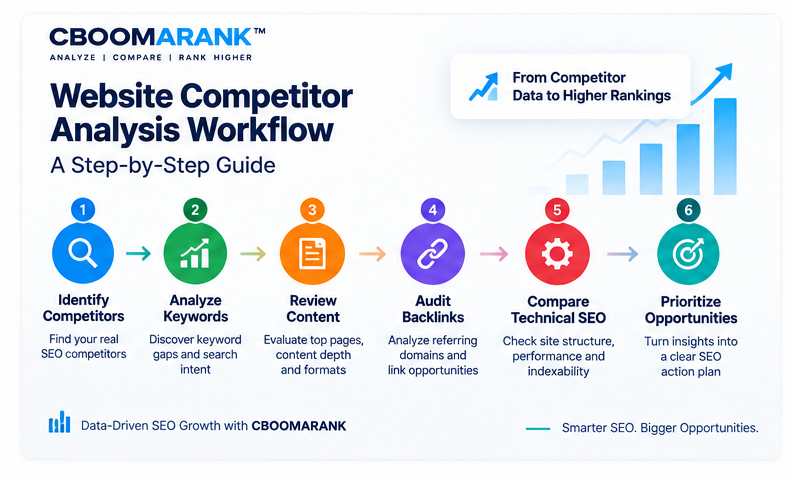
This guide explains how to reverse-engineer a competitor’s SEO strategy step by step, identify meaningful gaps and turn the findings into practical actions. If you are still deciding which research platforms to use, start with CBOOMARANK’s guide to the best competitor analysis tools.
What Is Website Competitor Analysis?
Website competitor analysis is a structured comparison of your site against other domains that compete for the same audience, search queries or organic visibility. The analysis focuses on evidence that can explain why another website earns rankings, traffic, links or engagement that your site does not yet capture.
In SEO, the process usually examines several connected areas:
- keywords and queries competitors rank for;
- pages generating organic visibility;
- search intent and page formats;
- content depth, freshness and topical coverage;
- backlinks and referring domains;
- internal linking and information architecture;
- technical SEO and crawlability;
- ranking trends and changes over time; and
- commercial relevance of the opportunity.
The purpose is not to create a giant spreadsheet of competitor metrics. The purpose is to answer practical questions: Which topics are we missing? Which competitor pages are outperforming ours? Why are they earning links? Where do they have weak content? Which opportunities fit our business? What should we prioritize first?
This is why a broader competitor research process is most useful when it connects observations to specific actions rather than treating competitor data as an end in itself.
Why Website Competitor Analysis Matters for SEO
SEO decisions become stronger when they are made in context. A keyword with high search volume may look attractive until you discover that the results are dominated by a page type your site cannot realistically compete with. A competitor may rank for thousands of keywords that have little commercial relevance to your business. Conversely, a small cluster of high-intent queries may represent a much more valuable opportunity.
Website Competitor Analysis Reveals Realistic Search Opportunities
Competitor research can expose queries where other sites already demonstrate measurable demand. Instead of starting from a blank keyword list, you can examine terms that generate visibility for relevant competing domains and then judge whether those searches also fit your audience.
Website Competitor Analysis Exposes Content Gaps
When multiple competitors cover a topic that your site barely addresses, that may indicate an opportunity. But a content gap is not automatically a publishing instruction. The gap still needs to be evaluated for intent, relevance, authority requirements and business value.
It helps explain ranking differences
A competitor may outrank you because its page satisfies intent better, contains more useful information, has stronger links, fits the preferred result format or benefits from better site architecture. Website competitor analysis helps break the difference into components that can actually be investigated.
It improves prioritization
The strongest competitor findings are those that help answer what to do next. For example, a page with strong demand, weak competing content and clear relevance may deserve attention before a much larger keyword whose results are dominated by authoritative brands.
| Competitor signal | What to investigate | Possible opportunity |
|---|---|---|
| Competitor ranks for relevant keywords you do not target | Intent, demand, SERP format and business relevance | New or expanded content |
| Competitor page consistently outranks yours | Content quality, links, freshness and technical signals | Refresh and strengthen your page |
| Competitor attracts many relevant backlinks | Why publishers reference the resource | Create stronger link-worthy assets |
| Competitor has weak or outdated content | Freshness, missing detail and user experience | Build a more useful alternative |
| Several competitors cluster content around one topic | Topic architecture and internal links | Develop a stronger topical cluster |
How to Identify Your Real SEO Competitors
One of the most common mistakes in website competitor analysis is starting with a list of business competitors and assuming they are also your main SEO competitors. Some will be. Others may have very little search overlap with your site.
Start Website Competitor Analysis With Priority Queries
Search the queries that matter most to your business and record which domains repeatedly appear. A domain that consistently competes with you across many important queries is usually more useful for SEO research than a business rival with little organic visibility.
Website Competitor Analysis at Domain and Page Level
You do not need to compete with an entire domain for it to matter. A single competitor page may dominate one valuable topic. For that reason, competitor research should work at both the domain level and the individual URL level.
Group competitors by type
Your search competitors may include direct businesses, informational publishers, marketplaces, review sites, software companies, news sites and communities. Grouping them helps explain why their strategies differ.
For example, a comparison publisher may win by producing large volumes of commercial research content, while a SaaS company may rank through product-led guides and original data. Their tactics should not be interpreted the same way.
Use several queries instead of one
A single search result is too narrow to define your competitive landscape. Build a set of priority topics, products and informational queries, then look for domains that repeatedly overlap.
You can also use Google Trends to compare interest patterns and understand whether topics are rising, seasonal or declining before investing heavily in them.
How to Reverse-Engineer Competitor Keywords and Search Intent
Keyword research is one of the fastest ways to understand how a competitor attracts organic visibility, but raw keyword lists can be misleading. The important question is not simply which terms a competitor ranks for. It is why those terms matter and what intent their ranking pages satisfy.
Use Website Competitor Analysis to Find Keyword Gaps
Start by comparing competitor visibility against your own site. Look for missing queries, weak positions and topics where competitors consistently appear while your site has little or no presence.
A structured keyword research workflow can help separate meaningful opportunities from irrelevant keyword overlap.
Group keywords by intent
Do not evaluate every keyword independently. Group related queries according to what users are trying to accomplish. Common intent patterns include informational research, comparison, commercial investigation, transactional action and navigation.
This prevents a frequent SEO mistake: creating a separate page for every keyword variation even when several queries clearly belong to the same intent. Use the site’s existing search intent framework to decide when keywords should share one authoritative page and when they genuinely require separate content.
Trace keywords back to ranking URLs
The ranking URL often reveals more than the keyword itself. Ask whether the competitor uses a guide, product page, category page, comparison, calculator, template or another format. Search engines may consistently favor one type of result for that query.
Look for clusters, not isolated terms
The strongest opportunity is often a group of related keywords supported by one well-structured resource and several supporting pages. This is where competitor analysis connects directly with broader SEO strategy rather than functioning as a standalone report.
Turn Competitor Data Into Action
Analyze your website and uncover higher-impact SEO opportunities
Connect competitor, keyword and website signals so you can prioritize the pages and opportunities that matter most.
How to Analyze Competitor Content and Ranking Pages
A strong website competitor analysis does not stop at keywords. You also need to understand why particular competitor pages earn visibility. Two pages may target similar queries but perform very differently because one satisfies intent more completely, presents information more clearly or demonstrates stronger authority.
Website Competitor Analysis of High-Value Ranking Pages
Start with pages that rank across multiple relevant queries, attract consistent visibility or appear repeatedly across your priority topic clusters. These are usually more valuable to study than isolated pages ranking for one low-value term.
Record the page type, primary topic, supporting subtopics, apparent intent, freshness, depth and calls to action. The goal is to identify patterns rather than copy individual paragraphs or layouts.
Compare information coverage
Ask what the competitor explains that your page does not. Look for missing definitions, examples, workflows, comparisons, statistics, FAQs, tables, screenshots and decision-support information.
This does not mean longer content automatically wins. A shorter page can outperform a longer page if it answers the user’s question more directly. Use a broader content optimization process to improve usefulness instead of simply adding words.
Evaluate freshness and evidence
Check whether competitors update dates, screenshots, pricing information, product references and industry examples. A page that was once strong can become vulnerable when its evidence is outdated.
Study result formats
Pay attention to whether winning pages are guides, comparisons, product pages, category pages, tools, templates or data studies. The preferred format can reveal what users and search engines expect from the query.
How to Audit Competitor Backlinks and Authority
Backlinks can explain why a competitor page remains difficult to outrank even when your content appears equally useful. Competitor backlink analysis helps identify which resources attract references, which publishers link to them and what kinds of assets repeatedly earn authority.
Website Competitor Analysis of Backlinks and Authority
Domain-level authority provides context, but page-level links are often more actionable. A competitor may have a powerful domain while a specific ranking page has relatively few relevant links. The reverse can also happen when one research asset attracts unusually strong references.
Use your existing competitor backlink analysis resources to compare referring domains, link relevance and the types of pages earning citations.
Look for patterns in link-worthy assets
Competitors frequently attract links through original research, statistics, calculators, templates, visual assets, comprehensive guides and useful tools. Instead of trying to reproduce their asset, identify why publishers considered it worth referencing.
Distinguish link quantity from link quality
Hundreds of irrelevant or low-quality links should not be treated as equivalent to a smaller set of relevant editorial references. Context, topical relevance and source quality matter.
Google Search Console’s Links report can also help you understand your own site’s linked pages and linking sites so you can compare your current link profile against the opportunities identified during competitor research.
How to Compare Technical SEO and Site Structure
Competitor rankings are not explained by content and backlinks alone. Technical accessibility, page performance, crawl paths and site architecture can affect how efficiently search engines discover and understand a website.
Website Competitor Analysis of Crawl Depth and Architecture
Examine how competitors organize categories, hubs and supporting articles. Important pages that sit close to the homepage and receive relevant internal links are generally easier for users and crawlers to discover than isolated pages buried deep in the site.
Review indexability and canonical signals
Look for patterns in indexable pages, duplicate URLs, pagination, canonicalization and thin archives. You are not trying to duplicate a competitor’s technical setup; you are looking for structural advantages or weaknesses that may influence visibility.
Check page experience and technical consistency
Review mobile usability, loading behavior, broken links, redirects, structured data and HTTPS consistency where relevant. A disciplined technical SEO audit helps determine whether your competitor advantage is partly structural rather than purely editorial.
Connect technical findings to ranking pages
Technical observations become useful when they explain important URLs. For example, if a competitor’s topic hub receives strong internal links and clean crawl paths while your equivalent content is fragmented, the issue is not simply keyword targeting. It is architecture.
How to Analyze Internal Linking and Topic Clusters
Internal linking reveals which pages a website considers important and how its content is organized into topical relationships. During website competitor analysis, this can expose strategic patterns that are easy to miss when looking only at individual URLs.
Website Competitor Analysis of Internal Links
Identify which pages consistently link to a competitor’s important resources and what anchor text they use. Strong internal linking can distribute authority, reinforce topical context and help users move naturally through related information.
Map topic clusters
Look for a central guide supported by narrower articles, comparisons, tools or commercial pages. If a competitor dominates a topic through a coordinated cluster rather than one isolated article, creating a single competing post may not be enough.
A dedicated internal linking workflow can help you uncover orphan pages, clarify relationships and strengthen the pages that matter most.
Compare your own cluster coverage
Build a simple map showing the competitor’s pillar pages and supporting URLs beside your own. Mark missing pages, weak links, outdated content and places where several of your URLs compete for the same intent.
How to Turn Competitor Findings Into an SEO Action Plan
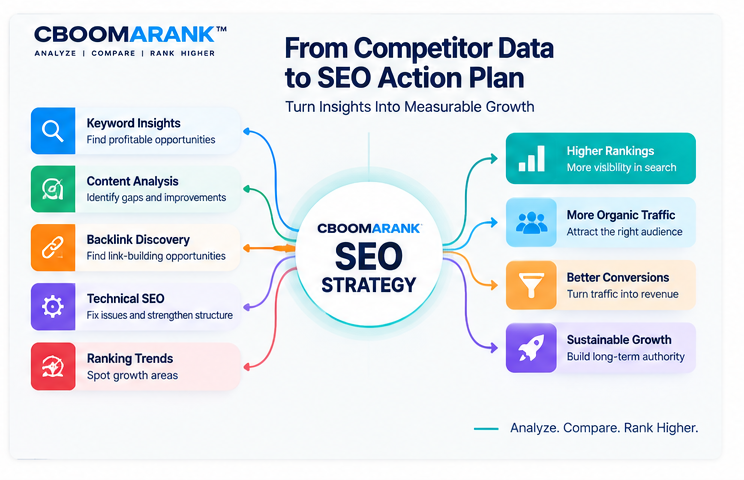
Research has little value if every finding becomes an urgent task. The final stage of website competitor analysis is prioritization: deciding which opportunities are relevant, achievable and likely to produce meaningful results.
Combine competitor evidence with your own data. Google Search Console’s Performance report can help you evaluate queries, pages, clicks, impressions and positions on your own site. That context prevents you from prioritizing competitor ideas without understanding your existing performance.
Prioritize Website Competitor Analysis Opportunities by Impact
Estimate the potential business value, search relevance, competitive difficulty, authority requirements and implementation effort. A moderate-volume opportunity with clear commercial relevance and a weak competitive result may deserve attention before a much larger but unrealistic keyword.
Separate quick wins from strategic projects
Quick wins may include improving titles, strengthening internal links, refreshing outdated sections or expanding a page that already ranks on page two. Strategic projects may require new topic clusters, original research, stronger backlinks or significant technical work.
Measure Results After Website Competitor Analysis
Record the baseline before changing a page, then monitor impressions, clicks, rankings, conversions and engagement afterward. Your rank tracking workflow should show whether the improvement is sustained rather than a temporary fluctuation.
| Opportunity | Impact | Effort | Recommended action |
|---|---|---|---|
| Existing page ranks just outside top results | High | Low–Medium | Refresh content, improve intent match and strengthen internal links |
| Competitors cover a valuable topic you completely miss | High | Medium–High | Create a differentiated authoritative resource |
| Competitor content is visibly outdated | Medium–High | Medium | Publish fresher evidence, examples and clearer guidance |
| Competitor page has strong relevant backlinks | High | High | Develop a link-worthy asset and targeted outreach plan |
| Your content exists but is poorly connected | Medium | Low | Improve contextual internal linking and topic architecture |
The purpose of this matrix is not to create a rigid score. It is to stop competitor research from turning into an unfiltered list of tasks. Your team should prioritize opportunities that fit its audience, resources and growth objectives.
One additional related resource from the CBOOMARANK library can support this process: this related SEO guide.
How CBOOMARANK Can Support Website Competitor Analysis
A useful website competitor analysis workflow becomes much more valuable when competitor findings connect directly with your own website data. Instead of treating keyword research, backlink analysis, content optimization, technical SEO and rankings as separate activities, the stronger approach is to evaluate them together.
CBOOMARANK is being designed around that connected workflow. The objective is to help website owners, publishers and SEO teams move from competitor discovery to prioritization and measurable action without losing the relationship between the signals.
Connect competitor keywords with your own opportunities
A competitor may rank for hundreds or thousands of keywords, but only a portion of those queries will be relevant to your audience. The useful workflow is to compare competitor visibility against your existing rankings, pages and topical coverage, then isolate gaps that have realistic value.
Connect content gaps with page-level evidence
Finding a missing topic is only the first step. You also need to determine whether the opportunity requires a new page, a stronger existing page, a consolidated resource or better internal linking. Competitor findings should therefore be evaluated alongside your own content inventory.
Connect authority signals with specific pages
Domain-level authority metrics provide context, but actionable SEO decisions normally happen at the page level. A useful workflow should help identify which pages need stronger backlinks, which already have sufficient authority and where better content or architecture may have a greater impact.
Prioritize instead of simply reporting
The goal is not to produce a long competitor report and leave users to interpret it manually. Higher-value analysis should help distinguish quick wins, important strategic projects and low-priority observations so teams can focus their resources where they are most likely to matter.
Turn Competitor Insights Into Action
Find the SEO opportunities that deserve attention first
Analyze your website, compare competing domains and connect keyword, content, backlink and technical signals with practical SEO priorities.
Frequently Asked Questions About Website Competitor Analysis
1. What is website competitor analysis?
Website competitor analysis is the process of examining websites that compete with you for search visibility, audience attention or commercial demand. It normally compares keywords, ranking pages, content, backlinks, site architecture, technical SEO and other signals to identify useful opportunities and weaknesses.
The objective is not to copy competitors. It is to understand why particular strategies are producing results and decide whether the underlying opportunity is relevant to your own website.
2. How do I find my real SEO competitors?
Start with the search queries and topics that matter most to your business. Identify the domains that repeatedly appear for those searches rather than relying only on your known business competitors.
A company can be a direct commercial competitor but have little organic overlap with you. Conversely, a publisher, marketplace or informational website can be an important SEO competitor even though it sells a completely different product.
3. What should I analyze during website competitor analysis?
At minimum, analyze competitor keywords, ranking URLs, search intent, content quality, backlinks, referring domains, internal linking, topic clusters and technical structure. For important opportunities, also evaluate freshness, user experience, result format and the business relevance of the query.
The most useful analysis connects these signals instead of judging any one metric in isolation.
4. How can I find competitor keywords?
Competitor research tools can show queries for which another domain or URL receives organic visibility. Compare those keywords with your own rankings to identify missing topics, weaker positions and queries where competitors have an advantage.
Then group the terms by search intent. Several keyword variations may belong to one authoritative page rather than requiring separate articles.
5. How do I analyze competitor backlinks?
Review both the competitor’s domain-level referring domains and the links pointing to specific high-performing pages. Look for patterns in the kinds of resources earning links and the relevance of the websites providing those references.
The useful question is not simply how many backlinks the competitor has. It is what makes particular pages link-worthy and whether you can create a genuinely stronger resource for your own audience.
6. Is it okay to copy a competitor’s SEO strategy?
No. Competitor analysis should provide evidence and context, not a template to duplicate. Another company’s strategy may depend on its brand authority, resources, audience, business model or history in ways that do not apply to your website.
Use the research to discover gaps, understand search intent and identify proven demand. Then create a differentiated approach that fits your own users and objectives.
7. How often should I perform website competitor analysis?
There is no single interval that fits every website. Competitive markets, rapidly changing search results and major content programs may justify more frequent reviews. Stable sites may conduct broader reviews quarterly while monitoring priority competitors and keywords more regularly.
Competitor analysis should also be repeated when rankings decline unexpectedly, when entering a new topic or market, when launching a major content cluster or when a new competitor begins gaining substantial visibility.
Final Verdict: Build a Website Competitor Analysis Workflow
Website competitor analysis is most powerful when it becomes an ongoing decision-making process rather than a one-time report. Competitor keywords can expose demand. Ranking pages can reveal search intent. Content gaps can highlight missing coverage. Backlinks can show what earns authority. Internal links and technical structure can explain why strong content performs consistently.
None of those signals should be interpreted alone. A competitor’s high-volume keyword may be irrelevant to your business. A heavily linked page may succeed because of original research that cannot simply be reproduced. A content gap may exist because the topic does not belong on your website at all.
The strongest approach is therefore to reverse-engineer the logic behind competitor performance rather than copy its visible output. Ask why a page ranks, why users choose it, why publishers link to it and how the site supports it through architecture and related content.
Then compare those findings with your own strengths, weaknesses and objectives. Prioritize improvements that are relevant, achievable and measurable. Preserve what already works. Strengthen pages with realistic upside. Build missing resources where genuine demand exists. Improve internal links and technical structure where they limit otherwise valuable content.
Finally, measure the result. Competitor research is only useful when it leads to better decisions and those decisions lead to measurable improvements in visibility, traffic, engagement or conversions.
CBOOMARANK’s broader opportunity is to connect this process into one workflow: discovery, comparison, prioritization, optimization and validation. That is what turns competitor data from another SEO report into actionable intelligence.
