

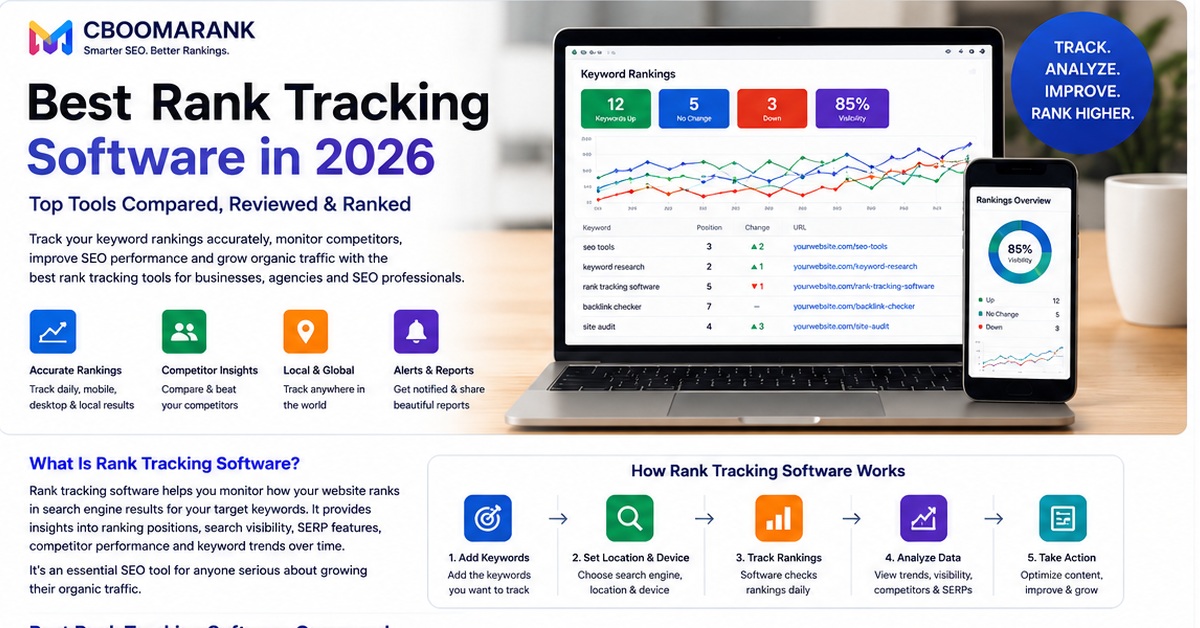
Best Rank Tracking Software in 2026: Quick Verdict
Rank tracking software answers one of the most practical questions in SEO: are the keywords and pages you care about actually moving up or down in search results? The best tools do more than record a number. They help you segment rankings by country, city and device, compare competitors, monitor SERP features, spot sudden drops, measure search visibility and turn ranking movements into decisions about content, technical SEO and links.
For this 2026 comparison, CBOOMARANK reviewed six leading options using current vendor pricing, tracking limits, update cadence, reporting, local capabilities, competitor features and overall fit for different users. We also include Google Search Console as the free first-party companion that every site owner should use alongside a dedicated tracker.
CBOOMARANK recommendation: SE Ranking offers the strongest overall balance of daily tracking capacity and price for most growing sites and agencies. Semrush is the best all-in-one marketing/SEO option, while AccuRanker is the best dedicated rank-tracking specialist.
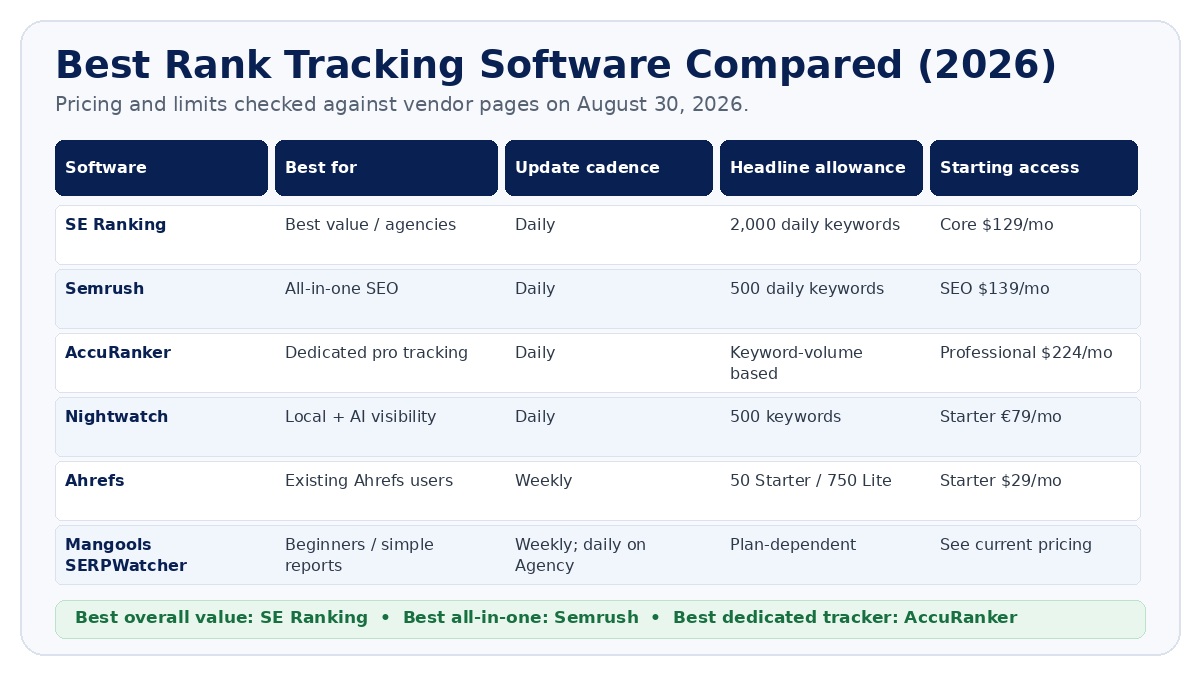
Best Rank Tracking Software at a Glance
| Software | Best for | Update cadence | Key tracking allowance | Starting price/access | CBOOMARANK pick |
| SE Ranking | Agencies & growing sites | Daily | 2,000 keywords on Core | $129/mo Core | Best overall value |
| Semrush | All-in-one SEO/marketing | Daily | 500 keywords on SEO | $139/mo SEO | Best all-in-one |
| AccuRanker | SEO specialists & agencies | Daily | Volume-based | Professional $224/mo | Best dedicated tracker |
| Nightwatch | Local SEO & AI visibility | Daily | 500 keywords Starter | €79/mo Starter | Best local/AI blend |
| Ahrefs | Existing Ahrefs users | Weekly | 50 Starter / 750 Lite | $29 Starter / $129 Lite | Best ecosystem fit |
| Mangools SERPWatcher | Beginners & simple reporting | Weekly; daily on Agency | Plan-dependent | See current pricing | Best for simplicity |
Pricing and limits above were checked on August 30, 2026. Vendors change plans frequently, so always verify the final checkout page before purchasing.
What Is Rank Tracking Software?
Rank tracking software monitors where a domain or URL appears in search results for a defined set of keywords. Unlike manually searching Google, a rank tracker can use a consistent location, device type and schedule, making trend analysis much more useful. Most professional platforms can also group keywords, compare competitors, report visibility metrics and show which landing page is ranking for each query.
Rank tracking is not the same thing as Google Search Console average position. Search Console uses first-party impression data and reports the average topmost position for your property across actual impressions. Google itself recommends focusing on trends in impressions and clicks as well as position. A rank tracker, by contrast, repeatedly checks a selected keyword set under controlled conditions. The two data sources complement each other rather than replacing one another.
Official reference: Google Search Console — Performance report and average position
How We Evaluated the Best Rank Trackers
A tool is only useful when its tracking model matches the decisions you need to make. Our comparison prioritizes practical buying criteria rather than the size of a vendor’s feature list.
- Update frequency: daily tracking is preferable for active campaigns, launches and agencies; weekly tracking can still be enough for stable content sites.
- Location and device control: strong platforms let you track countries, cities, mobile and desktop separately.
- Competitor visibility: ranking data is more useful when you can compare rivals across the same keywords.
- Reporting and alerts: scheduled reports, white-label options, Looker Studio integrations and change notifications matter for teams and clients.
- Historical data: longer history makes it easier to diagnose algorithm updates, migrations and content changes.
- SERP features: modern tracking should identify more than ten blue links, including local packs and other search-result features when supported.
- Value: we compared included keyword capacity, project limits and the breadth of other SEO tools bundled into the subscription.
1. SE Ranking — Best Overall Rank Tracking Software for Value
SE Ranking is our overall pick for most growing businesses and agencies because rank tracking remains one of the platform’s strongest capabilities while the current Core plan provides unusually generous daily capacity. As of August 30, 2026, Core is listed at $129 per month or $103.20 per month on annual billing, with 10 projects and 2,000 keywords tracked daily. Growth increases that to 5,000 daily keywords across 30 projects.
The platform tracks across major search engines and supports Google Top 100 tracking, reporting integrations, competitor research and historical data. It also bundles keyword, competitor and backlink research, website auditing and broader GEO/AI-search features, so the subscription can replace several standalone tools for a small agency.
SE Ranking is especially compelling when you need frequent position updates at scale without moving into high-end dedicated-tracker pricing. Its optional Agency Pack adds client-facing and white-label features for teams that need branded reporting.
SE Ranking strengths
- 2,000 daily tracked keywords on the current Core plan
- Strong project capacity for agencies
- Rank tracking across major search engines
- Competitor and visibility analysis
- Integrations with Data Studio/Looker Studio, GA4 and GSC
- 14-day free trial with no credit card required
SE Ranking limitations
- Core now costs more than lightweight rank-tracker-only products
- Agencies needing full white-label platform features may need the Agency Pack
- Its broad platform can be more than a solo blogger needs
Official pricing: SE Ranking plans and pricing
2. Semrush Position Tracking — Best All-in-One SEO and Marketing Suite
Semrush Position Tracking is the best fit when rankings are only one part of a much larger marketing workflow. The current SEO plan is $139 per month, or $117.33 per month when billed annually, and includes five monitored websites plus 500 keywords tracked daily. Position Tracking is included alongside keyword research, competitor analysis, Site Audit and AI-search monitoring features.
The appeal is integration. You can research a competitor, discover keyword gaps, track the target terms, audit the site, measure visibility and connect ranking changes back to the broader SEO campaign without moving between multiple vendors. Semrush is therefore an excellent choice for in-house marketing teams and full-service agencies that also work on content, competitive research and paid search.
The main tradeoff is capacity at the entry tier. SE Ranking Core tracks four times as many daily keywords as Semrush SEO at a slightly lower annual-equivalent cost. If you are buying primarily for rank tracking, that matters. If you are buying a complete marketing intelligence stack, Semrush can still justify the premium.
Semrush strengths
- Daily keyword position tracking
- Strong competitor and visibility analysis
- Excellent integration with keyword research and Site Audit
- Mobile data included
- Broad marketing and AI-search ecosystem
Semrush limitations
- 500 daily tracked keywords on the entry SEO plan
- Higher total cost when adding users or advanced toolkits
- More complex than a dedicated rank tracker
Official pricing: Semrush SEO + AI Search pricing
3. AccuRanker — Best Dedicated Rank Tracker for SEO Professionals
AccuRanker is the strongest option in this comparison when you want a specialist rank-tracking product rather than an all-in-one SEO suite. Its current Professional plan starts at $224 per month, with pricing scaling by the keyword volume selected. Daily updates are standard, and the platform focuses heavily on filtering, search intent, tagging, integrations, reporting and fast access to ranking data.
Dedicated tooling can be a major advantage for agencies and in-house SEO teams that already use separate products for crawling, backlinks and keyword research. Instead of paying for overlapping features, AccuRanker concentrates on reliable rank monitoring and reporting. Higher tiers add capabilities such as dynamic tagging, AI CTR and search-volume features, Data Studio and API access.
The downside is obvious: the starting price is high for a blogger or small business that only tracks a few hundred terms. AccuRanker makes the most sense when ranking data is business-critical and speed, segmentation, API/reporting workflows or higher volumes justify the specialist cost.
AccuRanker strengths
- Dedicated rank-tracking focus
- Daily updates
- Advanced filtering and tagging
- Google Search Console and Google Analytics integrations
- Reporting, export and API options on higher tiers
AccuRanker limitations
- Professional plan starts at $224 per month
- Less attractive for small sites that need an all-in-one SEO suite
- Keyword volume affects pricing
Official pricing: AccuRanker pricing
4. Nightwatch — Best for Local Rank Tracking and AI Visibility
Nightwatch has become a particularly interesting choice for teams that want traditional rank tracking and AI visibility in the same subscription. Its Starter plan is currently listed at €79 per month with 500 keywords tracked daily, five websites and five competitors per site. Professional increases to 2,500 daily keywords across 25 websites.
Unlike tools that focus only on Google desktop rankings, Nightwatch supports multiple search engines and emphasizes location-specific tracking. The current platform lists Google, YouTube, Bing, Yahoo, DuckDuckGo and Google Maps among supported engines. It also includes AI visibility tracking across assistants and search experiences such as ChatGPT, Claude, Gemini, Perplexity, AI Mode and AI Overviews, with limits determined by plan.
This makes Nightwatch appealing to local businesses, agencies and brands that increasingly need to report both classic SERP visibility and generative-search visibility. The tradeoff is that the starting price is significantly higher than beginner tools.
Nightwatch strengths
- Daily rank tracking
- Strong location and language controls
- Multi-search-engine coverage
- AI visibility monitoring included
- Unlimited seats according to current pricing page
- 14-day free trial with no credit card
Nightwatch limitations
- Starter begins at €79 per month
- May be excessive for a single small website
- AI prompt limits vary by plan
Official pricing: Nightwatch pricing
5. Ahrefs Rank Tracker — Best for Existing Ahrefs Users
Ahrefs Rank Tracker is a logical choice when your team already relies on Ahrefs for backlinks, competitor research and keyword analysis. The 2026 Starter plan costs $29 per month and includes 50 Rank Tracker keywords, while Lite is listed at $129 per month and includes 750 tracked keywords. The current main pricing table lists weekly Rank Tracker updates on Lite, Standard, Advanced and Enterprise plans.
Ahrefs is not our first recommendation when rank tracking alone is the purchase driver because dedicated and competing all-in-one products offer daily tracking at similar or lower prices. However, Ahrefs remains extremely useful when you want ranking movements interpreted alongside backlink growth, organic competitor data, keyword opportunities and Site Explorer insights.
The Starter tier is a low-cost way to access Ahrefs data and basic rank tracking, but its 50-keyword limit is too small for many content-heavy sites. Lite expands capacity substantially, although weekly updates are less responsive than daily trackers for active SEO campaigns.
Ahrefs strengths
- Excellent integration with backlink and competitor data
- Starter plan provides low-cost entry
- 750 tracked keywords on Lite
- Strong keyword and SERP research ecosystem
Ahrefs limitations
- 50 tracked keywords on Starter
- Weekly Rank Tracker updates on main paid plans
- Less suitable for teams needing daily movement alerts
Official pricing: Ahrefs pricing | Ahrefs Starter plan limits
6. Mangools SERPWatcher — Best Simple Rank Tracker for Beginners
Mangools SERPWatcher is designed around a simpler dashboard than many enterprise SEO platforms. It tracks ranking positions, historical performance, mobile and desktop results, locations, competitor performance, alerts and shared reports. The platform also uses a Performance Index/Dominance-style view to help users focus on overall organic visibility rather than obsessing over one keyword.
The current SERPWatcher product pages state that Basic and Premium use weekly ranking updates, while the Agency plan provides daily updates. The tool supports more than 65,000 locations and includes interactive reports, alerts, competitor tracking and white-label reporting features. Because Mangools sells SERPWatcher as part of its broader SEO suite, it can be attractive to beginners who also want KWFinder for keyword research and other simple SEO tools under one login.
The main limitation is update cadence. Weekly checks can be perfectly adequate for a small evergreen content site, but agencies, news publishers and active campaigns will generally prefer daily monitoring.
SERPWatcher strengths
- Very beginner-friendly interface
- Desktop and mobile tracking
- Strong local/location support
- Interactive reports and alerts
- Competitor tracking and white-label reporting
- Bundled with the Mangools SEO suite
SERPWatcher limitations
- Weekly updates on Basic and Premium
- Daily updates reserved for Agency
- Less deep than enterprise trackers for automation and large-scale analysis
Official product page: Mangools SERPWatcher | Mangools plans and pricing
Google Search Console — The Free First-Party Companion
Every rank-tracking workflow should include Google Search Console, even when you pay for one of the products above. Search Console reports clicks, impressions, CTR and average position based on real Google Search impressions for your verified property. It also lets you filter by query, page, country and device and compare performance over time.
Search Console should not be treated as a drop-in replacement for a dedicated tracker. Average position is calculated from actual impressions and can vary with query, location, device and result type. It does not give you the same controlled keyword list, fixed location checks, competitor monitoring or client reporting. Its real strength is first-party confirmation: a rank tracker tells you what its controlled checks are seeing; Search Console tells you how your pages actually appeared and performed for users in Google Search.
Official reference: Google Search Console Performance report
How to Choose the Right Rank Tracking Tool
1. Start with update frequency
Daily tracking is useful when rankings are tied to client reports, active content launches, migrations, local SEO or competitive campaigns. Weekly tracking is usually enough for small evergreen sites that care about directional change rather than day-to-day volatility.
2. Count keywords correctly
A “keyword” may be counted separately for desktop and mobile or for each location, depending on the platform. A business tracking 300 phrases in five cities could consume far more than 300 checks. Model your real campaign before choosing a plan.
3. Decide whether you need a specialist or an SEO suite
If you already use separate crawling, backlink and research tools, a dedicated tracker such as AccuRanker may be efficient. If you want one subscription for rank tracking plus research, audits and competitor analysis, SE Ranking or Semrush is usually easier to justify.
4. Check local and mobile requirements
Local businesses should make sure the platform can reproduce the geographic precision they need. National tracking is not enough for businesses that compete city by city. Mobile tracking matters too because mobile and desktop SERPs can diverge.
5. Evaluate reporting before you buy
Agencies should test scheduled reporting, white-label capabilities, exports, Looker Studio integrations, guest links and user permissions during the trial. Reporting friction becomes expensive when repeated across dozens of clients.
Rank Tracking Metrics That Actually Matter
Visibility or share of voice: A weighted view of how much search visibility your tracked keyword set generates. It is often more useful than average rank alone.
Top 3 / Top 10 / Top 20 distribution: Shows whether your keyword portfolio is moving into commercially meaningful SERP zones.
Landing-page changes: Helps detect keyword cannibalization or unexpected URL changes.
Competitor visibility: Shows whether your improvements are real competitive gains or simply market-wide volatility.
SERP features: Useful when clicks are affected by local packs, featured results or other search features.
Clicks and impressions in Search Console: First-party performance data helps validate whether rank improvements are translating into real search exposure and traffic.
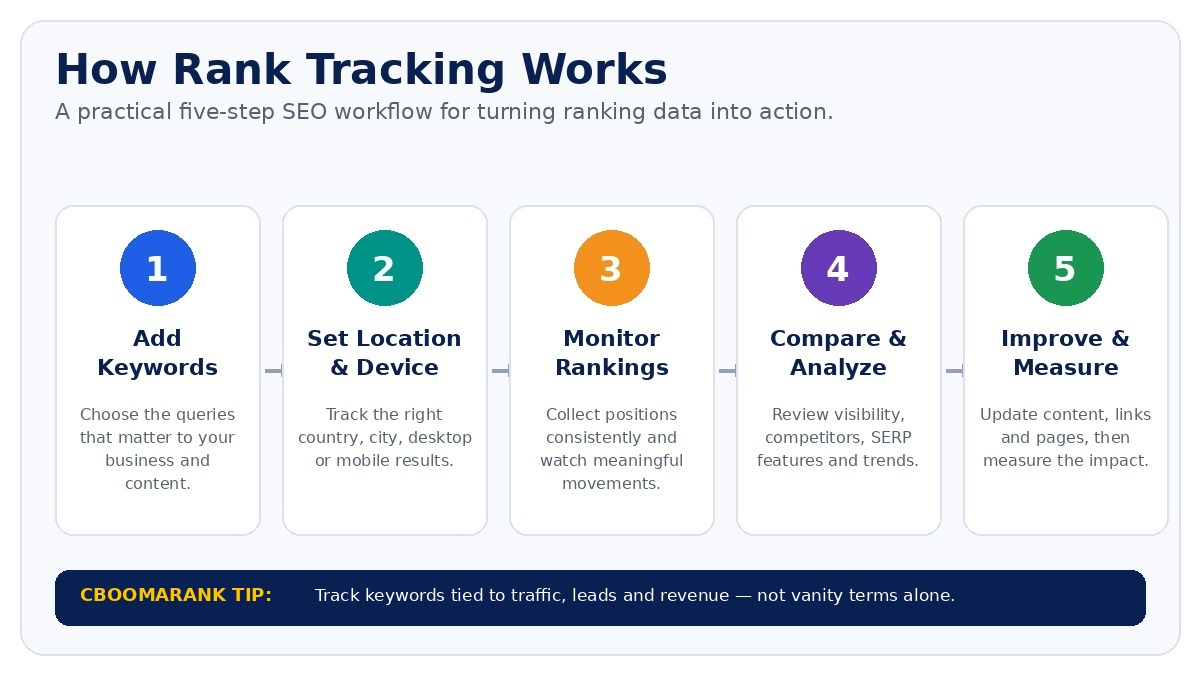
A Practical Rank Tracking Workflow
- Build a keyword set around pages, products, services and search intent—not just high-volume terms.
- Segment keywords by topic, funnel stage, location, device and business importance.
- Record a baseline before a major content update, migration or link-building campaign.
- Monitor directional movement and visibility, not every one-position daily fluctuation.
- Compare ranking movements with Search Console clicks/impressions and GA4 outcomes.
- Investigate drops by checking technical changes, content updates, SERP changes, competitors and links.
- Update content or technical elements based on evidence, then track whether the intervention works.
Best Rank Tracking Software by User Type
| User type | Recommended tool | Why |
| Solo blogger / beginner | Mangools SERPWatcher | Simple interface and bundled SEO tools; weekly updates can be sufficient. |
| Small business | SE Ranking | Strong daily capacity, audits and research in one platform. |
| SEO agency | SE Ranking or AccuRanker | Choose SE Ranking for value/breadth; AccuRanker for dedicated specialist tracking. |
| Full-service marketing team | Semrush | Rank tracking connects directly to broader SEO and marketing intelligence. |
| Local SEO agency | Nightwatch | Strong daily local tracking plus multi-engine and AI visibility. |
| Ahrefs-heavy SEO team | Ahrefs | Keeps rank data inside the same backlink and competitor ecosystem. |
| Budget / first-party measurement | Google Search Console | Free and essential for real impression, click and average-position trends. |
Recommended CBOOMARANK Internal Links
- SE Ranking vs Semrush: Which SEO Tool Offers Better Value in 2026? — Natural supporting comparison for the top two all-in-one platforms.
- Best SEO Audit Software Reviewed in 2026 — Connect rank tracking with technical SEO auditing.
- Best Free SEO Tools for Beginners in 2026 — Useful for readers who are not ready for paid rank tracking.
- 15 Best AI SEO Tools for Search Growth in 2026 — Supports the discussion of AI visibility and modern search monitoring.
- Google Keyword Planner for SEO — Helps readers build the keyword list they will later track.
- 10 SEO Automation Tools for Improved Efficiency — Relevant for reporting, monitoring and automated SEO workflows.
Authoritative External References
- SE Ranking pricing
- Semrush SEO + AI Search pricing
- AccuRanker pricing
- Nightwatch pricing
- Ahrefs plans and pricing
- Ahrefs Starter plan limits
- Mangools SERPWatcher
- Google Search Console Performance report
- Google Search Console position methodology
Frequently Asked Questions
What is the best rank tracking software in 2026?
For most growing websites and agencies, CBOOMARANK recommends SE Ranking because the current Core plan combines 2,000 daily tracked keywords with 10 projects, research tools and audits at $129 per month. Semrush is stronger if you need a broader all-in-one marketing suite, while AccuRanker is the strongest dedicated rank-tracking specialist.
What is the best free rank tracker?
Google Search Console is the essential free first-party option. It reports real clicks, impressions, CTR and average position for queries that generated impressions for your verified site. It is not a controlled competitor rank tracker, so it works best alongside a dedicated tool.
How often should rankings be checked?
Daily tracking is useful for agencies, local SEO, launches and active campaigns. Weekly tracking is often sufficient for smaller evergreen sites. The most important practice is consistency and comparing ranking trends with traffic and conversions.
Why are my rank tracker and Search Console positions different?
They measure different things. A tracker checks selected keywords under controlled location/device conditions. Search Console reports average topmost position across actual impressions, so personalization, location, device and query mix can produce different numbers.
Is rank tracking still useful with AI search?
Yes, because traditional search rankings still drive meaningful discovery and traffic, but modern reporting is expanding. Tools such as Semrush, SE Ranking and Nightwatch increasingly combine classic SERP tracking with AI or generative-search visibility.
Which rank tracker is best for local SEO?
Nightwatch is particularly strong for location-based workflows, while SE Ranking also provides local and map-related tracking options. Always verify that the plan supports the specific locations and keyword volume your business needs.
Is Ahrefs good for daily rank tracking?
Ahrefs is excellent as an SEO research ecosystem, but its main 2026 pricing table lists weekly Rank Tracker updates. Teams that need daily movement monitoring should compare SE Ranking, Semrush, AccuRanker or Nightwatch.
How many keywords should I track?
Track enough keywords to represent your priority pages, topics, locations and funnel stages. For a small site this may be 50–200 terms; larger content sites and agencies can easily need thousands. Focus on keywords tied to decisions and business outcomes.
Final Verdict: Which Rank Tracking Software Should You Choose?
If you want the strongest combination of daily tracking capacity, price and broader SEO functionality, choose SE Ranking. Its current Core plan is unusually generous for agencies and growing publishers, and rank tracking is clearly one of the product’s core strengths.
Choose Semrush when rank tracking must live inside a complete marketing intelligence platform. Choose AccuRanker when rank tracking itself is the specialist workflow and you are willing to pay for a dedicated tool. Choose Nightwatch when local tracking and AI visibility matter together. Choose Ahrefs when you already depend on its backlink and competitor ecosystem, and choose Mangools SERPWatcher when simplicity matters more than daily updates.
Whatever platform you select, keep Google Search Console in the workflow. Rankings are a diagnostic metric—not the business outcome. The goal is to connect visibility changes to impressions, qualified clicks, leads, revenue and sustainable organic growth.
