

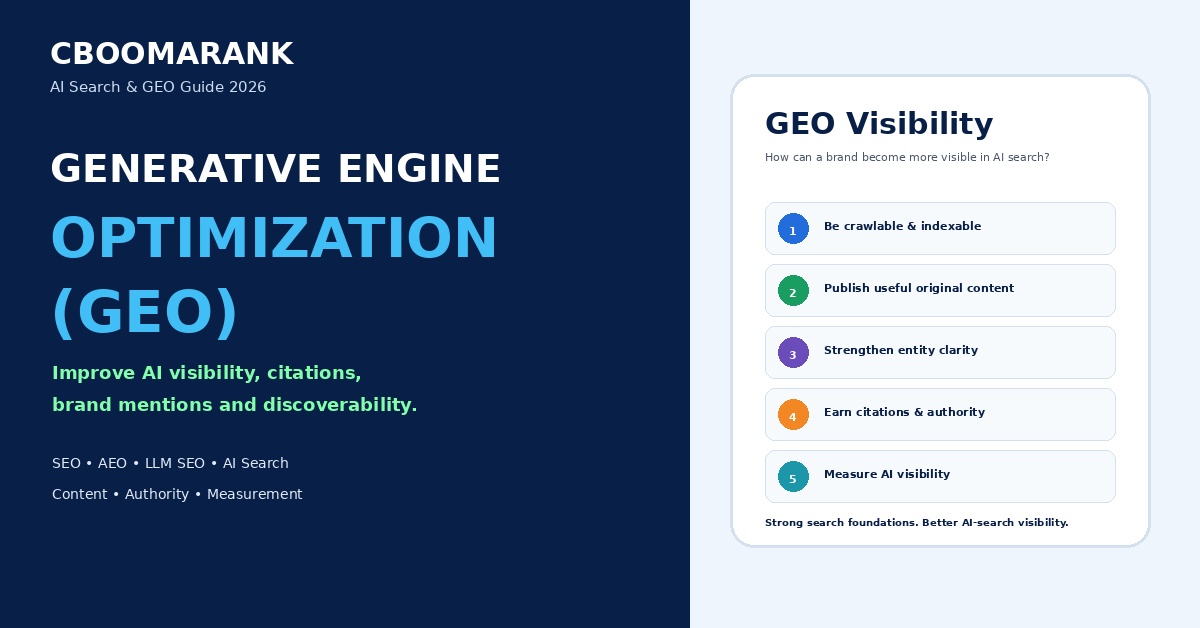
Search is changing from a list of links into a mixture of traditional results, AI-generated summaries, conversational answers, citations and recommended sources.
This shift has created a new discipline known as Generative Engine Optimization, or GEO.
GEO focuses on improving the likelihood that a brand, website or piece of content is discovered, understood, cited, linked or referenced by generative search and answer engines.
But GEO should not be treated as a replacement for SEO. Google explicitly says that the same foundational SEO best practices remain relevant for AI Overviews and AI Mode, with no special AI-only technical requirements. OpenAI likewise provides crawler guidance for websites that want content to be discoverable in ChatGPT Search.
The strongest approach in 2026 is therefore not “SEO versus GEO.” It is a connected strategy combining technical SEO, useful content, authority, entity clarity, internal linking, structured information, AI visibility measurement and business outcomes.
This guide explains what Generative Engine Optimization means, how it differs from traditional SEO and AEO, what the research actually supports, how major AI-search systems discover content, and how to build a practical GEO workflow.
This article is part of the CBOOMARANK AI Search series. Continue your research with Best AI Visibility Tools in 2026, How to Rank in Google AI Overviews, Best LLM SEO Tools in 2026, Google AI Mode SEO and How to Rank in ChatGPT.
What Is Generative Engine Optimization?
Generative Engine Optimization (GEO) is the practice of improving content and website signals so that information has a stronger chance of being discovered, selected, cited or represented in answers produced by generative search systems.
The term was formally introduced in the research paper GEO: Generative Engine Optimization by Pranjal Aggarwal, Vishvak Murahari, Tanmay Rajpurohit, Ashwin Kalyan, Karthik Narasimhan and Ameet Deshpande.
The researchers studied how content creators might improve visibility inside generative engines that retrieve information from multiple sources and synthesize an answer rather than simply returning a ranked list of webpages.
In the researchers’ experimental framework, certain optimization approaches improved measured visibility substantially, with the paper reporting gains of up to 40% in some settings. That result is important evidence that presentation and source quality can affect generative-engine visibility, but it should not be interpreted as a universal ranking formula for ChatGPT, Google AI, Gemini, Perplexity or every future AI system.
Original research: GEO: Generative Engine Optimization.

SEO vs GEO vs AEO: What Is the Difference?
| Discipline | Primary Goal | Typical Visibility |
|---|---|---|
| SEO | Improve visibility in traditional search engines | Organic rankings, snippets, traffic and conversions |
| AEO | Optimize information for direct answers and answer engines | Featured answers, voice results, answer boxes and structured responses |
| GEO | Improve discoverability and representation within generative search | AI citations, links, brand mentions, recommendations and source visibility |
| LLM SEO | Improve visibility across LLM-driven search and conversational systems | Prompt-level visibility, citations, mentions and AI referrals |
These disciplines overlap heavily. A technically healthy, authoritative, well-structured website with useful content can perform across traditional search, answer engines and generative search.
How Generative Search Engines Find and Use Content
Different AI-search platforms use different models, retrieval systems, crawlers and data sources, so there is no single universal GEO mechanism.
However, a simplified generative-search workflow often looks like this:
- A user submits a question.
- The system interprets the intent and may expand or reformulate the query.
- Relevant information is retrieved from indexes, search systems or other data sources.
- Candidate sources are evaluated.
- A generative model synthesizes an answer.
- Supporting sources, citations or links may be surfaced.
- The user may continue with follow-up questions.
Google documents a related process for AI Overviews and AI Mode called query fan-out, where multiple related searches can be issued across subtopics and data sources to develop an answer and identify supporting web pages.
Google also states that a page must be indexed and eligible to appear in Google Search with a snippet before it can be shown as a supporting link in AI Overviews or AI Mode.
Official Google guidance: AI Features and Your Website.
ChatGPT Search and GEO
For ChatGPT Search, OpenAI says public websites can appear in search results and publishers should avoid blocking OAI-SearchBot if they want site content to be discoverable, surfaced, cited and linked in ChatGPT Search.
OpenAI also distinguishes OAI-SearchBot from GPTBot. OAI-SearchBot supports search discovery, while GPTBot relates to content that may be used to improve generative AI models.
This distinction is covered in more detail in our guide on How to Rank in ChatGPT.
Official OpenAI guidance: Publishers and Developers FAQ.
Google AI and GEO
Google’s guidance is particularly important because it prevents marketers from turning GEO into a collection of unsupported hacks.
Google says there are no additional technical requirements or special optimizations required specifically for AI Overviews and AI Mode. Core SEO practices remain applicable.
- Allow crawling through robots.txt and hosting infrastructure.
- Keep important pages indexable.
- Use clear internal links.
- Provide a strong page experience.
- Keep important information available in text.
- Use relevant, high-quality images and video.
- Ensure structured data matches visible content.
- Keep business and product information current.
Google specifically says websites do not need special AI text files or additional schema markup to appear in AI features.
For practical implementation, see How to Rank in Google AI Overviews and Google AI Mode SEO.
12-Step Generative Engine Optimization Framework
1. Build on Strong Technical SEO
A generative engine cannot reliably use information it cannot access.
- Allow legitimate crawler access.
- Fix accidental noindex directives.
- Maintain correct canonicals.
- Use HTTPS.
- Fix broken internal links.
- Maintain useful XML sitemaps.
- Ensure important pages load correctly on mobile.
2. Make Important Information Available in Text
Critical facts should not exist only inside images, video, complex scripts or interactive interfaces.
Use normal crawlable text for product specifications, definitions, pricing explanations, comparisons, research findings and key conclusions.
3. Answer Real Questions Clearly
Generative search is strongly driven by questions and tasks.
Instead of creating a page around a keyword alone, identify the decisions, comparisons and follow-up questions a user is likely to have.
A useful GEO page should help answer not just “what is this?” but also:
- How does it work?
- Who is it for?
- What are the alternatives?
- What are the advantages and limitations?
- How much does it cost?
- What evidence supports the claim?
- What should the user do next?
4. Publish Original, Citation-Worthy Information
One of the strongest long-term GEO strategies is to create information other publishers, journalists, search engines and AI systems have a reason to reference.
- Original research
- Surveys
- First-hand testing
- Industry benchmarks
- Expert interviews
- Case studies
- Unique datasets
- Technical experiments
- Original charts and visual frameworks
The goal is not to manufacture “AI-friendly” wording. The goal is to create information with genuine informational value.
5. Cite Reliable Sources
The original GEO research found that citation-oriented strategies could improve visibility in its experimental setup.
For publishers, the practical lesson is straightforward: factual claims should be supported by reliable evidence, especially when covering medicine, finance, technology, law, pricing, statistics or rapidly changing software capabilities.
Use primary sources whenever possible.
6. Use Statistics Carefully
Useful statistics can make a page more specific and informative, but numbers should never be added merely because they might improve AI visibility.
- Use current data.
- Name the source.
- Provide context.
- Avoid invented percentages.
- Explain the methodology when relevant.
- Update statistics when the source changes.
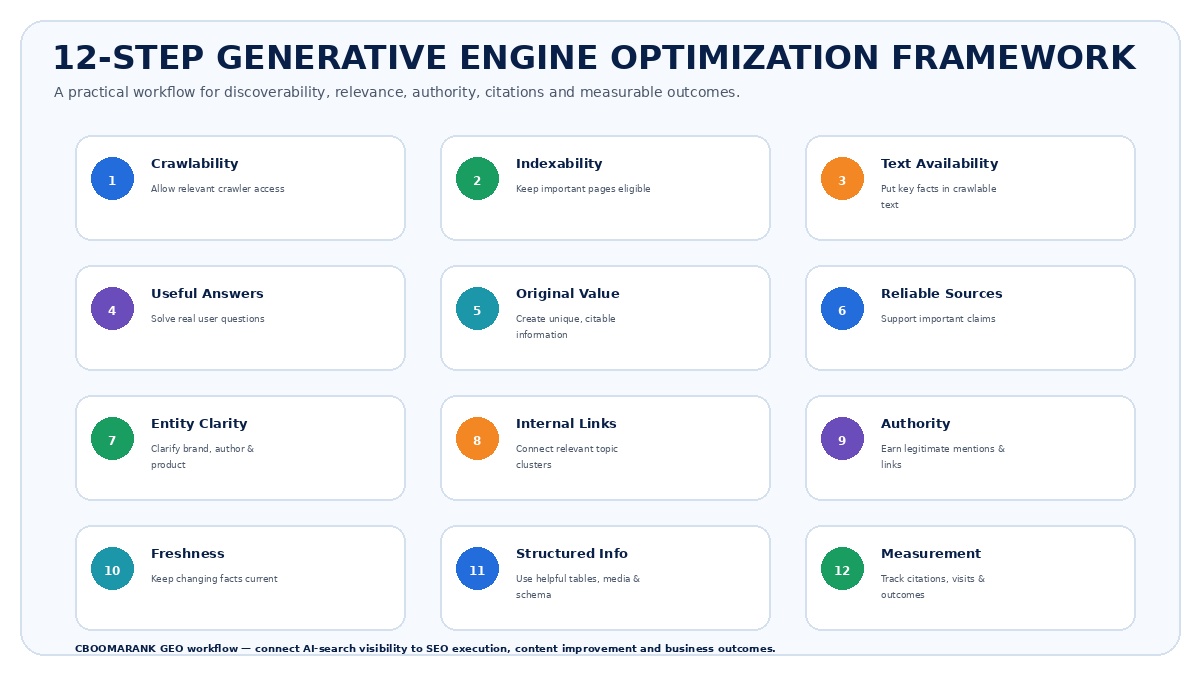
7. Strengthen Entity and Brand Clarity
Make it easy to understand who your company is, what it offers and why it is relevant to the topic.
- Use consistent company and product names.
- Maintain a clear About page.
- Show author information.
- Keep business information accurate.
- Describe products and services precisely.
- Use appropriate structured data.
Entity clarity should be viewed as good information architecture and branding practice, not as a secret AI ranking factor.
8. Build Strong Internal Topic Connections
Internal links help users and crawlers discover related information and understand how individual pages fit into a broader subject.
CBOOMARANK’s current AI Search cluster, for example, connects:
- Best AI Visibility Tools
- How to Rank in Google AI Overviews
- Best LLM SEO Tools
- Google AI Mode SEO
- How to Rank in ChatGPT
Each page satisfies a different intent while strengthening the overall topical architecture.
9. Earn Legitimate Mentions and Backlinks
GEO discussions often focus heavily on “mentions,” but the quality of those mentions matters.
- Publish research worth referencing.
- Contribute expert commentary.
- Earn editorial backlinks.
- Build genuine industry partnerships.
- Participate in reputable communities.
- Avoid fake reviews, fabricated citations and link schemes.
There is no credible evidence that simply manufacturing large numbers of brand mentions guarantees AI visibility.
10. Keep Facts and Commercial Information Fresh
AI-search answers often support buying and comparison journeys. Stale information can make your page less useful even if it once performed well.
- Review pricing.
- Update features.
- Check product names.
- Update screenshots.
- Refresh statistics.
- Remove discontinued services.
- Verify external references.
11. Use Helpful Images, Tables and Structured Information
Good visual communication helps users understand complex information and can strengthen the overall usefulness of a page.
Use:
- comparison tables;
- original diagrams;
- process illustrations;
- screenshots;
- checklists;
- charts;
- descriptive ALT text.
Google specifically recommends supporting textual information with useful images and videos where appropriate.
12. Measure AI Visibility and Business Outcomes
GEO measurement should go beyond asking whether a brand appears in an AI answer.
- Brand mentions
- Citations
- Source links
- Prompt visibility
- Competitor share of voice
- AI referral traffic
- Landing pages
- Leads
- Conversions
- Revenue
See our comparison of AI visibility tools and LLM SEO platforms for measurement options.
GEO Optimization Checklist
| Check | What to Verify |
|---|---|
| Crawlability | Important public pages are accessible to relevant search crawlers |
| Indexability | Pages intended for Google AI features are eligible for Google Search indexing |
| Useful content | Page answers genuine questions and solves a clear user problem |
| Original value | Content includes information that adds something beyond generic summaries |
| Evidence | Important factual claims are supported by reliable sources |
| Entity clarity | Brand, author, company and product information are understandable |
| Internal links | Relevant content clusters are logically connected |
| Authority | Site earns legitimate references, mentions and backlinks |
| Freshness | Pricing, features and statistics remain current |
| Measurement | AI citations, referrals and business outcomes are tracked |

What GEO Does Not Mean
The growth of AI search has also produced questionable tactics. GEO should not mean:
- stuffing pages with phrases such as “according to experts”;
- inventing statistics;
- creating fake citations;
- adding unsupported quotations;
- manufacturing fake Reddit discussions;
- buying low-quality mentions;
- creating dozens of nearly identical AI-generated articles;
- adding special markup that the platform does not require;
- claiming guaranteed inclusion in ChatGPT or Google AI.
Strong GEO should increase usefulness and trust—not manipulate the page into appearing more authoritative than it really is.
Does llms.txt Improve GEO?
The idea of an llms.txt file has attracted attention as publishers look for ways to communicate with AI systems.
However, website owners should distinguish experimental ecosystem proposals from documented platform requirements.
Google explicitly says publishers do not need to create new machine-readable AI text files to appear in AI Overviews or AI Mode.
OpenAI’s published guidance for ChatGPT Search focuses on OAI-SearchBot access rather than requiring an llms.txt file.
Therefore, llms.txt should not replace crawlability, indexability, technical SEO, useful content or authority-building.
How to Measure GEO Performance
Traditional rank tracking alone cannot capture the full AI-search journey.
| Metric | What It Tells You |
|---|---|
| Prompt visibility | Whether your brand appears for tracked buyer questions |
| Brand mentions | How often generative systems name your brand |
| Citations | Whether your website is used as a supporting source |
| AI share of voice | How your visibility compares with competitors |
| Source overlap | Which domains repeatedly influence answers in your category |
| Referral traffic | How many users actually click through from AI experiences |
| Conversions | Whether AI-assisted discovery produces business value |
OpenAI states that ChatGPT referral URLs include utm_source=chatgpt.com, which can help publishers identify inbound traffic from ChatGPT Search.
Where CBOOMARANK Fits Into the GEO Workflow
Editorial disclosure: CBOOMARANK publishes this guide and is also developing its own SEO and analytics platform.
CBOOMARANK’s opportunity is to connect generative-search visibility with the underlying SEO work required to improve it.
- Identify an AI visibility, citation or competitor gap.
- Research the underlying topic and keywords.
- Analyze competitors and sources appearing in AI answers.
- Audit the website and target pages.
- Find technical SEO issues.
- Identify content and internal-linking gaps.
- Analyze backlinks and authority.
- Create or improve useful content.
- Measure organic and AI-search performance.
- Connect results to leads, conversions and revenue.
This connected workflow is more valuable than treating GEO as an isolated visibility score.
Put Your GEO Strategy Into Practice With CBOOMARANK
Use CBOOMARANK to connect website analysis, keyword research, competitor research, SEO audits, backlink analysis, reporting and content workflows around your AI-search opportunities.
Frequently Asked Questions
What is Generative Engine Optimization?
Generative Engine Optimization is the practice of improving content and website signals so information has a stronger chance of being discovered, selected, cited, linked or represented by generative search and answer engines.
Is GEO replacing SEO?
No. GEO extends SEO into generative-search environments. Technical SEO, crawlability, useful content, internal linking, authority and user experience remain important foundations.
Does Google require special GEO optimization?
No. Google says there are no additional technical requirements or special optimizations required specifically for AI Overviews or AI Mode. Existing SEO fundamentals remain applicable.
How do I optimize for ChatGPT?
OpenAI recommends allowing OAI-SearchBot if you want public website content to be discoverable in ChatGPT Search. Beyond crawler access, focus on useful, reliable and well-structured content, strong website foundations and legitimate authority.
Do citations help GEO?
The original GEO research found citation-oriented content strategies could improve visibility in its experimental framework. In practice, publishers should cite reliable primary sources because doing so improves evidence quality and usefulness, not because citations guarantee AI placement.
Does structured data help GEO?
Supported structured data can improve machine understanding when it accurately represents visible page content, but Google says no special AI-specific schema is required for AI Overviews or AI Mode.
How do I track GEO performance?
Track prompt visibility, citations, brand mentions, AI share of voice, source links, referral traffic, landing pages and conversions. Combine dedicated AI visibility monitoring with analytics and traditional SEO reporting.
Final Verdict
Generative Engine Optimization is becoming an important part of modern search strategy, but it should not be separated from strong SEO fundamentals.
The most sustainable GEO strategy is to make your site accessible, publish genuinely useful and original information, support important claims with reliable sources, build clear topic relationships, strengthen brand authority and keep your information current.
Avoid shortcuts that manufacture expertise or chase undocumented ranking factors.
Search engines and AI systems will continue to evolve, but useful, trustworthy and well-organized information remains the strongest foundation.
Continue the CBOOMARANK AI Search series: Best AI Visibility Tools in 2026, How to Rank in Google AI Overviews, Best LLM SEO Tools in 2026, Google AI Mode SEO and How to Rank in ChatGPT.
