


SEO Optimization in 2026: What Actually Matters
SEO optimization is the ongoing process of making a website easier for search engines to crawl, understand and surface—and easier for people to use, trust and act on. The original CBOOMARANK guide correctly emphasized keyword research, on-page improvements, technical health, internal links, user experience and measurement. This 2026 rewrite turns those foundations into a complete operating system for modern search.
Search has expanded beyond ten blue links. People now discover information through classic organic results, AI Overviews, AI Mode, images, video, local results, shopping experiences and other search surfaces. The practical implication is not that you need a separate bag of “AI SEO” tricks. Google’s current guidance says foundational SEO best practices still apply to generative AI features. Your pages must be eligible for Search, crawlable, useful, reliable and easy to understand.
The goal is also bigger than ranking for more keywords. Good SEO connects the right audience with a page that solves the right problem, then helps that visitor take the next useful action—subscribe, request a quote, buy, compare, contact your business or continue learning.
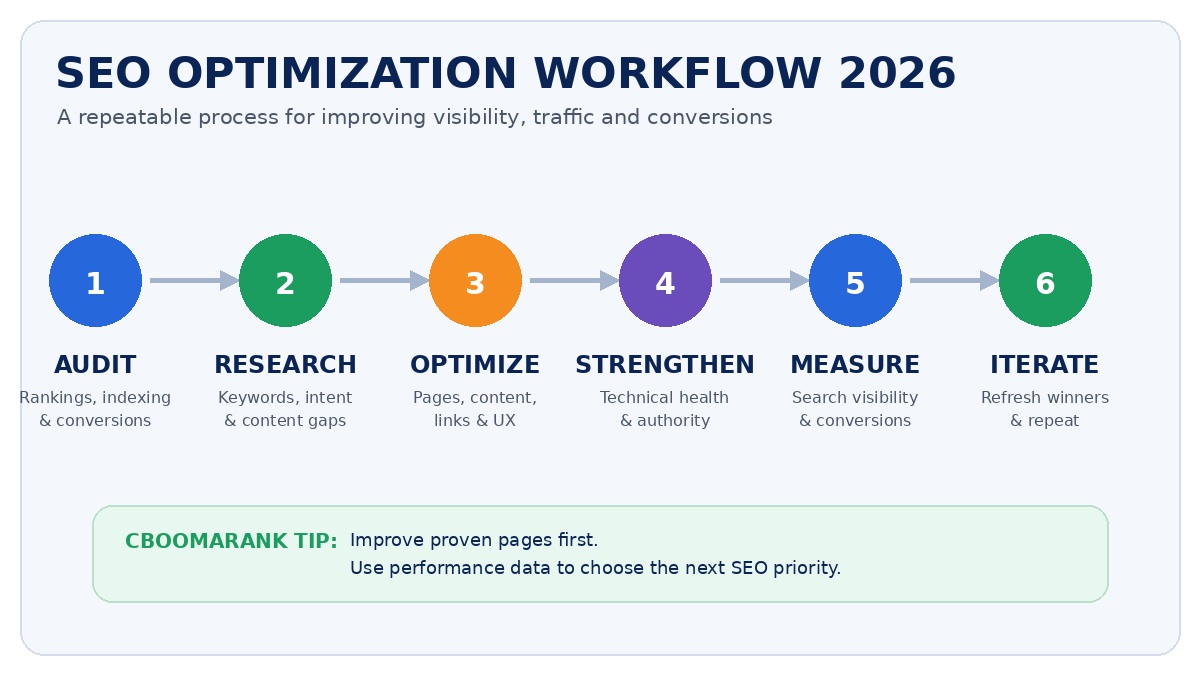
SEO Optimization Framework at a Glance
- 1. Baseline: Measure current traffic, impressions, rankings, indexed pages and conversions.
- 2. Research: Map keywords, search intent, competitors, topic gaps and audience questions.
- 3. Optimize: Improve titles, headings, content, images, internal links and conversion paths.
- 4. Strengthen: Fix crawl/indexing issues, improve performance and earn relevant authority.
- 5. Measure: Use Search Console, analytics and rank tracking to identify gains and losses.
- 6. Iterate: Refresh proven pages, consolidate weak pages and repeat what produces business value.
1. Establish an SEO Baseline Before You Change Anything
Start with evidence. Export at least the last three months of Google Search Console data and review performance by page, query, country and device. Record impressions, clicks, click-through rate and average position. Then connect those landing pages to conversions in your analytics platform.
Create a priority list instead of treating every page equally. High-impression pages with weak CTR may need better titles and snippets. Pages sitting just outside the strongest results may benefit from deeper content, stronger internal links or improved topical coverage. Pages losing traffic need diagnosis before rewriting. Pages that already generate leads or revenue deserve special protection.
Use your baseline to answer one question: where is the highest-leverage opportunity? SEO often grows faster when you improve a page that already has demand than when you publish dozens of new articles with no evidence of demand.
2. Keyword Research: Target Intent, Not Just Volume
Keyword research is the foundation of SEO optimization because it tells you what audiences are trying to accomplish. Search volume is useful, but it should never be the only deciding factor. A smaller keyword with strong commercial intent can be far more valuable than a large informational query that never converts.
Classify opportunities by intent: informational queries seek an answer; navigational queries seek a particular brand or page; commercial queries compare choices; transactional queries signal readiness to act. The page type and call to action should match that intent.
Build topic clusters around one primary intent instead of publishing a new page for every minor keyword variation. Modern search systems can understand related language. One useful, complete page is usually better than several thin pages competing with each other.
Related CBOOMARANK resources: Google Keyword Planner for SEO • Trending Keywords for SEO • Best Free SEO Tools for Beginners
3. On-Page SEO: Make Every Important Page Easy to Understand
Write a descriptive title
Use a unique title that accurately describes the page and naturally reflects the main topic. Avoid keyword stuffing or titles written only for algorithms.
Align the H1 with the page promise
Your H1 should make the central topic obvious. It does not need to be identical to the title tag, but both should describe the same page intent.
Answer the main question early
Readers should understand the answer, recommendation or value proposition without scrolling through a long generic introduction.
Use descriptive headings
H2 and H3 sections help people scan the page and help search systems understand how the ideas fit together.
Optimize images
Use clear, relevant images near supporting text. Compress them, specify dimensions, use descriptive filenames and write concise alt text that explains the image’s purpose.
Strengthen calls to action
Informational pages can lead to a related guide, tool or newsletter. Commercial pages can lead to pricing, demos, trials or contact forms. The CTA should fit the visitor’s stage.
4. Technical SEO: Make Crawling, Indexing and Rendering Reliable
- Indexability: Important pages should return the correct status code, not be accidentally blocked by robots rules, and not carry unintended noindex directives.
- Canonicalization: Use canonicals to identify the preferred URL when duplicate or near-duplicate versions exist. Avoid creating unnecessary duplicates through parameters and alternate URL patterns.
- XML sitemaps: Keep sitemaps clean and focused on canonical, indexable URLs. Submit them through Search Console and Bing Webmaster Tools.
- Internal crawl paths: Important pages should be reachable through normal HTML links. Avoid orphan pages that only exist in a sitemap.
- Mobile parity: The mobile version should contain the same essential content, metadata, links and structured data as the desktop experience.
- HTTPS and security: Serve pages securely and address malware, hacked content and insecure resources quickly.
- JavaScript SEO: If important content depends on JavaScript, verify that search engines can render it and that critical links and page content are not hidden behind fragile client-side behavior.
Use Bing Webmaster Tools and SEO audit software alongside Google Search Console to identify crawl, indexing and technical problems.
5. Improve Core Web Vitals and Overall Page Experience
Performance should be optimized for users, not for a perfect laboratory score. Google’s current guidance says Core Web Vitals are used by ranking systems and recommends achieving good results while also considering the overall experience.
The current Core Web Vitals targets are: Largest Contentful Paint (LCP) within 2.5 seconds, Interaction to Next Paint (INP) under 200 milliseconds, and Cumulative Layout Shift (CLS) below 0.1, measured at the 75th percentile of real-user visits.
Common improvements include serving properly sized images, reducing render-blocking scripts, caching effectively, limiting heavy plugins, reserving space for ads and embeds, improving server response time and avoiding unnecessary third-party JavaScript.
6. Publish Content That Adds Original Value
Generic summaries are easy to reproduce and difficult to defend. Strong pages give visitors a reason to choose your site: original screenshots, tests, data, templates, expert commentary, examples, calculators, checklists, first-party experience, practical recommendations or transparent methodology.
Accuracy matters. Check facts that can change, cite authoritative sources and state when pricing, policies or product features were verified. Update important articles instead of allowing stale claims to remain indefinitely.
Use AI as an assistant rather than as a substitute for editorial judgment. Google’s spam policies target scaled content created primarily to manipulate rankings regardless of whether automation, human writers or a combination produced it. The useful distinction is value—not the mere presence of AI.
7. Build a Strong Internal Linking System
Internal links help people discover relevant pages and help search engines find and interpret site structure. Use standard crawlable links with descriptive anchor text. Link from strong, relevant pages to the content that deserves greater visibility.
Create topic hubs where a broad guide links to specialized pages and those supporting pages link back to the hub when relevant. Review older articles whenever you publish a new cornerstone resource so your newest content is not left isolated.
Do not force links where they do not help the reader. Relevance and clarity matter more than hitting a fixed number of internal links per page.
8. Build Authority Without Link Spam
Backlinks can help discovery, authority and competitive visibility, but link building should focus on earning useful editorial references—not manufacturing large volumes of artificial links.
Create assets people have a reason to cite: original research, benchmarks, industry statistics, calculators, templates, comparison tables, definitive guides and visual frameworks. Promote those assets to relevant publishers, journalists, communities and partners.
Paid placements and sponsorships are normal parts of the web, but they should be qualified appropriately. Google’s current spam policies permit paid links when they use rel=”sponsored” or rel=”nofollow” so they are not disguised as editorial ranking signals.
Related CBOOMARANK resource: How to Build High-Quality Backlinks in 2026 and External Links for SEO
9. Optimize for AI Overviews and AI Mode Without Chasing Tricks
Google’s 2026 documentation is explicit: SEO remains relevant for generative AI features, and there are no separate technical requirements to appear as a supporting link beyond being indexed, eligible for Search and eligible to show a snippet.
Focus on foundational SEO plus information that is easy to interpret and worth citing. Make important answers clear, use descriptive headings, support claims with evidence, include useful images and video where appropriate, and ensure the page is crawlable.
Google’s newer AI optimization guidance also emphasizes non-commodity content. That means pages with distinctive experience, original information, strong media, clear structure and genuine usefulness are harder to replace with generic summaries.
10. Optimize Search Appearance: Titles, Snippets, Images and Structured Data
Title links
Write descriptive page titles that match the page content. Google can generate title links from multiple page signals, so consistency between the title, visible headings and content helps.
Meta descriptions
Use concise, unique descriptions that summarize the page’s most useful information. Google may choose a different snippet when another passage better matches the query.
Images
Use high-quality images near relevant text. Keep image URLs stable, optimize file size and provide useful alt text.
Structured data
Add structured data only when it accurately represents visible page content and when the relevant Search feature supports it. Avoid markup added merely because a plugin offers it.
Favicons and branding
Maintain a crawlable favicon and consistent brand identity so users can recognize your site more easily in results.
11. Measure SEO Performance With Business Outcomes
| Metric | What It Tells You |
| Impressions | Are more people seeing your pages in Search? |
| Clicks and CTR | Are your titles and snippets earning clicks from relevant queries? |
| Average position | Are important keyword groups improving over time? |
| Indexed pages | Are the pages you want indexed actually eligible and discoverable? |
| Organic conversions | Are visitors subscribing, buying, contacting you or completing other goals? |
| Revenue or lead quality | Does search visibility produce commercial value, not just traffic? |
| Referring domains | Is your authority profile improving through relevant editorial links? |
| Page experience | Do field data and user behavior suggest that the experience is improving? |
12. The CBOOMARANK 90-Day SEO Optimization Plan
Days 1–15: Benchmark and audit
Connect Search Console and analytics, crawl the site, review indexing, identify technical blockers, export keyword/page performance and choose the most valuable pages.
Days 16–30: Fix technical foundations
Resolve indexability, canonicals, status codes, sitemaps, broken links, mobile problems and obvious performance bottlenecks.
Days 31–50: Upgrade proven pages
Improve titles, intros, headings, content completeness, original examples, media, internal links and conversion paths on pages that already have demand.
Days 51–65: Build topic coverage
Fill genuine content gaps, create supporting pages for important clusters and consolidate overlapping or thin pages.
Days 66–80: Build authority
Promote linkable assets, conduct relevant outreach, earn editorial mentions and improve external trust signals.
Days 81–90: Measure and repeat
Compare performance to the baseline. Protect wins, diagnose losses, refresh pages with rising impressions and create the next 90-day priority list.
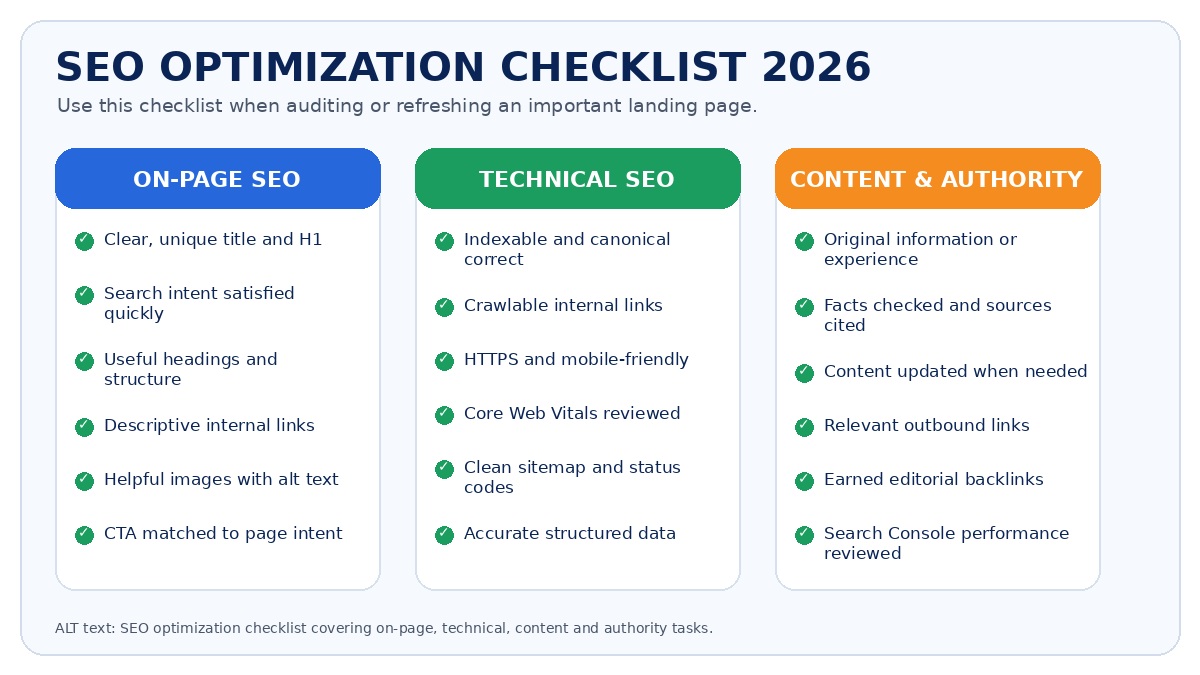
SEO Optimization Checklist
- ✓ Baseline performance exported from Search Console and analytics
- ✓ Primary page intent and keyword cluster defined
- ✓ Unique, descriptive title and clear H1
- ✓ Main answer or value proposition visible early
- ✓ Logical H2/H3 structure and helpful supporting sections
- ✓ Useful original information, examples or evidence
- ✓ Relevant images compressed and supplied with alt text
- ✓ Descriptive, crawlable internal links
- ✓ Correct indexability and canonical URL
- ✓ XML sitemap contains canonical indexable pages
- ✓ Mobile content and functionality match desktop essentials
- ✓ HTTPS enabled and security issues resolved
- ✓ Core Web Vitals reviewed with field data where possible
- ✓ Structured data accurately reflects visible content
- ✓ Relevant authoritative external sources cited
- ✓ Link-building activity avoids spam and disguised paid links
- ✓ Organic conversions and business outcomes tracked
- ✓ Important pages scheduled for periodic review and refresh
Common SEO Optimization Mistakes to Avoid
- Publishing large volumes of generic content with little added value.
- Creating a separate page for every keyword variation instead of mapping by intent.
- Rewriting pages that already perform without preserving what makes them successful.
- Using exact-match keyword repetition that makes copy unnatural.
- Treating a perfect speed score as more important than useful content and overall user experience.
- Using non-crawlable navigation or JavaScript-only links for important pages.
- Leaving important pages orphaned from the rest of the website.
- Buying or exchanging links primarily to manipulate rankings.
- Adding schema that does not match visible content.
- Measuring SEO only by traffic rather than leads, sales, subscriptions or other outcomes.
Frequently Asked Questions
What is SEO optimization?
SEO optimization is the process of improving a website’s content, structure, technical health, internal linking, authority and user experience so search engines can understand it and the right users can discover it.
How long does SEO optimization take?
Some technical or title changes can influence performance relatively quickly, while competitive content and authority improvements can take months. The timeline depends on crawl frequency, competition, site quality and the scale of the changes.
Is SEO still important with AI search?
Yes. Google states that foundational SEO best practices continue to apply to AI Overviews and AI Mode. A page still needs to be indexed and eligible to appear in Search.
How many keywords should one page target?
Focus on one primary intent and the related phrases needed to answer it comprehensively. Avoid creating artificial limits or separate pages for synonyms when the intent is the same.
Do Core Web Vitals affect rankings?
Google says Core Web Vitals are used by ranking systems and recommends good results, but there is no single page-experience signal and perfect scores do not guarantee top rankings.
Should every page use structured data?
No. Use supported structured data only when it accurately represents content visible on the page and when it is useful for the relevant search feature.
How often should SEO content be updated?
Update when facts, prices, product features, search intent or user needs change. High-value pages should be reviewed regularly, but do not change content simply to create an artificial freshness signal.
Final Verdict
SEO optimization in 2026 is not a collection of secret tricks. It is a disciplined cycle: understand demand, build useful pages, make them technically accessible, connect them through a clear site structure, earn trustworthy authority and measure whether visibility produces real business value.
The websites most likely to build durable search visibility are the ones that combine helpful original content with strong technical execution and continuous improvement. Start with the pages that already matter to your audience and your business, improve them with evidence, then expand from a stronger foundation.
Recommended CBOOMARANK Internal Links
- SEO Best Practices for 2026
- Google Keyword Planner for SEO
- Trending Keywords for SEO
- Best Free SEO Tools for Beginners
- Best SEO Audit Software Reviewed
- Bing Webmaster Tools Guide
- How to Build High-Quality Backlinks in 2026
- External Links for SEO
Authoritative External Sources
- Google Search Essentials
- Google SEO Starter Guide
- Google: AI Features and Your Website
- Google: Optimizing for Generative AI Features
- Google: Core Web Vitals
- Google: Page Experience
- Google: Link Best Practices
- Google: Spam Policies
Editorial note: This article was rewritten from CBOOMARANK’s August 23, 2026 SEO Optimization guide and expanded using current official Google Search documentation available in August 2026. Search systems and documentation change over time, so re-check time-sensitive guidance during major future updates.
