

Updated: August 4, 2026 | By CBOOMARANK Team | Estimated reading time: 16 minutes
Discover a practical 2026 workflow for finding rising search topics, validating demand and publishing useful content before competitors catch up.
What Are Trending Keywords?
Trending keywords are search terms, questions or topics whose interest is rising within a particular market, location or time period. Some trends last only a few hours, while others grow steadily for months and eventually become evergreen demand.
| Trend type | Typical pattern | Best content response |
| Breaking | A sharp spike caused by news, announcements or events | Fast, factual coverage with continuous updates |
| Seasonal | Demand returns around predictable dates or periods | Publish and refresh before the seasonal peak |
| Emerging | Interest grows from a small base over weeks or months | Build a useful topic cluster before competition becomes intense |
| Enduring shift | A new behavior, platform or technology changes how people search | Create a durable guide, original research and supporting pages |
The strongest SEO opportunities are usually not the loudest daily trends. They are relevant emerging topics with growing demand, useful commercial intent and enough durability to justify a high-quality article.
Why Trending Keyword Research Changed in 2026
Traditional keyword research often starts with historical monthly search volume. That remains useful, but it can miss new questions that have little recorded volume even though interest is accelerating. Search behavior is also becoming more conversational and multimodal.
Google reported in May 2026 that the average AI Mode query in the United States was about three times the length of a traditional Search query. Google also reported that more than one in six searches used voice or images, while planning-oriented AI Mode queries were growing faster than AI Mode queries overall. These changes mean trend research should examine questions, tasks, comparisons, images and decision journeys—not only short keyword strings.
| Key principle: Treat a trend as an audience signal, not an instruction to publish. Validate relevance, intent, durability and your ability to add original value before creating a page. |
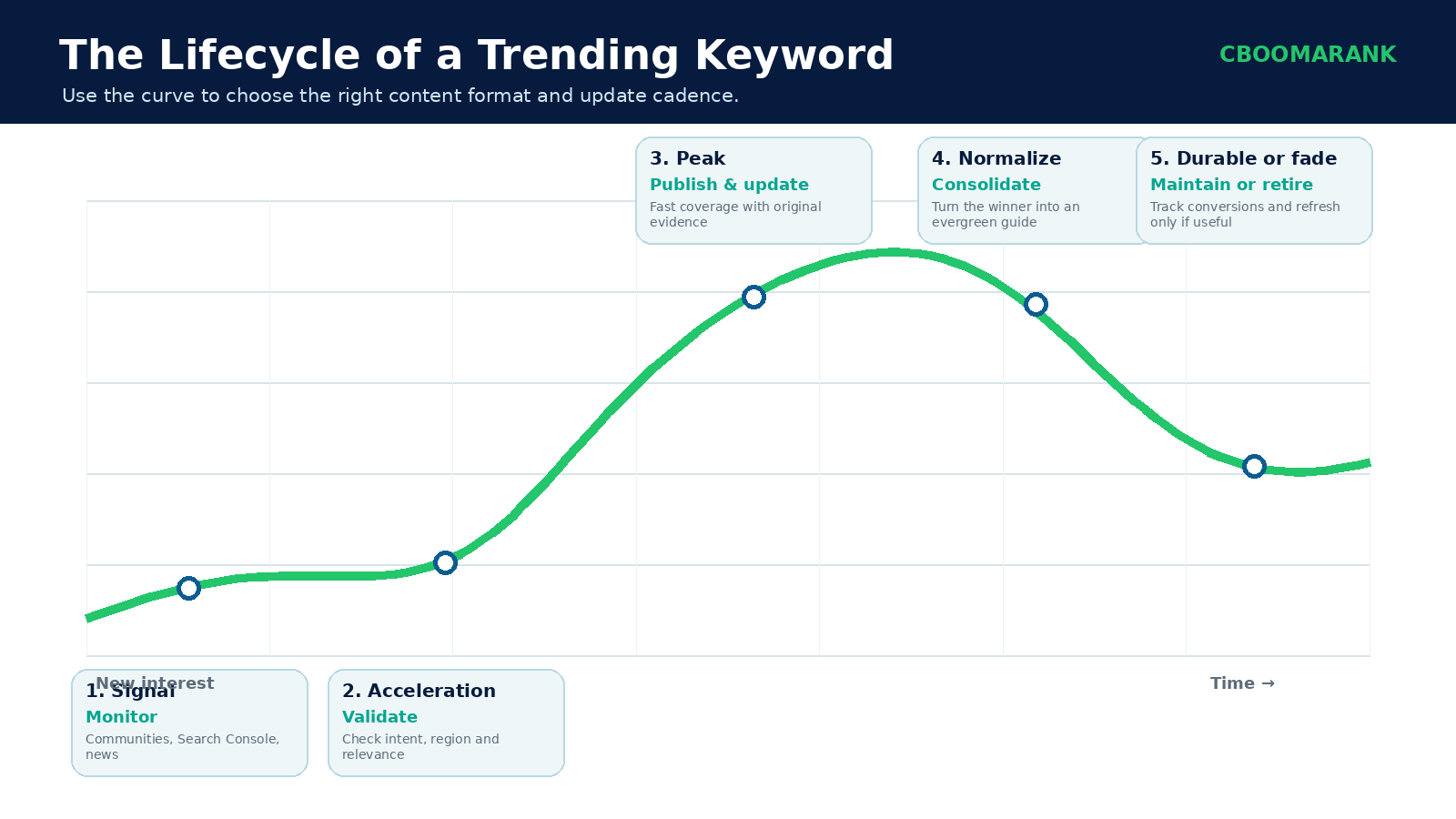
Figure 1. Use the trend lifecycle to choose the right publishing speed, update cadence and evergreen strategy. | Alt text: Line chart showing the lifecycle of a trending keyword from early signal through acceleration, peak and long-term normalization.
12 Proven Ways to Find Trending Keywords for SEO
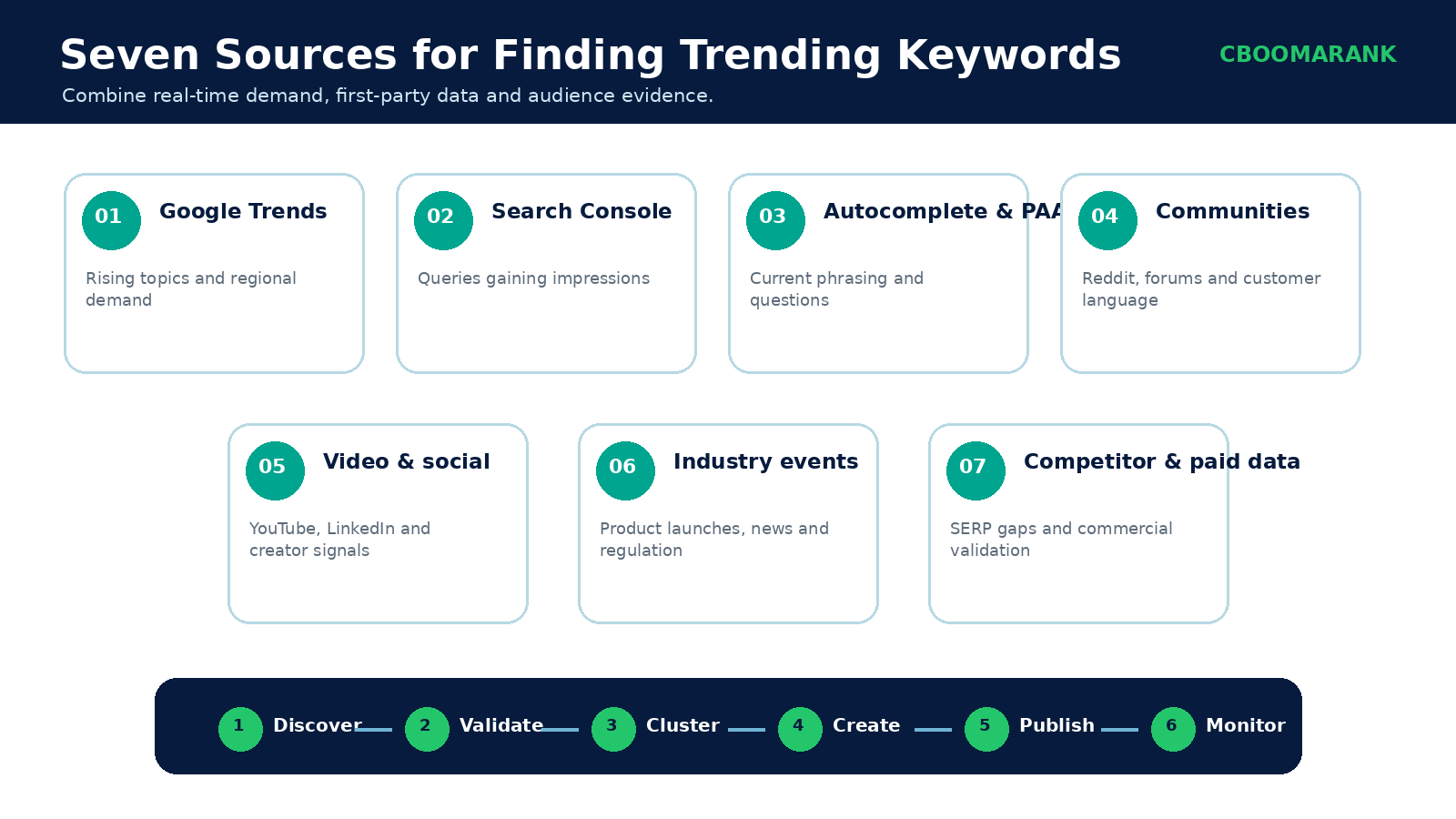
Figure 2. A reliable trend workflow combines real-time demand, first-party data and audience evidence. | Alt text: Infographic showing seven sources for discovering trending keywords, including Google Trends, Search Console, communities, social platforms and competitor data.
1. Start With Google Trends Trending Now
Use Google Trends Trending Now to identify rapidly rising searches by country or region. The page can show trends from recent hours, the previous day, two days or seven days, and Google says the data is refreshed frequently.
- Choose the country that matches your target customers.
- Ignore unrelated mass-market stories unless they connect naturally to your niche.
- Open a trend to inspect related queries and news context.
- Save only topics that can support a useful article, tool, comparison or service page.
2. Use the Redesigned Google Trends Explore Page
The updated Google Trends Explore experience uses Gemini to suggest and compare related search terms. It can help reveal adjacent questions and subtopics that might be missed when you begin with only one seed term.
Compare a topic rather than an isolated spelling whenever possible. Topics can combine related language variants, while exact search terms are more literal. Use location, timeframe, category and Search property filters to separate genuine demand from noise.
3. Compare Short and Long Timeframes
A keyword can look strong over seven days but flat over five years, or appear small over five years while rising rapidly over ninety days. Review several timeframes:
- Past 4 hours or day for breaking developments
- Past 30 or 90 days for emerging demand
- Past 12 months for seasonality
- Past five years for long-term direction
The goal is to distinguish a temporary spike from a new baseline. A rising ninety-day curve supported by a healthy five-year pattern is usually more valuable than a single-day burst.
4. Mine Google Search Console for Query Acceleration
Your own Google Search Console Performance report contains first-party query data that generic tools cannot replicate. Compare the latest 28 days with the previous 28 days, then sort by impression growth.
- Export queries and landing pages for both periods.
- Calculate the change in impressions, clicks, click-through rate and average position.
- Filter for queries gaining impressions even when clicks are still low.
- Group similar queries into one intent rather than creating a page for every wording.
- Improve an existing page when it already satisfies the intent; create a new page only when the intent is genuinely different.
This method often exposes early demand around products, terminology and questions already associated with your site.
5. Use the Google Trends API for Scalable Monitoring
Google announced an alpha Google Trends API in 2025. The limited-access API was designed to provide consistently scaled interest data across requests, with daily, weekly, monthly and yearly aggregations and regional filters. When available to your team, it can support automated trend watchlists and dashboards.
| Availability note: The Google Trends API has been introduced as an alpha with limited tester access. Do not build a critical workflow that assumes immediate public access. |
6. Study Autocomplete, Related Searches and Question Patterns
Search suggestions show how users phrase current needs. Begin typing a seed topic and note the modifiers that appear, such as “best,” “versus,” “for small business,” “near me,” “pricing,” “how to,” or a current year.
Use the phrases as research clues, not as a list to copy into separate thin pages. Google’s AI-search guidance explains that its systems understand synonyms and related meaning, so a comprehensive page can address several natural variations without repeating every keyword.
7. Monitor YouTube and Visual Search Behavior
Search trends often emerge in video before they become established blog keywords. Review YouTube Trends and compare the same subject in Google Trends using the YouTube Search property. Examine recurring questions in video titles and comments.
Because search is increasingly multimodal, add original diagrams, screenshots or short demonstrations to important pages. Follow Google image SEO guidance by using descriptive filenames, useful alt text, relevant surrounding copy and high-quality images.
8. Follow Communities, Reviews and Customer Conversations
Reddit communities, industry forums, product reviews, support tickets, sales calls, website chat and social comments reveal the language people use before formal keyword databases catch up.
- Record repeated problems and objections.
- Look for newly popular product names, features and acronyms.
- Identify questions that existing search results answer poorly.
- Confirm the signal with Search Console, Trends or paid-search data.
9. Track Industry Releases, Events and Regulatory Calendars
Product releases, conferences, policy deadlines, sports seasons and recurring reports can create predictable search demand. Maintain a calendar of events relevant to your industry and plan useful content before interest peaks.
The best opportunity is often a second-order question generated by the event—for example, comparisons, pricing, setup guides, compliance implications or alternatives—not the event name itself.
10. Use Competitor Gap Analysis Carefully
Review competitors’ recently published pages, fast-growing folders and newly ranking queries. Tools such as Semrush and Ahrefs can help identify new or improved pages, but third-party volume estimates should be treated as directional rather than exact.
Do not copy a competitor’s list. Ask what evidence, examples, screenshots, calculator, template or first-hand test CBOOMARANK can add that is not already available.
11. Combine Organic, Paid and On-Site Search Data
Google Ads search terms, Google Keyword Planner and your website’s internal search can reveal commercial phrases before they mature organically. A query that repeatedly produces qualified leads is often more valuable than a larger informational trend.
When paid-search and organic-impression growth point to the same topic, prioritize it. Align the article with a relevant conversion path such as a free analysis, product trial, consultation or service page.
12. Build a Weekly Trend Watchlist
Create a simple spreadsheet or dashboard that records the topic, source, date discovered, market, growth signal, intent, business relevance and recommended action. Review it weekly and archive false positives.
| Signal | Question to ask | Score 1–5 |
| Growth | Is demand rising across more than one timeframe or source? | 1 = weak, 5 = accelerating |
| Relevance | Does the topic fit the site’s established expertise and audience? | 1 = distant, 5 = core |
| Intent | Can the article help a reader make a useful decision or take action? | 1 = vague, 5 = strong |
| Durability | Will demand persist after the immediate event? | 1 = hours, 5 = years |
| Original value | Can you add experience, data, testing or a unique tool? | 1 = commodity, 5 = distinctive |
| Conversion fit | Is there a natural next step for the reader? | 1 = none, 5 = direct |
Prioritize topics with strong relevance and original-value scores even if the raw search spike is smaller. A trend that does not fit your site can attract unqualified visitors and weaken topical focus.
Best Tools for Finding Trending Keywords
| Tool | Best use | Important limitation |
| Google Trends | Compare interest, locations, timeframes and related queries | Shows relative interest rather than absolute search volume |
| Google Search Console | Find query and page growth specific to your website | Only contains data for your verified properties |
| Google Keyword Planner | Estimate advertiser demand and discover related terms | Designed primarily for Google Ads planning |
| YouTube Trends | Spot video topics and creator-led demand | Video interest does not always translate directly to web-search demand |
| Semrush or Ahrefs | Competitor gaps, keyword history and SERP research | Third-party metrics are estimates |
| Exploding Topics or Glimpse | Surface early-stage subjects and trend alerts | Always verify business relevance and source data |
| AlsoAsked or AnswerThePublic | Expand questions and subtopics | Do not create a thin page for every variation |
| CBOOMARANK | Audit pages, monitor SEO issues and connect content to site performance | Use alongside first-party Search Console and analytics data |
For a broader comparison of research platforms, read the CBOOMARANK keyword research tools guide.
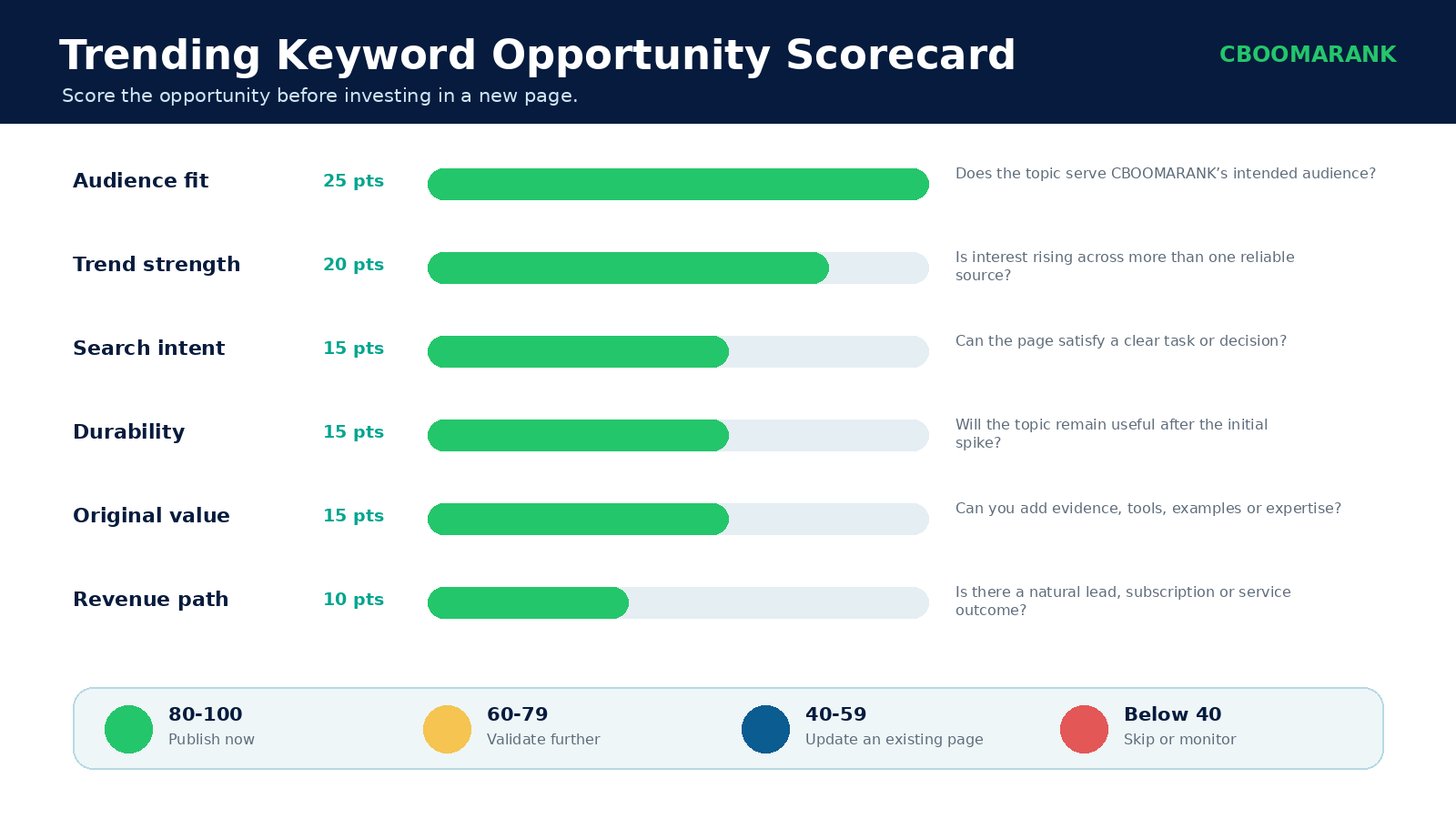
Figure 3. Score opportunities before investing in a new page; not every rising query deserves publication. | Alt text: Weighted keyword opportunity scorecard assessing audience fit, trend strength, intent, durability, original value and revenue potential.
How to Evaluate a Trending Keyword Before Publishing
Confirm the search intent
Inspect the current results. Are users looking for news, a definition, a tutorial, a product, local information, a comparison or a tool? The format of your page should match the dominant need while providing something more useful.
Check whether the trend fits your topical authority
A site focused on SEO and digital marketing should not chase every entertainment or political trend. Google recommends people-first content created for an existing or intended audience, rather than publishing across unrelated topics simply to capture traffic.
Estimate durability and update cost
Breaking content may require several updates in a day. A slowly emerging concept may justify a detailed evergreen guide. Choose a format your team can maintain accurately.
Assess the revenue path
Define the useful next step before writing. For CBOOMARANK, that may be a website analysis, an SEO service inquiry, a pricing-plan comparison or a related educational guide. Avoid forcing a commercial call to action when it does not fit the reader’s intent.
Measure SERP and AI-search opportunity
Review the types of results already present: news panels, video, image packs, forums, shopping, local results, AI Overviews and classic organic pages. Create the assets needed for those formats rather than assuming a text-only article is sufficient. The CBOOMARANK SERP features guide can help you identify different result types.
A Seven-Step Trending Keyword Content Workflow
- Discover a signal from Trends, Search Console, communities, paid search or industry events.
- Validate it with at least one additional independent source.
- Classify the intent and decide whether to update an existing page or create a new one.
- Build a content brief around the reader’s task, not a list of keyword variations.
- Add original evidence such as screenshots, examples, data, interviews or testing.
- Publish with useful images, clear internal links and an accurate update date.
- Monitor impressions, engagement, conversions and the trend curve; update, consolidate or retire the page when needed.
Use CBOOMARANK website analytics tools to check technical and on-page issues, and follow the CBOOMARANK SEO best-practices guide when optimizing the finished page.
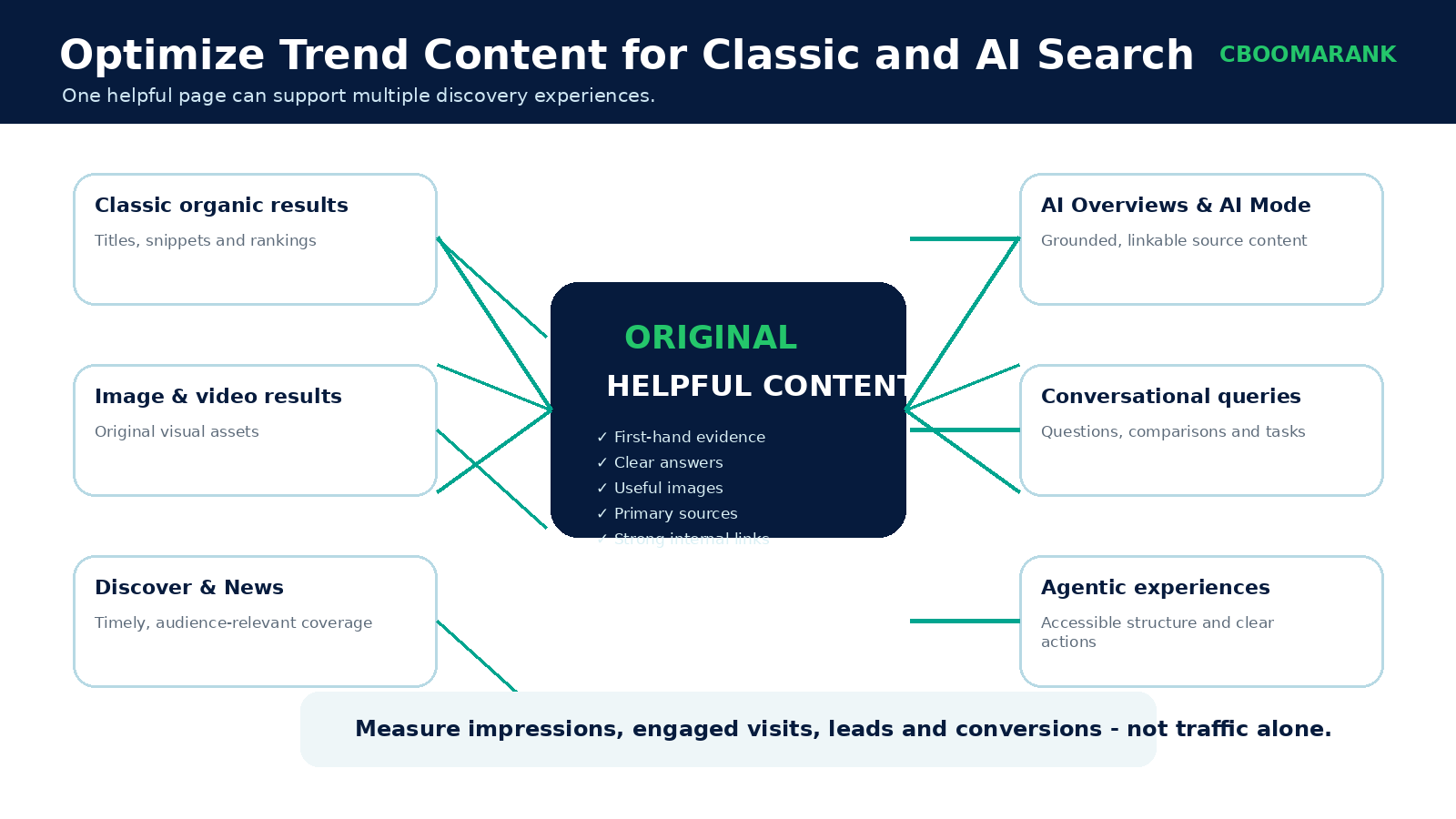
Figure 4. Build one distinctive, technically accessible resource that can serve classic search and newer AI-assisted discovery. | Alt text: Diagram showing how original helpful content can support classic organic results, image and video results, Discover, AI Overviews, AI Mode and conversational queries.
How to Optimize Trend Content for Classic and AI Search
- Answer the central question early and clearly.
- Include the publication and meaningful last-updated dates.
- Use a descriptive title instead of exaggerated clickbait.
- Add first-hand observations, original examples or a distinct point of view.
- Organize the article with logical headings and descriptive internal links.
- Use high-quality images, charts or videos when they improve understanding.
- Keep factual claims current and link to primary sources.
- Make sure the page is crawlable, indexable, mobile-friendly and technically sound.
- Measure signups, leads, sales and engaged visits—not only raw clicks.
Google’s AI search optimization guide says foundational SEO remains relevant to AI Overviews and AI Mode. It emphasizes valuable non-commodity content, clear technical structure and avoiding attempts to manufacture a page for every possible query variation.
Common Mistakes to Avoid
- Publishing unrelated trends that do not fit the site’s audience or expertise.
- Treating a one-day spike as proof of long-term demand.
- Using Google Trends scores as absolute search-volume numbers.
- Creating many near-duplicate pages for minor wording variations.
- Copying social posts or competitor articles without adding original value.
- Publishing quickly without fact-checking or planning updates.
- Ignoring geographic differences and seasonality.
- Measuring success only by traffic rather than qualified conversions.
Frequently Asked Questions
What is the fastest way to find trending SEO keywords?
Start with Google Trends Trending Now for recent spikes, then validate relevant topics in Google Trends Explore and Google Search Console. Use at least two sources before committing resources.
Does a Google Trends score of 100 mean 100 searches?
No. Google Trends uses normalized relative interest. A score of 100 represents the peak popularity for the selected comparison, location and timeframe—not an absolute number of searches.
Should I create a new post for every rising query?
No. Update an existing relevant page when it already serves the same intent. Create a new page only when the audience need and content format are meaningfully different.
Are zero-volume keywords worth targeting?
Sometimes. New queries may not yet appear in historical databases. First-party impressions, community demand, product launches and a rising Trends curve can justify a page when the topic is relevant and useful.
How often should I check keyword trends?
A weekly review is suitable for most evergreen publishers. News, ecommerce and event-driven teams may need daily monitoring during important launches or seasons.
Can AI generate trending keyword ideas?
AI can expand ideas and group patterns, but it can also invent or misinterpret trends. Verify every suggestion with real search data, customer evidence or trusted primary sources.
Do trending keywords help with AI Overviews and AI Mode?
Timely, accurate pages may become relevant to newer queries, but there is no special keyword trick. Google advises publishers to use established SEO practices and create unique, useful content for people.
How can CBOOMARANK help?
Use CBOOMARANK to review website performance and SEO issues, then connect trend-driven content to a technically sound site and measurable conversion path. Explore CBOOMARANK pricing plans or discuss your strategy through CBOOMARANK SEO services.
Final Thoughts
Trending keyword research is most valuable when it helps you understand changing audience demand early—not when it becomes an excuse to chase every spike. Combine live trend data, first-party Search Console insights, customer language and industry knowledge. Then publish only where CBOOMARANK can add accurate, distinctive and useful information.
The winning workflow is simple: discover early, verify carefully, create original value, publish in the right format and measure business outcomes.
