

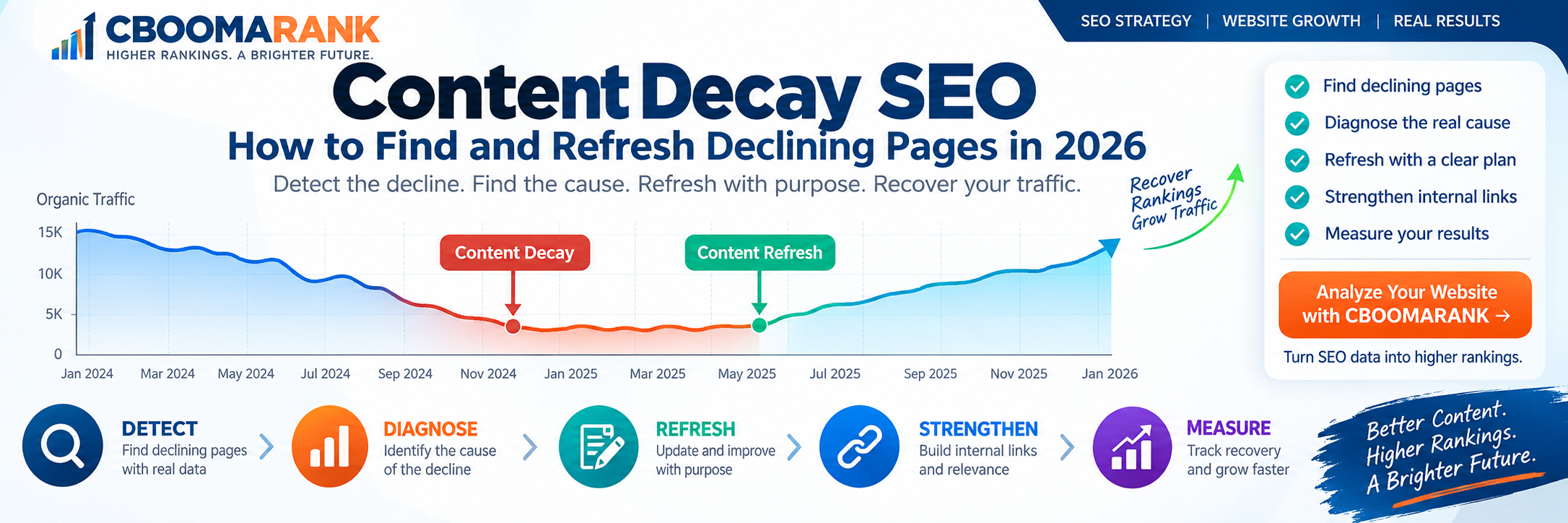
Content decay SEO describes the gradual loss of organic visibility that can happen when an existing page becomes less useful, less competitive or less aligned with what searchers and search engines now expect. A page that once generated strong rankings, clicks and conversions may slowly decline even though nothing obvious appears to be broken.
That decline matters because established pages often already have backlinks, internal authority, historical engagement data and ranking signals. In many cases, improving an existing resource can create faster gains than publishing another article targeting the same topic.
The goal is not to update every old page simply because it is old. A better approach is to identify pages with meaningful deterioration, diagnose why performance is falling and invest in the URLs where a refresh can produce measurable business value.
This guide explains how to detect declining pages, prioritize refresh opportunities, strengthen content, improve internal relationships and measure whether the work actually restores organic performance.
Content Decay SEO: What It Means
A page experiences content decay when its search performance weakens over time compared with its previous baseline. The decline may appear through lower clicks, impressions, rankings, click-through rate, conversions or visibility across the query set that once drove traffic.
Content decay is different from a temporary fluctuation. Rankings naturally move, competitors publish new material and search demand changes throughout the year. A meaningful decay pattern normally becomes clearer when you compare performance across longer periods and see sustained deterioration rather than a short-term dip.
The age of a page alone does not determine whether it has decayed. Some evergreen resources perform well for years with only minor maintenance. Other pages become stale quickly because statistics, products, search behavior, competitors or industry standards change frequently.
This is why a strong content optimization process evaluates usefulness, relevance and performance rather than treating publication date as the main signal.
What Causes Content Decay SEO?
Organic decline usually has more than one possible cause. The most useful diagnosis separates content problems from technical problems and market changes before deciding what to edit.
1. Information becomes outdated
Statistics, screenshots, product features, pricing, recommendations, examples and industry guidance can lose accuracy. When competing pages contain fresher and more complete information, an older resource may gradually become less useful.
2. Search intent changes
A query that once rewarded informational guides may begin favoring tools, comparison pages, videos, commercial pages or more specialized resources. Before refreshing a declining URL, compare its purpose with current search behavior and your existing search intent strategy.
3. Competitors create stronger resources
Your page may not have become objectively bad. The competitive standard may simply have improved. Newer pages can include clearer structure, better examples, stronger data, useful visuals, expert commentary and more complete answers.
4. Internal authority weakens
As a website grows, newer articles can receive most of the contextual internal links while older resources become buried deeper in the architecture. The page remains published, but its relationship to the rest of the site becomes weaker.
5. Technical SEO problems reduce visibility
Indexing changes, accidental canonical directives, redirect chains, crawl problems, broken resources, mobile issues and other technical defects can mimic content decay. Use a technical SEO checklist before assuming that rewriting the page is the correct solution.
You should also understand how technical SEO affects rankings, because content changes alone will not repair an underlying crawling, indexing or rendering problem.
6. Search demand changes
Some traffic losses are caused by declining interest rather than declining SEO quality. Seasonal topics, discontinued products and changing trends can all reduce search volume. Updating the article will not necessarily restore traffic if fewer people are searching for the subject.
How to Identify Content Decay SEO
The strongest diagnosis combines historical search performance with page-level review. Start with evidence rather than selecting old posts at random.
Step 1: Compare meaningful date ranges
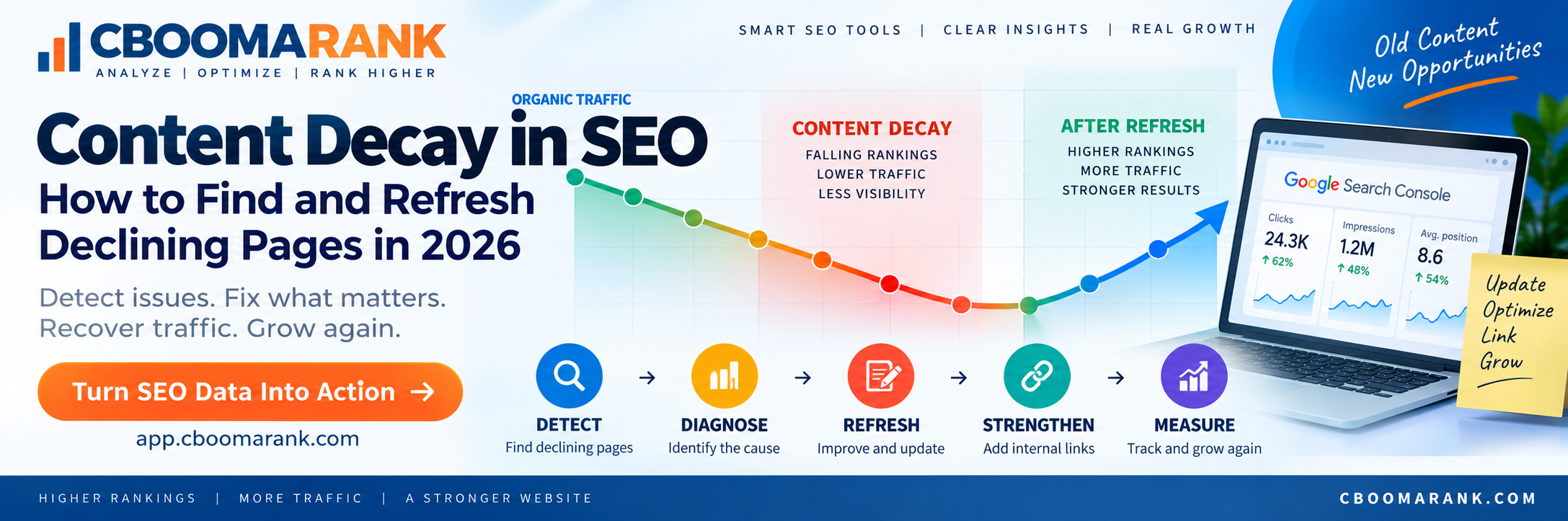
Use the Google Search Console Performance report to review clicks, impressions, click-through rate and average position. Compare a recent period against an equivalent earlier period so that you can identify sustained deterioration.
For seasonal businesses, year-over-year comparisons are often more useful than comparing one month against the immediately previous month.
Step 2: Look at the pattern behind the decline
- Clicks down, impressions stable: investigate rankings, titles and click-through rate.
- Clicks and impressions both down: investigate lost query visibility, demand changes, indexing and competition.
- Position down across important queries: review competing pages and search intent.
- Traffic down while rankings remain similar: check demand, SERP features and click behavior.
- A sudden collapse: investigate technical changes, indexing, redirects and site-wide issues before rewriting content.
Google also provides guidance for analyzing Search performance changes, which can help distinguish different types of traffic loss.
Step 3: Audit the page itself
Run a structured review rather than relying only on rankings. A comprehensive website SEO audit can expose technical and on-page problems that are easy to miss when looking only at traffic graphs.
| Signal | What to investigate |
|---|---|
| Falling rankings | Intent changes, stronger competitors, lost relevance or weak authority |
| Declining impressions | Query loss, search demand, indexing and topical relevance |
| Lower CTR | Title, description, SERP features and competitive snippets |
| Outdated information | Statistics, screenshots, products, examples and recommendations |
| Weak internal links | Page depth, anchor relevance and contextual linking opportunities |
How to Decide Which Declining Pages to Refresh
Not every declining URL deserves the same investment. Prioritization should consider historical performance, business value, ranking opportunity, backlinks, conversion potential and the effort required to regain competitiveness.
A page that previously generated qualified traffic and still has strong links may deserve immediate attention. A thin article with almost no impressions, no links and little commercial value may be a better candidate for consolidation, redirection or removal.
Historical value + current opportunity + business importance + recoverability should determine which declining pages are refreshed first.
The next stage is to turn that diagnosis into a repeatable content-refresh process without destroying the elements that already make the page valuable.
How to Refresh Decaying Content Step by Step
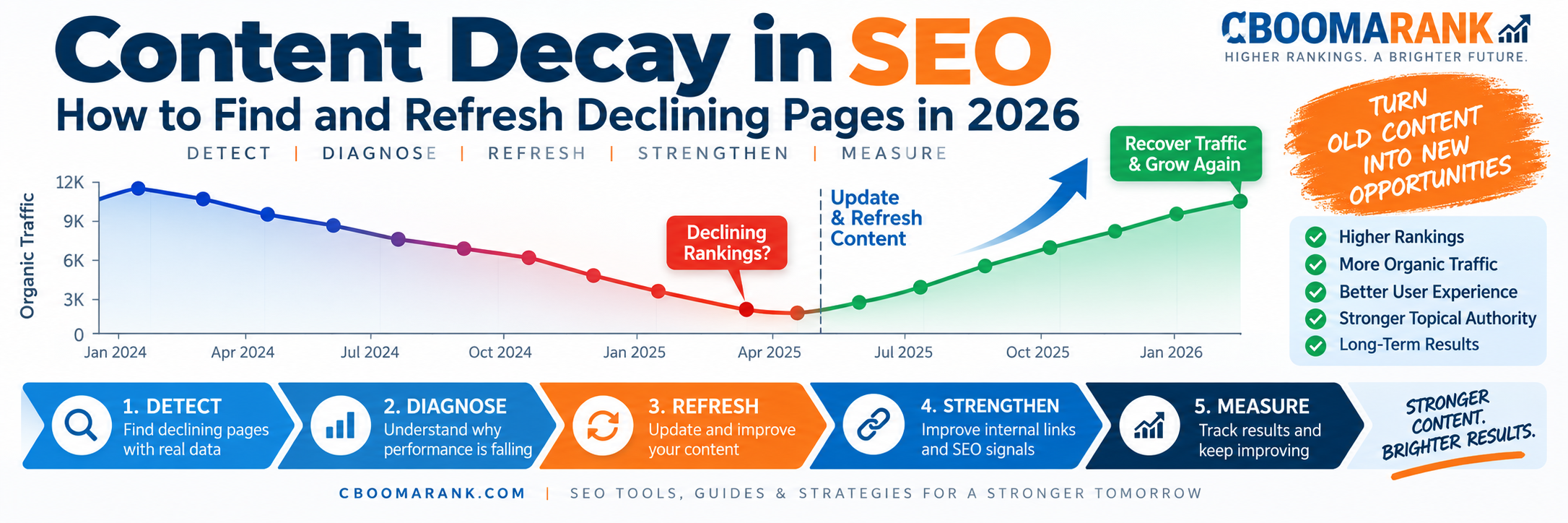
Once you have confirmed genuine content decay, the objective is not simply to add more words. A successful refresh should make the page more useful, more current and more clearly aligned with the search intent that exists today.
1. Preserve What Is Working During a Content Decay Refresh
Before editing, identify the elements that still perform well. These may include ranking sections, backlinks, useful examples, original data, conversion elements, strong headings or passages that already satisfy important queries.
A refresh should improve the page without unnecessarily removing assets that contributed to its historical performance.
2. Recheck the primary search intent
Review the queries currently generating impressions and compare them with the purpose of the page. If the page has drifted away from the dominant user need, restructure it around the most relevant intent rather than simply expanding every existing section.
A clear keyword mapping strategy can help ensure that the refreshed page owns a specific topic while related URLs serve distinct supporting purposes.
3. Replace outdated information
Review dates, examples, screenshots, statistics, tools, recommendations, product details and references. Remove information that is no longer accurate and replace it with current material that improves the reader’s ability to act.
4. Strengthen weak sections
Look for sections that answer an important question only superficially. Expand them when additional explanation genuinely improves usefulness. Do not add filler simply to increase word count.
5. Improve structure and readability
Break large blocks of text into clear sections. Use descriptive H2 and H3 headings, concise paragraphs, lists, tables and visual explanations where they improve comprehension. A strong refresh should be easier to scan on both desktop and mobile devices.
6. Reassess title and search snippet
If rankings remain reasonably strong but click-through rate has weakened, improve the SEO title and meta description so they accurately communicate the page’s value. Avoid changing a successful URL simply because the article has been refreshed.
7. Strengthen Internal Links for Content Decay Pages
Add links from relevant authoritative pages to the refreshed resource and make sure the refreshed article points naturally to useful supporting content. Our guide to the best internal linking tools explains approaches that can help manage this process at scale.
8. Run a final SEO and technical check
Before considering the refresh complete, review the page with a structured SEO audit checklist. Confirm that the page remains indexable, its canonical is correct, important links work and the content renders properly across devices.
When Updating Content Is Not Enough
Some declining pages should not be refreshed as standalone URLs. The correct action depends on whether the URL still has a unique role in the site’s content architecture.
| Situation | Recommended action |
|---|---|
| Page is useful but outdated | Refresh and strengthen the existing URL. |
| Two pages serve substantially the same intent | Consolidate useful material into the stronger page and consider a 301 redirect. |
| Page has backlinks but content is obsolete | Preserve valuable signals by merging into the most relevant current resource. |
| Page serves a distinct intent despite lower traffic | Keep it separate and improve its positioning, internal links and relevance. |
| Page has no meaningful value or suitable replacement | Evaluate removal instead of maintaining low-value content indefinitely. |
Do not use redirects simply to hide weak content. The destination should be genuinely relevant. Likewise, do not merge two URLs merely because they contain similar keywords. Different search intents can justify separate pages.
If performance fell suddenly after technical changes, investigate the problem before consolidating anything. Our guide to checking and resolving technical SEO problems covers issues that can affect crawling, indexing and ranking independently of content quality.
How Internal Linking Helps Recover Content Decay SEO
Internal linking is one of the most practical ways to reconnect an older page with the rest of a growing website. New content often receives links naturally during publication while older pages gradually become isolated.
A strong recovery process should examine both incoming and outgoing internal links.
- Link to the refreshed page from highly relevant newer articles.
- Use descriptive anchors that explain the relationship between the pages.
- Remove internal links pointing to obsolete or redirected versions.
- Make sure important evergreen pages are not buried many clicks from the main content structure.
- Link from the refreshed page to supporting resources that help readers complete the next step.
Internal linking should reinforce topic architecture rather than create artificial repetition. The goal is to help users and search engines understand which URL is the primary resource and how supporting pages relate to it.
How CBOOMARANK Can Help Identify Content Decay Opportunities
Content decay becomes much easier to manage when keyword, technical and page-performance signals are evaluated together instead of in separate spreadsheets and disconnected reports.
CBOOMARANK is being built around this connected SEO workflow. A useful content-decay process can combine:
- historical keyword and ranking movement;
- page-level organic visibility;
- keyword and search-intent relationships;
- technical crawl findings;
- internal-link relationships;
- authority and backlink indicators;
- competitor visibility;
- business value and opportunity;
- recommended remediation actions; and
- post-refresh performance validation.
This approach makes it possible to prioritize pages based on potential impact instead of refreshing content simply because it has an old publication date.
A broader SEO management workflow is especially important on larger websites because content decay, technical maintenance, internal linking and keyword strategy influence one another over time.
Connect website analysis, keyword signals and SEO opportunities so you can prioritize the pages that deserve attention first.
How to Measure Results After Refreshing Content
A refresh is not complete when the content is saved. The final stage is validation. Record the pre-refresh baseline and compare performance after search engines have had enough time to recrawl and reassess the page.
Monitor the metrics that reflect the purpose of the page rather than relying on a single ranking position.
- organic clicks;
- impressions;
- average ranking position;
- click-through rate;
- number of relevant ranking queries;
- conversions or qualified actions;
- engagement where useful;
- internal-link growth; and
- visibility against important competitors.
The Google Search Console performance metrics documentation can help interpret clicks, impressions, CTR and position when monitoring the page after an update.
Do not judge a substantial refresh after only a day or two. Search engines need time to recrawl pages and ranking systems may reassess them gradually. The appropriate observation window depends on crawl frequency, site authority, query volatility and the size of the changes.
How to Prevent Content Decay SEO
The most efficient content-decay strategy is not to wait until valuable pages lose most of their traffic. Build maintenance into the publishing workflow so important URLs are reviewed before deterioration becomes severe.
Maintain a refresh calendar
Not every page requires the same review frequency. Fast-changing topics such as software, pricing, statistics, regulations and technology may need frequent checks, while stable evergreen guides can often be reviewed less often.
Prioritize pages with meaningful historical traffic, backlinks, conversions or strategic importance.
Track Content Decay Performance Trends
A single ranking change rarely tells the whole story. Monitor clicks, impressions, query coverage, CTR and conversions over time. A gradual decline across several indicators is more useful than reacting to one temporary movement.
Keep search intent mapped clearly
As your content library grows, maintain clear ownership of major topics. Strong SEO keyword mapping reduces the risk of new articles unintentionally competing with established pages.
Build internal links during every publishing cycle
New articles should support relevant evergreen pages rather than creating isolated content. Regularly review your internal linking strategy so older high-value resources continue receiving contextual authority.
Audit important pages after major site changes
Redesigns, migrations, URL changes, plugin updates and structural adjustments can affect established pages. Run a technical SEO review after significant changes instead of assuming a traffic decline is caused by stale content.
Refresh for usefulness, not simply freshness
Changing a publication date without materially improving the page is not a content strategy. Update information because the new version is more accurate, complete, helpful or better aligned with current search intent.
Monitor → detect meaningful decline → diagnose the cause → choose the correct action → improve the page → strengthen internal relationships → validate results.
Related CBOOMARANK SEO Guides
Frequently Asked Questions About Content Decay SEO
1. What is content decay in SEO?
Content decay is a sustained reduction in the organic performance of an existing page. It may appear as declining rankings, fewer clicks, fewer impressions, lower CTR or reduced conversions. The cause can include outdated information, changed search intent, stronger competitors, weaker internal linking or technical problems.
2. How do I know if a page is losing rankings because of content decay?
Compare historical performance across equivalent periods and review the queries the page previously ranked for. Then check search intent, competitors, technical health and content accuracy. A decline should be diagnosed before it is labelled as content decay because seasonality or technical issues can produce similar patterns.
3. How often should old content be updated?
There is no universal schedule. Review rapidly changing topics more frequently and monitor strategically important evergreen pages using performance data. Update a page when evidence shows that its usefulness, accuracy or competitiveness has weakened—not simply because a certain number of months has passed.
4. Should I update the publish date after refreshing content?
If the page has been substantially revised, showing an updated date can help readers understand that the information is current. However, changing the date alone without meaningful improvements provides little value. The content itself should justify the freshness signal.
5. Can internal links help recover declining content?
Yes. Relevant internal links can reconnect an older page with the site’s current architecture, make the page easier to discover and clarify its topical relationship to other resources. They work best when combined with genuine content improvements and a clear search-intent strategy.
6. Should declining pages be deleted or redirected?
Not automatically. Refresh pages that still have a useful purpose. Consolidate overlapping pages when one stronger resource can satisfy the same intent. Redirect an obsolete URL when there is a genuinely relevant replacement. Pages with no meaningful value may sometimes be removed, but the decision should be based on evidence.
7. How long does it take refreshed content to recover rankings?
Recovery time varies. Search engines must recrawl and reassess the page, and competitive queries can take longer to respond. Monitor several weeks of performance where appropriate rather than judging a substantial refresh immediately after publication.
Final Verdict: Build a Content Decay SEO Workflow
Content decay is not simply an “old content” problem. It is a performance-management problem that sits at the intersection of content quality, search intent, technical SEO, internal linking, competition and business value.
The strongest workflow begins with data. Identify pages that have genuinely declined, understand why performance changed and choose the appropriate response. Sometimes the answer is a comprehensive refresh. In other cases, consolidation, redirection, stronger internal linking or technical repair may be more effective.
For growing websites, the objective should be to build a repeatable system that detects deterioration early. Combining a regular SEO audit with search-intent analysis, content optimization and historical performance data can help protect the value already created by your strongest pages.
CBOOMARANK’s broader opportunity is to connect those signals into one workflow—from discovery and diagnosis through prioritization, remediation and post-refresh measurement.
Analyze your website with CBOOMARANK and connect content, keyword and technical signals to the pages that deserve attention first.
