


Want to find competitors online without spending an afternoon in research tools? Start with three customer-intent searches, confirm which sites consistently appear for those searches, and separate businesses that sell a similar product from websites that compete for the same search clicks. You can build a useful first shortlist in about ten minutes, then decide which rivals deserve deeper SEO, content or backlink research.
This guide is specifically about competitor discovery — answering “Who should we monitor?” — rather than attempting a comprehensive competitive audit. For a broader business strategy, read our competitor analysis guide. For repeatable analysis, use our competitive analysis template and Excel workbook.
You will need a browser, a list of customer problems you solve, and a simple recording sheet. The process works for agencies, SaaS businesses, local services, ecommerce stores, publishers and consultants. A business with customers in several countries should repeat the search with the relevant market or language settings; a result in the United States may not reflect results in France or India.
Record SERP observations, classify rivals, score relevance and select your top three targets before opening a heavyweight report.
How to Find Competitors Online in 10 Minutes: The Quick Answer
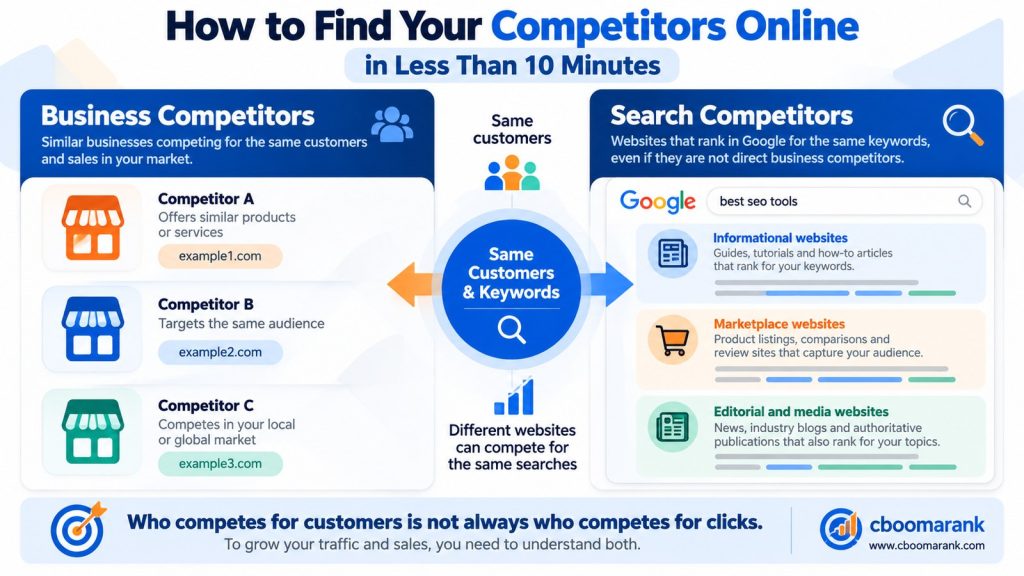
To find competitors quickly, search for what your ideal customer would buy or solve, note the domains ranking repeatedly for those queries, examine their offers and audience, and rank the three best matches. The crucial distinction is that search competitors are not always direct commercial competitors. For example, a software company may compete in Google results with comparison publishers, reviews, marketplaces or communities even if those websites do not sell competing software.
| Time | Task | Output |
|---|---|---|
| 0–1 min | Define one customer problem | Seed problem and customer intent |
| 1–3 min | Search three specific queries | Visible relevant domains |
| 3–5 min | Vary wording and geography | Hidden or regional competitors |
| 5–7 min | Open and classify top results | Business vs search rival |
| 7–9 min | Score and shortlist | Top three candidates |
| 9–10 min | Choose a next action | Research brief |
Before You Start: Understand What Counts as a Competitor
Direct business competitors
A direct competitor serves roughly the same buyer and solves the same job with a similar product or service. Two SEO subscription platforms targeting small agencies may compete directly, even if their feature lists differ. Likewise, two plumbers offering emergency callouts in the same city compete directly for local enquiries.
Indirect competitors and alternatives
An indirect competitor solves the underlying problem in a different way. An agency service can compete with software, a spreadsheet-based workflow, an in-house specialist or an adjacent platform. These alternatives matter in pricing and positioning research, although they may not rank for exactly the same phrases.
Search and content competitors
A search competitor earns visibility for queries you want to own. It might be a directory, comparison website, tutorial blog, forum, video result or marketplace. Search competitors matter because they intercept attention before prospects reach your brand. Separate these from business rivals so your next move is appropriate: optimize a landing page, publish a guide, strengthen backlinks, or improve a commercial offer.
Minute 0–1: Define Your Goal Before You Find Competitors
Write one sentence that describes the buyer, their need and their geography: “Small marketing agencies in Canada looking for affordable website audit software.” This is more useful than simply searching a generic word such as “marketing.” It gives your ten-minute exercise a measurable audience and makes it easier to reject irrelevant results.
Then list three phrases from different stages of the decision: a problem phrase such as “how to audit website SEO”; a solution phrase such as “website audit tool”; and a purchase phrase such as “SEO audit software for agencies.” Choose terms that reflect genuine business intent rather than forcing the focus keyphrase into every search.
Use specific intent, not just broad market labels
A broad query often returns dictionaries, famous brands, general industry publications or unrelated countries. By contrast, a detailed phrase reveals which sites compete for a specific customer problem. This protects the shortlist from being dominated by large publishers that are visible but not commercially comparable.
Minute 1–3: How to Find Competitors Using Google Search
Open Google Search and run your three phrases separately. For each one, record the visible organic domains, the result type and the page that answers the user’s need. Ignore navigation results unrelated to your offer. Sponsored placements can help reveal advertisers, but label them separately from organic listings: paying for an ad does not mean a site ranks organically.
Capture the page, not just the domain
Write down the specific URL and what it offers. A domain can rank for a long-form guide, a product category, a tool landing page and a comparison article. Each signals a different route to winning search traffic. If a rival appears with a product page while yours ranks with a broad blog article, the gap may be intent rather than content length.
A simple evidence table
| Search phrase | Observed site | Page type | Competitive meaning |
|---|---|---|---|
| SEO audit software for agencies | Example product domain | Commercial landing page | Potential direct business rival |
| How to audit website SEO | Example tutorial publisher | Educational guide | Search-content competitor |
| Best website audit tools | Example comparison publication | Listicle / comparison | Research-stage search rival |
The examples above are fictional, not a claimed live ranking list. Search results vary with country, time, language, device and personalization.
Minute 3–4: Find Competitors Through Keyword Research
Real customers do not all use the terminology in your product descriptions. Test one synonym and one alternative framing. For example, a business selling “website analysis software” may also compete for “SEO checker,” “technical site audit,” “site performance report” or “SEO analysis tool.” Look for domains that appear more than once; repeated relevance is a better early signal than a single appearance for an ambiguous query.
Use search operators carefully
Quotation marks can narrow a query to an exact phrase; site: can help explore pages on a known domain; a minus sign can exclude a distracting meaning. Google documents these operators in its Search Help. Operators are discovery aids, not a substitute for a competitor dataset, and results can still differ across markets.
For a local service, pair the term with a location (“office cleaning Manchester”) or make the geographical area explicit in Google. For a SaaS business, try industry-specific modifiers such as “for agencies,” “for ecommerce,” “for startups” or “enterprise.” Your shortlist should represent the audience you want to win, not all businesses globally.
Minute 4–5: Check the Country, Language and Buyer Journey
Repeat one important query for the country you serve. A site that is highly visible in one market might be absent in another, and regional competitors can have better language, pricing or local proof. Use country- and language-aware results and be cautious about claiming exact rankings from manually observed searches. Record the date, location and device context beside each finding.
Compare demand signals with Google Trends
If the wording is ambiguous, Google Trends can help compare search interest by region or time. Trends shows normalized relative interest, not competitor traffic or absolute keyword volume. For a multilingual comparison, distinguish literal search terms from broader topics as described in Google’s Trends guidance.
Minute 5–6: Find Competitors by Business and Search Type
A direct product competitor may justify a feature, pricing or positioning comparison. By contrast, an educational publisher may signal an opportunity to create a stronger guide with expert examples and internal links. For high-intent local queries, a directory result may indicate that your business profile or location page needs improvement. These distinctions help you choose the right action instead of treating every competitor alike.
The difference matters for the action plan
A direct product competitor may justify a feature, pricing or positioning comparison. A publisher ranking with an educational article might justify a better guide, stronger expert examples, or improved internal linking. A directory appearing for high-intent local terms may signal that your business profile or location page needs work. Without classification, competitors are treated as interchangeable and the action plan becomes unfocused.
Minute 6–7: Find Competitors Using Your Existing Audience Clues
Look at sales conversations, lost-deal notes, Search Console queries, customer feedback, on-site search terms and competitor names mentioned during onboarding. These clues often surface rivals that keyword tools underrepresent. If a prospect repeatedly compares your offer with a particular workflow, that is evidence of a business alternative even if its website does not outrank you.
Do not mistake your own Search Console for competitor analytics
Google Search Console reports search performance for properties you control and verify. It is not a way to inspect another company’s private queries or analytics. Use it to discover which search intents already bring impressions to your site, then independently investigate the public search results for those topics.
Minute 7–8: How to Find Competitors and Compare Their Websites
Suppose Domain A scores 5 for intent, 4 for audience overlap and 4 for repeated presence, giving it a total of 13. By comparison, Domain B scores 9, while Domain C scores 8. Therefore, Domain A is the strongest initial comparison target, even if B is the best-known brand. This approach favors actionable overlap over fame.
| Factor | Score 1 | Score 5 |
|---|---|---|
| Intent match | Answer unrelated | Addresses the same customer job |
| Audience overlap | Different buyer | Same buyer, region and price range |
| Repeat presence | Appears once | Visible across several relevant searches |
A total of 12–15 suggests a high-priority candidate for deeper research. A score of 8–11 may deserve monitoring or a narrow follow-up. Below that, defer the domain unless another business signal makes it strategically important. Adjust these informal thresholds for your market, and always keep the evidence links visible.
Example: interpreting a shortlist
Suppose Domain A scores 5 for intent, 4 for audience overlap and 4 for repeated presence: its combined score is 13. Domain B scores 2, 5 and 2 for 9. Domain C scores 4, 3 and 1 for 8. Domain A is the strongest initial comparison target even if B is the most recognizable brand. This favors actionable overlap over fame.
Minute 8–9: Find a Competitive Weakness You Can Actually Address
Review a top competitor result and identify one concrete limitation. Is the information outdated or written for the wrong geography? Check whether the page provides clear methodology, screenshots, practical examples and a useful next step. For commercial queries, determine whether the result offers a relevant product comparison rather than only general advice. Finally, verify that the gap matters to your audience before investing resources.
When to conduct deeper keyword and backlink research
Only after a candidate passes this quick relevance check should you run a full keyword-gap, top-pages or backlink comparison. At that stage, CBOOMARANK can serve as the research starting point for SEO analysis and competitor-focused workflows; check the available tools and account access on the pricing page. Avoid interpreting modeled traffic estimates as measured visits, and compare like-for-like periods where possible.
For a separate workflow that targets the content themes competitors win, see our competitor content-gap analysis article. For a more detailed inventory of website competitors, domain metrics and research methodology, our domain analytics guide provides further context.
Minute 9–10: Turn Your Findings into One Clear Next Step
Select the best three domains, record why each matters, and write a next action with an owner and deadline. Keep the decision small enough to act on this week. For example: “Compare the five commercial pages that rank for agency SEO audit searches and improve our product page’s use cases and evidence.” A ten-minute exercise is valuable only when it creates a measurable follow-up.
- Choose one primary comparison rival with the closest search and audience overlap.
- Select one article or landing page to inspect more deeply.
- Define one metric to track: qualified organic clicks, ranking share for a relevant query cluster, enquiries or trial signups.
- Set a review date after making the change, allowing time for search systems and visitors to respond.
Common Mistakes When You Find Competitors Online
Confusing search visibility with commercial market share
A ranking result does not prove that a site leads its market or earns more revenue. A popular how-to publication may attract research traffic while a smaller SaaS site closes more qualified customers. Keep ranking evidence separate from business sales claims.
Assuming a single query represents the market
One search can be skewed by local intent, ambiguous wording or a major brand. Use at least three purposefully selected queries. When possible, repeat the exercise across relevant markets and monitor patterns, not an individual search screenshot.
Copying a rival instead of solving the customer problem
Research should expose unmet needs, not encourage wholesale duplication. Use observed page weaknesses to propose better information, better product positioning or clearer examples. Preserve originality, cite sources, and do not claim competitors’ unpublished numbers as facts.
Treating every automated traffic source as a qualified visitor
Competitor research works best with trustworthy data. If website analytics contain suspicious Direct traffic, very low engagement or bot activity, investigate measurement quality before using that traffic as a competitive benchmark. Search impressions, sessions, conversions and modeled competitor traffic are different measurements.
Find Competitors in Different Industries: Three Fast Examples
SaaS: website audit and SEO reporting
Begin with “website audit software,” “SEO reports for agencies” and “SEO checker.” Classify subscription tools as direct business rivals, review publishers as search competitors, and broad search portals as lower-priority visibility rivals unless they consistently intercept high-intent traffic.
Local services: emergency plumbing
Search “emergency plumber [city],” “24-hour plumbing repair [city]” and “plumber near me” with location context. Service companies compete for customers, while local directories and map results may compete for visibility. Inspect service areas and after-hours availability before deciding that a listing is a true rival.
Ecommerce: standing desks
Search “buy standing desk,” “best standing desks for home office” and “standing desks [country].” Product sellers and marketplaces may compete for sales; review sites may compete for information-stage searches. Compare delivery geography and audience intent before interpreting rankings.
Frequently Asked Questions About Finding Competitors
Can I find competitors for free?
Yes. Google Search, business directories, customer feedback and selected public search data can produce a useful shortlist without payment. Paid SEO tools can deepen the analysis once you know which competitors are relevant.
How can I find competitors for my website?
List three keywords that reflect the problems your ideal visitors want solved, inspect relevant search results, and note domains that appear repeatedly. Then review whether those sites sell to the same buyers or simply compete for search clicks.
What is the difference between direct and indirect competitors?
Direct competitors offer similar solutions to similar buyers. Indirect competitors solve the same underlying problem in a different way. Search competitors may include both, along with publishers or marketplaces targeting the same queries.
How many competitors should I track?
Start with three to five serious candidates. A short list with documented evidence is more useful than dozens of unrelated domains. Expand when a distinct audience, region or product line needs its own research.
Does Google show the same competitors in every country?
No. Results can change by location, language, query wording and other contextual signals. Repeat crucial searches using the intended market, and record the observation date and location.
Can I use Google Analytics to find competitors?
Your own Analytics property shows visitors and behavior for your site, not another business’s private analytics. It can reveal customer journeys and interests that suggest research topics, but competitor discovery requires separate market and public search evidence.
How do I find competitors for SEO, not just business?
Focus on domains ranking for relevant informational and commercial queries, regardless of whether they sell the same product. Then classify those domains by result type, audience overlap and repeat presence. That identifies websites competing with your content for attention.
What should I do after I identify competitors?
Pick one opportunity to investigate: an important keyword cluster, a content gap, a backlink opportunity or an offer-positioning difference. Use a consistent worksheet so future research is comparable and decisions can be measured.
Final Checklist: Find Competitors, Then Take Action
The fastest credible approach to find competitors is to begin with customer intent, review multiple search results, classify business versus search rivals, and document the evidence. Avoid equating popularity with relevance. Ten minutes should give you a shortlist worth investigating — not an unsupported claim that you have mapped an entire industry.
Download the Rank 59 competitor-finder worksheet and explore relevant research workflows at CBOOMARANK. You can also review plans and access when you are ready to compare keywords, backlinks and website opportunities in more detail.
