


Content gap analysis is the process of comparing what your website provides with what your audience needs and what competing pages already answer well. The most valuable gap is not necessarily a keyword you have never targeted. It may be a missing explanation, outdated example, weak decision aid, unsuitable format, or unanswered buying question that prevents your page from satisfying a real visitor.
In this practical competitor content analysis guide, you will learn to identify winning competitor pages, examine their structure and evidence, map gaps against your own inventory, and prioritize content changes without copying rival websites. We also provide an illustrative comparison matrix and a 30-day workflow that marketers, publishers, SaaS teams, local businesses, and agencies can adapt.
Quick answer: Choose three to five relevant search competitors, select the pages competing for one topic, compare audience intent and five content dimensions, identify what your own page is missing, and decide whether to improve an existing URL or create a new one. Measure the effect on impressions, qualified clicks, engagement, and conversions rather than relying on word count alone.
What Is Competitor Content Analysis?
Competitor content analysis is the systematic review of competing pages to understand their target audiences, topic coverage, formats, credibility signals, on-page experience, and conversion paths. It differs from a simple keyword export. A keyword export shows search terms associated with a rival page; a content review explores whether that page actually answers the visitor’s question and why a comparable page may be more useful.
For example, your site might already have a guide about website SEO audits. Three competitors may rank for the same topic, but each helps the reader differently: one includes an issue-priority matrix, another shows sample screenshots, and a third provides a report template. Your missing element could be an actionable reporting example rather than a missing target keyword.
Content Gap Analysis vs Keyword Gap Analysis
| Question | Keyword gap analysis | Competitor content analysis |
|---|---|---|
| Primary unit | Search query or keyword cluster | Page, section, format and user task |
| Main question | Which terms do rivals rank for that we do not? | What does a visitor need that our content fails to deliver? |
| Typical inputs | Rankings, SERPs, intent, volume estimates | Page structure, examples, evidence, UX, internal links, CTAs |
| Typical output | Prioritized keyword opportunities | Specific page improvements, missing sections and format changes |
| Best next action | Choose an appropriate URL for an intent cluster | Upgrade that URL to serve the user more completely |
The two methods reinforce each other. For missing search queries, use our keyword gap analysis guide. For a broader website-level strategy, visit our website competitor analysis guide. This article concentrates on the page-level content work that follows discovery.
Why Content Gap Analysis Matters for Organic Growth
Publishing more content does not automatically improve traffic. Stronger outcomes usually come from serving an identifiable audience more clearly and making the next step easier. A page can cover the right topic yet underperform because readers must search elsewhere for implementation details, fresh examples, comparison criteria, or a trustworthy explanation.
Improve Search Intent Alignment
A query about “best competitor analysis tools” often calls for comparisons, criteria, and limitations. A query about “how to analyze competitor content” calls for a repeatable process. Even a technically optimized page can disappoint when it uses the wrong format. The first gap to address is therefore intent, not sheer length.
Build Better Topical Coverage Without Thin Pages
Examining competing resources helps reveal which subtopics deserve attention and which ones belong elsewhere. Several closely related questions may fit inside one comprehensive guide. However, a separate calculator, checklist, case study, or product page may deserve its own URL when users need a fundamentally different task or experience.
Support Commercial Decisions
For businesses, content analysis should also consider how readers evaluate choices. Transparent limitations, pricing context, onboarding examples, demonstrations, and evidence often matter more than a large glossary. Good content earns trust before asking readers to sign up or purchase.
Step 1: Select the Right Content Competitors
Start With SERP Competitors, Not Just Business Rivals
Search the queries and topic clusters that support your business. Record the domains and page URLs that consistently appear. A blog, directory, university, community page, or review publisher may be a more relevant search competitor than a direct commercial rival. Begin with three to five representative pages for one shared topic.
Separate Page Types Before Comparing Them
Do not evaluate a product landing page against a tutorial as if both pages had the same job. Label each candidate as a guide, category page, tool, comparison, template, study, FAQ, or product page. Check whether the search results consistently favor one format. If your page type does not meet the prevailing user expectation, that is already a useful content gap.
Track Geography, Device and Evaluation Date
Search results can vary by location, language, device, and time. Record where and when you checked the results. For teams targeting the United States, United Kingdom, Canada, India, France and Germany, do not assume one country’s SERP represents every market. Localize examples and supporting data where user needs truly differ.
Content Gap Analysis Step 2: Build a Page-Level Evidence Sheet
For each competitor page, record its URL, search-intent category, headline, update date when visible, main subtopics, formats, original research, source quality, internal links, media, calls to action, and notable limitations. Add your own URL alongside it. Your objective is to collect verifiable observations, not invent traffic or conversion estimates.
Compare Five Core Content Gap Analysis Dimensions
- Coverage: essential questions, definitions, use cases and subtopics.
- Intent: how directly the page helps readers complete the searched task.
- Evidence: sources, examples, demonstrations and transparent methodology.
- Format: tables, screenshots, templates, video, accessibility and mobile readability.
- Action: practical next steps, internal links and appropriate conversion paths.
Score each dimension from 0 (missing) to 3 (excellent), but retain an evidence note for every score. A simple score makes comparisons easier; the notes prevent an arbitrary number from becoming a false fact.
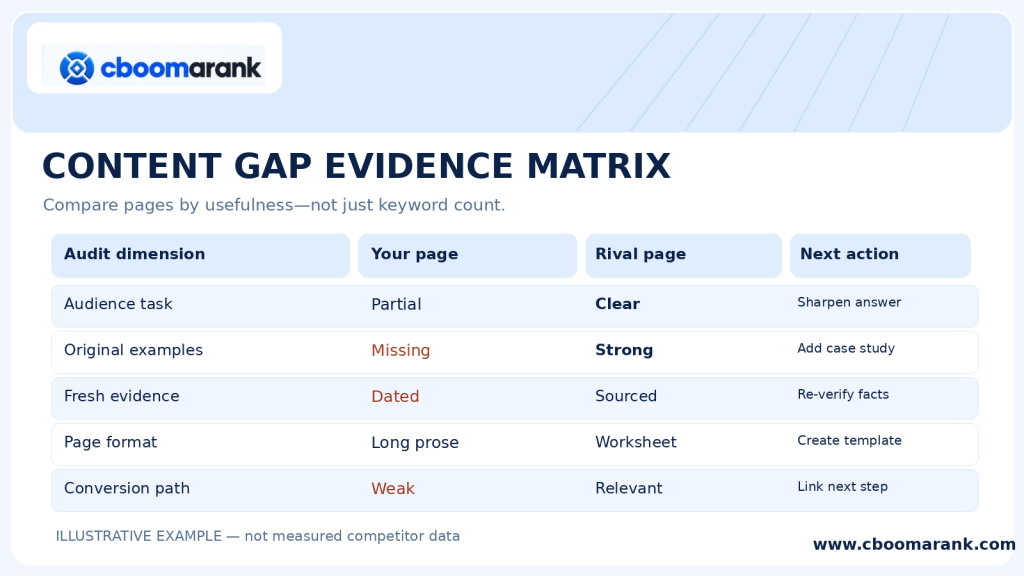
Illustrative Content Gap Matrix
| Dimension | Your page | Competitor A | Recommended action |
|---|---|---|---|
| Search intent match | 2/3 | 3/3 | Move the direct answer nearer the top |
| Original examples | 0/3 | 2/3 | Add an independently produced example |
| Recent supporting evidence | 1/3 | 3/3 | Verify and cite current sources |
| Actionable template | 0/3 | 2/3 | Provide a practical worksheet |
| Next-step clarity | 1/3 | 2/3 | Improve task-specific internal links |
Illustrative values only: this table is a teaching example, not measured performance data for CBOOMARANK or any competitor.
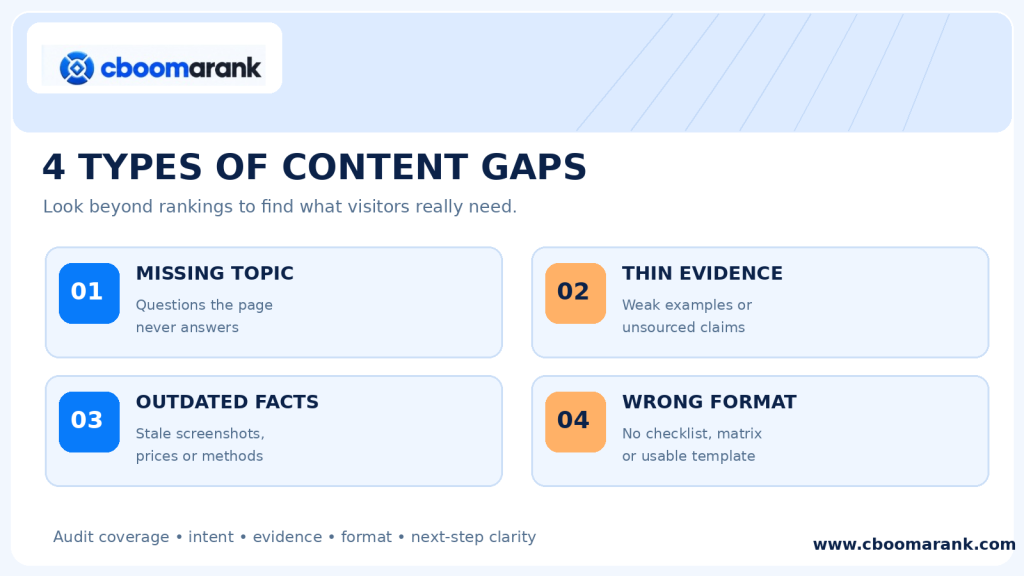
Content Gap Analysis: Four Types of Competitor Content Gaps
1. Missing Topic or Audience Question
Competitors may cover a relevant audience question that your page does not address. Before adding it, check whether the question belongs to the main intent and whether the answer improves the reader’s ability to act. A missing question is not automatically a reason to publish a separate article.
2. Thin Explanation or Weak Evidence
Your page may mention a topic but provide little usable guidance. Competitor pages might include an authentic workflow, sample output, comparison table, or authoritative references. Improve the useful detail rather than padding paragraphs with repeated keywords. When you cannot independently verify a claim, qualify it or leave it out.
3. Outdated or Unmaintained Information
Old screenshots, superseded product capabilities, prices without verification dates, or broken source links can make a page less helpful. Review update-sensitive claims and explain when the information was checked. An updated timestamp alone is not proof of a substantive refresh.
4. Wrong Format or Poor User Experience
A wall of text may be less useful than a clear diagram, checklist, decision matrix or downloadable template. Compare mobile layout, page navigation, visual hierarchy, accessibility, load behavior and whether important answers are buried. Solve the visitor’s problem rather than copying whichever design seems trendy.
Step 4: Analyze Winning Competitor Pages Without Copying
Study Their Helpful Patterns
Ask which sections readers likely need to make a decision, which facts are backed by sources, what is explained with examples, and where the page provides a practical output. Use the observations to form a hypothesis about usefulness. Avoid reproducing distinctive wording, charts, copyrighted images or page structures wholesale.
Distinguish Popularity From Quality
A page may rank for many queries partly because of links, brand recognition, topical relevance or history. High visibility alone does not mean each section is excellent. Evaluate its actual answers, freshness and limitations, then create something genuinely stronger for your own audience.
Look for Originality Opportunities
The best response to a competitor’s thorough guide is rarely a longer imitation. Consider original interviews, a real example from your team’s workflow, a reproducible framework, tested screenshots, a transparent checklist or comparative research you have permission to publish. Google’s people-first content guidance emphasizes useful, reliable information written for readers.
Step 5: Perform Content Gap Analysis on Your Existing Pages
Map Content Gap Analysis Findings to a Current URL
Before creating a new article, search your site for pages covering the same question. Include variants of the title and related search intent, not just the exact focus keyword. If an existing page is relevant, expand or consolidate it instead of competing against yourself. Our keyword cannibalization guide explains the risk of overlapping URLs.
Use Your Own Search Console Data as a Reality Check
Review queries and pages with impressions but weak click-through rates or declining visibility. Where your existing page earns impressions for adjacent questions, an improved answer may be more practical than a new URL. Google’s Search Console Performance report documentation describes how to interpret clicks, impressions and search performance.
Pair Page-Level Findings With Site Health
A missing example is a content problem; a blocked canonical or broken mobile layout is a technical problem. Record both, but solve them through the appropriate workflow. Use our SEO audit reporting guide to document technical evidence and assign a remediation owner.
Content Gap Analysis Step 6: Build a Prioritized Action Plan
Create one row per opportunity with an owner, affected URL, reader problem, supporting evidence, business relevance, estimated effort, proposed change, and measurable outcome. Start with high-impact changes to pages that already receive meaningful visibility, then consider new assets for genuinely distinct intents.
Use a Transparent Priority Score
For example, rate audience relevance, evidence strength, expected user impact and commercial fit from 1–5, then subtract complexity and risk. Treat the result as a discussion tool, not a predictive ranking formula. A small change that answers a major buyer objection may be worth more than a large rewrite on a low-value topic.
Choose Create, Refresh, Merge, Reformat or Ignore
| Situation | Decision | Success measure |
|---|---|---|
| Existing page answers intent but lacks examples | Refresh | Task completion, engagement, qualified clicks |
| Two pages overlap the same need | Merge with planned redirects where necessary | Consolidated search visibility and better navigation |
| Topic requires a genuine separate tool or template | Create | Relevant impressions and repeat usage |
| Readers need a matrix or step-by-step walkthrough | Reformat | Improved clarity and conversions |
| Competitor topic is irrelevant to your customers | Ignore | Resources remain focused on higher-value work |
Content Gap Analysis Step 7: Measure the Impact
Define a Baseline Before Editing
Record the URL, publication state, indexability, key queries, impressions, clicks, engagement, conversions and the date range before editing. For newly created content, note that there is no comparable historical baseline; do not manufacture one.
Track Leading and Business Outcomes
Monitor query coverage and qualified traffic, but also whether visitors reach a useful next step. Newsletter subscriptions, trials, inquiries or genuine product activation may matter more than raw traffic. Use analytics events and conversion definitions consistently.
Account for Noise and Attribution Limits
Search results change for many reasons. Competitors also update content, seasonality shifts and algorithms evolve. A ranking change immediately after a content edit is not proof of causation. Review trends over a meaningful window, compare similar periods and document other site changes.
30-Day Competitor Content Gap Analysis Workflow

Week 1 — Inventory and Evidence
List the most commercially important pages, review Search Console results and record three to five real search competitors per topic. Label page types, audience questions and reliable source dates. Establish baseline metrics and identify your own closest matching URL.
Week 2 — Compare and Diagnose
Build the five-dimension content matrix. Review missing questions, evidence quality, media, accessibility and format. Separate genuinely missing user tasks from irrelevant competitor topics. Document each opportunity with a source URL and a hypothesis.
Week 3 — Improve and Publish Carefully
Prioritize three to five high-value changes. Improve the best existing URL when its intent matches; create a new page only for a distinct reader task. Add original examples, trustworthy references, clear subheadings, accessible diagrams, descriptive ALT text and relevant contextual links. Back up existing posts before replacing them.
Week 4 — Verify and Measure
Check HTTP status, canonical URLs, image loading, mobile layout, internal links and editor SEO settings. Record publication changes and revisit impressions, relevant clicks and conversions as data accumulates. Continue monitoring rather than declaring success after one day.
How CBOOMARANK Fits Into a Content Gap Analysis Workflow
Start with CBOOMARANK to examine your site and connect website auditing, keyword research and competitor intelligence. Use the available research views to identify priority domains and ranking topics, then perform the page-level quality review with the matrix in this guide. Combine your own Search Console evidence with competitor signals instead of treating modeled third-party traffic as exact analytics.
When a gap depends on stronger referring domains or linkable assets, consult our competitor backlink analysis guide. For tool selection, see our competitor analysis tools comparison. For technical quality before publication, use our technical SEO tools guide.
Explore CBOOMARANK plans and features when you are ready to connect research with an ongoing website improvement workflow.
Example: A SaaS Content Gap Analysis Finds a Useful Opportunity
Consider a fictional SaaS company that sells appointment-scheduling software. Its guide to booking automation attracts some impressions, yet visitors rarely reach its product comparison page. A competing guide covers the same topic and includes a downloadable implementation checklist, screenshots of two booking scenarios, and a candid section about migration limitations.
Observe the Difference Before Writing
The team first verifies that both pages target the same audience: operations managers comparing scheduling processes. The competitor has a useful implementation checklist, but the SaaS company already explains some integrations better. The team records the differences rather than copying the competitor page. The missing item is not the phrase “appointment scheduling software”; it is a worked migration example that makes the topic easier to apply.
Make One Measurable Improvement
The owner adds a clearly labeled migration example to the existing guide, includes screenshots of a test environment, notes assumptions and limitations, and provides a checklist visitors can use. They link the guide contextually to an appropriate product comparison page. Before editing, the team saves baseline Search Console data and records how many visitors reach the next step.
Review What Happens Without Overclaiming
After publication, the team checks whether relevant queries gain clicks and whether readers use the checklist and navigate to the product page. Those observations guide iteration; they do not prove that a single paragraph caused an algorithmic change. This example illustrates why content gap analysis should result in a specific, testable improvement rather than an undifferentiated list of competitor headings.
Content Gap Analysis Brief: Fields Your Team Should Capture
Use a consistent content brief for each proposed improvement. Capture the reader’s primary task; the existing target URL; relevant search queries; three verified competitor URLs; observed gaps; evidence and source dates; recommended page format; the original example, resource or method you will add; the relevant internal links; the reviewer and owner; and the baseline metrics. Leave proposed rankings, conversion outcomes and traffic totals as projections only when they are explicitly labeled as estimates.
Before approving the brief, an editor should ask three questions: Does this help a specific audience? Does it add information or utility our page genuinely lacks? Are we updating the right canonical page instead of duplicating an existing intent? These questions prevent unnecessary articles and keep content efforts tied to reader value.
For navigation and discoverability, ensure important links are normal crawlable HTML anchors. Google’s guidance on crawlable links explains why discoverable links matter. For older pages losing visibility, see our content decay guide before deciding to replace a resource.
Common Mistakes in Competitor Content Analysis
- Copying instead of learning: repeatable patterns may be useful; copied content and visuals are not a strategy.
- Judging quality by word count: a concise answer with a real example can serve readers better than a much longer article.
- Confusing keywords with needs: related queries can map to one task; the broader gap may be a missing tool, example, format or explanation.
- Using invented competitor numbers: label modeled data as estimates and never imply access to a rival’s private analytics.
- Creating duplicate URLs: check your live site and content inventory before publishing.
- Ignoring accessibility and mobile usability: unreadable tables and low-contrast graphics weaken otherwise useful work.
- Skipping measurement: document the original state so improvements can be assessed fairly.
Frequently Asked Questions About Content Gap Analysis
What is content gap analysis in SEO?
It is the review of missing or underdeveloped information, formats and reader tasks between your pages, audience needs and competing resources. It may include keyword gaps, but the most useful output is an actionable content decision.
How many competitors should I review?
Three to five relevant pages per important topic is a manageable starting point. Add more when the search landscape is fragmented or the decision has substantial business impact.
Is content gap analysis the same as competitor keyword analysis?
No. Keyword analysis compares query visibility. Content analysis compares the actual page experience, completeness, format, trust signals and practical usefulness. Use them together, but do not turn them into identical articles.
Can competitor content analysis help an existing page rank better?
It can reveal worthwhile improvements, but no specific ranking outcome is guaranteed. Refreshes may improve clarity and relevance; results also depend on search intent, competition, links and technical conditions.
Should I publish every competitor topic that my site lacks?
No. A missing topic is worth pursuing only if it fits your audience, has credible evidence of demand, belongs within your scope and can be served better than available alternatives.
How often should content gaps be reviewed?
Quarterly checks often work for stable sites, while fast-changing product categories and high-value landing pages may need more frequent review. Update sooner when you discover stale claims, changing search intent or customer questions your page does not answer.
What is the best content gap analysis tool?
No single tool covers every need. Ranking and keyword tools help find competitive visibility, Search Console supplies your own search performance data, and human page reviews assess evidence, clarity, originality, user experience and conversion context. Choose a workflow that connects these inputs.
Final Takeaway: Turn Competitor Content Gaps Into Better Pages
Effective competitor content analysis is not a race to publish more pages than rival websites. It is a disciplined way to find where your audience is underserved and make focused, evidence-backed improvements. Start with the right search competitors, compare their page-level usefulness, classify genuine gaps and map each opportunity to one clear action.
Use your existing content wherever possible, reserve new URLs for distinct tasks and measure whether the changes improve the experience and business outcomes. Start your next content gap analysis with CBOOMARANK at www.cboomarank.com and turn your findings into a practical content roadmap.
