

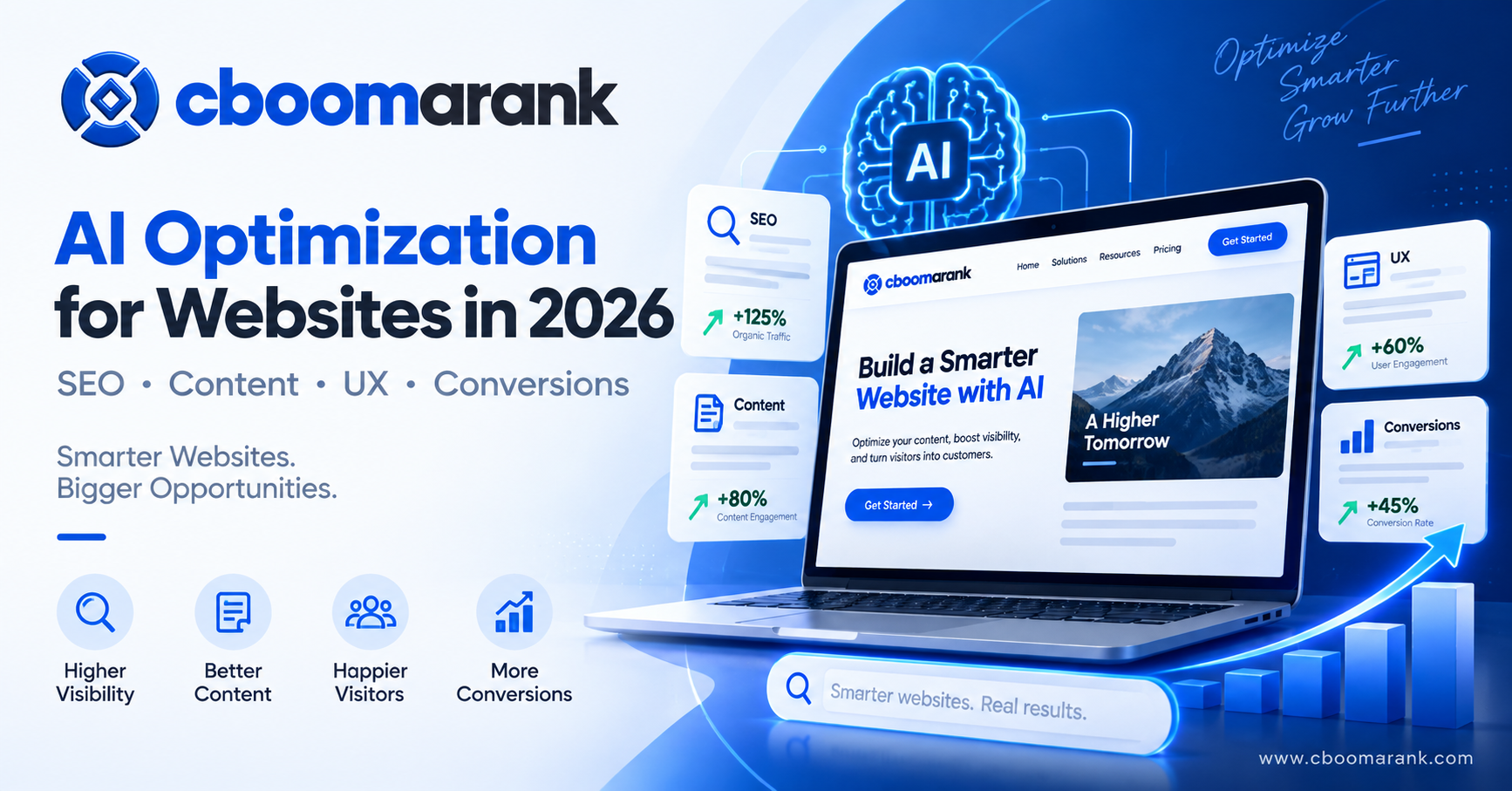
AI optimization is becoming a practical way for businesses to improve websites faster, uncover opportunities that are difficult to spot manually, and make better decisions across SEO, content, user experience, and conversion optimization.
However, AI optimization does not mean handing an entire website to an AI system and accepting every recommendation automatically. Instead, the strongest approach combines machine-assisted analysis with reliable data, clear business goals, human review, and established SEO and UX principles.
In 2026, AI can help website teams analyze large datasets, identify content gaps, prioritize technical issues, improve internal linking, summarize customer behavior, generate test ideas, and accelerate optimization workflows.
At the same time, businesses still need to protect content quality, factual accuracy, brand voice, privacy, and user experience.
This guide explains how to use AI optimization across your website without confusing it with AI search optimization, Answer Engine Optimization, or simply generating more content.
What Is AI Optimization for Websites?
AI optimization for websites is the use of artificial intelligence and machine-assisted analysis to improve the performance of a website across one or more measurable areas.
Those areas can include:
- Search engine optimization
- Keyword and search-intent analysis
- Content quality and relevance
- Technical SEO
- Internal linking
- User experience
- Conversion rate optimization
- Competitor research
- Analytics interpretation
- AI-search visibility
- Workflow automation
In practice, AI optimization is less about replacing specialists and more about helping them process more information, identify patterns, and prioritize work.
For example, a traditional SEO audit may produce hundreds of issues. AI-assisted prioritization can help group those problems by likely impact, affected templates, page type, business importance, or effort required.
Likewise, a content team may have thousands of pages. AI can help cluster them by intent, identify overlapping topics, detect outdated sections, and surface pages that deserve deeper manual review.
AI Optimization vs AI Search Optimization
These concepts overlap, but they are not identical.
AI optimization for websites means using AI to improve the website itself.
AI search optimization focuses on improving visibility inside AI-powered search experiences such as Google AI Overviews, Google AI Mode, ChatGPT, Perplexity, and other answer engines.
Therefore, an AI optimization strategy can include AI-search visibility, but it is much broader.
If your immediate goal is AI-search visibility, see the CBOOMARANK guides to ranking in Google AI Overviews, Google AI Mode SEO, and Answer Engine Optimization.
Why AI Optimization Matters in 2026
Website optimization has become increasingly data-intensive.
SEO teams may need to examine crawl information, rankings, competitor pages, backlinks, search intent, performance metrics, structured data, and content quality simultaneously.
Meanwhile, product and marketing teams must consider user behavior, conversion paths, page speed, engagement, testing results, and customer feedback.
AI can help connect these signals faster.
Importantly, Google’s current guidance does not suggest abandoning traditional SEO because of generative AI. In its 2026 guidance for generative AI features in Search, Google states that established SEO practices remain foundational because its AI features rely on core Search ranking and quality systems.
See Google’s official guide to optimizing for generative AI features in Google Search.
Therefore, AI should strengthen sound optimization practices rather than replace them.
1. AI Optimization for SEO Audit Prioritization
SEO audits often uncover more issues than a team can fix immediately.
For example, a crawl may reveal broken links, duplicate titles, thin content, missing canonical tags, redirect chains, slow templates, orphaned pages, weak internal linking, and indexing problems.
The difficult part is deciding what to fix first.
AI-assisted prioritization can classify issues by:
- Potential organic traffic impact
- Number of affected pages
- Page importance
- Conversion relevance
- Technical severity
- Implementation effort
- Template-level impact
As a result, teams can move from a long list of errors to a prioritized action plan.
For a broader technical workflow, use the CBOOMARANK SEO Optimization Guide.
2. AI Optimization for Keyword and Search-Intent Analysis
Keyword research is another area where AI can save substantial analysis time.
Instead of treating every keyword as an isolated phrase, AI can help cluster related terms according to topic and likely search intent.
For example, a list of several thousand keywords may contain informational, commercial, transactional, navigational, comparison, and problem-solving searches.
AI can help group these terms and identify which page type is most appropriate for each cluster.
However, keyword decisions should still be grounded in actual search data rather than generated estimates.
Use real metrics such as search volume, ranking difficulty, CPC, current rankings, and competitor visibility alongside AI-generated classification.
This combination helps prevent a common mistake: creating content around plausible-sounding queries that have little real demand.
3. Find Content Gaps Faster
Content-gap analysis can become difficult when competitors have hundreds or thousands of pages.
AI can speed up the comparison process.
For instance, it can summarize competing pages, extract their major subtopics, compare content structures, and identify useful questions your existing page does not answer.
Nevertheless, the objective should not be to copy every section appearing on a competitor’s page.
Instead, use the analysis to understand user expectations and then add unique expertise, examples, original insights, tools, data, or practical guidance.
Google’s people-first content guidance emphasizes original information, substantial coverage, usefulness, and a satisfying experience for visitors.
Review Google’s official people-first content guidance.
4. AI Content Optimization for Existing Pages
One of the strongest AI optimization use cases is improving pages that already exist.
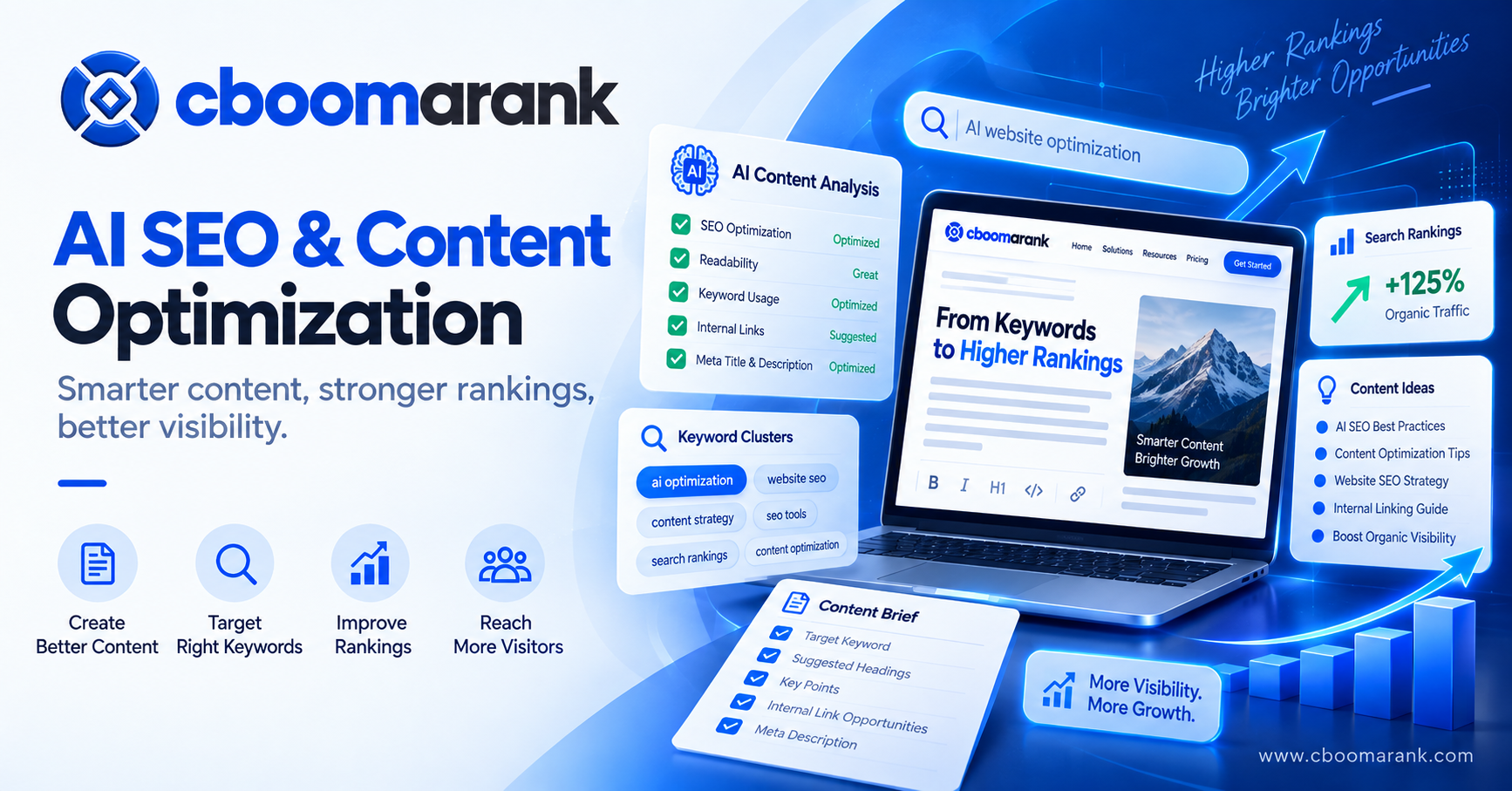
Rather than automatically producing new articles, AI can help audit older pages for:
- Outdated facts
- Missing definitions
- Weak introductions
- Poor heading structure
- Incomplete examples
- Unanswered questions
- Duplicate sections
- Unclear calls to action
- Missing internal links
- Readability problems
This approach can be more valuable than increasing publishing volume.
In addition, updating an established page may preserve existing links, authority, rankings, and historical signals while improving its usefulness.
5. Use Generative AI Carefully for Content Creation
Generative AI can help with research, outlining, summarization, drafting, rewriting, and content structure.
However, automatic generation at scale creates quality risks.
Google’s guidance says generative AI can be useful for research and adding structure to original content. At the same time, generating many pages without adding meaningful user value may violate Google’s scaled content abuse policies.
Read Google Search’s guidance on generative AI content.
Therefore, a safer workflow is:
- Start with real keyword and audience data.
- Use AI to organize the research.
- Add subject-matter expertise.
- Verify factual claims.
- Add original examples and recommendations.
- Review the article for search intent.
- Check internal and external links.
- Perform a final human editorial review.
AI should accelerate the workflow without removing accountability.
6. Improve Internal Linking With AI
Internal linking becomes increasingly difficult as a website grows.
AI can help identify related pages based on topic, entities, keywords, and search intent.
For example, an SEO site may contain articles about technical SEO, backlinks, keyword research, Google AI Overviews, AEO, and competitor research.
An AI-assisted internal-link system can identify relevant connections while avoiding random or repetitive links.
However, every recommendation should still be checked for contextual relevance.
A good internal link should help the reader move naturally to the next useful resource.
7. Detect Cannibalization and Duplicate Intent
AI can also help detect groups of pages competing for very similar search intent.
This matters because two pages may use different wording while effectively answering the same question.
For example, “AI SEO optimization,” “AI for SEO,” and “how to optimize SEO using AI” may overlap substantially depending on the purpose of each page.
AI-assisted semantic comparison can flag likely overlap for editorial review.
Then, the team can decide whether to:
- Keep both pages because the intent is genuinely different
- Merge the weaker page into the stronger page
- Reposition one page around a distinct intent
- Improve internal linking between related resources
- Redirect a redundant page where appropriate
This is exactly why a duplicate and cannibalization check should happen before publishing new high-priority content.
8. Use AI for Technical SEO Analysis
Technical SEO produces large amounts of structured data that are well suited to machine-assisted analysis.
AI can help summarize crawl reports and detect recurring patterns such as:
- Template-level title problems
- Repeated canonical errors
- Redirect patterns
- Indexability inconsistencies
- Missing structured data
- Slow page groups
- Broken internal links
- Orphaned content
However, AI-generated recommendations should not be applied blindly to production systems.
A canonical rule, redirect rule, robots directive, or structured-data change can affect thousands of pages at once.
Therefore, technical changes should be tested, backed up, and validated before deployment.
9. AI Optimization for Website UX
AI optimization is not limited to search rankings.
It can also help teams understand friction in the user journey.
For example, behavioral data may reveal that users abandon a page before reaching the main call to action.
AI can help summarize patterns from analytics, session notes, survey feedback, support messages, and conversion funnels.
From there, a UX team can develop hypotheses around navigation, page structure, messaging, forms, or calls to action.
Still, an AI-generated hypothesis is not proof.
Validate important UX changes through analytics, user testing, controlled experiments, or other reliable evidence.
10. Use Core Web Vitals as an Optimization Signal
Website performance remains part of user experience.
Google’s Core Web Vitals framework currently focuses on loading performance, responsiveness, and visual stability through metrics including Largest Contentful Paint, Interaction to Next Paint, and Cumulative Layout Shift.
See the official Core Web Vitals documentation.
AI can assist by grouping slow pages, detecting recurring performance patterns, and summarizing technical reports.
For example, it may reveal that a specific template, third-party script, oversized image pattern, or frontend component is associated with poor performance.
However, the underlying performance data should come from real measurement tools rather than AI estimates.
11. AI Optimization for Conversion Rate Improvement
Conversion optimization is another practical AI use case.
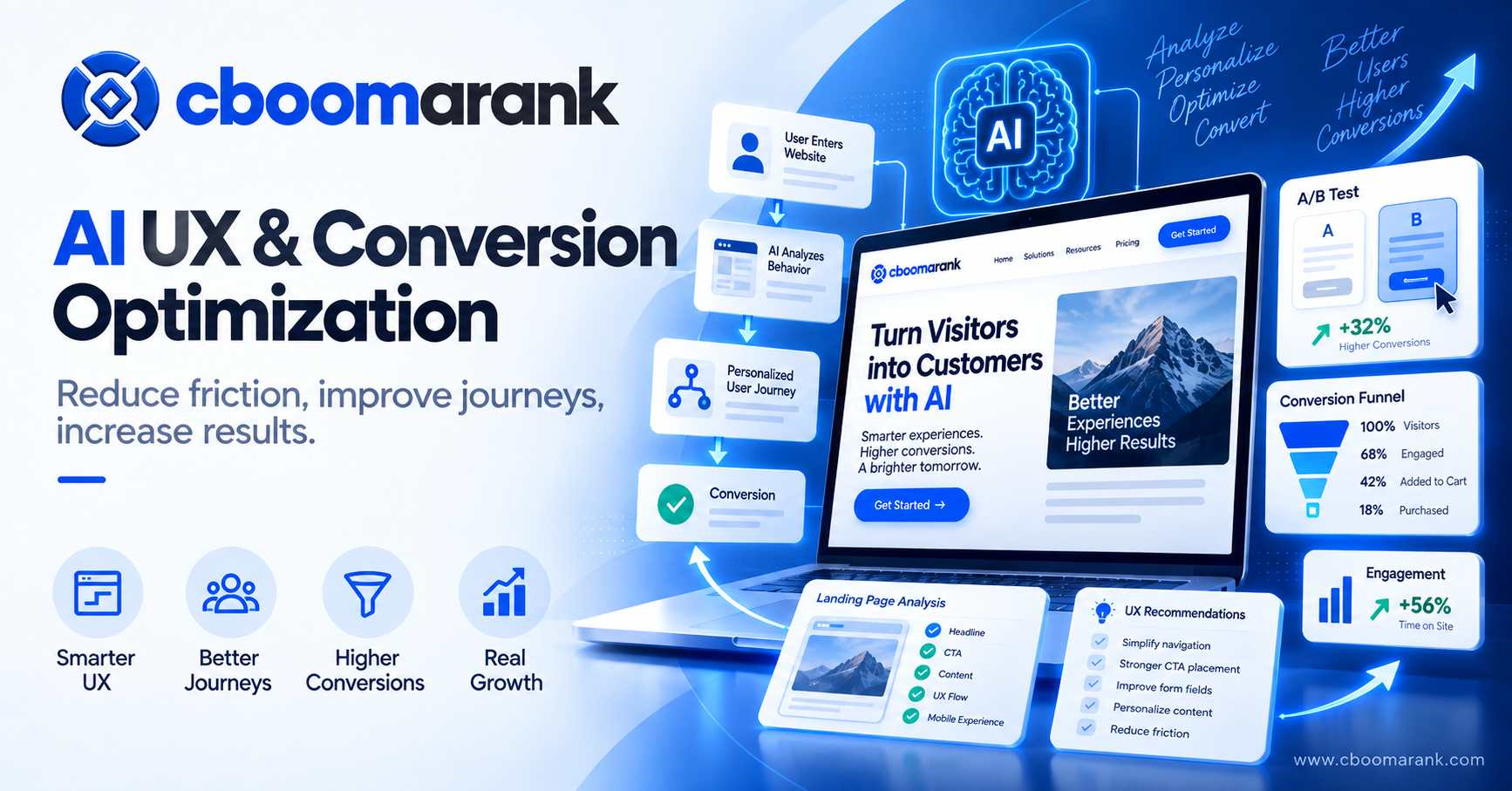
AI can help analyze:
- Landing-page copy
- CTA placement
- Form complexity
- Pricing-page structure
- Product messaging
- Checkout friction
- Customer objections
- Test results
For example, AI may help identify that a page discusses features extensively but does not explain the business outcome clearly enough.
It can then generate alternative headlines or CTA ideas for testing.
Nevertheless, the winner should be determined by real performance data rather than the AI system’s preference.
12. Measure Conversions With Real Analytics Data
Any AI optimization program needs reliable measurement.
Google Analytics allows businesses to measure important actions as key events and conversions, depending on their analytics setup.
See Google’s official GA4 conversion documentation.
Useful website optimization metrics may include:
| Metric | What It Helps Measure |
|---|---|
| Organic clicks | Search traffic generated by optimized pages |
| Organic impressions | Search visibility and potential reach |
| Keyword positions | Ranking movement for target topics |
| Conversion rate | Percentage of visitors completing important actions |
| Lead volume | Number of qualified inquiries generated |
| Revenue | Commercial impact of optimization work |
| Engagement | How users interact with important pages |
| Core Web Vitals | Real-world loading, responsiveness, and visual stability |
AI can summarize these metrics and highlight unusual patterns, but the source data should remain authoritative.
13. AI Optimization for Competitor Research
Competitor analysis is one of the most useful areas for AI-assisted research.
Instead of manually comparing dozens of competitor pages, AI can help summarize:
- Common topic coverage
- Content depth
- Page structure
- Frequently used entities
- Commercial messaging
- Pricing positioning
- Feature comparisons
- Content gaps
In addition, competitor backlink and authority data can reveal which resources are earning genuine industry attention.
The goal is not to clone a competitor.
Rather, use the research to understand the market standard and then produce something clearer, more useful, or more differentiated.
14. Optimize for AI Search Without Abandoning SEO
AI-powered search experiences are increasingly important, but they should not be treated as a separate universe from traditional SEO.
Google’s 2026 generative AI guidance explicitly says SEO fundamentals remain relevant to AI features in Search.
Therefore, strong foundations still matter:
- Crawlable pages
- Clear site architecture
- Useful content
- Accurate information
- Strong internal links
- Relevant external references
- Structured data where appropriate
- Fast and usable pages
For platform-specific strategies, see CBOOMARANK’s guides to ranking in ChatGPT and ranking in Perplexity.
You can also compare monitoring tools in the Best AI Visibility Tools guide.
15. Avoid Over-Automating Website Decisions
One of the biggest risks of AI optimization is excessive automation.
An AI system may identify correlations without understanding the full business context.
For example, it may recommend removing a low-traffic page even though that page supports sales conversations, customer onboarding, regulatory requirements, or high-value enterprise prospects.
Therefore, important decisions should include business context.
A useful rule is:
Automate data processing and repetitive analysis first. Keep high-impact strategic and production decisions reviewable.
16. Protect Accuracy, Privacy, and Brand Quality
Before sending data into an AI system, determine whether it contains sensitive customer information, confidential business information, account details, proprietary material, or regulated data.
Additionally, every AI-assisted content workflow should include factual review.
AI systems can produce incorrect information, outdated claims, invented references, or overly confident recommendations.
Therefore, sources, numbers, product claims, legal statements, medical claims, financial claims, and other high-impact facts should be verified carefully.
A Practical AI Optimization Workflow
A strong website AI optimization process can be organized into six stages.
Stage 1: Collect Reliable Data
Gather crawl data, keyword information, rankings, analytics, conversion data, competitor information, content inventory, and performance metrics.
Stage 2: Use AI to Analyze Patterns
Group related issues, summarize large datasets, identify anomalies, classify intent, and surface potential opportunities.
Stage 3: Prioritize by Business Impact
Separate high-impact opportunities from low-priority recommendations.
Consider traffic potential, conversions, revenue relevance, page importance, implementation effort, and technical risk.
Stage 4: Apply Human Review
Validate recommendations against brand strategy, customer needs, technical constraints, and factual accuracy.
Stage 5: Implement Carefully
Make controlled changes and preserve backups before modifying important production systems.
Stage 6: Measure the Outcome
Compare the post-change results with the original baseline.
If performance improves, document the workflow. If it does not, use the result to refine the next hypothesis.
30-Day AI Optimization Plan
Week 1: Audit
Analyze website health, content inventory, search performance, AI visibility, user behavior, and conversion data.
Week 2: Prioritize
Use AI-assisted analysis to group opportunities and rank them by likely business impact.
Week 3: Implement
Update priority pages, improve internal links, fix selected technical issues, strengthen calls to action, and improve key content gaps.
Week 4: Measure
Review rankings, traffic, engagement, conversions, and technical metrics. Then compare the outcome with the original baseline.
This creates a repeatable optimization cycle rather than a one-time AI experiment.
Use CBOOMARANK AI to Turn Website Data Into Action
CBOOMARANK connects website analysis, SEO auditing, keyword research, competitor research, authority signals, and AI-assisted recommendations into a practical optimization workflow.
Start by analyzing your website. Then use CBOOMARANK AI to identify priorities, investigate opportunities, and turn website data into actionable SEO and content decisions.
Analyze your website with CBOOMARANK →
Need the right plan? View CBOOMARANK pricing →
How CBOOMARANK Fits Into an AI Optimization Workflow
CBOOMARANK can support the process from initial diagnosis through prioritization.
Website Analysis establishes the baseline.
SEO Auditing identifies technical and on-page issues.
Keyword Research helps validate real search demand.
Competitor Research reveals content, visibility, and market gaps.
Authority and backlink data provide additional context around trust and external visibility.
CBOOMARANK AI can then help turn those signals into prioritized recommendations and optimization ideas.
The workflow becomes:
Analyze → understand → prioritize → optimize → measure → repeat.
For additional AI SEO workflows, see 15 Best AI SEO Tools for Research, Content and AI Visibility.
Frequently Asked Questions About AI Optimization
What is AI optimization?
AI optimization is the use of artificial intelligence and machine-assisted analysis to improve website performance, SEO, content, user experience, conversions, and optimization workflows.
Can AI improve SEO?
Yes. AI can assist with keyword classification, content-gap analysis, technical SEO summaries, internal-link recommendations, competitor analysis, content updates, and prioritization. However, recommendations should be validated with real SEO data and human review.
Can AI write SEO content?
AI can assist with research, outlines, drafts, summaries, and rewriting. However, published content should provide real value, accurate information, original insight, and appropriate human review.
Does Google penalize AI-generated content?
Google’s guidance focuses on content quality and purpose rather than simply whether AI was used. However, using automation or generative AI to create large amounts of low-value content for ranking manipulation can violate spam policies.
Can AI improve conversion rates?
AI can help identify friction, summarize user feedback, analyze page messaging, and generate testing ideas. Nevertheless, actual conversion improvements should be verified through reliable analytics and experiments.
What data should AI optimization use?
Useful inputs can include crawl data, keyword metrics, rankings, analytics, conversions, Core Web Vitals, content inventories, competitor information, backlinks, and customer feedback.
Is AI optimization the same as AEO?
No. Answer Engine Optimization focuses specifically on visibility in AI-powered answers and answer engines. AI optimization for websites is broader and includes SEO, content, UX, technical performance, conversions, and workflow automation.
Should AI automatically make website changes?
Low-risk automation can be useful, but high-impact changes should generally remain reviewable. Technical SEO, redirects, canonical rules, production code, sensitive content, and important business pages should be validated before deployment.
Final Thoughts
AI optimization can make website improvement faster and more systematic, but the technology works best when it is connected to reliable data and clear business objectives.
Use AI to process information, detect patterns, prioritize opportunities, and accelerate repetitive analysis.
At the same time, preserve human judgment for strategy, quality control, factual verification, customer understanding, and high-impact production decisions.
Ultimately, the best AI optimization strategy is not the one that automates the most work.
It is the one that helps your team make better website decisions, implement improvements faster, and measure whether those changes actually produce better search visibility, user experience, and business results.
