

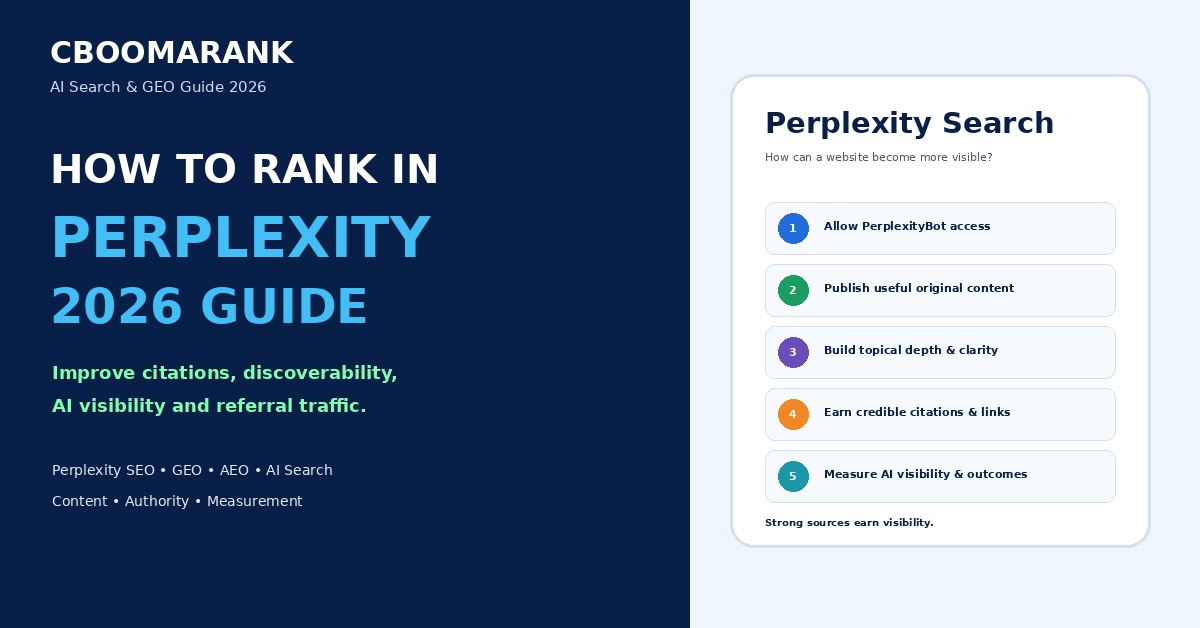
Perplexity has become an important part of the AI-search landscape because it combines conversational answers with web research, citations and links to original sources.
For publishers, marketers and SEO teams, this creates a new visibility question: how can a website improve its chances of being discovered, cited or referenced in Perplexity?
There is no guaranteed formula for “ranking number one” in Perplexity. The platform does not publish a simple list of SEO ranking factors that publishers can manipulate.
What Perplexity does publicly explain is that it searches the web, gathers information from sources, synthesizes answers and provides citations that allow users to verify and explore the underlying information.
That means the practical strategy is not to chase an imaginary Perplexity-only trick. Instead, make your website accessible, publish original and useful information, demonstrate expertise, support important claims with evidence, build strong topical context, maintain accurate information and earn legitimate authority across the web.
This guide explains how Perplexity works, what PerplexityBot does, how citations fit into AI visibility, and how to build a practical Perplexity SEO and AI-search workflow for 2026.
This article is part of the CBOOMARANK AI Search series. Related guides include Best AI Visibility Tools in 2026, How to Rank in Google AI Overviews, Best LLM SEO Tools in 2026, Google AI Mode SEO, How to Rank in ChatGPT, Generative Engine Optimization and Answer Engine Optimization.
What Is Perplexity?
Perplexity describes itself as an AI-powered search engine that searches the web and delivers conversational answers supported by citations and links to original sources.
Unlike a traditional search-results page that primarily presents a list of links, Perplexity generally synthesizes information into a direct answer while still exposing the sources used to build that answer.
Its search products can use information gathered from websites, articles, academic material, forums, videos and other available sources depending on the query and search mode.
Official Perplexity resource: What Is Perplexity?.
What Does “Ranking in Perplexity” Actually Mean?
Traditional SEO often measures visibility through a numeric search position.
Perplexity visibility is more complex. A site may gain exposure through several different outcomes:
- being selected as a cited source;
- being linked from an answer;
- being referenced for a particular fact;
- appearing across several related prompts;
- earning visibility for branded or non-branded questions;
- receiving referral traffic from Perplexity;
- being used as supporting evidence in deeper research responses.
For this reason, it is more accurate to think in terms of Perplexity visibility, citations and source inclusion rather than one universal ranking position.
How Perplexity Finds and Uses Web Sources
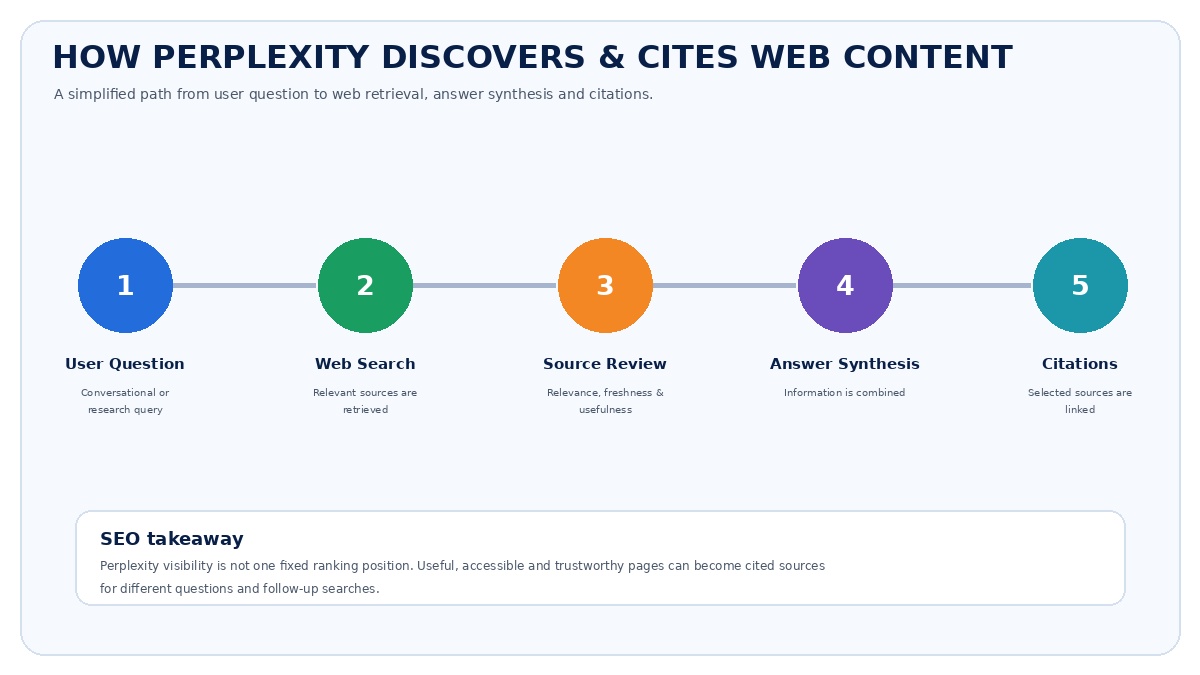
Perplexity’s public documentation describes a workflow in which the system understands the user’s question, searches the internet, collects relevant information, synthesizes that information and exposes citations to the underlying sources.
A simplified publisher-facing model is:
- A user submits a question.
- The system interprets the query and context.
- Web searches retrieve potential sources.
- Relevant information is evaluated and assembled.
- The answer is synthesized.
- Selected sources may be cited and linked.
- The user may ask follow-up questions or investigate the original sources.
Perplexity’s Pro Search documentation also explains that complex searches can involve multiple web searches and synthesis from numerous sources rather than a single keyword lookup.
Official resource: How Does Perplexity Work?.
PerplexityBot and robots.txt
One of the most important technical considerations for publishers is PerplexityBot.
Perplexity’s current documentation states that PerplexityBot respects robots.txt directives and will not index the full or partial textual content of a website that blocks it through robots.txt.
Perplexity also notes that even when a page is blocked, it may still retain limited information such as the domain, headline and a brief factual summary.
Therefore, if your goal is to maximize eligibility for Perplexity discovery, review your robots.txt configuration and make sure you are not unintentionally blocking PerplexityBot.
Official resource: How Does Perplexity Follow robots.txt?.
Perplexity SEO vs Traditional Google SEO
| Traditional SEO | Perplexity / AI Search Visibility |
|---|---|
| Keyword rankings | Prompt and question-level source visibility |
| SERP position | Citations and source inclusion |
| Organic click-through rate | AI referral traffic |
| Googlebot crawlability | PerplexityBot accessibility plus wider web discoverability |
| Search competitors | Sources and brands appearing in AI answers |
| Keyword share of voice | AI citation and answer share of voice |
| Backlink profile | Authority, references and source reputation |
These are not opposing strategies. Strong technical and content SEO improves the underlying website foundation that answer engines can discover and evaluate.
This is why Answer Engine Optimization, GEO and traditional SEO increasingly overlap.
12-Step Perplexity SEO & AI Visibility Framework
1. Allow Legitimate PerplexityBot Access
Start with technical eligibility.
- Review robots.txt.
- Check firewall and CDN rules.
- Do not accidentally block legitimate crawler traffic.
- Keep important public pages accessible without unnecessary authentication.
- Make sure important HTML content is available to crawlers.
Blocking PerplexityBot is a legitimate publisher choice, but it conflicts with the goal of maximizing full-content indexing by Perplexity.
2. Maintain Strong Traditional Search Visibility
Do not optimize only for Perplexity.
Answer engines retrieve information from the wider web, so conventional search discoverability remains important.
- Use descriptive titles.
- Maintain clean canonical URLs.
- Keep pages indexable where appropriate.
- Fix broken internal links.
- Improve page speed and rendering.
- Create logical site architecture.
A technically weak website makes discoverability harder across traditional and AI-assisted search.
3. Answer Real Questions Clearly
Perplexity users often ask natural-language questions rather than isolated keywords.
Your content should clearly solve the actual problem behind the query.
When a section targets a specific question, provide a useful answer near the beginning of that section and then add supporting depth.
Do not force readers to navigate through unnecessary introductions before reaching the information they need.
4. Build Topical Depth for Follow-Up Questions
Conversational search encourages follow-up questions.
A strong resource should therefore cover:
- the core definition;
- how something works;
- advantages and limitations;
- comparisons;
- examples;
- common problems;
- pricing or commercial considerations where relevant;
- related questions;
- next steps.
This creates a more complete topical resource rather than a page built around one narrow keyword phrase.
5. Publish Original, Citation-Worthy Information
Generic summaries compete with thousands of similar pages.
Give answer engines and human readers a reason to use your page as a source.
- Publish original research.
- Run product tests.
- Provide first-hand experience.
- Create original statistics.
- Publish case studies.
- Offer expert analysis.
- Add unique screenshots or data.
- Create proprietary frameworks and comparisons.
Original information can become a stronger citation target because it cannot simply be replaced by another generic summary.
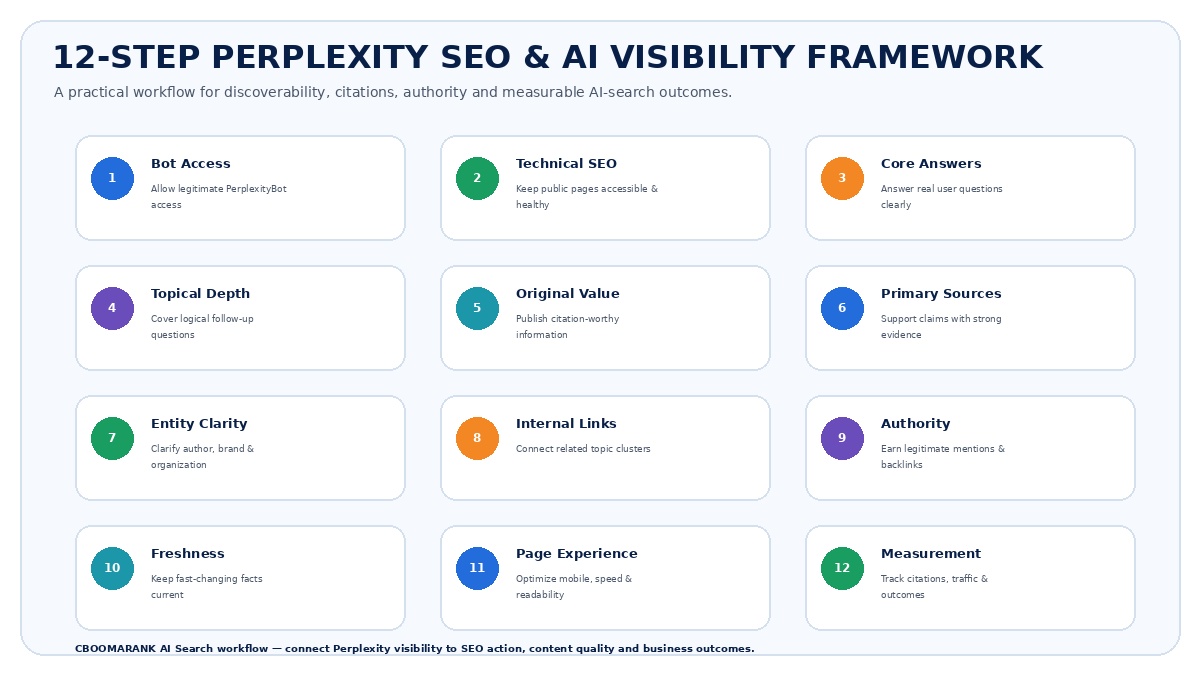
6. Cite Primary and Authoritative Sources
A trustworthy article should make important factual claims easy to verify.
Whenever possible, use:
- official product documentation;
- government data;
- peer-reviewed research;
- company announcements for company-specific facts;
- original datasets;
- credible first-party technical documentation.
Perplexity introduced domain-level source labels in 2026 for some Government, Academic and Trusted sources. Its documentation says the review considers signals including whether a site identifies authors, corrects mistakes and separates news from advertising or opinion.
However, Perplexity also says most domains do not have a label and that the absence of a label should not be interpreted as a negative judgment.
Official resource: Understanding Source Labels.
7. Make Authorship and Entity Information Clear
Readers and systems should be able to determine who created the content and what organization stands behind it.
- Use identifiable authors.
- Provide author biographies.
- Maintain a useful About page.
- Use consistent brand naming.
- Describe your products and services clearly.
- Keep contact and company information accurate.
- Use appropriate structured data where supported.
This is not a guaranteed Perplexity ranking factor. It is sound publishing practice that makes source identity easier to understand and verify.
8. Strengthen Internal Linking
Internal links create topic relationships and help users navigate supporting information.
For example, CBOOMARANK’s AI Search series connects this Perplexity guide with:
- AI Visibility Tools
- Google AI Overviews
- LLM SEO Tools
- Google AI Mode SEO
- ChatGPT SEO
- Generative Engine Optimization
- Answer Engine Optimization
Together, these resources create broader topical context around AI search.
9. Earn Legitimate Backlinks and Mentions
Authority on the open web still matters.
Focus on earning references because your information is genuinely useful.
- Publish data others want to cite.
- Create useful free resources.
- Contribute expert commentary.
- Build legitimate industry relationships.
- Earn editorial backlinks.
- Participate in relevant communities.
Avoid buying fake mentions or mass-producing low-quality links in an attempt to influence AI systems.
10. Keep Fast-Changing Information Fresh
Perplexity emphasizes current web information, making freshness especially important for fast-moving topics.
- Update software features.
- Review pricing regularly.
- Check model names and availability.
- Update statistics.
- Remove obsolete instructions.
- Add meaningful “last updated” information when appropriate.
Do not change dates merely to make old content appear fresh. Update the underlying information.
11. Improve Page Experience and Content Accessibility
Make your content useful regardless of whether the visitor arrives from Google, Perplexity, ChatGPT or a direct referral.
- Use readable typography.
- Maintain mobile responsiveness.
- Compress large images.
- Avoid disruptive overlays.
- Use descriptive ALT text.
- Keep critical information in accessible HTML text.
- Use tables and visual frameworks where they improve comprehension.
12. Measure Perplexity Visibility and Outcomes
AI visibility is valuable only when it contributes to meaningful outcomes.
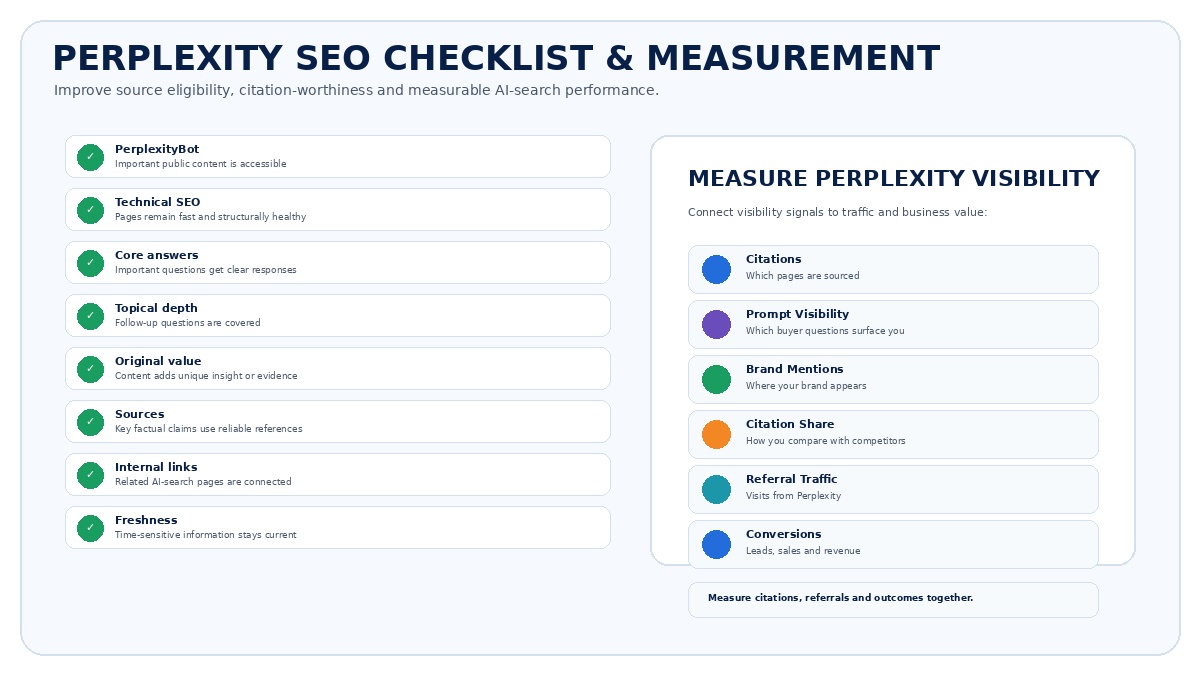
Track:
- Perplexity citations;
- prompt visibility;
- brand mentions;
- competitor citation share;
- pages cited by Perplexity;
- AI referral traffic;
- engagement;
- leads;
- conversions;
- revenue.
For platforms that can help monitor AI search performance, compare the options in Best AI Visibility Tools and Best LLM SEO Tools.
Perplexity SEO Checklist
| Check | What to Verify |
|---|---|
| PerplexityBot | Important public content is not unintentionally blocked |
| Technical SEO | Pages are accessible, fast and structurally healthy |
| Core answers | Important user questions receive clear responses |
| Topical depth | Logical follow-up questions are covered |
| Original value | The page includes unique insight, evidence or experience |
| Sources | Important claims link to reliable primary sources |
| Authorship | Author and organization information is clear |
| Internal linking | Relevant topic-cluster pages are connected |
| Authority | The domain earns legitimate external references |
| Freshness | Time-sensitive facts remain accurate |
| User experience | The page works well across desktop and mobile |
| Measurement | AI visibility is connected to traffic and conversions |
Perplexity SEO Mistakes to Avoid
- Blocking PerplexityBot unintentionally.
- Publishing generic AI-generated content with no original value.
- Creating hundreds of thin prompt pages.
- Repeating every possible question variation unnaturally.
- Inventing citations or statistics.
- Using fake experts or fabricated author profiles.
- Buying low-quality links or mentions.
- Ignoring ordinary SEO fundamentals.
- Allowing pricing and technical facts to become outdated.
- Measuring citations without measuring business results.
Can You Guarantee a Perplexity Citation?
No.
Perplexity decides which information and sources are appropriate for each question. The selected sources can vary depending on the query, available web information, search mode, freshness and other system-level decisions.
SEO professionals should therefore avoid promising guaranteed Perplexity citations or permanent visibility.
The realistic goal is to improve the conditions that make your information discoverable, trustworthy, useful and citation-worthy.
Where CBOOMARANK Fits Into the Perplexity SEO Workflow
Editorial disclosure: CBOOMARANK publishes this guide and is also developing its own SEO and analytics platform.
CBOOMARANK’s role is to connect AI-search visibility opportunities with practical SEO execution.
- Identify a Perplexity citation or visibility opportunity.
- Research the underlying user intent and keywords.
- Analyze competitors and sources being cited.
- Audit the target website and page.
- Investigate technical SEO problems.
- Find missing subtopics and content gaps.
- Strengthen internal linking.
- Analyze backlinks and authority.
- Create or improve original content.
- Measure AI visibility, referrals and conversions.
Turn Perplexity Visibility Insights Into SEO Action With CBOOMARANK
Use CBOOMARANK to connect website analysis, keyword research, competitor research, SEO audits, backlink analysis, reporting and content workflows around your Perplexity and AI-search opportunities.
Frequently Asked Questions
How do I rank in Perplexity?
There is no guaranteed Perplexity ranking formula. Improve discoverability by maintaining crawlable public content, publishing original and useful information, answering real questions, supporting claims with credible sources, building authority and keeping information current.
Does Perplexity have its own web crawler?
Yes. Perplexity identifies its search crawler as PerplexityBot. Its current documentation says PerplexityBot respects robots.txt directives.
Should I allow PerplexityBot?
If you want Perplexity to be able to index the textual content of your public pages, blocking PerplexityBot works against that goal. Publishers should make the decision based on their own content and access policies.
Does Perplexity cite websites?
Yes. Perplexity’s search experience provides citations and links to original sources so users can verify information and investigate the underlying material.
Are backlinks important for Perplexity SEO?
Perplexity does not publish a simple backlink-ranking formula. However, legitimate backlinks, mentions and references contribute to broader web authority and discoverability, so earning credible links remains sound SEO practice.
Is Perplexity SEO the same as GEO?
Perplexity SEO is a platform-specific application of the broader ideas behind Generative Engine Optimization and Answer Engine Optimization. Traditional SEO remains part of the foundation.
How should I measure Perplexity visibility?
Track citations, prompt visibility, brand mentions, cited landing pages, referral traffic, competitor visibility and downstream business outcomes such as leads and conversions.
Final Verdict
Ranking in Perplexity is not about discovering a secret AI-search shortcut.
The sustainable strategy is to make your website accessible, answer real questions clearly, publish genuinely useful and original information, support important claims with credible evidence, strengthen topical context, earn legitimate authority and keep fast-changing information current.
Perplexity’s citation-driven interface makes source quality especially visible to users. That gives publishers another reason to create information worth reading, referencing and verifying.
Finally, connect Perplexity visibility to actual SEO and business outcomes. Citations are valuable, but engaged visitors, leads, conversions and revenue are what turn AI-search visibility into business value.
Continue the CBOOMARANK AI Search series: Best AI Visibility Tools, Google AI Overviews, Best LLM SEO Tools, Google AI Mode SEO, ChatGPT SEO, Generative Engine Optimization and Answer Engine Optimization.
