

Introduction
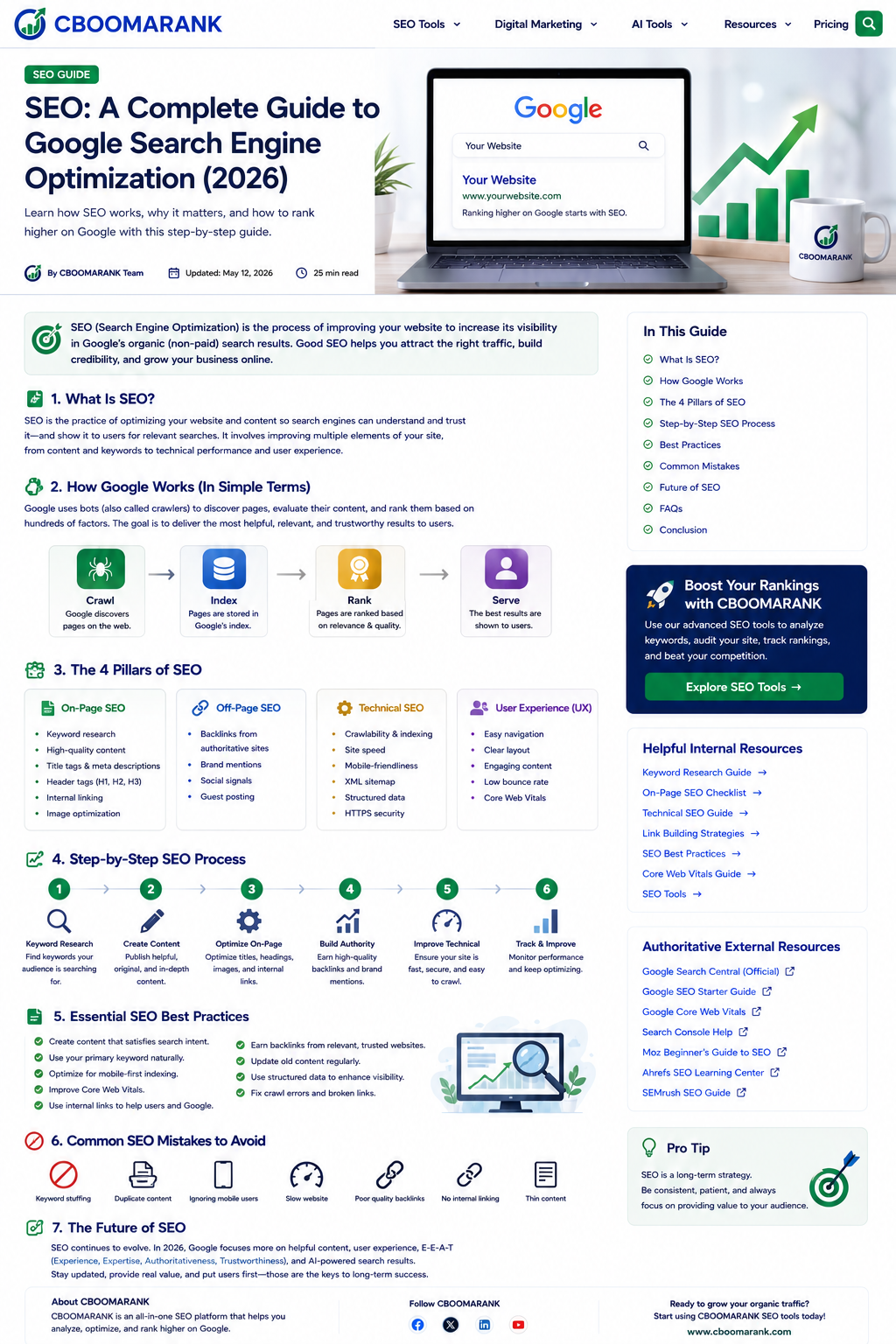
Search engine optimization is the process of improving a website so search engines can understand it and people can discover it when they search for relevant information, products, or services. Good SEO is not a collection of tricks. It combines helpful content, sound technical foundations, clear site structure, trustworthy signals, and continuous measurement.
Google Search now includes far more than traditional blue links. Search results may include images, video, local results, shopping results, featured snippets, AI Overviews, and AI Mode experiences. The same core principles still matter: publish original and useful information, make it easy for Google to crawl and interpret your pages, and create an experience that genuinely helps the visitor.
This guide replaces the older 2023 version with a current, practical framework for building organic visibility. It explains how Google finds and evaluates pages, the major areas of SEO, what to prioritize, what to avoid, and how to measure progress without relying on myths or shortcuts.
What Is SEO?
SEO helps search engines understand your content and helps users decide whether your page is worth visiting. It includes content strategy, keyword and audience research, technical optimization, internal linking, site experience, authority building, local visibility, and performance analysis.
Google describes SEO as making it easier for search engines to crawl, index, and understand content while helping users find a site through search. See the official Google SEO Starter Guide for foundational guidance.
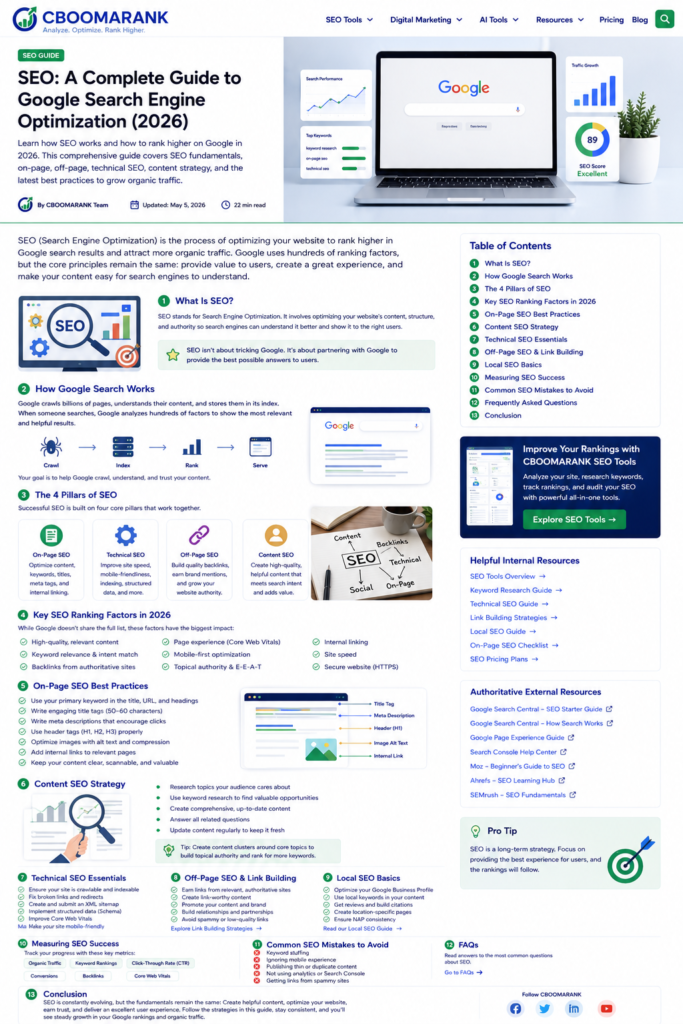
How Google Search Works
- Discovery: Google finds URLs through links, sitemaps, feeds, and previous crawls.
- Crawling: Googlebot requests pages and follows accessible links.
- Indexing: Google analyzes the page, its main content, images, structured data, language, and canonical signals.
- Serving and ranking: Google selects results that appear most useful and relevant for a specific query, location, device, and context.
Most pages are discovered automatically rather than submitted manually. Google explains the process in its How Google Search Works documentation.
The Six Pillars of a Modern SEO Strategy
1. Audience and keyword research
Understand who you serve, what problems they need solved, and the language they use. Group queries by intent: informational, commercial, transactional, navigational, and local.
2. Helpful content
Create original, accurate, well-structured pages that answer the query completely. Add first-hand experience, examples, screenshots, data, expert commentary, or practical templates that competitors cannot easily copy.
3. On-page SEO
Use clear titles, headings, descriptive URLs, concise meta descriptions, meaningful image ALT text, and natural keyword language. Make the main purpose of the page obvious.
4. Technical SEO
Ensure pages are crawlable, indexable, secure, mobile-friendly, fast, canonicalized correctly, and supported by clean internal links, XML sitemaps, and appropriate structured data.
5. Authority and reputation
Earn relevant links and brand mentions by publishing useful assets, original research, expert content, and resources people genuinely want to reference. Avoid paid or manipulative link schemes.
6. Measurement and improvement
Use Search Console, analytics, conversion data, and business outcomes to understand what is working. Update, consolidate, redirect, or retire pages based on evidence.
People-First Content and E-E-A-T
Google recommends creating content primarily to help people rather than content designed mainly to manipulate rankings. Strong pages demonstrate experience, expertise, authoritativeness, and trust through accurate information, transparent authorship, credible sourcing, clear editorial standards, and evidence of real knowledge.
Use Google’s self-assessment questions in Creating Helpful, Reliable, People-First Content before publishing or refreshing an important page.
SEO for AI Overviews and AI Mode
There is no separate secret optimization system for generative search. Google says established SEO best practices remain the foundation. Pages should be indexable, technically accessible, original, clear, and useful. Strong entity descriptions, concise answers, supporting evidence, well-labeled sections, images, and structured data can help systems understand the page, but none guarantees inclusion.
Review Google’s official guidance on optimizing for generative AI features and its explanation of AI features and websites.
A Step-by-Step SEO Process
- Audit the site: identify indexing problems, duplicate URLs, slow templates, broken links, weak pages, and missing conversion tracking.
- Research the audience and market: define customer needs, competitor strengths, search demand, and business value.
- Map keywords and intent to pages: give each important topic a clear primary page and avoid creating multiple pages for the same intent.
- Create or improve content: make the page more complete, original, useful, and trustworthy than the alternatives.
- Optimize on-page elements: refine title, headings, introduction, images, internal links, metadata, and calls to action.
- Strengthen technical foundations: improve crawlability, canonicals, sitemaps, mobile performance, Core Web Vitals, HTTPS, and structured data.
- Build authority ethically: promote useful resources, earn editorial links, develop partnerships, and grow branded demand.
- Measure and iterate: track impressions, clicks, CTR, rankings, conversions, leads, sales, and assisted value.
Essential On-Page SEO Practices
- Write a unique title that accurately describes the page.
- Use one clear primary heading and logical subheadings.
- Answer the main question early, then provide depth.
- Use descriptive internal anchor text rather than vague phrases such as “click here.”
- Optimize images for size, context, file name, and accessibility.
- Write for natural language and related concepts instead of repeating an exact keyword.
- Add a useful next step, such as a tool, service, template, or related guide.
Technical SEO Essentials
- Allow Google to crawl important resources and pages.
- Use canonical URLs consistently and redirect duplicate or obsolete URLs properly.
- Maintain an accurate XML sitemap containing canonical, indexable URLs.
- Design for mobile users and test real-world Core Web Vitals.
- Use HTTPS and keep software, plugins, and dependencies updated.
- Implement structured data only when it accurately represents visible page content.
- Test JavaScript-rendered pages with URL Inspection and rendered HTML.
Related CBOOMARANK guide: Technical SEO: Complete Guide
Structured Data and Search Appearance
Structured data helps Google understand page entities and may make eligible pages available for enhanced search appearances. It is not a ranking shortcut and does not guarantee a rich result. For blog posts, accurate Article or BlogPosting markup can identify the headline, author, images, and dates.
Use the Google Article structured data documentation and follow the general structured-data guidelines.
Internal Linking and Site Architecture
A strong site architecture connects important pages through crawlable HTML links. Organize related articles into topic clusters, link from established pages to priority resources, use descriptive anchor text, and avoid orphan pages. Internal links help users navigate and help Google discover and understand relationships between pages.
Off-Page SEO and Link Building
Focus on earning editorially given links from relevant websites. Strong link-worthy assets include original studies, tools, calculators, templates, detailed guides, expert surveys, and data visualizations. Backlink quality, relevance, context, and authenticity matter more than raw quantity.
Related CBOOMARANK guide: Best Link Building Tools
Local SEO
Businesses serving specific areas should maintain an accurate Google Business Profile, consistent contact details, useful location pages, local reviews, relevant citations, and content that answers local customer needs. Avoid creating thin doorway pages for every nearby city.
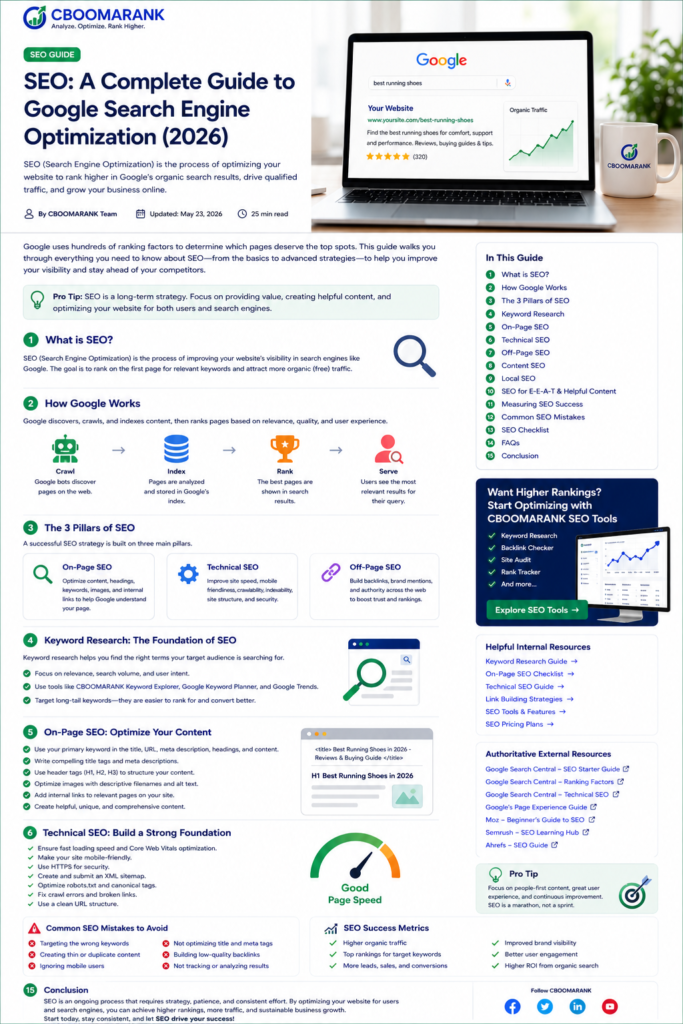
How to Measure SEO Success
| Metric | What It Shows | How to Use It |
| Search impressions | How often pages appear | Identify growing topics and pages with visibility potential |
| Clicks and CTR | Traffic and result appeal | Improve titles and descriptions where impressions are strong but clicks are weak |
| Average position | Directional ranking movement | Use with query, page, country, and device context |
| Indexed pages | Coverage and technical health | Find important pages excluded from the index |
| Conversions and revenue | Business impact | Prioritize content that produces leads, sales, signups, or assisted value |
| Core Web Vitals | Real-user experience | Fix poor templates that affect many URLs |
Use Google Search Console for search performance and indexing data, then connect it with analytics and business reporting.
Common SEO Mistakes to Avoid
- Publishing many low-value pages across unrelated topics just to capture traffic.
- Repeating keywords unnaturally or creating near-duplicate pages for slight phrase variations.
- Buying links, using private link networks, or exchanging links at scale.
- Changing URLs without redirects and migration planning.
- Blocking important pages or resources with robots.txt, noindex, login walls, or broken JavaScript.
- Treating structured data, sitemaps, or URL submission as ranking guarantees.
- Measuring only rankings while ignoring conversions, retention, and revenue.
Recommended CBOOMARANK Internal Links
- Keyword Research Tools
- SEO Best Practices
- Technical SEO Guide
- XML Sitemap Guide
- Submit URLs to Search Engines
- International SEO Guide
- AI SEO Tools
- CBOOMARANK Pricing
Frequently Asked Questions
How long does SEO take?
Meaningful improvement commonly takes weeks or months, depending on competition, site condition, content quality, authority, and how quickly changes are crawled and evaluated.
Is SEO free?
Organic clicks are not purchased per click, but successful SEO requires investment in strategy, content, development, tools, promotion, and measurement.
Does Google use a fixed list of 200 ranking factors?
Google uses many systems and signals, but there is no reliable public checklist of exactly 200 factors that marketers can optimize one by one.
Can AI-written content rank?
AI-assisted content can perform when it is accurate, useful, original, and reviewed. Mass-produced low-value content created mainly to manipulate rankings can violate spam policies.
Do backlinks still matter?
Editorially earned, relevant links and mentions remain useful authority signals, but quality and context matter more than volume.
Should every business hire an SEO agency?
Not necessarily. Some businesses can manage the basics internally, while complex migrations, technical problems, competitive markets, or limited team capacity may justify professional help.
Conclusion
SEO in 2026 is a long-term growth system built on useful content, technical accessibility, strong user experience, clear site architecture, trustworthy reputation, and continuous measurement. The fundamentals remain stable even as search interfaces evolve.
Use this guide as a framework rather than a one-time checklist. Start with the problems that block crawling, indexing, relevance, or conversion; improve the pages that already have potential; and publish new content only when it serves a clear audience and business purpose.
