

Introduction
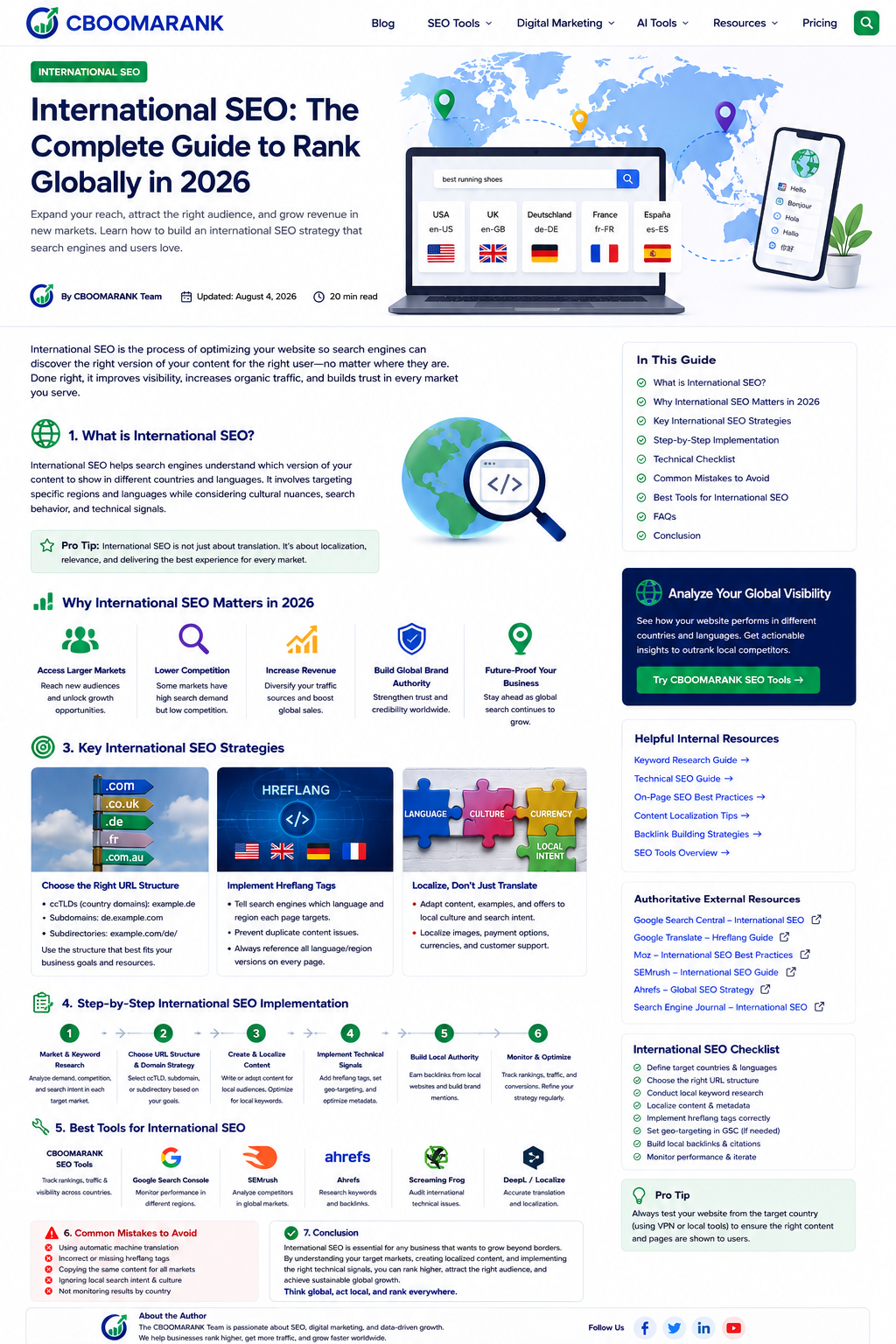
International SEO helps search engines and users reach the most relevant version of your website for their country, language, and needs. It combines technical configuration with local keyword research, useful localization, market-specific trust signals, and accurate measurement.
It is not simply a translation project. A page can be translated correctly and still perform poorly if the search intent, currency, examples, availability, legal information, or calls to action do not fit the target market. Strong international SEO makes each local experience useful while keeping the site technically clear and manageable.
This guide explains how to choose markets, select an international URL structure, implement hreflang correctly, localize content, avoid duplicate and indexing problems, and measure performance by market.
What Is International SEO?
International SEO is the process of optimizing a website for audiences in multiple countries, regions, or languages. A multilingual site serves more than one language. A multi-regional site targets users in different countries or regions. Many global websites are both multilingual and multi-regional.
The objective is to help search engines discover every version, understand the relationship between alternatives, and serve the most appropriate URL. The user should also receive locally useful content, not merely a mechanically translated copy.
1. Choose Markets Based on Evidence
- Review current traffic and conversions by country and language.
- Measure local search demand and commercial intent.
- Confirm product availability, delivery, payments, support, and legal requirements.
- Evaluate local competitors and the difficulty of earning visibility.
- Start with a manageable number of markets and expand after proving the model.
2. Research Keywords Locally
Do not translate a master keyword list word for word. People use different product names, spellings, units, modifiers, and questions in each market. Review local search results, autocomplete suggestions, related questions, competitor pages, Search Console data, and customer language.
Map each keyword to a local search intent: informational, commercial, navigational, or transactional. Then build a page plan that avoids forcing one URL to satisfy incompatible markets.
Related CBOOMARANK guide: Best Keyword Research Tools
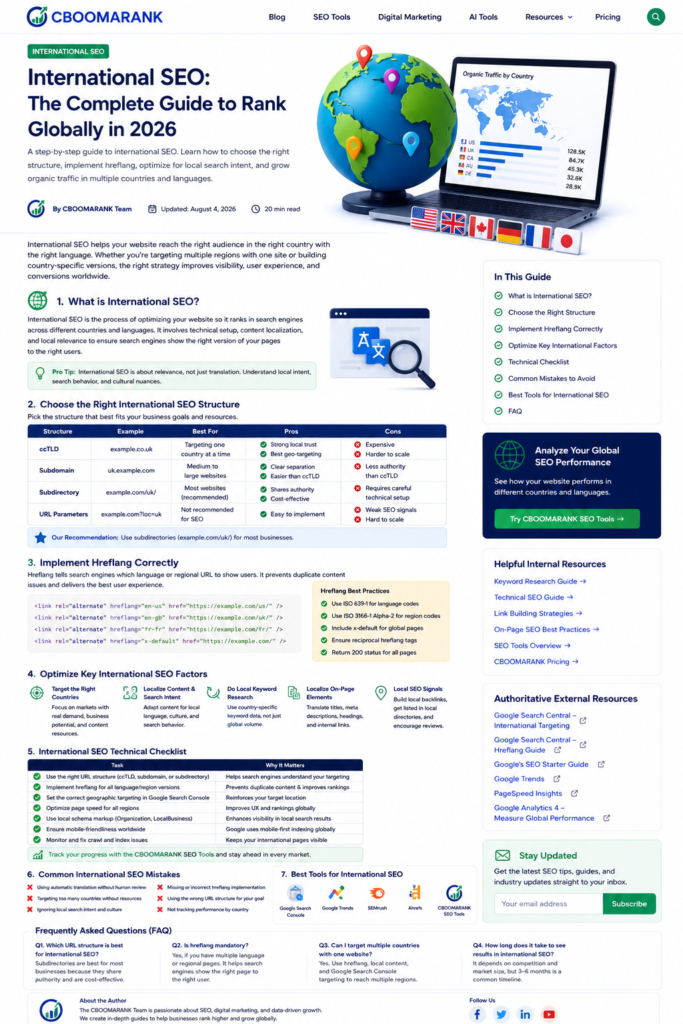
3. Choose an International URL Structure
| Structure | Example | Advantages | Considerations |
| Country-code domain | example.fr | Strong country association and local trust | Higher cost and separate authority-building |
| Subdomain | fr.example.com | Useful for operational separation | Requires careful governance and can fragment management |
| Subdirectory | example.com/fr/ | Efficient authority sharing and simpler management | Needs consistent architecture and reporting |
| URL parameters | example.com?lang=fr | Easy to generate | Not recommended as the primary international SEO structure |
For many organizations, subdirectories offer a practical balance of shared authority, analytics, and maintenance. The best structure is the one your organization can support consistently with unique content, correct technical signals, and clear ownership.
4. Implement Hreflang Correctly
Hreflang annotations identify equivalent language or regional versions. They help Google show the right URL to the right searcher, but they are not a ranking boost and do not replace localization.
- Use valid ISO 639-1 language codes and optional ISO 3166-1 Alpha-2 region codes.
- Every version should reference itself and all equivalent alternatives.
- Return links must be reciprocal.
- Point hreflang to canonical, indexable URLs that return a successful status.
- Use x-default for a genuine global selector or fallback page when appropriate.
- Keep hreflang sets consistent in HTML, HTTP headers, or XML sitemaps; do not create conflicting implementations.
Example: en, en-US, en-GB, fr-FR, and x-default may belong in one cluster when the pages are genuine equivalents.
5. Align Canonicals and Hreflang
Each localized page should normally have a self-referencing canonical. Do not canonicalize every language or country version to one global page, because that can tell search engines to treat the localized pages as duplicates. Hreflang and canonical signals should reinforce the same architecture.
6. Localize the Full Experience
- Rewrite titles, headings, examples, and calls to action for local intent.
- Use the correct currency, tax information, delivery promises, measurements, and availability.
- Provide local contact details or clearly explain support coverage.
- Localize images and accessibility text when visuals contain language or culturally specific information.
- Use local proof: customers, case studies, reviews, certifications, and media mentions.
- Review translations with qualified native speakers who understand the subject and brand.
7. Avoid Forced Redirects and Locale-Adaptive Traps
Google recommends separate URLs for language versions. Avoid relying entirely on cookies, IP detection, or browser language to swap content on the same URL. Googlebot may not discover every locale-adaptive version. If you suggest a local page, let users change the selection and avoid trapping them in automatic redirects.
8. Build Clear Internal Linking
Users and crawlers should be able to navigate between language and regional versions. Add a visible selector, use descriptive links, and link local content to relevant local category, service, product, and editorial pages. Avoid creating orphan regional pages that exist only in a sitemap.
Related CBOOMARANK guides: Technical SEO and SEO Best Practices
9. Technical International SEO Checklist
- Every locale has a unique, crawlable URL.
- Canonical tags point to the correct same-language page.
- Hreflang is reciprocal, valid, and complete.
- XML sitemaps contain canonical URLs and may include hreflang annotations.
- Robots.txt and meta robots do not block important regional pages.
- HTTP status codes, redirects, pagination, and faceted URLs are audited.
- Mobile and desktop experiences contain equivalent primary content and hreflang signals.
- Structured data matches the visible localized content.
- Page speed and Core Web Vitals are tested from relevant regions.
- Analytics and Search Console reporting can be segmented by directory, domain, country, and language.
10. Build Local Authority
International rankings require more than translated pages. Earn relevant local mentions and links from industry publications, directories, partners, associations, and communities. Use digital PR and genuinely useful assets rather than buying low-quality links or duplicating one outreach campaign across every country.
Related CBOOMARANK guide: Best Link Building Tools
11. Measure Performance by Market
- Organic impressions, clicks, CTR, and average position by country and URL group.
- Conversions, qualified leads, revenue, and average order value by market.
- Index coverage and crawl issues for every international directory or domain.
- Brand and non-brand search visibility.
- Local landing-page engagement and support issues.
- Performance in image, video, local, shopping, and AI-enhanced search experiences where relevant.
Use third-party visibility data as directional context, but base business decisions on first-party search, analytics, CRM, and revenue data.
Common International SEO Mistakes
- Launching too many markets without content and operational capacity.
- Using automatic translation without expert review.
- Serving the wrong currency, availability, or contact details.
- Creating thin country pages that differ only by a place name.
- Incorrect hreflang codes, missing return tags, or non-indexable targets.
- Canonicalizing all localized pages to the global version.
- Redirecting users automatically with no way to choose another locale.
- Ignoring mobile parity, page speed, and local conversion barriers.
- Measuring rankings without measuring qualified leads and revenue.
Recommended Internal Links
- Technical SEO
- Keyword Research Tools
- SEO Best Practices
- Link Building Tools
- Competitor Traffic Analysis
- CBOOMARANK Pricing
Authoritative External References
- Google: Managing Multi-Regional and Multilingual Sites
- Google: Localized Versions and Hreflang
- Google: Locale-Adaptive Pages
- Google: Canonical URL Guidance
- Google: Mobile-First Indexing
- Google Search Console
Frequently Asked Questions
What is the best URL structure for international SEO?
There is no universal best structure. Subdirectories are practical for many businesses, while country-code domains may suit organizations with independent local operations and resources.
Is hreflang mandatory?
No, but it is strongly recommended when equivalent pages target different languages or regions because it helps Google select the appropriate version.
Can I use automatic translation?
Automated tools can support a workflow, but important pages should be reviewed and localized by qualified humans for accuracy, intent, compliance, and trust.
Should every country have unique content?
Pages should be meaningfully useful for their market. They may share a core message, but local offers, proof, examples, language, and operational information should be accurate.
How long does international SEO take?
Timelines depend on technical quality, competition, site authority, localization depth, and demand. Treat expansion as a staged program measured over months rather than a quick translation task.
Conclusion
International SEO works when technical clarity and local usefulness reinforce each other. Choose markets based on evidence, publish each locale on a stable URL, implement hreflang and canonicals accurately, localize the complete customer experience, and measure business outcomes separately by market.
Keep the existing CBOOMARANK permalink and replace the shorter article with this expanded guide so the page retains its indexing history while offering much stronger value.
