

Introduction
If you want more organic traffic, stronger content ideas, and a clearer growth strategy, you need to know where your competitors are getting attention. Competitor traffic analysis is no longer just about guessing monthly visits from a single third-party tool. Today, smart marketers compare traffic channels, top pages, search visibility, backlinks, and content depth to understand what is really driving growth.
The goal is not to copy a competitor page for page. The goal is to understand what is working in your market, spot the gaps in your own strategy, and prioritize the opportunities with the highest upside. When done well, competitor traffic analysis helps you discover which topics attract demand, which channels bring qualified visitors, and which content formats deserve more investment.
This updated guide explains how to analyze competitor website traffic using a practical, repeatable framework. It also reflects the modern shift toward first-party data, cross-channel benchmarking, AI-search visibility, and better content quality rather than shallow pageview chasing.
Why Competitor Traffic Analysis Matters Now
Before comparing competitors, review CBOOMARANK’s SEO best-practices guide to ensure your site has the technical and content foundations needed to benefit from the findings.
- Search results are more competitive. Your brand competes for clicks in organic results, snippets, video results, and other high-visibility search features.
- Traffic quality matters as much as traffic quantity. A smaller amount of high-intent traffic can be more valuable than a huge volume of weak visits.
- First-party data is more important than ever. Third-party tools are useful, but your own Google Search Console, analytics, and lead data should guide decisions.
- Content depth beats thin content. Competitor analysis helps you understand why certain pages attract attention and others do not.
- Cross-channel benchmarking gives a fuller picture. Organic, direct, referral, email, paid, and social traffic each reveal different strengths.
What to Measure When You Analyze Competitor Traffic
Use the official Google Search Console Performance report to validate your own clicks, impressions, queries, pages, countries, and devices. Google explains how clicks, impressions, and average position are calculated, which helps you compare third-party estimates with first-party data.
| Metric | What It Tells You | Why It Matters |
| Estimated monthly visits | The scale of demand competitors capture | Useful for benchmarking, but not enough on its own |
| Traffic channels | Where visits come from | Shows whether competitors win through SEO, direct traffic, referrals, social, email, or paid media |
| Top pages | Which pages attract the most attention | Helps you identify the formats and topics that perform best |
| Top keywords | Which terms send search visibility | Supports keyword gap analysis and content planning |
| Backlinks and referring domains | How authority is built | Helps you identify link-worthy content and outreach targets |
| Traffic quality indicators | How valuable the traffic might be | Useful when comparing pages built for leads, signups, or product discovery |
| SERP feature visibility | Where brands show up beyond classic listings | Important for modern search visibility and click potential |
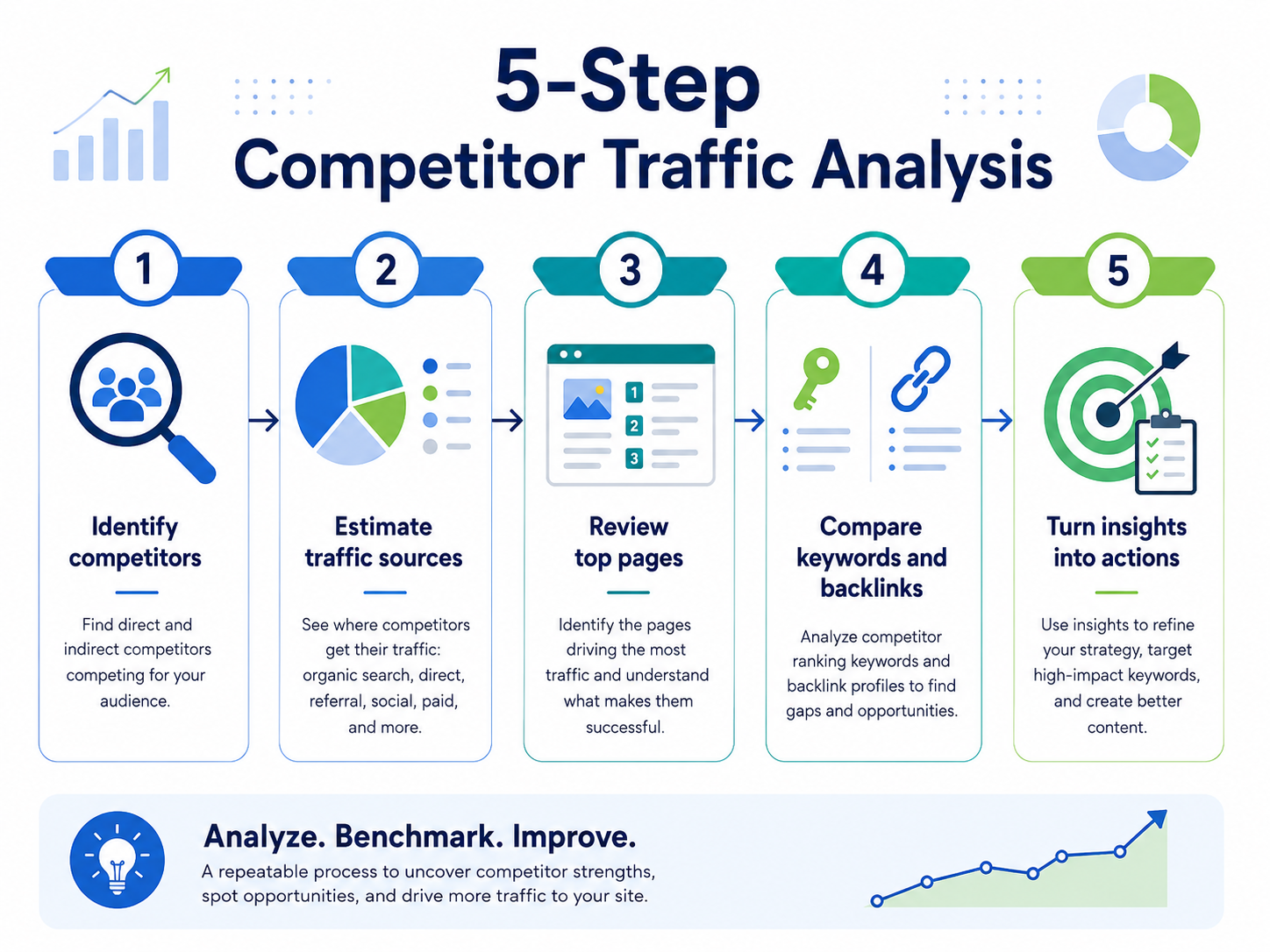
Original infographic: a five-step framework for competitor traffic analysis.
A 5-Step Framework for Analyzing Competitors Traffic
1. Identify the right competitors
Start with a structured keyword set. CBOOMARANK’s keyword-research tools guide can help you identify the domains that repeatedly compete for the same queries and audience intent.
Separate direct competitors from search competitors. A direct competitor sells a similar solution to a similar audience. A search competitor may rank for the same topics even if the business model is different. Use search results, industry directories, and your keyword list to build a short list of realistic competitors.
2. Estimate traffic sources
For paid-channel research, compare campaign intelligence and competitive-ad tools from the CBOOMARANK PPC tools guide alongside organic and referral estimates.
Use traffic intelligence tools to understand whether competitors depend mainly on organic search, direct traffic, referrals, paid traffic, social platforms, or email. This shows how diversified their acquisition strategy is and where your biggest gaps may exist.
3. Review top-performing pages
Check whether the topics are growing or seasonal with Google Trends and use CBOOMARANK’s trending-keywords guide to distinguish short-lived spikes from durable opportunities.
Find the pages driving the most visibility. Look for recurring patterns such as comparison pages, “best tools” roundups, category pages, pricing guides, case studies, or evergreen tutorials. Study the format, angle, and search intent rather than just the headline.
4. Compare keywords and backlinks
Use the CBOOMARANK link-building tools guide to review referring domains, link gaps, and link-worthy competitor assets without copying or pursuing manipulative links.
Run a keyword gap analysis to find phrases competitors rank for that you do not. Then review backlinks to see which pages attract links, mentions, and partnerships. This helps you decide whether you need better content, stronger internal linking, more authority, or all three.
5. Turn insights into actions
Prioritize improvements using Google’s SEO Starter Guide and connect Search Console with analytics as described in Google’s Search Console and Google Analytics guide so traffic changes can be tied to engagement and conversions.
Convert findings into a simple action plan. Build or update pages for high-opportunity topics, strengthen internal links, improve content quality, create better assets for outreach, and track results over time.
Best Tools to Analyze Competitor Website Traffic
| Tool | Best For | What to Use It For |
| Google Search Console | Your own first-party search data | Compare your strongest queries and pages against competitor opportunities you uncover elsewhere. |
| Google Trends | Topic momentum and seasonality | Check whether a topic is rising, seasonal, or declining before building content around it. |
| Semrush | Traffic estimates and keyword gap analysis | Estimate traffic, review top pages, compare domains, and uncover keyword opportunities. |
| Ahrefs | Organic keyword and backlink analysis | Research ranking keywords, top pages, link profiles, and content gaps. |
| Similarweb | Traffic channel comparison | Understand channel mix, referrals, and broad traffic trends. |
| SparkToro | Audience and source discovery | Find where audiences pay attention and which sites, channels, or creators influence them. |
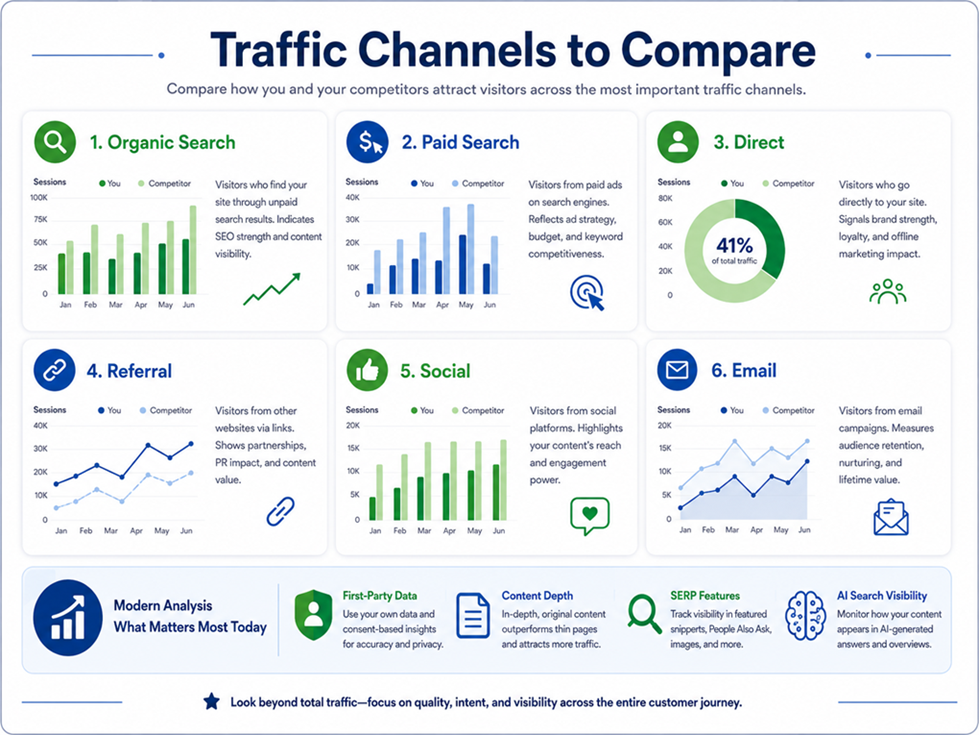
Original infographic: the traffic channels worth comparing across competitors.
Traffic Channels You Should Compare
When evaluating AI-search exposure, review Google’s generative AI performance reporting guidance and compare it with the practical workflows in CBOOMARANK’s AI SEO tools guide.
Organic search shows the strength of a competitor’s SEO strategy, content library, and search intent alignment. Direct traffic often reflects brand awareness, customer loyalty, and offline demand. Referral traffic can reveal PR wins, partnerships, and content that earns links naturally.
Paid search highlights whether competitors are investing in fast customer acquisition. Social traffic can show which brands know how to distribute content and capture attention across platforms. Email traffic reflects audience retention and lifecycle marketing strength. Looking at the full mix helps you avoid drawing the wrong conclusion from a single number.
How to Turn Competitor Traffic Insights into SEO Wins
After identifying priority gaps, use CBOOMARANK’s SEO plans and reporting features to organize audits, monitoring, and recurring performance reviews.
- Create a keyword gap list using pages and terms competitors rank for that you do not.
- Prioritize pages with clear commercial or lead-generation intent rather than chasing every high-volume keyword.
- Upgrade weak pages with better structure, deeper coverage, stronger examples, and clearer calls to action.
- Strengthen internal links from related posts, category hubs, and service pages.
- Create new comparison pages, tools roundups, pricing guides, or tutorials when you see repeated demand patterns.
- Build link-worthy assets such as original research, checklists, templates, and case studies.
- Review performance monthly so competitor analysis becomes a habit instead of a one-time task.
Common Mistakes to Avoid
- Treating third-party traffic estimates as exact numbers instead of directional benchmarks.
- Comparing brands that are too large, too small, or too different from your market position.
- Obsessing over total traffic without checking whether the traffic is relevant or likely to convert.
- Ignoring top pages and only looking at domain-level metrics.
- Failing to turn research into a prioritized action plan.
Recommended Internal Links for CBOOMARANK
- Best Keyword Research Tools
- Link Building Tools
- Trending Keywords for SEO
- SEO Best Practices for Organic Traffic
- Negative Keywords
- Shopify vs WordPress
- CBOOMARANK Pricing
Suggested External Reference Links
FAQs
What is competitor traffic analysis?
Competitor traffic analysis is the process of estimating and comparing how other websites attract visitors, which channels they rely on, which pages perform best, and where they gain authority and visibility.
Can I see the exact traffic numbers of a competitor?
No. Third-party tools provide estimates, not exact traffic data. Use them directionally and combine them with search visibility and content analysis.
Which channel matters most?
There is no single best channel. Organic search is often the first place to look, but the strongest insights usually come from comparing the full channel mix.
How often should I analyze competitors traffic?
A monthly review is ideal for most blogs and marketing teams. A larger quarterly review can be used for strategic planning.
What should I do after the analysis?
Turn the findings into action: update priority pages, build new content around gaps, improve internal linking, and create stronger assets for outreach and promotion.
Conclusion
Analyzing competitors traffic is one of the fastest ways to sharpen your SEO and content strategy. It helps you move beyond assumptions and make smarter decisions about keywords, channels, content formats, and growth priorities.
Instead of copying a competitor blindly, use the data to understand what is working, why it is working, and where your own site can create something better. If you build the habit of reviewing top competitors consistently, you will uncover stronger opportunities and make more confident content decisions over time.
For CBOOMARANK, this kind of analysis fits naturally with keyword research, traffic benchmarking, backlink analysis, and SEO reporting. Use the framework in this guide to turn competitor traffic data into practical wins.
