

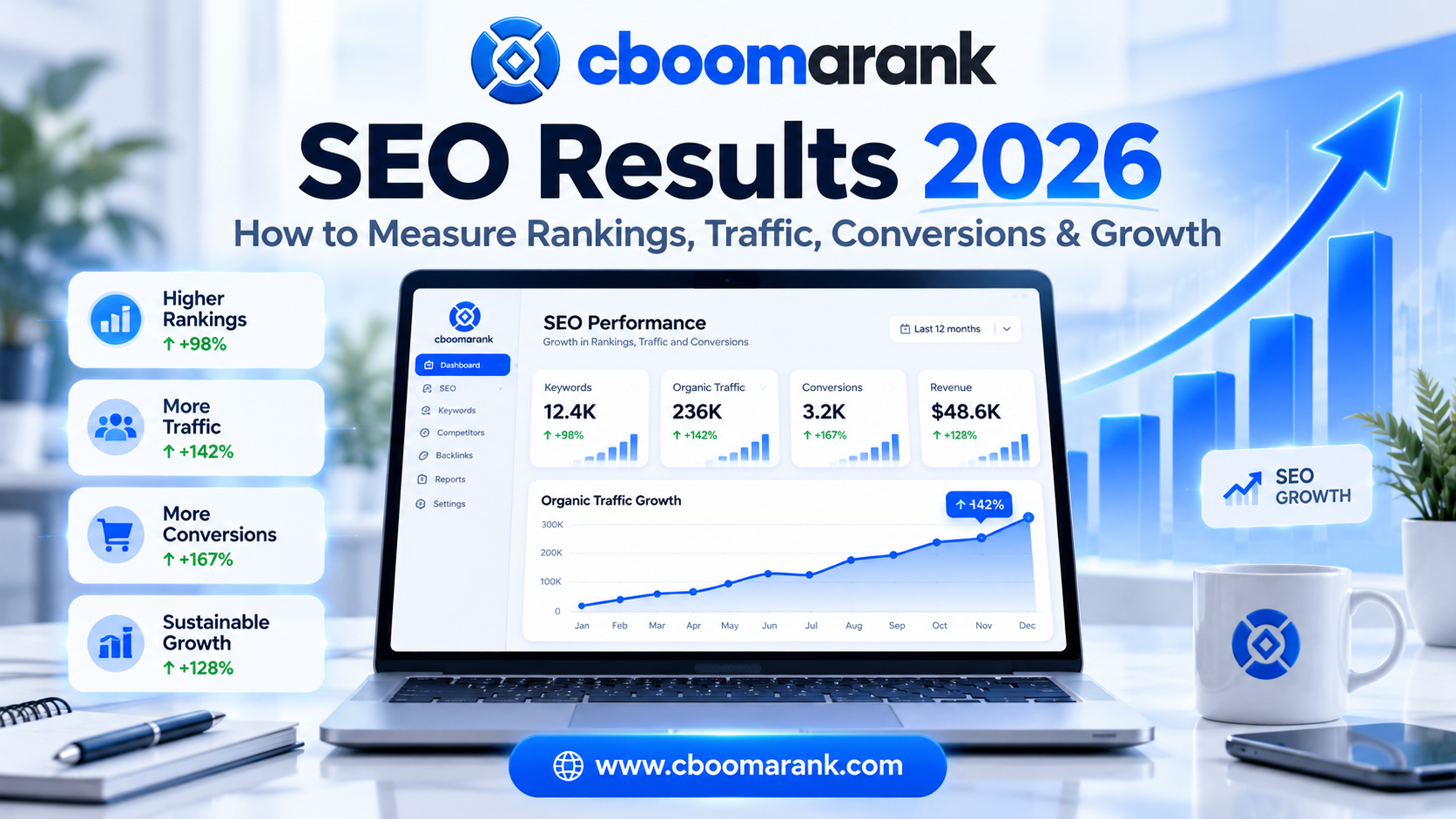
SEO results are the measurable outcomes of your search engine optimization work. In 2026, that means looking beyond a single ranking number and connecting search visibility with clicks, qualified organic traffic, engagement, leads, sales, revenue, technical health, content performance, backlinks, and long-term business value.
A page can move from position 18 to position 8 and still produce little business impact if the query has weak intent, the snippet earns few clicks, or the landing page does not convert. On the other hand, a page can create strong SEO value even when its average position looks modest if it earns qualified traffic across many long-tail queries and contributes to leads, assisted conversions, or brand discovery.
This guide explains how to measure SEO results with a practical framework built around Google Search Console, Google Analytics, technical SEO data, conversion tracking, content performance, and business outcomes. It also shows how to use CBOOMARANK to connect SEO audits, keyword research, competitor research, authority metrics, backlink opportunities, and reporting around the same website.
What Are SEO Results?
SEO results are the changes that occur because your website becomes easier to crawl, understand, trust, discover, and use. They can appear at several levels: visibility in search, traffic from search, engagement after the click, lead generation, ecommerce revenue, local visibility, brand demand, and the strength of the website itself.
The most useful SEO measurement system separates leading indicators from business outcomes. Leading indicators include impressions, rankings, indexed pages, referring domains, crawl health, content coverage, and click-through rate. Business outcomes include key events, qualified leads, transactions, revenue, booked calls, sign-ups, and other actions that matter to the organization.
Google Search Console’s Performance report currently provides core search metrics including clicks, impressions, click-through rate, and average position, with dimensions such as queries, pages, countries, devices, dates, and search appearance. Those metrics are excellent for understanding visibility and search demand, but they should be interpreted alongside analytics and business outcomes rather than used in isolation.
Reference: Google Search Console Performance report.
Why Measuring SEO Results Is Harder Than Tracking Rankings
Rankings are useful, but they are not a complete performance system. Search results vary by query, location, device, search features, personalization, and timing. Google also explains that Search Console average position is based on the topmost result from your property or page in the relevant aggregation. Therefore, one average number can hide a wide distribution of actual positions.
In addition, modern search includes rich results, images, videos, local packs, shopping features, AI-generated experiences, and other interfaces that can change how users discover websites. A good SEO reporting model therefore measures trends and outcomes rather than treating a single ranking metric as the final score.
Google’s own Search Console guidance recommends looking closely at clicks and impressions trends instead of relying only on position history. Reference: Search Console performance use cases.
The SEO Results Funnel
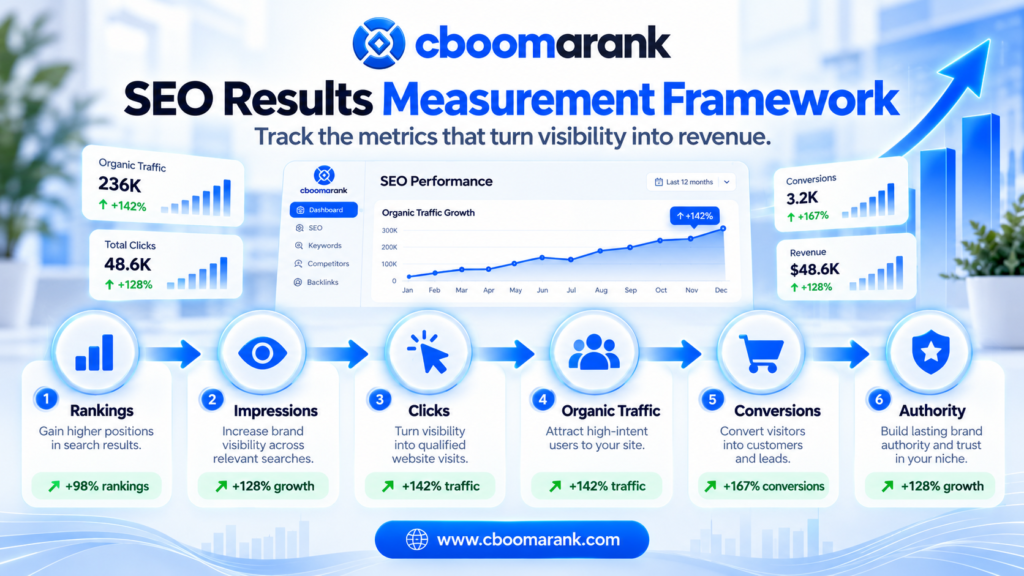
A practical way to understand SEO performance is to think of it as a funnel:
- Discovery: Can search engines crawl and index the right pages?
- Visibility: Are your pages earning impressions for relevant queries?
- Traffic: Are searchers clicking through to your site?
- Engagement: Do visitors consume the content and continue their journey?
- Conversion: Do organic visitors complete important actions?
- Revenue or value: Does organic search contribute to measurable business growth?
If one stage is weak, the next stage usually suffers. For example, excellent content cannot earn organic clicks if it is not indexed. Strong rankings may underperform if the title and snippet produce a poor click-through rate. High traffic can still fail commercially if the landing page does not match user intent.
1. Measure Organic Search Visibility
Visibility shows whether your website is becoming more discoverable for the topics that matter. The primary measurements are impressions, keyword coverage, search appearance, page visibility, and ranking distribution.
Search Impressions
Impressions tell you how often your pages appear in eligible search results. Growth in impressions can indicate that Google is finding your content relevant for more searches, more locations, more long-tail variations, or higher-volume topics.
However, impression growth alone is not success. If impressions rise while clicks remain flat, inspect click-through rate, query intent, SERP competition, title quality, and whether Google is showing the page for loosely related searches.
Keyword Coverage
Track how many relevant queries produce impressions and clicks. Keyword coverage helps you understand whether a page or topic cluster is expanding beyond one primary phrase.
CBOOMARANK’s keyword and competitor research workflows can help you compare target topics, identify gaps, and decide which queries deserve deeper optimization. See the advanced SEO techniques guide for broader optimization ideas.
Ranking Distribution
Instead of reporting only an average rank, group tracked keywords into ranges such as positions 1–3, 4–10, 11–20, 21–50, and 51+. This makes progress easier to understand and highlights keywords that are close to meaningful page-one visibility.
2. Measure Organic Clicks and Click-Through Rate
Clicks are a direct measure of how much traffic Google Search sends from the results interface. Click-through rate is the percentage of impressions that become clicks.
A low CTR can occur even when rankings are strong. Reasons include unattractive titles, weak meta descriptions, poor brand recognition, search features that answer the query without a click, or a mismatch between the query and the page’s apparent promise.
Use CTR diagnostically. Compare pages with similar average positions, segment by query, and inspect changes after title or snippet improvements. Avoid assuming that one universal CTR benchmark applies to every query type.
3. Measure Organic Traffic in Google Analytics
Search Console explains how your site performs inside Google Search. Google Analytics explains what users do after arriving on the site.
Google Analytics currently provides Traffic acquisition reporting that helps you understand where sessions come from across organic and paid channels. For organic search analysis, isolate the relevant organic source or channel and compare landing pages, engagement, events, and key events.
Reference: Google Analytics Traffic acquisition report.
Sessions and Users
Sessions show visits. Users help you understand the people behind those sessions. Both can be useful, but neither proves business value on its own.
Compare organic traffic year over year when seasonality matters. Also compare similar periods rather than one isolated week, especially if your business experiences weekends, holidays, launches, or promotional spikes.
Landing Pages
Landing-page reporting reveals which pages attract organic visitors. Separate branded pages, informational content, product pages, service pages, tools, and category pages because they play different roles in the funnel.
A page with high traffic may be a strong awareness asset even if it produces few direct conversions. A lower-traffic commercial page may generate much more revenue per session. Both can be valuable for different reasons.
4. Measure SEO Conversions and Key Events
Google Analytics uses the term key event for an event that measures an action particularly important to the success of your business. Examples can include lead-form submissions, account registrations, purchases, quote requests, booked calls, or other meaningful actions.
Reference: Google Analytics key events.
Google also distinguishes Analytics key events from advertising conversions. This matters when teams compare SEO reporting with Google Ads reporting. Reference: Conversions versus key events in Google Analytics.
Lead Generation SEO Results
For lead-generation websites, measure qualified actions such as submitted forms, phone calls, booked consultations, trial registrations, demo requests, and sales-qualified leads.
Do not stop at form count. Connect lead quality back to the landing page, query theme, and content journey whenever your analytics and CRM setup allows it.
Ecommerce SEO Results
For ecommerce, track transactions, revenue, product views, add-to-cart activity, checkout progression, new-customer acquisition, repeat purchases, and organic revenue by landing page.
For a broader ecommerce workflow, read Best Ecommerce SEO Tools.
5. Measure SEO Revenue and Return on Investment
SEO ROI attempts to compare the value created by organic search with the cost of earning and maintaining that performance.
A simple framework is:
SEO ROI = (SEO-attributed value − SEO cost) ÷ SEO cost × 100
SEO cost can include internal salaries, freelancers, agencies, content production, development, tools, digital PR, link acquisition, technical work, and other investments.
Revenue attribution is more complicated because organic search may assist conversions that are ultimately credited to another channel. Use both direct and assisted evidence where possible, and document the attribution model used in reports.
6. Measure Indexing and Search Eligibility
SEO cannot produce search traffic if important pages are not indexed or eligible to appear in results.
Google’s Page indexing report shows which known URLs are indexed and provides reasons for non-indexed URLs. Google notes that not every excluded URL is a problem; duplicate, redirected, or intentionally excluded pages may be correct.
Reference: Google Search Console Page indexing report.
For individual pages, the URL Inspection tool provides information about Google’s indexed version and allows live testing for indexability. Reference: Google Search Console URL Inspection.
Track indexing as a quality metric, not a vanity ratio. The goal is not to index every URL. The goal is to make sure that important, canonical, valuable pages are indexable and that low-value duplicates or utility URLs are handled correctly.
7. Measure Technical SEO Health
Technical SEO results show whether the website is becoming easier for search engines and users to access. Relevant measurements include crawl errors, broken links, redirect chains, canonical issues, duplicate titles, missing metadata, internal-link depth, structured-data errors, mobile usability, HTTPS, page performance, and indexability.
CBOOMARANK’s SEO audit workflows can help organize technical issues into actionable priorities. For a reporting framework, see the SEO Audit Report guide.
Google’s Search Essentials describe the technical requirements, spam policies, and key best practices that underpin eligibility and performance in Google Search. Reference: Google Search Essentials.
8. Measure Content Performance
Content should be measured by purpose. An informational article, comparison page, product page, glossary, calculator, and service page should not all be judged by the same conversion rate.
Informational Content
Measure impressions, organic clicks, engaged visits, internal navigation, assisted conversions, newsletter sign-ups, backlinks, and whether the page introduces visitors to relevant commercial pages.
Commercial Investigation Content
Comparison guides and product-research pages should be evaluated by organic visibility, clicks, movement into pricing or product pages, trial starts, and conversions.
Transactional Content
Product, service, and pricing-oriented pages should connect more directly to enquiries, sales, purchases, booked calls, or other commercial outcomes.
For a broader content and platform comparison workflow, see Semrush vs Similarweb and Semrush vs Moz.
9. Measure Backlink and Authority Progress
Backlinks remain useful indicators of external recognition, but raw link count is not enough. Track referring domains, link relevance, editorial quality, page-level authority, lost links, new links, competitor gaps, and whether links point to strategically important pages.
CBOOMARANK’s authority metrics, backlink opportunities, outreach, monitoring, and reporting workflows can help organize that work around projects. For competitive link research, see Competitor Backlinks Analysis.
A growing number of relevant, trusted referring domains can strengthen the overall evidence that your content is useful and noteworthy. At the same time, avoid manipulative link schemes or tactics that violate search-engine spam policies.
10. Measure Competitor SEO Results
Your SEO results are more meaningful when viewed in context. Organic traffic may rise while competitors grow faster. Rankings may remain stable while a new competitor captures more search features or content coverage.
Track competitor visibility, keyword gaps, backlink growth, content velocity, traffic estimates, SERP ownership, and the topics where competitors are gaining momentum.
Use competitor data as directional intelligence rather than exact first-party truth. Third-party platforms use proprietary datasets and estimation models, so absolute numbers can vary.
11. Measure SEO Results by Topic Cluster
Page-level reporting is necessary, but topic-level reporting can reveal whether your website is building authority around an entire subject.
Create groups of related pages around products, services, problems, or user intents. Then measure total impressions, clicks, ranking coverage, conversions, internal links, and backlinks for the cluster.
This helps prevent teams from overreacting to one page declining while the broader topic continues to grow.
12. Measure Branded and Non-Branded SEO Separately
Branded search often behaves differently from generic search. People who already know your company may click at a much higher rate and convert more easily.
Separate branded queries from non-branded queries so you can understand whether SEO is expanding discovery among people who did not already know the brand.
Branded growth still matters. It can reflect stronger awareness, successful marketing, public relations, offline activity, customer retention, and increased demand. The point is to avoid mixing two very different search behaviors into one number.
13. Build an SEO Results Dashboard
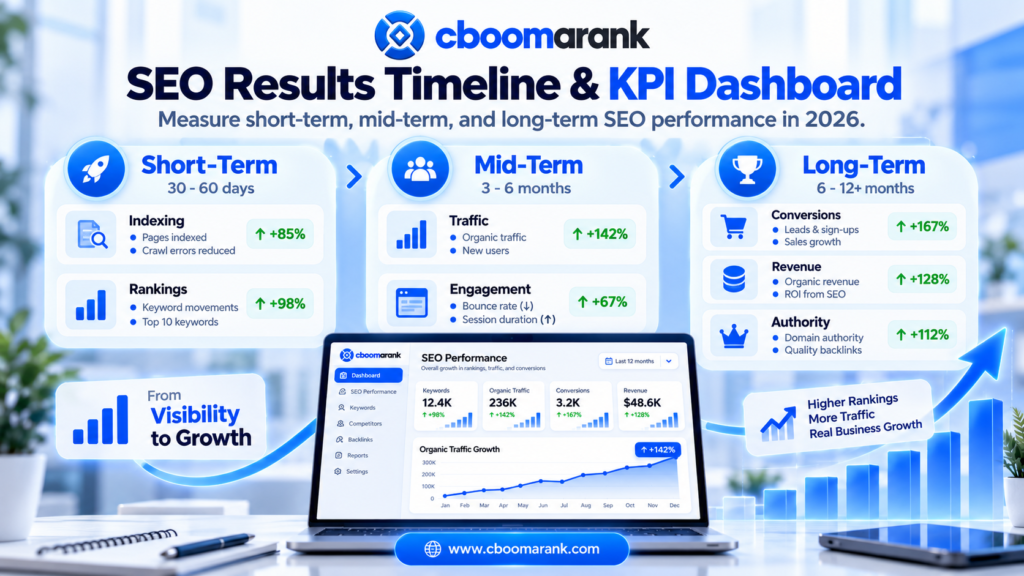
A useful SEO dashboard should make decisions easier. It does not need every available metric.
For most teams, include organic clicks and impressions, organic sessions and users, key landing pages, keyword visibility, ranking distribution, click-through rate, indexed important pages, key events, conversion rate, organic leads or transactions, revenue or estimated business value, new and lost referring domains, technical issues requiring action, competitor visibility trends, and progress against quarterly SEO goals.
CBOOMARANK reporting can be used to bring together website analysis, SEO audits, authority metrics, backlink intelligence, and project-level performance. Start with CBOOMARANK and review available options on the CBOOMARANK pricing page.
14. Compare SEO Results Over the Right Time Period
SEO is rarely measured well with a single week-over-week comparison. Search demand changes by season, holidays, news cycles, product launches, algorithm updates, and competitor activity.
Use week-over-week views for operational monitoring, month-over-month views for short-term direction, quarter-over-quarter views for strategic progress, year-over-year views for seasonality, and pre/post comparisons after major SEO changes.
Google notes that newer Search Console data can sometimes be preliminary and may change as collection completes. Reference: Search Console performance data details.
15. Use Segmentation to Explain SEO Results
Sitewide averages often hide the real story. Segment performance by brand versus non-brand, country, device, page type, content category, funnel stage, new versus updated content, commercial versus informational intent, new versus returning users, desktop versus mobile, and priority keyword group.
Segmentation turns a vague statement such as “organic traffic is down” into an actionable finding such as “mobile non-brand clicks to product-category pages declined in the United Kingdom while blog traffic remained stable.”
16. Diagnose SEO Traffic Drops Systematically
When SEO results decline, avoid changing everything at once. Diagnose the loss by asking a sequence of questions.
Did Impressions Fall?
If impressions fall, investigate rankings, indexing, query demand, page eligibility, competitor changes, seasonality, and search-result changes.
Did CTR Fall?
If impressions remain stable but clicks decline, review rankings, titles, snippets, search features, intent, and competitor listings.
Did Organic Sessions Fall While Search Console Clicks Stayed Stable?
Investigate analytics configuration, consent behavior, attribution, redirects, landing-page tracking, and reporting filters.
Did Conversions Fall While Traffic Stayed Stable?
Review landing-page experience, offer quality, form performance, checkout issues, pricing changes, traffic mix, and search intent.
Did Important Pages Become Unindexed?
Use the Page indexing report and URL Inspection. Also check canonicals, redirects, robots directives, HTTP status codes, internal links, and sitemap inclusion.
Google’s Manual actions report should also be checked if there is evidence of a serious search visibility problem. Reference: Google Search Console Manual actions report.
17. Connect SEO Results to Business Goals
The best SEO report starts with the business objective, not with the metric.
For lead generation, prioritize qualified organic leads, conversion rate, sales pipeline, and cost per acquired opportunity. Ecommerce teams should focus on organic revenue, transactions, product discovery, category visibility, and customer acquisition.
Brand-awareness programs should emphasize non-brand impressions, search demand, branded search growth, reach across high-value topics, and referral recognition. Publishers should prioritize qualified traffic, audience retention, advertiser or marketplace activity, content visibility, and monetization outcomes.
18. Set SEO Targets That Are Measurable
Vague goals such as “rank higher” are difficult to manage. Better SEO targets describe the metric, segment, time period, and business reason.
Examples include increasing non-brand organic clicks to commercial pages by a defined year-over-year percentage, moving a specific group of priority keywords from positions 11–20 into the top 10, increasing qualified organic leads while maintaining lead quality, reducing critical technical SEO errors to zero, increasing the share of indexed priority pages, earning relevant referring domains to strategic pages, or increasing organic revenue from category pages.
Targets should reflect business reality and the maturity of the website. A new domain and an established authority site should not use the same expectations.
19. Understand SEO Results After Major Updates
Major site changes can affect rankings, indexing, and traffic. Examples include migrations, redesigns, URL changes, CMS changes, internal-link restructuring, large content updates, and changes to navigation.
Before the change, save baseline data. After the change, monitor crawlability, indexation, canonical signals, redirect coverage, rankings, clicks, traffic, and conversions.
Google recommends building sites that are secure, fast, accessible, mobile-friendly, and understandable to Search. Reference: Google Search developer guide.
20. Common SEO Results Reporting Mistakes
Reporting Rankings Without Business Context
A ranking improvement is encouraging, but explain whether it created more impressions, clicks, qualified traffic, or conversions.
Using Traffic as the Only Success Metric
Traffic can rise because of low-intent informational queries. Measure quality and outcomes as well as volume.
Ignoring Seasonality
Year-over-year comparisons are often more informative than month-over-month changes in seasonal industries.
Mixing Brand and Non-Brand Search
This can make SEO growth appear stronger than discovery growth actually is.
Treating Third-Party Scores as Google Metrics
Authority scores, difficulty scores, traffic estimates, and health scores are useful analytical models, but they are not Google ranking signals unless Google explicitly says so.
Changing Too Many Variables at Once
If titles, content, internal links, templates, and URLs all change together, it becomes harder to understand what caused the result.
21. A Practical Monthly SEO Results Review
At the end of each month, compare Search Console clicks and impressions with the previous month and previous year, review important query and page gains or losses, check organic traffic and key events in Google Analytics, review revenue or leads, inspect indexation and technical SEO health, monitor new and lost referring domains, compare priority keyword groups and competitor movement, identify pages that should be updated or consolidated, and document the next actions with an owner and priority.
This process turns reporting into decision-making rather than a monthly collection of screenshots.
22. How CBOOMARANK Supports SEO Results Measurement
CBOOMARANK is designed to connect SEO research with action. Current workflows include SEO audits, keyword research, competitor research, authority analysis and metrics, backlink opportunities, reporting, and connected marketplace workflows where relevant.
That means a website owner can identify technical problems, research keywords, compare competitors, evaluate authority, discover backlink opportunities, and report progress without treating each activity as a completely separate project.
Use CBOOMARANK to work with your projects, and review CBOOMARANK pricing for available plans.
SEO Results Checklist for 2026
A strong reporting setup checks whether Search Console clicks are trending in the right direction, relevant impressions are expanding, priority ranking groups are improving, CTR is monitored by query and page, important pages are indexed correctly, organic sessions are measured separately from other channels, key events are configured for meaningful actions, organic leads or revenue are reported, technical SEO issues are prioritized and reduced, content is evaluated according to intent, new and lost backlinks are monitored, competitor movement is reviewed, brand and non-brand search are segmented, country and device differences are understood, and monthly reports lead to clear next actions.
Frequently Asked Questions About SEO Results
How long does it take to see SEO results?
There is no universal timeline. Results depend on site history, competition, technical condition, content quality, crawl and indexing behavior, links, demand, and the scale of the work. Some changes can affect visibility quickly, while competitive topics may require sustained effort over months.
What is the most important SEO metric?
The most important metric depends on the business goal. Search Console clicks and impressions are useful search indicators, while leads, transactions, revenue, and other key events are stronger business outcomes.
Are rankings still important?
Yes, but rankings should be interpreted as part of a larger system that includes impressions, clicks, traffic, conversions, and business value.
Should SEO traffic be measured in Search Console or Analytics?
Use both. Search Console measures performance in Google Search, while Analytics measures user behavior after people reach your site. Differences between the systems are normal because they use different measurement methods and scopes.
What counts as a good SEO result?
A good result is a measurable improvement aligned with the business objective. It might be more qualified organic leads, stronger non-brand visibility, higher organic revenue, improved indexation, better CTR, or more relevant backlinks.
Can SEO results decline even when the site improves?
Yes. Demand, competitors, search-result layouts, seasonality, tracking changes, and algorithmic systems can affect performance. That is why trends should be diagnosed with multiple data sources.
Final Thoughts: Measure SEO Results That Matter
SEO measurement is most useful when it connects visibility with outcomes. Rankings, impressions, clicks, traffic, backlinks, and technical health all matter, but they become far more valuable when they are tied to the reason the website exists.
Build a reporting system that starts with business goals, uses Search Console and Analytics as first-party evidence, applies technical and competitive data for context, and turns findings into specific actions.
For deeper analysis, continue with the AI Search Visibility guide and the SEO Software Pricing guide.
To analyze your own website and connect SEO audits, keywords, competitors, authority, backlinks, and reporting, visit CBOOMARANK and review the current plans.
