

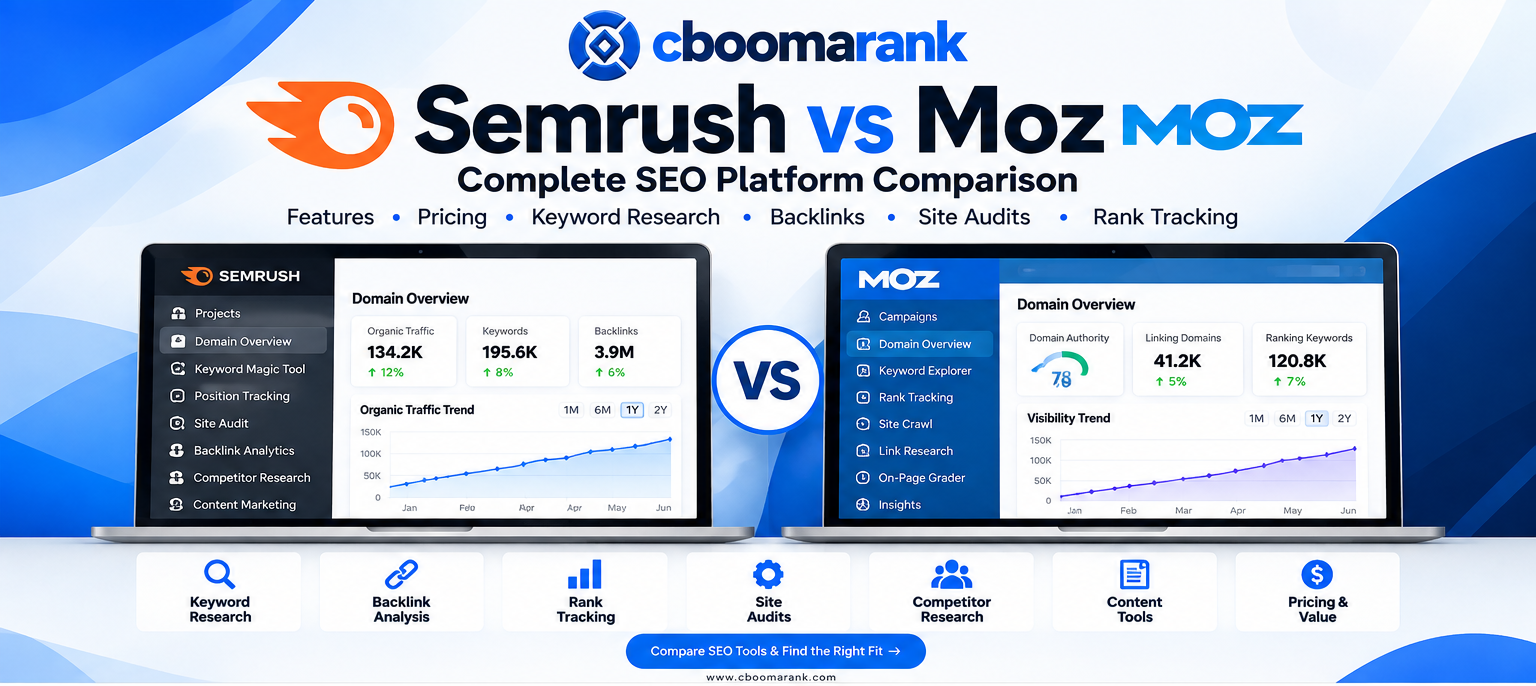
Semrush vs Moz is a practical comparison for SEO teams choosing between two established platforms for keyword research, competitive analysis, backlinks, rank tracking, site audits and reporting in 2026. Both products cover the foundations of search engine optimization, but their workflows, data presentation, limits and broader feature sets differ.
Semrush has evolved into a wide search and digital visibility platform. Its current product pages highlight keyword research, competitor analysis, backlink analysis, technical site audits, daily rank tracking, reporting and AI visibility features. Moz Pro remains focused on core SEO workflows built around Keyword Explorer, Link Explorer, rank tracking, site crawling, competitive research and Moz authority metrics.
The useful question is not whether one brand is universally better. A solo website owner, an agency, an ecommerce team and an enterprise SEO department can value completely different capabilities. The right choice depends on the research depth, number of projects, reporting requirements, workflow complexity and budget your team actually needs.
This guide compares Semrush vs Moz by real SEO tasks. It also explains where CBOOMARANK can fit when you want keyword research, competitor intelligence, authority metrics, SEO audits and backlink workflows connected in one broader platform.
Semrush vs Moz: Quick Comparison for 2026
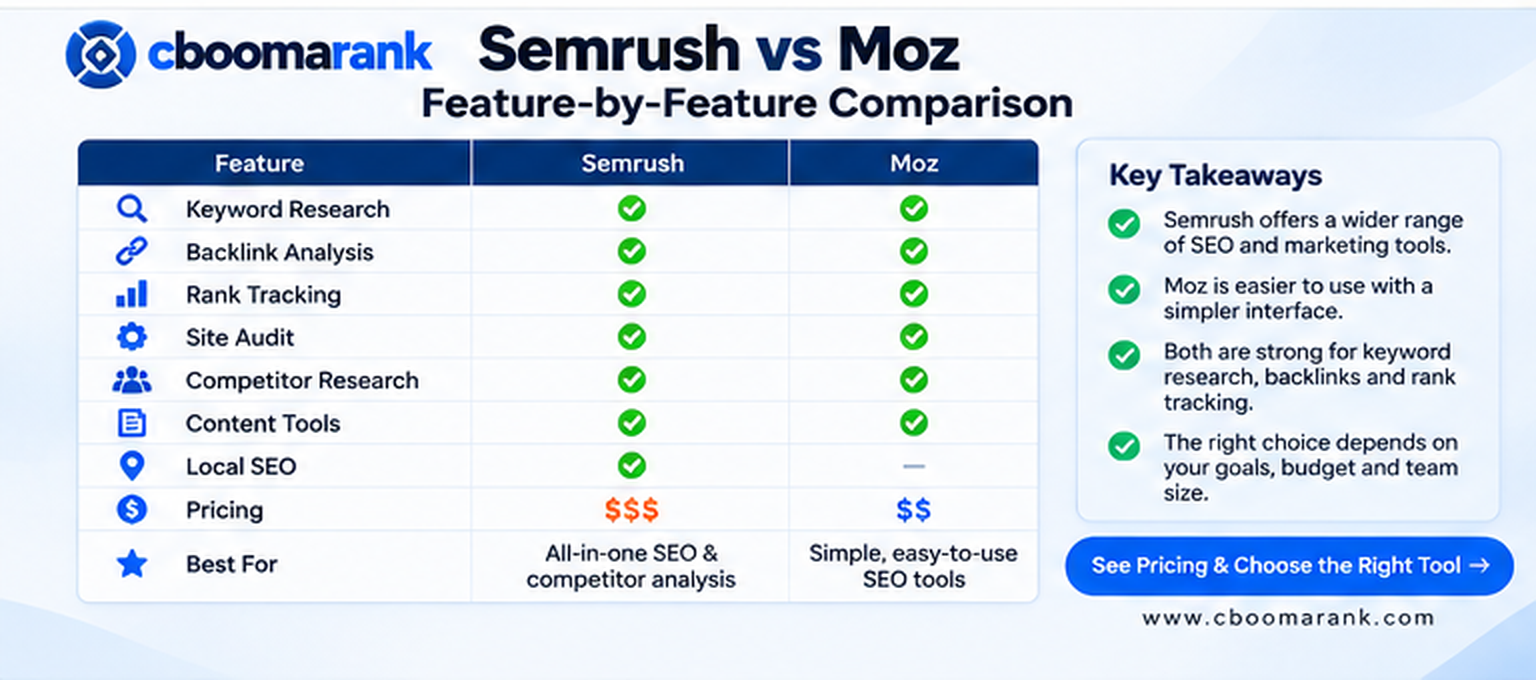
| SEO Area | Semrush | Moz Pro |
|---|---|---|
| SEO keyword research | Keyword research, intent, competitor keywords, keyword gaps and content planning | Keyword Explorer, volume, difficulty, intent, SERP analysis and keyword suggestions |
| Competitor research | Broad organic, paid, backlink and market visibility analysis | Competitive keyword, link and campaign analysis |
| Backlinks | Backlink Analytics, Backlink Gap, auditing and outreach-oriented workflows | Link Explorer, linking domains, inbound links and authority metrics |
| Rank tracking | Daily tracking across locations, devices and search environments on current plans | Campaign-based rank tracking and competitive visibility monitoring |
| Technical SEO | Site Audit with prioritized technical checks and AI-search accessibility features | Site Crawl inside Moz Pro campaigns |
| Authority metric | Authority Score | Domain Authority and Page Authority |
| AI visibility | Integrated AI visibility, prompt and brand monitoring capabilities | AI-search features vary by current Moz plan and product packaging |
| Best evaluation method | Test the same site, keyword set and reporting workflow in both tools before choosing | |
What Is Semrush?
Semrush is a broad online visibility platform that now combines traditional SEO research with AI-search visibility, content, competitor intelligence, digital PR and reporting features.
Its official feature directory currently lists keyword research, competitor analysis, backlink analysis, technical site auditing, rank tracking, marketing reports, local search visibility, AI visibility and prompt research among its major capabilities.
The platform also emphasizes large research datasets. Semrush currently publishes figures in the tens of billions for keywords and backlinks, though those numbers change over time as databases are updated. For current product details, review the official Semrush feature directory.
What Is Moz Pro?
Moz Pro is an all-in-one SEO platform centered on keyword research, search visibility, backlink analysis, rank tracking, technical crawling and competitive research.
Moz is particularly well known for Domain Authority and Page Authority. These are proprietary Moz metrics designed to help users compare the relative strength of domains and pages. They are not Google ranking metrics and should not be treated as direct substitutes for Google’s own signals.
Moz’s core research environment includes Keyword Explorer, Link Explorer and Moz Pro campaign features. Because Moz can change packaging and plan limits, confirm the current Moz Pro product information before purchasing.
Semrush vs Moz for Keyword Research
Keyword research is a major part of the Semrush vs Moz decision because both tools go well beyond basic keyword suggestions.
Semrush connects keyword discovery with search intent, competitive rankings, keyword gaps, topic planning and content workflows. Its Keyword Magic Tool and related research modules are designed to move from a seed term to a broader opportunity map.
Moz Keyword Explorer provides keyword suggestions, volume estimates, difficulty, intent and SERP analysis. It also supports competitive keyword investigation so users can identify terms that competing sites rank for.
Semrush vs Moz for Keyword Discovery
Teams doing large-scale research should compare more than database size. Test whether each tool returns useful long-tail phrases, commercial terms, question keywords and location-specific opportunities relevant to your market.
Use the same group of seed keywords in both platforms. Then compare the usefulness of suggestions rather than simply counting rows.
Semrush vs Moz for Search Intent
Intent is important because a keyword can have substantial search demand and still be a poor match for the page you plan to create.
Both platforms now organize research around intent-related signals. Your team should evaluate how clearly each tool separates informational, commercial and transactional opportunities and how easily those keywords can be grouped into a content plan.
For a broader keyword-tool comparison, see the Ubersuggest alternatives guide.
Semrush vs Moz for Competitor Research
The two platforms differ noticeably when competitor research expands beyond rankings.
Semrush provides extensive domain-level research covering organic visibility, ranking keywords, backlinks, traffic-related estimates and other competitive datasets. The platform also connects competitor gaps across keywords and backlinks.
Moz supports competitor research through keyword rankings, Keyword Explorer, Link Explorer and campaign workflows. This can be enough for teams focused primarily on organic SEO without needing a broader digital-marketing intelligence environment.
What Competitor Data Should You Compare?
Run the same competitors through both platforms and compare their top pages, ranking keywords, referring domains, content gaps and visibility trends.
However, third-party SEO estimates will not exactly match first-party analytics. The useful question is whether the dataset is consistent and actionable enough to help you identify opportunities your own website can realistically pursue.
For backlink-focused competitive research, use the CBOOMARANK competitor backlink analysis guide.
Semrush vs Moz for Backlink Analysis
Backlink research is another major comparison point.
Semrush currently provides Backlink Analytics, Backlink Gap and backlink auditing features. Its backlink tools are designed to inspect referring domains, identify gaps against competitors and review potentially problematic links.
The official Semrush backlink analysis page also emphasizes link opportunities, competitor gaps and media or citation discovery.
Moz Link Explorer focuses on inbound links, linking domains, Domain Authority, Page Authority and related link metrics. It is widely used by teams that already rely on DA and PA for comparative prospect evaluation.
Semrush vs Moz for Link Prospecting
However, neither tool should be evaluated simply by which platform reports the largest backlink count.
A useful link opportunity should be relevant to the target topic, editorially credible, contextually appropriate and capable of sending a real audience. Authority scores can help prioritize research, but they should not replace a quality review.
If your workflow extends from research into opportunity management and outreach, CBOOMARANK connects backlink intelligence with broader acquisition workflows.
Semrush vs Moz for Authority Metrics
Semrush uses Authority Score, while Moz is known for Domain Authority and Page Authority.
These metrics are proprietary indicators built from each company’s own datasets and methodologies. They should not be interpreted as Google scores.
Do not assume that a Semrush Authority Score of 50 equals a Moz Domain Authority of 50. Compare sites consistently inside the same metric system and combine authority indicators with actual organic visibility, topical relevance, link quality and traffic context.
Semrush vs Moz for Rank Tracking
Ranking monitoring matters when SEO teams need to understand whether visibility is improving for important keyword groups.
Semrush’s current platform promotes daily rank tracking across locations, devices and search environments. Position Tracking can also compare competitors and SERP features.
Moz Pro supports campaign-based rank tracking and competitive visibility monitoring. Teams should check the latest Moz plan documentation for update frequency, keyword allowances and campaign limits.
What Matters More Than Keyword Capacity?
A plan may allow thousands of tracked keywords, but that number is useful only if your team can interpret and act on the data.
Compare location support, desktop and mobile tracking, historical trends, SERP features, competitor monitoring and report delivery.
For larger organizations, also consider how easily multiple teams can segment rankings by brand, country, product line or funnel stage.
Semrush vs Moz for Technical SEO
Both platforms include technical auditing, but their approach and depth differ.
Semrush Site Audit currently promotes more than 100 technical checks covering crawlability, HTTPS, mobile, internal linking, markup and other categories. It also includes features aimed at checking accessibility for AI-oriented crawlers.
See the official Semrush Site Audit page for its current capabilities.
Moz Pro includes Site Crawl inside its campaign environment. Technical teams should compare the same website in both platforms to see which crawler surfaces the most useful issues for their architecture.
For dedicated crawlers and specialist platforms, review the top technical SEO tools guide.
Semrush vs Moz for Site Health Reporting
For example, a site-health score can be useful for monitoring improvement, but the score should not become the goal itself.
The real objective is to fix issues that prevent important pages from being discovered, crawled, indexed, rendered or understood correctly.
Teams should review the issue details behind any aggregate health score. A website can have a high percentage score while still containing a small number of serious indexability or canonical problems.
The SEO audit report guide explains how to turn audit findings into a prioritized action plan.
Semrush vs Moz for Content Strategy
Semrush includes a broader set of content research and optimization features alongside keyword research. This can help teams move from topic discovery to content planning and optimization without leaving the ecosystem.
Moz focuses more heavily on traditional SEO research around keywords, rankings, links and site health. Teams that already use a separate content platform may find that narrower focus sufficient.
The best approach is to map your actual workflow. If your writers need briefs, content recommendations and integrated competitive data, compare those capabilities directly. If they only need a clean keyword and SERP research environment, a simpler process may be preferable.
Semrush vs Moz for AI Search Visibility
AI search has become a larger part of SEO platform development in 2026.
Semrush now explicitly integrates AI visibility into its product range. Its current feature pages include AI visibility, prompt research, AI brand sentiment and tracking across several AI answer environments.
Moz has also been adding AI-search capabilities to its broader SEO product offering. Because these features are evolving quickly, check which AI visibility functions are actually included in the specific Moz plan your organization is considering.
When evaluating either product, separate traditional search rankings from AI mentions, citations and referral traffic. They are related visibility channels, but they are not identical metrics.
For a dedicated framework, see the AI search visibility guide.
Semrush vs Moz Pricing in 2026
Pricing and feature packaging can change, so check the vendors’ live pricing pages before making a purchasing decision.
Semrush’s current SEO and AI Search pricing page offers multiple tiers aimed at freelancers, small teams, agencies and larger organizations. Plan differences include project capacity, tracked keywords, historical data, AI visibility usage, API access and reporting capabilities.
See the current Semrush SEO and AI Search pricing.
Moz Pro also uses tiered plans with different allowances for campaigns, tracked keywords, crawled pages, reports and related functionality. Because those limits and prices can change, verify the live Moz Pro pricing page before subscribing.
Compare Total Workflow Cost, Not Only Monthly Price
However, the cheapest subscription is not automatically the least expensive solution.
Consider whether you would need additional products for reporting, backlink research, content optimization, technical crawling or AI visibility. A broader platform may replace several separate subscriptions, while a focused platform may be more economical if you only need core SEO functions.
The SEO software pricing guide provides a framework for comparing real platform value.
Semrush vs Moz for Small Businesses
In practice, small businesses usually need clarity more than feature volume.
The most useful platform will help the team answer several recurring questions: what customers search for, which competitors rank, whether the website has technical problems, which pages attract visibility and where relevant backlinks may be available.
Moz can suit businesses that want a focused SEO environment and familiar authority metrics. Semrush can suit businesses that want a broader competitive and search-visibility suite.
You can also evaluate CBOOMARANK when you want keyword, competitor, authority, audit and backlink workflows connected around your own website.
Semrush vs Moz for Agencies
Meanwhile, agencies should compare client capacity rather than evaluating one project in isolation.
Important considerations include the number of websites, tracked keywords, crawl limits, scheduled reports, seats, client-facing dashboards, exports and historical data.
Semrush currently emphasizes automated and white-label reporting in its agency and professional workflows. Moz Pro also provides campaign and reporting features, but agencies should verify the exact allowances of the plan they would need.
Build a capacity model for the next 12 months before purchasing. A plan that works for five clients may become expensive or restrictive at 30 clients.
Semrush vs Moz for Ecommerce SEO
Ecommerce SEO adds catalog scale, product intent and technical complexity.
Teams often need keyword research for categories and products, competitor visibility, technical crawling, backlinks and reporting that connects organic performance to commercial outcomes.
Semrush’s breadth can be useful for teams that want competitive, content, link and site-audit functions in one environment. Moz can fit ecommerce teams that prefer a focused SEO toolset and already have separate analytics or content systems.
For a dedicated comparison of ecommerce platforms and workflows, read the best ecommerce SEO tools guide.
Semrush vs Moz for Enterprise SEO
By contrast, large organizations should evaluate governance, scale and integrations in addition to research features.
Questions include whether the tool supports enough sites and keywords, how historical data is handled, whether APIs are available, how reports can be automated and how permissions work across teams.
Semrush currently offers higher-tier plans with API and larger project allowances. Moz’s enterprise suitability depends on the scale of the specific Moz offering and the organization’s workflow.
For large-site requirements, see the enterprise SEO platform guide.
Semrush vs Moz for Local SEO
Similarly, local businesses should consider whether their SEO platform covers the specific markets where customers search.
Semrush includes local visibility and listing-related capabilities in its broader ecosystem. Moz also has a long history in local search through Moz Local, although Moz Local and Moz Pro are distinct product areas.
If local SEO is central to your strategy, compare map visibility, listing management, review workflows and local keyword tracking separately from general organic SEO.
Semrush vs Moz for Reporting
Finally, reporting can become the deciding factor for agencies and in-house teams with executives or clients.
Useful reporting should explain what changed, why it matters and what the team should do next. It should not simply export every available metric.
Semrush currently promotes branded, automated and scheduled reports that can combine multiple data sources. Moz Pro includes campaign reporting and exports for SEO performance.
Test whether stakeholders can understand the report without requiring an SEO specialist to translate every chart.
Semrush vs Moz: Data Differences Are Normal
However, do not expect the two platforms to return identical search volume, backlink totals, ranking estimates or authority metrics.
Third-party SEO providers operate their own crawlers, databases and estimation models. Differences can result from crawl coverage, refresh schedules, keyword sources, geographic databases and filtering.
The goal is not to find a tool that perfectly reproduces Google Analytics or Google Search Console. Use first-party data for your own site’s actual performance and third-party platforms for market and competitive intelligence.
Google’s Search Console Performance report documentation explains the first-party clicks, impressions, CTR and position data available for your own Google Search presence.
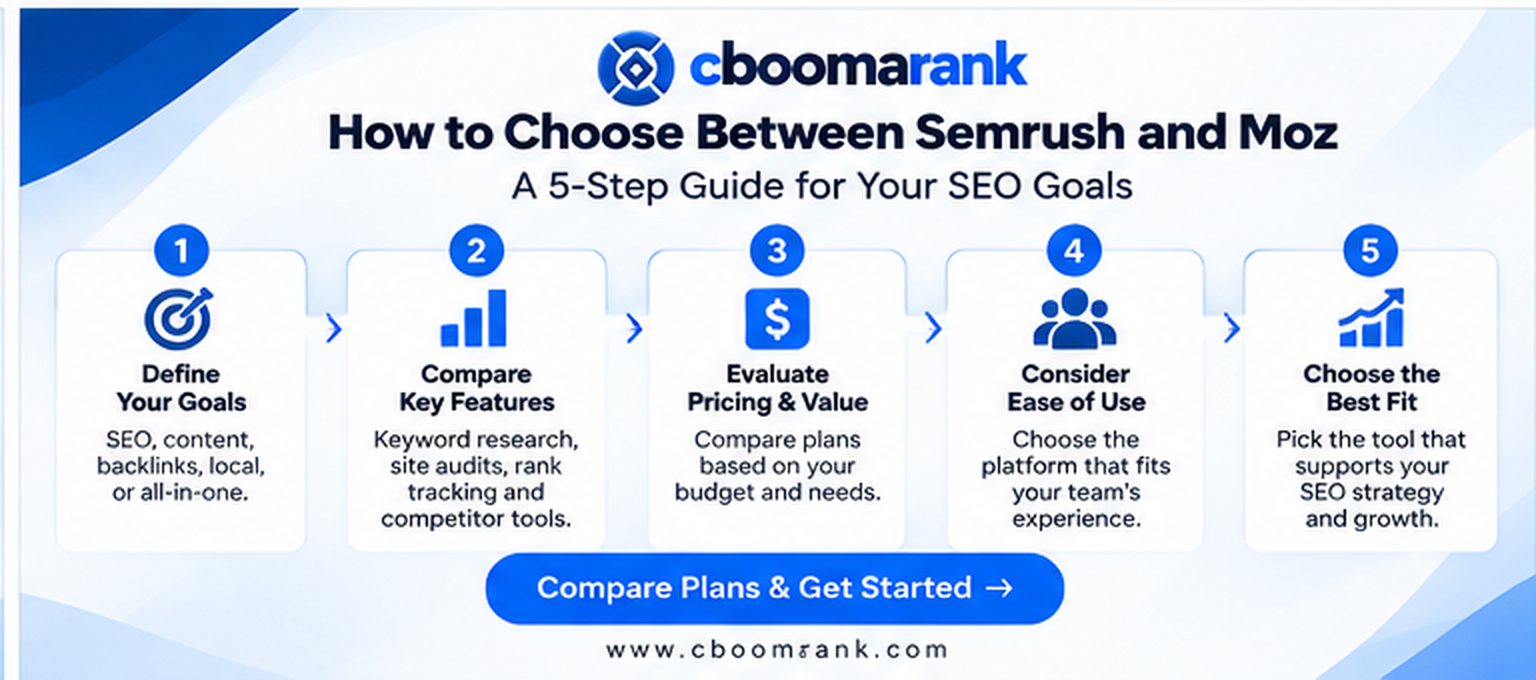
How to Test Semrush vs Moz Before Choosing
Therefore, use real work instead of a generic feature checklist.
Test 1: Keyword Research
Choose 20 keywords from your niche. Compare relevant suggestions, intent, difficulty, SERP context and competitor visibility.
Test 2: Competitor Research
Analyze three direct competitors. Compare their top pages, ranking keywords and backlink opportunities.
Test 3: Technical Audit
Crawl the same website. Compare critical errors, warnings, explanations and how easily issues can be prioritized.
Test 4: Backlink Gap
Use known competitors and identify domains that link to several competitors but not to your own site.
Test 5: Rank Tracking
Track the same keyword set by the same country and device. Compare refresh frequency, competitor views and reporting.
Test 6: Reporting
Create the report you would actually send to a client, manager or executive. Measure how much manual cleanup is required.
Semrush vs Moz Evaluation Checklist
- Keyword database relevance for your market
- Search intent and keyword grouping
- Competitor keyword research
- Backlink coverage and link-gap workflows
- Authority metrics and how your team uses them
- Technical crawl limits
- Site-audit issue quality
- Rank-tracking update frequency
- Country, device and location support
- AI visibility capabilities
- Historical data requirements
- Project and campaign limits
- Team seats and permissions
- API and integration requirements
- Report customization and scheduling
- Total annual workflow cost
How CBOOMARANK Fits Into the Comparison
CBOOMARANK is designed around connected SEO workflows rather than isolated reports.
Inside CBOOMARANK, website analysis can connect with keyword research, competitor intelligence, authority reporting and backlink opportunities.
This becomes useful when a research finding needs to turn into an action. A keyword opportunity can be evaluated alongside competitor strength, website health and backlink gaps rather than being reviewed separately.
CBOOMARANK’s backlink workflows also extend beyond research into opportunity management, outreach, monitoring and reporting where those features are available in the application.
Review CBOOMARANK Pricing to compare available plans.
Frequently Asked Questions About Semrush vs Moz
Which is better for keyword research, Semrush or Moz?
Both support serious keyword research. Semrush provides a broad keyword and competitor research environment, while Moz Keyword Explorer provides volume, difficulty, intent and SERP-oriented research inside the Moz ecosystem. Test both with your own keyword set.
Which is better for backlink analysis?
Semrush provides backlink analytics, gap analysis and auditing, while Moz Link Explorer provides inbound-link research together with Domain Authority and Page Authority. The better fit depends on the workflow and limits your team needs.
Does Semrush use Domain Authority?
No. Domain Authority is a Moz metric. Semrush uses its own Authority Score. These metrics should not be treated as interchangeable.
Does Moz include technical SEO audits?
Yes. Moz Pro includes site crawling and technical SEO diagnostics through its campaign features. Check current plan allowances before purchasing.
Does Semrush track rankings?
Yes. Semrush includes Position Tracking and currently promotes daily tracking across locations and devices, subject to plan limits.
Can Semrush and Moz show different numbers?
Yes. Different databases and methodologies can produce different keyword volumes, backlink totals and visibility estimates. This is normal for third-party SEO platforms.
Which platform is better for agencies?
Agencies should compare client capacity, reports, seats, keyword tracking, crawl allowances, historical data and integrations. The best platform depends on the size and structure of the agency.
Should I use Semrush or Moz with Search Console?
Yes. Search Console provides first-party data for your own Google Search performance, while Semrush and Moz provide broader market and competitor intelligence.
Can CBOOMARANK complement Semrush or Moz?
Yes. Teams may use more than one data source. CBOOMARANK can connect website, keyword, competitor, authority and backlink workflows around your own projects.
Final Thoughts on Semrush vs Moz
The Semrush vs Moz decision should be based on workflow, not brand recognition.
Semrush offers a wide SEO and visibility ecosystem spanning keywords, competitors, backlinks, technical SEO, reporting and AI-search monitoring. Moz Pro provides a focused SEO environment built around Keyword Explorer, Link Explorer, rank tracking, site crawling and established Moz authority metrics.
Test both platforms with the same sites and tasks before committing. Compare the quality of decisions they help you make, the amount of manual work they remove and the cost of the plan your team would actually need.
If you want to connect research with broader SEO and backlink workflows, explore CBOOMARANK or review CBOOMARANK Pricing.
For additional comparisons, read Ahrefs vs Moz and the existing Semrush vs Ahrefs guide.
