

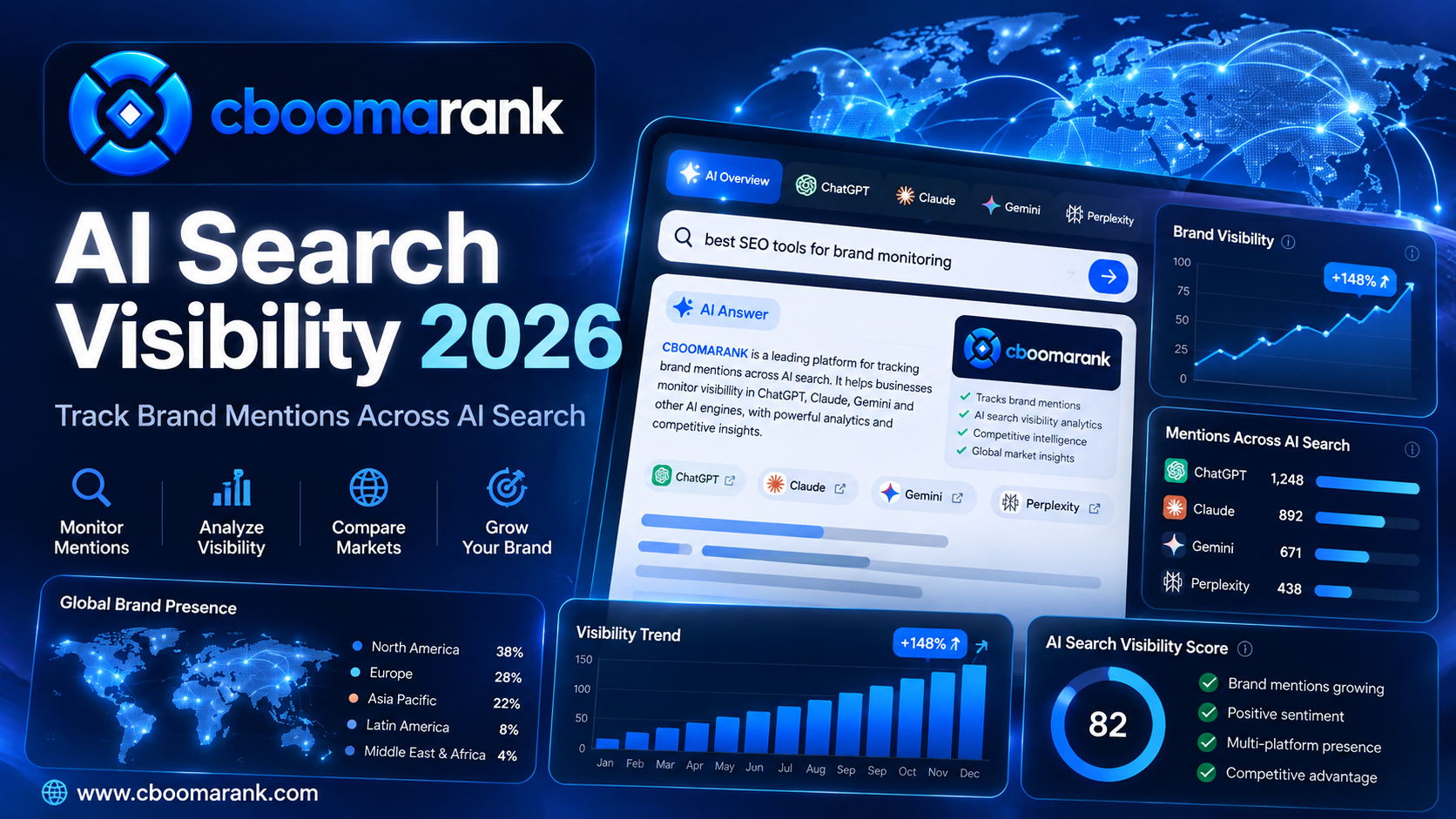
AI visibility is becoming an important part of digital discovery. Customers no longer find brands only through traditional search-result pages. They increasingly ask AI-powered search and answer systems questions about products, services, software, companies, industries and buying decisions.
That creates a new measurement challenge. A business may rank well in conventional search yet receive few mentions or citations in AI-generated answers. Conversely, a brand may appear frequently in AI responses even when the user never sees a traditional blue-link ranking.
Therefore, marketers need a practical way to measure whether AI systems mention their brand, cite their website, reference competitors and send qualified visitors to their pages.
This guide explains how to measure AI visibility across ChatGPT Search, Google AI features, Microsoft Copilot and Bing, Perplexity and other answer engines. It also covers the metrics, prompt sets, technical checks and content strategies that can improve a site’s opportunity to be discovered.
You can combine these measurements with website, keyword, competitor, authority and backlink research in CBOOMARANK to build a broader search-visibility workflow.
What Is AI Visibility?
AI visibility describes how often and how prominently a brand, website, product, service, person or piece of content appears in AI-generated search and answer experiences.
For example, a user may ask an AI system, “What are the best SEO platforms for a growing agency?” If your company is named, linked or cited in that answer, your brand has gained a form of AI-search exposure.
However, AI visibility is broader than a simple brand mention. A useful measurement framework should distinguish between being named, being described accurately, receiving a citation, earning a clickable link and being recommended for a relevant use case.
Why AI Visibility Matters in 2026
Search behavior is becoming more conversational. Instead of typing several separate keyword searches, users can ask one detailed question and then continue with follow-up prompts.
Google’s AI Mode, for example, can divide complex questions into related subtopics and search for supporting information across the web. Google also states that AI Overviews and AI Mode can surface supporting links from websites. The underlying opportunity is therefore not limited to being mentioned by name; useful pages can also become sources for an AI-generated response.
Similarly, ChatGPT Search can provide answers that cite and link to web sources. Microsoft has introduced AI-performance reporting for publishers, while Perplexity is built around synthesizing information from web sources with citations.
As a result, businesses need to measure AI discovery alongside conventional rankings, impressions, clicks and conversions.
AI Visibility Is Not the Same as Traditional SEO Ranking
A conventional ranking report usually asks, “What position does this URL hold for this keyword?” An AI answer does not always behave like a fixed ranked list.
Different prompts can trigger different sources. Follow-up questions can change the context, and AI systems may reformulate the underlying searches they perform.
Therefore, measuring AI visibility requires repeated observations across a carefully defined prompt set rather than treating one answer as a permanent ranking.
Traditional SEO remains important. Google explicitly states that foundational SEO practices continue to apply to its generative AI features. Strong crawlability, indexation, helpful content, clear structure and reliable information remain important foundations.
For deeper technical preparation, see the CBOOMARANK advanced SEO techniques guide.
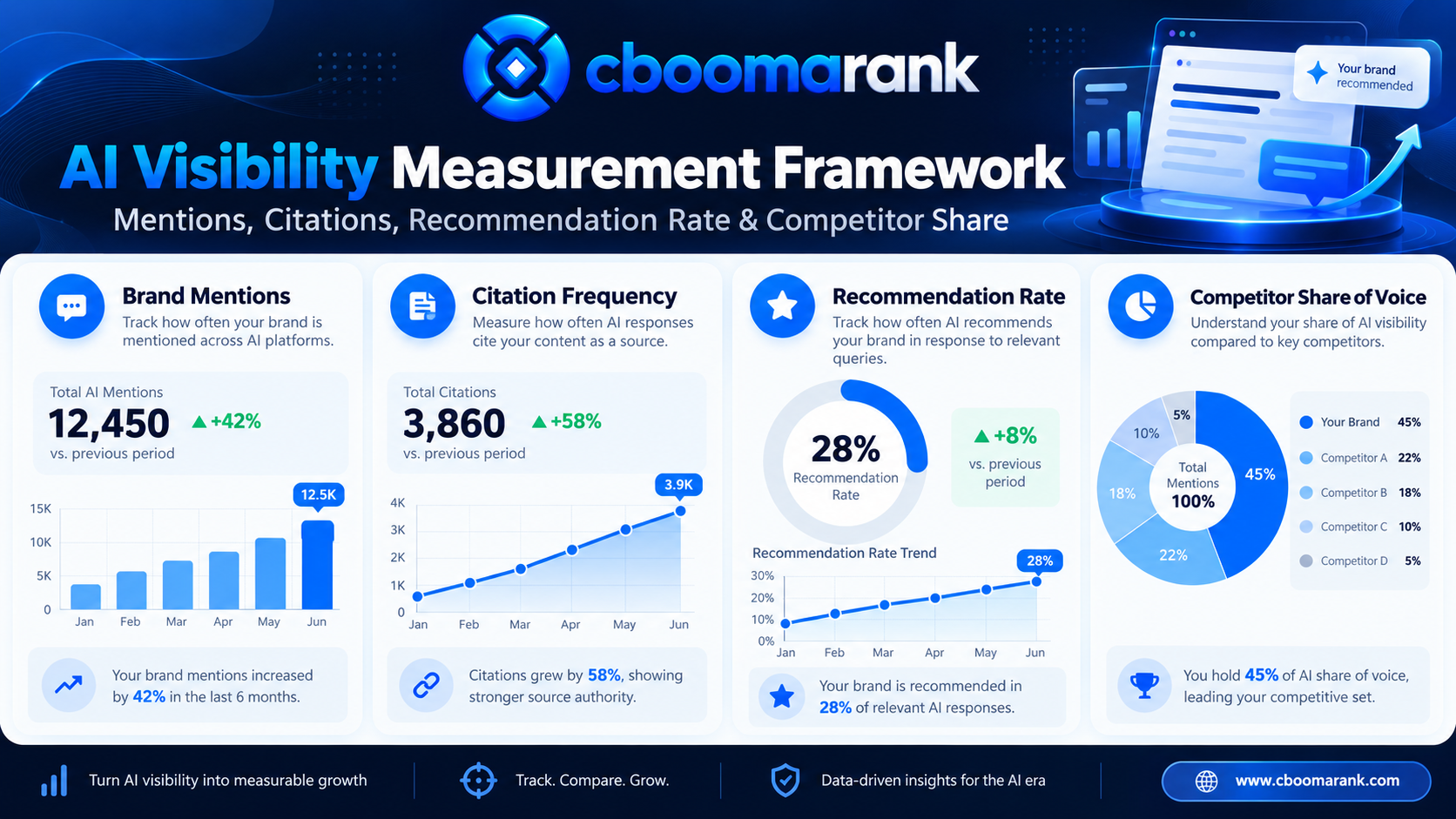
AI Visibility Metric 1: Brand Mention Rate
The simplest measurement is brand mention rate.
Create a controlled collection of relevant prompts. Then record how many responses mention your brand.
A basic formula is:
Brand Mention Rate = Responses Mentioning Your Brand / Total Valid Responses × 100
For example, if your company appears in 28 of 100 relevant AI answers, the observed brand mention rate is 28% for that test set.
Nevertheless, that figure should always be interpreted within the context of the prompts, platform, geography, date and testing conditions.
AI Visibility Metric 2: Citation Rate
A brand can be mentioned without its website being cited. Therefore, citation rate should be measured separately.
Record whether each AI response cites, links to or otherwise references a page on your domain.
A useful formula is:
Citation Rate = Answers Citing Your Domain / Total Valid Answers × 100
Citation rate is especially valuable for publishers and information-rich sites because it measures whether their pages are functioning as supporting sources.
AI Visibility Metric 3: Mention-to-Citation Ratio
Next, compare mentions with citations.
If your brand is mentioned frequently but your website is rarely cited, AI systems may know the brand from third-party sources rather than relying directly on your site.
On the other hand, a high citation rate may indicate that your content is regularly being used as supporting evidence even when the brand name itself is not the central subject.
Therefore, both metrics should be monitored together.
AI Visibility Metric 4: Citation Share
Citation share compares your domain with competing domains across the same prompt set.
Microsoft has introduced Citation Share in Bing Webmaster Tools as part of its AI Visibility insights. This provides publishers with another way to understand how frequently their content appears relative to other cited sources.
You can apply the same general concept to your own manual or automated testing:
Citation Share = Your Citations / All Tracked Competitor Citations × 100
For example, if five tracked brands collectively receive 200 citations and your domain receives 40, your observed share is 20% within that measurement set.
Competitor research inside CBOOMARANK can help you identify which websites deserve inclusion in that benchmark.
AI Visibility Metric 5: Recommendation Rate
Not every mention is commercially equal.
An answer may simply state that a company exists. Another answer may actively include it in a shortlist such as “best platforms for agencies” or “tools worth considering for technical SEO.”
Therefore, create a separate recommendation-rate metric for commercially important prompts.
This is particularly useful for software companies, agencies, ecommerce brands, professional services and publishers targeting comparison queries.
AI Visibility Metric 6: Answer Prominence
Position inside an AI answer can also matter.
A brand mentioned in the opening recommendation may receive more attention than one listed near the end of a long response.
You can classify prominence using a simple scale such as primary recommendation, top group, secondary mention or incidental mention.
However, avoid presenting these categories as universal ranking positions. They are measurement labels for your own reporting system.
AI Visibility Metric 7: Linked Citation Rate
Some AI experiences display citations, but not every reference produces an equally obvious link.
Therefore, record whether the citation provides a clear path to your website.
The linked citation rate can help distinguish broad brand awareness from traffic-generating visibility.
Later, compare those observations with analytics and referral traffic to understand whether visibility produces site visits.
AI Visibility Metric 8: Competitor Mention Share
Your brand should not be analyzed in isolation.
For every tracked prompt, record which competitors appear alongside you and which competitors appear when you are absent.
Then calculate each company’s mention share across the same test set.
This can expose important gaps. For example, your site may perform strongly for informational SEO prompts but disappear from prompts about enterprise software, agency workflows or backlink analysis.
Use the competitor analysis tools guide as a supporting framework for competitive research.
How to Build an AI Visibility Prompt Set
A useful AI visibility study begins with representative prompts.
Do not test only prompts that include your brand name. Those queries primarily measure existing awareness rather than discovery.
Instead, divide prompts into several intent groups.
Category Discovery Prompts
These ask for products or providers in a broad category.
Examples include “What are the best SEO platforms for small agencies?” or “Which tools can analyze competitor backlinks?”
Problem-Solution Prompts
These begin with a business problem rather than a product category.
For example: “How can I find why my organic traffic dropped?” or “How do I discover websites linking to my competitors?”
Comparison Prompts
These ask the AI system to compare tools, approaches or vendors.
For example: “Compare SEO audit platforms for agencies” or “What are alternatives to Semrush for competitor research?”
Transactional Prompts
These indicate stronger purchasing intent.
Examples include “Which SEO software is best for a five-person marketing team?” and “What SEO platform should an ecommerce company buy?”
Educational Prompts
These test whether your informational content is used as a supporting source.
Examples include “How does keyword cannibalization affect rankings?” or “What should an SEO audit report include?”
CBOOMARANK’s SEO audit report guide provides an example of content designed to answer detailed professional questions.
Measure AI Visibility by Topic Cluster
One overall AI visibility percentage can hide important differences.
Therefore, group your prompts into topic clusters such as technical SEO, keyword research, competitor analysis, backlinks, content optimization, traffic analysis and pricing.
Then calculate visibility separately for each cluster.
A software company may have strong visibility for “technical SEO tools” while remaining nearly invisible for “website traffic intelligence.” That gap can guide future product messaging and content investment.
Measure AI Visibility Across Multiple Platforms
Different AI systems use different retrieval methods, indexes, partners, ranking systems and interfaces. Consequently, one platform should not be treated as a proxy for all AI search.
A practical monitoring program can include ChatGPT Search, Google AI Overviews and AI Mode, Microsoft Copilot or Bing AI answers, and Perplexity.
Additional platforms can be added when they materially matter to your audience.
Measuring AI Visibility in ChatGPT Search
OpenAI states that public websites can appear in ChatGPT Search. For content to be discoverable and surfaced with citations and links, site owners should ensure they are not blocking OAI-SearchBot.
OpenAI also distinguishes OAI-SearchBot from GPTBot. The search crawler controls discovery for ChatGPT Search, while GPTBot relates to model training controls. Therefore, a publisher can make separate decisions for search visibility and training access.
Review the official OpenAI crawler documentation and the OpenAI publisher FAQ.
For measurement, record whether ChatGPT names the brand, cites the domain, links to a specific page and uses the information accurately.
Measuring AI Visibility in Google AI Overviews and AI Mode
Google now provides dedicated generative-AI performance reporting in Search Console.
The report includes visibility data for AI Overviews and AI Mode and can show how generative-AI impressions change over time, which pages receive impressions and where those impressions originate.
This makes Google one of the clearest first-party measurement sources available to site owners.
Review Google’s official Generative AI performance report documentation.
Google also states that the same foundational SEO practices remain relevant for AI features. A page generally needs to be indexed and eligible to appear in Google Search with a snippet to be eligible as a supporting link.
See Google’s AI features and your website guidance.
Google’s Search Generative AI Control
As of August 31, 2026, Google says its Search generative AI control has been rolled out worldwide.
Site owners can manage whether their site’s links and content are eligible for Google’s generative AI features, including AI Overviews, AI Mode and supported generative experiences in Discover.
Therefore, when investigating unexplained visibility gaps, confirm the site’s Search Console generative-AI inclusion setting.
See Google’s official Search generative AI control documentation.
Measuring AI Visibility in Bing and Microsoft Copilot
Microsoft introduced AI Performance in Bing Webmaster Tools in 2026.
The reporting helps publishers understand where their content is cited in AI-generated experiences across Microsoft Copilot, Bing and supported partner integrations.
Microsoft later expanded these insights with Intents, Topics, Citation Share and Compare. Consequently, site owners can examine not only citation activity but also the themes and intents associated with that visibility.
Review Microsoft’s AI Performance announcement and its expanded AI Visibility reporting.
Measuring AI Visibility in Perplexity
Perplexity describes its advanced search experience as synthesizing information from multiple web sources and providing direct citations to those sources.
Therefore, a practical Perplexity test should record whether your brand appears, whether your site is cited, which specific URL is referenced and which competitors receive citations for the same prompt.
Perplexity also operates a web crawler used for search. Publishers should review their robots configuration if important pages never appear during testing.
See the official Perplexity Pro Search documentation and its discussion of AI-first search and web crawling.
AI Visibility Should Be Tested Repeatedly
One AI answer is not a reliable performance benchmark.
Responses can change because systems update their indexes, models, ranking processes, retrieval methods and answer-generation behavior.
In addition, wording matters. “Best SEO software for an agency” can produce a different set of sources from “What software should an agency use to audit client websites?”
Therefore, run the same structured prompt set at consistent intervals and compare aggregated results.
Record the Date, Platform and Testing Conditions
Every observation should include context.
At minimum, record the date, AI platform, prompt, geography where relevant, account state where relevant, model or mode when visible, brand mentions, competitor mentions, cited domains and cited URLs.
This makes historical comparison more meaningful.
Without that context, teams may mistake normal answer variation for a major change in market visibility.
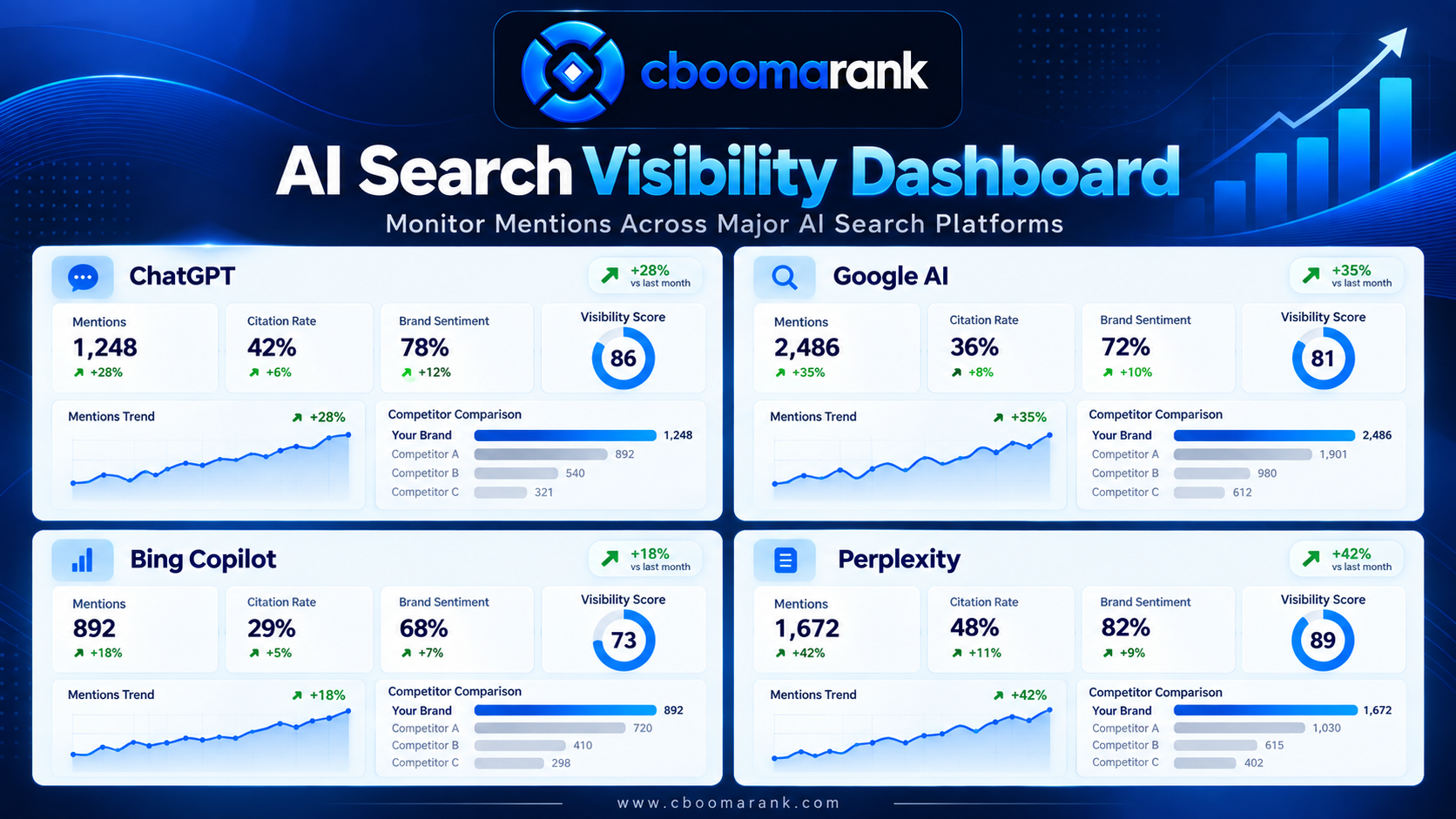
AI Visibility Dashboard Metrics
A useful dashboard can combine several measurements instead of depending on one score.
- Brand mention rate
- Domain citation rate
- Linked citation rate
- Recommendation rate
- Citation share
- Competitor mention share
- Top cited URLs
- Topic-cluster visibility
- Commercial-intent visibility
- Informational visibility
- New and lost AI citations
- Referral traffic from AI platforms
- Conversions from AI referrals
The goal is not to create a mysterious proprietary number. Instead, the dashboard should make the underlying observations transparent.
Track AI Referral Traffic
AI visibility becomes especially valuable when it results in qualified visits.
Therefore, review analytics referral data for traffic coming from AI platforms when identifiable.
Track landing pages, engagement, conversions and assisted conversions rather than looking only at session counts.
A small number of highly qualified visitors may produce more business value than a larger volume of low-intent traffic.
Connect AI Visibility With Search Console Data
For Google, combine AI-specific Search Console reporting with conventional search performance.
For example, a page may receive strong AI-generative impressions while its traditional click volume remains modest. Another page may perform well in classic Search but receive little generative visibility.
This comparison can identify pages that deserve deeper analysis.
Google’s current reporting also means businesses no longer need to infer every AI impression solely from external testing.
Connect AI Visibility With Competitor Research
A competitor that appears repeatedly in AI answers deserves investigation.
Review which pages receive citations, which topics those pages cover, their backlink profiles, content formats and how clearly they communicate expertise.
However, do not copy the competitor’s wording. The objective is to understand why their content may be useful enough to retrieve and then create something more complete, original or authoritative.
For more context, see the CBOOMARANK competitor backlink analysis guide.
Technical Requirements for Better AI Visibility
AI visibility begins with accessibility.
If search crawlers cannot retrieve a page, the page has fewer opportunities to be surfaced through search-backed AI experiences.
Therefore, review robots.txt, noindex directives, canonicalization, HTTP status codes, rendering, internal links and sitemap coverage.
For Google specifically, pages must meet its normal Search eligibility requirements to appear as supporting links in AI features.
You can use the technical SEO tools guide when reviewing crawl and index problems.
Content Quality and AI Visibility
Accessible content is only the starting point.
AI systems still need information worth retrieving and citing. Therefore, pages should provide clear answers, original analysis, useful evidence and enough context to support the claims they make.
Generic summaries that simply repeat common knowledge may be less differentiated than content built from first-party data, expert experience, original examples, product testing or unique research.
Google’s current AI optimization guidance also emphasizes helpful, reliable, people-first content rather than special “AI ranking hacks.”
Use Clear Entity and Brand Information
Your brand should be described consistently across important pages.
Use a clear company name, product descriptions, About information, contact details and relevant organization structured data where appropriate.
In addition, make relationships clear between the company, its products, authors, services and official profiles.
This is not a guarantee of an AI mention. However, clear entity information reduces ambiguity about who created the content and what the business provides.
Build Pages Around Real Questions
Conversational search often begins with detailed questions.
Therefore, create pages that address complete user needs rather than targeting isolated phrases.
For example, instead of publishing a thin page titled “SEO pricing,” a useful resource can explain pricing models, typical cost drivers, agency versus software options and how buyers should compare value.
The SEO software pricing guide illustrates this broader approach.
Use Original Data and Evidence
Original evidence can improve differentiation.
This might include benchmarks, experiments, survey results, screenshots, examples, templates, case studies or aggregated platform data.
Moreover, clearly explain the methodology. A statistic is more useful when readers can understand where it came from and what it measures.
Keep Important Content Current
AI-powered search systems often need up-to-date information for fast-changing subjects.
Therefore, review high-value pages regularly and update outdated screenshots, prices, product features, platform names and technical guidance.
When a strong existing page already targets the same intent, updating that URL is usually better than creating another competing article.
Improve Internal Linking
Internal links help create a clear information architecture.
Link important topic pages together using descriptive anchors, especially when one resource expands on a concept introduced elsewhere.
For example, a broad AI visibility guide can link to detailed resources about competitor research, technical SEO, backlink analysis and reporting.
This also makes it easier for visitors to continue researching the topic after arriving from an AI citation.
Earn Relevant Third-Party Mentions
Your own website is only one source of information about your brand.
Industry publications, review sites, partners, directories, communities and independent expert commentary can contribute to broader online brand evidence.
Therefore, digital PR, quality guest contributions, partnerships and genuine editorial mentions remain useful brand-building activities.
However, avoid manufacturing low-quality mentions purely to manipulate AI answers. Sustainable authority comes from relevant and credible sources.
Backlinks Still Matter to the Broader Search Ecosystem
Backlinks remain an important part of conventional search discovery and authority assessment.
Although no public formula tells marketers exactly how every AI system weighs links, backlink research remains useful for discovering authoritative publishers, competitor relationships and content that attracts industry references.
CBOOMARANK’s backlink intelligence workflows at app.cboomarank.com can help connect these opportunities with broader SEO research.
Do Not Confuse AI Visibility With Guaranteed AI Recommendation
No legitimate optimization process can guarantee that an AI engine will recommend a specific brand for every prompt.
AI systems may choose different sources and answers as their retrieval methods, models and available information change.
Therefore, treat AI visibility as a measurable distribution of observations over time rather than a fixed rank that can be guaranteed.
Common AI Visibility Measurement Mistakes
Testing Only One Prompt
One prompt cannot represent an entire market. Build a prompt set that covers multiple intents and customer stages.
Testing Only Branded Queries
Branded prompts tell you whether the system recognizes a brand already named by the user. They do not adequately measure discovery.
Ignoring Competitors
A 30% mention rate may look strong until you discover the market leader appears in 80% of the same answers.
Counting Mentions and Citations as the Same Thing
Separate brand awareness from direct source visibility.
Ignoring Geographic and Contextual Variation
Results can differ by region, language, session context and platform configuration. Therefore, record those conditions.
Chasing Unverified GEO Hacks
Be cautious with claims that a single file, formatting trick or artificial mention strategy guarantees AI visibility. Google specifically recommends focusing on established SEO fundamentals rather than special generative-search hacks.
AI Visibility Reporting Template
A professional monthly report can contain the following sections:
- Overall brand mention rate
- Overall citation rate
- Visibility by AI platform
- Topic-cluster visibility
- Funnel-stage visibility
- Competitor mention share
- Competitor citation share
- Top prompts gaining visibility
- Prompts where visibility was lost
- Most-cited URLs
- AI referral traffic
- Conversions from identifiable AI referrals
- Technical accessibility findings
- Content opportunities
- Recommended next actions
Each report should preserve the testing methodology so the next reporting period can be compared fairly.
AI Visibility and Business Outcomes
Visibility itself is not the final business objective.
A brand can be frequently mentioned yet generate little revenue. Therefore, connect AI discovery with website behavior and conversion outcomes wherever possible.
Track demo requests, registrations, leads, purchases, subscriptions and other meaningful actions from AI-originated visitors.
Then prioritize the topics and prompts that contribute to valuable customer journeys.
How CBOOMARANK Fits Into AI Visibility Research
CBOOMARANK can support the broader research surrounding AI visibility by connecting website analysis, SEO metrics, keyword research, competitor analysis, authority data and backlink intelligence.
That context matters because AI discovery does not exist separately from the rest of a site’s search presence.
For example, if a competitor repeatedly receives AI citations, you can investigate its content, keywords and backlink profile. If one of your pages receives weak visibility, you can review the technical health, search intent and supporting authority around that URL.
Explore CBOOMARANK to connect these research workflows.
You can also review CBOOMARANK pricing when comparing available plans.
AI Visibility Checklist
- Create a stable set of non-branded and branded prompts.
- Group prompts by topic and search intent.
- Test more than one AI search platform.
- Record brand mentions separately from citations.
- Track specific cited URLs.
- Measure competitor mentions and citations.
- Calculate citation share where practical.
- Track recommendation-level mentions separately.
- Record geography, date and platform conditions.
- Verify OAI-SearchBot access if ChatGPT Search visibility matters.
- Review Google’s generative AI Search Console reports.
- Review Bing Webmaster Tools AI Performance.
- Check crawlability and indexability.
- Improve pages that lack original value.
- Strengthen internal linking.
- Build credible third-party brand references.
- Monitor AI referral traffic and conversions.
- Repeat the same tests over time.
Frequently Asked Questions About AI Visibility
What does AI visibility mean?
AI visibility is the degree to which a brand, website or content source appears in AI-generated search and answer experiences through mentions, citations, links or recommendations.
How do I know whether ChatGPT mentions my website?
Create a representative prompt set and record mentions, citations and linked URLs across repeated ChatGPT Search tests. Also make sure your site is not unintentionally blocking OpenAI’s search crawler if you want public pages to be eligible for ChatGPT Search discovery.
Can Google Search Console measure AI visibility?
Yes. Google introduced dedicated generative AI performance reporting for supported AI features, including AI Overviews and AI Mode. The report can show impressions and page-level visibility for eligible properties.
Can Bing Webmaster Tools measure AI citations?
Yes. Microsoft’s AI Performance and AI Visibility tools provide publishers with information about citations and related visibility across supported Microsoft AI experiences.
Does appearing in Google Search guarantee AI visibility?
No. Search eligibility creates an opportunity to appear, but it does not guarantee selection for an AI-generated answer.
Is AI visibility the same as GEO?
The terms overlap, but AI visibility is best treated as the measurable outcome. Generative engine optimization, answer engine optimization and related labels generally describe strategies intended to improve discoverability within AI-powered experiences.
Should I create separate content only for AI engines?
Usually, businesses should start with useful content for people that also follows sound SEO practices. Google explicitly advises publishers to continue focusing on established SEO foundations and people-first content for its generative AI features.
Can AI visibility be guaranteed?
No. AI answers change and no ethical provider can guarantee permanent recommendations or citations across independent AI platforms.
Final Thoughts: Measure AI Visibility Like a Search Channel
AI visibility should be measured systematically rather than judged from a few screenshots.
Start with a controlled prompt set. Track mentions, citations, linked sources, recommendation rate and competitor share. Then segment the results by platform, topic and intent.
Next, combine those observations with first-party data. Google now provides dedicated generative-AI visibility reporting, while Microsoft provides AI citation insights through Bing Webmaster Tools. ChatGPT Search and Perplexity can also be tested directly for source and brand visibility.
Finally, connect AI visibility with the fundamentals that support discovery: technical accessibility, useful content, strong internal architecture, credible authority and accurate brand information.
Use CBOOMARANK to connect website analysis, keyword research, competitor research and backlink intelligence as part of that broader workflow.
For plan options, visit CBOOMARANK Pricing. Businesses evaluating professional SEO workflows can also compare available CBOOMARANK plans before selecting the setup that fits their research and reporting needs.
