

Advanced SEO techniques in 2026 go far beyond adding keywords to pages or building more backlinks. Modern organic growth depends on making important pages easy to crawl and understand, matching real search intent, strengthening internal relationships between pages, earning trustworthy references, improving user experience, and measuring visibility across both traditional and AI-assisted search.
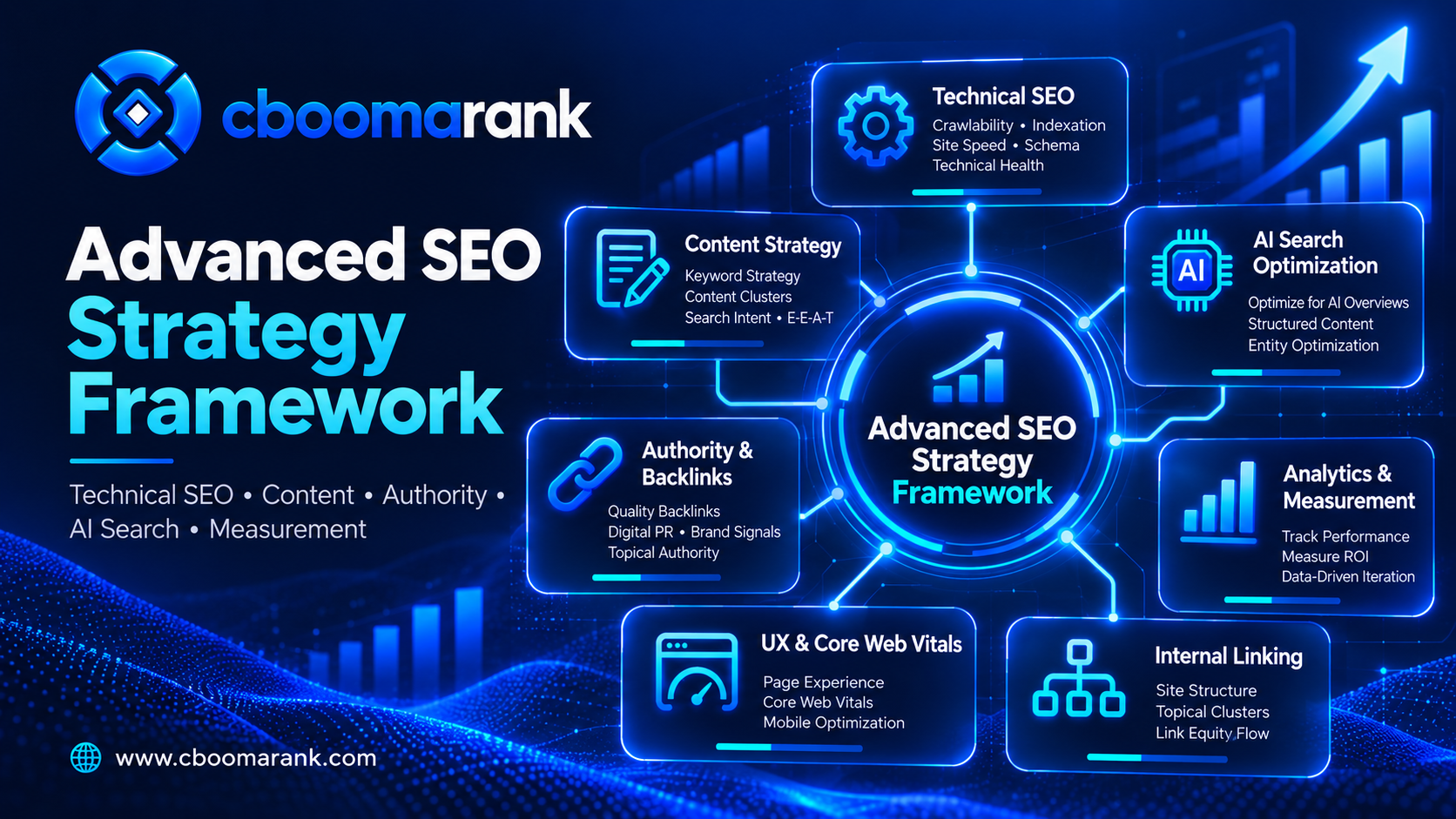
The strongest SEO programs now connect technical SEO, content strategy, competitor intelligence, authority building and analytics into one operating system. That is especially important as search becomes more multimodal and AI-assisted while the fundamentals of discoverability, indexability, relevance and usefulness continue to matter.
This updated guide explains practical advanced SEO strategies for businesses, publishers, marketers and SEO teams that want to improve organic visibility in 2026 without relying on shortcuts that create long-term risk.
2026 update: Google states that AI Overviews and AI Mode do not require special technical optimization beyond normal Search eligibility and SEO best practices. Pages still need to be indexable and eligible to appear with a search snippet.
What Advanced SEO Techniques Mean in 2026
Advanced SEO is not simply “more SEO.” It is the process of identifying the technical, content, authority and measurement constraints that prevent a site from reaching its potential and then solving them systematically.
For a small website, that may mean consolidating overlapping articles and improving internal linking. On an ecommerce platform, that may mean controlling faceted URLs and duplicate product paths. For a large publisher, advanced SEO may include crawl-budget analysis, log-file analysis, structured data validation, content refreshing and multimodal search measurement.
The right techniques therefore depend on the site’s size, business model, technical architecture and existing search performance.
1. Advanced SEO Techniques for Smarter Indexation
One of the most valuable advanced SEO techniques is deciding which URLs actually deserve to be indexed.
For example, large sites frequently accumulate thin archives, parameter URLs, duplicated categories, outdated landing pages, internal search results and near-identical pages. Therefore, publishing more content without controlling that inventory can make the site harder to maintain and understand.
Audit the Indexable URL Set
Compare your XML sitemap, CMS URL inventory and Google Search Console indexing data. Look for important URLs that are missing and low-value URLs that are unnecessarily indexable.
Every indexable page should have a clear purpose. It should answer a distinct search need, support a meaningful business objective or strengthen the architecture around an important topic.
Consolidate Duplicate and Near-Duplicate Pages
When several URLs compete for essentially the same intent, choose the strongest destination. Merge useful information, update internal links and use the appropriate canonical or redirect strategy.
This is often more effective than creating another page that targets the same keyword with slightly different wording.
2. Advanced SEO Techniques for Crawl-Budget Optimization
However, crawl-budget optimization is important, but not every website needs a complex crawl-budget project.
Google’s current guidance says that smaller sites whose important content is crawled quickly can generally focus on keeping sitemaps accurate and monitoring indexing. Crawl-budget work becomes more relevant for sites with very large URL inventories, rapidly changing content or substantial numbers of discovered-but-not-indexed URLs.
Google’s crawl-budget documentation recommends reducing duplicate URL inventory, keeping sitemaps current, avoiding unnecessary redirect chains and maintaining healthy server performance.
Prioritize Crawlable Value
For large sites, reduce crawler time spent on useless combinations of filters, tracking parameters, duplicate pagination paths and obsolete URLs.
Important pages should return reliable responses, be internally linked and appear in updated XML sitemaps.
3. Advanced SEO Techniques for Internal Linking
Internal linking is one of the most controllable advanced SEO strategies because it influences discovery, architecture and contextual relationships between pages.
Instead of adding arbitrary links, build topic pathways. Supporting articles should link to important commercial or pillar pages where the connection is genuinely useful, and pillar pages should help users discover deeper supporting resources.
CBOOMARANK already has several strong supporting resources that can participate in this structure, including the technical SEO tools guide, keyword gap analysis guide, competitor backlink analysis guide, and enterprise SEO platform guide.
Use Descriptive Anchor Text Naturally
Anchors should tell readers what they will find after clicking. Avoid forcing the same exact-match phrase into every internal link.
A healthy internal-link profile uses descriptive phrases, natural variations, branded references and contextual links that genuinely help navigation.
4. Advanced SEO Techniques for Search Intent
For example, high search volume does not automatically make a keyword valuable.
The more advanced approach is to evaluate intent, business relevance, difficulty, SERP composition, competitors, conversion potential and the existing authority of your domain.
A keyword with moderate volume and strong commercial relevance can outperform a very large informational keyword that attracts visitors unlikely to convert.
Map Keywords to the Customer Journey
Separate discovery queries, comparison queries, solution queries and purchase-intent queries. Then make sure each page has one clear primary job.
For example, a beginner’s guide should educate, while a pricing comparison should help someone evaluate a purchase. Mixing both intents excessively can weaken the page.
Use CBOOMARANK keyword and competitor workflows to connect research with the website and business context rather than treating every high-volume query as an isolated opportunity.
5. Advanced SEO Techniques for Keyword Gap Analysis
Keyword gap analysis identifies topics that competing sites already rank for while your site is missing or underperforming.
The advanced version goes beyond exporting thousands of competitor keywords. Segment opportunities by relevance, search intent, ranking difficulty, current position, topical fit and commercial value.
See the full CBOOMARANK keyword gap analysis workflow for a structured approach.
6. Advanced SEO Techniques for Content Refreshing
In addition, content refreshing is frequently more efficient than starting from zero.
Identify pages that already have backlinks, impressions, historical rankings or useful engagement but have become outdated. Improve the information, examples, links, screenshots, headings and search-intent alignment while preserving the established URL when appropriate.
Look for Decay, Not Only Low Traffic
A page that falls from position 4 to position 12 may deserve attention before a page that has never ranked at all.
Use Search Console trends, analytics, ranking history and competitor changes to identify declining URLs with recoverable value.
7. Advanced SEO Techniques for Information Gain
Meanwhile, search results are crowded with pages that repeat the same generic points. Advanced SEO requires adding something genuinely useful.
Examples include original research, product screenshots, testing methodology, firsthand observations, proprietary data, templates, calculators, comparison frameworks or detailed implementation steps.
Google’s spam policies specifically warn against scaled content created primarily to manipulate rankings and provide little original value, regardless of whether automation or generative AI is used. Review Google’s current spam policies before scaling automated publishing.
8. Advanced SEO Techniques for AI-Assisted Workflows
For example, AI can accelerate research, clustering, brief creation, QA, internal-link discovery, data summarization and draft development. However, automation should not replace editorial judgment.
Useful AI-assisted content still needs accurate facts, original value, clear authorship, appropriate links and a reason to exist beyond targeting a keyword.
The safest operating model is automation plus review: use machines for repetitive analysis and people for strategy, verification, experience and final publishing decisions.
9. Advanced SEO Techniques for AI Search Visibility
However, there is no separate technical checklist that guarantees visibility in AI Overviews or AI Mode.
Google’s AI features guidance says that existing SEO fundamentals remain relevant. Pages need to be crawlable, indexable, useful, internally discoverable and eligible for Search.
Make Important Information Explicit
Use clear headings, concise definitions, supporting evidence and logical page structure. Important information should exist as accessible text rather than only inside an image or interactive component.
Use Supporting Images and Video Where They Add Value
Visual material can make difficult topics easier to understand. This is increasingly important as search experiences incorporate images, video and multimodal queries.
10. Advanced SEO Techniques for Multimodal Search Visibility
In addition, search behavior increasingly includes cameras, uploaded images and visual discovery.
In September 2026, Google announced web multimodal Search performance reporting in Search Console, covering experiences such as Lens, Circle to Search, image uploads and related visual search interactions.
Publishers should therefore optimize useful original images with descriptive filenames, meaningful ALT text, relevant surrounding content and technically accessible image URLs.
See Google’s multimodal Search Console reporting announcement for the latest measurement details.
11. Improve Core Web Vitals With Real-User Performance in Mind
Therefore, technical SEO should improve the experience for real users rather than chase a laboratory score in isolation.
Google’s current Core Web Vitals guidance focuses on Largest Contentful Paint, Interaction to Next Paint and Cumulative Layout Shift. The recommended good thresholds are an LCP within 2.5 seconds, INP below 200 milliseconds and CLS below 0.1.
Use Google’s Core Web Vitals documentation together with Search Console and PageSpeed Insights.
Fix Templates, Not Individual URLs, When Possible
If thousands of pages share the same slow header, oversized hero image or layout-shifting component, solve the problem in the shared template.
Template-level improvements usually create more value than repeatedly fixing individual pages.
12. Audit JavaScript Rendering and Content Accessibility
Modern websites often depend heavily on JavaScript. That does not automatically prevent indexing, but critical content and links should remain reliably accessible to search engines and users.
Compare source HTML, rendered HTML and Google’s inspected version when important content appears only after client-side execution.
Pay particular attention to navigation, canonical tags, metadata, pagination, structured data and links generated dynamically.
13. Use Structured Data Strategically
Structured data helps search engines interpret eligible content, but it is not a substitute for strong pages.
Use only schema types that genuinely describe visible page content and follow Google’s feature-specific requirements.
Google’s Article structured-data documentation recommends validating implementation and checking rendered URLs with Search Console.
Do Not Build Strategy Around Obsolete Rich Results
Google’s 2026 documentation updates announced the deprecation of FAQ rich results in Search beginning May 7, 2026. That is a useful reminder that search appearance features can change.
Keep FAQ content when it helps users, but do not assume every structured-data feature will continue generating a special result indefinitely.
14. Create Topic Clusters With Clear Specialization
Topic authority is stronger when a website covers a subject through useful, non-duplicative pages that each satisfy a distinct intent.
A cluster might include a broad SEO software guide, separate competitor comparisons, technical SEO tutorials, pricing analysis and implementation guides.
For example, the CBOOMARANK SEO software pricing guide serves a pricing intent, while the Semrush alternatives guide serves comparison intent. These should support one another instead of competing for the same query.
15. Use Competitor Backlink Gaps to Prioritize Authority Building
Advanced backlink analysis is not about copying every link a competitor has.
Compare multiple competitors, identify referring domains relevant to your topic and prioritize opportunities that could realistically provide editorial value, referral traffic or authority.
The CBOOMARANK competitor backlink analysis guide explains how to turn competitor data into actionable opportunities.
Connect Research to Outreach
CBOOMARANK’s backlink workflows can connect opportunity discovery with marketplace matching, outreach campaigns, monitoring and reporting. This reduces the operational gap between finding a potential backlink and managing the acquisition process.
Explore the current platform at app.cboomarank.com.
16. Reclaim Lost and Broken Backlinks
Link reclamation can produce faster wins than starting every authority campaign from zero.
Monitor important referring pages and investigate backlinks that disappear, point to obsolete URLs or encounter redirects and errors.
If an old resource has moved, preserve equity through an appropriate redirect. If a publisher changed the link accidentally, outreach may recover it.
17. Strengthen Digital PR With Assets Worth Referencing
Strong link acquisition often starts with something publishers actually want to cite.
Original datasets, industry surveys, interactive tools, benchmark reports, templates, calculators and unique visualizations can generate stronger editorial reasons to link than generic promotional content.
The goal is not simply “build links.” It is to create a resource that deserves references from relevant websites.
18. Use Log-File Analysis for Large or Complex Websites
Server logs can reveal how search crawlers interact with a site in practice.
Analyze which URL groups receive crawler attention, which sections are rarely visited, where errors occur and whether crawlers spend excessive time on low-value URL patterns.
Combine log analysis with Search Console indexing data and your crawler output. Each dataset answers a different question.
19. Control Ecommerce Faceted Navigation
Ecommerce filters can generate enormous numbers of URL combinations for attributes such as price, brand, size, color, availability and sorting.
Some filtered pages may have real search value. Others simply duplicate the same product set under many URLs.
Advanced SEO teams define which facets deserve indexable landing pages and which combinations should remain navigation-only.
Keep Canonicals, Internal Links and Sitemaps Consistent
Do not send conflicting signals by canonicalizing a URL away while heavily linking to it and including it in the sitemap as an important destination.
The indexation strategy should be reflected consistently across templates and feeds.
20. Implement International SEO With Precise Targeting
International sites need a clear relationship between language, region and canonical versions.
Use unique URLs for localized content, implement hreflang carefully and avoid automatically redirecting all users based solely on perceived location.
Localized pages should offer genuine regional value rather than simple machine-translated duplicates.
21. Test SEO Changes Instead of Relying on Assumptions
Advanced SEO teams measure the effect of major changes.
When possible, compare similar page groups, establish a baseline and monitor clicks, impressions, rankings, crawl behavior and conversions after implementation.
Not every observed improvement is caused by the last SEO change. Seasonality, competitors, algorithm changes, SERP features and demand shifts can all influence results.
22. Combine Search Console, Analytics and Business Outcomes
Rankings alone are not enough.
Track impressions and clicks from Search Console, user behavior and conversions from analytics, and qualified leads or revenue from business systems.
An advanced SEO campaign should answer three questions: Did visibility improve? Did useful traffic increase? Did the improvement contribute to meaningful business outcomes?
Advanced SEO Techniques for CBOOMARANK Users
CBOOMARANK is designed to connect several parts of the SEO workflow that are often separated across different applications.
Teams can use website analysis, keyword research, competitor research, authority metrics, backlink intelligence, outreach workflows, monitoring and reporting to move from diagnosis to execution more efficiently.
For businesses comparing broader software options, see the enterprise SEO platform guide and SEO software pricing guide.
You can explore the platform at CBOOMARANK or review the latest Buyer and Publisher pricing plans.
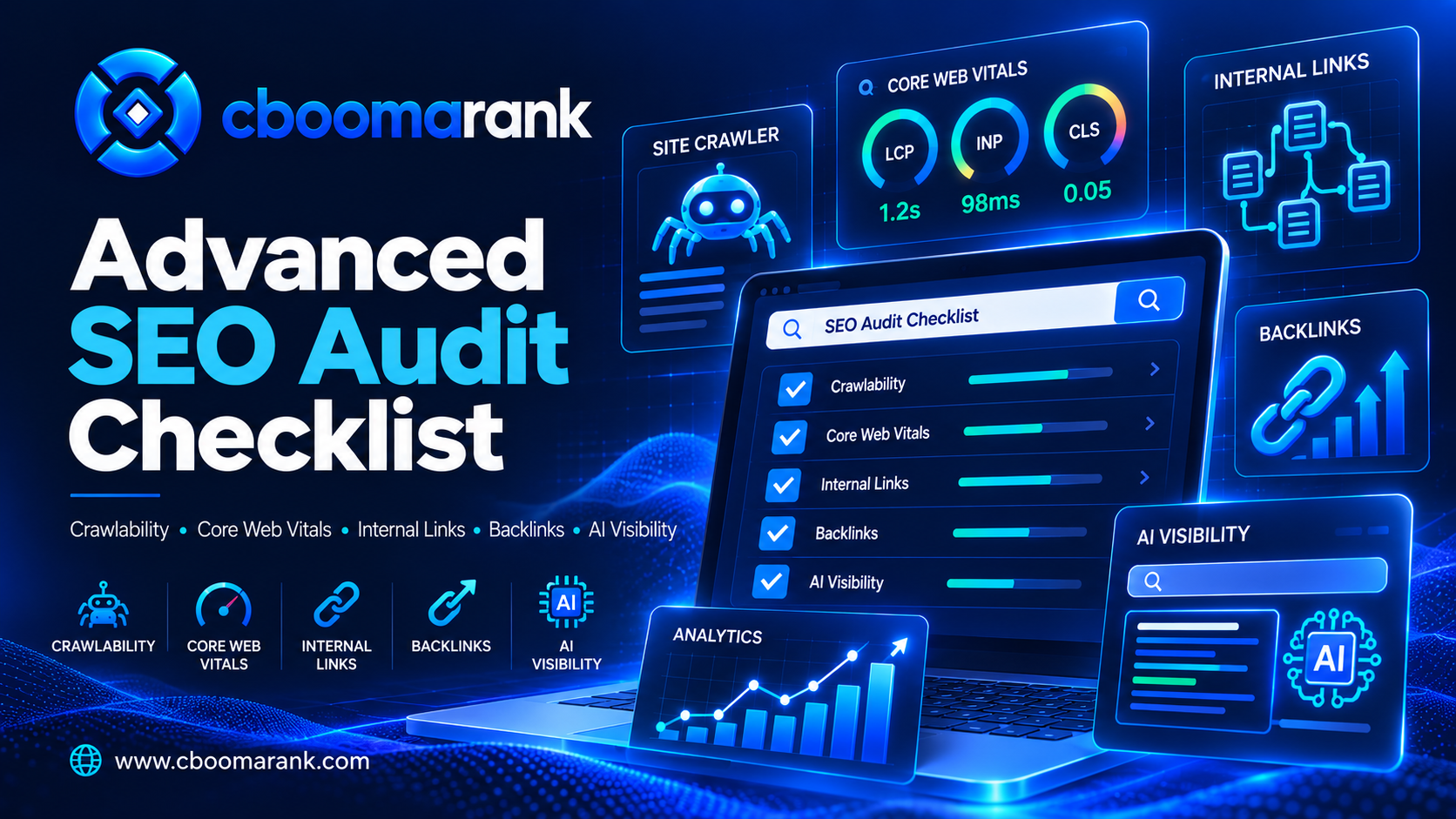
Advanced SEO Audit Checklist
- Confirm important URLs are crawlable and indexable.
- Remove or consolidate unnecessary duplicate URL inventory.
- Keep XML sitemaps accurate and current.
- Review internal links to high-value pages.
- Map search intent before creating new content.
- Refresh strong declining URLs before publishing duplicates.
- Add original information, data or experience where possible.
- Check JavaScript-rendered content and links.
- Monitor LCP, INP and CLS.
- Validate structured data against visible content.
- Analyze competitor keyword and backlink gaps.
- Monitor lost and broken links.
- Review ecommerce filters and parameter URLs.
- Validate hreflang on international sites.
- Measure AI, classic web and multimodal search performance where data is available.
- Connect SEO metrics to conversions and business outcomes.
Common Advanced SEO Mistakes
Publishing Large Numbers of Similar Pages
More pages do not automatically create more visibility. Similar pages can dilute signals, create maintenance problems and compete with one another.
Chasing Every Algorithm Update
Major ranking changes deserve investigation, but constantly redesigning a strategy around speculation can create unnecessary volatility.
Focus on technically accessible pages, useful content, strong architecture and legitimate authority signals.
Treating Every Backlink as Equally Valuable
Relevance, editorial context, source quality and real audience value matter more than simply increasing a link count.
Using Automation Without Quality Controls
Automation should speed up useful work, not produce thousands of low-value pages. Google explicitly includes scaled low-value generation within its spam policies.
Ignoring Conversion Performance
A page can rank well and still fail the business. Improve calls to action, trust signals, information hierarchy and next-step clarity where appropriate.
Frequently Asked Questions About Advanced SEO Techniques
What are advanced SEO techniques?
Advanced SEO techniques are strategies used beyond basic keyword placement and on-page optimization. They include technical indexation management, crawl analysis, sophisticated internal linking, content consolidation, structured data, competitor gap analysis, authority building, performance optimization and advanced measurement.
Do I need special optimization for Google AI Overviews?
No special technical optimization is required. Google’s current guidance says standard Search eligibility and SEO fundamentals continue to apply to AI Overviews and AI Mode.
Does structured data guarantee higher rankings?
No. Structured data can help search engines understand eligible content and can support certain search appearances, but it does not guarantee rankings or rich results.
Is crawl budget important for every website?
No. It is most relevant to large or rapidly changing websites and sites experiencing significant crawling or index-discovery problems. Smaller sites should normally prioritize clean architecture, sitemaps and indexing health.
How often should old SEO content be updated?
There is no universal schedule. Update a page when its facts, product details, examples, screenshots, user intent or competitive landscape have materially changed, or when performance data shows a meaningful decline that an update can address.
Can AI-generated content rank in Google?
How content was produced is not the only issue. Google focuses on whether content complies with its policies and provides value. Large-scale unoriginal content created mainly to manipulate rankings can violate scaled-content-abuse policies regardless of the production method.
What should I measure after implementing advanced SEO techniques?
Measure indexing health, impressions, clicks, organic landing-page performance, conversions, revenue or leads, backlink changes and relevant technical metrics. The best KPI depends on the business objective of the page.
Final Thoughts on Advanced SEO Techniques in 2026
The most effective advanced SEO techniques are not tricks. They are disciplined ways to make websites easier to discover, easier to understand, more useful to people and more authoritative within their markets.
Technical SEO creates access. Content satisfies demand. Internal linking organizes authority. Backlinks build external credibility. Measurement tells you whether the work actually created value.
In 2026, AI search and multimodal discovery add new surfaces, but the underlying principles remain remarkably consistent: create valuable information, make it accessible, maintain a clean website architecture and earn genuine reasons for people and other websites to reference your work.
Use CBOOMARANK to connect website analysis, keyword and competitor research, backlink intelligence and reporting. When you are ready to compare subscription options, visit the current CBOOMARANK pricing page.
