


SEO pricing is one of the most confusing parts of hiring an SEO agency or consultant. One provider may quote $500 per month, another may recommend $3,000 per month, and an enterprise agency may propose $10,000 or more. The wide range exists because SEO is not one fixed service. It can include technical audits, keyword research, content production, local SEO, link building, conversion tracking, ecommerce optimization, reporting, and ongoing strategy.
For most businesses, the right question is not simply “How much does SEO cost?” A better question is: “What level of SEO investment matches our competition, website size, growth goal, and expected return?” This guide explains what businesses should expect to pay, what should be included in SEO packages, how to compare agencies, and how to avoid cheap SEO offers that can damage long-term performance.
Industry references show why expectations should be realistic. WebFX lists monthly SEO retainers as a common model around $1,000 to $5,000 per month, while Ahrefs found in its SEO pricing research that monthly retainers are a dominant way SEO providers charge clients. Google’s own guidance also makes clear that SEO should support crawlable, understandable, helpful content rather than shortcuts or manipulative tactics.
If you are building a long-term marketing system, this article pairs well with CBOOMARANK resources such as Best Free SEO Tools for Beginners, Semrush vs Ahrefs, Ubersuggest vs Semrush, and Submit URL to Search Engines.
Quick Answer: How Much Should SEO Cost?
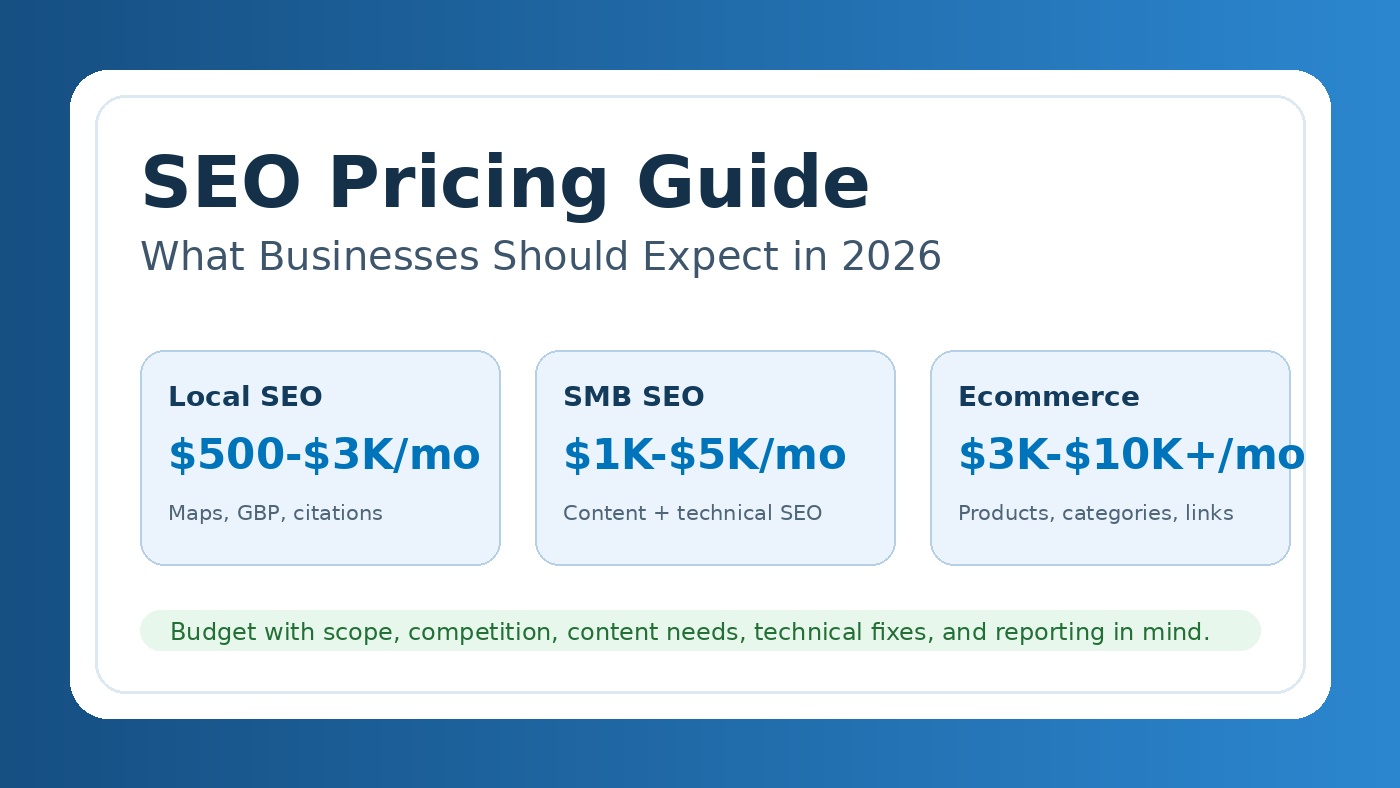
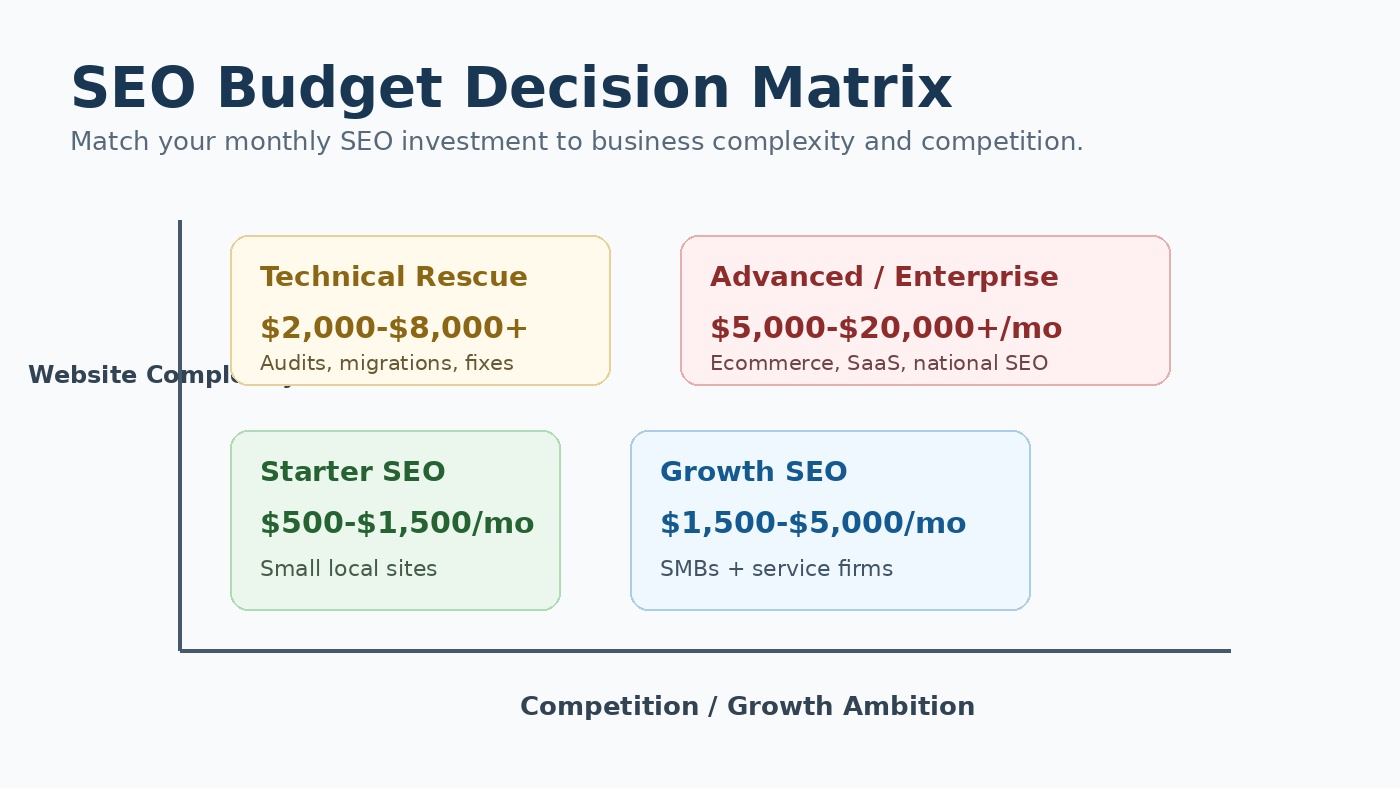
A small local business may start with $500 to $1,500 per month for basic local SEO. A growing small business usually needs $1,500 to $5,000 per month for a balanced mix of technical fixes, content, on-page optimization, and reporting. Ecommerce, SaaS, legal, finance, healthcare, insurance, hosting, and national brands often need $5,000 to $20,000+ per month because the competition is stronger and the work is more complex.
| Business Type | Typical Monthly SEO Budget | Best Fit |
| Small local business | $500-$1,500 | Google Business Profile, citations, local pages, basic reporting |
| Growing small business | $1,500-$5,000 | Technical SEO, content strategy, on-page optimization, analytics |
| Competitive service business | $3,000-$8,000 | Content production, competitor research, authority building, CRO |
| Ecommerce website | $3,000-$10,000+ | Category optimization, product SEO, technical crawl fixes, content |
| National or enterprise brand | $10,000-$50,000+ | Large-scale technical SEO, strategy, reporting, links, governance |
What Is SEO Pricing?
SEO pricing is the amount a freelancer, consultant, or agency charges to improve your visibility in organic search. A full SEO campaign may include several disciplines. Technical SEO helps search engines crawl, index, and understand your pages. On-page SEO improves titles, headings, internal links, structured content, and search intent alignment. Content SEO develops pages and articles that answer the queries your customers search for. Off-page SEO builds brand authority through digital PR, backlinks, and mentions. Analytics connects rankings and traffic to leads, revenue, or other business outcomes.
Because SEO has many moving parts, price depends on scope. A one-time audit may be affordable, while an ongoing campaign with content production, technical implementation, reporting, and link acquisition requires a larger monthly budget. Businesses should also remember that SEO is cumulative. The work completed this month can support traffic next month, but results normally build over time rather than appearing instantly.
Common SEO Pricing Models
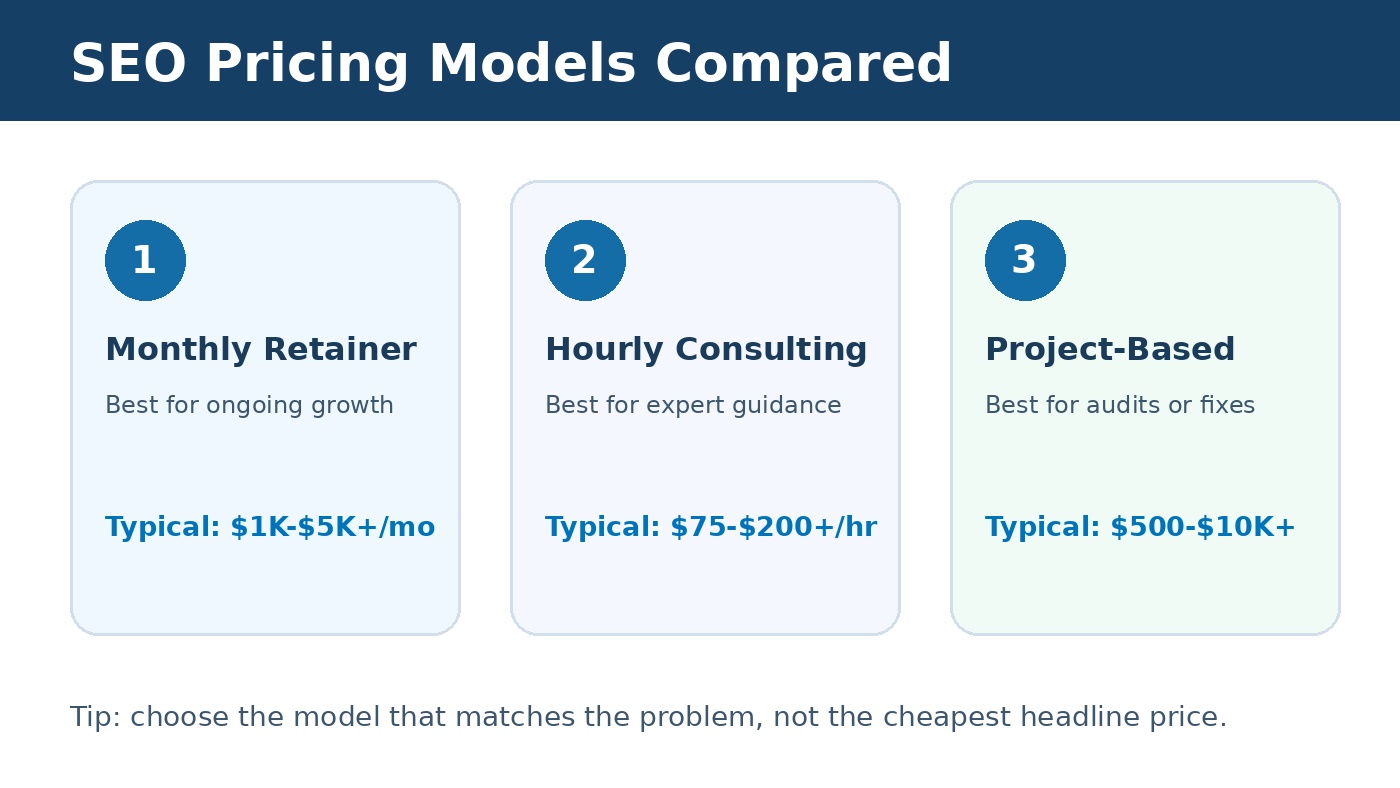
1. Monthly SEO Retainer
A monthly retainer is the most common model for ongoing SEO. You pay a fixed monthly fee and the provider works continuously on agreed priorities. This may include keyword research, content briefs, technical fixes, reporting, on-page optimization, local SEO, and link building. Retainers work well because SEO needs consistency. Search visibility improves through repeated improvements, not one isolated task.
Monthly retainers are best for businesses that want ongoing organic growth, not just a one-time checklist. They are also useful when an agency needs enough time to measure results, adjust strategy, and respond to competitors.
2. Hourly SEO Consulting
Hourly consulting works when you need expert advice but already have a team to implement the work. For example, an ecommerce company may hire an SEO consultant to review a migration plan, train content writers, or audit category page templates. Hourly SEO can be cost-effective when the problem is specific and the deliverable is clear.
3. Project-Based SEO
Project-based SEO is useful for defined deliverables such as a technical audit, website migration, keyword research project, content strategy, or local SEO setup. The advantage is clarity: you pay for a specific output. The disadvantage is that SEO results often need ongoing implementation after the project is complete.
4. Performance-Based SEO
Performance-based SEO charges according to rankings, traffic, leads, or revenue. This model can sound attractive, but businesses should be careful. Organic results are affected by competition, algorithm changes, website quality, content budget, brand authority, and technical limitations. Be cautious with providers that guarantee specific ranking positions.
| Pricing Model | Best For | Advantages | Risks |
| Monthly retainer | Long-term growth | Consistent work, reporting, strategy adjustments | Requires trust and clear scope |
| Hourly consulting | Expert guidance | Flexible and targeted | Can become expensive without clear priorities |
| Project-based | Audits, migrations, one-time fixes | Clear deliverable and budget | Implementation may still be needed |
| Performance-based | Mature tracking environments | Aligns cost with outcomes | Can encourage shortcuts or unclear attribution |
What Affects SEO Pricing?
SEO pricing changes because no two websites have the same starting point. A small brochure website in a low-competition local market requires less work than a national ecommerce store with thousands of products. Before comparing prices, businesses should understand the factors that affect cost.
Competition Level
The harder your market is, the more SEO work you need. A local cleaning business may compete against a few nearby companies. A finance, insurance, real estate, software, hosting, healthcare, or legal website may compete against national brands with large content teams and strong backlinks. Competitive niches require stronger content, better technical execution, deeper keyword mapping, and authority building.
Website Size and Technical Condition
A 20-page website is easier to audit than a 20,000-page ecommerce store. Large websites may have duplicate pages, crawl waste, faceted navigation problems, thin product pages, index bloat, slow templates, broken internal links, and complex analytics requirements. Fixing those problems increases cost.
Content Requirements
Content is often one of the largest SEO cost drivers. If your campaign requires blog posts, service pages, comparison articles, product descriptions, category copy, or topic clusters, the budget must cover research, writing, editing, optimization, and publishing. Google’s helpful content guidance emphasizes content created for people, not only for search engines.
Local, National, or International Targeting
Local SEO is usually less expensive than national SEO because the target area is narrower. International SEO is usually more expensive because it may involve language targeting, hreflang, regional keyword research, country-specific content, and technical implementation across multiple markets.
Link Building and Digital PR
Authority building can significantly affect SEO pricing. Quality links and mentions are not generated by spam software. They require strong content, outreach, relationship building, editorial value, and brand credibility. Google’s spam policies warn against links created primarily to manipulate rankings, so businesses should avoid cheap link packages that promise hundreds of backlinks.
SEO Budget Decision Matrix
What Should Be Included in an SEO Package?
A professional SEO package should explain what work will be delivered, how success will be measured, and how often the client will receive updates. Avoid packages that only list vague terms like “optimization” or “link building” without describing the actual work.
| Package Level | Typical Inclusions | Best For |
| Basic SEO | Technical check, keyword research, on-page fixes, Search Console setup, monthly report | Small websites and new local businesses |
| Standard SEO | Technical audit, keyword mapping, content strategy, internal links, local SEO, competitor research | Growing businesses and service companies |
| Advanced SEO | Content production, digital PR, link earning, ecommerce SEO, CRO, advanced reporting | Competitive businesses and ecommerce brands |
| Enterprise SEO | Technical governance, large-scale audits, cross-team workflows, international SEO, custom dashboards | Large websites and national brands |
Local SEO Pricing
Local SEO focuses on visibility in a specific city, region, or service area. It often includes Google Business Profile optimization, local landing pages, citation management, review strategy, map pack tracking, and local link opportunities. Local SEO packages often cost less than national campaigns because the target market is narrower, but competitive cities and multi-location brands can still require larger budgets.
| Local SEO Level | Expected Monthly Cost | What to Expect |
| Starter local SEO | $500-$1,000 | Basic Google Business Profile optimization, citations, simple reporting |
| Standard local SEO | $1,000-$2,500 | Location pages, reviews, local content, on-page optimization |
| Competitive local SEO | $2,500-$5,000 | Local content strategy, authority building, technical fixes, conversion tracking |
| Multi-location SEO | $3,000-$10,000+ | Location management, templates, reporting, content scaling, local governance |
SEO Agency vs Freelancer vs In-House SEO
The provider type also affects price. Agencies usually cost more because they bring several specialists: strategist, technical SEO, content manager, writer, outreach specialist, and analyst. Freelancers may be more affordable and flexible, but capacity can be limited. In-house SEO gives the business dedicated focus, but salary, tools, training, and content support must be considered.
| Option | Best For | Pros | Cons |
| SEO agency | Businesses needing full execution | Team support, reporting, scale, multiple skills | Higher cost, contracts vary |
| Freelancer | Small businesses or specific tasks | Flexible, affordable, direct communication | Limited capacity, fewer specialties |
| Consultant | Teams needing strategy | Expert audits, training, high-level direction | May not handle execution |
| In-house SEO | SEO-led companies | Dedicated focus, deep brand knowledge | Salary, tools, and extra production costs |
Cheap SEO vs Professional SEO
Cheap SEO is not automatically bad, but suspiciously cheap SEO often comes with hidden risk. A low-cost provider may be fine for a small website that needs basic setup. However, if a provider promises instant page-one rankings, hundreds of backlinks, or guaranteed traffic for a very low price, the business should be careful.
Professional SEO should be transparent. The provider should explain what they will work on, why it matters, which pages are priorities, what tools they use, and how success will be measured. A good SEO partner should also be honest about what is outside their control. No agency controls Google’s algorithm, competitor budgets, or every market factor.
Red Flags in SEO Pricing
- Guaranteed number-one rankings for competitive keywords.
- Hundreds or thousands of backlinks included for a very low price.
- No access to reporting, analytics, or work logs.
- No explanation of keyword strategy or target pages.
- Duplicate content, automated content at scale, or copied articles.
- Secret methods that cannot be explained.
- No technical audit before making promises.
- Long contracts with unclear deliverables.
How to Compare SEO Proposals
When reviewing SEO proposals, compare scope, deliverables, reporting, experience, and risk. Do not choose only by price. A $1,000 package with clear deliverables may be better than a $500 package that only promises “optimization.” At the same time, a $7,000 package should explain why that investment is needed and how the work connects to leads, revenue, or measurable business goals.
- What exactly is included each month?
- Which pages and keywords will be prioritized first?
- Will the provider handle implementation or only recommendations?
- How many content pieces, briefs, or optimizations are included?
- How will link building or digital PR be handled?
- What reports will be delivered and how often?
- Who owns the content, accounts, dashboards, and work output?
- How will SEO performance be connected to leads or revenue?
Best SEO Budget Recommendation
For most small businesses, a realistic starting budget is $1,000 to $3,000 per month. This is usually enough for basic technical work, keyword research, on-page optimization, some content planning, reporting, and steady improvements. Businesses in competitive niches should expect to invest more because results require stronger content and authority building.
For ecommerce brands, SaaS businesses, national service companies, and high-value lead generation markets, $3,000 to $10,000+ per month is more realistic. Enterprise websites may need $10,000 to $50,000+ per month depending on complexity, content volume, international targeting, and technical SEO requirements.
How Long Does SEO Take?
SEO is not instant. Some technical improvements can help quickly, but meaningful ranking and traffic growth often takes several months. New websites, weak domains, and competitive industries may need 6 to 12 months to see stronger results. Businesses should judge SEO by leading indicators as well as final outcomes: indexed pages, technical health, keyword movement, impressions, clicks, engagement, leads, and conversions.
Is SEO Worth the Cost?
SEO is worth the cost when your customers search online before they buy. Local service businesses, ecommerce brands, SaaS companies, real estate firms, finance brands, healthcare providers, legal practices, and affiliate sites can all benefit from organic search visibility. Unlike paid ads, SEO can keep generating traffic after a page starts ranking, but it still requires maintenance, updates, and ongoing improvement.
Final Verdict
Businesses should expect SEO pricing to vary based on competition, website size, technical condition, content needs, link requirements, and growth goals. A small local campaign may begin under $1,500 per month, while a serious growth campaign often falls between $1,500 and $5,000 per month. Competitive ecommerce, SaaS, national, and enterprise SEO campaigns can require much larger monthly budgets.
The best SEO package is not the cheapest one. It is the package that clearly connects work to business outcomes, follows search engine guidelines, improves useful content, fixes technical barriers, and reports progress honestly. Start with a budget that matches your goals, ask clear questions, and choose a provider that can explain exactly how your investment will be used.
FAQ
How much does SEO cost per month?
Many businesses pay between $1,000 and $5,000 per month for ongoing SEO, while small local campaigns may cost less and competitive campaigns may cost much more.
Is $500 per month enough for SEO?
It can be enough for basic local SEO or a small website setup, but it is usually not enough for competitive content, technical SEO, and quality authority building.
Why do SEO agencies charge different prices?
Pricing differs because agencies include different levels of strategy, content, technical implementation, reporting, link building, and support.
Should I choose monthly SEO or a one-time SEO project?
Choose monthly SEO for long-term growth. Choose a one-time project for audits, migrations, keyword research, or specific technical fixes.
What is the cheapest way to start SEO?
Start with Google Search Console, a basic technical audit, keyword research, on-page optimization for important pages, and a simple content plan.
Can an SEO agency guarantee rankings?
Be cautious with guaranteed rankings. Ethical SEO providers can estimate opportunities and create a strategy, but they cannot control search engine algorithms.
How long before SEO works?
Some improvements may appear within weeks, but meaningful results often take 3 to 6 months, and competitive campaigns may require 6 to 12 months or more.
What should an SEO report include?
A useful SEO report should include completed work, technical improvements, keyword movement, traffic changes, conversions, content performance, backlinks, and next steps.
Suggested Internal Links for CBOOMARANK
- Best Free SEO Tools for Beginners
- Semrush vs Ahrefs
- Ubersuggest vs Semrush
- Submit URL to Search Engines
- CBOOMARANK Blog