

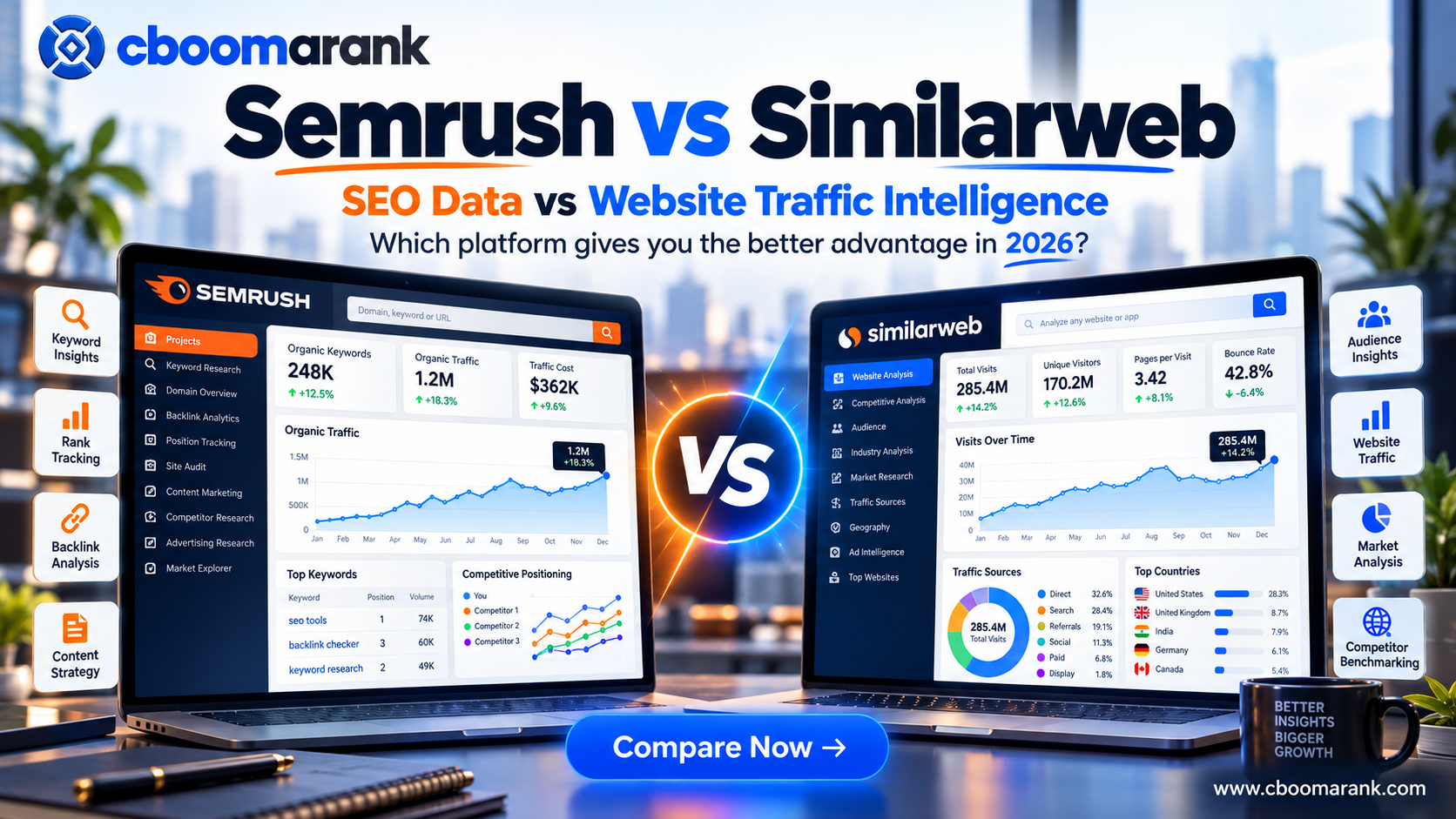
Semrush vs Similarweb is one of the most useful comparisons for marketers who need both SEO intelligence and broader website traffic research. The two platforms overlap in competitor analysis, traffic estimates, keyword insights and market research, but they approach those jobs from different starting points.
Semrush is built around search marketing and digital visibility. Its current platform combines SEO, keyword research, backlink intelligence, rank tracking, technical audits, competitive analysis, traffic analytics and AI visibility. Similarweb is built around digital intelligence: website traffic, engagement, audiences, channels, referrals, market share, competitive benchmarking and broader web behavior.
That difference matters. An SEO team comparing keyword gaps may prefer a platform deeply connected to rankings and backlinks, while a strategy team sizing an industry may care more about cross-channel traffic, audience behavior and market-share trends.
This guide compares Semrush vs Similarweb by practical use case. It also explains where CBOOMARANK can fit when you want website analysis, keyword research, competitor intelligence, authority metrics and backlink workflows connected around your own projects.
Semrush vs Similarweb: Quick Comparison for 2026
| Area | Semrush | Similarweb |
|---|---|---|
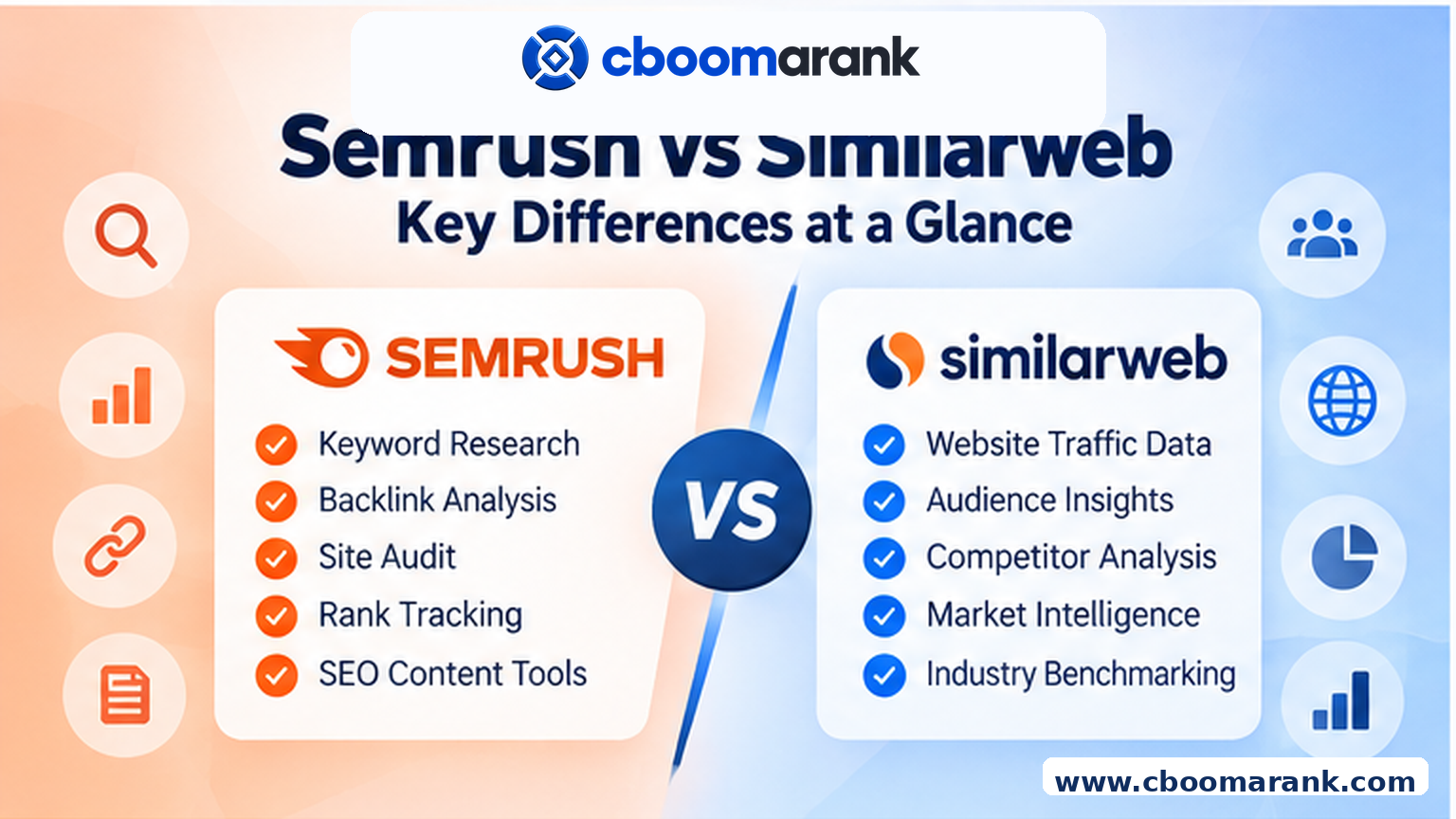
| Primary strength | SEO, search marketing and digital visibility workflows | Website traffic intelligence, market analysis and audience behavior |
| Website traffic estimates | Traffic Analytics and Traffic & Market | Website Analysis and Web Intelligence |
| Keyword research | Deep SEO keyword research, rankings, intent and gap analysis | Search traffic, keyword trends and competitive search intelligence |
| Backlinks | Backlink Analytics, Backlink Gap and SEO link research | Backlink Analytics and referral intelligence within web research |
| Traffic channels | Organic, paid, referral, social, email, display and AI traffic | Direct, search, referral, social, display and other channel views |
| Audience analysis | Audience and market insights in Traffic & Market | Strong emphasis on audience behavior, loyalty and cross-web journeys |
| Technical SEO | Dedicated Site Audit | Site Audit available within Similarweb’s broader SEO toolset |
| Best fit | SEO-led teams needing an integrated search workflow | Strategy, research and growth teams needing market-level digital intelligence |
What Is Semrush?
Semrush is a broad search marketing and digital visibility platform. Its current competitor-analysis suite includes Domain Overview, Organic Rankings, Traffic Analytics, market research, backlink tools and AI visibility features.
The official Semrush competitor analysis page explains that the platform can analyze competitor keywords, paid strategies, backlinks, traffic trends and channel performance.
Semrush also provides a dedicated Traffic & Market environment. According to its current documentation, the toolkit combines traffic analysis, audience insights, competitive benchmarking and market trends, including channel breakdowns such as organic search, paid search, social, referrals, email, display and AI traffic.
For current product details, see the official Semrush Traffic & Market documentation.
What Is Similarweb?
Similarweb is a digital intelligence platform designed to estimate and analyze online behavior across websites, markets and competitive sets.
Its Web Intelligence environment covers website traffic and engagement, audience behavior, search terms, marketing channels, referrals, market trends and competitive benchmarking.
Similarweb’s current Web Intelligence overview also includes SEO-oriented capabilities such as rank tracking, backlink analytics and site auditing alongside its broader traffic and market research products.
The platform is widely used when the research question goes beyond “which keywords does this site rank for?” and becomes “how large is this competitor, where does its audience come from, which channels drive growth and how is market share changing?”
Semrush vs Similarweb for Website Traffic Estimates
This comparison becomes especially useful when the goal is to estimate traffic for websites you do not own.
Semrush Traffic Analytics provides estimates for traffic volume, engagement, traffic sources, top pages and competitive performance. The platform’s current documentation describes it as a way to evaluate competitor websites over time and understand which channels drive visits.
Similarweb Website Analysis is built around the same broad research problem. Its current website traffic checker exposes traffic and engagement data, rankings, keywords, referring domains and related competitive information.
Semrush vs Similarweb: Traffic Estimates Are Not Analytics
Neither platform can replace Google Analytics, first-party server data or another analytics system installed on your own website.
Third-party traffic intelligence is modeled and estimated. It is most useful for benchmarking competitors, analyzing markets and identifying directional trends where first-party data is unavailable.
For your own site, compare third-party estimates with actual first-party analytics. That helps you understand how much confidence to place in estimates for competitors of similar size.
Which Traffic Metrics Matter?
Useful traffic analysis considers traffic trends, unique visitors where available, pages per visit, session or visit duration, engagement-related metrics, country distribution, channel mix, top pages, referrals, audience overlap, market share and AI-originated traffic where supported.
If you want to start from your own domain, use CBOOMARANK Website Analysis and connect the findings with deeper project research in CBOOMARANK.
Semrush vs Similarweb for Competitive Intelligence
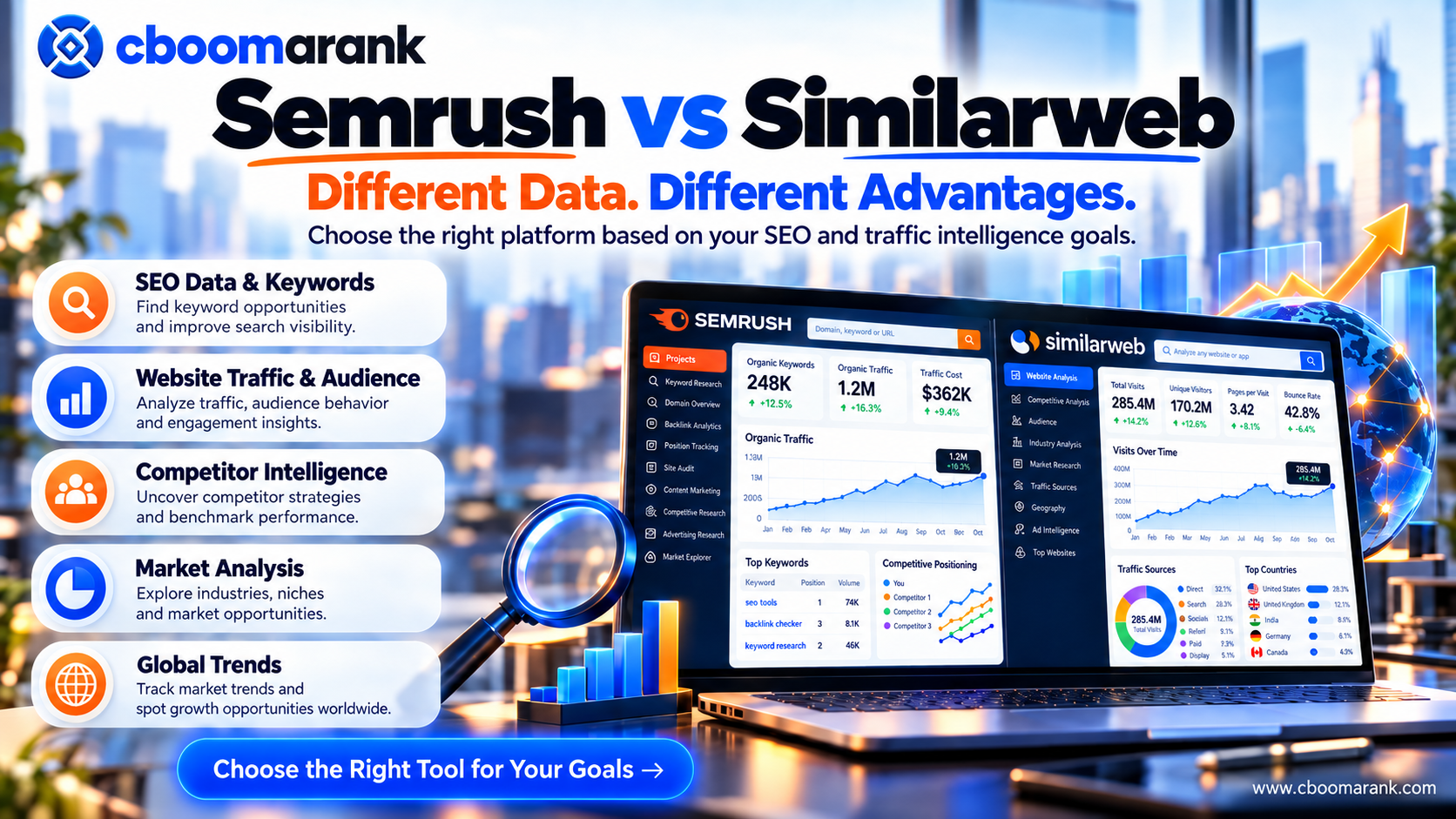
Both platforms are strong for competitive intelligence, but they answer different types of questions.
Semrush is particularly useful when competitor research needs to connect directly to SEO actions. A marketer can move from a competitor domain to organic keywords, backlink gaps, content opportunities, traffic channels and search visibility.
Similarweb places more emphasis on overall digital performance and market position. Its current competitive analysis tools highlight traffic, engagement, user journeys, marketing channels, market shifts and competitor growth.
The official Similarweb competitive analysis page focuses on understanding competitor performance across markets and channels rather than only search.
Semrush vs Similarweb for Market Share
Market-level analysis is one of Similarweb’s traditional strengths. Teams can benchmark a brand against competitors and study changing traffic share across a category or market.
Semrush has expanded strongly in this direction through Traffic & Market. Its current Market Overview and competitive intelligence workflows support market sizing, benchmarking and regional analysis.
Therefore, the correct choice depends on how central broad market intelligence is to your work compared with SEO execution.
Semrush vs Similarweb for SEO Research
For dedicated SEO research, Semrush has a clear search-first orientation.
The platform connects organic rankings, Keyword Gap, keyword research, backlinks, rank tracking and technical auditing in one workflow. This makes it easy to move from “a competitor gets traffic” to “these keywords, pages and links are contributing to that visibility.”
Similarweb also provides search intelligence and SEO tools, but the product’s broader identity is digital intelligence rather than an SEO suite alone.
If SEO execution is the main job, compare how many steps it takes in each platform to go from competitor discovery to an actionable keyword, content or backlink task.
For another search-platform comparison, read Semrush vs Moz.
Semrush vs Similarweb for Keyword Research
The two platforms also differ in how they support keyword research workflows.
Semrush provides specialist keyword tools for discovery, intent, difficulty, competitive gaps, related queries, ranking URLs and SERP research. These tools are tightly integrated with SEO planning.
Similarweb can show which search terms and keyword groups contribute traffic to websites and categories. That is useful when you want to understand demand in the context of broader digital behavior.
Search Demand vs Search Visibility
These are not the same question.
Search-demand research asks what people are looking for. Search-visibility research asks which websites appear for those searches and capture traffic.
A strong workflow uses both. Start with demand, identify competitors capturing that demand, then analyze the pages, links and site quality behind their visibility.
Semrush vs Similarweb for Traffic Channels
Traffic-channel analysis is central to both platforms.
Semrush’s current Traffic & Market documentation lists channels including AI Traffic, Organic Search, Paid Search, Paid Social, Organic Social, Referral, Email and Display Ads.
Similarweb provides channel-level traffic analysis across sources such as direct, search, referrals, social and paid activity.
Channel data is especially useful when competitors have similar total traffic but very different acquisition strategies.
For example, one competitor may rely heavily on organic search while another depends on paid campaigns or referrals. Those differences can reveal where your own growth opportunities may be strongest.
Semrush vs Similarweb for Audience Research
Audience research is an area where Similarweb’s digital-intelligence heritage becomes especially relevant.
Similarweb can help teams investigate audience behavior, cross-site activity, loyalty, geographic distribution and how users move through a competitive landscape.
Semrush Traffic & Market also includes audience-profile and demographic-oriented research, allowing marketers to connect competitor traffic with broader audience insights.
The practical test is whether your team needs audience intelligence as a core research function or as supporting context for SEO and marketing decisions.
Semrush vs Similarweb for Top Pages
Top-page analysis helps answer a simple but important question: which pages are actually driving competitor growth?
Semrush currently provides Top Pages inside Traffic & Market so users can identify pages, sections and launches associated with traffic growth.
Similarweb also provides popular-page and website-performance analysis within its Web Intelligence products.
This is useful for content planning because it moves competitive research away from domain averages. A competitor may receive most of its growth from a small number of pages, tools, product categories or campaigns.
Semrush vs Similarweb for Geographic Research
Geographic analysis matters for businesses operating in multiple countries.
Semrush Traffic & Market supports regional and country-oriented traffic research. Its current market-analysis features also include regional trend reporting.
Similarweb provides geographic traffic distribution and supports research across many countries and categories.
Regional differences can materially change which competitors, keywords and channels deserve attention.
Semrush vs Similarweb for Backlink Research
Backlinks are more deeply integrated into Semrush’s traditional SEO workflow.
Semrush provides Backlink Analytics and Backlink Gap, allowing marketers to compare referring domains and identify potential link opportunities.
Similarweb’s current Web Intelligence product lineup also includes Backlink Analytics, while its traffic intelligence can provide useful referral context.
However, backlink opportunity research should not be reduced to authority scores or raw link counts. Relevance, editorial quality, topical fit and real audience value matter.
For a structured workflow, see the competitor backlink analysis guide.
Semrush vs Similarweb for Technical SEO
Technical SEO is another area where Semrush has a strong established workflow through Site Audit.
Semrush Site Audit can crawl websites and identify technical and on-page issues that may affect crawlability, indexation, internal linking and other aspects of search performance.
Similarweb’s current Web Intelligence product lineup also advertises Site Audit as part of its SEO capabilities.
Teams with technically complex websites should test both crawlers against the same representative site section. The most useful platform is the one that surfaces important issues clearly enough for developers, content teams and SEO specialists to act on them.
For dedicated auditing workflows, read the SEO audit report guide.
Semrush vs Similarweb for Rank Tracking
Rank tracking connects competitive research with actual search visibility.
Semrush has a mature Position Tracking environment for monitoring keyword positions, locations, devices and competitors.
Similarweb now also includes rank-tracking capabilities in its broader Web Intelligence and SEO product set, including visibility and SERP-oriented reporting.
If ranking monitoring is a major purchasing criterion, compare update frequency, keyword limits, location support, historical data and reporting rather than simply checking whether the feature exists.
Semrush vs Similarweb for AI Traffic and AI Visibility
AI discovery is increasingly becoming part of competitive intelligence.
Semrush currently exposes AI Traffic as a dedicated channel inside its Traffic & Market environment and also offers broader AI visibility products.
Similarweb has also been expanding AI-related search and digital intelligence capabilities.
When evaluating AI data, separate referral traffic from AI platforms, brand mentions in AI answers, citations, prompt visibility and traditional organic rankings.
For a dedicated framework, read the AI search visibility guide.
How Similarweb Builds Website Traffic Estimates
Understanding methodology is important because website traffic data for competitors is estimated.
Similarweb’s public traffic checker says its estimates draw from several source types: direct measurement from participating websites and apps, a contributory network, data partnerships and public data extraction.
Those signals are processed into estimates of website traffic and engagement.
This does not mean every website estimate will match the site’s own analytics. Accuracy can vary with website size, geography, device mix and available data.
See the official Similarweb Website Traffic Checker for its current methodology overview.
How Semrush Builds Traffic Intelligence
Semrush also uses modeled traffic intelligence rather than direct access to a competitor’s private analytics.
Its current competitor-analysis documentation says traffic estimates use anonymized clickstream data from third-party providers combined with proprietary processing and machine-learning models.
The platform then normalizes the data across factors such as countries, devices, demographics and industries.
As with Similarweb, the resulting figures are best treated as competitive estimates and directional signals rather than exact audited visit counts.
Semrush vs Similarweb: Which Data Is More Accurate?
There is no responsible universal answer for every website, country and traffic level.
Accuracy can vary by domain size, region, traffic composition and the amount of behavioral data available to the provider.
The best way to test accuracy is to use a website for which you have first-party analytics. Compare the estimated visits, channels and trends against your actual data, then repeat the exercise across several sites if possible.
Focus on directional usefulness. A competitive-intelligence platform can still be valuable when its absolute estimates differ from first-party analytics if it consistently identifies the right trends, channel shifts and relative competitor positions.
Semrush vs Similarweb for Historical Data
Historical data matters when the goal is to understand long-term growth rather than this month’s snapshot.
Semrush states that its Traffic & Market environment provides historical competitor data, with availability depending on the product and plan.
Similarweb’s Web Intelligence API documentation currently describes access to multiple years of historical data, with depth depending on subscription.
Before buying, verify how much historical data your intended plan includes and whether exports or API access preserve the level of detail your team needs.
Semrush vs Similarweb for APIs and Data Integration
Large teams often need data outside the vendor interface.
Semrush offers API access in applicable products and plans, enabling SEO and competitive datasets to feed internal tools, dashboards and reporting workflows.
Similarweb offers Web Intelligence APIs and data services for integrating traffic, engagement, channels and market information into external systems.
The official Similarweb Web Intelligence API documentation describes metrics such as visits, page views, bounce rate, traffic sources, geography, referrals and popular pages.
If API access matters, test rate limits, dimensions, historical depth, export size and licensing before selecting a plan.
Semrush vs Similarweb for Agencies
Agencies need repeatable competitor research across many clients.
Semrush can be attractive when teams want keyword, SEO, backlink, audit and traffic intelligence inside one ecosystem.
Similarweb can be particularly useful when strategy engagements require market sizing, audience research, competitor traffic and broader digital-channel intelligence.
An agency may even use both when one platform supports SEO execution while the other supports high-level digital-market strategy.
Semrush vs Similarweb for Investors and Market Research Teams
Investors and strategy teams often care less about individual keyword positions and more about company growth, market share, traffic quality, channels and audience behavior.
That type of work aligns naturally with Similarweb’s Web Intelligence positioning.
Semrush Traffic & Market has also expanded substantially into market intelligence, making the comparison more competitive than it was when Semrush was viewed primarily as an SEO platform.
The deciding factor may be which dataset, interface and export model best fits the team’s investment or market-analysis process.
Semrush vs Similarweb for Ecommerce Competitive Research
Ecommerce teams need to understand both search visibility and broader digital demand.
Semrush can connect category keywords, competitor rankings, backlinks and SEO opportunities. Similarweb can help reveal traffic trends, geographic demand, channel mix and market positioning.
Together, those perspectives answer different questions: which search terms can we win, and where is market demand already moving?
For ecommerce-focused SEO workflows, see the best ecommerce SEO tools guide.
Semrush vs Similarweb Pricing in 2026
Both vendors change product packaging and pricing over time, so this article does not hard-code plan prices that may quickly become outdated.
Instead, compare the actual plan required for your workflow.
For Semrush, check whether you need only core SEO tools or the separate Traffic & Market capabilities. For Similarweb, determine whether you need individual website research, broader Web Intelligence, API access or enterprise market research.
Calculate the total annual cost including seats, exports, historical data, APIs and any add-ons.
For a broader buying framework, read the SEO software pricing guide.
Semrush vs Similarweb: Which Platform Fits Which Team?
Choose Semrush When SEO Execution Is Central
Semrush may be the stronger fit when your daily workflow revolves around keyword research, competitor rankings, backlinks, technical audits, content opportunities and rank tracking.
Choose Similarweb When Market Intelligence Is Central
Similarweb may be the stronger fit when your core questions involve market share, website traffic, audience behavior, channel mix, geographic demand and competitive positioning.
Use Both When Search and Market Intelligence Are Equally Important
Some organizations need both perspectives. A strategy team can use broad digital intelligence to identify where demand is shifting, while an SEO team uses search-specific tools to translate those findings into rankings, content and link opportunities.
Semrush vs Similarweb Evaluation Checklist
Compare the same websites in both platforms, validate estimates against first-party analytics where possible, review geographic coverage, compare channel estimates, inspect keyword and search capabilities, test market-share research, review backlink and referral intelligence, compare ranking requirements, review AI traffic features, verify historical depth, evaluate exports and APIs, and calculate the annual cost for your actual use case.
How CBOOMARANK Fits Into Website and Competitor Analysis
CBOOMARANK focuses on turning website and competitor research into connected SEO workflows.
You can begin with CBOOMARANK Website Analysis, then use CBOOMARANK for deeper keyword, competitor, authority, audit and backlink research.
This is useful when the goal is not simply to estimate competitor traffic but to identify what your own website should improve next.
For backlink-specific competitive workflows, CBOOMARANK also connects opportunity research with outreach, monitoring and reporting where those capabilities are available.
Review CBOOMARANK Pricing, compare CBOOMARANK options, and choose the plan that fits your workflow.
Frequently Asked Questions About Semrush vs Similarweb
Is Semrush better than Similarweb for SEO?
Semrush has a more SEO-centered workflow, with keyword research, rankings, backlinks, Site Audit and competitor search analysis deeply integrated. Similarweb also includes SEO capabilities, but its broader emphasis is digital and market intelligence.
Is Similarweb better than Semrush for website traffic?
Similarweb is strongly focused on website traffic and digital market intelligence. Semrush also provides substantial traffic analytics through Traffic & Market. Test both against a website where you know the actual analytics before deciding which dataset is more useful for your market.
Can Semrush and Similarweb show different traffic numbers?
Yes. They use different datasets, panels, processing methods and models. Traffic estimates should therefore be treated as directional competitive intelligence rather than exact first-party analytics.
Which tool is better for competitor research?
It depends on the research question. Semrush is strong when competitor research needs to lead directly into SEO actions. Similarweb is strong when the research extends into market share, audiences, channels and broader digital behavior.
Does Similarweb provide SEO keyword data?
Yes. Similarweb provides search and keyword intelligence as part of its broader Web Intelligence and SEO capabilities.
Does Semrush provide market intelligence?
Yes. Semrush Traffic & Market includes traffic analytics, market overview, regional trends, audience analysis and competitive benchmarking.
Can I use CBOOMARANK with either platform?
Yes. Teams can use multiple data sources. CBOOMARANK can complement external market intelligence by connecting website analysis, keyword research, competitor research, authority and backlinks around your own projects.
Final Thoughts on Semrush vs Similarweb
The Semrush vs Similarweb decision comes down to the kind of intelligence your team needs most.
Semrush starts from search marketing and extends into traffic, audiences, market research and AI visibility. Similarweb starts from digital behavior and website intelligence while also providing search, backlink, rank-tracking and site-audit capabilities.
For SEO-led execution, Semrush may align more naturally with daily search workflows. For market and audience intelligence, Similarweb may provide the perspective your strategy team needs. In some organizations, the two products can be complementary rather than direct substitutes.
Before committing, compare the same domains, countries and time periods in both platforms. Validate estimates against first-party data where possible, and choose the system that helps your team make better decisions rather than the one that simply displays more metrics.
To analyze your own site and connect the findings with SEO actions, start at CBOOMARANK, continue in the CBOOMARANK app, and review CBOOMARANK Pricing.
Practical Semrush vs Similarweb Workflow for Better Decisions
A strong evaluation should begin with a question, not a dashboard. Decide whether you are trying to improve organic search, estimate competitor traffic, identify new markets, understand audience behavior, discover referral sources or benchmark overall digital share.
Next, select a controlled comparison set. Use your own website plus three to five direct competitors. Keep the country, date range and device assumptions consistent so the platforms are being asked the same question.
Then compare direction before precision. If both platforms show the same competitor accelerating while another declines, that trend can be useful even when the absolute visit estimates differ. Investigate which channels, pages and keywords are associated with the change.
After that, connect the intelligence to action. Search visibility can become a keyword or content project, referral intelligence can become a partnership or backlink investigation, and market growth can justify deeper geographic research.
Finally, measure outcomes with first-party data. Competitive intelligence helps you decide what to test, while your own analytics, conversions and revenue determine whether the decision worked.
Semrush vs Similarweb for Reporting and Stakeholder Communication
Reporting quality matters because different stakeholders ask different questions. An SEO specialist may want ranking changes and keyword gaps, while an executive may want market share, traffic growth and channel performance.
Semrush reports naturally connect SEO metrics with competitive and traffic intelligence. Similarweb reports are particularly useful when the story centers on market movement, audience behavior and digital-share comparisons.
Before purchasing, build one report you would genuinely send to leadership or a client. Check whether it communicates the answer clearly without extensive spreadsheet cleanup. Also verify export limits, scheduled reporting, historical comparisons and whether the platform supports the level of branding or customization your organization requires.
Semrush vs Similarweb for Content Opportunity Discovery
Content teams can use both platforms to discover opportunities, but the discovery paths differ. Semrush can identify keywords, competitor pages, ranking gaps and SERP opportunities. Similarweb can reveal which competitor sections, categories or traffic channels appear to be gaining attention.
Combining those views can improve prioritization. A topic with keyword demand becomes more interesting when competing sites are also gaining traffic from related pages. Conversely, strong market traffic without relevant search demand may suggest a social, referral, direct-response or brand-driven opportunity rather than a traditional SEO article.
This prevents teams from assuming that every competitor traffic gain should be copied with an SEO page.
Semrush vs Similarweb for International Expansion
International expansion requires more than translating existing keywords. Teams need to understand country-level demand, local competitors, channel preferences and the relative importance of search within each market.
Semrush can help identify country-specific keywords, ranking competitors and organic search gaps. Similarweb can provide broader context about traffic share, leading sites, channel behavior and category movement.
For companies evaluating multiple countries, create a consistent scorecard that includes addressable traffic, search demand, competitive intensity, backlink requirements, market growth and the operational cost of entering the region. The result is more useful than picking a country based on keyword volume alone.
Semrush vs Similarweb: Common Buying Mistakes
A common mistake is purchasing based on the largest number shown on a vendor page. Database size matters only when the data is useful in the countries, niches and workflows your team actually serves.
Another mistake is comparing entry-level prices while ignoring the plan required for historical data, APIs, extra seats or traffic intelligence. Calculate the configuration you would really use.
Teams also make the mistake of treating estimates as audited facts. Both platforms are strongest when their competitive data is combined with judgment and validated against first-party information whenever possible.
Finally, avoid buying a platform without an adoption plan. Define who will use it, which recurring decisions it should support, which reports matter, and how insights will become tasks. A powerful intelligence platform creates little value if teams continue making decisions from disconnected spreadsheets.
Semrush vs Similarweb: A 30-Day Evaluation Plan
During the first week, establish benchmarks for your own site and several competitors. Record traffic estimates, important channels, major keywords, leading pages, referrals and market-share indicators.
In week two, use each platform for a real SEO or market-research project. Build a keyword opportunity list, investigate competitor growth and document any new insights each platform reveals.
During week three, test reporting and collaboration. Export data, create stakeholder reports and assess how much manual processing is required.
In the final week, compare the cost of the plan needed for your workload with the value of the decisions made during the trial. Consider whether one platform covers enough of the workflow or whether multiple tools have clearly distinct roles.
That process gives your team evidence based on its own use case rather than relying on a generic feature comparison.
