


Want to increase website traffic without chasing empty numbers? Start with search intent, useful content, a crawlable website and honest measurement. The 50 tactics below show what to do, why it matters and what to measure—from fixing indexing to earning relevant backlinks and converting qualified visitors into leads. This is a practical checklist for business owners, digital marketers, website publishers and agencies in 2026, not a promise of guaranteed rankings or overnight growth.
Quick answer: To increase website traffic, fix crawling and indexing issues, target questions with clear intent, publish evidence-led resources, link related pages, earn editorial backlinks and promote each useful resource through appropriate channels. Measure qualified visits and conversions rather than traffic volume alone.
Use this guide: Begin with the baseline checklist, pick the ten tactics most relevant to your website, and review their impact over 30–90 days. Some SEO changes may take months, and no single tactic guarantees growth. These recommendations follow Google Search Central’s SEO guidance and its emphasis on helpful, people-first pages.
How to increase website traffic: A practical starting checklist
Before changing anything, verify that important URLs are indexable and that analytics capture meaningful actions. Next, select a small group of topics close to your audience’s needs, inspect your existing content, and assign a realistic owner and timeline. This prevents a long checklist from becoming fifty disconnected projects.
- Search visibility: Google Search Console impressions, clicks and pages.
- Visitor behavior: GA4 organic sessions, engagement and key events.
- Technical health: indexing, mobile usability, Core Web Vitals and broken links.
- Business outcome: qualified leads, sales, demo requests or valuable publisher inquiries.
For deeper measurement examples, see our SEO results measurement guide and the SEO statistics and trends guide. To explore site-analysis workflows, visit CBOOMARANK.
Increase website traffic with search demand and on-page SEO: Strategies 1–10
Improve the match between what your audience needs and what your most important pages deliver. Together, these steps can help you increase website traffic from more relevant audiences while building a foundation that is easier to maintain.
1. Know your starting traffic numbers
Export the last 90 days of Search Console clicks, impressions, CTR and queries, then compare with Google Analytics 4 organic sessions and key events. Search Console measures search visibility while Analytics describes what people do after arriving; the two systems will not produce identical totals.
Practical next step: Record the highest-performing landing pages and the pages losing clicks. What to track: Search clicks, engaged sessions and leads.
2. Define the visitors most likely to become customers
Describe your ideal audience by problem, buying stage, geography and device rather than chasing anonymous visits. A local service business and a publisher seeking advertisers need different topics and calls to action.
Practical next step: Write three audience profiles and list a real decision each profile needs to make. What to track: Qualified visit-to-lead rate.
3. Match search intent to increase website traffic
Study the top search results before creating a page: a query might demand an explanation, a checklist, a comparison or an immediate purchase option. If the searcher wants a tool comparison, a generic brand homepage often will not satisfy that need.
Practical next step: Map each target query to an existing suitable URL before commissioning new content. What to track: Relevant search impressions and organic conversions.
4. Find long-tail questions to increase website traffic
Specific searches usually reveal clearer needs than broad one-word keywords. Gather customer questions from sales calls, forums and Search Console; cross-check search patterns with keyword research data before investing in the page.
Practical next step: Select five lower-competition, high-relevance topics with a clear next action. What to track: New non-brand query clicks.
5. Prioritize keywords by business value, not volume alone
A large search-volume estimate is only a clue. Assess intent, competition, achievable page quality and the probability that a visitor will value your service; a smaller commercial query can outperform a popular unrelated topic.
Practical next step: Score candidate keywords on relevance, difficulty, conversion intent and content effort. What to track: Qualified leads per target query.
6. Compare competitor ranking pages for coverage gaps
Review the articles and tools ranking for a core term and identify missing comparisons, examples or technical details. Do not copy competitors; add a genuinely different answer, a better walkthrough or original evidence.
Practical next step: Build a gap table listing competing URLs, missing needs and your proposed value. What to track: Positions and clicks for gap topics.
7. Write useful SEO title tags to increase website traffic
Give every priority page a short, distinct title that describes its main benefit. Lead with the concept a searcher expects rather than a list of repeated keywords. Revisit high-impression pages with weak click-through rates where the current title is unclear.
Practical next step: Rewrite three titles and keep a before-and-after click report. What to track: Search CTR, interpreted with query mix.
8. Create descriptions that set accurate expectations
Meta descriptions can help clarify page value but search engines may generate their own snippets. Promise what the page actually delivers, mention the audience or outcome and keep the message readable.
Practical next step: Add unique descriptions to five important pages with missing or duplicate metadata. What to track: Clicks and engagement on updated pages.
9. Use a logical H1, H2 and H3 information hierarchy
Keep a single clear article title and group the answer under meaningful sections. Heading words should communicate the reader journey; changing headings only to satisfy a plugin score can make a page less helpful.
Practical next step: Read the headings without the paragraphs: they should still tell the story. What to track: Scroll engagement and user feedback.
10. Build internal links to help increase website traffic
Connect definitions to detailed tutorials, comparisons to product workflows, and guides to relevant tools. Descriptive anchor text helps both readers and crawlers understand where a link goes; avoid repeating the same commercial anchor across every paragraph.
Practical next step: Add three genuinely helpful links from older articles to a newer priority page. What to track: Crawled URLs and assisted conversions.
Related reading: Use organic keyword research fundamentals and keyword cannibalization analysis to keep page intent clear.
Increase website traffic with technical SEO and better UX: Strategies 11–20
Remove discovery barriers and make content fast, usable and easy to navigate. Together, these steps can help you increase website traffic from more relevant audiences while building a foundation that is easier to maintain.
11. Inspect indexing before rewriting content
A page cannot earn normal search visits if indexing is intentionally blocked or the canonical points elsewhere. Use URL Inspection in Search Console, check noindex directives and examine the selected canonical before changing copy.
Practical next step: Audit five important URLs with impressions unexpectedly close to zero. What to track: Indexed priority URLs.
12. Maintain an accurate XML sitemap
Keep the sitemap focused on canonical, indexable pages you actually want discovered. Remove redirects, soft 404s and intentionally excluded pages from the submitted list where your CMS allows.
Practical next step: Submit the sitemap in Search Console and review discovery reports. What to track: Valid indexed sitemap URLs.
13. Resolve crawling errors and broken destinations
Find internal 404 links, redirect chains and pages that return server errors. Fix the link at its source and redirect genuinely moved content only when there is a relevant replacement; avoid sending every missing URL to the homepage.
Practical next step: Crawl the site and triage errors by landing-page value. What to track: Broken internal links and crawl errors.
14. Improve Core Web Vitals to help increase website traffic
Measure Largest Contentful Paint, Interaction to Next Paint and Cumulative Layout Shift using field data when available. Fix the root causes—oversized hero media, blocking JavaScript or unstable layouts—instead of optimizing a laboratory score alone.
Practical next step: Run PageSpeed Insights on the homepage and top organic landing-page template. What to track: LCP, INP and CLS trends.
15. Design the mobile experience first
On a small screen, navigation, comparison tables, forms and buttons must remain usable without sideways scrolling. Mobile usability affects conversion even when technical SEO is satisfactory.
Practical next step: Complete the full customer journey on a phone and record friction points. What to track: Mobile engagement and form completion.
16. Serve fast, responsive images
Resize assets to their display dimensions, use modern formats where compatible and lazy-load suitable below-the-fold media. Keep important above-the-fold images discoverable and avoid lazy-loading a critical hero image by default.
Practical next step: Inspect the three heaviest pages and replace oversized image files. What to track: Transferred bytes and page loading.
17. Give informative images useful ALT descriptions
Describe what an illustration contributes rather than stuffing keywords into its ALT attribute. Charts should include the relationship or trend being illustrated; decorative graphics can use empty ALT when appropriate.
Practical next step: Audit ALT text for the featured and two supporting images of major posts. What to track: Image accessibility and image-search discovery.
18. Simplify site architecture and navigation
Important resources should be findable from relevant topic hubs and menus without obscure click paths. Keep category structures predictable so visitors understand where to continue next.
Practical next step: Choose one high-value page and trace how a new visitor can reach it. What to track: Navigation click-through and discoverability.
19. Apply structured data only when it accurately describes the page
Article, breadcrumb and other eligible markup can help search engines interpret content, but markup alone does not guarantee enhanced results. Follow the applicable content and property requirements; do not manufacture reviews or ratings.
Practical next step: Validate relevant structured data with supported testing tools. What to track: Rich-result eligibility and validation errors.
20. Audit canonical and pagination signals
Category archives, filtered URLs and duplicate variants can divide attention if their indexing behavior is unclear. Verify canonical URLs, self-references where appropriate and consistent internal linking before changing indexation settings.
Practical next step: Sample ten filtered or paginated URLs and document their canonical behavior. What to track: Duplicate or alternate URL reports.
Related reading: Review the top technical SEO tools and our free website SEO audit checklist.
Increase website traffic with helpful content: Strategies 21–30
Build an editorial library based on evidence, usefulness and fresh answers. Together, these steps can help you increase website traffic from more relevant audiences while building a foundation that is easier to maintain.
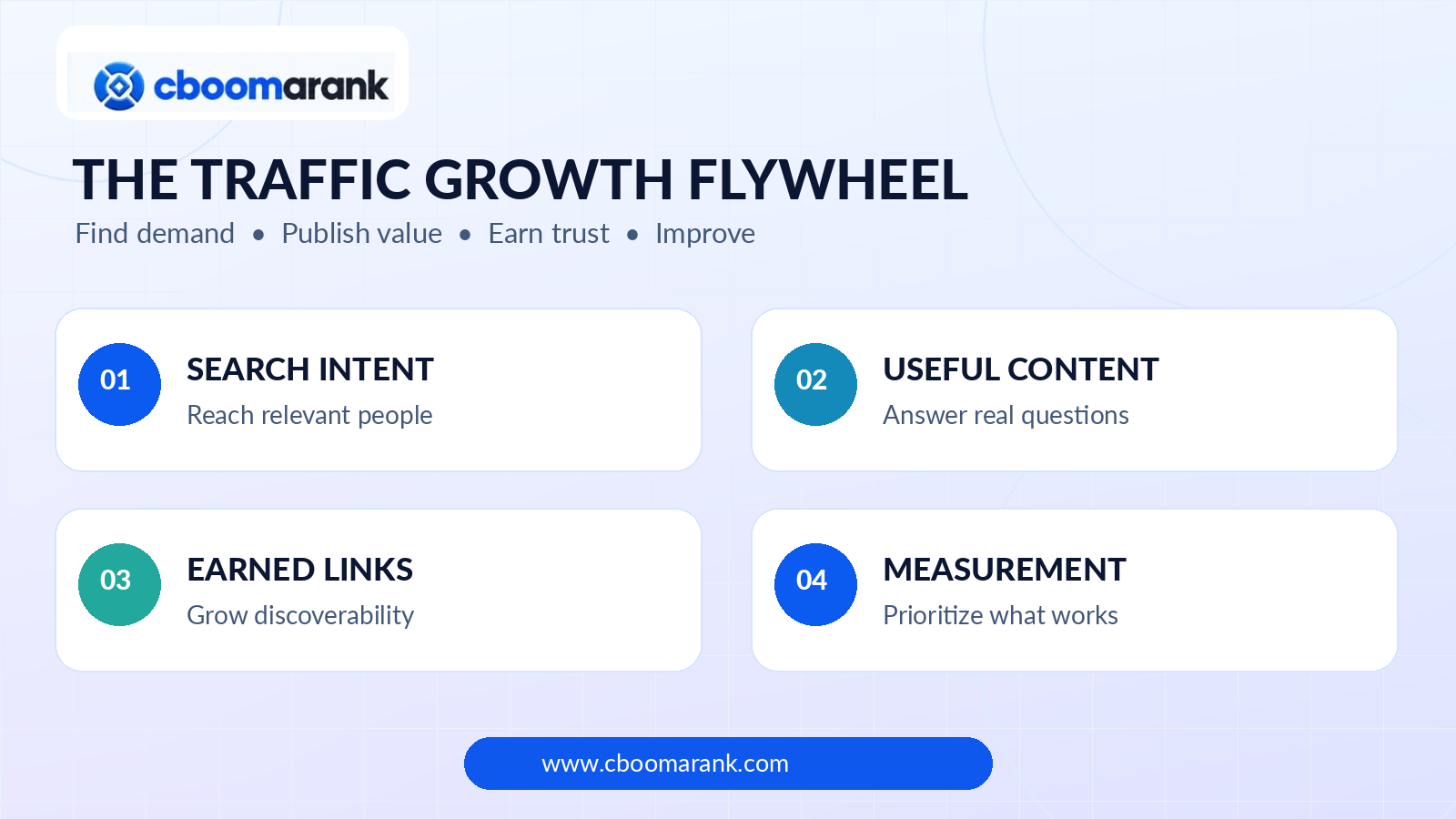
21. Publish first-hand answers that generic articles lack
Examples, screenshots, experimental methods and practitioner observations make content useful. Explain how you reached a conclusion, its limitations and who the advice may not suit.
Practical next step: Add one verified example or process demonstration to a priority guide. What to track: Engaged organic sessions and mentions.
22. Create pillar guides to increase website traffic
A strong pillar guide links to narrower answers while remaining useful on its own. Cover the main decision, the steps and the pitfalls without forcing a reader to open multiple pages to understand the basics.
Practical next step: Choose a core theme and connect six supporting resources. What to track: Non-brand organic clicks across the cluster.
23. Answer the question early, then offer depth
Open informational pages with a short direct answer before the detailed explanation. Visitors should understand whether the page addresses their problem within the first screen.
Practical next step: Rewrite the opening of three articles to answer the exact question immediately. What to track: Organic landing-page engagement.
24. Publish original case studies with limitations
Show the starting problem, changes, timeframe, result and what else may have affected the outcome. Avoid presenting a single success story as proof that every reader will experience the same growth.
Practical next step: Document a real customer-approved or internal experiment with a reproducible method. What to track: Qualified referrals and assisted conversions.
25. Write buyer-intent comparisons to increase website traffic
People deciding between tools want criteria, drawbacks, price transparency and use-case recommendations. Explain when each alternative makes sense rather than filling the page with affiliate or brand claims.
Practical next step: Create a comparison framework covering requirements, pricing model and learning curve. What to track: Trial starts or demos from comparison pages.
26. Build a glossary that solves real terminology questions
Define concepts in plain language and link readers to practical implementations. Only create a glossary entry when it answers a distinct question; near-identical thin pages can compete with each other.
Practical next step: Expand one frequently misunderstood term into a useful worked example. What to track: Glossary-assisted navigation.
27. Refresh pages losing relevance or accuracy
Find pages that once attracted relevant clicks but have declined. Diagnose whether the topic changed, competition improved or the intent shifted before simply changing the publication year.
Practical next step: Update evidence, examples, links and screenshots, preserving the existing URL. What to track: Clicks on refreshed pages over 8–12 weeks.
28. Turn verified data into compelling visuals
A diagram can explain a process faster than several paragraphs. Label the source, date and units of any real figures; illustrative graphics should not imply fabricated performance results.
Practical next step: Convert one complex workflow into a branded, accessible visual with ALT text. What to track: Image shares and resource citations.
29. Create localized pages only when they provide distinct value
Different countries may require different vocabulary, pricing, laws or service availability. Avoid mechanically substituting city names into otherwise identical pages; write genuinely useful local information.
Practical next step: Select one location where products, examples or customer needs materially differ. What to track: Country-specific qualified organic visits.
30. Use an editorial calendar tied to search demand
Plan content around audience questions, business seasonality and resource capacity. A steady schedule helps operations, but sheer publishing volume is not a ranking strategy and should never outrun quality control.
Practical next step: Assign an editor, owner, review date and outcome metric to every planned article. What to track: Published quality-controlled pages.
Earn relevant backlinks to increase website traffic: Strategies 31–40
Earn authority through resources worth citing and relevant editorial relationships. Together, these steps can help you increase website traffic from more relevant audiences while building a foundation that is easier to maintain.
31. Build link-worthy resources to increase website traffic
Useful calculators, templates, original data and carefully maintained checklists give other sites a reason to link to you. The resource must work without requiring a backlink in return.
Practical next step: Release one practical, freely accessible resource solving a repeated audience problem. What to track: Relevant referring domains.
32. Earn media citations by contributing credible expertise
Journalists and specialist publishers value clear evidence and quotable explanations. Share accurate observations and disclose your affiliation; do not pressure editors for a link or imply coverage is guaranteed.
Practical next step: Prepare a short expert briefing with sources and reproducible figures. What to track: Earned mentions and referral sessions.
33. Collaborate on useful research with industry experts
A joint survey, benchmark definition or methods guide can add expertise and reach. Agree on editorial independence, data integrity and link disclosure before inviting partners.
Practical next step: Invite a qualified collaborator to review an evidence-based resource. What to track: Collaborative referrals and citations.
34. Ask relevant partners to cite the right resource
Vendors, integration partners and associations may maintain useful resource pages. Suggest a link only when it improves their readers’ experience; never trade links solely to manipulate search rankings.
Practical next step: Identify five partners whose audience actually benefits from your resource. What to track: Relevant partner referral traffic.
35. Contribute to professional associations and communities
Industry organizations often feature tutorials, directories and learning material. Offer a genuinely helpful contribution and use accurate authorship; participation is more valuable than placement in a low-quality directory.
Practical next step: Submit an original educational talk, article or tool to one relevant association. What to track: High-intent partner visits.
36. Guest-post for editorial value, not link manipulation
Publish where you bring new expertise to a genuinely relevant audience. Avoid scaled low-quality guest posts and paid placements that pass ranking credit; sponsored links must be appropriately qualified.
Practical next step: Pitch one evidence-backed article tailored to an external publication’s readers. What to track: Qualified referral visits.
37. Turn unlinked brand mentions into clear resource citations
When a publication mentions your original work but omits a useful source link, a polite correction request may help readers verify the claim. Accept that editors control whether and how to cite.
Practical next step: Review legitimate brand mentions and prioritize those referring to specific research. What to track: Relevant linked mentions.
38. Offer a better replacement for genuinely broken resources
A broken external resource presents an editorial problem. If your guide actually fills the gap, alert the editor to the issue without mass automated outreach or irrelevant replacement pitches.
Practical next step: Verify each broken link and submit a concise, relevant alternative once. What to track: Referral-quality earned backlinks.
39. Monitor new and lost backlinks in context
Backlink totals alone can be misleading; judge topical relevance, page quality, link attributes and whether the destination still works. Changes matter most when they coincide with valuable traffic or lost citations.
Practical next step: Review new and lost links alongside authority signals and landing-page performance. What to track: Relevant referring domains and referral conversions.
40. Avoid backlink schemes and unnatural anchor patterns
Buying followed links, excessive exchanges, automated comments and private link networks can undermine trust and violate search spam policies. Invest in useful assets, real partnerships and editorial outreach instead.
Practical next step: Audit outreach templates and remove requests that demand exact-match followed links. What to track: Spam-risk exposure and quality referrals.
Related reading: The high-authority links guide explains how to assess link relevance and earn trustworthy citations. For link-earning practices, check Google’s spam policies.
Increase website traffic through promotion and retention: Strategies 41–47
Broaden discovery with consent-based promotion and useful returning-visitor experiences. Together, these steps can help you increase website traffic from more relevant audiences while building a foundation that is easier to maintain.
41. Send useful, segmented email newsletters
Subscribers return when emails consistently solve a problem they care about. Segment by audience and behavior, obtain consent and measure on-site outcomes rather than open-rate vanity metrics alone.
Practical next step: Send a concise digest with two relevant resources and one clear next step. What to track: Email-attributed engaged sessions.
42. Repurpose one guide into platform-native explanations
A detailed tutorial can become a short video, infographic, carousel or social thread without copying entire sections verbatim. Adapt the opening and context to each platform, then link to the full resource when useful.
Practical next step: Create three audience-specific formats from one pillar article. What to track: Engaged social referrals.
43. Answer community questions to increase website traffic
Forums and Q&A communities reward specific, transparent answers. Contribute value first, disclose affiliations and add a link only when it provides genuinely useful detail.
Practical next step: Answer three real questions with actionable steps and no promotional spam. What to track: High-quality community referral sessions.
44. Teach live workshops and educational webinars
A short demonstration makes a complex workflow credible and creates material worth sharing afterward. Publish the notes, transcript or slides as a resource that remains useful beyond the event.
Practical next step: Host a 30-minute tutorial centered on one audience problem. What to track: Attendee-to-visitor and lead rates.
45. Offer useful free tools to increase website traffic
An interactive utility gives visitors a reason to return and recommend your site. Explain what its output means, its data limitations and what a user should do next rather than hiding everything behind registration.
Practical next step: Start with a narrowly scoped checklist, calculator or site-analysis experience. What to track: Tool completion and follow-on conversion.
46. Use paid search selectively for validated demand
Paid clicks are not organic rankings, but carefully targeted campaigns can test landing pages or support a time-sensitive offer. Set budgets and negative keywords, track outcomes and pause segments without a plausible path to positive unit economics.
Practical next step: Test a small set of high-intent queries with dedicated landing pages. What to track: Cost per qualified lead.
47. Retarget visitors only with consent-compliant tracking
Remarketing can bring interested visitors back when privacy choices and local laws permit it. Limit frequency, segment by meaningful interest and avoid following users with irrelevant ads across channels.
Practical next step: Review consent handling, audience rules, exclusions and campaign frequency. What to track: Incremental conversions and acquisition cost.
CBOOMARANK workflow: Review SEO visibility, research competitors and monitor backlink opportunities within your projects. Learn about available plans on the CBOOMARANK pricing page.
Measure and improve results to increase website traffic: Strategies 48–50
Turn visits into measurable business outcomes and a repeatable improvement cycle. Together, these steps can help you increase website traffic from more relevant audiences while building a foundation that is easier to maintain.
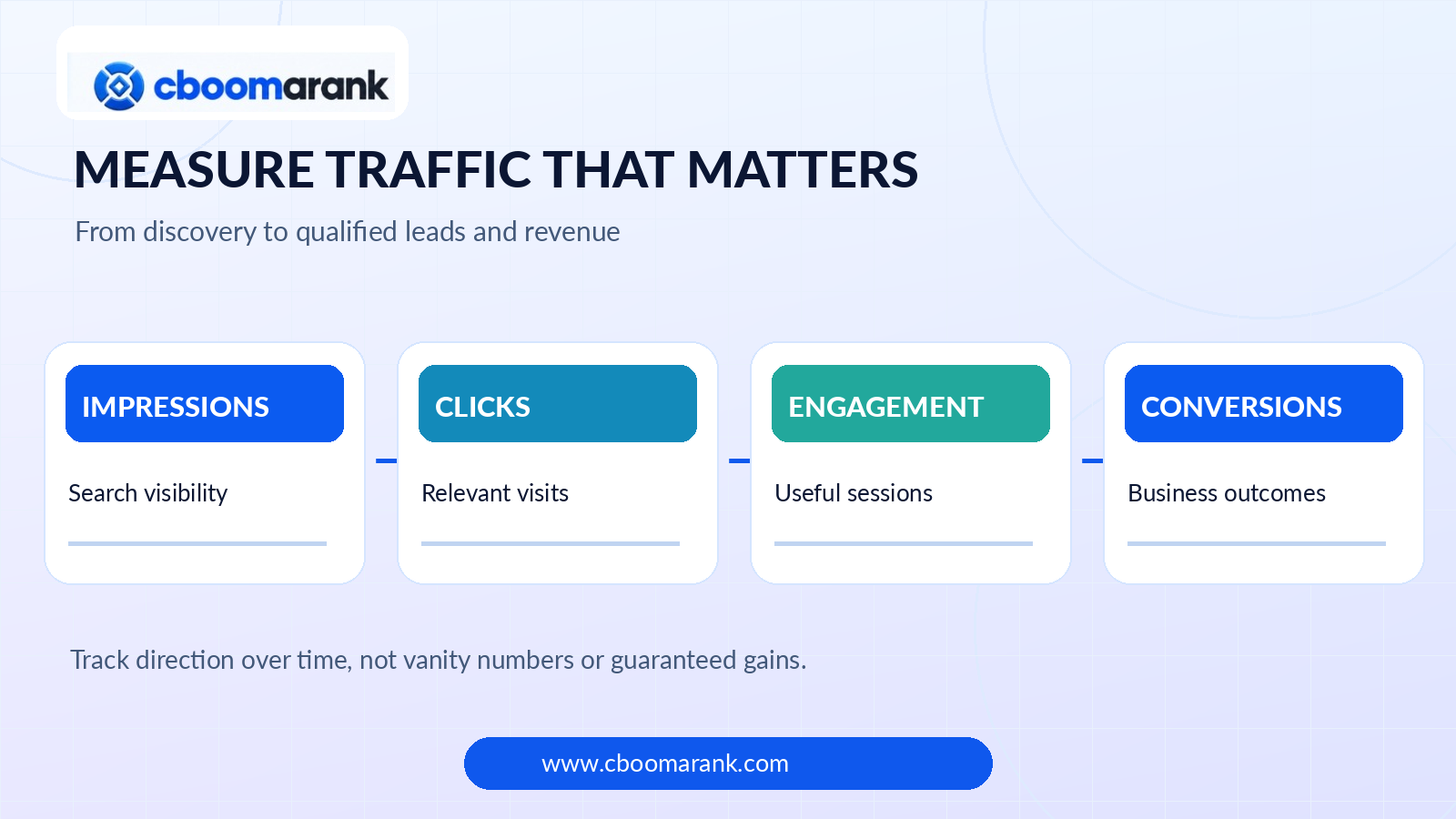
48. Compare acquisition channels using meaningful conversions
Sessions are not equivalent to sales. Separate organic, paid, email, social and referral channels; evaluate key events, assisted journeys and attribution caveats before reallocating budget.
Practical next step: Build a monthly channel table with visits, leads and revenue when reliable data exists. What to track: Channel-level qualified lead and revenue trends.
49. Improve high-traffic pages that convert poorly
Increasing website traffic is only valuable when the right visitors can take an appropriate next step. Match each page to a relevant CTA, reduce distractions and test clarity before adding more form fields.
Practical next step: Experiment with the CTA and layout on one high-traffic landing page. What to track: Engaged sessions-to-lead rate.
50. Run a monthly traffic-improvement cycle
Traffic growth is iterative: select one hypothesis, make a traceable change, wait for enough data and compare with seasonality and competitor movement. Keep an experiment log so the team learns from unsuccessful as well as successful tests.
Practical next step: Review the last 30–90 days, choose three prioritized fixes and assign owners. What to track: Qualified traffic and conversion trend.
Your 90-day plan to increase website traffic
Use a sequence that matches dependencies. Publishing more content cannot compensate for blocked indexation, and high search traffic with no relevant conversion path may not improve the business.
| Period | Priority | Deliverable | Success check |
|---|---|---|---|
| Days 1–15 | Baseline and technical barriers | Analytics audit, indexing review, ten priority URLs | Reliable tracking and resolved critical blockers |
| Days 16–30 | Search intent and existing content | Keyword-to-page map; refresh five high-value pages | Improved relevance and internal navigation |
| Days 31–60 | Publish and promote useful content | Two deep resources, one visual and expert outreach | New relevant queries and earned mentions |
| Days 61–90 | Measure and expand winners | Traffic-to-conversion report and three controlled experiments | Qualified visitor and lead trend |
For a small business, a positive result might mean fewer visits but more inquiries. For a publisher, relevant returning visitors, advertiser interest and newsletter growth can matter more than a broad spike in sessions.
How CBOOMARANK can help increase website traffic
Rather than juggling disconnected exports, teams can use CBOOMARANK website analysis, keyword research, competitor research, authority reporting and backlink workflows to prioritize improvements. These tools support investigation and decision-making; they do not guarantee search visibility or revenue.
Explore CBOOMARANK SEO workflows and review CBOOMARANK plans when you are ready to track progress across projects.
Frequently asked questions about increasing website traffic
How can I increase website traffic for free?
Improve indexability, write useful answers to real search questions, refresh pages that have lost relevance, add contextual internal links and participate helpfully in communities. These steps cost time and effort, even without paying for clicks.
How long does SEO take to increase website traffic?
There is no universal timeframe. Some fixes are reflected quickly, while competitive organic visibility may take weeks or months. Search Console trends should be interpreted alongside seasonality, site changes and search demand.
Do backlinks still help website traffic?
Relevant editorial links can help readers discover your site and can contribute to a broader SEO strategy. Low-quality paid links, automated link schemes and irrelevant exchanges create risk rather than durable value.
Should I focus on traffic or conversions first?
Measure both, but prioritize traffic from people who might reasonably benefit from your offer. Set up key events or lead goals before major promotion so you can evaluate the business outcome.
What is the difference between SEO and paid traffic?
SEO aims to earn visibility in unpaid search results; paid campaigns buy ad placement and stop generating paid clicks when spending stops. Both can be useful when matched to intent and measured against outcomes.
Which website traffic metrics should I report monthly?
Report search clicks, engaged organic sessions, landing-page performance, conversions, qualified leads and key referring sources. Explain attribution limitations and annotate major site changes.
Conclusion: Increase website traffic through sustained relevance
If you want to increase website traffic in 2026, prioritize what helps the right visitor. Use technical SEO to remove obstacles, content to answer valuable questions, ethical backlinks to earn discovery and trustworthy measurement to guide decisions. Choose the next three actions you can genuinely complete, then track both traffic and conversions.
Next step: Visit www.cboomarank.com to explore website-analysis resources or compare CBOOMARANK plans for a more organized SEO workflow.
Authoritative references: Google SEO Starter Guide, Google people-first content guidance, Google link best practices, and Google Search spam policies.
