


AI Content Creation in 2026: The Opportunity and the Risk
AI content creation has moved from novelty to normal workflow. Marketing teams now use generative AI to brainstorm campaigns, research topics, outline articles, draft copy, repurpose assets, edit long-form content, produce images, create downloadable files and accelerate work that once required several separate tools.
The benefit is obvious: speed. The risk is just as important: speed makes it easier to publish mediocre, inaccurate or interchangeable content at scale. The teams getting the most value from AI are not simply asking a model to “write an article.” They are building a controlled process in which AI handles repeatable work while humans supply strategy, expertise, judgment, original evidence, brand voice and final accountability.
That distinction matters for SEO. Google’s current guidance does not say that AI-assisted content is automatically bad. It emphasizes accuracy, quality, relevance and people-first value, while warning that automation used mainly to manipulate rankings can violate spam policies. Google’s 2026 guidance for generative AI search also stresses unique, non-commodity content rather than pages that merely recycle what is already on the web.
This guide explains the strongest AI content creation tools for different use cases, then gives you a practical process for producing content that is faster to create but still worth reading, trusting, sharing and ranking.
Related CBOOMARANK resources: Best AI Marketing Tools in 2026 • SEO Optimization Guide • Top Keyword Research Tools Compared
What Is AI Content Creation?
AI content creation is the use of artificial intelligence to support one or more stages of the content lifecycle. That can include ideation, research, outlining, drafting, editing, translation, personalization, repurposing, visual generation, SEO optimization and content analysis.
The most important word is support. A mature AI workflow does not outsource the entire content strategy to a model. It uses AI where automation creates leverage, then adds human review where context, accuracy, taste, ethics and business judgment matter most.
For example, an AI tool can quickly turn a product brief into ten headline options. A subject-matter expert still needs to decide which promise is credible. AI can draft a 2,000-word article. An editor still needs to verify the facts, remove generic filler, add first-hand insight, improve the examples and make sure the article actually answers the reader’s question.
Best AI Content Creation Tools in 2026
| Tool | Best For | Key Strength | Pricing / Access |
| CBOOMARANK AI + Article Generator | CBOOMARANK publishers and SEO-led content workflows | Website/SEO context, article drafting, editable title/slug/meta/body, publisher workflow | Check current CBOOMARANK plan |
| ChatGPT | General-purpose content creation, editing and research | Plan, draft, revise, adapt tone, work with files and research | Free tiers; Plus $20/mo |
| Claude | Long-form thinking, editing and creative knowledge work | Ideation, nuanced drafting, long-context review and creative workflows | Free and paid tiers; check current plan |
| Gemini | Google ecosystem and file creation | Writing, planning, multimodal work and direct file generation/export | Free and paid tiers vary |
| Jasper | Marketing teams that need brand governance | Brand Voice, marketing agents, content pipelines and team governance | Pro $69/mo/seat |
| Copy.ai | GTM teams and repeatable marketing workflows | Content creation, workflows, Brand Voice and multi-model access | Chat $29/mo monthly |
| Grammarly | Editing, clarity, tone and final polish | Proofreading, rewrites, tone suggestions and AI editing assistance | Free and paid tiers |
1. CBOOMARANK AI + Article Generator — Best for Integrated SEO Publishing
Best for: CBOOMARANK publishers who want AI-assisted content creation connected to website and SEO context.
CBOOMARANK’s strongest content-creation advantage is integration. The Publisher AI Copilot is designed to use a publisher’s own SEO context — including website metrics, audits, keyword research and competitor research — to surface prioritized actions and SEO questions. The separate Publisher Article Generator gives publishers an editable draft workspace with fields such as title, slug, meta description and body.
That connected path matters because the hardest part of AI content creation is rarely generating words. The harder problem is deciding what to create, why it matters, which keyword and audience it serves, and how the finished article fits into a broader SEO plan.
Editorial disclosure: CBOOMARANK AI and the Publisher Article Generator are CBOOMARANK products. This section is first-party product information, not an independent benchmark against third-party models.
- Integrated with the wider CBOOMARANK SEO workflow
- Supports publisher-specific content generation rather than mixing publisher drafts with buyer/order records
- Editable title, slug, meta description and article body
- Can use configured AI providers when available and data-backed generation when needed
- Useful when keyword, audit and competitor insights should directly inform content decisions
Learn more: CBOOMARANK app • CBOOMARANK pricing
2. ChatGPT — Best General-Purpose AI Writing Partner
ChatGPT is a strong general-purpose choice for planning, drafting, revising and adapting content. OpenAI’s current writing guidance recommends a simple Plan → Draft → Revise → Package workflow and explicitly treats model output as a draft that should be reviewed rather than a final authority.
For content teams, the flexibility is the main advantage. You can turn rough notes into a structured article, generate multiple versions for different audiences, rewrite technical language in simpler terms, critique a draft, create an editorial checklist, or use uploaded files as source material.
ChatGPT Plus is currently listed at $20 per month and includes broader model/tool access plus features such as file uploads, image generation and Deep Research where available.
- Strong for ideation, outlines and first drafts
- Good at tone adaptation and rewriting
- Useful for file-based drafting and research
- Flexible across blog, email, social, scripts and internal documents
- Best results come from detailed context and human revision
Official source: OpenAI Academy: Writing with ChatGPT
Official source: OpenAI: ChatGPT Plus
3. Claude — Best for Thoughtful Long-Form and Creative Work
Claude is a strong fit for long-form editing, synthesis and creative knowledge work. Anthropic’s own creative-work guidance frames AI as a way to expand ideation and reduce repetitive manual work without replacing taste or imagination.
That philosophy maps well to high-quality content production. Claude can help a team explore angles, restructure an article, challenge weak reasoning, summarize source packs, maintain context across long drafts and generate alternatives without forcing every task into a rigid template.
For editorial teams, Claude is especially useful when the job involves sustained reasoning over a large amount of context rather than just generating short marketing copy.
- Strong long-form drafting and editing
- Useful for analyzing source-heavy material
- Good for creative variation and restructuring
- Works well when nuance and consistency matter
- Should still be fact-checked and edited before publication
Official source: Anthropic: Claude for Creative Work
4. Gemini — Best for Google-Centric Workflows and File Creation
Gemini is attractive for teams that already work heavily inside Google’s ecosystem. Google describes Gemini as an AI assistant for writing, planning and other tasks, and in 2026 expanded the app so users can create downloadable files such as Microsoft Word documents, PDFs, Google Docs, Sheets and Slides directly from a prompt.
That makes Gemini useful when content creation is not just about producing text in a chat window. A marketer can move from brainstorming to a formatted deliverable without manually copying content between tools.
Gemini is also useful for multimodal workflows where text, images and other content formats are part of the same project.
- Writing and planning inside the Gemini app
- Direct generation of common document/file formats
- Natural fit for teams using Google Workspace
- Useful multimodal capabilities
- Good for packaging content after drafting
Official source: Google: Generate files in Gemini
5. Jasper — Best for Marketing Brand Governance at Scale
Jasper is purpose-built for marketing rather than general chat. Its current platform combines marketing agents, content pipelines, Brand Voice, style guides, audience context and a knowledge base so teams can codify the rules that should shape generated content.
That governance layer is valuable for larger teams because the challenge at scale is consistency. If ten people use AI differently, the brand can become fragmented. Jasper’s positioning is built around making AI outputs repeatable, on-brand and governed across marketing workflows.
Jasper currently lists its Pro plan at $69 per month per seat, with custom Business pricing for more advanced workflows and controls.
- Marketing-specific agents and workflows
- Brand Voice, style guides and audience context
- Content Pipelines for repeatable execution
- Useful for localization, campaign content and enterprise governance
- Strong fit for teams with strict brand standards
Official source: Jasper Platform
Official source: Jasper Pricing
6. Copy.ai — Best for Repeatable GTM Content Workflows
Copy.ai has evolved beyond a simple copy generator into a go-to-market AI platform. Its current product includes content creation workflows, Brand Voice, reusable workflows, chat and integrations designed to connect marketing, sales and operations.
That makes it useful when content is part of a repeatable business process — for example, turning account research into personalized outreach, generating product or campaign variants, or codifying an internal content playbook.
Copy.ai currently lists its Chat plan at $29 per month billed monthly or $24 per month billed annually, with five seats, unlimited words in Chat and access to OpenAI, Anthropic and Gemini models.
- Useful for structured GTM content workflows
- Brand Voice and shared process automation
- Multi-model access in the Chat plan
- Good for marketing/sales content at scale
- Better fit for workflow automation than one-off article drafting alone
Official source: Copy.ai platform
Official source: Copy.ai pricing
7. Grammarly — Best for Editing, Clarity and Final Polish
Grammarly is most valuable late in the workflow. Its current product combines proofreading, paragraph rewrites, tone suggestions and AI assistance focused on improving how finished writing reads.
That makes it a useful quality-control layer after a draft has already been researched and fact-checked. Instead of asking it to invent the article strategy, use Grammarly to simplify awkward sentences, catch grammar problems, tighten tone and make the final copy easier to read.
Grammarly also offers AI-detection and “humanizer” features, but those should not become a substitute for genuine human editing. The goal is not to trick a detector; it is to publish content that sounds natural because a real editor shaped it.
- Proofreading and clarity improvement
- Tone suggestions and rewrites
- Useful final-stage quality control
- Good companion to other generative AI tools
- Best used to improve real editorial work, not conceal automation
Official source: Grammarly AI writing assistance
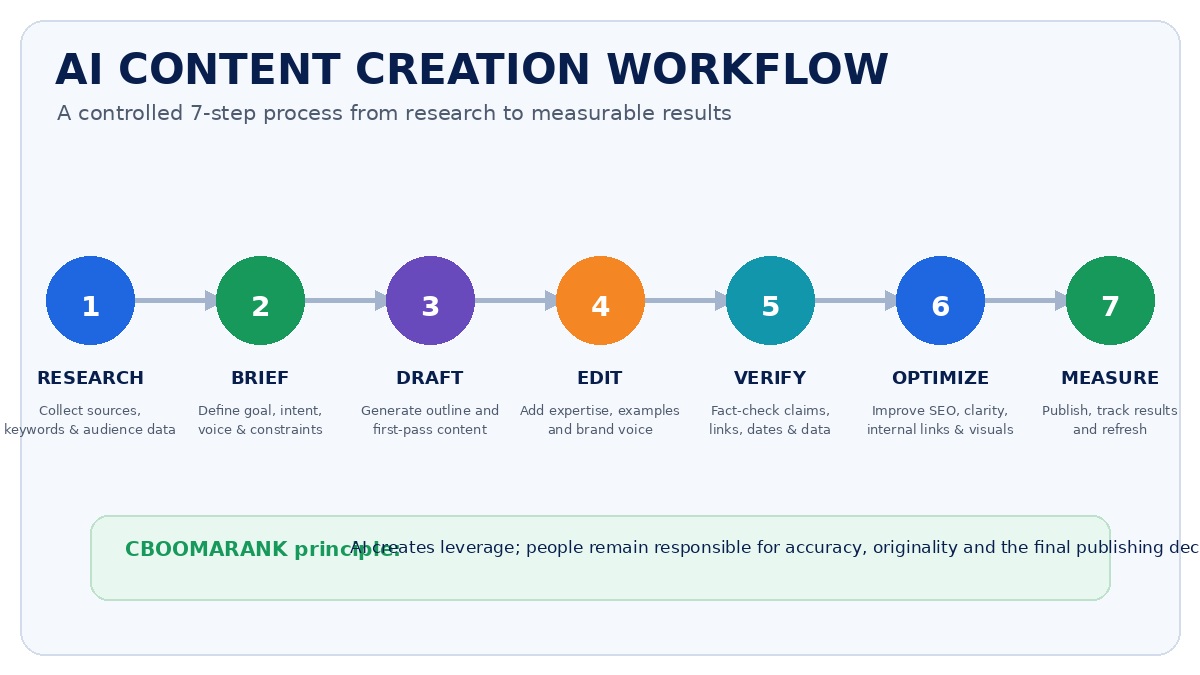
The AI Content Creation Workflow: From Idea to Publishable Asset
1. Define the business goal and audience
Start with the outcome. Is the content meant to rank for an informational query, generate a lead, support a product launch, nurture customers, answer a support question or build authority? Give the AI that context before asking it to write.
2. Research before generating
Collect primary sources, product information, customer questions, keyword data, competitor examples and subject-matter expertise. AI performs better when it is grounded in real material instead of being asked to guess.
3. Create a detailed content brief
Specify the audience, purpose, topic, primary search intent, key points, required sources, brand voice, prohibited claims, desired structure, examples and CTA. A good brief reduces generic output.
4. Generate an outline first
Review the outline before producing the full draft. It is much faster to fix a weak structure at the outline stage than to rewrite 2,500 words after generation.
5. Draft in sections
For important long-form content, generate and review major sections separately. This gives you more control over depth, examples, repetition and factual accuracy.
6. Add human expertise and original value
Insert your own examples, screenshots, process details, test results, customer insights, opinions and first-hand experience. This is what turns generic AI text into content only your organization could publish.
7. Fact-check every material claim
Verify dates, prices, product features, statistics, quotations, legal claims and technical statements against primary sources. Never assume a confident AI answer is automatically correct.
8. Optimize for search without writing for algorithms
Use a descriptive title, clear H1, useful subheadings, descriptive internal links, relevant images and accurate metadata. Match the search intent first; keyword placement is secondary.
9. Edit for voice, clarity and trust
Remove filler, repeated conclusions, generic transitions and inflated claims. Make the writing sound like your brand and make authorship/review responsibility clear.
10. Publish, measure and improve
Track impressions, clicks, engagement, conversions and downstream business value. Refresh content when facts change or when performance data shows a specific opportunity.
A Better Prompt Framework for Content Teams
Prompts improve when they look more like a professional brief and less like a one-line command. Instead of “Write a blog post about email marketing,” give the model enough context to make informed choices.
A practical prompt can follow this structure:
- Role: who the model should act like — editor, researcher, product marketer or SEO strategist.
- Goal: what the content should accomplish after the reader finishes it.
- Audience: who the reader is, what they already know and what they care about.
- Inputs: approved facts, source links, interview notes, product documentation and keyword data.
- Deliverable: article, email sequence, landing page, brief, script, FAQ, social post or other format.
- Constraints: tone, length, claims to avoid, compliance rules, reading level and must-use facts.
- Quality bar: request original examples, clear reasoning, source attribution and a self-critique before finalizing.
Example workflow prompt: “Create a detailed outline for a 2,000-word guide for small-business owners evaluating AI content tools. Use the attached research as the factual source. Separate verified facts from recommendations. Include an SEO title, meta description, practical examples, a decision table and a final checklist. Do not invent pricing or statistics. Flag any fact that needs verification.”
AI Content Creation Best Practices for 2026
Use AI as a collaborator, not an autopilot
The best workflow assigns AI tasks it can accelerate while keeping a human accountable for final claims, positioning and publishing decisions.
Create from first-party knowledge whenever possible
Feed the model interviews, product documentation, proprietary data, customer questions, internal research and real examples. Original inputs produce more differentiated outputs.
Require primary sources for time-sensitive facts
Pricing, policies, model names, software features, regulations and statistics change. Link to the original source and record the date checked.
Separate drafting from fact-checking
Do not ask the same generation to invent and verify itself. Use a second pass that explicitly checks every factual claim against sources.
Build a brand voice system
Document preferred tone, vocabulary, formatting, prohibited phrases, example copy and audience expectations. Reusable voice rules reduce inconsistency.
Avoid scaled commodity content
Publishing hundreds of near-duplicate pages because AI makes it cheap is not a sustainable content strategy. Google explicitly warns against scaled content created mainly to manipulate rankings.
Be transparent when the creation method matters
Google recommends considering disclosure when readers would reasonably want to know how automation or AI substantially contributed to a piece. Disclosure can increase context and trust.
Protect confidential information
Do not paste sensitive customer data, private credentials, unpublished financial information or restricted documents into AI systems unless your organization has approved the data-handling setup.
Use human editorial review for high-stakes topics
Health, finance, law, safety and other YMYL topics need especially strong expertise, sourcing and review. AI is not a substitute for qualified professional judgment.
Measure quality, not just output volume
Track whether AI-assisted content attracts qualified traffic, earns engagement, generates leads and improves customer outcomes. More published words are not automatically better content operations.
What Google Says About AI-Generated Content
Google’s current guidance is more nuanced than “AI content is good” or “AI content is bad.” Its ranking systems aim to reward helpful, reliable, people-first information regardless of how it was produced.
The red line is purpose and quality. Google says using automation primarily to manipulate rankings can violate spam policies. Its people-first guidance also warns against mass-producing content, summarizing what others say without adding value, or using extensive automation across many topics simply to capture search traffic.
For generative AI search experiences, Google’s 2026 optimization guide emphasizes unique, valuable, non-commodity content. In practical terms, that means original perspective, first-hand experience, useful media, trustworthy sourcing and satisfying task completion are becoming more important — not less.
Official source: Google: Helpful, reliable, people-first content
Official source: Google: Guidance on generative AI content
Official source: Google: Optimizing for generative AI features

Where AI Content Creation Works Best
| Use Case | How AI Helps |
| Blog and SEO content | Research support, outlines, draft sections, FAQs, comparison tables, metadata and content refreshes. |
| Email marketing | Subject-line variants, lifecycle sequences, personalization ideas, summaries and segmentation copy. |
| Social media | Platform-specific rewrites, hooks, captions, content calendars and repurposing long-form assets into short-form posts. |
| Product marketing | Feature-to-benefit rewrites, launch messaging, use-case pages, FAQs and comparison copy. |
| Sales enablement | Call summaries, personalized follow-ups, account-specific messaging and proposal drafts. |
| Video and podcast support | Scripts, show notes, chapter summaries, title ideas and repurposed clips/posts. |
| Internal knowledge | SOPs, FAQs, training material, meeting summaries and structured documentation. |
| Visual content | Concept ideation, image prompts, layouts, presentation structure and derivative graphics. |
Common AI Content Mistakes to Avoid
- Publishing the first draft without human review.
- Allowing AI to invent sources, quotations, case studies or statistics.
- Creating one page for every keyword variation with little unique value.
- Copying competitor structure so closely that the result becomes derivative.
- Optimizing for AI detectors instead of optimizing for readers.
- Using a generic brand voice across every channel.
- Feeding confidential information into unapproved tools.
- Treating search volume as a content strategy without validating intent.
- Measuring productivity only by words produced instead of business outcomes.
- Failing to update AI-assisted content when products, prices or policies change.
Pre-Publication AI Content Quality Checklist
- ✓ The article has a clear audience and purpose.
- ✓ The main answer appears early and matches search intent.
- ✓ Every statistic, price, date and product claim has been verified.
- ✓ Primary sources are linked where practical.
- ✓ The content includes original examples, experience, data or perspective.
- ✓ Generic filler and repeated conclusions have been removed.
- ✓ The title, H1 and meta description are descriptive and accurate.
- ✓ Internal links point to relevant supporting pages.
- ✓ Images have meaningful ALT text and are relevant to the nearby copy.
- ✓ The content has been reviewed for brand voice and readability.
- ✓ The author/reviewer responsibility is clear where readers would expect it.
- ✓ Any appropriate AI/automation disclosure has been considered.
- ✓ The page has a useful next step or CTA.
- ✓ A measurement plan exists for traffic, engagement and conversions.
A 30-Day AI Content Creation Implementation Plan
Week 1: Build the rules
Choose approved tools, define brand voice, document privacy rules, decide which content types may use AI and create a fact-checking standard.
Week 2: Build the workflow
Create reusable briefs, prompts, review checklists and source templates. Test the workflow on one important article rather than dozens of low-value pages.
Week 3: Connect SEO and distribution
Use keyword research, Search Console data and audience insights to select content with real demand. Add internal linking and distribution plans before publication.
Week 4: Measure and improve
Compare AI-assisted output with previous content on time saved, editing effort, engagement, rankings, leads and conversion quality. Keep what improves outcomes and remove what only creates more volume.
Which AI Content Tool Should You Choose?
| User / Need | Recommended Starting Point |
| CBOOMARANK publisher using SEO data | CBOOMARANK AI + Article Generator |
| General-purpose individual creator | ChatGPT |
| Long-form/editorial-heavy work | Claude |
| Google Workspace-centric team | Gemini |
| Marketing team with strict brand governance | Jasper |
| GTM team automating repeatable content processes | Copy.ai |
| Writer who mainly needs editing and polish | Grammarly |
| Advanced content operation | Use a layered stack: strategy/data tool + generative model + editing/QA layer |
Frequently Asked Questions
Is AI-generated content bad for SEO?
Not automatically. Google says the focus should be on helpful, reliable, people-first content. Automation used primarily to manipulate rankings can violate spam policies, while useful AI-assisted content can be perfectly legitimate.
What is the best AI content creation tool?
There is no universal winner. ChatGPT is a flexible general-purpose option, Claude is strong for thoughtful long-form work, Gemini fits Google-centric workflows, Jasper focuses on marketing governance, Copy.ai emphasizes GTM workflows, Grammarly is strong for editing, and CBOOMARANK is best for its integrated publisher/SEO workflow.
Should I disclose that content used AI?
It depends on context. Google recommends considering disclosure when readers would reasonably want to know how content was created, especially when automation substantially contributed.
Can AI write a complete SEO article?
Yes, but a publishable article still needs research, source verification, human expertise, editing, internal links, visual support and a clear reason for the page to exist.
How do I stop AI content from sounding generic?
Give the model proprietary inputs, first-party experience, strong examples, explicit brand rules and a detailed brief. Then remove repetitive phrases and add a human editorial pass.
What should never be delegated entirely to AI?
Final factual accountability, sensitive legal or compliance judgments, high-stakes expert advice, confidential-data decisions and the strategic promise your brand makes to readers.
Can AI help with content updates?
Yes. It is especially useful for identifying stale sections, rewriting outdated explanations, comparing old and new source material, generating new FAQ candidates and repackaging existing content — but changed facts must be verified before publishing.
How should AI content performance be measured?
Track the same outcomes as any other content: qualified impressions, clicks, engagement, conversions, leads, revenue, backlinks and customer usefulness. Also measure production time and editing effort to see whether AI is actually improving operations.
Final Verdict: AI Should Increase Editorial Leverage, Not Remove Editorial Judgment
The strongest AI content programs in 2026 are not built around a single magic tool. They combine a clear strategy, reliable data, strong source material, one or more generative models, a repeatable editorial process and measurable quality standards.
Use AI to move faster on research, outlining, variations, first drafts and repetitive production. Keep humans responsible for expertise, originality, accuracy, taste, brand voice and the final decision to publish.
That balance is what turns AI from a content-volume machine into a genuine competitive advantage: better ideas, faster execution and more useful content without sacrificing trust.
Recommended CBOOMARANK Internal Links
- Best AI Marketing Tools in 2026
- SEO Optimization Guide
- Top Keyword Research Tools Compared
- Google Keyword Planner for SEO
- How to Find Trending Keywords for SEO
- Best Free SEO Tools for Beginners
- SEO Best Practices for 2026
- CBOOMARANK app
- CBOOMARANK pricing
External Sources and Further Reading
- OpenAI Academy — Writing with ChatGPT
- OpenAI — ChatGPT Plus
- Anthropic — Claude for Creative Work
- Google — Generate files in Gemini
- Jasper Platform
- Jasper Pricing
- Copy.ai platform
- Copy.ai Pricing
- Grammarly AI Writing Assistance
- Google — Helpful, reliable, people-first content
- Google — Generative AI content guidance
- Google — Generative AI search optimization guide
