


Additionally, A modern marketing technology stack should make marketing easier to measure, easier to automate and easier to improve. Yet many businesses build the opposite: dozens of disconnected tools, duplicate data, overlapping subscriptions and reports that do not agree. In 2026, the strongest approach is not to collect the most software. It is to choose a focused set of tools that work together around a clear customer journey.
In practice, This guide explains how to design a marketing technology stack for SEO, analytics, automation, customer management and reporting. It focuses on practical choices for website owners, marketers, agencies and growing businesses that need reliable data without creating unnecessary complexity.
What Is a Marketing Technology Stack?
Moreover, A marketing technology stack, often called a martech stack, is the collection of software a business uses to plan, execute, measure and improve marketing. The tools may cover content management, SEO, analytics, advertising, customer relationship management, email, automation, reporting and collaboration.
As a result, The important word is stack. Each platform should have a clear job and should exchange useful data with the rest of the system. A website analytics tool can show what visitors do. Search data can explain which queries bring them to the site. A CRM can show which visitors become leads or customers. Automation can move information between those systems and trigger follow-up actions.
For example, When those layers are connected, marketers can move from isolated activity metrics to a more useful question: which channels, pages, campaigns and messages create business results?
Why Marketing Technology Stack Design Matters in 2026
At the same time, Marketing teams now work across traditional search, paid media, social platforms, email, marketplaces and AI-assisted discovery. Measurement is also changing. Google Analytics continues to add cross-channel and AI-related reporting capabilities, while Search Console remains a core source for understanding queries, clicks, impressions and search-result performance.
Therefore, That means a technology stack must do more than collect pageviews. It should help a team understand discovery, engagement, conversion and retention across multiple channels. It also needs enough flexibility to adapt as new traffic sources emerge.
Meanwhile, A well-designed stack can reduce manual reporting, shorten response times, improve campaign attribution and make optimization decisions more consistent. By contrast, a poorly designed stack often produces duplicate records, broken tracking, conflicting dashboards and unnecessary subscription costs.
The 6 Core Layers of a Marketing Technology Stack
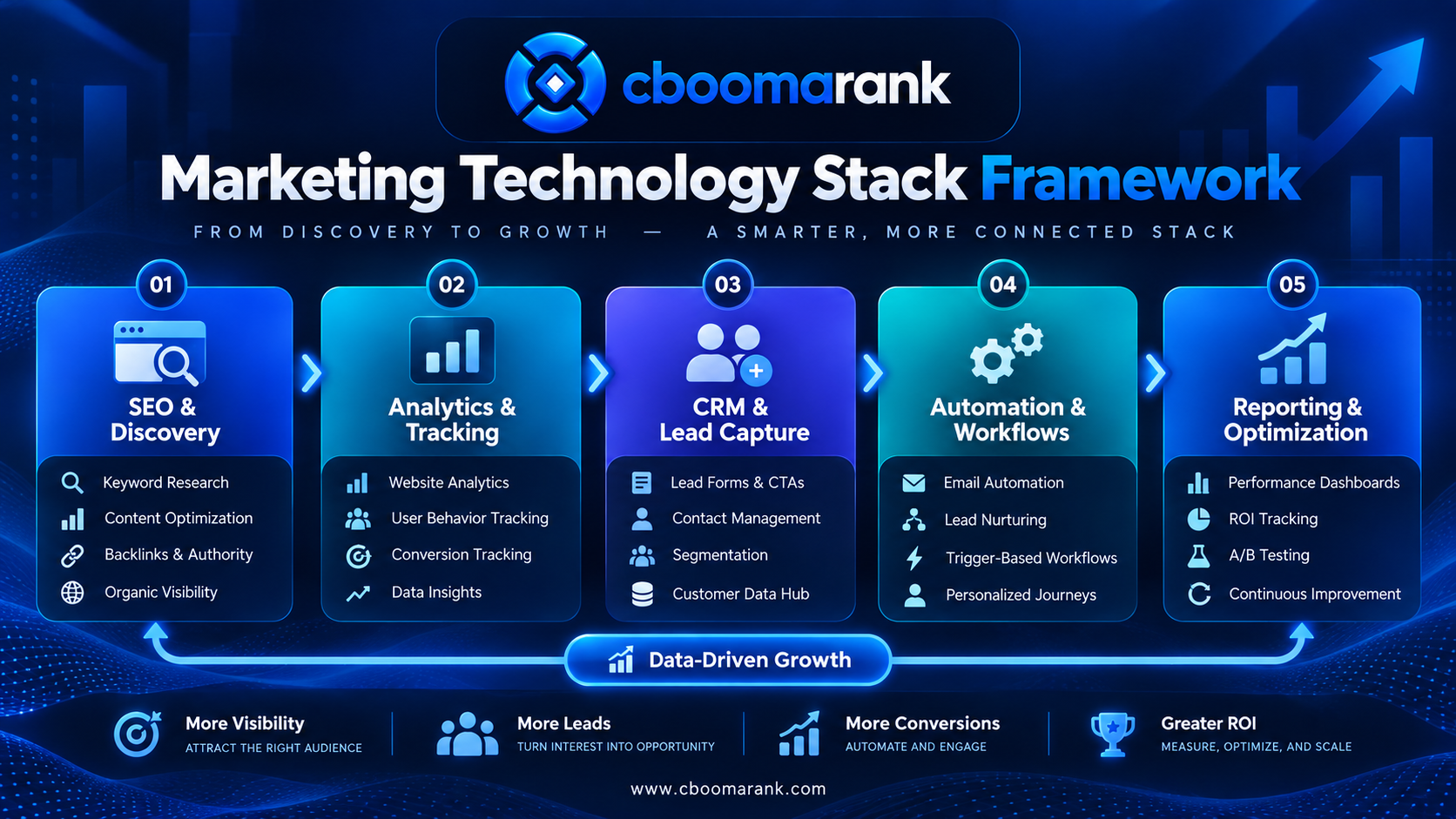
1. Website and Content Management
Additionally, Your website or commerce platform is the foundation of the stack. It hosts landing pages, content, product information, forms and many of the conversion events that other tools measure.
In practice, WordPress remains a flexible choice for content-led businesses, while ecommerce companies may use platforms such as Shopify or a custom application. The correct platform depends on publishing needs, development resources, ecommerce complexity and integration requirements.
Moreover, Whichever platform you use, prioritize speed, mobile usability, clean technical SEO, structured navigation and reliable event tracking. Marketing software cannot compensate for a website that is difficult to crawl, slow to use or unclear about the next step.
2. SEO and Search Intelligence
As a result, The SEO layer should help answer four questions: what are people searching for, how well does the site satisfy that demand, which competitors are visible, and what technical problems may be limiting performance?
A practical SEO workflow combines keyword research, competitor research, technical auditing and performance monitoring. CBOOMARANK can support this layer by bringing website analysis, keyword research, competitor insights and reporting into the same workflow. For a broader measurement perspective, see the CBOOMARANK guide to brand visibility measurement.
Search Console should also be part of the stack because it provides direct Google Search performance data, including queries, clicks, impressions, click-through rate and position. Google explains these metrics in its Search Console Performance report documentation.
Use first-party search data alongside broader keyword and competitor research rather than treating either source as complete on its own.
3. Analytics and Conversion Measurement
Analytics connects marketing activity to user behavior. Google Analytics 4 can measure traffic acquisition, engagement, events and conversion-related behavior across websites and apps. Review Google’s Google Analytics release notes for current reporting changes.
In 2026, Google has continued adding reporting capabilities, including dashboards and dedicated measurement for traffic from recognized AI assistants. These changes make it increasingly important to look beyond conventional referral and organic-search categories when analyzing discovery.
Analytics works best when the implementation starts with business questions rather than a long event list. Decide which actions represent meaningful progress: a qualified form submission, account creation, pricing-page visit, purchase, demo request, subscription or another outcome that matters to the business.
Paid advertising measurement belongs in this layer as well. Google Ads conversion tracking can connect ad interactions to valuable actions such as leads or sales. Google’s conversion tracking documentation explains the measurement concept and common conversion actions.
Consistent conversion definitions across advertising and analytics reduce the risk of optimizing campaigns toward vanity metrics.
4. CRM and Lead Management
A CRM stores the relationship history behind marketing activity. It can connect forms, email engagement, sales conversations and customer status to a single contact or account record.
For many small and mid-sized teams, HubSpot is a common example because its marketing automation can use CRM data for workflows, lead nurturing, scoring and customer journeys. HubSpot documents these capabilities in its marketing automation overview.
Other businesses may prefer Salesforce, Zoho, Pipedrive or a sector-specific CRM. The choice matters less than the operating discipline.
Define lifecycle stages, decide what qualifies a lead, prevent duplicate records and make sure the same status definitions are used by marketing and sales. A sophisticated CRM filled with inconsistent data is less useful than a simpler system with clean processes.
5. Automation and Integration
Automation connects the stack. It can move form submissions into a CRM, notify sales when a high-intent lead appears, add customers to the correct onboarding sequence or send campaign data to a reporting system.
Built-in automation is often the best place to start because it reduces integration complexity. HubSpot, for example, supports workflows for forms, emails and CRM-related processes.
When tools do not integrate directly, platforms such as Zapier can connect many applications and automate handoffs between them. See Zapier’s marketing automation overview for examples of cross-tool workflows.
Automation should remove repetitive work, not hide a broken process. Before creating a workflow, define the trigger, required data, action, owner and failure condition. Then monitor it. A silent automation failure can create missed leads or inaccurate reporting for weeks.
6. Reporting, Attribution and Decision Support
The final layer turns data into decisions. A useful dashboard should answer a limited number of recurring questions: where traffic comes from, which content attracts qualified visitors, which campaigns generate conversions, how conversion rates change and where the customer journey is leaking.
A reporting layer may use native dashboards in analytics, CRM and advertising platforms, or a dedicated business intelligence tool. The key is consistency. Agree on definitions for leads, conversions, revenue, channel groups and reporting periods before building executive dashboards.
AI can help summarize trends and surface anomalies, but it should not replace validation. For more on AI-assisted optimization, see AI SEO tools for research, content and visibility.
When a dashboard flags a sudden change, confirm that tracking, filters and integrations are working before assuming the market has changed.
Recommended Marketing Technology Stack by Function
| Function | Typical Tools | Primary Job |
|---|---|---|
| Website / CMS | WordPress, Shopify, custom application | Publish content and convert visitors |
| SEO intelligence | CBOOMARANK, Search Console | Research demand, competitors and site performance |
| Analytics | Google Analytics 4 | Measure acquisition, engagement and conversions |
| Paid media | Google Ads and platform ad managers | Acquire targeted traffic and measure paid conversions |
| CRM | HubSpot, Salesforce, Zoho, Pipedrive | Manage leads, lifecycle stages and customer relationships |
| Email / nurture | CRM email or specialist email platforms | Nurture audiences and customers |
| Automation | Native workflows, Zapier | Connect systems and reduce repetitive work |
| Reporting | Native dashboards or BI software | Turn channel data into decisions |
This is a framework, not a requirement to buy every category separately. One platform may cover several jobs. Consolidation can lower cost and reduce data fragmentation, but only when the consolidated tool performs the required functions well.
How to Choose Marketing Technology Stack Tools
Start With the Customer Journey
Map the steps from discovery to conversion before comparing software. A simple journey might be: search or social discovery, landing page, content engagement, pricing or product evaluation, lead form, sales follow-up and purchase.
For each step, identify the information needed to make a decision. If the team cannot explain how a tool supports one of those steps, the tool may not belong in the stack.
Choose One System of Record for Important Data
Decide where customer status lives, where conversion definitions live and where campaign naming rules are maintained. Multiple systems can use the data, but one source should be authoritative whenever possible.
For example, the CRM may own lifecycle stage, analytics may own website behavior and the accounting or commerce platform may own recognized revenue. Clear ownership prevents teams from arguing over numbers that were calculated from different definitions.
Prefer Integration Over Feature Count
A tool with hundreds of features is not automatically better than a focused platform that integrates cleanly with the rest of the stack. Evaluate APIs, native connectors, export options, permissions and data portability before buying.
Also consider what happens when a tool is removed. If historical data cannot be exported or workflows cannot be migrated, switching costs may become much higher than the subscription price suggests.
Measure Adoption as Well as Capability
Software only creates value when people use it correctly. During evaluation, consider setup time, training needs, documentation and the number of manual steps required for routine tasks.
A smaller team may get better results from a simpler stack with clear ownership than from enterprise software that requires constant administration.
A Practical Marketing Technology Stack for Small Businesses
A small business does not need an enterprise martech architecture. Start with the minimum stack that supports acquisition, measurement and follow-up.
- A reliable website or ecommerce platform.
- Google Search Console for organic search performance.
- Google Analytics 4 for site behavior and conversion measurement.
- An SEO research and website analysis platform such as CBOOMARANK.
- A lightweight CRM or email platform for lead management.
- Native automation or a connector for workflows that genuinely save time.
This setup covers the major questions without creating a large maintenance burden. Add tools only when a real process cannot be handled effectively by the existing stack.
A Marketing Technology Stack for Growing Teams
As a company grows, the stack usually needs stronger segmentation, attribution, workflow management and governance. The website and analytics layers remain important, but CRM and automation become more central.
At this stage, establish campaign naming conventions, lead-source rules, lifecycle definitions, dashboard ownership and a regular tracking audit. Create documentation for integrations so the team knows which system sends data, which system receives it and what happens when an error occurs.
Growing teams should also separate experimentation from core reporting. New AI, personalization or automation tools can be tested without immediately making them the source of truth for business-critical metrics.
Where CBOOMARANK Fits in the Marketing Technology Stack
CBOOMARANK belongs primarily in the SEO intelligence and website performance layer. Its role is to help website owners, marketers, buyers and publishers turn search and site data into actions.
Use website analysis to identify technical and on-page issues. You can also review the CBOOMARANK technical SEO guide and the SEO results measurement guide when planning the measurement layer.
Use keyword research to discover demand and prioritize content opportunities. The keyword research guide provides additional context for this process.
Use competitor research to understand where other sites are visible. Then connect those findings to content planning, reporting and conversion goals.
The important point is integration of decisions, not just integration of software. SEO insights should influence content, landing pages and campaigns. Analytics should show whether those changes improve engagement and conversions. CRM data should reveal whether the resulting leads become valuable customers.
Build your SEO intelligence layer with CBOOMARANK.
Analyze websites, research keywords, study competitors and connect search insights to your broader marketing workflow.
How to Connect SEO, Analytics and Automation
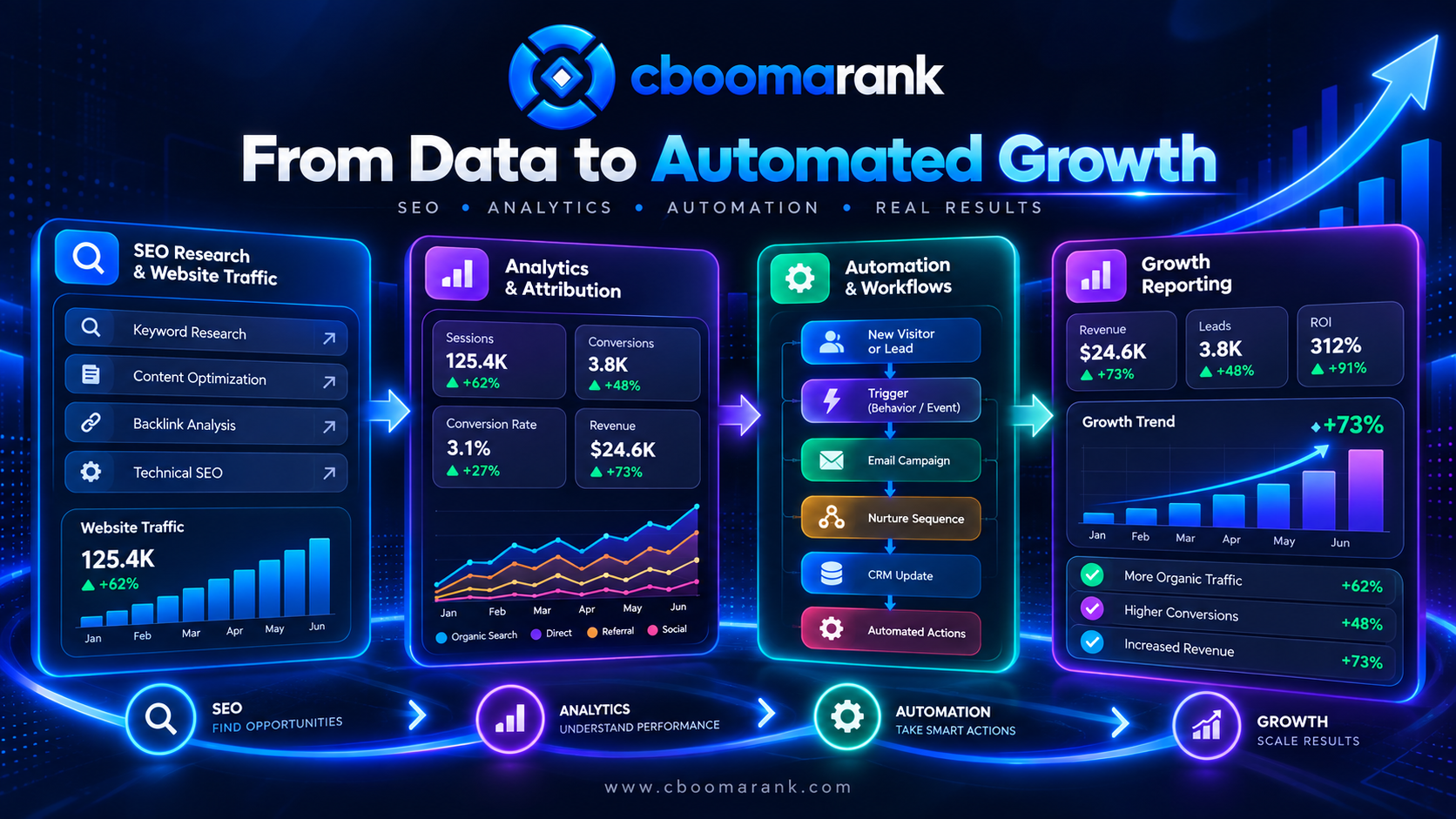
A useful stack creates a feedback loop. SEO research identifies an opportunity. Content or landing pages address the opportunity. Analytics measures engagement and conversion. CRM data shows lead quality. Automation routes the lead or triggers follow-up. Reporting then shows whether the original SEO opportunity produced business value.
Start with one workflow rather than trying to automate everything. For example, track visitors who land on a high-intent SEO page, visit pricing and then submit a form. Send the form to the CRM with campaign and landing-page context. Notify the appropriate team member and record the outcome.
Once that workflow is reliable, expand. The goal is to create repeatable processes that preserve context as prospects move between systems.
Marketing Technology Stack KPIs to Monitor
SEO and Discovery KPIs
Monitor impressions, clicks, click-through rate, ranking visibility, non-brand search growth and high-intent landing-page traffic. Avoid treating ranking position alone as the final outcome.
Engagement KPIs
Measure engagement with important pages, content paths, key events and return visits. These indicators help distinguish qualified traffic from traffic that leaves without meaningful interaction.
Conversion KPIs
Track lead conversion rate, purchase conversion rate, cost per acquisition, demo requests, sign-ups and other actions tied to business value. Ensure the same conversion event is not counted twice across integrations.
Revenue and Lifecycle KPIs
Where possible, connect marketing activity to qualified leads, opportunities, customers, revenue and retention. This prevents channel decisions from being based only on top-of-funnel volume.
Operational KPIs
Track automation errors, duplicate records, missing attribution, broken tags and reporting delays. Operational quality is part of marketing performance because bad data can lead to bad decisions.
Common Marketing Technology Stack Mistakes
Buying Tools Before Defining the Process
A platform cannot fix an undefined workflow. Document the process first, then choose software that supports it.
Collecting More Data Than the Team Uses
Every new event, field and dashboard increases maintenance. Prioritize data that influences a decision, report or automation.
Ignoring Data Governance
Define who can change tracking, integrations, CRM fields and campaign conventions. Uncontrolled changes create inconsistent reports.
Automating Low-Quality Inputs
Automation scales whatever enters the system. If lead data, campaign tagging or customer status is inaccurate, automation spreads the problem faster.
Using Too Many Overlapping SEO or Analytics Tools
Overlap can be useful for validation, but paying for several tools that answer the same question often adds cost without adding insight. Assign each platform a clear role.
Building Dashboards Without Decisions
A dashboard should support an action. If nobody knows what should happen when a metric rises or falls, the report is probably too broad.
A 30-Day Marketing Technology Stack Implementation Plan
Week 1: Audit the Current Stack
List every marketing platform, owner, cost, primary purpose, integration and renewal date. Identify duplicate tools, unused subscriptions and broken connections.
Week 2: Define Measurement and Data Ownership
Agree on conversions, lifecycle stages, channel names and the system of record for each important field. Confirm that Search Console, analytics and advertising conversions are configured correctly.
Week 3: Connect the Core Workflow
Integrate the website, analytics, SEO intelligence, CRM and essential automation. Test a real customer journey from acquisition through conversion and follow-up.
Week 4: Build Reporting and Governance
Create a small executive dashboard, document the integrations, assign owners and schedule a recurring tracking audit. Remove redundant tools only after confirming that required data has been preserved.
Marketing Technology Stack Checklist
- Each tool has one clearly defined primary purpose.
- Important customer and campaign data has an identified system of record.
- SEO data is connected to content and landing-page decisions.
- Search Console and analytics tracking are reviewed regularly.
- Conversions are defined consistently across analytics and advertising.
- CRM lifecycle stages are documented.
- Automations have owners and failure monitoring.
- Dashboards answer specific business questions.
- Data can be exported if a platform is replaced.
- Unused or overlapping subscriptions are reviewed regularly.
Frequently Asked Questions About a Marketing Technology Stack
How many tools should a marketing technology stack include?
There is no ideal number. A small business may need only a handful of platforms, while a complex organization may require many specialized systems. The better measure is whether each tool has a unique job and whether the stack can exchange reliable data.
What is the most important tool in a martech stack?
No single tool is universally most important. The website, analytics and customer data layers are usually foundational because other marketing activity depends on them. For organic acquisition, SEO and search-performance tools become essential as well.
Should SEO tools connect with analytics?
Yes. SEO tools help identify opportunities and problems, while analytics shows how visitors behave after they arrive. Combining those perspectives makes prioritization more useful.
Do small businesses need marketing automation?
Often, but they should start small. Automate repetitive tasks with clear value, such as lead routing, follow-up or reporting. Avoid complex workflows until the underlying process is stable.
What is the difference between a marketing technology stack and a marketing strategy?
The strategy defines who you want to reach, what value you offer and how you plan to grow. Clear positioning also depends on consistent communication; the brand messaging guide explains how search intent and conversion fit together.
The technology stack supports execution and measurement. Buying software without a strategy usually produces activity rather than direction.
How often should a marketing technology stack be reviewed?
Review core tracking and integrations regularly and conduct a broader stack audit at least a few times each year. Also review the stack after major changes to the website, CRM, advertising setup, privacy requirements or customer journey.
Final Takeaway
The best marketing technology stack is not the one with the most logos. It is the one that gives the team reliable data, clear ownership and faster decisions. Start with the customer journey, choose a system of record for important data, connect SEO and analytics to business outcomes, and automate only the processes that are already understood.
For CBOOMARANK users, the SEO intelligence layer can connect website analysis, keyword opportunities and competitor research to the rest of the marketing workflow. Combine those insights with first-party search data, analytics, CRM outcomes and carefully designed automation to build a stack that supports growth without becoming a burden.
Turn search data into a practical growth workflow.
Start with CBOOMARANK and review CBOOMARANK pricing when you are ready to expand your SEO workflow.
