

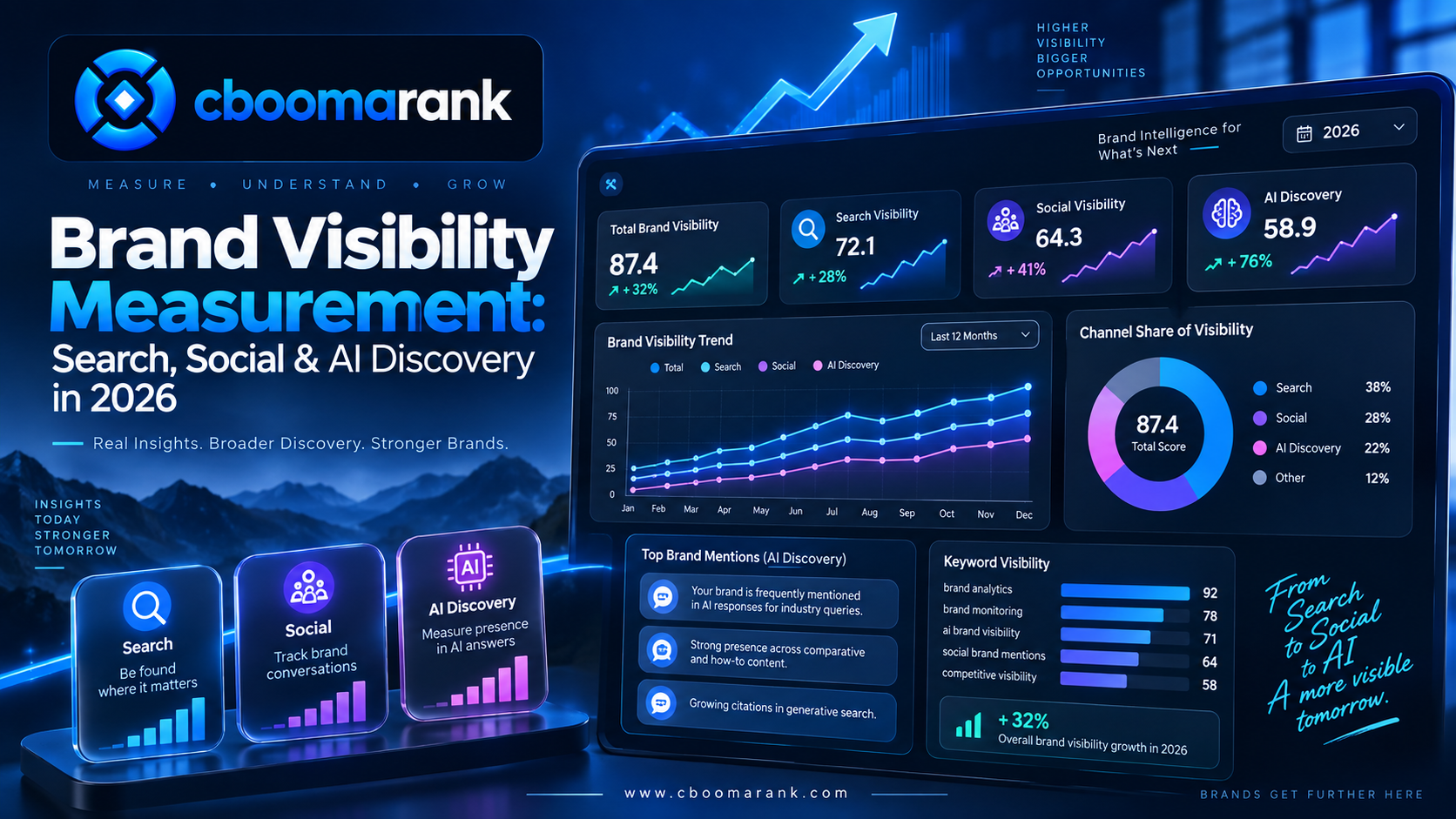
Brand visibility measurement helps businesses understand how often their brand is discovered, recognized and chosen across search engines, social platforms, websites, referral sources and AI-powered discovery experiences.
Modern branding and visibility can no longer be measured with one metric. Search impressions may increase while branded searches remain flat. Social reach may grow while referral traffic declines. Meanwhile, a company can appear frequently in AI-generated recommendations even when traditional organic rankings tell only part of the story.
For that reason, businesses need a connected measurement framework that tracks visibility across multiple channels while linking exposure to meaningful outcomes such as website visits, leads, sign-ups and revenue.
This guide explains how to measure brand visibility across Google Search, social media, AI discovery, competitor activity and website performance. It also shows how to turn visibility data into a reporting system that helps marketers decide where to invest next.
Want a clearer picture of your digital visibility? Use CBOOMARANK to analyze your website, keywords and competitors, then connect those insights to your broader brand-growth strategy.
Brand Visibility Measurement: Quick Answer
Brand visibility measurement tracks how frequently and prominently a company appears when potential customers discover, research and compare solutions.
A practical measurement framework should examine several connected areas:
- Branded search demand — how often people search for your company, products or branded terms.
- Organic search visibility — how often your pages appear for relevant branded and non-branded searches.
- Competitor share of voice — how much visibility your brand captures compared with competing websites.
- Social visibility — reach, mentions, engagement and discovery across social platforms.
- Referral visibility — exposure generated by publishers, directories, communities and other websites.
- AI discovery — whether your brand is surfaced or referenced when users research topics through AI-assisted experiences.
- Website engagement — whether visibility produces qualified visits and useful actions.
- Conversions — whether greater visibility contributes to leads, registrations, purchases or other business goals.
No single metric provides the complete answer. Instead, the strongest reporting combines these signals so the business can distinguish genuine brand growth from temporary traffic fluctuations.
What Is Brand Visibility?
Brand visibility describes how noticeable and discoverable a company is within the environments where its audience searches for information, compares alternatives and makes decisions.
Visibility is broader than brand awareness. Awareness asks whether people know the brand. Visibility asks whether the brand actually appears in the places where discovery happens.
For example, a company can have strong recognition among existing customers but weak visibility for new non-branded search queries. Another company may rank strongly in search but receive very little discussion or referral exposure elsewhere.
Therefore, brand visibility measurement should examine both presence and performance.
Presence
Presence measures whether your brand appears at important customer touchpoints. Examples include search results, comparison articles, social conversations, industry publications, directories and AI-generated research experiences.
Performance
Performance measures what happens after that exposure. Useful signals include clicks, website sessions, engagement, leads and conversions.
Why Brand Visibility Measurement Matters in 2026
Digital discovery is increasingly fragmented. A buyer may discover a company through Google, validate it through social media, compare it with competitors on a third-party website and use an AI assistant to summarize available options before ever contacting the business.
Consequently, measuring only website traffic can hide important parts of the customer journey.
A broader brand visibility framework can help answer questions such as:
- Is branded search demand growing?
- Are more relevant keywords exposing the brand to new audiences?
- Which competitors appear most often for the same topics?
- Where are people mentioning or linking to the brand?
- Which visibility channels actually send qualified traffic?
- Does increasing visibility contribute to conversions?
- Is the brand becoming easier to discover through AI-powered research?
These questions make visibility reporting more useful for marketing strategy, SEO planning, content investment and competitive positioning.
Brand Visibility Measurement Framework
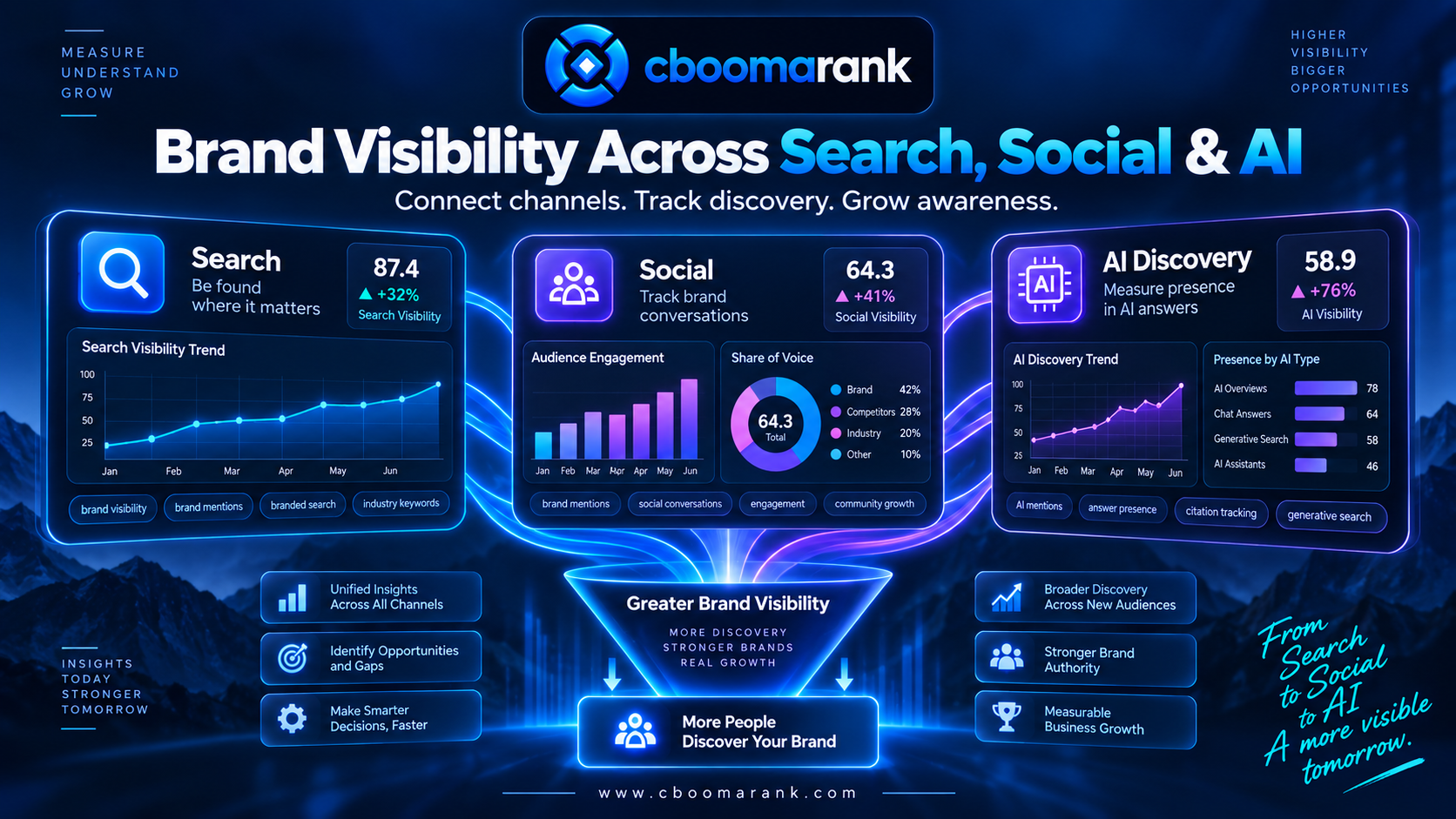
A useful framework separates visibility into four layers: discovery, exposure, engagement and business outcomes.
1. Discovery
Discovery measures where people can encounter the brand. Search engines, social networks, referral websites, publishers, directories and AI-assisted tools may all contribute.
2. Exposure
Exposure measures how often the brand or its content appears. Search impressions, social reach, mentions and competitor visibility comparisons belong at this stage.
3. Engagement
Engagement measures whether people interact after seeing the brand. Examples include clicks, website visits, social interactions and time spent exploring relevant pages.
4. Business Outcomes
Ultimately, visibility should support useful outcomes. Depending on the business, these may include enquiries, registrations, demo requests, marketplace orders, subscriptions or purchases.
The framework prevents teams from treating exposure alone as success. High visibility without meaningful engagement or conversion may indicate poor targeting, weak positioning or an ineffective customer journey.
How to Measure Brand Visibility in Google Search
Search visibility is one of the most measurable parts of digital brand discovery because search data can show which queries trigger your pages and how users respond.
Track Branded Search Queries
Branded queries include searches containing your company name, product names, domain, founders, branded services or common variations of those terms.
Monitor branded search performance over time rather than relying on a single snapshot. Useful signals include:
- Branded impressions
- Branded clicks
- Click-through rate
- Average search position
- Number of branded query variations
- Countries or markets generating branded searches
Growth in branded impressions can indicate increasing search interest. However, analyze the context carefully because news events, campaigns, reputation issues or seasonal demand can also change branded-search behavior.
Measure Non-Branded Search Discovery
Brand visibility is not limited to people who already know the company. Non-branded search visibility measures whether potential customers discover your site while researching problems, services, products or categories.
For example, an SEO platform should not rely only on searches for its company name. It also needs visibility for relevant topics such as website analysis, keyword research, competitor research, SEO auditing and related commercial queries.
This type of discovery expands the audience beyond existing brand awareness.
Track Search Impressions
Impressions show how often a page is displayed in eligible search results. When interpreted alongside queries, pages and countries, impression trends can help reveal whether the site is becoming more visible for relevant topics.
However, impressions should not be analyzed alone. Rising impressions with falling click-through rate may mean the site is appearing for broader queries without earning proportionate traffic.
Monitor Search Click-Through Rate
Click-through rate helps measure how effectively search visibility turns into website visits. Titles, descriptions, ranking position, search intent, competing results and SERP features can all influence CTR.
Therefore, evaluate CTR by query group and page type instead of applying one universal target across the site.
Measure Brand Visibility by Search Topic
One of the most useful reporting approaches is to organize keywords into topic groups rather than inspecting hundreds of unrelated queries individually.
For example, a digital marketing platform might create visibility groups for:
- Website analysis
- SEO auditing
- Keyword research
- Competitor research
- Backlinks
- Content optimization
- Local SEO
- AI search visibility
- Marketing analytics
This allows the business to see which areas are gaining visibility and which strategic topics still have weak search coverage.
Brand Visibility and Search Share of Voice
Search share of voice compares your organic presence with competitors across a defined keyword set.
The important part is defining a relevant comparison group. Comparing every ranking keyword can produce misleading results because competing websites may target different audiences or business models.
Instead, create a focused set of commercially and strategically important keywords, then track how often your domain and competing domains appear across that set.
This provides a clearer picture of relative visibility within the market you actually want to compete in.
See where competitors are capturing search visibility.
Measure Brand Visibility Beyond Rankings
Rankings are important, but they do not explain every way search visibility contributes to brand discovery.
Also monitor:
- Branded search growth
- Search impressions
- Top-performing landing pages
- New queries entering visibility
- Featured and enhanced search appearances where relevant
- Referral traffic generated after search discovery
- Conversions from organic landing pages
For a broader discussion of digital discoverability, see our guide to boosting online visibility in a crowded digital landscape.
You can also read our guide to company branding and SEO for additional context on connecting brand strategy with organic search.
How to Measure Brand Visibility on Social Media
Social visibility measures how often people encounter, mention and interact with your brand across social platforms. Unlike search visibility, social discovery may happen even when the user is not actively looking for your company or service.
Because each platform reports engagement differently, avoid relying on one universal number. Instead, monitor a consistent set of indicators that reflect reach, attention and response.
Track Reach and Impressions
Reach estimates how many people were exposed to content, while impressions generally reflect how many times content was displayed. Together, these metrics can show whether the brand is becoming more visible within a platform.
However, increasing impressions do not automatically indicate stronger brand demand. Compare exposure with engagement, website visits and conversions to understand whether the additional visibility is useful.
Monitor Brand Mentions
Brand mentions include direct tags, company-name references, product mentions and relevant discussions that identify your business.
Monitor both tagged and untagged mentions where your available tools allow it. A customer may discuss a brand without using an official account handle.
Measure Engagement Quality
Likes alone provide limited context. Depending on the platform and campaign, stronger engagement signals may include:
- Comments
- Shares or reposts
- Saves
- Profile visits
- Link clicks
- Direct enquiries
- Video completion
- Newsletter registrations
- Website conversions
Therefore, social visibility should be measured alongside the actions that follow exposure.
Track Social Referral Traffic
Website analytics can show whether social visibility produces visits to your website. Separate traffic by platform and campaign where possible so you can identify which channels attract engaged users rather than simply generating impressions.
Measure Brand Visibility Through Referral Mentions and Earned Media
Brands are often discovered through third-party websites before a visitor reaches the company’s own domain. These sources can include news publications, blogs, directories, review websites, industry resources, partner websites and community discussions.
Referral visibility can be measured through several signals:
- New referring domains
- Brand mentions on external websites
- Backlinks
- Referral sessions
- Traffic quality from referring sources
- Conversions from referral traffic
- Publisher or industry coverage
Track Mentions With and Without Links
A brand mention can contribute to discovery even when it does not contain a clickable backlink. Therefore, backlink reporting and brand-mention monitoring should be treated as related but different visibility signals.
A linked mention may generate direct referral traffic, while an unlinked mention may still expose the brand to a relevant audience.
Measure Referral Quality
Not every referring website carries equal business value. Evaluate whether visitors from a source engage with relevant pages, return later or complete useful actions.
A small number of highly relevant referrals can be more valuable than a large volume of low-intent traffic.
Brand Visibility Measurement Against Competitors
Visibility becomes more meaningful when measured relative to competitors. A company may increase its search impressions by 20%, yet still lose market visibility if major competitors grow much faster across the same topics.
Competitor benchmarking provides context.
Build a Relevant Competitor Set
Do not compare your brand with every website ranking for a keyword. Separate competitors into useful groups such as:
- Direct product or service competitors
- Search competitors
- Content competitors
- Marketplace competitors
- Regional competitors
- Large publishers occupying important search results
This distinction matters because a website can compete with you for search visibility without selling the same product.
Compare Keyword Coverage
Measure which commercially relevant topics each competitor covers and where those domains gain stronger organic visibility.
Useful comparisons include:
- Total relevant ranking keywords
- Keywords in high-visibility positions
- Topic gaps
- Branded versus non-branded visibility
- Pages generating the most organic discovery
- New content entering competitive search results
Compare Content Visibility
A competitor may dominate a topic because it has a deeper content cluster rather than one exceptionally strong page.
For example, instead of publishing one article about keyword research, a competitor may cover keyword difficulty, search intent, competitor keywords, keyword clustering, local keywords and content optimization.
Consequently, measure visibility at both the page level and topic level.
How to Calculate Brand Share of Voice
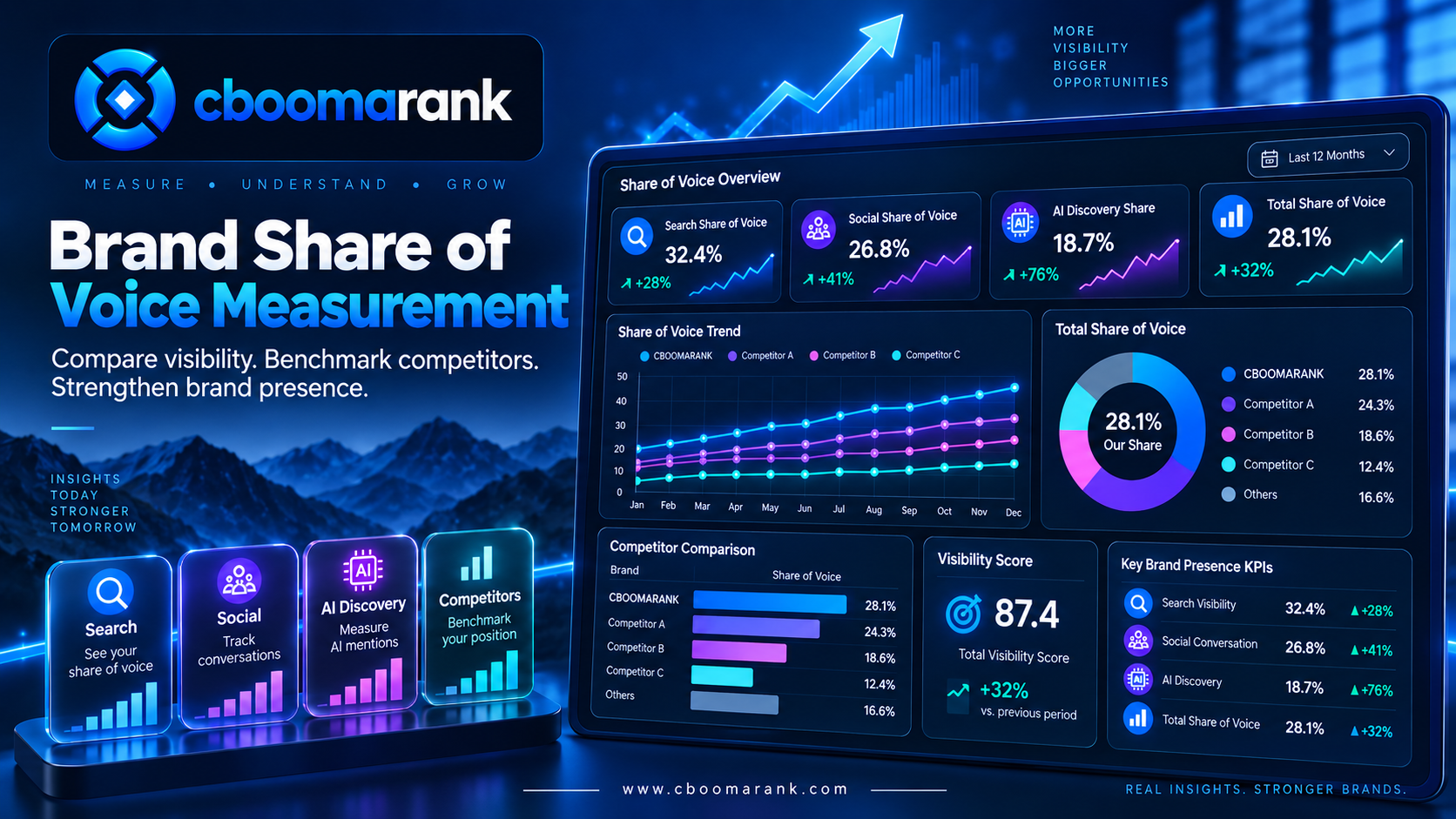
Share of voice estimates how much visibility your brand captures compared with the defined competitive market.
A simplified visibility formula is:
Brand Share of Voice = Brand Visibility ÷ Total Measured Market Visibility × 100
The underlying visibility measure can vary. For example, you might calculate share of voice using:
- Organic keyword visibility
- Search impressions
- Brand mentions
- Social mentions
- Referral coverage
- Advertising impressions
- AI recommendation appearances
Do not combine unrelated metrics into one percentage unless you have a documented weighting model. Instead, maintain separate share-of-voice views for search, social, earned media and AI discovery.
Brand Visibility Measurement in AI Discovery
AI-assisted discovery has added another layer to brand research. Users can ask conversational systems to summarize options, compare platforms, explain industries or recommend tools without following the same journey as a traditional search-results page.
As a result, businesses increasingly need to understand whether their brand is represented accurately and consistently in AI-assisted research experiences.
Track Brand Appearance Across Relevant Prompts
Create a controlled list of questions that represent how potential customers research your market.
Examples might include:
- What are the best tools for website SEO analysis?
- Which platforms help with competitor keyword research?
- What SEO tools are suitable for small businesses?
- Which tools combine SEO reporting and competitor analysis?
- What alternatives exist to major enterprise SEO platforms?
Test the same research themes consistently rather than relying on isolated prompts.
Measure AI Brand Mention Rate
A simple AI visibility metric is the percentage of tracked prompts where your brand appears.
AI Brand Mention Rate = Prompts Mentioning Your Brand ÷ Total Tracked Prompts × 100
This does not prove preference or recommendation quality. It simply measures whether the brand appears within your defined monitoring set.
Track Brand Position and Context
A mention alone does not tell the whole story. Record the context surrounding the brand:
- Was the brand included in a comparison?
- Was it described accurately?
- Was the correct website referenced?
- Which products or capabilities were associated with it?
- Which competitors appeared beside it?
- Was the brand presented positively, neutrally or critically?
Because AI-generated responses can change, treat individual outputs as observations rather than permanent rankings.
Monitor Citation and Source Visibility
Where an AI experience displays sources or links, record which websites are repeatedly referenced for important industry questions.
This can reveal opportunities to strengthen the pages, documentation, articles, research and third-party coverage associated with your brand.
Track AI Referral Traffic Where Detectable
Website analytics may sometimes show visits originating from AI products or related referral sources. Track these separately when they can be identified reliably.
However, referral traffic captures only part of AI visibility because a user may learn about a company through an AI response and later visit through branded search, direct navigation or another channel.
For additional context, see our guide to AI SEO tools for research, content and AI visibility.
Brand Visibility KPIs to Track
A practical dashboard should separate metrics by channel while still making it possible to view overall trends.
| Visibility Area | Useful KPIs |
|---|---|
| Branded search | Branded impressions, clicks, CTR, branded query growth |
| Organic discovery | Non-branded impressions, ranking keywords, landing-page clicks |
| Search share of voice | Visibility percentage across a defined competitive keyword set |
| Social visibility | Reach, impressions, mentions, shares, profile visits |
| Referral visibility | Referring domains, mentions, backlinks, referral sessions |
| AI visibility | Prompt mention rate, competitor co-occurrence, citation presence |
| Website engagement | Engaged sessions, relevant page visits, returning users |
| Business outcomes | Leads, registrations, purchases, subscriptions or qualified enquiries |
Leading and Lagging Brand Visibility Metrics
Separating leading and lagging indicators can make reporting more actionable.
Leading Indicators
Leading indicators can reveal visibility changes before they become revenue changes. Examples include:
- Search impressions
- New ranking keywords
- Social reach
- Brand mentions
- New referring domains
- AI mention rate
- Content visibility growth
Lagging Indicators
Lagging indicators measure outcomes that occur after exposure and engagement. Examples include:
- Organic traffic
- Branded search growth
- Qualified leads
- Sign-ups
- Sales
- Customer acquisition
- Revenue influenced by visible channels
Using both types of metrics helps teams avoid waiting until revenue changes before noticing that visibility has already weakened.
How to Measure Brand Visibility by Country
A global brand can have very different visibility levels across markets. Therefore, analyze important countries separately instead of relying only on worldwide totals.
For each priority market, compare:
- Branded search demand
- Non-branded keyword visibility
- Competitor rankings
- Search click-through rates
- Referral sources
- Social engagement
- Conversions
This is particularly useful when a company targets markets such as the United States, United Kingdom, Canada, France, Germany and other international regions.
Brand Visibility Measurement by Customer Journey Stage
Visibility should also be mapped to the stage of the customer journey.
Awareness Stage
Measure broad topic discovery, social reach, publisher mentions and non-branded search impressions.
Consideration Stage
Track comparison keywords, competitor research, product-page visits, branded search growth and third-party reviews or mentions.
Decision Stage
Measure branded commercial queries, pricing-page visits, sign-ups, enquiries and other high-intent actions.
This prevents teams from expecting every awareness metric to generate an immediate sale while still requiring visibility programs to contribute to measurable business progress over time.
Turn visibility data into competitive insight.
Use CBOOMARANK keyword research, competitor research and reporting to identify where your brand is gaining or losing search exposure.
How to Build a Brand Visibility Dashboard
A brand visibility dashboard should make trends understandable without forcing decision-makers to inspect dozens of disconnected reports.
Organize the dashboard into channel groups while maintaining a top-level view of overall progress.
Search Visibility Section
Include:
- Branded search impressions
- Branded clicks
- Non-branded search impressions
- Important ranking keywords
- Search share of voice
- Top gaining pages
- Top declining pages
Competitive Visibility Section
Track the competitors that appear most often across strategically important topics. Compare keyword coverage, content visibility, ranking changes and topic gaps.
The purpose is not simply to report that a competitor ranks higher. Instead, the dashboard should help explain where the visibility difference comes from.
Social Visibility Section
Include social reach, brand mentions, engagement, profile activity, referral traffic and conversions where reliable data is available.
Referral and Earned Visibility Section
Track new referring domains, external mentions, backlinks, publisher coverage and referral traffic.
AI Discovery Section
Where you maintain an AI visibility monitoring process, include:
- Tracked research prompts
- Brand mention rate
- Competitor mention rate
- Brand context
- Source or citation presence where available
- Detected referral traffic
Conversion Section
Finally, connect visibility to meaningful outcomes such as registrations, enquiries, purchases, subscriptions or other business goals.
Brand Visibility Measurement Formulas
Simple formulas can make visibility reporting easier to understand, provided the underlying data is defined consistently.
Branded Search Growth
Branded Search Growth = (Current Period Branded Searches − Previous Period Branded Searches) ÷ Previous Period Branded Searches × 100
Search Share of Voice
Search Share of Voice = Your Measured Search Visibility ÷ Total Visibility Across the Defined Competitor Set × 100
Brand Mention Share
Brand Mention Share = Your Brand Mentions ÷ Total Mentions Across the Defined Competitor Group × 100
AI Brand Mention Rate
AI Brand Mention Rate = Tracked Prompts Mentioning Your Brand ÷ Total Tracked Prompts × 100
Visibility-to-Visit Rate
Where reliable impression and traffic data can be connected, teams may also monitor how often exposure generates website visits.
However, cross-channel attribution should be interpreted carefully because users often encounter a brand multiple times before visiting or converting.
How Often Should You Measure Brand Visibility?
The reporting frequency should match how quickly the underlying channel changes.
- Weekly: major ranking changes, campaigns, competitor movement and unusual traffic changes.
- Monthly: primary visibility dashboard, branded search trends, keyword coverage and channel performance.
- Quarterly: strategic brand visibility trends, competitive position and investment decisions.
Daily reporting can create unnecessary noise unless the business operates in an unusually fast-moving environment.
Common Brand Visibility Measurement Mistakes
Measuring Only Website Traffic
Traffic is important, but it measures visits rather than every form of brand exposure. Search impressions, mentions and third-party visibility may change before traffic does.
Tracking Rankings Without Competitor Context
A ranking improvement is useful, but competitive visibility may still decline if other brands gain faster across the same market.
Mixing Branded and Non-Branded Search
Branded searches typically indicate existing awareness, while non-branded searches can reveal new audience discovery. Reporting them separately provides better insight.
Using One Share-of-Voice Number for Everything
Search, social, referral and AI discovery use different underlying signals. Keep their visibility calculations separate unless you have a clearly documented weighting methodology.
Ignoring Conversion Quality
More visibility does not always mean better business performance. Monitor whether increased exposure attracts the right audience.
Changing the Measurement Set Too Frequently
If tracked keywords, competitors or AI prompts change every month, historical comparisons become difficult. Maintain a stable core measurement set while adding new items when strategically necessary.
Brand Visibility Measurement for Small Businesses
Small businesses do not need an enterprise-scale measurement system to start.
A practical monthly dashboard can include:
- Branded search impressions
- Non-branded organic impressions
- Top local or commercial keywords
- Website traffic by source
- Top referring websites
- Social mentions and referrals
- Primary competitors
- Leads or sales generated from visible channels
As the business grows, the measurement framework can expand to include more competitive, international and AI discovery data.
Brand Visibility Measurement for Agencies
Agencies should define measurement rules before presenting visibility reports to clients.
Document:
- Which competitors are included
- Which keyword groups are measured
- Which markets are tracked
- Which social channels are included
- How AI prompts are selected
- How conversions are attributed
- Which time periods are compared
This helps prevent reporting changes from being mistaken for real performance changes.
How CBOOMARANK Can Support Brand Visibility Measurement
CBOOMARANK can help connect several important parts of the visibility workflow instead of forcing marketers to evaluate each SEO signal in isolation.
Use CBOOMARANK to support:
- Website analysis
- SEO audits
- Keyword research
- Competitor research
- Authority and visibility monitoring
- Content opportunity analysis
- Reporting
- AI-assisted SEO insights
For example, a brand visibility report may reveal that branded search is increasing while competitor visibility for important non-branded topics is also growing. Keyword and competitor research can then help identify where additional content or optimization work is required.
Similarly, CBOOMARANK reporting can help bring recurring SEO and competitive signals into a more consistent decision-making workflow.
Measure more than rankings.
Use CBOOMARANK to analyze your website, research keywords, compare competitors and build a clearer picture of search visibility.
How to Improve Brand Visibility After Measuring It
Measurement should lead to action. Once you identify a visibility gap, determine which channel and customer stage require improvement.
If Branded Search Is Weak
Strengthen awareness through useful content, partnerships, public relations, social distribution, customer advocacy and consistent brand positioning.
If Non-Branded Search Visibility Is Weak
Research keyword and content gaps, improve existing pages and create useful resources around relevant customer problems and commercial topics.
If Competitors Dominate Search Share of Voice
Analyze the pages and topic clusters contributing to their advantage. Then prioritize realistic gaps where your brand can provide stronger or more differentiated content.
If Referral Visibility Is Weak
Identify industry publishers, directories, communities, partners and relevant websites where useful brand mentions or links could naturally occur.
If AI Discovery Is Weak
Improve the clarity and usefulness of your public information. Maintain accurate product pages, documentation, comparison content, research and structured website information while continuing to monitor how the brand is represented.
Brand Visibility Measurement Frequently Asked Questions
What Is Brand Visibility?
Brand visibility describes how noticeable and discoverable a company is across the channels where potential customers research, compare and select products or services.
How Do You Measure Brand Visibility?
Measure branded search demand, non-branded search visibility, search share of voice, social reach and mentions, referral coverage, AI discovery signals, website engagement and conversions.
What Is the Difference Between Brand Awareness and Brand Visibility?
Brand awareness describes whether an audience knows or recognizes a brand. Brand visibility focuses on whether the brand appears where potential customers are actively discovering and evaluating options.
What Is Search Share of Voice?
Search share of voice estimates how much organic search visibility your brand captures compared with a defined group of competitors across a controlled keyword set.
Should Brand Visibility Be Measured Monthly?
Monthly reporting works well for many organizations because it reduces daily noise while still showing meaningful trends. Faster-moving campaigns may also require weekly monitoring.
Can AI Visibility Be Measured?
It can be monitored through a defined set of research prompts by recording brand mentions, competitor appearances, context and citations where available. Because AI outputs can vary, treat these measurements as repeated observations rather than fixed rankings.
Does Higher Brand Visibility Always Mean More Revenue?
No. Visibility creates opportunities for discovery, but audience relevance, positioning, customer experience, pricing and conversion performance also influence business outcomes.
What Is the Most Important Brand Visibility Metric?
There is no single metric that works for every business. The strongest approach combines channel-specific visibility indicators with engagement and conversion outcomes.
How Can CBOOMARANK Help Measure Visibility?
CBOOMARANK can support website analysis, keyword research, competitor research, SEO reporting and AI-assisted insights, helping marketers understand several of the search and competitive factors influencing digital visibility.
Final Takeaway
Brand visibility measurement is no longer limited to rankings, traffic or social impressions. Modern discovery happens across search engines, social platforms, publisher websites, referral sources and AI-assisted research experiences.
A useful measurement framework therefore connects branded demand, non-branded search visibility, competitor share of voice, social exposure, referral mentions, AI discovery and business outcomes.
Most importantly, measurement should produce decisions. The objective is not to collect the largest possible dashboard. It is to understand where your brand is gaining attention, where competitors are stronger and which visibility improvements are most likely to support meaningful growth.
Build a clearer view of your search and competitive visibility.
Analyze Your Website with CBOOMARANK or view CBOOMARANK pricing.
Sources and Further Reading
- Google Search Console Help — Performance Report
- Google Search Central — Get Started with Search Console
- Google Analytics Help — Traffic Acquisition
- Google Search Central — SEO Starter Guide
Search, social and AI discovery systems change over time. Review current platform documentation and maintain consistent measurement definitions when comparing visibility across reporting periods.
