

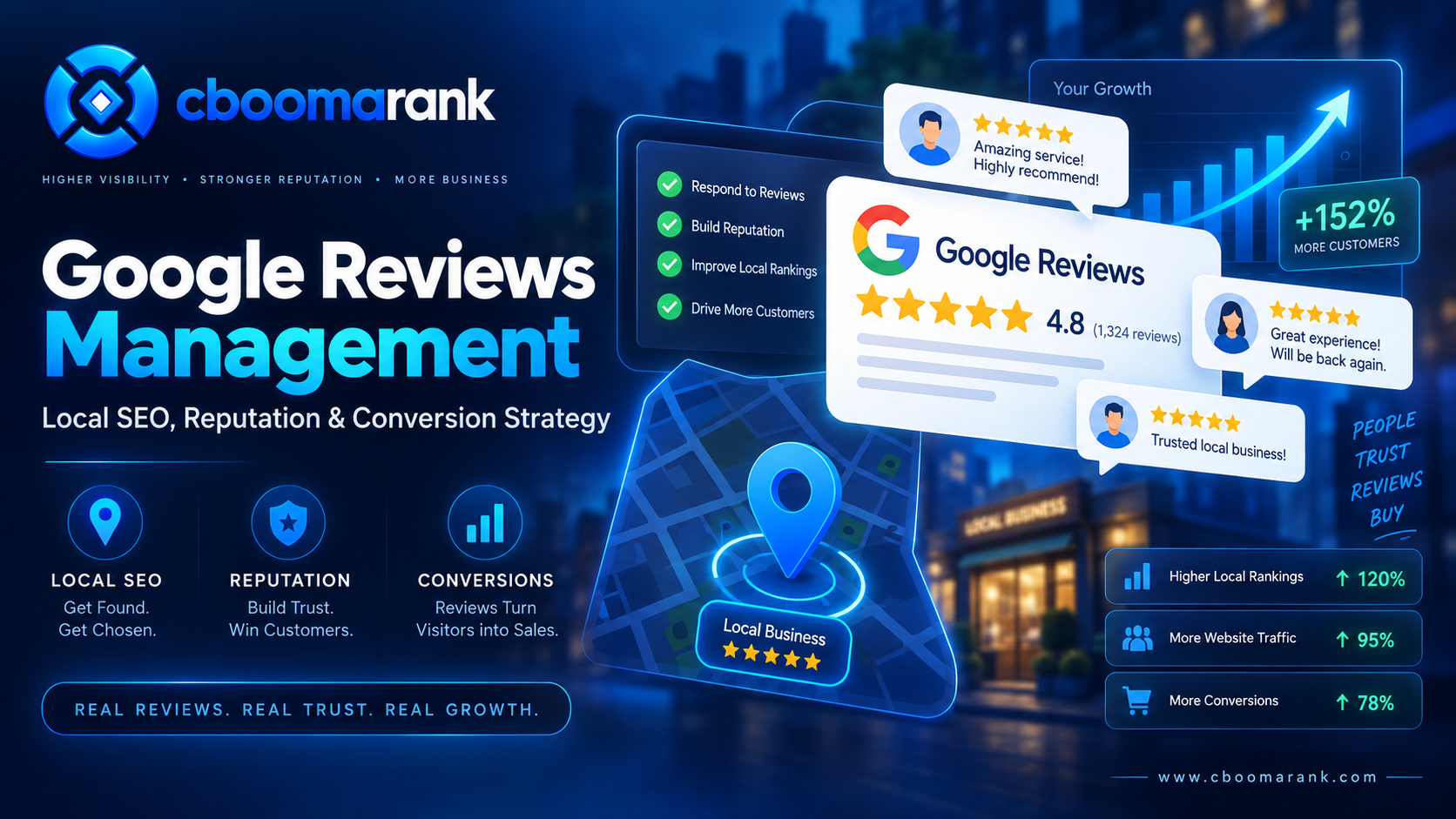
Google reviews management is the process of monitoring, requesting, responding to, analyzing and learning from customer reviews connected to your Google Business Profile.
For local businesses, reviews are more than a reputation metric. They influence how potential customers evaluate a company before calling, visiting, booking or buying. Google also identifies reviews and positive ratings as signals that can contribute to local-search prominence.
However, effective review management is not about chasing five-star ratings at any cost. Reviews should reflect genuine customer experiences. Businesses should avoid fake reviews, incentives for ratings, selective positive-review solicitation and other practices that can damage trust or violate platform rules.
This guide explains how to build a practical Google reviews management strategy that supports local SEO, reputation, customer experience and conversion.
Start with the website behind your local reputation. Use CBOOMARANK to analyze your site and compare competing businesses before building your local-search strategy.
Google Reviews Management: Quick Answer
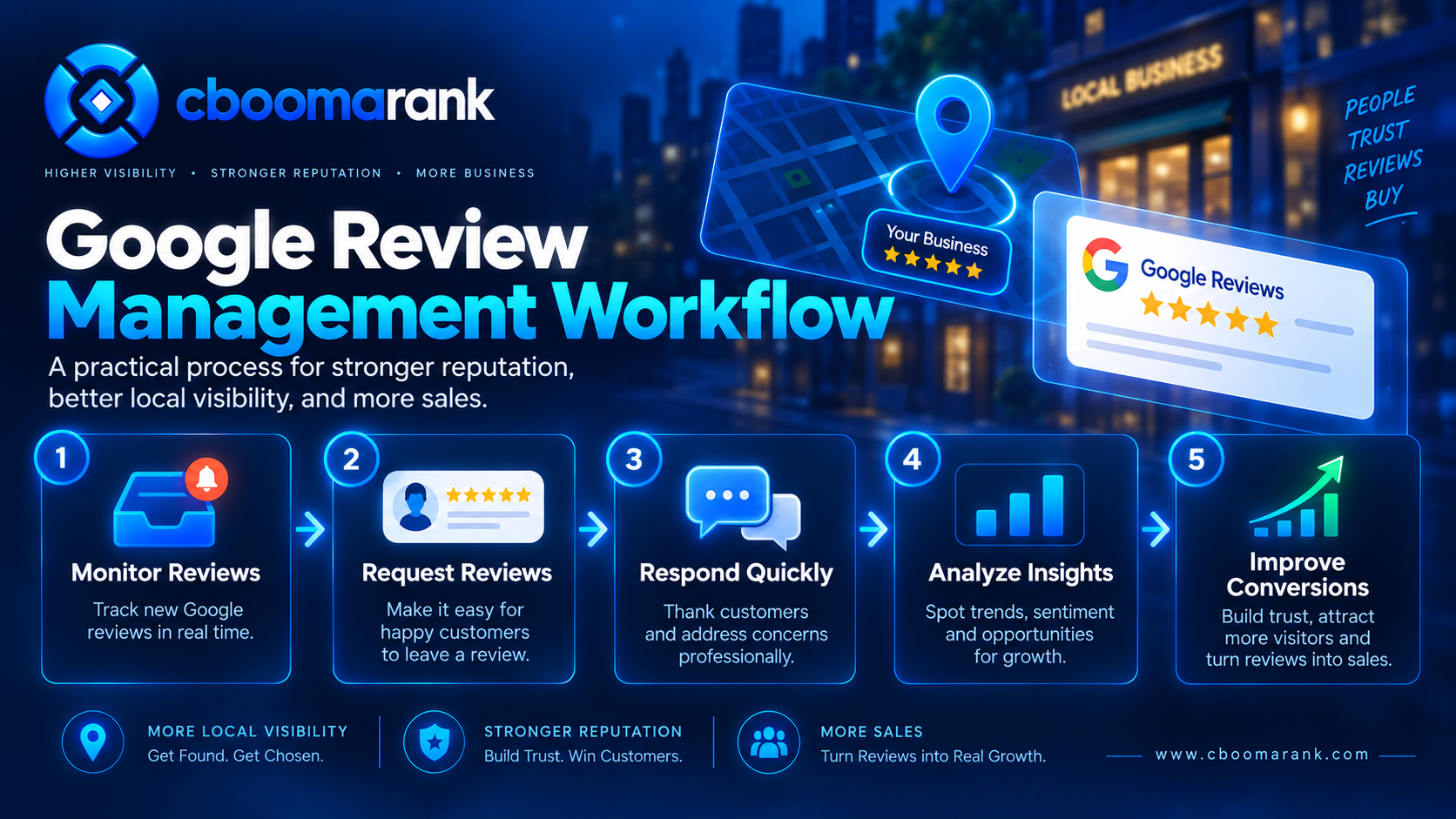
A reliable Google reviews management workflow combines five recurring activities:
- Monitor new reviews, ratings and recurring customer themes.
- Request genuine feedback from real customers using a neutral process.
- Respond professionally to positive, neutral and negative reviews.
- Report reviews that genuinely violate Google policies.
- Analyze feedback to improve customer experience, operations and marketing.
The goal is not a perfect five-star profile. Instead, the objective is a trustworthy and actively managed review presence that helps customers make informed decisions.
Why Google Reviews Management Matters for Local SEO
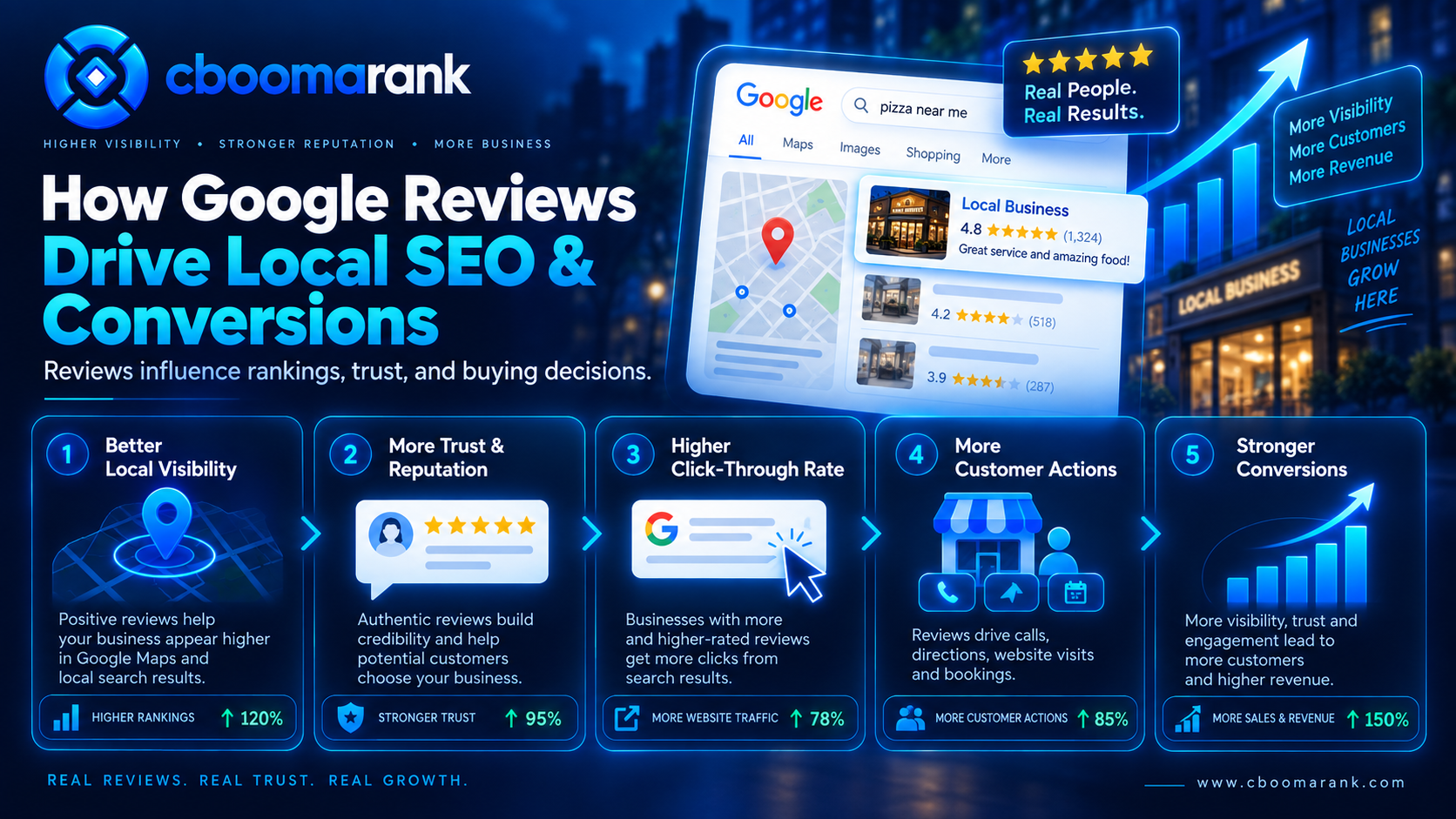
Local visibility depends on several signals, including how relevant a business is to a search, how close it is to the searcher and how prominent or well established it appears.
In addition, reviews can contribute to that wider prominence picture. At the same time, reviews cannot compensate for inaccurate business information, poor website quality, weak local relevance or serious technical SEO problems.
Therefore, review management should be treated as one part of a complete local SEO strategy.
For the wider foundation, read our Local SEO Research guide and our guide to mastering your Google Business Profile for local search.
Google Reviews Management Supports Local Prominence
A steady flow of genuine customer feedback can strengthen the public evidence that a business is active and established. Positive ratings and review volume may also help potential customers feel more confident when comparing nearby providers.
Reviews Influence Search-Result Trust
A customer comparing local businesses may see ratings, review counts and recent experiences before visiting any website. Consequently, review quality can influence whether a search impression turns into a profile visit, phone call, direction request or website click.
Reviews Reveal Customer Language
Customers often describe services differently from the terminology a company uses internally. Review themes can therefore help businesses understand how real customers describe products, services, problems, locations and outcomes.
Google Reviews Management and Conversion Strategy
At the decision stage, reviews frequently influence the customer journey. A prospective customer may already know which service they need but still be deciding which provider deserves their trust.
At that point, reviews can answer practical questions:
- Does this business deliver what it promises?
- How does it handle problems?
- Do customers mention the service I need?
- Are recent experiences still positive?
- Does the company respond professionally?
- Are complaints isolated or recurring?
For this reason, Google reviews management should connect to conversion optimization rather than exist as a separate reputation task.
How to Build a Google Reviews Management Workflow
1. Verify and Maintain Your Google Business Profile
Your Google Business Profile should contain accurate business information. Keep the business name, category, hours, address or service area, phone number, website and other important details current.
Accurate profile information helps customers understand the business and supports local-search relevance.
For more detail, read The Power of Google Business for Brand Visibility and Growth.
2. Assign Review Ownership
Someone should be clearly responsible for review management. Otherwise, businesses often respond inconsistently or allow important complaints to sit unanswered.
Define:
- Who monitors new reviews?
- Who responds?
- Which complaints require escalation?
- Who handles privacy, legal or safety issues?
- How quickly should important feedback receive attention?
3. Monitor New Reviews Consistently
The correct monitoring frequency depends on review volume. A busy multi-location business may need daily monitoring, while a smaller company may use a less frequent schedule.
Consistency matters more than choosing an arbitrary timetable.
4. Request Genuine Reviews
Businesses can ask real customers to share their experiences and can make the process easier by providing a direct review link or QR code.
However, review requests should remain neutral. Avoid asking only customers who appear satisfied while diverting unhappy customers elsewhere.
5. Respond to Reviews
In addition, public responses show future customers that feedback receives attention. Replies should be relevant, professional and specific enough to demonstrate that the business actually read the review.
6. Track Review Themes
Therefore, review management should feed operational improvement. If customers repeatedly mention slow communication, unclear pricing, delivery delays or particularly strong service, those patterns deserve attention.
How to Ask Customers for Google Reviews
A strong review-request process is simple, timely and unbiased.
Use a Direct Review Link
Make the review process easy by sending customers directly to the appropriate Google review flow rather than asking them to search for the business manually.
Ask After a Genuine Customer Experience
Natural opportunities include:
- After successful service completion
- Following product delivery
- After a resolved support interaction
- Following an appointment
- After a completed project milestone
- In an appropriate post-purchase follow-up
Keep the Request Neutral
Most importantly, ask customers to share their honest experience. Do not pressure them to give five stars or to leave only positive feedback.
Make the Request Easy to Complete
For example, a review request should contain one clear action. Long instructions and multiple links create unnecessary friction.
Google Reviews Management Practices to Avoid
However, some review-generation tactics can create serious platform, legal and reputation risks. A sustainable strategy should prioritize authentic customer feedback rather than trying to engineer a perfect rating.
Do Not Buy Google Reviews
Purchased or fabricated reviews do not represent genuine customer experiences. Fake engagement can undermine customer trust and may trigger platform enforcement.
In the United States, the Federal Trade Commission also prohibits specified fake and false review practices under its Reviews and Testimonials Rule.
Do Not Offer Incentives for Reviews
Avoid offering money, discounts, free products, services or other benefits in exchange for reviews, review changes or removal of negative feedback.
Even when the incentive does not explicitly demand five stars, it can influence the review process and create compliance concerns.
Do Not Use Review Gating
Review gating happens when a business screens customers first and sends only satisfied customers to a public review platform while directing unhappy customers somewhere private.
This produces a distorted review profile and can violate review-platform policies. Instead, give genuine customers the same neutral opportunity to share feedback.
Do Not Pressure Customers for Five Stars
Requests such as “Please give us five stars” influence the rating rather than simply inviting honest feedback.
A better request asks customers to share their experience in their own words.
Do Not Use Employees or Connected Parties to Manipulate Ratings
Reviews should represent independent customer experiences. Employees, business owners, competitors and other parties with conflicts of interest should not manipulate ratings or review sentiment.
How to Respond to Positive Google Reviews
In practice, positive-review responses should feel human rather than automated. A useful response acknowledges the customer’s experience without turning the reply into an advertisement.
A strong response can:
- Thank the customer for taking the time to leave feedback.
- Reference a specific detail from the review.
- Keep the message concise.
- Reinforce the positive experience naturally.
- Invite the customer back when appropriate.
Positive Review Response Example
Thank you for sharing your experience. We’re glad the team made the process straightforward and that you were happy with the service. We appreciate your feedback and your support.
Vary the wording from review to review. Repeating the same response under every comment can make engagement appear automated.
How to Respond to Negative Google Reviews
By contrast, negative reviews require additional care because your response is visible to both the reviewer and future customers evaluating your business.
Acknowledge the Concern
Show that you understood what the customer described instead of immediately defending the business.
Stay Professional
Avoid insults, accusations, sarcasm or emotional arguments. Even if you disagree with the reviewer, the response should demonstrate professionalism.
Protect Customer Privacy
Do not publish private account information, order details, health information, payment data or other confidential details in a public response.
If the issue requires sensitive information, invite the customer to continue the conversation through an appropriate private support channel.
Explain Without Arguing
If factual clarification is necessary, explain it calmly. Focus on helping future readers understand the situation rather than proving the reviewer wrong.
Offer a Practical Next Step
When possible, tell the customer how the issue can be investigated or resolved.
Negative Review Response Example
Thank you for bringing this to our attention. We’re sorry the experience did not meet expectations. We would like to understand what happened and review the situation properly. Please contact our support team directly so we can investigate and help resolve the issue.
Should You Respond to Every Google Review?
However, there is no need to write a long response to every review. However, meaningful feedback should receive appropriate attention.
Prioritize responses to:
- Detailed positive reviews
- Negative reviews
- Reviews containing questions
- Feedback describing service failures
- Reviews involving misunderstandings
- Feedback revealing repeated operational problems
Shorter responses can be appropriate for simple positive feedback. The important point is to avoid generic copy-and-paste replies across the entire profile.
How to Handle Fake or Policy-Violating Google Reviews
Importantly, a critical review is not automatically fake. Businesses should distinguish legitimate criticism from content that actually violates review-platform rules.
If a review appears to violate policy, it can be reported through the appropriate Google Business Profile process.
Potential policy problems can include:
- Fake engagement
- Paid or incentivized reviews
- Impersonation
- Conflicts of interest
- Harassment
- Spam
- Off-topic content
- Repetitive or manipulated submissions
Do not report a review merely because it is negative. Reporting should be based on a genuine policy concern.
Google Reviews Management for Multiple Locations
Meanwhile, multi-location businesses need stronger governance because inconsistent review practices can create brand, customer-service and compliance problems.
Create a standard operating process that covers:
- Monitoring frequency
- Response tone
- Escalation procedures
- Location-manager permissions
- Privacy requirements
- Review-request procedures
- Policy training
- Reporting across locations
At the same time, avoid forcing every location to use identical responses. Local details and the content of each review should shape the reply.
Google Reviews Management Metrics to Track
In addition, a review dashboard should measure more than the average star rating. Tracking several metrics gives a more complete view of customer sentiment and review-management performance.
| Metric | What it shows |
|---|---|
| Average rating | Overall customer sentiment at a high level |
| Total review count | Depth of public customer feedback |
| New reviews per month | Whether review generation is active |
| Response rate | How consistently the business engages |
| Response time | How quickly feedback receives attention |
| Rating distribution | Balance across one- through five-star reviews |
| Recurring topics | Repeated strengths and weaknesses in customer experience |
| Location comparison | Which branches show stronger or weaker review performance |
Track Review Velocity, Not Just Total Reviews
For example, a business may have hundreds of historical reviews but very little recent activity. Tracking new reviews over time helps you understand whether customers are still actively sharing experiences.
Track Common Customer Themes
Likewise, repeated mentions of staff behavior, pricing, communication, delivery, wait times or product quality can reveal patterns that deserve operational attention.
Google Reviews Management and Competitor Analysis
Similarly, competitor reviews can reveal customer expectations that traditional keyword research may not capture.
Analyze competing businesses for:
- Review volume
- Average rating
- Review recency
- Common praise
- Common complaints
- Services customers frequently mention
- Response quality
- Unmet customer expectations
However, the goal is not to copy competitors or manipulate ratings. Instead, public review patterns can help you identify ways to improve customer experience and differentiate your business.
Compare the wider search competition around your business.
Google Reviews Management and Website SEO
In addition, a strong review profile works best when the website supports the same local-search strategy.
Review your website for:
- Accurate business information
- Useful location pages
- Relevant local service content
- Mobile usability
- Page performance
- Clear contact information
- Strong internal navigation
- Effective conversion paths
- Consistent brand and business identity
CBOOMARANK website analysis can help identify broader SEO and site-quality problems that may affect how effectively local visibility converts into leads or customers.
For additional tooling options, see our Best Local SEO Software in 2026 comparison.
Google Reviews Management Response Framework
Therefore, a response framework helps teams stay consistent without producing robotic copy-and-paste replies. The structure should guide the response while leaving room for the details of each customer experience.
Framework for Positive Reviews
- Thank the customer. Acknowledge the time they spent leaving feedback.
- Reference something specific. Mention a service, employee, result or detail from the review.
- Reinforce the positive experience. Confirm that the outcome reflects the experience the business aims to provide.
- Close naturally. Invite them back only when it makes sense.
Framework for Neutral Reviews
- Thank the reviewer for the feedback.
- Acknowledge both positive and negative points.
- Explain any relevant improvement without becoming defensive.
- Invite additional feedback when appropriate.
Framework for Negative Reviews
- Acknowledge the concern.
- Remain calm and professional.
- Protect private customer information.
- Clarify facts without arguing.
- Offer an appropriate next step.
Google Reviews Management Mistakes That Damage Trust
However, a review strategy can produce the opposite of its intended effect when the business prioritizes appearance over genuine customer experience.
- Ignoring negative reviews for long periods
- Writing defensive or hostile responses
- Posting identical replies under every review
- Buying reviews
- Offering incentives for ratings
- Using review gating
- Pressuring customers to give five stars
- Disclosing private customer information
- Reporting every critical review as fake
- Focusing only on ratings while ignoring repeated service failures
The strongest reputation strategy improves the underlying customer experience instead of attempting to hide weaknesses.
Google Reviews Management Checklist
| Area | Recommended action |
|---|---|
| Google Business Profile | Keep business information verified, complete and accurate |
| Monitoring | Check new reviews consistently |
| Review requests | Ask genuine customers using neutral wording |
| Review link | Use a direct Google review link or QR code where appropriate |
| Positive reviews | Thank customers and personalize responses |
| Negative reviews | Acknowledge concerns, protect privacy and provide next steps |
| Policy issues | Report only content that appears to violate applicable Google policies |
| Measurement | Track rating, volume, response rate, response time and recurring themes |
| Operations | Use customer feedback to address repeated service problems |
| Local SEO | Connect reviews with Business Profile, website and local-content optimization |
How to Create a Monthly Google Reviews Management Report
For ongoing measurement, a simple monthly report can help business owners see whether review performance is improving and whether customer feedback reveals operational problems.
Include:
- Total reviews at the start and end of the month
- Number of new reviews
- Average rating
- Number of positive, neutral and negative reviews
- Percentage of reviews receiving a response
- Average response time
- Most common positive themes
- Most common complaints
- Location-level differences for multi-location businesses
- Actions taken because of customer feedback
Do not evaluate performance from star rating alone. A business can maintain a high average rating while repeatedly receiving complaints about the same operational issue.
Google Reviews Management for Small Businesses
For example, small businesses do not necessarily need complex reputation-management software to begin. A simple process can work when review volume is manageable.
Start with:
- A verified Google Business Profile
- One person responsible for reviews
- A regular monitoring schedule
- A neutral review-request process
- Clear response guidelines
- A monthly review of common customer themes
As review volume grows, automation and reporting tools may help with monitoring, alerts and multi-location coordination. However, automation should not replace human judgment when responding to sensitive customer issues.
Google Reviews Management for Agencies
Likewise, agencies managing reviews for clients should document responsibilities clearly. The client should know who is allowed to respond, which complaints require approval and which situations must be escalated.
A strong agency workflow includes:
- Client-approved response guidelines
- Brand tone documentation
- Location-specific access controls
- Escalation rules
- Privacy safeguards
- Monthly performance reporting
- Customer-feedback theme analysis
Agencies should also avoid promising guaranteed ratings or guaranteed removal of legitimate negative reviews.
How Google Reviews Management Connects to Local Search Strategy
Finally, reviews should not operate in isolation. A local business also needs accurate location information, relevant website content, strong service pages, useful location pages, mobile usability and competitive visibility.
For example, a company may have excellent customer reviews but still struggle to appear for profitable local searches because important location or service pages are weak.
Conversely, a business may rank well but lose potential customers because its review profile shows unresolved complaints or outdated feedback.
The strongest strategy connects reputation, local SEO and conversion optimization.
Use CBOOMARANK Alongside Google Reviews Management
Google reviews provide customer and reputation signals, while CBOOMARANK helps analyze the wider website and competitive environment surrounding those signals.
CBOOMARANK can support your broader local-search workflow through:
- Website analysis
- SEO auditing
- Keyword research
- Competitor research
- Search-performance reporting
- Content opportunity discovery
This broader view matters because review management alone cannot identify every reason a competitor outranks you or converts more local searchers.
For example, a competing business may have fewer reviews but stronger location pages, better keyword targeting, superior technical SEO or more useful service content.
Analyze the website behind your local reputation.
Google Reviews Management Frequently Asked Questions
Does Google Reviews Management Help Local SEO?
Reviews can contribute to local-search visibility as part of a broader local SEO strategy. Google identifies relevance, distance and prominence as major local-result considerations, and review quantity and positive ratings can contribute to prominence. Reviews should still be combined with accurate Business Profile information and a well-optimized website.
Can I Pay Customers to Leave Google Reviews?
Businesses should not offer money, discounts, free products, services or other incentives in exchange for Google reviews, review changes or removal of negative feedback.
Can I Ask Only Happy Customers for Google Reviews?
A safer process is to give genuine customers a neutral opportunity to share feedback rather than selectively requesting public reviews only from people who appear satisfied.
Should I Respond to Negative Google Reviews?
In many cases, yes. A professional response can acknowledge the issue, demonstrate accountability and provide an appropriate next step. Avoid arguments and protect customer privacy.
Can I Remove a Negative Google Review?
A legitimate negative review generally cannot be removed simply because the business disagrees with it. Reviews that appear to violate Google policies can be reported through Google’s review-management process.
How Can I Get More Google Reviews?
Ask genuine customers for honest feedback at appropriate moments and make the process easy with a direct review link or QR code. Avoid incentives, pressure and selective solicitation.
How Often Should I Check Google Reviews?
The right frequency depends on review volume. High-volume or multi-location businesses may monitor daily, while smaller businesses may use a less frequent schedule. The important point is that reviews are monitored consistently enough for meaningful feedback to receive timely attention.
Are Google Review Replies Public?
Yes. Business responses can appear publicly beneath reviews, which means responses should be written not only for the original reviewer but also for future customers evaluating the business.
What Is Review Gating?
Review gating is the practice of screening customer sentiment first and directing only satisfied customers toward public review platforms while routing dissatisfied customers elsewhere. This can create a distorted review profile and should be avoided.
Should Every Google Review Receive the Same Response Template?
No. A response framework is useful, but the wording should reflect the specific review. Repeated identical replies can appear automated and may reduce the credibility of the business’s engagement.
Final Takeaway
Google reviews management works best when it is treated as a continuous customer-experience, reputation and local-search process rather than a campaign designed to manufacture five-star ratings.
Build a repeatable workflow for monitoring reviews, requesting genuine feedback, responding professionally, reporting real policy violations and learning from recurring customer themes.
For local SEO, reviews are important but not isolated. Combine review management with an accurate Google Business Profile, a well-optimized website, strong local content, competitor research and measurable conversion paths.
Most importantly, keep the process authentic. Genuine customer experiences create durable reputation value, while artificial ratings, incentives and review manipulation introduce unnecessary platform, legal and brand risk.
Strengthen the website behind your local search reputation.
Analyze Your Website with CBOOMARANK or view CBOOMARANK pricing.
Sources and Further Reading
- Google Business Profile Help — Tips to Improve Your Local Ranking
- Google Business Profile Help — Tips to Get More Reviews
- Google Business Profile Help — Manage Customer Reviews
- Google Maps User Generated Content Policy — Prohibited and Restricted Content
- U.S. Federal Trade Commission — Final Rule Banning Fake Reviews and Testimonials
Google review policies and local-search systems can change. Verify current Google documentation and applicable local laws before implementing review-generation or reputation-management programs.
